Iloilo is one of those provinces where food and festivals seem to go naturally together. We know the province for dishes like batchoy and pancit molo, but travel outside Iloilo City and you’ll discover many towns with specialties of their own.
In Cabatuan, Iloilo, that specialty is tinuom nga manok—native chicken cooked with herbs and spices, wrapped tightly in banana leaves and steamed until the meat becomes tender and a flavorful broth forms inside the wrapper. The dish is so closely connected to the town that Cabatuan eventually named its annual cultural celebration after it: the Tinuom Festival.
But Tinuom Festival is more than a food festival.
It is also a celebration of Cabatuan’s history, agriculture, faith and local identity. Through street dancing, elaborate costumes, food activities, fairs and community events, Cabatuananons tell the story of their hometown using one of the simplest things imaginable—a traditional chicken dish wrapped in banana leaves.
If you’re planning to experience festivals in Iloilo, especially around late August and September, here’s everything you need to know about the Tinuom Festival of Cabatuan.
Content
What is the Tinuom Festival?
The Tinuom Festival is an annual cultural and culinary festival held in the municipality of Cabatuan in Iloilo Province.
Its centerpiece is tinuom nga manok, one of Cabatuan’s most recognized traditional dishes. The municipal government describes tinuom as a native chicken soup prepared with ingredients such as tomatoes, onions, garlic, ginger and lemongrass before being wrapped in banana leaves.
Instead of simply holding a food fair around the dish, Cabatuan transformed tinuom into a full cultural presentation.
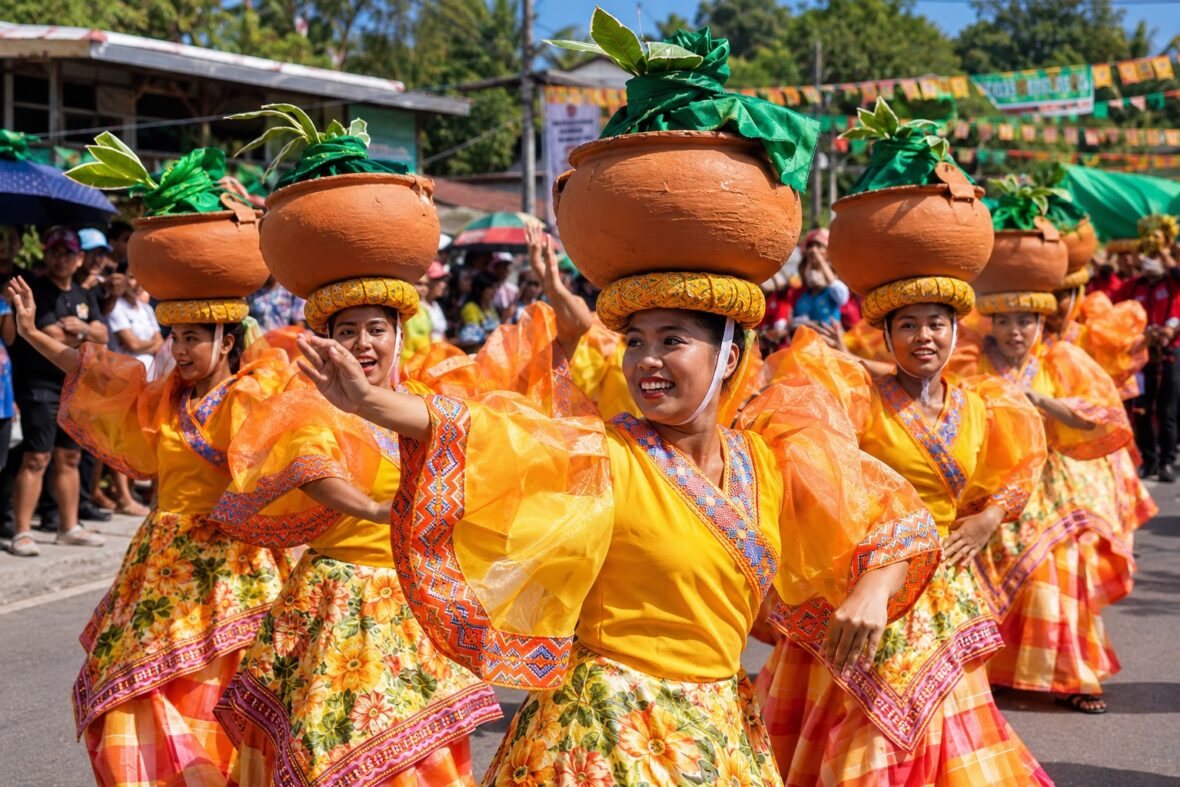
Festival dancers recreate different parts of the story—from raising chickens and working on farms to preparing and cooking the dish. Some performances even incorporate movements inspired by chickens into their choreography.
That makes the festival interesting to watch because the performances aren’t just random dances. There is usually a story behind what you see.
The costumes, props, choreography and music are designed to represent Cabatuan’s agricultural life and culinary traditions. The Philippine Information Agency notes that festival performances have portrayed both chicken movements and the traditional process of preparing tinuom.
Where is the Tinuom Festival celebrated?
Tinuom Festival is celebrated in Cabatuan, Iloilo.
This is an important distinction because some travelers may assume that the festival takes place in Iloilo City. Cabatuan is a separate municipality in Iloilo Province, located around 24 kilometers from Iloilo City.
Cabatuan is also particularly accessible for travelers arriving by plane because Iloilo International Airport is located within the municipality of Cabatuan.
Most of the major festival activities are held around the poblacion and central areas of town, including locations near the public plaza and municipal facilities.
During festival season, you’ll know you’ve arrived. Decorations appear around town, food stalls become busier, and residents prepare for weeks of cultural, religious, sports and entertainment activities.
When is Tinuom Festival celebrated?
Tinuom Festival is traditionally associated with the period leading into Cabatuan’s September town fiesta.
The town’s patron is St. Nicholas of Tolentino or San Nicolas de Tolentino, whose annual feast culminates on September 10. Cabatuan’s official history notes that the patronal celebration traditionally runs from September 1 to 10.
However, visitors should understand that the exact Tinuom Festival schedule can change from year to year.
Some older references describe the festival as taking place during the first week of September, while Cabatuan’s present festival calendar may begin considerably earlier.
Tinuom Festival 2026 Schedule
For 2026, the Cabatuan municipal government released its official Tinuom Festival and Patronal Fiesta schedule on August 18. This year’s celebration carries a theme centered on Cabatuan’s heritage, culture, agriculture and tourism.
Activities begin as early as August 17 and continue through September 10, 2026. One of the early major activities is the Tinuom Festival Opening Salvo, Street Dancing, Float Parade and Merrymaking at the Cabatuan Public Plaza Grounds on August 22.
The longer calendar also includes fairs, sports competitions, pageant-related events, dance competitions and community programs before the September 10 patronal celebration.
So if you’re traveling specifically for Tinuom Festival, don’t automatically assume that the biggest cultural activities will happen on September 10.
Always check the latest schedule from the Municipality of Cabatuan or Cabatuan Tourism Office before traveling.
History of the Tinuom Festival
Tinuom may be an old culinary tradition, but the festival itself is relatively young compared with many centuries-old Philippine fiestas.
The first Tinuom Festival was launched in 2006 during the administration of then Cabatuan Mayor Ramon C. Yee. It was introduced alongside the town’s patronal celebration and placed Cabatuan’s signature dish at the center of its cultural identity.
Before Tinuom Festival, Cabatuan had another cultural celebration known as Hirinugyaw.
The municipal government says Hirinugyaw began in 1995 and showcased Cabatuan’s culture through performances inspired by traditional ceremonies, courtship, marriage rituals and farming dances.
Eventually, Cabatuan shifted toward a festival that had something much more distinct to the town itself.
That something was tinuom.
It made sense.
Many municipalities have dance festivals, religious celebrations and agricultural festivals. But Cabatuan had a dish that people strongly associated with the community. By building a festival around it, the town gained an identity visitors could easily remember.
Cabatuan = Tinuom.
And that connection has become stronger over the years.
What Does “Tinuom” Mean?
According to the Philippine Information Agency, the term tinu-om refers to the idea of wrapping, which describes an important part of the cooking process.
The ingredients are placed together inside banana leaves, which are carefully folded and tied before the entire package is steamed.
What makes the dish unusual is that broth forms and remains inside the banana-leaf wrapper.
Imagine opening a tightly wrapped bundle of banana leaves at the table. Once you unfold it, you get tender pieces of chicken surrounded by hot, aromatic broth infused with lemongrass, ginger, tomatoes and the subtle fragrance of the leaves.
It’s simple food, but the preparation makes it special.
And when you understand the dish, many of the designs you see during Tinuom Festival start making more sense.
Banana leaves become giant props. Chicken feathers inspire costumes. Farm life appears in dance routines. Cooking movements become choreography.
The meal becomes a performance.
What is Tinuom Nga Manok?
At its heart, tinuom nga manok is a traditional chicken dish.
One well-known version in Cabatuan uses native chicken, lemongrass, tomatoes, onion, ginger, salt and water. The ingredients are layered inside banana leaves, tied together and steamed. The PIA documented a traditional preparation in which the wrapped chicken is steamed for around 20 to 30 minutes.
Using native chicken is important because it gives the dish a firmer texture and deeper chicken flavor compared with regular commercially raised chicken.
The banana leaves matter, too.
They don’t simply act as packaging. As the chicken cooks, the leaves help trap moisture, broth and aroma. The fragrance of the banana leaf mixes with the lemongrass and other ingredients.
The result is somewhere between a soup, steamed chicken and a traditional Filipino wrapped dish.
One of the establishments closely associated with Cabatuan’s tinuom tradition is Leah’s Tinu-om nga Manok, whose recipe traces its roots to Sabel Retotar and has been served in the town since the 1950s, according to the PIA.
For me, this is one of the reasons food festivals like Tinuom are worth experiencing. You aren’t simply trying something that was created for tourists. You’re eating a dish that families in the area have known for generations.
What to Expect During Tinuom Festival
The atmosphere changes depending on the day you visit, since the entire celebration can stretch across several weeks.
But there are a few experiences closely associated with Tinuom Festival.
Street Dancing
This is the visual side of the festival and probably what most visitors will want to photograph.
Groups perform choreographed routines inspired by Cabatuan’s culture, agriculture and tinuom-making tradition.
Expect colorful costumes, large props, energetic music and movements inspired by chickens and the preparation of the dish itself.
Some costumes use designs resembling feathers, leaves and agricultural materials. Meanwhile, props may represent banana leaves, cooking utensils, native chickens or farm products.
It is storytelling through dance.
Festival Dance Performances
Aside from performances along the streets, festival contingents traditionally participate in larger choreographed presentations where the story can be developed more fully.
This is where you usually appreciate the preparation that goes into the festival.
Hundreds of hours of rehearsals can go into synchronizing performers, designing props, creating costumes and arranging music.
And because the subject is tinuom, choreographers have the challenge of turning cooking into something entertaining onstage.
Float Parade and Merrymaking
Floats and merrymaking are also part of the celebration.
For 2026, for example, Cabatuan’s Opening Salvo on August 22 combines street dancing, a float parade and merrymaking at the public plaza.
These activities create a more relaxed festival atmosphere where residents, performers and visitors can participate instead of simply watching a formal competition.
Food, Tinuom and Local Products
You can’t attend a festival named after food without eating.
Make time to look for authentic tinuom nga manok while you’re in Cabatuan.
The festival period is also a good opportunity to discover products from local farmers, food producers and small businesses. The 2026 calendar, for example, includes an Agro-Industrial Fair, reinforcing the festival’s connection with Cabatuan’s agricultural economy.
Community Events
Like many Philippine fiestas, Tinuom Festival has grown into more than one parade or dance competition.
The festival calendar may include sports tournaments, dance events, pageants, entertainment programs and other community activities.
This is why spending more than a few hours in town can give you a very different experience.
Come only for the major street dance and you’ll see the spectacle.
Stay longer and you’ll see the community celebration behind it.
Tinuom Festival and San Nicolas de Tolentino
Although food and culture are major parts of the festival, Cabatuan’s fiesta also has a religious side.
The town is under the patronage of San Nicolas de Tolentino, and the traditional patronal festivities culminate on September 10.
That connection between cultural festival and Catholic fiesta is something you’ll notice in many towns across the Philippines.
One part celebrates the community’s history and livelihood.
Another expresses its religious traditions.
And both eventually become part of one long hometown celebration.
Visitors interested mainly in street dancing may choose the major festival dates, while those who want to experience Cabatuan’s patronal fiesta can also consider being there closer to September 10.
Why Tinuom Festival is Unique
I’ve covered and written about many Philippine festivals, and one thing that always makes a celebration easier to remember is when it has a clear identity.
Tinuom Festival has that.
You don’t have to spend too much time figuring out what the celebration is about.
It’s right there in the name.
The festival takes an ordinary local dish and uses it to tell a much bigger story about the people who cook it, the farmers who produce the ingredients, the families who continue the tradition and the town that eventually embraced it as part of its identity.
There’s also something very Filipino about that.
Food isn’t simply something we eat during celebrations. Food itself carries stories.
Recipes get passed down.
Certain dishes remind us of our hometown.
And whenever relatives come home, one of the first questions is usually about what we’re going to eat.
Tinuom Festival turns that connection between food and home into an entire town celebration.
How to Get to Cabatuan, Iloilo
Getting to Tinuom Festival is relatively convenient compared with festivals held in more remote parts of Panay.
From Iloilo City
Cabatuan is approximately 24 kilometers from Iloilo City.
Travel time depends on traffic and your transportation, but by private vehicle the trip can take around 30 minutes or more.
Public transportation going toward Cabatuan and nearby municipalities is also available from Iloilo’s transport terminals. During major festival days, expect heavier traffic as you approach the poblacion.
If you’re attending a major street dancing or parade event, leave Iloilo City early.
Road closures and traffic rerouting are common during festivals.
From Iloilo International Airport
This is where Cabatuan has a major advantage.
Iloilo International Airport is actually located in Cabatuan, so travelers arriving by plane are already in the same municipality where Tinuom Festival is celebrated.
You’ll still need transportation from the airport to the town center, but you won’t need to travel all the way from Iloilo City first.
If Tinuom Festival is the main reason for your trip, you can even plan Cabatuan as your first destination before heading into Iloilo City.
Best Time to Visit Tinuom Festival
If your priority is photography and festival performances, schedule your trip around the announced street dancing, opening salvo or major cultural competition.
If you want a broader experience, stay for two days.
Arrive the day before the main festival activity, walk around town, try tinuom, visit the local fairs and then attend the major performance the following day.
September is also part of the rainy season in Western Visayas, so be prepared for sudden rain even when the morning starts sunny.
Bring an umbrella or lightweight rain protection—but make sure whatever you carry won’t make it difficult to move through a crowd.
Tips for Attending Tinuom Festival
A little preparation makes Philippine festivals much easier to enjoy.
My main suggestion is to arrive early, especially when there is street dancing. Good viewing areas can fill up quickly, and roads near the main route may be closed before the event begins.
Bring drinking water, wear comfortable clothes and shoes, prepare for heat and rain, and keep your phone or camera protected from sudden showers. Most importantly, don’t leave Cabatuan without trying the dish that gave the festival its name.
Tinuom Festival makes much more sense once you’ve actually opened that banana-leaf package and tasted what everyone is celebrating.
Frequently Asked Questions About Tinuom Festival
What is Tinuom Festival?
Tinuom Festival is a cultural and food festival celebrated in Cabatuan, Iloilo. It highlights tinuom nga manok, the town’s traditional native chicken dish cooked with aromatics and wrapped in banana leaves.
Where is Tinuom Festival celebrated?
It is celebrated in the Municipality of Cabatuan, Iloilo Province, about 24 kilometers from Iloilo City.
When is Tinuom Festival celebrated?
The celebration is held around late August to September, alongside Cabatuan’s patronal fiesta. Exact festival dates vary each year.
For 2026, official activities begin in August and continue until the September 10 patronal celebration.
When did Tinuom Festival start?
The first Tinuom Festival was launched in 2006 during the administration of former Cabatuan Mayor Ramon C. Yee.
What does tinuom mean?
The term is associated with the method of wrapping ingredients before cooking. In Cabatuan’s famous version, native chicken and aromatics are wrapped inside banana leaves and steamed.
What is tinuom made of?
A traditional Cabatuan preparation uses native chicken together with ingredients such as lemongrass, tomatoes, onion, ginger, salt and water. These are wrapped in banana leaves before being steamed.
What is the highlight of Tinuom Festival?
Street dancing and cultural performances are among its most recognizable highlights. Festival dancers use choreography, costumes and props to portray chickens, farming life and the traditional preparation of tinuom.
Who is the patron saint of Cabatuan?
Cabatuan’s patron saint is San Nicolas de Tolentino or St. Nicholas of Tolentino, whose feast is celebrated on September 10.
Is Cabatuan far from Iloilo International Airport?
No. In fact, Iloilo International Airport is located in Cabatuan itself, making the town one of the more accessible festival destinations in Iloilo Province for visitors arriving by air.

Final Thoughts
There are bigger festivals in Iloilo, but that’s exactly what I like about celebrations such as Tinuom Festival.
They introduce you to a town through something very personal.
In Cabatuan, that something is food.
A native chicken dish wrapped in banana leaves eventually became a symbol of the municipality—then became the inspiration for costumes, music, street dances, fairs and an entire festival.
What starts with opening a small bundle of banana leaves becomes a way of understanding Cabatuan itself.
So if you’re visiting Iloilo around late August or September and want to experience something beyond the province’s more famous celebrations, consider making the short trip to Cabatuan.
Watch the dancers. Join the merrymaking. Explore the local fair.
And before heading home, sit down for a serving of hot tinuom nga manok.
After all, that’s where the entire celebration begins.