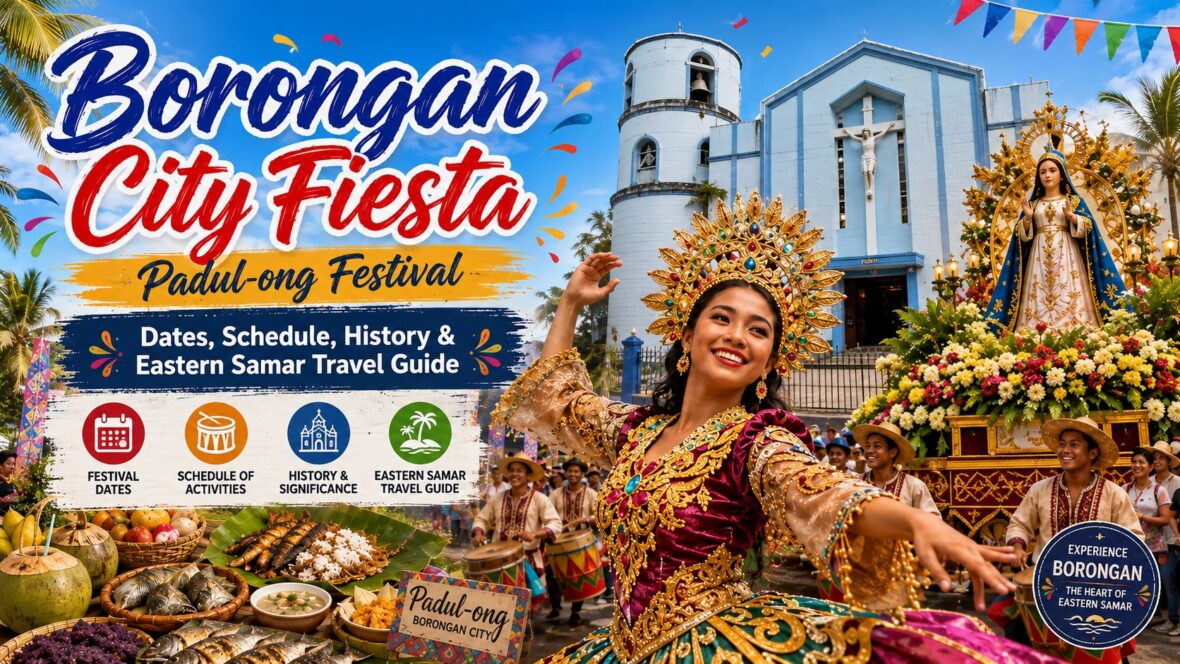
September is one of the best times to experience Borongan City, Eastern Samar.
Every year, the provincial capital celebrates its fiesta in honor of the Nativity of Our Lady, and one of the biggest highlights is the colorful Padul-ong Festival.
For 2026, the important dates to remember are September 7 and September 8.
September 7 is traditionally associated with the Padul-ong Festival, while September 8 is the Feast of the Nativity of the Blessed Virgin Mary and Borongan’s main patronal fiesta day. The Provincial Government of Eastern Samar officially lists Padul-ong on September 7 and describes it as a presentation of the story surrounding the arrival of the image of the Blessed Virgin in Borongan.
And Padul-ong isn’t just another street-dancing competition.
The festival combines faith, local legend, a fluvial procession, street dancing and Borongan’s connection with the sea. It’s one of those Philippine celebrations where the religious and cultural sides of the fiesta are closely connected.
If you’re planning to visit Eastern Samar this September, here’s a comprehensive guide to the Borongan City Fiesta and Padul-ong Festival 2026.
Content
Borongan City Fiesta 2026 at a Glance
Celebration: Borongan City Fiesta 2026
Festival: Padul-ong Festival
Location: Borongan City, Eastern Samar
Major festival date: September 7, 2026
Main fiesta day: September 8, 2026
Patroness: The Nativity of Our Lady / Nuestra Señora de Borongan
Religious feast: Nativity of the Blessed Virgin Mary
Province: Eastern Samar
Region: Eastern Visayas
The complete Borongan Fiesta 2026 schedule of activities has not yet been widely published in a searchable official calendar as of August 21, 2026.
However, the September dates are well established.
The Provincial Government of Eastern Samar lists Padul-ong on September 7, while the Cathedral Parish of the Nativity of Our Lady observes its annual feast on September 8.
When Is Borongan City Fiesta 2026?
The main celebration falls around:
September 7, 2026 – Monday
September 7 is traditionally the major Padul-ong Festival day.
This is when the cultural reenactment, street dancing and other major festival activities are commonly associated with the celebration.
September 8, 2026 – Tuesday
September 8 is the Feast of the Nativity of the Blessed Virgin Mary and the principal religious fiesta day in Borongan.
Borongan Cathedral officially celebrates the Nativity of Our Lady on September 8.
If you’re traveling specifically for the festival, I’d recommend arriving before September 7.
That way, you can experience both the cultural activities and the main religious celebration instead of arriving only on fiesta day.
What Is the Padul-ong Festival?
The Padul-ong Festival is one of Eastern Samar’s most important cultural and religious celebrations.
At its heart is the story of Nuestra Señora de Borongan, the Marian image associated with the city’s patronal devotion.
The Provincial Government of Eastern Samar describes Padul-ong as a mythical presentation of how the image of the Blessed Virgin was mysteriously transported to Borongan from Portugal. The story is also linked with the mysterious Lady in White associated with Hamorawon Spring.
That gives Padul-ong a very different character from a festival based mainly on harvest, food or local products.
This is fundamentally a story about faith and the arrival of the city’s patroness.
What Does “Padul-ong” Mean?
In the local context, Padul-ong is connected with bringing or transporting something to a destination.
That meaning fits the festival perfectly because the central story revolves around the journey of the Marian image to Borongan.
Rather than simply performing generic festival choreography, dancers traditionally dramatize portions of that journey and the arrival of the image in the community.
This gives the street dancing a narrative.
You’re watching Borongan’s local religious story being retold through costumes, music and movement.
The Story Behind Padul-ong Festival
According to Eastern Samar’s official festival account, the story tells of the image of the Blessed Virgin being mysteriously transported to Borongan from Portugal.
Another important part of the legend involves a Lady in White who was said to appear around Hamorawon Spring.
The spring became associated with stories of miraculous healing.
Over time, these traditions became intertwined with Borongan’s devotion to the Blessed Virgin Mary.
The Padul-ong Festival brings those stories into a public cultural presentation.
That is why you often see festival performers carrying or presenting an image of Mary during the choreography.
The Fluvial Procession
One of the most beautiful traditions associated with Padul-ong is the fluvial procession.
This is important because the festival story involves the arrival of the Marian image by sea.
The Philippine Information Agency reported that during the 2025 Padul-ong Festival, the celebration included a dawn fluvial procession across Borongan Bay, followed by a grand street parade and ritual dances dramatizing the arrival of the image.
So imagine starting the festival while much of the city is still waking up.
Boats gather on the water.
The image of the Blessed Virgin is carried across Borongan Bay.
Devotees wait along the route.
Then the celebration continues on land.
That combination of sea procession and street festival is one of the things that makes Padul-ong particularly memorable.
Padul-ong Street Dancing
After the fluvial tradition comes the side of Padul-ong that produces many of the festival’s most colorful photographs.
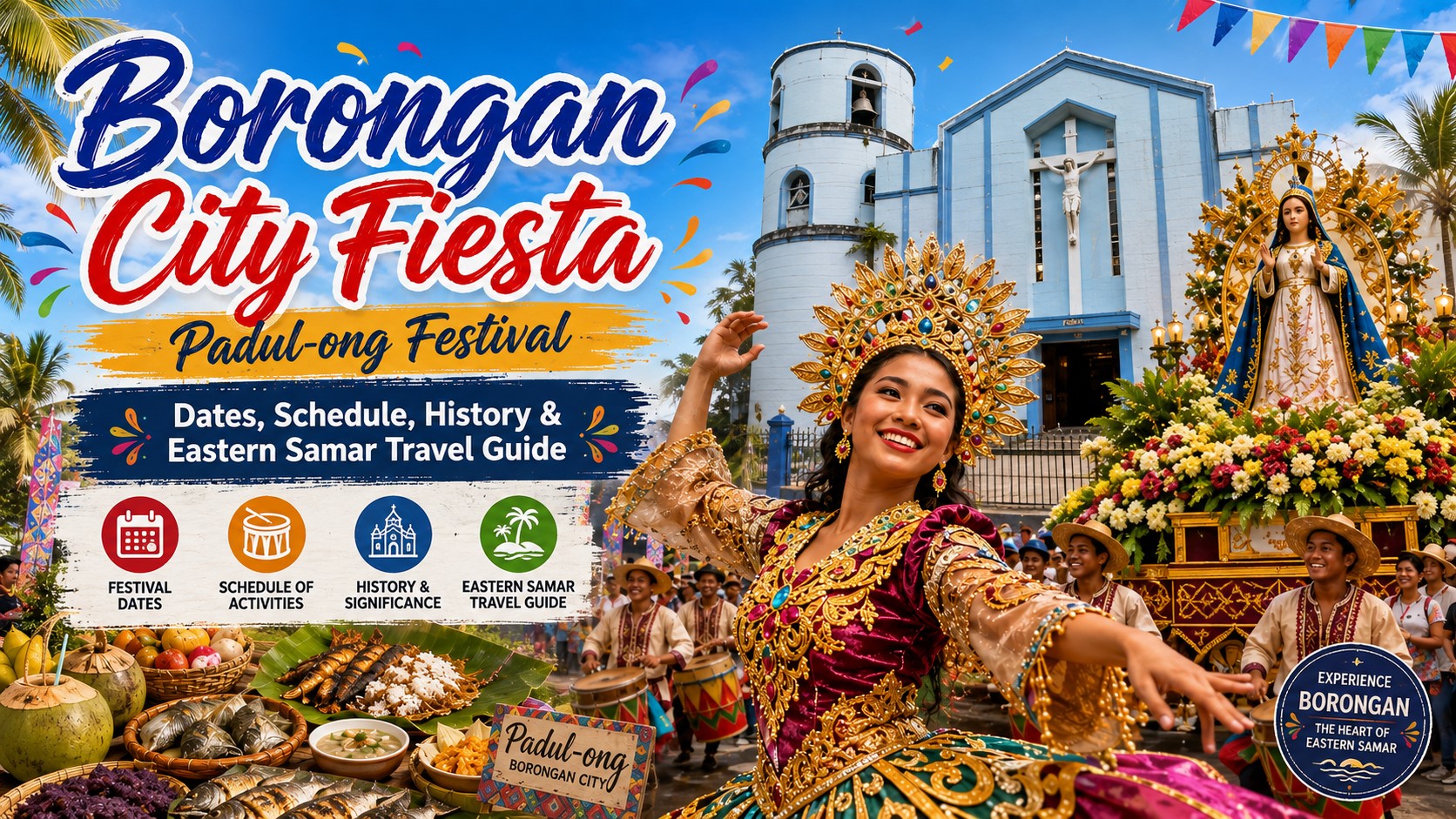
The streets fill with dancers wearing elaborate costumes inspired by nature, flowers, Marian imagery and local culture.
Music and drums accompany the contingents as they perform choreography telling the Padul-ong story.
The 2025 festival featured competing groups performing ritual pieces built around faith and the image of the Virgin Mary. PIA described the event as Borongan’s grand expression of faith and heritage.
The festival is therefore both a competition and a religious offering.
Padul-ong Festival 2025 Gives Us an Idea of What to Expect
Because the complete 2026 schedule has not yet been publicly indexed, the previous edition provides useful context.
During Padul-ong Festival 2025, participating contingents filled the streets with:
- Drum performances
- Elaborate costumes
- Choreographed street dancing
- Marian imagery
- Ritual presentations
- Competitive festival performances
One particularly memorable moment involved a student performer with a disability participating with the winning Tribu Sagitik contingent and raising the image of the Virgin Mary during the performance. The Philippine Information Agency highlighted the moment as an example of inclusion and community spirit within the festival.
The exact contingents and competition format can change in 2026, but the overall combination of religious symbolism and large-scale cultural performance is expected to remain central.
Borongan Fiesta 2026 Schedule of Activities
As of August 21, 2026, a complete official day-by-day Borongan City Fiesta 2026 calendar has not yet been located through publicly searchable government sources.
So details such as:
concert performers, pageant dates, competition times, parade routes and exact event venues
should not yet be treated as confirmed unless announced by the City Government of Borongan, the Diocese of Borongan or another official organizer.
Based on established annual traditions, visitors should watch for announcements concerning:
- Padul-ong Festival
- Fluvial procession
- Street dancing
- Ritual showdown
- Religious novena
- Fiesta Masses
- Marian procession
- Cultural presentations
- Sports events
- Civic programs
- Pageants
- Nightly entertainment
- Concerts
- Community activities
- September 8 fiesta celebrations
The most important confirmed annual dates remain September 7 and 8.
September 8 Is More Than Just Fiesta Day
There’s an interesting historical connection between September 8 and Borongan itself.
According to the Provincial Government of Eastern Samar, Borongan was established as a pueblo on September 8, 1619.
Spanish Jesuit missionaries had already been evangelizing the region, and on September 8, 1619, Borongan was formally established as a pueblo with its first priest assigned to the community.
So September 8 carries layers of meaning for the city.
It’s associated with:
the Nativity of the Blessed Virgin Mary, the annual patronal fiesta and an important date in Borongan’s early colonial history.
That makes the celebration even more closely connected with Borongan’s identity.
Borongan Cathedral
The religious heart of the fiesta is Borongan Cathedral, officially known as the Cathedral Parish of the Nativity of Our Lady.
The cathedral belongs to the Diocese of Borongan.
Catholic directory information identifies the parish as established in 1768, with the Nativity of Our Lady as its titular patron and September 8 as its feast date.
The cathedral becomes particularly important during fiesta week as devotees attend novena Masses and special liturgical celebrations.
The exact 2026 fiesta Mass and procession schedule should be checked with the Diocese or cathedral closer to September.
Why September 8 Is a Major Marian Fiesta Date in the Philippines
Borongan isn’t alone in celebrating on September 8.
The date commemorates the Nativity of the Blessed Virgin Mary, traditionally understood by Catholics as Mary’s birthday.
Several Philippine communities celebrate their patronal fiestas on this date.
In Eastern Visayas alone, notable early-September Marian celebrations can also be found in places such as Las Navas in Northern Samar and Calbayog City in Samar.
That makes the first week of September an interesting period for travelers interested in Philippine religious traditions.
Hamorawon Spring and the Lady in White
One of the most fascinating places connected with the Padul-ong story is Hamorawon Spring.
It is found within Borongan’s city proper.
The Provincial Government of Eastern Samar describes Hamorawon as a natural freshwater spring located in the center of the city. Local tradition associates the spring with sightings of a mysterious Lady in White, believed to be connected with the city’s patroness.
Stories also developed around the water having healing qualities.
Whether you approach the story from a religious, historical or folkloric perspective, Hamorawon helps explain why Padul-ong is more than a straightforward festival parade.
The celebration incorporates Borongan’s local legends into the city’s Marian devotion.
Where Is Borongan City?
Borongan is the capital of Eastern Samar and sits along the province’s Pacific coast.
The city is bordered by the Pacific Ocean to the east and includes coastal areas, rivers and offshore islands.
It is also regarded as the easternmost city in the Philippines.
That coastal location is an important part of Borongan’s identity.
The sea isn’t just something you see from the boulevard.
It’s part of the Padul-ong story itself.
How to Get to Borongan City
From Tacloban
For many travelers, Tacloban City is the easiest major gateway to Eastern Samar.
From Tacloban, buses and vans travel toward Borongan through the road network crossing Samar.
Actual travel time varies depending on road conditions, stops and the type of vehicle.
During fiesta week, allow extra time because passenger demand can increase.
From Manila by Land
Long-distance buses can reach Samar from Manila through the Bicol region.
The route generally continues through Matnog, Sorsogon, crosses the San Bernardino Strait by ferry to Allen, Northern Samar, and then proceeds through Samar toward Borongan.
The Eastern Samar provincial government identifies land transportation as one of the main ways of reaching Borongan.
This is a much longer journey than flying to Tacloban first, but it’s an option for travelers who prefer overland trips.
By Air
Borongan has an airport, although flight availability has historically been much more limited than services to larger airports such as Tacloban.
Always check current airline schedules rather than assuming a direct flight is operating on your travel date.
Things to Do in Borongan During Fiesta Week
The nice thing about attending Padul-ong is that you can easily turn the trip into an Eastern Samar getaway.
Borongan Bay and Baybay Boulevard
One of the easiest places to enjoy Borongan’s coastal atmosphere is around Borongan Bay and the boulevard area.
The waterfront is also closely tied to the city’s surfing culture.
Eastern Samar’s provincial government identifies the Boulevard/Borongan Bay area as one of Borongan’s surfing locations and notes that the city has several surf spots along its Pacific-facing coast.
It’s a relaxing area to visit before or after fiesta activities.
Divinubo Island
For beaches and island scenery, consider Divinubo Island.
The Provincial Government of Eastern Samar describes Divinubo as one of Borongan’s famous islands, with a long white-sand beach, coral rock formations and opportunities for swimming, boating, snorkeling and diving.
If conditions are good, it can be a nice addition to a multi-day fiesta trip.
Hamorawon Park and Spring
Because of its role in the Padul-ong legend, Hamorawon deserves a visit if you’re interested in understanding the festival rather than simply watching the street dancing.
The spring is located within the city center, making it one of the easiest cultural stops to combine with fiesta activities.
Borongan Cathedral
Even if you aren’t attending Mass, the cathedral is central to understanding why the fiesta exists.
During September 7–8, however, remember that this is first and foremost an active religious venue.
Visitors should be respectful of worshippers and ongoing services.
Surfing in Borongan
Here’s another reason to stay longer.
Borongan has a growing reputation as a surfing destination.
According to Eastern Samar’s provincial government, surf spots around the city include:
Borongan Bay/Boulevard, Sulangan Beach, Lalawigan and Guintagican Beach, among others.
September isn’t necessarily the peak period identified by the provincial tourism information—the stronger Amihan surf season is generally later—but conditions vary.
If surfing is part of your plans, check locally before heading out.
What to Eat in Eastern Samar
Fiesta travel and food naturally go together.
Eastern Samar has plenty of familiar Waray dishes and native delicacies.
The provincial government highlights foods such as minuron, a local suman-style delicacy, as well as seafood and other ingredients connected with the province’s coastal environment.
But during fiesta itself, some of the best food won’t necessarily come from a restaurant.
Like elsewhere in the Philippines, Borongan families may prepare large meals for relatives and guests.
Expect familiar fiesta dishes such as:
pancit, lumpia, meat dishes, grilled food, seafood, rice cakes and desserts.
And if you’re lucky enough to be invited into a local home, that’s often where you’ll experience the real fiesta atmosphere.
Where to Stay for Borongan Fiesta 2026
Because Borongan is the provincial capital, accommodation choices are generally better than in many smaller Eastern Samar municipalities.
If your priority is the fiesta, staying near the city center or Baybay area can make things easier.
Being close to the poblacion means easier access to:
Borongan Cathedral
Festival venues
Restaurants
Waterfront areas
City transportation
Book early if you’re visiting specifically on September 7–8.
Fiesta periods bring home returning families, government visitors, performers and tourists, which can increase accommodation demand.
Weather in Borongan in September
Borongan faces the Pacific, and Eastern Samar is known for receiving substantial rainfall.
September falls within the Philippine rainy and tropical cyclone season.
That means weather can affect:
street dancing, fluvial activities, outdoor concerts, boat trips and island excursions.
Bring:
- Umbrella
- Lightweight rain jacket
- Quick-drying clothes
- Comfortable walking footwear
- Waterproof phone pouch
- Power bank
- Drinking water
- Sun protection
And don’t assume an event is cancelled simply because it rains.
Many Philippine fiestas continue through light rain.
But for severe weather, follow official LGU and disaster-risk advisories.
Tips for Attending Padul-ong Festival 2026
Arrive Before September 7
If Padul-ong is your main reason for visiting, arriving on September 6 or earlier gives you more flexibility.
Wake Up Early for the Fluvial Tradition
If the 2026 program follows the established format, the fluvial procession may happen early.
The 2025 celebration featured a dawn fluvial procession, so don’t expect every major event to happen in the afternoon.
Find Your Street-Dancing Spot Early
Festival routes can become crowded.
If the official route is announced beforehand, choose your viewing location early rather than trying to move through the crowd once performances have started.
Protect Your Phone From Rain
This is Eastern Samar in September.
A waterproof pouch is a simple but useful item.
Stay for September 8
Don’t leave after street dancing.
September 8 is the actual patronal feast and offers a different side of the celebration.
Respect the Marian Image
For visitors, the image carried during performances may look like a festival prop.
For devotees, it represents the Blessed Virgin Mary.
Treat religious images and processions respectfully.
Is Borongan Fiesta 2026 a Holiday?
A city fiesta does not automatically make September 8 a national or local non-working holiday.
A special non-working day may be declared through an official proclamation, but this needs to be confirmed for the particular year.
If you’re checking whether there will be:
no classes, no government work or closed offices
during Borongan Fiesta 2026, wait for an official proclamation or local announcement.
Frequently Asked Questions About Borongan Fiesta 2026
When is Borongan City Fiesta 2026?
The main Borongan City patronal fiesta is celebrated on September 8, 2026.
When is Padul-ong Festival 2026?
Padul-ong is traditionally associated with September 7, immediately before Borongan’s September 8 fiesta. The Provincial Government of Eastern Samar officially lists Padul-ong on September 7.
What days are September 7 and 8 in 2026?
September 7, 2026 is Monday, while September 8, 2026 is Tuesday.
Who is the patron saint of Borongan?
Borongan’s cathedral and patronal celebration honor the Nativity of Our Lady, with the feast celebrated every September 8.
What does Padul-ong Festival celebrate?
Padul-ong commemorates the traditional story of the arrival of the image of the Blessed Virgin Mary in Borongan and its connection with the Lady in White associated with Hamorawon Spring.
Is there street dancing during Padul-ong?
Yes. Street dancing and ritual presentations are major features of the festival. The 2025 celebration included a grand street parade and competitive ritual performances.
Is there a fluvial procession?
The fluvial procession is an important Padul-ong tradition. In 2025, the image was carried during a dawn procession across Borongan Bay before the street celebration.
Is the Borongan Fiesta 2026 schedule already available?
As of August 21, 2026, I have not located a complete publicly searchable official 2026 calendar containing every concert, competition, parade time and activity. The established September 7–8 festival and fiesta dates are confirmed through recurring official sources.
Where is Padul-ong Festival held?
The festival is held in Borongan City, Eastern Samar, with activities traditionally taking place around the city proper, Borongan Bay and major festival venues.
What is Borongan known for aside from Padul-ong?
Borongan is known for its Pacific coastline, surfing, islands and beaches. Attractions include Divinubo Island, Borongan Bay and Hamorawon Spring.
Final Thoughts
The Borongan City Fiesta and Padul-ong Festival 2026 should be one of the more interesting September celebrations to watch in Eastern Visayas.
The main dates are easy to remember:
September 7, 2026 – Padul-ong Festival
and
September 8, 2026 – Feast of the Nativity of Our Lady and Borongan City Fiesta
What makes Padul-ong special is that the festival isn’t separate from Borongan’s story.
The boats crossing the bay, dancers carrying the Marian image, the story of the Lady in White, Hamorawon Spring and the celebration at Borongan Cathedral all connect back to the same tradition.
It’s faith expressed through festival.
For travelers, it’s also an opportunity to experience a part of Eastern Samar that deserves more attention.
You can watch the festival in the city, walk along the Pacific-facing waterfront, visit the cathedral, learn about the Hamorawon legend and add an island or beach trip if the weather cooperates.
The complete Borongan Fiesta 2026 schedule of activities is still worth watching for as September approaches, especially for announcements about the exact fluvial procession time, street-dancing route, ritual competition, concerts and other nighttime events.
But for now, mark September 7–8, 2026 on your calendar.
That’s when Borongan’s devotion, history and festival tradition come together once again for Padul-ong.