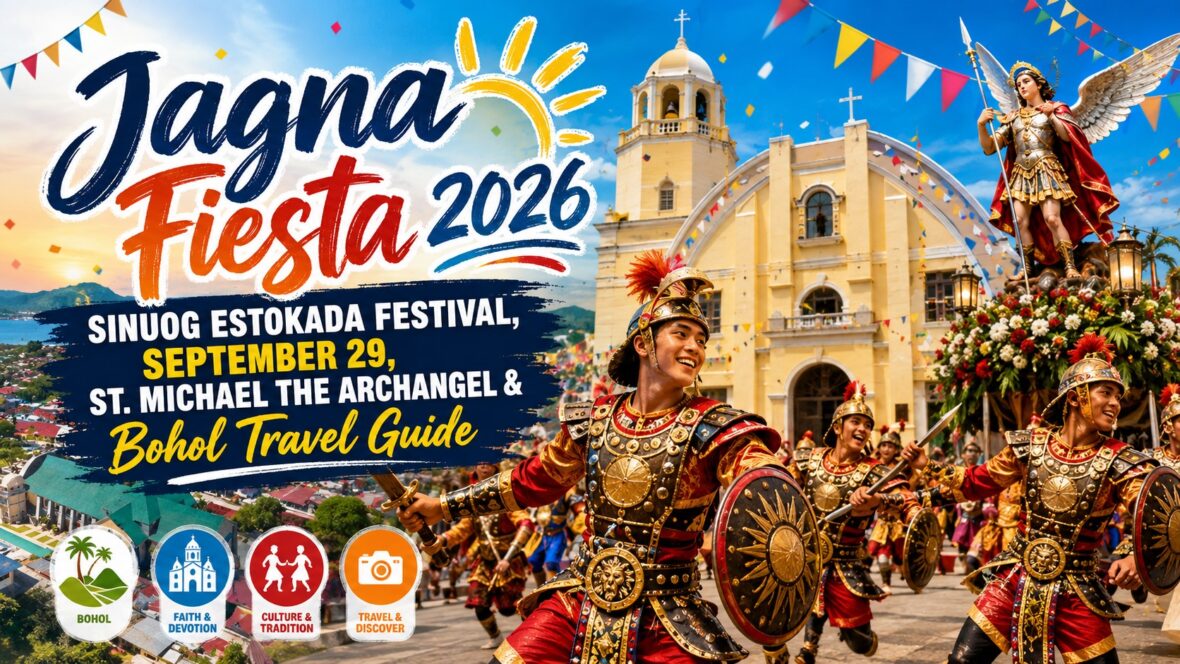
If you are looking for one of Bohol’s most interesting September fiestas, Jagna deserves a spot on your list.
The Jagna Town Fiesta is celebrated every September 29 in honor of St. Michael the Archangel, the municipality’s patron saint. But what makes this celebration especially interesting is that it is much more than the usual combination of Masses, processions, family reunions and community programs.
Jagna has its own centuries-old cultural tradition called Sinu-og, which eventually inspired the Sinuog Estokada Festival — a dramatic dance tradition built around themes of battle, faith and the triumph of good over evil. (Jagna)
For 2026, the main fiesta day falls on:
Tuesday, September 29, 2026.
The religious and cultural activities traditionally extend into September 28, or the vesper day, making September 28–29 the most important dates for visitors planning to experience the fiesta. Bohol’s provincial tourism profile also lists September 28–29 as the feast days of St. Michael the Archangel Parish in Jagna. (PPDO Bohol)
Here is a complete guide to the Jagna Fiesta 2026, including the Sinuog Estokada Festival, its history and meaning, the devotion to St. Michael the Archangel, what visitors can expect and places worth visiting while you are in this part of Bohol.
Content
Jagna Fiesta 2026 Quick Facts
| Details | Information |
|---|---|
| Celebration | Jagna Town Fiesta |
| Municipality | Jagna, Bohol |
| Main Fiesta Date | September 29, 2026 |
| Day | Tuesday |
| Patron Saint | St. Michael the Archangel |
| Main Cultural Celebration | Sinuog Estokada |
| Important Fiesta Period | September 28–29 |
| Main Church | St. Michael the Archangel Parish Church |
| Province | Bohol |
| Region | Central Visayas |
When Is the Jagna Fiesta 2026?
The main Jagna Fiesta is celebrated every September 29, the feast of St. Michael the Archangel.
That makes Tuesday, September 29, the principal fiesta day in 2026.
This date has deep historical significance for Jagna. According to the Municipality of Jagna, the Jesuit mission that became the town and parish was formally founded on September 29, 1631, with St. Michael the Archangel chosen as its patron. (Jagna)
Jagna’s own historical records say September 29 has remained the parish fiesta of San Miguel de Jagna since the seventeenth century. (Jagna)
So when Jagnaanons celebrate their fiesta, they are continuing a tradition that stretches back for centuries.
Is the Jagna Fiesta Only on September 29?
Not really.
September 29 is the feast day itself, but the fiesta celebration normally begins earlier.
September 28 is particularly important because it is the traditional vesper day. Jagna’s historical records describe Sinu-og dancers joining the vesper procession before participating again during the religious activities on September 29. (Jagna)
The provincial tourism profile likewise identifies September 28–29 as the feast period of St. Michael Parish. (PPDO Bohol)
In addition, modern fiesta celebrations can include cultural competitions, street dancing, community activities, sports, entertainment programs and other events scheduled in the days leading up to the feast.
For travelers, September 28 and 29 would therefore be the two dates I would prioritize.
As of September 1, I have not found a complete official Jagna Fiesta 2026 program containing exact times, concerts and competition schedules. Those details may be announced closer to the celebration, so visitors should still check the latest releases from the Municipality of Jagna and local tourism authorities.
Who Is the Patron Saint of Jagna, Bohol?
Jagna celebrates its fiesta in honor of St. Michael the Archangel, commonly called San Miguel Arkanghel.
St. Michael holds an important place in Catholic tradition as the archangel associated with the defense of God’s people and the defeat of evil.
That religious symbolism became closely intertwined with Jagna’s local history and eventually with the town’s Sinu-og tradition.
The Municipality of Jagna traces the establishment of the parish and town to September 29, 1631, with St. Michael already serving as patron saint.
This means the devotion is not simply a modern festival theme. It is part of Jagna’s historical identity.
What Is the Sinu-og Tradition of Jagna?
Long before the modern Sinuog Estokada street-dancing competitions, Jagna already had the traditional Sinu-og.
According to Jagna’s municipal historical profile, the dance developed around a local account involving coastal attacks and the town’s defense. In the tradition, Jagnaanons attributed their deliverance to the intervention and protection of St. Michael the Archangel.
The resulting Sinu-og became a ritualized war dance performed during the fiesta to remember the story.
The Provincial Government of Bohol describes it as a distinct Jagnaanon cultural tradition performed during the annual fiesta, accompanied by drums.
Historically, two groups of Sinu-og dancers have been associated with the tradition — one from Barangay Mayana and another from Cabungaan. They traditionally come down for the vesper procession and participate again during the September 29 celebration.
This older Sinu-og tradition is important because it explains where the more familiar Sinuog Estokada came from.
What Is the Sinuog Estokada Festival?
Sinuog Estokada is a later adaptation of Jagna’s traditional Sinu-og.
The municipal historical record says the first Sinu-og Estokada performance took place on September 29, 2001. The concept was developed as an additional cultural presentation without replacing the older Sinu-og tradition. (Jagna)
Instead of simply retelling a historical battle, Estokada emphasizes the larger symbolic struggle between good and evil.
That makes St. Michael the Archangel a natural central figure.
The Philippine Information Agency describes today’s Sinuog Estokada as Jagna’s major September 29 street-dancing attraction, using measured dance movements, contrasting costumes and dramatic choreography to depict the victory of St. Michael over evil. (Philippine Information Agency)
It has since become one of the most recognizable cultural features of the Jagna Fiesta.
What Does “Estokada” Mean?
Within Jagna’s festival tradition, Estokada refers to the symbolic fight between good and evil.
Municipal historical records explain that the term was adopted when the older Sinu-og tradition was reformatted into a performance better suited to younger participants, schools and organized cultural presentations. (Jagna)
The choreography uses coordinated movements and a marching rhythm while preserving the basic idea of struggle, defense and eventual victory.
That is why costumes often visually contrast the opposing sides of the story.
St. Michael is commonly portrayed as the victorious heavenly warrior.
Why Sinuog Estokada Is Different From Many Philippine Festivals
There are plenty of Philippine festivals built around street dancing, colorful costumes and competitions.
But Jagna’s celebration has an unusually strong connection to a much older ritual tradition.
Sinuog Estokada was not simply created as a tourism event and then given a historical story afterward. It grew out of the existing Sinu-og tradition that had long formed part of Jagna’s annual September fiesta.
Jagna’s development records note that Sinu-og and other religious-cultural practices were already established features of the yearly celebration before Sinuog Estokada was developed in 2001.
That continuity gives the festival a character that goes beyond the competition itself.
Sinuog Estokada Street Dancing
For photographers and festival travelers, the street dancing is likely to be one of the most anticipated parts of the celebration.
Recent editions have featured elaborately dressed contingents portraying angels, warriors and the forces of good and evil.
During the 2024 celebration, Sinuog Estokada included a street-dancing parade and ritual showdown on September 29. The municipality even organized a photography competition involving 22 local photographers to document the festival and create materials promoting Jagna’s cultural tourism.
That gives visitors a good idea of what the modern Sinuog Estokada experience can look like: dancers occupying the town’s streets, crowds lining the route and dramatic performances centered around St. Michael.
The exact competition format for 2026 should still be confirmed once the official schedule is released.
The Religious Side of Jagna Fiesta
Despite the increasingly colorful festival atmosphere, Jagna Fiesta remains first and foremost a religious celebration.
St. Michael the Archangel Parish Church serves as the center of the town’s major religious activities.
Traditional fiesta observances can include novena Masses, the vesper celebration, religious processions and feast-day Masses.
One particularly interesting Jagna tradition is the participation of Sinu-og dancers in the religious processions, creating a direct connection between cultural performance and devotion.
Historical accounts specifically mention the Sinu-og dancers joining the September 28 vesper procession and participating during the September 29 activities.
For visitors who want to understand the fiesta rather than simply photograph the street dancing, attending some of these religious events provides much more context.
St. Michael the Archangel Parish Church
The St. Michael the Archangel Parish Church is one of Jagna’s most important landmarks.
Bohol’s tourism authorities describe the church as a Spanish-era structure known for its architecture and ceiling artwork. (Behold Bohol)
The provincial tourism profile says the existing church was completed in 1808 under Augustinian Recollect missionary Fr. Blas de las Mercedes and describes it as one of Bohol’s older and larger churches. (PPDO Bohol)
During fiesta season, the church becomes the spiritual center of the celebration.
Even travelers who are primarily visiting for Sinuog Estokada should make time to see the church.
Jagna Fiesta 2026 Expected Highlights
Although the complete 2026 program still needs to be officially confirmed, Jagna’s established traditions give us a good idea of what visitors should watch for.
The most important activities are likely to revolve around the September 28 vesper celebration and September 29 feast day. Traditional or recurring elements include religious Masses and processions, Sinu-og performances, Sinuog Estokada street dancing and ritual performances, along with community and cultural programs.
Concerts, pageants, sports competitions, trade activities and other LGU-organized entertainment may also be part of the wider fiesta calendar, but those should be treated as unconfirmed until an official Jagna Fiesta 2026 schedule is released.
Jagna Fiesta 2026 Suggested Two-Day Visit
If your main purpose is experiencing the fiesta, arriving on September 28 would be ideal.
Spend the afternoon exploring the poblacion and St. Michael Parish Church before positioning yourself for the vesper activities. You will also get a sense of how the town changes as residents prepare for the main celebration.
Stay overnight in or near Jagna.
On September 29, start early. The feast-day religious activities traditionally begin in the morning, while cultural and street events may continue later in the day.
Visitors interested in photography should expect crowds and give themselves enough time to find a good viewing location before the street-dancing activities begin.
Where Is Jagna, Bohol?
Jagna is located along the southern coast of Bohol and belongs to the province’s Third Congressional District.
The municipality has 33 barangays and functions as one of southern Bohol’s commercial centers, supported by its public market and port. (Bohol Provincial Government)
The Jagna municipal profile places the town proper around 63 kilometers from Tagbilaran. (Jagna)
Its location makes Jagna particularly convenient for travelers exploring the southern and eastern side of Bohol rather than spending their entire vacation around Panglao and Tagbilaran.
Things to Do in Jagna Aside From the Fiesta
One advantage of attending Jagna Fiesta is that you can combine the festival with several local attractions.
St. Michael Parish Church should naturally be the first stop, especially during the feast.
Kinahugan Falls is another option. The Bohol Provincial Tourism Office describes it as a three-part waterfall located in the hilly area of Karap-agan, several kilometers from the poblacion.
There is also the San Pedro Calungsod Shrine in Malbog, which the province identifies as part of Jagna’s faith-tourism initiative. The site overlooks downtown Jagna and the Mindanao Sea.
Try Jagna’s Calamay
Food is always part of a Bohol fiesta, and Jagna has a particularly strong connection with calamay.
Bohol’s official tourism office even includes the Jagna Calamay Industry in one of its tourism itineraries, where visitors can see how the delicacy is prepared. (Behold Bohol)
Calamay is made primarily from glutinous rice, coconut milk and sugar and is one of Bohol’s most familiar native delicacies.
If you are visiting Jagna during fiesta season, this is one pasalubong that makes sense to look for locally.
Jagna also has another lesser-known food tradition called Tableja de Binsoy. Bohol’s tourism profile describes it as a Jagna style of making tableya in which the chocolate is molded using a binsoy knife. (PPDO Bohol)
Why September Is a Good Time to Visit Jagna
September gives travelers a completely different side of Bohol.
A lot of first-time visitors immediately associate the province with Panglao, the Chocolate Hills, tarsiers and the Loboc River.
Jagna Fiesta offers something more local.
Instead of visiting only established tourist attractions, you are entering a town while families are preparing food, former residents are returning home, churches are holding special celebrations and the streets are becoming performance spaces.
It is the type of experience that helps explain why fiestas remain so important in provincial communities around the Philippines.
Tips for Attending Jagna Fiesta 2026
If you plan to visit, a little preparation will make the experience easier.
- Arrive by September 28 if you want to experience both the vesper celebration and the main fiesta.
- Check official Jagna announcements before traveling because event times and street closures can change.
- Book accommodations early if you intend to stay overnight.
- Expect heavier traffic around the poblacion on September 29.
- Bring water, sun protection and an umbrella because many festival activities take place outdoors.
- Be respectful during Masses, religious processions and traditional Sinu-og performances.
- If photographing dancers or religious activities, avoid blocking performers, processions or worshippers.
- Bring cash because smaller food stalls and local vendors may not accept electronic payments.
Jagna Fiesta vs. Sinuog Estokada: Are They the Same?
They are connected, but they are not exactly the same thing.
Jagna Fiesta is the larger religious and community celebration honoring St. Michael the Archangel every September 29.
Sinuog Estokada is one of the major cultural events associated with that fiesta.
And behind Sinuog Estokada is the even older Sinu-og tradition.
Understanding those three layers makes the celebration much more interesting:
Jagna Fiesta is the overall feast.
Sinu-og is the traditional ritual war dance.
Sinuog Estokada is the newer cultural and street-dancing adaptation that developed from that tradition.
Frequently Asked Questions About Jagna Fiesta 2026
When is Jagna Fiesta 2026?
Jagna Fiesta will be celebrated on Tuesday, September 29, 2026.
Who is the patron saint of Jagna?
The patron saint of Jagna is St. Michael the Archangel.
What festival is celebrated in Jagna, Bohol?
Jagna is known for the Sinuog Estokada Festival, which is held in connection with the annual feast of St. Michael the Archangel.
When is Sinuog Estokada 2026?
The major Sinuog Estokada activities are traditionally connected with the September 29 fiesta. The complete official timetable for the 2026 edition should still be checked once released by the municipality.
What is Sinuog Estokada about?
The festival grew from Jagna’s traditional Sinu-og war dance. The modern Estokada presentation emphasizes the symbolic conflict between good and evil, with St. Michael the Archangel representing the victory of good.
Is there a procession during Jagna Fiesta?
Yes. Processions have long formed part of the celebration. Historical municipal records describe Sinu-og dancers joining the vesper procession as well as activities on the September 29 feast day.
Where is Jagna?
Jagna is a municipality on Bohol’s southern coast, approximately 63 kilometers from Tagbilaran according to the municipality’s profile. (Jagna)
What should I visit in Jagna?
Aside from the fiesta, visitors can see St. Michael the Archangel Parish Church, Kinahugan Falls, the San Pedro Calungsod Shrine and other coastal and upland attractions promoted by the local and provincial tourism offices. (Behold Bohol)
Final Thoughts
Jagna Fiesta is one of those celebrations that deserves more attention from travelers exploring Bohol.
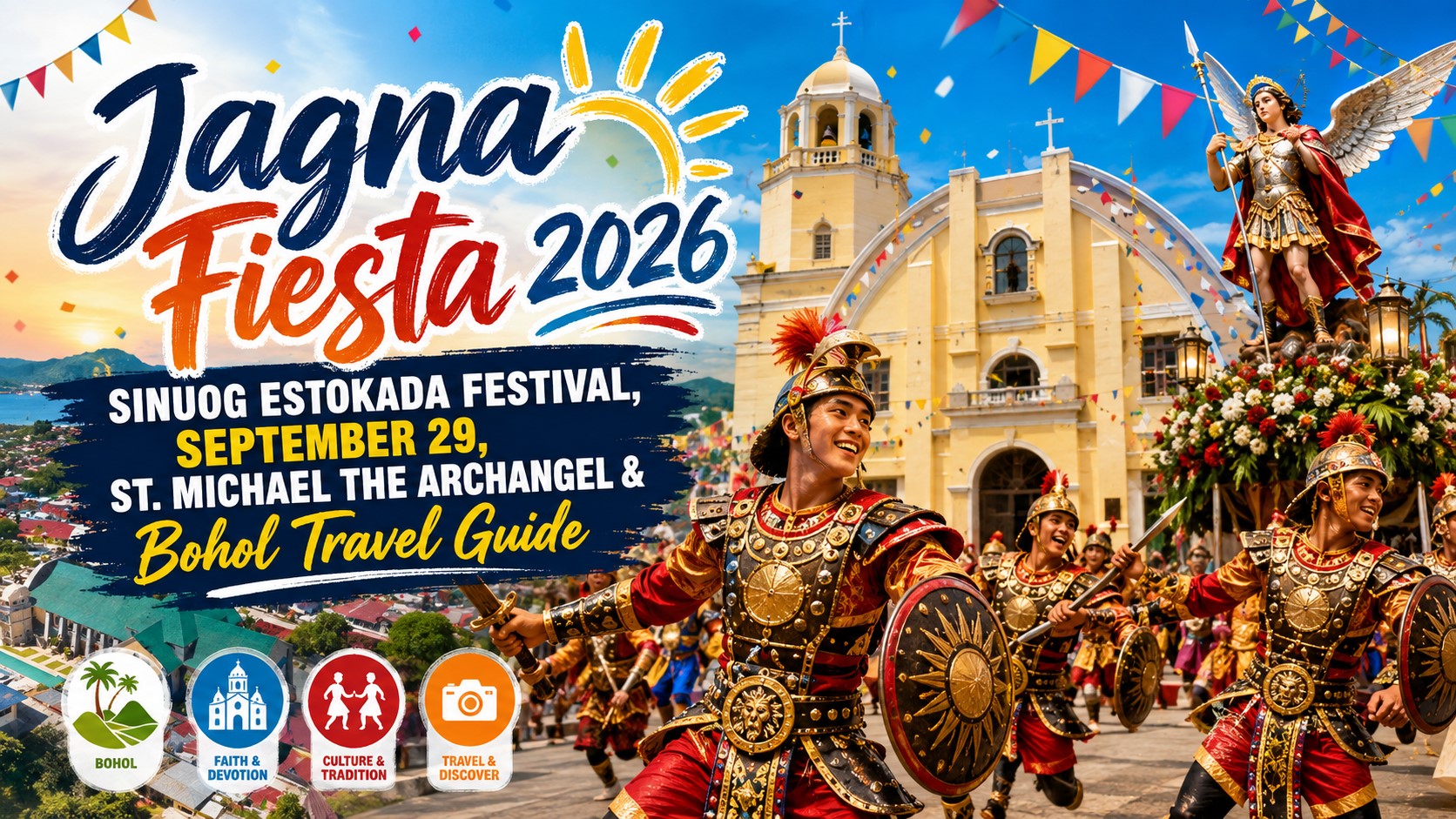
Yes, Sinuog Estokada gives the fiesta its visual spectacle — the costumes, drums, street dancing and dramatic portrayal of St. Michael defeating evil.
But underneath the modern festival is a much older story.
Jagna’s connection with St. Michael dates to the establishment of the parish in 1631. The traditional Sinu-og developed as part of that devotion, and the newer Sinuog Estokada was eventually introduced in 2001 as another way of preserving and presenting Jagna’s cultural heritage. (Jagna)
That combination of faith, history and living tradition is what makes Jagna Fiesta different.
So if you are planning a Bohol trip toward the end of September 2026, remember these dates: September 28 and 29.
September 28 lets you experience the buildup and vesper traditions.
September 29 is the big one — the Feast of St. Michael the Archangel and the heart of the Jagna Fiesta.
And once the official 2026 schedule is released, the exact street-dancing time, ritual showdown, concerts and other fiesta events will be worth adding to the itinerary.