Rice is such an ordinary part of Filipino life that it is easy to forget how much work happens before a single grain reaches our plate.
Long before the rice cooker is switched on, farmers have already spent months preparing fields, planting seedlings, managing irrigation, dealing with pests and unpredictable weather, and waiting for the right time to harvest.
In Alicia, Isabela, that entire story becomes a festival.
Pagay Festival, now also known as Pagay Festival: Balitok ti Alicia, is the municipality’s celebration of rice, agriculture, farmers and the community whose livelihood has long been connected to the fields surrounding the town.
“Pagay” is the Ilocano word for palay or unhusked rice.
That makes the festival’s name very straightforward.
Alicia celebrates rice because rice is part of Alicia.
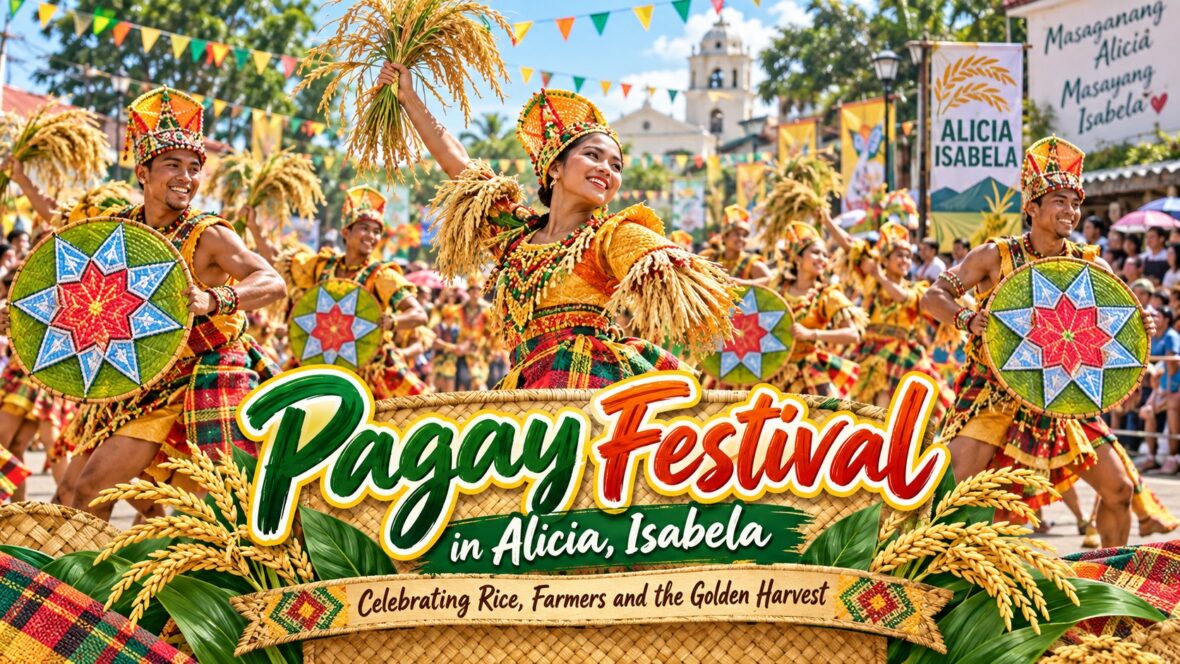
From street dancers dressed in colors inspired by golden rice fields to agricultural competitions, farmers’ activities, local food and festival performances, Pagay Festival transforms an everyday agricultural product into a symbol of local identity.
And once you understand how important rice farming is to the municipality, the festival makes perfect sense.
Content
What is Pagay Festival?
Pagay Festival is an agricultural and cultural festival celebrated in Alicia, Isabela.
The festival was created to highlight the municipality’s rice industry while giving Alicia a distinct cultural celebration of its own.
The Provincial Government of Isabela describes Pagay Festival as a celebration that preserves Alicia’s cultural identity and heritage while promoting its main agricultural product: pagay, the Ilocano word for rice.
Rice is more than the festival’s decorative theme.
It represents one of the foundations of the local economy.
That connection is why festival performances often draw inspiration from farming activities such as planting, harvesting and processing rice.
The result is a celebration where agriculture becomes performance.
Something farmers do throughout the year suddenly appears in costumes, choreography, floats, competitions and community celebrations.
Where is Pagay Festival celebrated?
Pagay Festival is celebrated in Alicia, a municipality in the province of Isabela in the Cagayan Valley region.
Alicia is part of one of the Philippines’ most important agricultural provinces, and its landscape has long been closely connected with rice and corn production.
The municipality itself has extensive agricultural areas devoted to palay production. Local legislation describing the festival has identified rice as Alicia’s prime crop and emphasized the municipality’s position as one of Isabela’s important rice-producing communities.
Drive through this part of Isabela during the growing season and the agricultural character of the area becomes obvious.
Large stretches of farmland surround communities.
Fields change color depending on the stage of the rice-growing cycle.
During planting season, paddies can look like huge mirrors filled with water.
Weeks later they turn green.
And when harvest approaches, the landscape begins changing again as mature rice plants take on their familiar golden color.
That image eventually became part of the modern identity of Pagay Festival.
What does “Pagay” mean?
Pagay is an Ilocano word referring to palay or unhusked rice.
It is rice before milling removes the husk and produces the grains Filipinos eventually cook and eat.
Choosing “Pagay” as the festival’s name was significant because Ilocano is widely spoken in Alicia and throughout much of Isabela.
Rather than simply calling the event a generic Rice Festival, the municipality used a word closely connected to the language of the community.
That gives the celebration a stronger local identity.
And because rice is one of Alicia’s most important agricultural products, “Pagay” became more than a name.
It became a symbol of livelihood.
How Pagay Festival began
The modern Pagay Festival traces its formal establishment to 2010.
Before that, celebrations connected with Alicia’s founding anniversary were generally referred to as the Alicia Town Festival.
In 2010, under then-Mayor Cecilia Claire N. Reyes, the celebration was redefined as Pagay Festival to give the municipality a clearer cultural identity and highlight its most important agricultural product. The provincial tourism office likewise records the renaming of the former Alicia Town Festival to Pagay Festival in 2010.
Municipal Ordinance No. 2010-003, dated September 13, 2010, formally identified Alicia as the Home of the Pagay Festival.
The idea was simple but effective.
If Alicia wanted a festival that represented the town, why not build it around something residents actually depended on?
Rice farming was already part of daily life.
The festival simply brought that identity into the streets.
From Pagay Festival to Balitok ti Alicia
Over time, another name became increasingly associated with the celebration:
Balitok ti Alicia.
“Balitok” means gold in Ilocano.
Rice is often described as a golden grain, particularly when mature palay turns fields into broad stretches of yellow and gold before harvest.
Alicia eventually adopted Pagay Festival: Balitok ti Alicia as the festival’s expanded official identity.
Municipal legislation explaining the name says “Balitok” represents Alicia’s golden era and reflects its status as one of Isabela’s major palay-producing municipalities. The same ordinance describes pagay as the town’s “Golden Grain.”
It’s an appropriate image.
Before harvest, sunlight hitting a mature rice field can make the landscape appear almost golden.
But “gold” also works as a metaphor.
For farming communities, a successful rice harvest means food, income and another agricultural cycle completed.
The grain really does carry enormous value.
Why rice is at the heart of the festival
To understand Pagay Festival, you have to understand that rice is not simply something displayed during the celebration.
It supports livelihoods.
Rice production involves an entire chain of people.
There are farmers preparing the fields.
There are agricultural workers planting and harvesting.
There are people operating machinery.
There are traders, millers, transport workers and sellers.
There are agricultural technicians helping manage crops.
There are families whose household income depends on whether a season produces a good harvest.
So when Alicia celebrates pagay, it is also celebrating all the people whose lives are connected with it.
That is what gives the festival substance.
Without agriculture, the colorful street dancing would simply be a performance.
With agriculture at its center, the dancing becomes a representation of real life.
Street dancing and the Pagay Festival Dance Showdown
One of the most colorful sides of Pagay Festival is its dance competition.
Festival dancers use choreography to interpret farming, rural life and the importance of rice to Alicia.
Movements can evoke planting, tending crops, harvesting and celebrating the fruits of agricultural work.
Rice stalks, woven materials and agricultural imagery can also influence costumes and props.
The dominant colors naturally tend toward the shades associated with the fields: green for growing rice and yellow or gold for mature palay.
The modern Pagay Festival Dance Showdown remains one of the important cultural events connected with the festival. Alicia’s festival identity is also represented outside the municipality, particularly during Isabela’s provincial Bambanti Festival.
In January 2026, Alicia’s Balitok ti Alicia contingent won both the Streetdance and Dance Showdown competitions at the Bambanti Festival, using rice-harvest traditions as a major part of its presentation.
That performance demonstrates how Pagay Festival has developed into something beyond a municipal event.
It has become the cultural identity Alicia presents when competing on a provincial stage.
The Pagay Parade
Historically, one of the festival’s biggest highlights has been the Pagay Parade.
Provincial tourism descriptions mention decorated carabaos, rice-themed floats and participants wearing colorful costumes as important elements of the parade.
The combination fits the festival perfectly.
The rice represents the harvest.
The carabao represents Philippine farming tradition.
The floats showcase creativity.
And the participants bring everything together in one public celebration.
For visitors, this is the kind of event where the agricultural theme becomes immediately visible.
You don’t need to read an explanation of what Pagay Festival celebrates.
You see rice.
You see farmers.
You see agricultural imagery.
The identity of the festival is right there in the streets.
The carabao and farming tradition
The inclusion of carabaos in Pagay Festival is particularly meaningful.
For generations, carabaos were among the most important working animals in Philippine agriculture.
Before tractors became widely available, farmers depended on them to pull plows through muddy paddies and help prepare fields for planting.
Mechanized farming has changed agriculture considerably, but the carabao remains one of the most recognizable symbols of Filipino rural life.
Including decorated carabaos in Pagay Festival therefore creates a link between modern rice farming and traditional agricultural practices.
Even as farming technology changes, the festival remembers where much of that agricultural history began.
Rice planting and harvesting competitions
Another interesting feature of Pagay Festival has traditionally been the inclusion of farming-related competitions.
Provincial tourism information lists activities involving rice planting and harvesting among the events associated with the celebration.
These competitions bring actual agricultural skills into the festival.
Rice planting looks simple when experienced farmers do it.
It isn’t.
Planting seedlings requires rhythm, balance and the ability to work efficiently while standing in mud and water.
Harvesting also requires skill.
By turning these activities into competitions, the festival recognizes abilities that might otherwise be taken for granted.
For farmers, these aren’t novelty games.
They are things they actually know how to do.
Honoring Alicia’s farmers
In more recent editions, the festival has placed even clearer emphasis on farmers themselves.
One activity documented by the Isabela Provincial Tourism Office is Pammadayaw Kadagiti Mannalon.
In Ilocano, “mannalon” refers to farmers, while the activity centers on giving recognition to them.
Recent festival programs have also included a Farmers’ Congress.
This is an important evolution of the celebration.
It would be easy to create a festival about rice while forgetting the people who actually grow it.
Pagay Festival tries to keep farmers visible.
After all, no rice harvest exists without them.
Makan ken Mainum
Food is naturally another major part of a festival centered on agriculture.
Recent celebrations of Pagay Festival: Balitok ti Alicia have included Makan ken Mainum.
“Makan” refers to food, while “mainum” refers to something to drink.
The activity provides a platform for local culinary creativity while allowing ingredients and agricultural products from Alicia to become part of dishes and beverages.
The Isabela Provincial Tourism Office documented Makan ken Mainum among the activities of the 2024 Pagay Festival celebration.
This is another reminder that agriculture doesn’t end in the field.
The harvest eventually arrives in kitchens.
Rice becomes meals.
Agricultural products become ingredients.
And ingredients become part of local food culture.
Queen Pa-Gay ti Alicia
Pageants have long been part of Philippine fiestas, and Pagay Festival has developed its own distinctive version.
Recent festival celebrations have included the Search for Queen Pa-Gay ti Alicia.
The name itself plays with the word “pagay,” reinforcing the festival’s rice-centered identity.
Earlier versions of the town celebration included Mutya ng Alicia, while contemporary festival programming has featured Queen Pa-Gay as one of the major events.
Like many festival pageants, the event adds glamour to a celebration otherwise strongly rooted in agriculture.
But even here, the branding remains connected to pagay.
Singing, music and community entertainment
Not everything during Pagay Festival revolves directly around farming.
A town festival is still a town festival.
Residents also come for entertainment.
Festival programs have included activities such as singing competitions, musical performances and other community events.
Recent editions have featured the Alicia Singing Idol competition, while older festival descriptions mention events such as battle of the bands.
These activities help turn the agricultural celebration into something the entire community can enjoy.
Farmers may be at the heart of the festival, but students, families, performers, businesses and visitors all become part of it.
Pagay Festival and Araw ng Alicia
For much of its history, Pagay Festival has been closely connected with Alicia’s founding anniversary.
Alicia became a municipality on September 28, 1949, when President Elpidio Quirino signed Executive Order No. 268. The municipality was named Alicia in honor of his late wife, Doña Alicia Syquía Quirino.
Because of this, September 28 became the traditional date of Araw ng Alicia.
Provincial tourism information has consequently long listed Pagay Festival on September 28 in conjunction with the town’s founding anniversary.
That connection explains why older festival calendars consistently place Pagay Festival in September.
However, there has been an important development in recent years.
Why Pagay Festival has also been celebrated in April
Alicia’s local government decided that a festival celebrating the harvest could be even more meaningful if it were held during the actual local harvest season.
Municipal Ordinance No. 2023-004 designated the last week of April as the municipality’s Harvest Festival period under the name Pagay Festival: Balitok ti Alicia.
The ordinance specifically notes that April and May are important rice-harvesting months in Alicia and describes the celebration as thanksgiving for a bountiful harvest and recognition of the farmers who produce food for the community and the country.
In 2024, for example, Pagay Festival activities were held around April 26 and included Pammadayaw Kadagiti Mannalon, Farmers’ Congress, Queen Pa-Gay ti Alicia, Alicia Singing Idol, the Festival Dance Showdown and Makan ken Mainum.
This explains why you may encounter different dates when researching Pagay Festival online.
Older tourism references associate Pagay Festival primarily with September 28 and Araw ng Alicia.
More recent municipal legislation also establishes a Pagay Festival harvest celebration during the last week of April.
The important point is that both are connected to the same cultural identity: rice, farmers and Alicia.
The meaning of Balitok
The word “Balitok” gives the modern festival another layer of meaning.
Gold is valuable.
So is rice.
For the farmer, golden palay standing ready for harvest can represent the outcome of months of labor.
The farmer has already invested money.
Seedlings have been planted.
Fertilizer has been used.
Water has been managed.
Weather has been endured.
Then finally the field turns gold.
That color signals something farmers have been waiting for:
harvest.
So “Balitok ti Alicia” isn’t simply a catchy festival name.
It reflects the moment when the work of the farming season becomes something tangible.
The festival as thanksgiving
Thanksgiving is one of the oldest themes behind agricultural festivals around the world.
Pagay Festival follows the same idea.
A successful harvest is never completely guaranteed.
Farmers work with nature, but they cannot fully control it.
Too much rain can damage crops.
Too little rain creates another problem.
Typhoons can arrive.
Pests can spread.
Prices can change.
Production costs can rise.
That uncertainty makes a good harvest something worth celebrating.
Municipal documents establishing the harvest-season Pagay Festival explicitly frame the occasion as an expression of gratitude for agricultural blessings and the work of farmers.
That’s really the emotional heart of the festival.
After months of work, the community says thank you.
Pagay Festival at Bambanti Festival
One interesting thing about Alicia’s festival identity is that it also appears during Isabela’s much larger Bambanti Festival.
Bambanti brings together municipalities and cities from across Isabela, with local governments presenting their own products, culture and traditions through exhibits and dance competitions.
Alicia competes under its Pagay Festival: Balitok ti Alicia identity.
Over the years, its contingent has become particularly competitive in the street dancing and festival dance showdown events.
In the 2026 Bambanti Festival, Alicia won the Streetdance Competition and Dance Showdown, while its presentation celebrated rice harvest traditions and the agricultural identity represented by Pagay Festival.
The performance also marked the continuing development of the Balitok ti Alicia concept, combining previous themes and choreography associated with the festival.
For Alicia, this is valuable.
The local festival becomes a way of representing the town to the rest of the province.
Why Pagay Festival matters
It would be easy to look at Pagay Festival and see only bright costumes.
But there is much more happening beneath the surface.
The festival turns farming into cultural heritage.
Planting becomes choreography.
Rice stalks become costume designs.
The color of mature palay becomes the festival’s golden visual identity.
Farmers become honorees.
Traditional agricultural work becomes competition.
Local produce becomes food.
And the rice field becomes part of the story Alicia tells about itself.
That’s what successful community festivals do.
They take things residents see every day and remind everyone why those things matter.
What makes Pagay Festival different?
There are several rice festivals in the Philippines, which isn’t surprising in a country where rice is central to everyday life.
What makes Alicia’s Pagay Festival distinctive is the way the municipality has built an identity around the concept of the golden grain.
Pagay represents the crop.
Balitok represents its value.
Alicia represents the community that grows it.
Put the three together and you get a festival that is strongly rooted in place.
The municipality isn’t simply celebrating rice because Filipinos eat rice.
It is celebrating rice because thousands of local lives are connected to producing it.
What to expect when visiting Pagay Festival
Festival programs can change every year, but a visitor may encounter events connected with agriculture, food, entertainment and local culture.
Among the activities historically or recently associated with Pagay Festival are the Pagay Parade, festival street dancing, rice planting and harvesting competitions, farmers’ activities, agricultural exhibits, food and drink competitions, Queen Pa-Gay ti Alicia, singing contests and other community programs.
If you’re particularly interested in photography, street dancing and the agricultural-themed performances are usually among the most visually interesting events.
If you’re more interested in local culture, spend time around farmers’ activities, food competitions and agricultural exhibits.
They may tell you more about Alicia than the grandest stage performance.
When is Pagay Festival celebrated?
This question now requires a little explanation.
Traditionally, Pagay Festival was celebrated around September 28 alongside Araw ng Alicia, the municipality’s founding anniversary. Provincial tourism references continue to identify September 28 with the festival.
However, Municipal Ordinance No. 2023-004 established the last week of April as Alicia’s harvest-festival period under the name Pagay Festival: Balitok ti Alicia, reflecting the local rice harvest occurring around April and May.
Because these two traditions now overlap in public references, anyone planning a trip specifically for major Pagay Festival activities should check Alicia’s current annual program rather than relying solely on an older September festival calendar.
Pagay Festival 2026 schedule
As of September 15, 2026, I could not verify a complete official public schedule for a local Pagay Festival program in Alicia for the remaining September 2026 celebration period.
September 28 remains the traditional Araw ng Alicia date and has historically been associated with Pagay Festival. Meanwhile, municipal legislation also places the dedicated harvest-festival observance in the last week of April.
What is confirmed for 2026 is that Alicia continued to use the Pagay Festival: Balitok ti Alicia identity at the provincial level. Its contingent represented the municipality at Bambanti Festival in January 2026 and won both the Streetdance and Dance Showdown competitions.
Travelers planning specifically around the Alicia celebration should therefore check the latest announcement from the municipal government for the exact dates of major local events.
Tips for visiting Pagay Festival
If you’re planning to experience Pagay Festival, don’t treat it simply as a street-dancing event.
Watch the performances, but also look at what they are trying to represent.
Notice the rice-inspired costumes.
Look for choreography depicting planting and harvesting.
Visit agricultural displays.
Try local food.
And if there are farmer-centered activities, spend time there as well.
Bring comfortable clothes and prepare for outdoor conditions. If attending the April harvest celebration, expect hot Philippine summer weather. If attending September activities, prepare for the possibility of rain.
And wherever possible, buy from local vendors.
Agricultural festivals make much more sense when tourism actually benefits the communities being celebrated.

Final thoughts
There is something beautifully appropriate about Alicia calling rice its golden grain.
You can see the gold in the fields.
But the real value isn’t simply the color.
Rice represents months of work.
It represents farmers waking early.
It represents families depending on the success of another planting season.
It represents food arriving on tables far beyond Alicia.
Pagay Festival takes that story and turns it into a celebration.
The rice fields become costumes.
Planting becomes dance.
Harvesting becomes competition.
Farmers receive recognition.
And an agricultural town gets an opportunity to show everyone what keeps it moving.
That is why Pagay Festival is more than a fiesta about rice.
It is Alicia celebrating the people behind the harvest.
And in a town where pagay has helped shape livelihood, landscape and local identity, there may be no better symbol to celebrate than the golden grain itself.