Buwan ng Wika is one of those school celebrations that instantly brings back memories—Filipino costumes, traditional games, poetry recitations, cultural performances, and of course, poster-making contests.
If you’re a student looking for a Buwan ng Wika poster idea, a parent helping your child with a school project, or a teacher searching for inspiration for your class, you probably want something that is both creative and meaningful.
And for 2026, there is an interesting new element you can play with: technology and artificial intelligence.
The official theme for Buwan ng Wikang Pambansa 2026 is:
“Wikang Filipino at AI: Kasangkapan sa Pananaliksik at Tulay sa Yaman ng Impormasyon.”
Government materials explaining the theme emphasize the connection between Filipino and artificial intelligence, particularly the responsible use of AI in research and the continuing importance of Filipino in emerging technologies.
That gives students plenty of room to get creative.
You don’t have to abandon the usual Filipino cultural elements like the Philippine flag, books, Baybayin, traditional clothing, or indigenous patterns. Instead, you can combine them with modern elements such as computers, digital networks, robots, smartphones, and AI.
Below are 30+ Buwan ng Wika poster ideas for 2026, ranging from easy designs for elementary students to more detailed concepts that could work well for poster-making competitions.
Content
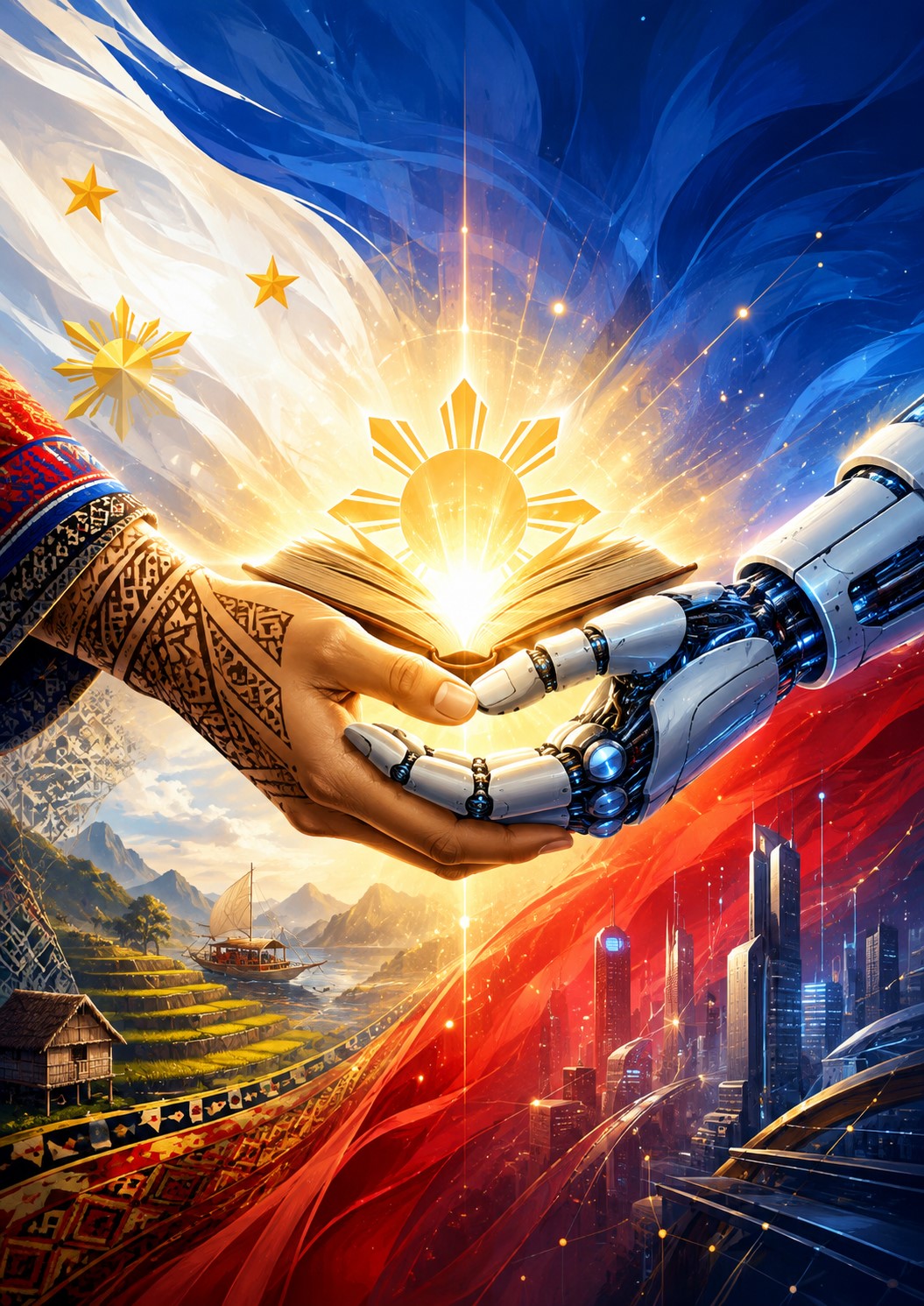
1. Filipino and AI Handshake Poster
One of the easiest ways to represent the 2026 theme is through two hands meeting in the center.
On one side, draw a human hand decorated with Filipino cultural patterns. On the other side, draw a robotic hand representing artificial intelligence.
Where the two hands meet, you can place a glowing book, light bulb, or Philippine sun.
The idea is simple: Filipinos and technology working together to create and discover knowledge.
This could look especially good with the Philippine flag colors incorporated into the background.
2. Filipino Student Using AI for Research
Draw a Filipino student sitting at a desk with books, notebooks, and a laptop.
On the laptop screen, you can show an AI-inspired symbol or digital interface. Around the student, draw floating Filipino words, books, question marks, light bulbs, and research materials.
The poster can show that while technology changes the way we study, Filipino remains an important language for learning and research.
This is also one of the easiest concepts to understand immediately when someone looks at the poster.
3. Filipino Language Connecting the Past and Future
Divide your poster into two sides.
On the left, illustrate traditional Filipino culture—perhaps an old book, Baybayin characters, indigenous textiles, traditional houses, or people wearing traditional clothing.
On the right, show modern technology—computers, smartphones, digital networks, AI, satellites, or futuristic cities.
Connect the two sides with the words:
Wikang Filipino
The message is powerful: our language can connect our cultural heritage with the future.
4. A Bridge Made of Filipino Words
Since the official theme describes Filipino and AI as a “tulay sa yaman ng impormasyon,” why not literally draw a bridge?
On one side of the bridge is a Filipino student.
On the opposite side is a huge library, globe, computer, or world of information.
Instead of bricks, make the bridge out of Filipino words such as:
Wika. Kaalaman. Saliksik. Kultura. Teknolohiya. Pagkakaisa. Kinabukasan.
This is simple but very symbolic.
5. Philippine Map Filled With Filipino Words
Draw a large outline of the Philippines at the center of the poster.
Inside the map, fill the islands with words related to Filipino language and culture.
You can add phrases such as:
Wika
Kultura
Kasaysayan
Panitikan
Kaalaman
Pagkakaisa
Pananaliksik
Then surround the map with digital lines, computer circuits, books, and speech bubbles.
This combines national identity with the technological aspect of the 2026 theme.
6. Philippine Sun as a Symbol of Knowledge
Create a large Philippine sun as the centerpiece.
Instead of ordinary sun rays, turn each ray into something connected with knowledge—books, pencils, computers, microphones, newspapers, smartphones, or Filipino words.
At the center of the sun, you could write:
Wikang Filipino
The rising sun can symbolize the continuing growth of Filipino in a changing world.
7. Book Transforming Into Digital Information
Draw an open book at the bottom of the poster.
From the pages, allow different objects to rise:
letters,
Filipino words,
Baybayin symbols,
digital numbers,
computer icons,
AI circuits,
and small images representing Philippine culture.
The traditional book gradually transforms into a futuristic digital world.
It beautifully represents the movement from traditional sources of information toward modern technology without forgetting the importance of language.

8. Filipino Words Coming Out of a Computer
This is another easy Buwan ng Wika poster idea.
Draw a laptop or computer screen and have Filipino words flowing out of it.
You could include:
Mabuhay
Salamat
Pag-ibig
Kalayaan
Kaalaman
Wika
Kultura
Bayan
Add digital effects and Filipino cultural designs around the computer.
The message is that Filipino belongs not only in books and classrooms but also in the digital world.
9. Robot Learning Filipino
Want something playful?
Draw a friendly robot holding a Filipino dictionary or reading a book about Philippine culture.
Add speech bubbles showing the robot learning Filipino expressions such as:
“Magandang araw!”
or
“Mabuhay!”
Beside the robot, draw Filipino students teaching it.
This is especially suitable for elementary students because the design can be colorful, cute, and easy to understand.
10. AI Robot Wearing Filipino-Inspired Clothing
Here’s another fun idea.
Draw a futuristic robot wearing a Barong Tagalog, salakot, or clothing decorated with traditional Filipino patterns.
Behind the robot, add books, Filipino words, computer symbols, and the Philippine flag.
It’s unusual enough to catch people’s attention while still connecting directly to Filipino identity and technology.
11. Filipino Alphabet Meets Computer Code
Divide the page creatively between letters and computer code.
On one side, show Filipino letters, words, books, and handwriting.
On the other side, show binary numbers, circuits, and digital symbols.
In the center, allow them to merge.
A good message for the poster could revolve around the idea that language and technology don’t have to compete—they can work together.
12. Speech Bubble Filled With Philippine Culture
Draw a huge speech bubble in the center of your poster.
Inside it, place illustrations representing the Philippines:
jeepney,
bahay kubo,
traditional dances,
Filipino food,
mountains,
rice fields,
books,
and traditional clothing.
The speech bubble itself represents language.
Around it, add digital lines or AI-inspired patterns to connect the design with 2026.
13. Filipino Language Tree
Draw a large tree.
Its roots can represent:
Kasaysayan
Kultura
Katutubong Wika
Tradisyon
The trunk represents:
Wikang Filipino
And its branches can lead to:
Edukasyon
Pananaliksik
Teknolohiya
AI
Kinabukasan
This is one of my favorite concepts because the symbolism is very clear.
Language grows from our history while continuing to branch out into new areas of society.
14. Tree With Books as Leaves
Here’s an easier variation.
Draw a large tree with books, letters, Filipino words, or speech bubbles instead of ordinary leaves.
At the roots, add traditional Filipino cultural symbols.
Above the tree, add technological icons or digital networks.
This can symbolize the growth of knowledge through language.
15. Light Bulb Filled With Filipino Symbols
Draw one giant light bulb.
Inside it, illustrate the Philippine flag, books, Baybayin symbols, traditional patterns, computer circuits, and Filipino words.
A light bulb immediately represents ideas and knowledge, making it perfect for the theme of research and information.
It’s also relatively easy to draw.
16. Filipino Student Holding the World of Information
Draw a Filipino student holding a glowing globe.
Around the globe, add tiny icons representing books, websites, computers, libraries, research, science, history, and AI.
Connect everything using digital lines.
The idea is that Filipino students now have access to a huge world of information—and language helps them understand and use that knowledge.
17. Open Filipino Dictionary Becoming a Digital World
Start with an open dictionary at the bottom.
From the dictionary, draw a futuristic city made of computers, books, networks, and Filipino words.
It can symbolize how language provides a foundation for education, innovation, and progress.
18. Baybayin Meets Artificial Intelligence
For something visually striking, use Baybayin-inspired elements together with futuristic computer designs.
You could place Baybayin characters on one side and glowing digital circuits on the other.
Let them meet in the middle around the Philippine sun.
Just make sure any Baybayin text you use is correct rather than adding random characters purely for decoration.
19. Filipino Culture Inside a Smartphone
Draw a large smartphone.
Instead of regular apps, fill its screen with illustrations representing Filipino culture:
traditional dances,
food,
literature,
history,
music,
languages,
festivals,
and tourist attractions.
Outside the phone, add AI and information icons.
This poster shows how Filipino culture and language continue to live in the digital age.
20. Filipino Language as the Key to Knowledge
Draw a giant key labeled:
Wikang Filipino
The key opens a door labeled:
Yaman ng Impormasyon
Behind the door, show books, computers, libraries, science, history, and technology.
It’s a straightforward interpretation of the theme and also easy enough for younger students to create.
21. Doorway to Knowledge
Instead of a key, draw a student opening a huge door.
The world behind the door can contain:
books,
AI,
science,
computers,
research,
history,
culture,
and global information.
Place Filipino words along the path leading toward the doorway.
The visual message is clear—language gives us greater access to knowledge.
22. Filipino and AI Working at the Same Desk
Draw a Filipino student and a friendly robot sitting beside each other.
Both are studying books or researching something on a computer.
Behind them, add the Philippine flag and Filipino cultural symbols.
This is a nice way of emphasizing that AI should be seen as a tool or partner, not something that completely replaces human creativity and thinking.
23. Human Brain and AI Brain
Divide a large brain into two halves.
The first half represents human thought and Filipino culture.
Fill it with books, traditions, history, words, and Philippine symbols.
The second half represents AI and technology.
Use circuits, digital networks, numbers, and futuristic patterns.
Connect both halves in the middle using a Filipino word such as:
KAALAMAN
This could work particularly well for high school poster-making competitions.
24. Filipino Words Forming the Philippine Flag
Instead of simply drawing the Philippine flag, build parts of it using Filipino words.
For example, fill sections with words related to identity, culture, research, technology, and unity.
At the center, highlight:
Wikang Filipino
Add subtle digital designs around the flag to connect it to the year’s theme.
25. Philippine Eagle Carrying a Book
Draw a Philippine eagle flying while carrying an open book.
From the book, Filipino words and digital symbols can flow outward.
The eagle can represent strength and national pride, while the book represents knowledge.
This is a beautiful option if you’re comfortable drawing animals.
26. Jeepney Carrying Filipino Knowledge Into the Future
Want something very Filipino and a little different?
Draw a colorful jeepney traveling from a traditional Filipino town toward a modern digital city.
Place words such as:
Wika
Kultura
Kaalaman
Pananaliksik
along the jeepney.
You could even make its destination sign say:
KINABUKASAN
Now that’s a Buwan ng Wika poster that people will remember.
27. Bahay Kubo Connected to the Digital World
Draw a traditional bahay kubo surrounded by rice fields or Philippine scenery.
Above or behind it, add digital networks connecting the house to computers, satellites, libraries, and the rest of the world.
The concept shows that modern knowledge and technology can reach communities while still respecting Filipino identity and culture.
28. Filipino Children Around a Globe
Draw children wearing different Filipino traditional costumes around a globe.
Have them holding books, tablets, pens, and laptops.
Place Filipino words around the globe while digital lines connect everyone.
This concept can represent both unity and access to information.
It’s especially appropriate for elementary-school posters.
29. Traditional Filipino Patterns With Futuristic Designs
If you’re good at decorative drawing, create a poster where traditional Filipino textile-inspired patterns gradually transform into computer circuits.
One half looks traditional.
The other looks futuristic.
The transition between them represents the meeting of culture and technology.
This can create a sophisticated poster without requiring too many characters or complicated scenes.
30. Filipino Language Superhero
Here’s a creative idea for younger students.
Turn Wikang Filipino into a superhero.
The superhero could carry a book in one hand and a digital device in the other while flying across a world filled with information.
You can give the character Philippine-inspired colors and symbols.
It’s fun, colorful, and different from the usual serious poster designs.
31. The River of Knowledge
Draw a river flowing from the mountains toward a modern city.
Along the river are books, Filipino words, cultural symbols, and information.
Label the river:
Wikang Filipino
At the end, it reaches the world of technology and AI.
The idea is that language acts as a continuous flow carrying knowledge from one generation to another.
32. Filipino Family Passing Knowledge Between Generations
Draw grandparents talking to parents and children.
The grandparents may hold traditional books or tell stories, while the younger generation uses tablets and computers.
Connect everyone using speech bubbles filled with Filipino words.
This is a beautiful reminder that technology may change, but language continues to connect generations.
33. Library of the Future
Imagine what a Filipino library might look like decades from now.
Draw holographic books, AI assistants, digital screens, and futuristic computers—but make Filipino words and Philippine culture visible everywhere.
The poster could communicate that Filipino has a place even in a highly technological future.
34. Filipino Words Orbiting the Earth
Draw Earth in the middle of the poster.
Around it, create an orbit filled with Filipino words, letters, books, computers, and digital information.
Include the Philippine flag prominently.
The message can be about bringing the Filipino language into the global information age.
35. Filipino Language as a Wi-Fi Signal
Here’s a minimalist idea that can look surprisingly creative.
Draw the familiar Wi-Fi symbol.
Instead of ordinary signal lines, fill each level with Filipino words.
At the bottom, place:
Wikang Filipino
Above it, show information reaching students, communities, schools, and families.
Simple concept, strong message.
36. Knowledge Highway
Draw a highway leading toward the future.
Along the road, place signs saying:
Wika
Kultura
Edukasyon
Pananaliksik
AI
Impormasyon
Kinabukasan
Have a Filipino student walking or traveling along this road.
The road represents the journey toward greater knowledge and progress.
37. The Philippines Connected by Digital Lines
Draw the Philippine map and connect Luzon, Visayas, and Mindanao using glowing digital lines.
Around the islands, add speech bubbles, books, and Filipino words.
You can also incorporate different Philippine languages to emphasize our linguistic diversity.
At the center, highlight Filipino as a means of communication and connection.
38. Half Traditional, Half Futuristic Face
For advanced artists, draw a Filipino face divided vertically.
One half contains traditional cultural elements.
The other half looks futuristic or digital.
Behind the person, blend Filipino patterns with computer circuits.
This can create a dramatic contest poster representing Filipino identity moving confidently into the future.
39. Hands Protecting Filipino Language
Draw two large hands surrounding a glowing book labeled:
Wikang Filipino
Around the hands are technology, information, AI, and modern communication tools.
The idea is not to reject technology but to protect and strengthen Filipino while using new technology responsibly.
40. Filipino Language at the Center of Everything
For the final idea, make WIKANG FILIPINO the largest words on the entire poster.
Around them, create different sections representing:
culture,
education,
history,
literature,
research,
science,
technology,
AI,
and communication.
Connect everything to the center.
This can be incredibly effective because viewers immediately understand the main message: language is connected to almost every part of our lives.

Easy Buwan ng Wika Poster Ideas for Kids
If the poster is for an elementary-school activity, don’t make things unnecessarily complicated.
Some of the easiest concepts from the list above are:
Philippine sun with books
Robot learning Filipino
Philippine map filled with words
Light bulb filled with Filipino symbols
Filipino language superhero
Filipino words coming from a computer
Book transforming into a digital world
Key opening the door to knowledge
The important thing is that children can explain what their drawing means.
A simple drawing with a clear message can be much better than an extremely complicated poster filled with unrelated images.
Creative Buwan ng Wika Poster Ideas for Contests
If you’re joining a poster-making contest, try going beyond simply drawing a Philippine flag, bahay kubo, and people wearing traditional clothes.
Those elements are beautiful, but they’re also commonly used.
For 2026, the theme gives you an opportunity to make something different.
Consider concepts such as the human and robotic handshake, traditional patterns transforming into computer circuits, a bridge made of Filipino words, or a human brain connected with an AI brain.
The strongest contest posters usually have one central idea that viewers can understand without needing a long explanation.
Instead of putting every Filipino symbol you can think of into one poster, choose a clear message and build the entire design around it.
How to Create a Good Buwan ng Wika Poster
Start by asking yourself one simple question:
What message do I want people to understand when they look at my poster?
For the 2026 theme, your message could be something like:
Filipino can grow alongside technology.
AI should help Filipinos discover knowledge.
Language connects culture with innovation.
Technology changes, but Filipino identity remains.
Filipino can become a language of research and modern knowledge.
Once you’ve chosen your message, deciding what to draw becomes much easier.
For example, if your message is about connecting tradition with technology, you could draw a bridge between an old Filipino library and a futuristic digital world.
If your message is about Filipino and AI working together, you could draw a student’s hand shaking a robot’s hand.
The artwork should support the message—not distract from it.
Colors You Can Use for Your Poster
You can’t really go wrong with colors inspired by the Philippine flag, especially blue, red, yellow, and white.
But don’t feel limited to those colors.
For the technology or AI parts of the poster, you can use futuristic-looking tones and glowing effects. For Filipino cultural elements, earth tones and traditional textile-inspired patterns can create a nice contrast.
The key is balance.
If every section of your poster uses extremely bright colors, nothing stands out anymore.
Choose one main focal point and make that the strongest part of the composition.
Don’t Forget the 2026 Theme
One mistake students sometimes make is creating a beautiful Buwan ng Wika poster that barely relates to the actual theme.
For 2026, simply drawing traditional Filipino culture may not fully communicate the theme.
The year’s theme specifically brings Wikang Filipino, AI, research, information, and responsible technology use together. Official explanations emphasize using AI as a tool while continuing to give Filipino a meaningful place in technology, research, and discussions surrounding emerging technologies.
You don’t necessarily need to draw a robot.
AI can also be represented through:
computer circuits,
digital networks,
data,
computers,
smartphones,
search interfaces,
technology,
or connected information.
Then combine those images with Filipino language and culture.
That’s where the 2026 theme really comes alive.
Should You Put Words on a Buwan ng Wika Poster?
Yes, but don’t turn the poster into an essay.
A poster is primarily visual.
A short slogan or powerful phrase can strengthen your message, but huge paragraphs will usually make the design crowded.
You could place the official theme somewhere in the poster and then create one short central slogan.
For example:
“Wikang Filipino, Kaagapay ng Teknolohiya.”
“Wika at AI: Magkasamang Tulay sa Kaalaman.”
“Sariling Wika, Makabagong Kaalaman.”
“Wikang Filipino sa Makabagong Mundo.”
“Teknolohiya’y Kasangkapan, Wika ang Sandigan.”
These are short enough to support your artwork without overwhelming it.
Buwan ng Wika Poster Layout Idea
If you’re having trouble deciding where everything should go, try this simple layout.
Put your main illustration in the center.
Place the official Buwan ng Wika theme near the top.
Put your slogan near the bottom.
Then use smaller cultural and technological elements around the central image to fill empty spaces.
This creates a natural visual hierarchy:
Theme → Main Illustration → Slogan → Supporting Details
It also prevents your poster from becoming too crowded.
Frequently Asked Questions About Buwan ng Wika Posters 2026
What is the Buwan ng Wika theme for 2026?
The official theme is “Wikang Filipino at AI: Kasangkapan sa Pananaliksik at Tulay sa Yaman ng Impormasyon.” It focuses on the relationship between Filipino, artificial intelligence, research, information, and the responsible use of emerging technologies.
What should I draw for Buwan ng Wika 2026?
You can combine traditional Filipino symbols with modern technology. Good examples include a Filipino student using AI, a human and robot handshake, books transforming into digital information, a bridge made of Filipino words, or Filipino cultural patterns transforming into computer circuits.
What is an easy Buwan ng Wika poster idea?
One of the easiest ideas is an open book with the Philippine sun rising from it. Add Filipino words and a few computer or digital symbols around the book to connect the design with the 2026 theme.
Another easy option is a large light bulb containing books, the Philippine flag, Filipino words, and digital symbols.
What should I put on a Buwan ng Wika poster?
Ideally, include a central illustration, the theme or a short slogan, Filipino cultural elements, and symbols related to the year’s theme.
For 2026, consider adding something that represents technology, AI, research, or access to information.
Can I use the Philippine flag in my Buwan ng Wika poster?
The Philippine flag and its colors are commonly used to represent Filipino identity and national pride. You can incorporate them into your design, but your poster doesn’t necessarily have to revolve around the flag.
Sometimes a more original symbol—such as a bridge, book, tree, light bulb, or computer—can make your poster more distinctive.
Final Thoughts
Creating a Buwan ng Wika poster for 2026 is especially interesting because this year’s celebration gives students a chance to combine two worlds that may initially seem very different: Filipino culture and artificial intelligence.
You can still celebrate everything we usually associate with Buwan ng Wika—the Philippine flag, traditional clothing, literature, Baybayin, Filipino history, indigenous culture, and our national identity.
But this time, you can bring computers, AI, digital information, research, and futuristic imagery into the picture too.
And perhaps that’s the most interesting message behind many of these poster ideas.
Our language doesn’t have to remain only in old books or history lessons.
Wikang Filipino can move forward with us.
It can be spoken at home, taught in classrooms, written in literature, used in research, shared online, and brought into new technologies.
So whether you’re creating a very simple poster for an elementary-school project or preparing a detailed artwork for a major poster-making contest, focus on one clear idea:
Celebrate where our language came from—but don’t be afraid to imagine where it can go next.