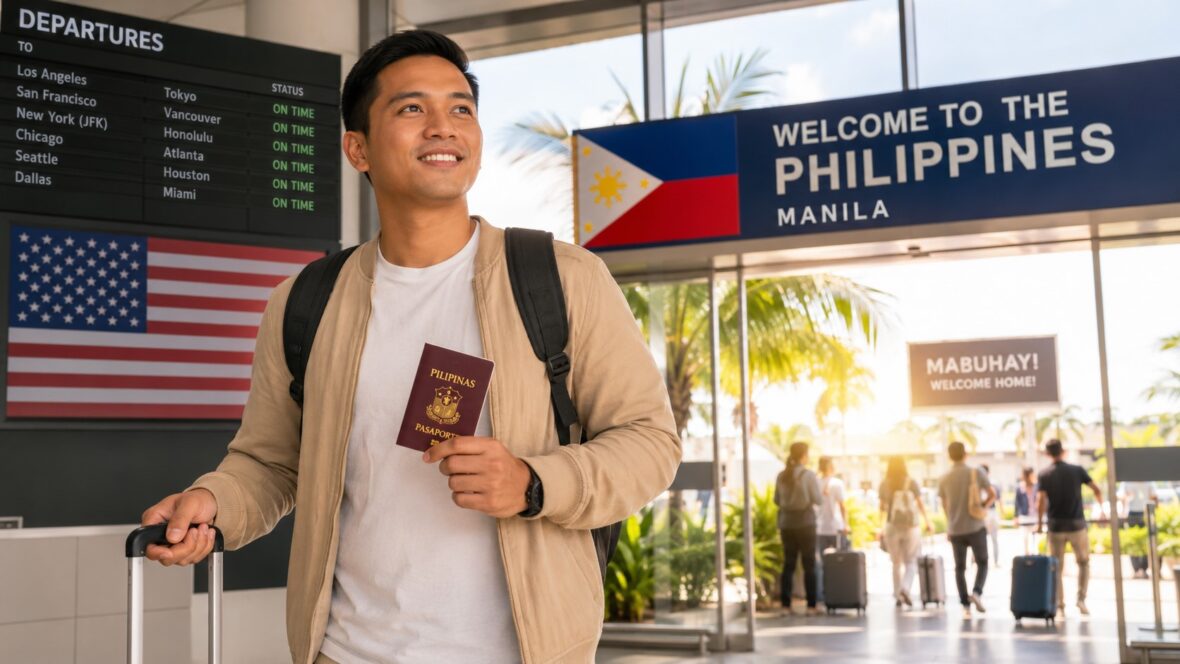
Traveling from the United States to the Philippines in 2026 is relatively straightforward, especially if you’re a U.S. citizen visiting for a vacation or coming home to see family.
But if you’re Filipino American, there’s one extra layer to the trip:
Your entry requirements can be very different depending on whether you’re a U.S. citizen, former Filipino, Philippine-U.S. dual citizen, or still traveling on a Philippine passport.
A U.S. tourist might be allowed to stay for 30 days.
A former Filipino could potentially stay for an entire year under the Balikbayan privilege.
And a dual Philippine-U.S. citizen can stay indefinitely as a Filipino citizen.
Then there’s eTravel, passport validity, onward-ticket requirements, customs declarations, children traveling with you, and the question I still hear all the time:
“Do I still need a vaccine card to enter the Philippines?”
So if you’re flying from the USA to the Philippines in 2026, here’s a complete guide to what you should prepare before heading to the airport.
Content
Travel to the Philippines From USA 2026: Quick Requirements
For a typical U.S. passport holder traveling to the Philippines as a tourist for 30 days or less, prepare the following:
- Valid U.S. passport
- Passport with sufficient validity for your trip
- Return or onward airline ticket
- eTravel registration
- eTravel QR code
- Accommodation/address information in the Philippines
- Customs and currency declarations, when applicable
U.S. passport holders remain eligible for visa-free entry for stays of up to 30 days under the Philippines’ visa-waiver rules. A return or onward ticket is generally required, and the passport must meet the applicable validity requirement.
However, Filipino Americans should first determine which traveler category applies to them, because that can significantly change the rules.
First: What Kind of Traveler Are You?
Before worrying about anything else, answer this question:
What citizenship status will you use when entering the Philippines?
Here’s the simplest way to look at it.
| Your Status | Typical Entry Situation |
|---|---|
| U.S. citizen only | Visa-free for up to 30 days |
| Former Filipino, now U.S. citizen | May qualify for Balikbayan privilege for up to 1 year |
| Philippine-U.S. dual citizen | May stay indefinitely as a Philippine citizen |
| Philippine citizen living in USA | Enters as a Filipino citizen |
| Foreign spouse/child of a Balikbayan | May receive Balikbayan privilege when traveling together and requirements are met |
The differences are important.
Let’s go through each one.
Do U.S. Citizens Need a Visa to Visit the Philippines in 2026?
For ordinary tourism of 30 days or less, U.S. passport holders generally do not need a Philippine visa.
The Philippine Consulate General in Los Angeles currently confirms that U.S. passport holders are among the nationals eligible for visa-free entry for up to 30 days.
The U.S. Department of State likewise states that a tourist visa isn’t required for a U.S. citizen visiting the Philippines for 30 days or less.
So if you’re flying from California to Manila for a three-week family vacation, you generally don’t need to go through a Philippine visa application beforehand.
You simply need to meet the entry requirements.
What Do U.S. Citizens Need to Enter the Philippines?
For a typical visa-free visit, the most important requirements are:
1. Valid U.S. Passport
Your passport must meet Philippine validity rules.
Philippine consular guidance states that passports used for visa-free entry generally need to remain valid for at least six months beyond the intended period of stay.
The U.S. State Department also advises travelers to have at least six months of passport validity for travel to the Philippines.
So if you’re planning to travel in December and your passport expires shortly afterward, don’t assume you’ll be fine simply because the passport technically hasn’t expired yet.
Renew it before traveling.
Practical tip
I personally wouldn’t plan an international trip anywhere near my passport’s expiration date.
Flights from the United States to the Philippines aren’t cheap, and the last thing you want is to be standing at the airport check-in counter arguing about passport validity while your family is already heading through security.
2. Return or Onward Ticket
Ordinary U.S. tourists entering under the 30-day visa-free privilege should have a confirmed ticket leaving the Philippines.
That can be:
- A return flight to the United States
- A flight to another country
- Another valid onward international ticket
Philippine consular guidance specifically lists a return or onward ticket as a requirement for ordinary visa-free entry.
For example:
You fly:
Los Angeles → Manila
and stay 20 days.
Your:
Manila → Los Angeles
return ticket satisfies the basic onward-travel requirement.
But suppose you’re buying a one-way ticket because you plan to “figure things out later.”
That can become a problem if you’re entering strictly as an ordinary visa-free U.S. tourist.
There are exceptions, however, particularly for Balikbayans and Philippine citizens—which we’ll discuss later.
3. eTravel Registration
This is one of the most important requirements to remember.
Travelers entering the Philippines need to use the government’s eTravel system.
The Philippine Embassy describes eTravel as mandatory for travelers entering the Philippines, including both Filipino and foreign travelers.
You can register through the official Philippine eTravel system.
And here’s the most important reminder:
eTravel is FREE.
The official eTravel website clearly states that registration is free.
If you find a website asking you to pay $50, $70, or some other ridiculous amount to “process your Philippine eTravel,” stop.
You’re probably looking at a third-party service.
When Should You Register for eTravel?
You can register within:
72 hours before your arrival in the Philippines.
The official eTravel FAQ confirms that travelers may register within 72 hours, or three days, before arrival.
So don’t try to register three weeks before your vacation.
Wait until you’re within that 72-hour window.
For example:
If you’re arriving in Manila on:
December 20
you’ll generally complete your eTravel registration within the three-day period immediately before arrival.
I usually recommend doing it before leaving home in the United States rather than waiting until you’re standing at the airport.
You’ve already got enough to worry about at that point.
What Information Do You Need for eTravel?
Expect to provide travel and personal information such as:
- Passport details
- Citizenship
- Flight information
- Date of arrival
- Country of origin
- Destination/address in the Philippines
- Travel details
- Health-related declarations
- Customs information when applicable
The eTravel platform combines several Philippine border-control functions, including immigration, quarantine/health information, and Customs declarations.
So before you start, have your:
passport + airline ticket + Philippine address
beside you.
It’ll make the process much easier.
What Do You Do With the eTravel QR Code?
After completing your registration, save the QR code.
I would do all three:
- Save it to your phone.
- Take a screenshot.
- Keep it somewhere easy to access.
The official eTravel FAQ specifically recommends taking a screenshot or downloading the QR code because travelers may need to show proof of registration before boarding.
Don’t depend completely on airport Wi-Fi.
A screenshot works even when your phone suddenly decides it doesn’t want to connect to anything—which, somehow, always happens at the worst possible moment.
Do You Still Need a COVID-19 Vaccine Card?
For ordinary international arrivals, the Philippine Embassy’s current travel-information page states that presentation of COVID-19 vaccination status or a vaccination certificate is no longer required, and arriving international travelers are accepted regardless of COVID vaccination status.
So you’re no longer dealing with the complicated vaccination-card, quarantine-hotel, and pre-departure COVID testing requirements that travelers experienced during the pandemic.
However, health-entry requirements can change during outbreaks or public-health emergencies.
It’s still smart to check current Philippine government and airline advisories shortly before departure.
What About Yellow Fever Vaccination?
For someone traveling directly from the United States, this normally isn’t an issue.
However, the U.S. State Department notes that a yellow fever vaccination may be required when arriving from certain countries in Africa or South America where yellow fever risk applies.
This could matter if your itinerary is something unusual like:
USA → South America → Philippines
rather than a typical USA-to-Asia itinerary.
Check health requirements if you’ve recently traveled through a yellow-fever-risk country.
Philippine Entry Requirements for Filipino-American Dual Citizens
Now let’s talk about Filipino Americans who are citizens of both the Philippines and United States.
This is where things become much easier.
As a Philippine citizen, you’re not limited to the standard 30-day tourist stay.
The Philippine Embassy confirms that Philippine dual citizens may stay in the Philippines indefinitely because they are Filipino citizens.
So if you’re retiring in the Philippines or staying for six months to take care of family, you don’t have to keep extending a 30-day tourist admission simply because you also happen to be American.
Which Passport Should a Filipino-American Dual Citizen Use?
If you have both a valid Philippine passport and valid U.S. passport, bringing both is the most practical option.
Remember that U.S. law requires U.S. citizens—including dual citizens—to use a U.S. passport when entering and leaving the United States.
Your Philippine passport establishes your ability to travel as a Philippine citizen on the Philippine side.
If you’re a recognized Philippine dual citizen but don’t yet have a current Philippine passport, Philippine consular guidance states that a dual citizen may present a foreign passport together with the appropriate Dual Citizenship Identification Certificate to establish Philippine citizenship.
A good dual-citizen travel folder therefore includes:
- Valid U.S. passport
- Valid Philippine passport, if available
- Dual Citizenship Identification Certificate
- Copy of Oath of Allegiance or related citizenship documents
Even if you don’t need every document at every checkpoint, having them with you can make your status much easier to establish.
What If You’re a Former Filipino but Not a Dual Citizen?
This is where the Balikbayan privilege becomes extremely useful.
Suppose you were born and raised in the Philippines.
You later moved to America and became a naturalized U.S. citizen.
You haven’t reacquired Philippine citizenship.
Can you still visit the Philippines for longer than 30 days?
Potentially, yes.
Qualified former Filipino citizens can receive the Balikbayan visa-free privilege, allowing a stay of up to:
1 year
The Philippine Embassy reconfirmed this in January 2026.
That’s a huge difference from the ordinary 30-day visa-free stay available to a regular U.S. tourist.
What Do Former Filipinos Need for Balikbayan Privilege?
You should be prepared to prove your former Philippine citizenship.
Acceptable evidence can include documents such as:
- Old Philippine passport
- PSA Philippine birth certificate
The Philippine Embassy specifically lists an old Philippine passport or Philippine birth certificate as evidence that can be presented by a former Filipino seeking Balikbayan treatment.
Here’s a practical example.
Let’s say Roberto was born in Quezon City.
He moved to California in the 1990s and later became a U.S. citizen.
He’s now retired and wants to spend eight months in the Philippines.
Instead of entering simply as an ordinary American tourist with a 30-day stay, he may present evidence that he’s a former Filipino and request admission under the Balikbayan privilege.
If granted, he can stay for up to one year.
That’s why I always tell former Filipinos:
Bring proof that you used to be Filipino.
Don’t leave that old Philippine passport buried in a drawer in California.
Do Balikbayans Need a Return Ticket?
Here’s another useful advantage.
The Philippine Embassy specifically advises that travelers qualified for the Balikbayan Program are not required to provide a return or onward ticket when entering the Philippines under that privilege.
This makes sense because they’re permitted to remain for up to one year.
However, you should make your Balikbayan status clear and carry the documents supporting it.
Don’t just show up with a one-way ticket and assume the airline employee in the United States automatically knows your life story.
Bring your:
- U.S. passport
- Old Philippine passport or PSA birth certificate
- Other supporting citizenship documents
That can prevent a lot of unnecessary discussion at the check-in counter.
Can Your American Spouse Get the Balikbayan Privilege?
Potentially, yes.
The foreign spouse and children of a qualified Balikbayan may also benefit from the one-year privilege when they travel together with the Balikbayan and meet the applicable requirements.
For your spouse, bring proof of the relationship, such as:
- Marriage certificate
For children, bring:
- Birth certificates
The foreign spouse or child generally cannot claim this specific derivative Balikbayan privilege simply by traveling alone; Bureau of Immigration guidance states that the foreign spouse or child must travel with the Balikbayan spouse or parent.
So imagine:
Former Filipino mother + American husband + American children
all travel together to Manila.
The former Filipino proves her previous Philippine citizenship, while the marriage and birth certificates establish the family relationship.
They may then be admitted under the Balikbayan privilege if immigration determines that they qualify.
What If You’re Still a Philippine Citizen Living in the USA?
If you’re a Philippine citizen working or living in the United States—perhaps as a green-card holder—you enter the Philippines as a Filipino citizen.
Make sure your Philippine passport is valid before traveling.
The Philippine Embassy recommends that Filipino travelers renew passports well before expiration and warns that passports with limited validity can create boarding or international travel problems.
If your Philippine passport has expired and you’re facing an urgent trip to the Philippines, Philippine consular posts may issue an emergency Travel Document in qualifying situations.
The Washington Embassy says such a document is intended for urgent one-way travel to the Philippines when a Filipino citizen cannot obtain a regular passport in time.
But if you’re not dealing with an emergency, just renew your passport early.
It’s much easier.
What If You Want to Stay More Than 30 Days as a U.S. Tourist?
Suppose you’re not Filipino, don’t qualify for Balikbayan privilege, and aren’t a dual citizen.
But you want to stay in the Philippines for two or three months.
You still have options.
Foreign nationals initially admitted for 30 days may apply through the Philippine Bureau of Immigration for a visa waiver or extension.
The Bureau of Immigration’s online services specifically offer a 29-day visa waiver to extend an initial 30-day visa-free stay.
The Philippine Embassy also explains that visitors admitted for 30 days may first obtain an additional 29 days and may then pursue subsequent extensions under applicable immigration rules.
Don’t simply overstay.
Extend your authorized stay before it expires.
New in 2026: Philippine e-Visa Expansion in the United States
Here’s a timely update.
Beginning August 10, 2026, the Philippine Embassy in Washington began implementing the Philippine electronic visa or e-Visa system within its U.S. jurisdiction for eligible applicants requiring certain 9(a) temporary visitor visas.
This doesn’t mean ordinary U.S. passport holders suddenly need an e-Visa.
They don’t for normal visa-free visits of 30 days or less.
The e-Visa system is more relevant to travelers whose:
- Nationality requires a Philippine visa
- Purpose of travel requires a visa
- Circumstances don’t qualify for ordinary visa-free entry
So don’t confuse:
eTravel
with
e-Visa.
They are completely different.
eTravel
Travel registration and border declaration system.
e-Visa
An actual Philippine visa issued electronically to eligible foreign travelers who require one.
A normal American tourist going to Boracay for two weeks generally needs eTravel, not an e-Visa.
Philippine Customs Requirements When Arriving From the USA
After immigration and baggage claim comes another important step:
Customs.
The Bureau of Customs requires arriving travelers to declare goods and applicable currency information. The Customs declaration functions are now integrated into the Philippine eTravel ecosystem.
The Bureau of Customs’ 2026 travel guide specifically reminds travelers to comply with:
- eTravel registration
- Currency declaration
- Baggage declaration
- Rules covering regulated products
If you’re unsure whether something needs to be declared, ask Customs.
Trying to hide it usually creates a much bigger problem than declaring it.
How Much U.S. Cash Can You Bring Into the Philippines?
This question comes up all the time—especially among Filipino Americans bringing money for family expenses, a wedding, house renovation, or an extended vacation.
You may carry foreign currency up to:
US$10,000 or its equivalent
without triggering the foreign-currency declaration threshold.
If you carry more than US$10,000 or its equivalent in foreign currency, the entire amount must be properly declared through the required currency-declaration process.
Notice the wording:
It’s not that carrying more than $10,000 is automatically illegal.
It’s that declaration is required.
Don’t split money between pockets and pretend it doesn’t exist.
Follow the rules.
How Many Philippine Pesos Can You Bring?
Different rule.
Travelers may generally bring into or take out of the Philippines up to:
₱50,000
in Philippine currency without prior Bangko Sentral ng Pilipinas authorization.
Amounts above ₱50,000 generally require prior written BSP authorization and proper declaration. The Bureau of Customs reiterated this rule in March 2026.
For most travelers coming from America, there’s no reason to carry huge amounts of Philippine peso bills anyway.
You can exchange or withdraw money after arriving.
What Should You Declare at Philippine Customs?
Customs expects travelers to declare applicable goods they’re bringing into the country, particularly items subject to duties, restrictions, permits, or currency-declaration requirements.
The Bureau of Customs advises travelers to declare goods they are carrying and to consult a Customs officer if they’re unsure.
Pay particular attention if you’re carrying:
- Large amounts of currency
- Commercial quantities of goods
- High-value merchandise
- Regulated food or agricultural products
- Medicines requiring special authorization
- Firearms or weapons
- Restricted or prohibited products
- Items intended for sale
Bringing a laptop, your clothes, and normal personal belongings is very different from arriving with 20 brand-new iPhones in boxes.
Customs officers understand the difference too.
What About Pasalubong?
Ah yes.
You’re Filipino.
Of course there’s pasalubong.
Chocolate.
Shoes.
Perfume.
Spam.
Coffee.
Vitamins.
Toys for the pamangkins.
Maybe half of Costco.
The key issue isn’t simply whether something is a “gift.”
Customs rules can still apply depending on the value, quantity, and type of goods you’re bringing in. Goods brought in commercial quantities or regulated items can require additional procedures.
So don’t assume:
“Pasalubong naman ito.”
automatically exempts an item from Customs law.
Pack reasonable quantities for personal and family use.
Can You Bring a Balikbayan Box With You on the Flight?
Airline checked baggage and a traditional freight-forwarded Balikbayan box are two different things.
Some travelers use cardboard boxes as checked luggage, but those boxes are subject to the airline’s baggage rules, not automatically the same Customs procedures that apply to a Balikbayan box shipped through an accredited freight forwarder.
Check your airline’s:
- Baggage allowance
- Maximum dimensions
- Maximum weight
- Oversize charges
- Box packaging rules
before showing up at the airport with a refrigerator-sized carton wrapped in three rolls of packing tape.
We’ll cover traditional USA-to-Philippines Balikbayan boxes separately in this series because there’s a lot more to discuss there.
Traveling to the Philippines With American-Born Children
This is extremely common among Filipino-American families.
If your child is a U.S. citizen, make sure the child has their own valid U.S. passport.
If the child was born in the United States while at least one parent was still a Philippine citizen, the child may also be a Philippine citizen from birth, depending on the circumstances.
In that case, parents may want to complete the appropriate Report of Birth process and eventually obtain a Philippine passport for the child.
But for the actual trip, don’t assume your child’s citizenship documentation is automatically the same as yours.
Prepare each traveler’s documents separately.
Special Rule for Foreign Children Under 15 Traveling Without a Parent
This is one rule families should know about before sending children to the Philippines with grandparents, aunts, uncles, or family friends.
Under Philippine immigration law, a foreign child under 15 years old who is not accompanied by or coming to join a parent may require a Waiver of Exclusion Ground, commonly called a WEG.
The Bureau of Immigration recommends handling the waiver before arrival when possible and publishes procedures for qualifying minors.
So if you’re thinking:
“We’ll just send our 12-year-old American-born daughter to Manila with Lola for summer vacation.”
Don’t automatically book the flight and figure out the paperwork afterward.
Check the WEG requirements first.
That’s an entirely different situation from a child traveling with their parent.
Do You Need Travel Insurance for the Philippines?
Travel insurance isn’t generally part of the standard immigration checklist for an ordinary U.S. visitor entering under the 30-day visa-free rule.
But I still think it’s worth considering—especially for a long international trip.
A good policy can potentially cover things such as:
- Medical emergencies
- Hospitalization
- Trip cancellation
- Flight disruptions
- Lost luggage
- Travel delays
- Emergency evacuation
Healthcare costs in the Philippines may feel inexpensive compared with the United States, but serious private-hospital treatment can still become expensive quickly.
And if you’re planning adventurous activities like diving, hiking, surfing, or motorbike travel, check whether those activities are actually covered by your policy.
Before Leaving the USA: My Suggested Document Folder
Whether you store these digitally or physically, I recommend keeping a travel folder with:
- Passport
- Second passport if you’re a dual citizen
- eTravel QR code
- Airline itinerary
- Return/onward ticket
- Hotel reservation
- Philippine home/family address
- Dual citizenship certificate, if applicable
- Old Philippine passport, if claiming Balikbayan status
- PSA birth certificate copy, if useful for proving former Philippine citizenship
- Marriage certificate if claiming Balikbayan privilege for a foreign spouse
- Children’s birth certificates
- Travel insurance information
- Emergency contact information
- Prescription information for important medication
Also save copies of important documents somewhere separate from the originals.
I wouldn’t keep every document inside the exact same passport wallet.
If that wallet disappears, so does everything.
What Happens at the U.S. Airport?
Your experience will vary depending on the airline and airport, but the basic sequence is familiar.
1. Airline Check-In
The airline may verify:
- Passport
- Philippine entry eligibility
- Return/onward ticket
- eTravel registration
- Visa, if required
- Other applicable documents
This is one reason you shouldn’t wait until you reach Manila to think about Philippine entry requirements.
The airline in the United States may check whether you’re properly documented before allowing you onto the aircraft.
2. Baggage Check
USA-to-Philippines travelers have a reputation for maximizing every last pound of baggage allowance.
And I understand.
You’re not just bringing clothes.
You’re bringing shoes for Mom.
Chocolate for your nieces.
A handbag for Ate.
Medicine for Dad.
Two jars of peanut butter someone specifically requested.
And somehow a rice cooker that already exists in the Philippines.
But weigh your luggage at home.
International overweight charges can get expensive quickly.
Airline baggage allowances differ significantly by carrier, fare class, route, and loyalty status, so check the exact rules on your ticket before departure.
3. TSA and Departure
Go through normal U.S. airport security and then proceed to your gate.
If you’re a U.S.-Philippine dual citizen, remember that the U.S. Department of State requires U.S. citizens to use their U.S. passport when entering and leaving the United States.
Keep your passports somewhere accessible rather than inside checked baggage.
What Happens When You Arrive in the Philippines?
After that long transpacific flight, you’re finally back.
The basic arrival process normally looks like this:
Step 1: Quarantine/Health and eTravel Processing
Your eTravel information is already in the Philippine border system.
Keep your QR code available in case it’s requested.
Step 2: Philippine Immigration
Choose the appropriate immigration lane and present your travel documents.
This is where your status matters.
U.S. tourist
Present your U.S. passport and satisfy visa-free admission requirements.
Former Filipino/Balikbayan
Present your U.S. passport plus evidence of former Philippine citizenship and request Balikbayan treatment.
Dual citizen
Present your Philippine passport or appropriate documentation establishing your Philippine citizenship.
The Philippine Embassy confirms that dual citizens traveling on foreign passports should present their dual-citizenship documents to immigration.
Step 3: Baggage Claim
Collect everything before leaving the baggage area.
Count your bags.
Seriously.
After a 14-hour flight and almost no sleep, your brain is not operating at full capacity.
Step 4: Customs
Complete the applicable Customs process using your eTravel declaration and QR information.
Declare currency or goods when required.
Step 5: Welcome Back to the Philippines
And then comes the moment every Filipino-American traveler knows.
The airport doors open.
The humidity hits you.
Your relatives somehow brought six people to pick up two passengers.
Someone immediately asks:
“Kumain na kayo?”
You’re home.
Connecting to Another Philippine Destination
Manila isn’t necessarily your final stop.
Many Filipino Americans arrive internationally and then continue to:
- Cebu
- Davao
- Iloilo
- Bacolod
- Cagayan de Oro
- Bohol
- Puerto Princesa
- Boracay
- General Santos
- Dumaguete
- Legazpi
- Other provincial destinations
If you’re buying the domestic flight separately from your international ticket, give yourself enough connection time.
Remember that you may need to:
- Clear Philippine immigration.
- Collect checked baggage.
- Clear Customs.
- Move to the correct domestic terminal.
- Check your luggage again.
- Go through domestic security.
A tight connection might look possible when you’re staring at Google Maps in California.
It feels very different when you’ve just spent 14 hours on an airplane and your luggage is taking forever to appear.
Give yourself breathing room.
What If Your Flight Connects Through Another Country?
Many USA-to-Philippines itineraries involve a connection in places such as:
- Japan
- South Korea
- Taiwan
- Hong Kong
- Singapore
- Canada
- Middle East hubs
Transit requirements are determined by the country where you connect.
Even when you’re not leaving the airport, passport, visa, or transit rules may apply depending on your nationality and itinerary.
The Philippine Embassy specifically reminds travelers to check the requirements of countries they transit through and to confirm requirements with their airline.
This becomes especially important if you’re traveling on:
- Emergency travel document
- Nearly expired passport
- Refugee travel document
- Unusual visa status
- Multiple citizenships
Don’t only check the Philippines.
Check the whole route.
Common Mistakes Travelers From the USA Make
1. Forgetting eTravel
Don’t wait until you’re at the boarding gate.
Register within the official 72-hour window and save your QR code.
2. Paying for eTravel
Official registration is free.
3. Not Having Enough Passport Validity
Check expiration dates months before the trip.
4. Buying a One-Way Ticket as an Ordinary U.S. Tourist
Regular visa-free travelers are generally expected to have a return or onward ticket.
5. Former Filipinos Forgetting Proof of Philippine Citizenship
That old Philippine passport could be the document that helps establish your Balikbayan eligibility.
6. Dual Citizens Leaving Their Philippine Documents at Home
If you’re using a foreign passport, bring proof of your Philippine citizenship.
7. Assuming an American-Born Child Automatically Has the Same Travel Status as the Parent
Each traveler needs proper documentation.
8. Sending a Child Under 15 With Grandma Without Checking WEG Rules
Foreign minors under 15 traveling without or not coming to join a parent may require a Waiver of Exclusion Ground.
9. Carrying More Than $10,000 Without Declaring It
Foreign currency exceeding the $10,000-equivalent threshold must be declared.
10. Packing as Though the Airline Has Unlimited Baggage
I know.
Pasalubong.
But check your allowance.
Your cousin will survive without that third box of cereal.
Complete Pre-Flight Checklist: USA to Philippines
Before heading to the airport, check:
- Passport is valid
- Philippine passport available if you’re a dual citizen
- U.S. passport available if you’re a U.S. citizen
- Return/onward ticket if required
- eTravel registration completed
- eTravel QR code screenshot saved
- Hotel or Philippine destination address saved
- Dual citizenship certificate packed, if applicable
- Old Philippine passport/PSA birth certificate packed if claiming Balikbayan privilege
- Marriage certificate packed if foreign spouse is claiming Balikbayan privilege
- Children’s birth certificates packed when relevant
- WEG arrangements checked if a foreign child under 15 is traveling without a parent
- Customs declarations reviewed
- Currency amount checked
- Airline baggage allowance checked
- Medication packed properly
- Transit-country requirements checked
- Travel insurance considered
- Important documents backed up digitally
Do that a few days before your flight rather than two hours before leaving for the airport.
Frequently Asked Questions
Do U.S. citizens need a visa to travel to the Philippines in 2026?
Not for a normal tourist stay of 30 days or less. U.S. passport holders currently qualify for visa-free entry, subject to Philippine entry requirements.
How long can an American stay in the Philippines without a visa?
Ordinary U.S. tourists may generally stay for up to 30 days visa-free.
Eligible visitors can pursue extensions through the Philippine Bureau of Immigration if they want to stay longer.
Do I need eTravel to enter the Philippines?
Yes. The Philippine government’s eTravel system is used for arriving travelers and integrates information required by border-control agencies.
How much does eTravel cost?
Nothing.
Official eTravel registration is free.
When should I complete eTravel?
Within 72 hours before arrival in the Philippines.
Do I need a COVID vaccination card to enter the Philippines?
The Philippine Embassy’s current travel-information guidance states that proof of COVID-19 vaccination is no longer required for arriving international travelers.
Do I need a return ticket?
If you’re entering as an ordinary U.S. tourist under the 30-day visa-free privilege, you generally need a return or onward ticket.
Qualified Balikbayans are exempt from the return/onward-ticket requirement according to the Philippine Embassy.
How long can a former Filipino U.S. citizen stay in the Philippines?
A qualified former Filipino may receive the Balikbayan privilege, allowing an initial visa-free stay of up to one year.
What documents prove I’m a former Filipino?
An old Philippine passport or Philippine birth certificate can be used to establish former Philippine citizenship for Balikbayan purposes.
How long can a Filipino-American dual citizen stay in the Philippines?
Indefinitely.
A dual citizen is a Philippine citizen and isn’t subject to the ordinary 30-day tourist limitation.
Can a dual citizen enter the Philippines using a U.S. passport?
Yes, but bring your Philippine dual-citizenship documentation.
The Philippine Embassy advises dual citizens traveling with a foreign passport to present their dual-citizenship documents to immigration.
Should a dual citizen bring both passports?
If you have valid Philippine and U.S. passports, bringing both is the practical choice.
U.S. citizens are required by U.S. law to use a U.S. passport when entering and leaving the United States.
Can my American spouse stay for one year with me?
A foreign spouse of a qualified Balikbayan may also receive Balikbayan treatment when traveling together with the Balikbayan and presenting proof of the relationship.
How much cash can I bring to the Philippines?
Foreign currency above US$10,000 or its equivalent must be declared.
For Philippine currency, travelers may generally bring up to ₱50,000 without prior BSP authorization; larger amounts require prior authorization and declaration.
So, Is Traveling From the USA to the Philippines Complicated?
Not really.
For most travelers, the process is much easier than it looks once you separate everything according to citizenship status.
If you’re an ordinary American tourist:
Passport + onward ticket + eTravel.
If you’re a former Filipino:
Bring proof of your former citizenship and look into Balikbayan privilege.
If you’re a dual citizen:
Bring your Philippine citizenship documents and, ideally, both passports.
That’s really the key.
And for Filipino Americans, understanding those differences can make a huge difference.
Imagine planning to spend six months with your parents in the Philippines and thinking you have to worry about your 30-day tourist status—only to discover you’re eligible for a one-year Balikbayan stay.
Or entering as a regular American visitor when you’ve already reacquired Philippine citizenship and could simply establish yourself as a Filipino citizen.
A little preparation goes a long way.
Personally, I like having every important document ready before leaving the United States. Passport in one pocket. eTravel screenshot on the phone. Citizenship documents in the travel folder. Airline itinerary saved offline.
Then once you’re on the plane, you’re done.
You can finally relax.
Watch three movies.
Attempt to sleep.
Wake up six times.
Wonder how many more hours are left.
And eventually, somewhere over the Pacific, you’ll see the flight map getting closer and closer to Manila.
For Filipino Americans, that flight is always a little different from an ordinary vacation.
You’re traveling internationally.
You’re crossing thousands of miles.
But somehow it still feels like you’re simply going home.
Philippine immigration, health, customs, visa, and airline requirements can change. This guide reflects official information available as of August 2026. Always verify the latest requirements with the Philippine Bureau of Immigration, Philippine Embassy or Consulate, official eTravel system, Bureau of Customs, and your airline shortly before departure.