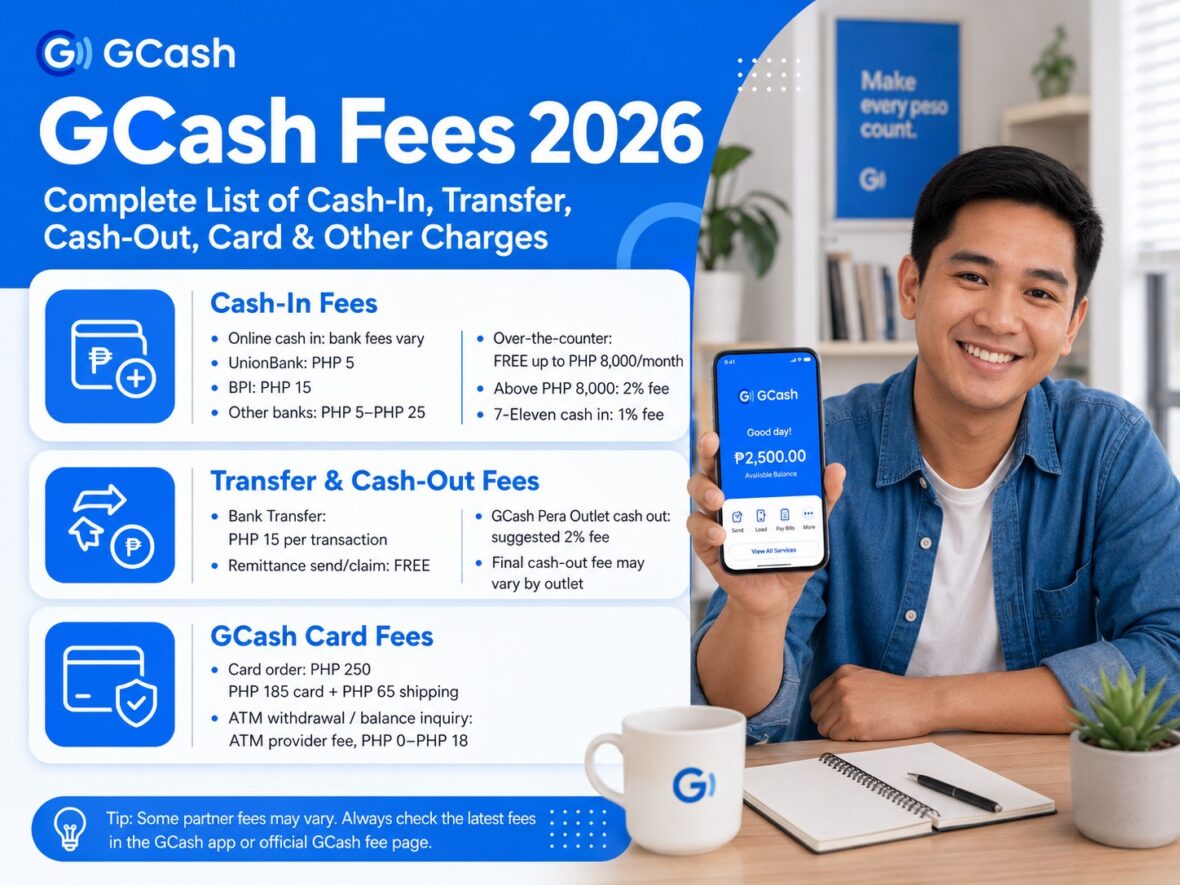
GCash makes it easy to send money, pay bills, buy load, transfer funds, and withdraw cash. However, not every GCash transaction is free.
Some charges are fixed, such as the ₱10 fee for transferring money to a local bank or e-wallet. Others depend on the amount, cash-in channel, biller, ATM, load product, country, or financial service you use.
The confusing part is that two transactions that appear similar may have completely different fees.
For example:
- Sending money to another GCash user is generally free within the standard Express Send allowance.
- Sending the same amount to a bank costs ₱10.
- Cashing in through Payoneer is free, while PayPal charges 1%.
- Over-the-counter cash-ins are free only within the combined ₱8,000 monthly allowance.
- Cashing out at a partner outlet costs 2%.
- Paying Meralco through GCash currently has no fee, while paying other billers may cost ₱5, ₱7, ₱10, ₱12, or more.
This guide breaks down the major GCash fees you may encounter in 2026, including cash-in charges, bank-transfer fees, cash-out costs, GCash Card fees, bill-payment charges, and borrowing costs.
The fees in this article were checked against the official GCash Help Center as of July 15, 2026. Fees, promotions, and partner charges can change without much notice. Always review the final confirmation page inside the GCash app before completing a transaction.
Content
GCash Fees at a Glance
Here is a quick overview of the most common charges:
| GCash transaction | Current fee or charge |
|---|---|
| GCash-to-GCash Express Send | Generally free within the standard transaction allowance |
| Send Money+ after applicable Express Send limits | ₱5 per succeeding transaction |
| GCash to a local bank or e-wallet | ₱10 per transaction |
| International bank or e-wallet transfer | Varies by amount and destination |
| Linked BPI cash-in | ₱15 |
| Linked UnionBank cash-in | Current fee depends on amount and active promotion |
| PayPal-to-GCash cash-in | 1% of the cash-in amount |
| Payoneer-to-GCash cash-in | Free |
| Over-the-counter cash-in | Free up to combined ₱8,000 monthly; 2% on the excess |
| GCash Pera Outlet cash-in | Suggested 1%; final fee depends on outlet |
| Claiming supported remittance | Free on GCash’s side |
| Partner-outlet cash-out | 2% |
| RCBC Scan to Withdraw | ₱18 per transaction |
| GCash Card ATM withdrawal or balance inquiry | ₱0–₱18, depending on ATM provider |
| Regular GCash Card | ₱250, including listed delivery charge |
| Bills payment | Depends on biller |
| Buy Load | Depends on product and amount |
| GCredit | 5%–7% monthly rate, charged based on days used |
| GLoan | 1.59%–6.99% monthly interest plus 3%–5% processing fee |
| GLoan Sakto | 0% interest plus 5%–12% processing fee |
| GGives | 0%–5.49% monthly interest |
| Borrow Load | Processing fee varies by load product |
| GFunds buying and selling | No GCash transaction fee; annual fund trust fees apply |
| GCrypto wallet top-up or withdrawal | No fee |
| Sending crypto | Network fee varies by coin |
| GStocks PH | Brokerage, VAT, PSE, SCCP, and applicable sales taxes |
| GBonds | Fees depend on bond and market type |
These are general charges. Some partners may impose an additional fee, and promotions may temporarily reduce or waive a charge.
GCash Send Money Fees
Is GCash-to-GCash Send Money Free?
A regular GCash-to-GCash transfer through Express Send is generally free while you remain within the standard monthly transaction-count allowance.
GCash currently allows up to:
- 500 Express Send transactions per month
- 500 received Express Send transactions per month
After reaching both applicable limits, eligible users may continue through Send Money+, which charges ₱5 for every succeeding transaction. The transaction counts reset at the beginning of the next month.
The count limit is different from your wallet’s peso-denominated outgoing limit. You could reach 500 transactions by sending many small amounts even when the total amount sent remains relatively low.
Example
Suppose you regularly receive small customer payments.
Even when each payment is only ₱100, receiving 500 separate Express Send transactions may cause you to reach the monthly transaction-count limit.
The next eligible Send Money+ transaction may carry a ₱5 charge.
For businesses accepting frequent customer payments, a personal account may not be the most suitable setup. GCash recommends exploring an appropriate merchant or GCash Pera Outlet account rather than depending entirely on personal Express Send.
GCash Bank Transfer Fee
How Much Is the GCash-to-Bank Transfer Fee?
As of July 4, 2026, GCash charges ₱10 per transaction when transferring money to a participating local bank or e-wallet through InstaPay.
The ₱10 charge applies whether you enter the recipient’s bank-account details manually or scan a supported bank QR code. GCash advises users to update the app to make sure the current fee appears correctly.
Example
Suppose you want the recipient to receive ₱5,000.
Your wallet needs at least:
- Transfer amount: ₱5,000
- GCash fee: ₱10
- Total deduction: ₱5,010
The fee is normally deducted from your wallet in addition to the amount sent.
Is the Fee Based on the Transfer Amount?
The current local bank-transfer fee is a fixed ₱10 per transaction rather than a percentage of the amount.
This means:
- Sending ₱500 costs ₱10.
- Sending ₱5,000 costs ₱10.
- Sending ₱50,000 costs ₱10, provided the amount is within all applicable limits.
Although the fee remains fixed, the transfer must still fit within your GCash wallet, outgoing limit, and the receiving institution’s requirements.
Can You Avoid the Bank-Transfer Fee?
There is no regular option inside GCash to remove the ₱10 InstaPay charge from every local transfer.
However, you may reduce the number of fees you pay by combining several small transfers into one larger transfer—provided that you are comfortable doing so and have carefully verified the recipient’s details.
For example, sending ₱1,000 five separate times would cost ₱50 in total transfer fees. Sending ₱5,000 once would cost only ₱10.
Never combine payments when doing so creates a greater risk of sending a large amount to the wrong account.
International Transfer Fees
GCash also supports transfers to selected international banks and e-wallets.
The fee depends on:
- The destination country
- The transfer amount
- The receiving bank or wallet
- The exchange rate
- Applicable partner charges
GCash shows the transfer fee and converted amount on the confirmation page before you proceed. The minimum international-transfer amount is currently ₱500, while the maximum depends on your wallet and transaction limits.
Because international transfer costs vary, there is no single flat fee that applies to every country.
Review:
- The peso amount deducted
- The foreign-currency amount received
- The transfer fee
- The exchange rate
- Any receiving-bank charges
Do this before tapping the final confirmation button.
GCash Cash-In Fees
Cashing in means adding money to your GCash wallet.
The fee depends on how the money enters the account.
Linked BPI Cash-In Fee
Cashing in through a BPI account linked directly inside GCash currently costs ₱15 per transaction.
Example
If you cash in ₱5,000 from your linked BPI account:
- Amount credited to GCash: ₱5,000
- Cash-in fee: ₱15
- Total bank deduction: ₱5,015
Your BPI and GCash accounts must also have enough remaining transaction allowance for the transfer.
Linked UnionBank Cash-In Fee
GCash’s current fee page lists the following UnionBank arrangement:
- ₱0 for amounts up to ₱1,000 during a promotion that ran from February 16 to April 30, 2026
- ₱5 for amounts above ₱1,000 beginning February 16, 2026
Because the listed zero-fee offer ended on April 30, users should check the fee currently displayed inside the app for a cash-in of ₱1,000 or less.
Do not assume that a previous promotional fee is still available.
Cashing In Through Another Bank’s App
You may transfer money from another bank to GCash using InstaPay or PESONet.
The fee is charged by the sending bank and varies by institution. GCash’s official comparison states that InstaPay and PESONet fees depend on the bank.
For example, a bank may offer:
- Free transfers
- A limited number of free transfers each month
- A fixed InstaPay fee
- A lower PESONet fee
- Promotional fee waivers
Review the transfer page in your bank’s app before confirming.
PayPal-to-GCash Cash-In Fee
Starting March 7, 2026, PayPal-to-GCash cash-ins carry a fee equal to 1% of the cash-in amount.
PayPal Fee Examples
| PayPal cash-in | 1% fee |
|---|---|
| ₱1,000 | ₱10 |
| ₱5,000 | ₱50 |
| ₱10,000 | ₱100 |
| ₱20,000 | ₱200 |
| ₱50,000 | ₱500 |
Check whether currency conversion is also required. The exchange rate can affect the final amount even when the GCash cash-in fee is straightforward.
Payoneer-to-GCash Cash-In Fee
GCash currently lists Payoneer cash-ins as free.
That means GCash does not list a separate cash-in fee for moving an available Payoneer balance into GCash.
However, Payoneer’s own account, receiving, conversion, or withdrawal fees may still depend on how you originally received and held the money. Review your Payoneer account before transferring.
Over-the-Counter Cash-In Fees
GCash provides a combined free over-the-counter cash-in allowance of ₱8,000 per month.
Once your combined OTC cash-ins exceed ₱8,000 during the month, GCash charges 2% on the portion above the free allowance. The free allowance resets on the first day of each month.
How the 2% OTC Fee Is Calculated
Suppose you have already cashed in ₱7,500 over the counter during the month.
You then cash in another ₱2,000.
The calculation is:
- Remaining free allowance: ₱500
- Amount above the free allowance: ₱1,500
- Fee: ₱1,500 × 2% = ₱30
The 2% fee applies only to the excess, not necessarily to the entire ₱2,000 transaction.
Another OTC Fee Example
Your monthly cash-ins are:
- First OTC cash-in: ₱6,000 — free
- Second OTC cash-in: ₱2,000 — free
- Third OTC cash-in: ₱3,000 — subject to a ₱60 fee
The first two transactions used the full ₱8,000 free allowance. The third ₱3,000 cash-in is entirely above the allowance:
₱3,000 × 2% = ₱60
Can an OTC Partner Charge Its Own Fee?
Yes. GCash’s list of over-the-counter partners warns that some partners may impose their own cash-in charge.
For example, the current partner list specifically shows a 1% cash-in fee at 7-Eleven.
This means you should not assume that every OTC cash-in below ₱8,000 will cost nothing in every location. Ask the outlet and review any displayed charge first.
GCash Pera Outlet Cash-In Fee
GCash lists a suggested GCash Pera Outlet cash-in fee of 1% of the total amount.
However, the individual outlet sets the final charge, so the actual fee may vary. The minimum GPO cash-in amount is currently ₱100.
Example
For a ₱1,000 cash-in using the suggested 1% fee:
- Amount credited to your wallet: ₱1,000
- Outlet fee: ₱10
- Total cash paid: ₱1,010
Confirm the charge with the outlet before handing over your cash.
Remittance Cash-In Fees
GCash currently states that sending and claiming supported remittances through its remittance services is free on the GCash side.
The overseas remittance provider may still apply:
- Sending fees
- Foreign-exchange margins
- Agent fees
- Country-specific charges
The person sending the remittance should check the total cost with the provider before confirming.
GCash Cash-Out Fees
Cashing out converts your GCash wallet balance into physical cash.
Partner-Outlet Cash-Out Fee
GCash charges 2% for all cash-outs at participating partner outlets.
Current examples of partner outlets include Puregold, Cebuana Lhuillier, and ECPay locations.
Cash-Out Fee Examples
| Cash-out amount | 2% fee |
|---|---|
| ₱500 | ₱10 |
| ₱1,000 | ₱20 |
| ₱2,000 | ₱40 |
| ₱5,000 | ₱100 |
| ₱10,000 | ₱200 |
Ask whether the fee will be deducted from the amount you receive or collected separately by the outlet.
Example
Suppose you request a ₱5,000 cash-out.
Depending on the partner’s process:
- You may receive ₱4,900 after the ₱100 fee is deducted, or
- Your wallet may need enough for the ₱5,000 withdrawal plus the ₱100 charge.
Confirm the final cash you will receive before approving the transaction.
RCBC Scan to Withdraw Fee
GCash’s RCBC Scan to Withdraw service charges ₱18 per transaction.
The current limits are:
- Minimum withdrawal: ₱100
- Maximum withdrawal: ₱5,000 per transaction
Your wallet must contain enough for both the withdrawal and the ₱18 service charge.
Example
To withdraw ₱5,000:
- Cash received: ₱5,000
- Service fee: ₱18
- Total wallet deduction: ₱5,018
RCBC Scan to Withdraw is available only to Fully Verified GCash users at supported RCBC ATMs.
GCash Card Fees
How Much Does a Regular GCash Card Cost?
The regular GCash Visa Card currently costs ₱250, consisting of:
- Card fee: ₱185
- Shipping fee: ₱65
The card is available to Fully Verified users, including eligible managed GCash Jr. accounts. Each account can order up to three cards, with one card order allowed every 30 days.
Double-check your delivery address before paying. GCash states that the order cannot be canceled after payment.
GCash Card ATM Fees
GCash Card withdrawal and balance-inquiry charges are set by the ATM provider.
The current official range is ₱0 to ₱18, based on BSP-approved rates.
The ATM should normally display the charge before completing the withdrawal.
Example
Suppose you withdraw ₱3,000 from an ATM that charges ₱18.
Your wallet needs at least:
- Withdrawal: ₱3,000
- ATM fee: ₱18
- Total wallet deduction: ₱3,018
If your wallet contains exactly ₱3,000, the withdrawal may fail because there is not enough balance for the ATM fee.
Do All ATMs Charge the Same Fee?
No.
One ATM may charge nothing, while another may charge ₱10, ₱15, or ₱18. GCash advises users to check the bank or ATM provider’s published fee information.
The ATM may also impose a withdrawal amount or denomination limit that is lower than your GCash Card’s general transaction limit.
International GCash Card Use
The GCash Card can be used at participating Visa merchants and compatible ATMs abroad. International transactions are subject to the applicable exchange rate, the foreign ATM’s charge, and other fees displayed by the provider or merchant.
When an overseas ATM offers to convert the withdrawal into Philippine pesos, compare that rate with the alternative of being charged in the local currency. The ATM’s conversion may include a separate markup.
GCash Bills Payment Fees
Bills-payment charges depend on the biller.
Some are free, while others charge a convenience fee. GCash maintains a biller directory containing partner fees and expected posting times.
Common Biller Fee Examples
GCash currently lists examples such as:
| Biller | Fee |
|---|---|
| Meralco | ₱0 |
| Manila Water | ₱6 |
| PLDT | ₱7 |
| Smart | ₱7 |
| Globe Postpaid | ₱7 |
| Globe At Home | ₱7 |
| Maynilad | ₱10 |
| Easytrip RFID | ₱12 |
| Autosweep | ₱12 |
| Converge | ₱12 |
These amounts may change, and some billers may temporarily become unavailable.
Why Can Two Similar Billers Have Different Fees?
The charge is set according to the arrangement among GCash, the biller, and the payment-processing partner.
For example:
- One electric cooperative may charge ₱5.
- Another may charge ₱10.
- Meralco may have no convenience fee.
- One water district may be free while another charges ₱12.
The company’s size, location, processing system, and payment partner can all affect the fee.
Always check the final payment screen rather than assuming that one biller’s fee applies to another.
Is the Bills Payment Fee Included in the Amount?
The fee is normally added to the payment amount.
For example, when paying a ₱2,000 bill with a ₱12 fee:
- Amount credited to biller: ₱2,000
- Convenience fee: ₱12
- Total GCash deduction: ₱2,012
Make sure your wallet has enough for both.
GCash Buy Load Fees
GCash does not apply one universal load-purchase fee.
The convenience fee depends on:
- Network or brand
- Load amount
- Promo
- Product category
- Current pricing arrangement
The fee and total deduction are shown on the payment page before you confirm.
This applies to products such as:
- Mobile load
- Data promos
- Broadband load
- Gaming credits
- Entertainment products
- Other prepaid services
Before paying, review:
- Recipient’s number
- Load product
- Validity period
- Load price
- Convenience fee
- Total wallet deduction
Do not rely only on the advertised load value. A ₱100 product may deduct more than ₱100 when a convenience fee applies.
GCash QR and Merchant Payment Fees
For ordinary customer QR transactions, any applicable charge should be shown before you confirm.
A merchant may also include service, delivery, or processing costs in the price of the product itself. These are different from a direct GCash wallet fee.
Always check:
- Merchant name
- Entered payment amount
- Total deduction
- Optional protection product
- Additional service charge
Never approve a QR transaction when the merchant name does not match the business or person you intend to pay.
GCredit Interest and Fees
GCredit is a revolving credit line that eligible users can use for supported payments.
GCash currently lists a GCredit monthly interest rate of 5% to 7%, depending partly on the user’s GCash activity. Interest begins the day after the transaction and is calculated according to the number of days the amount remains unpaid.
If you pay the GCredit balance on the same day as the transaction, GCash says no interest is charged.
GCredit Interest Example
Suppose:
- Amount used: ₱1,000
- Monthly interest rate: 5%
- Number of days borrowed: 9
GCash’s example converts the monthly rate into approximately 0.17% per day:
₱1,000 × 0.17% × 9 days = ₱15 interest
Total repayment:
₱1,000 + ₱15 = ₱1,015
Your actual rate appears in your GCredit dashboard.
Paying early reduces the number of days used to calculate interest.
GLoan Fees and Interest
GLoan charges both interest and a processing fee.
The current GLoan fee structure is:
- Loan amount: ₱500–₱150,000
- Monthly interest: 1.59%–6.99%
- Processing fee: 3%–5% of the loan amount
- Late-payment fee: 1% of the original loan amount for every missed due date, plus 0.15% of the total outstanding balance for every day overdue
The rate and processing fee depend on eligibility and the selected loan term.
How the GLoan Processing Fee Works
The processing fee is deducted from the amount you receive.
Suppose you borrow ₱10,000 and your processing fee is 5%.
- Approved loan: ₱10,000
- Processing fee: ₱500
- Amount credited to wallet: ₱9,500
Your repayment obligation is still based on the loan agreement—not only the ₱9,500 you received.
This is why you should compare the net amount credited with the total amount you will repay.
GLoan Late-Payment Fee
The late fee combines:
- 1% of the loan amount for each missed due date
- 0.15% of the outstanding balance multiplied by the number of days overdue
The daily portion continues increasing until payment is made.
Do not look only at the monthly installment. Review the complete repayment schedule before accepting the offer.
GLoan Sakto Fees
GLoan Sakto is a smaller short-term borrowing option.
GCash currently lists:
- Loan amount: ₱100–₱500
- Interest: 0%
- Processing fee: 5%–12%
- Late-payment fee: the same general formula of 1% of the loan amount per missed due date plus 0.15% of the outstanding balance per day overdue
Although the advertised interest is 0%, the processing fee means borrowing is not necessarily free.
Example
Suppose you borrow ₱500 with a 12% processing fee:
- Approved loan: ₱500
- Processing fee: ₱60
- Amount received: ₱440
Read the final disclosure to confirm the amount due and repayment date.
GGives Interest and Fees
GGives allows eligible users to pay participating merchants in installments.
The current monthly interest range is 0% to 5.49%, depending on eligibility and the selected term.
The late-payment fee is:
- 1% of the original loan amount for every missed due date
- Plus 0.15% of the outstanding balance for every day overdue
GCash provides an example in which a ₱10,000 GGives purchase paid five days late produces a ₱162.50 late fee.
A 0% offer may be attractive, but confirm whether:
- It applies to your account
- It applies to the selected merchant
- It applies to the full installment term
- Any merchant price difference exists
- Late charges apply
Borrow Load Fees
Borrow Load lets selected users buy eligible mobile or broadband load even when their wallet balance is insufficient.
GCash states that Borrow Load carries a processing fee based on the chosen product and load amount. The charge is in addition to any fee already associated with the load product.
The exact repayment amount appears before you confirm.
Review:
- Load value
- Load-product fee
- Borrow Load processing fee
- Repayment date
- Total amount due
Do not assume that borrowing ₱99 worth of load means repaying exactly ₱99.
GSave Fees
GSave contains savings accounts provided by partner banks. Each partner bank has its own fees, which may include:
- Dormancy fees
- Convenience fees
- Other account charges
GCash advises users to read the specific bank’s terms for the most accurate information.
GCash’s current GSave comparison states that the partner banks have a ₱30 dormancy fee, although the period before the account becomes dormant differs by provider.
For example:
- CIMB, BPI, Maybank, and UNO accounts are generally tagged dormant after 24 months without activity.
- Cebuana eC-Savings has a shorter inactivity rule tied to usage and remaining balance.
Keep your savings account active and review the partner bank’s current terms before leaving it unused for a long time.
GFunds Fees
GCash does not charge a separate transaction fee when you buy or sell investments through GFunds.
However, each investment fund charges an annual trust fee. This fee is already reflected in the fund’s daily net asset value, so it does not normally appear as a separate wallet deduction.
Current annual trust fees vary by fund, with examples ranging from around:
- 0.50% for selected money-market funds
- 1.00% for some bond or index funds
- 1.15%–1.75% for selected global, equity, and feeder funds
The fee reduces the investment’s return over time even though you do not receive a separate bill.
Always review:
- Annual trust fee
- Risk level
- Historical performance
- Recommended holding period
- Settlement period
No-transaction-fee investing does not mean the product is completely free.
GCrypto Fees
GCrypto currently charges no fee for:
- Topping up the GCrypto Trading Wallet from GCash
- Withdrawing from the GCrypto Trading Wallet to GCash
- Receiving crypto
Sending crypto to another wallet carries a fee that varies by coin and includes the applicable network fee paid by the sender. The exact fee appears on the send or receive page.
The buying and selling price of a cryptocurrency may also differ because of market prices and applicable spreads. This is not necessarily displayed as a simple fixed fee.
Before buying, selling, or sending crypto, review:
- Buying price
- Selling price
- Spread
- Network fee
- Minimum transfer
- Destination network
Sending a coin through the wrong blockchain network can result in permanent loss.
GStocks PH Fees
Buying and selling Philippine stocks through GStocks PH involves standard brokerage and market charges.
The current listed fees include:
- Online commission: 0.25% of gross trade value
- Broker-assisted commission: 1.50%
- VAT: 12% of the commission
- PSE fee: 0.005% of gross value
- SCCP fee: 0.01% of gross value
- Sales tax on stock sales: 0.60% of gross value
The sales tax applies when selling rather than buying.
Example of a ₱50,000 Stock Purchase
GCash’s sample includes:
- Commission: ₱125
- VAT: ₱15
- PSE transaction fee: ₱2.50
- SCCP fee: ₱5
A sale of the same gross value also includes the applicable stock-transaction tax.
Stocks can rise or fall in value, so trading fees are only one part of the potential cost.
GBonds Fees
Adding money to or withdrawing money from a GBonds account is currently free.
Buying or selling bonds may involve convenience and transaction fees depending on the security and whether it is being purchased on the primary or secondary market.
Current examples include:
Treasury Bills on the Primary Market
- Convenience fee: 0.50% per year
- Transaction fee: 0.25% of the amount, subject to the published calculation and maximum
Retail Treasury Bonds on the Primary Market
- Convenience fee: No fee
- Transaction fee: No fee
Retail Treasury Bonds on the Secondary Market
- Convenience fee: 0.75% per year
- Transaction fee: 0.25% of the amount, capped at ₱5 per transaction
Interest income is also subject to the applicable 20% withholding tax.
Fees That Depend on the Product or Partner
Some GCash services do not have one fixed charge.
These include:
- Buy Load
- Bills
- International transfers
- GSave
- GInsure
- International GCash Card use
- ATM withdrawals
- Borrow Load
- GCrypto transfers
- Merchant services
- Selected cash-in partners
For these transactions, the final confirmation screen is the most reliable place to see what you will actually pay.
Do not rely on an old screenshot, social media comment, or previous transaction. The partner may have changed its fee since then.
How to Check a GCash Fee Before Paying
Before confirming any transaction:
- Enter the transaction details.
- Stop at the review or confirmation screen.
- Check the principal amount.
- Look for a convenience, processing, service, or transfer fee.
- Check the total wallet deduction.
- Confirm how much the recipient or biller will receive.
- Proceed only when the amount is correct.
When the fee looks different from what you expected, do not tap Confirm yet.
Return to the previous page and verify that you selected the correct:
- Biller
- Bank
- Load product
- Cash-in method
- Merchant
- Loan term
- Recipient
Ways to Reduce GCash Fees
Use Express Send for Eligible GCash-to-GCash Transfers
Express Send is generally cheaper than transferring to a bank, provided that both parties have suitable GCash accounts and you remain within the transaction-count limit.
Combine Small Bank Transfers
Instead of making several small InstaPay transfers, consider one carefully verified transfer.
Monitor Your OTC Cash-In Total
Keep track of how much of the ₱8,000 monthly free allowance you have used.
Compare Cash-In Channels
Payoneer is currently free, while PayPal charges 1%. Linked banks and external bank apps have different charges.
Use Free Billers When Appropriate
Some billers do not charge a GCash convenience fee.
However, never select the wrong biller simply to save a fee.
Pay Credit Products Early
GCredit interest depends on the number of days the balance remains unpaid. Paying earlier can reduce interest.
Avoid Late Loan Payments
GLoan and GGives late fees combine a fixed percentage with a daily charge. Delays can become expensive quickly.
Compare ATM Fees
The GCash Card ATM fee varies by provider. Check the displayed charge before approving the withdrawal.
Cash Out Less Frequently
A 2% partner-outlet fee can become expensive when you make many small withdrawals.
For example:
- Ten ₱500 cash-outs cost ₱100 in total fees.
- One ₱5,000 cash-out also costs ₱100.
Although the percentage is the same, fewer transactions may save time and reduce the risk of transaction errors.
Common GCash Fee Mistakes
Forgetting the Fee When Checking the Balance
You may have exactly enough for the transfer amount but not enough for the fee.
Confusing the OTC Allowance With the Wallet Limit
The ₱8,000 OTC amount is a fee-free allowance, not your total GCash incoming limit.
Assuming Every Bank Cash-In Is Free
Linked-bank and bank-app transfers may carry charges.
Thinking a 0% Loan Has No Cost
GLoan Sakto may have 0% interest but still carries a processing fee.
Ignoring the Net Loan Proceeds
A processing fee may be deducted before the loan reaches your wallet.
Looking Only at the Monthly Installment
Review the total repayment amount, not just the advertised monthly payment.
Assuming Old Fees Still Apply
GCash reduced the local bank-transfer fee to ₱10 on July 4, 2026. Other fees and promotions can also change.
Not Reading the Final Screen
The review page is your last opportunity to catch an unexpected fee before the transaction is completed.
Frequently Asked Questions
Is GCash free to use?
Opening and using GCash does not mean every service is free. Express Send may be free within the applicable allowance, while bank transfers, cash-outs, cards, some cash-ins, bills, load, loans, and investment services may involve charges.
How much is the GCash bank-transfer fee in 2026?
GCash currently charges ₱10 per local InstaPay transfer. This fee took effect on July 4, 2026.
Is GCash-to-GCash Send Money free?
Express Send is generally free within the standard monthly transaction allowance. After reaching applicable transaction limits, eligible Send Money+ transactions cost ₱5 each.
Is there a fee to receive money in GCash?
There is generally no fee charged to the recipient for an ordinary Express Send transfer before the applicable Send Money+ conditions. However, incoming limits and transaction-count limits still apply.
How much is the OTC cash-in fee?
The first combined ₱8,000 of qualifying OTC cash-ins each month is free. GCash charges 2% on the portion above the allowance. Some partners may charge their own fee.
How much is the 2% fee on ₱10,000?
Two percent of ₱10,000 is ₱200.
However, for OTC cash-ins, the charge applies only to the amount above your remaining free allowance.
Is PayPal-to-GCash free?
No. The current PayPal-to-GCash cash-in fee is 1% of the amount.
Is Payoneer-to-GCash free?
GCash currently lists Payoneer cash-ins as free.
How much is cashing out at Cebuana or another partner outlet?
GCash currently applies a 2% fee to partner-outlet cash-outs.
How much is RCBC Scan to Withdraw?
The service fee is ₱18 per transaction.
How much is a GCash Card?
The regular card currently costs ₱250, consisting of a ₱185 card fee and ₱65 shipping fee.
How much is the GCash Card ATM fee?
ATM providers charge between ₱0 and ₱18 under GCash’s current published fee range.
Does GCash charge a fee for paying bills?
It depends on the biller. Some are free, while others charge convenience fees.
Is paying Meralco through GCash free?
GCash’s current biller-fee example lists Meralco with no convenience fee.
How much is the fee for paying PLDT through GCash?
The current listed PLDT fee is ₱7.
How much is the GCash load fee?
The fee depends on the network, load amount, and product. The exact charge appears on the payment page.
Does GCredit charge interest?
Yes. The current monthly rate ranges from 5% to 7%, calculated according to the number of days the balance remains unpaid.
What is the GLoan processing fee?
The regular GLoan processing fee currently ranges from 3% to 5% of the loan amount.
Is GLoan Sakto really 0%?
It has 0% interest, but it carries a processing fee of 5% to 12%.
How much is GGives interest?
The current rate ranges from 0% to 5.49% per month, depending on eligibility and term.
Is GFunds free?
GCash does not charge a transaction fee for buying or selling. However, the funds charge annual trust fees that are reflected in the investment value.
Does GCrypto have fees?
Topping up, withdrawing, and receiving crypto currently have no fee. Sending crypto carries a variable network fee based on the coin.
Can GCash fees change?
Yes. Fees may change because of updated GCash pricing, partner arrangements, promotions, and service policies. Check the final transaction page before confirming.
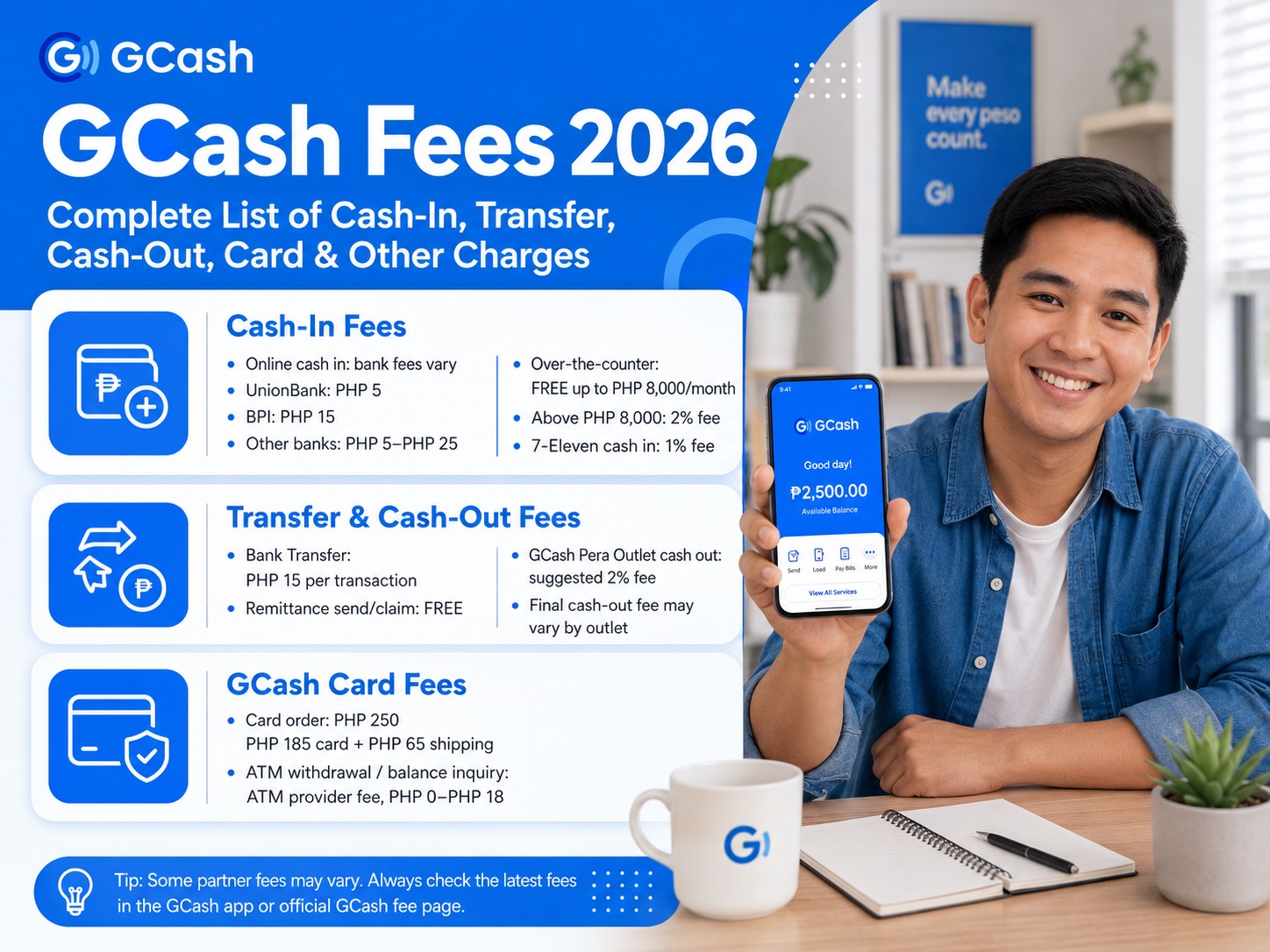
Final Thoughts
GCash can be inexpensive when you choose the right transaction method, but small fees can quickly add up when you use the app frequently.
The most important charges to remember are:
- ₱10 for a local bank or e-wallet transfer
- 2% for cashing out through a partner outlet
- ₱18 for RCBC Scan to Withdraw
- 2% on OTC cash-ins above the combined ₱8,000 monthly free allowance
- 1% for PayPal cash-ins
- ₱15 for linked BPI cash-ins
- ₱0–₱18 for GCash Card ATM services
- Variable fees for bills and load
Borrowing products require even more attention. GCredit charges interest based on the number of days used, while GLoan and GGives can include processing fees, monthly interest, and significant late-payment penalties.
Before confirming any transaction, slow down and read the final screen. Check the fee, total deduction, recipient, and amount to be credited.
A charge of ₱5, ₱10, or ₱15 may not feel significant on its own. But when repeated several times every week, it can become hundreds or even thousands of pesos over a year.
Using GCash wisely is not only about convenience—it is also about understanding exactly what that convenience costs.