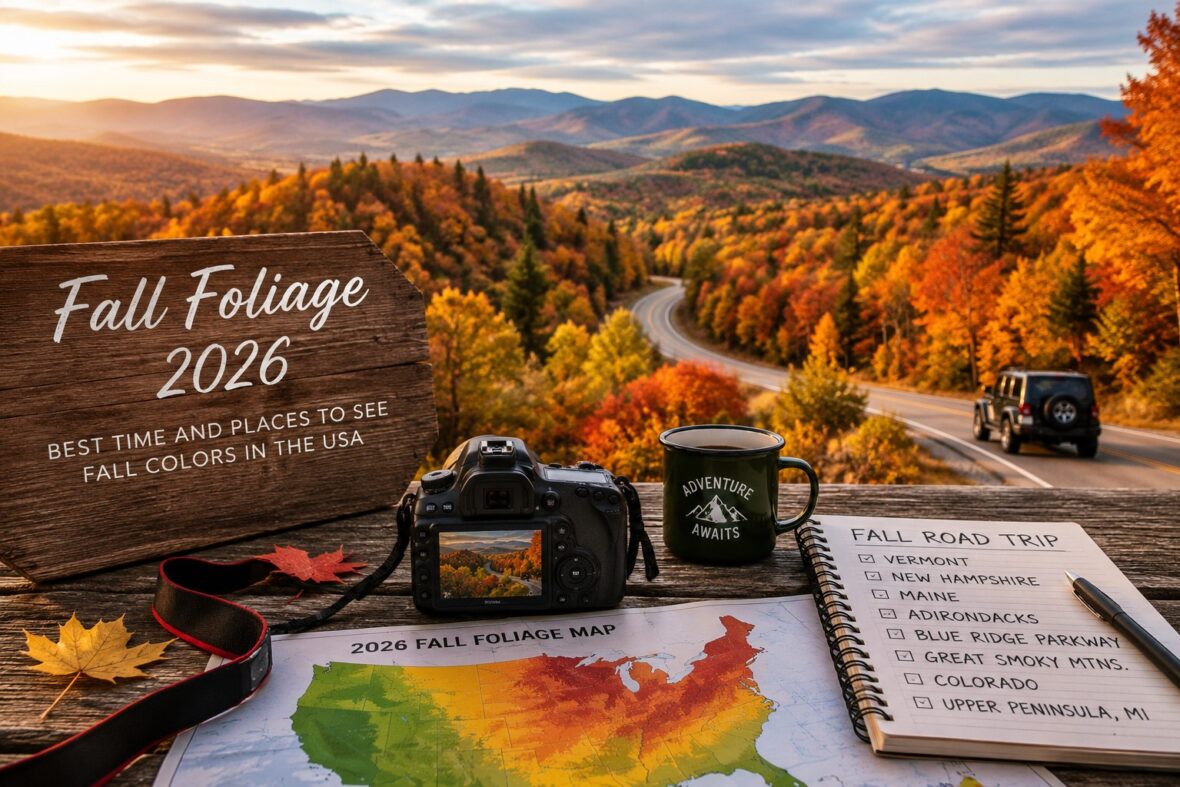
Fall foliage season is almost here, and if you have ever tried to plan a leaf-peeping trip, you already know the frustrating part: the colors don’t peak everywhere at the same time.
In fact, they don’t even peak at the same time within the same state.
Drive a few thousand feet higher in Colorado and the aspens may already be glowing gold while the valley below is still green. Head from northern Maine toward the coast and you can effectively follow fall for several weeks. The same thing happens along the Blue Ridge Parkway, where the changing leaves gradually move from the mountaintops toward lower elevations.
That’s exactly why timing matters.
For 2026, the overall fall foliage outlook is especially promising for New England and upstate New York, while parts of the Midwest and California’s Sierra Nevada could also put on a strong show. Some areas of the Rockies and parts of the Mid-Atlantic and Southeast have faced drought or other weather stress that could make colors less intense or cause leaves to fall earlier than usual.
So when should you travel?
And where should you go if you want those classic red, orange and gold landscapes?
Here’s a complete guide to the best time to see fall foliage in the USA in 2026, including peak-color estimates, road-trip ideas, national parks and some of America’s best fall destinations.
Content
Fall Foliage 2026 at a Glance
If you’re planning ahead and simply want the general timing, this is a good place to start.
| Region | Approximate best window in 2026 |
|---|---|
| Northern Rockies / highest elevations | Mid to late September |
| Colorado mountains | September 10–October 8, depending on elevation |
| Northern Maine | Late September–early October |
| Vermont & New Hampshire | Late September–mid-October |
| Adirondacks, New York | Late September–mid-October |
| Michigan Upper Peninsula | Late September–early/mid-October |
| Northern Wisconsin | Late September–mid-October |
| Massachusetts | Early to mid-October |
| Catskills / Hudson Valley | Mid to late October |
| Blue Ridge Mountains | Early October–early November, depending on elevation |
| Great Smoky Mountains | Early October–early November |
| Sierra Nevada, California | Mid to late October |
| Southern New England | Mid to late October |
| New York City / Long Island | Early to mid-November |
These are planning windows rather than guaranteed peak dates.
Weather during September and October can shift the schedule by several days—and sometimes more than a week.
The national 2026 foliage prediction map suggests peak color will already be appearing across portions of the northern U.S. by late September. By around October 6, much of Vermont, New Hampshire, Maine and Massachusetts is forecast to be near or at peak, while many northern areas will be past peak by around October 20.
Is 2026 Expected to Be a Good Fall Foliage Year?
It depends where you go.
AccuWeather’s 2026 fall foliage outlook is particularly encouraging for New England and upstate New York.
Wet weather during late spring and early summer followed by drier conditions heading into fall could create favorable conditions for strong autumn color in those areas.
Parts of the Midwest could also have a good year.
And if you’re considering California rather than the East Coast, the Sierra Nevada is another area worth watching. AccuWeather expects typical to potentially vibrant foliage in portions of the Sierra and northern California, with peak colors generally arriving later—often around mid to late October.
The picture is a little different in Colorado and other parts of the Rockies.
A hot and dry year has stressed vegetation in some mountain areas. AccuWeather warns that Colorado’s aspens may not be as spectacular everywhere as they have been in some previous seasons, although higher elevations that received summer rain could still perform well.
Colorado meteorologists are also watching for an earlier-than-normal color change in 2026 because drought-stressed aspens can begin turning sooner.
In other words:
2026 could be an excellent year for New England and New York.
But anyone heading west should pay especially close attention to local conditions as the trip approaches.
When Does Fall Foliage Start in the USA?
The first meaningful autumn colors usually appear in September.
But fall doesn’t suddenly arrive across the entire country.
It moves.
The transformation generally begins in colder northern areas and at higher elevations before progressing southward and downhill.
By late September, you may find excellent foliage in places like:
Colorado’s high country, northern New England, Michigan’s Upper Peninsula and parts of the northern Rockies.
By early and mid-October, the show expands into:
Vermont, New Hampshire, Maine, Massachusetts, New York, Wisconsin, Michigan and other northern states.
Then during mid- to late October, color reaches many portions of:
Pennsylvania, the Hudson Valley, southern New England, the Appalachians and lower elevations of the Blue Ridge Mountains.
And in places such as the Great Smoky Mountains, lower Southern Appalachian valleys and New York City, foliage can remain impressive into early November.
That’s one reason a nationwide “peak fall foliage date” doesn’t really exist.
What Does “Peak Fall Foliage” Actually Mean?
Peak foliage is generally the short period when the greatest proportion of trees in an area have reached their strongest autumn colors.
But don’t become obsessed with seeing an area on the exact day of peak.
“Near peak” can actually be just as beautiful.
Sometimes it’s better.
At near peak, you’ll often see a mixture of green, yellow, orange and red rather than an almost uniform late-season landscape.
And because peak color can last only a few days in one specific location, planning a trip within a broader one- or two-week window gives you much better odds.
New York tourism officials note that the full color cycle in a particular area can take roughly two weeks, while the absolute peak brilliance may last only three or four days.
Best Places to See Fall Foliage in the USA in 2026
Now for the fun part.
There are hundreds of beautiful fall destinations across America, but these are the places I’d put near the top of the list if fall colors are the main reason for your trip.
1. Vermont
Best time: Late September to mid-October
If someone asks you to picture an American fall road trip, there’s a good chance the image in your head looks like Vermont.
Think red barns.
White church steeples.
Covered bridges.
Rolling mountains.
Country roads surrounded by maple trees.
And hillsides covered in red, orange and gold.
Vermont tourism officials say higher elevations generally begin showing stronger color from mid- to late September, with the last week of September and first week of October often marking prime foliage conditions. Valleys can remain colorful later into October.
Where to go in Vermont
Some of the classic areas include Stowe, Woodstock, Manchester, Killington, the Green Mountains, Route 100 and Smugglers’ Notch.
If this is your first dedicated New England foliage trip, Vermont is one of the safest choices.
You can spend several days driving between small towns rather than trying to visit one exact viewpoint.
Ideal 2026 planning window
I would look particularly closely at:
September 28 through October 11
You may find earlier color at higher elevations and later color in valleys.
2. White Mountains, New Hampshire
Best time: Late September to mid-October
New Hampshire may offer the quintessential fall road trip.
The star is the famous Kancamagus Highway, a roughly 34-mile scenic section of New Hampshire Route 112 through the White Mountain National Forest.
There are mountain views, waterfalls, river stops and stretches of forest that turn into a wall of autumn color.
New Hampshire tourism officials emphasize that foliage timing changes each year, but historical conditions generally put the state’s dramatic color period around early to mid-October, with northern and mountainous areas changing first.
Waterville Valley and northern locations can often perform particularly well from late September into the first week of October.
Don’t miss
Kancamagus Highway, Franconia Notch, Crawford Notch, North Conway and the Mount Washington Valley are all excellent bases.
If you want a classic New England foliage photo with a winding road disappearing into red and orange mountains, New Hampshire delivers.
3. Maine
Best time: Late September through mid-October
Maine is another great option because the foliage season moves very predictably from north to south.
Northern Maine usually reaches peak first.
The color then works toward western and central Maine before eventually reaching coastal and southern areas.
The Maine Department of Agriculture, Conservation and Forestry says northern Maine typically reaches peak during the last week of September into the first week of October. Central Maine and the western mountains usually follow around early to mid-October, while southern and coastal Maine can hold peak or near-peak conditions later into October.
Great places to visit
Consider Rangeley, Baxter State Park, Bethel, Camden and Acadia National Park.
Acadia is particularly beautiful because the foliage is combined with rugged Atlantic coastline.
You can go from a colorful forest trail to an ocean overlook in the same morning.
One advantage of Maine
If you arrive too late for northern Maine, simply head south.
That’s a useful strategy throughout New England.
4. Adirondacks, New York
Best time: Late September to mid-October
New York’s Adirondack Mountains are enormous.
We’re talking about roughly six million acres of wilderness, mountain towns, lakes and forest.
That scale creates one of the longest and most varied foliage seasons in the Northeast.
I LOVE NY says the change historically begins in higher areas of the Adirondacks early in the season, with late September through mid-October being the general peak window.
Best bases
Lake Placid, Tupper Lake, Lake George and Saranac Lake are all strong choices.
You can drive scenic mountain highways, take gondola rides, hike to overlooks or simply sit beside a lake surrounded by colorful mountains.
One of the nicest things about the Adirondacks is that you don’t necessarily need an ambitious hiking itinerary.
The scenery comes to you.
5. Catskills and Hudson Valley, New York
Best time: Mid to late October
Missed the early October show farther north?
Head toward the Catskills and Hudson Valley.
This is one of the easiest fall getaways for travelers coming from New York City.
The 2026 national foliage prediction map puts the Catskills and Hudson Valley around the week of October 13 for peak conditions in many areas, although actual conditions will depend on elevation and weather.
I LOVE NY’s historical data generally places Hudson Valley peak foliage from mid-October into early November.
Why I like this region
You can combine nature with:
small towns, apple orchards, cider, wineries, historic sites and restaurants.
It’s a very easy fall weekend rather than an expedition.
Places such as Woodstock, Kingston, New Paltz and the area around Mohonk Preserve make excellent bases.
6. Berkshires, Massachusetts
Best time: Early to mid-October
Western Massachusetts doesn’t always receive the same attention as Vermont or New Hampshire, but the Berkshires are fantastic in fall.
Rolling hills, forests, lakes, historic towns and quiet rural roads make this an especially good destination for travelers who want foliage without spending their entire trip hiking.
The nationwide 2026 prediction maps show Massachusetts reaching widespread peak conditions around early October, with western Massachusetts often providing color before areas closer to the coast.
Think of the Berkshires as a relaxed version of the classic New England foliage trip.
Drive.
Stop for coffee.
Explore a small town.
Take a short hike.
Drive some more.
That’s pretty much the itinerary.
7. Michigan’s Upper Peninsula
Best time: Late September through early October
You don’t have to go to New England for spectacular fall color.
Michigan is one of America’s great autumn destinations.
The Upper Peninsula begins changing first before the season gradually moves south through the Lower Peninsula. Pure Michigan specifically encourages travelers to follow that progression using its fall color map and webcams.
Places to consider
Pictured Rocks National Lakeshore is one of the biggest standouts.
Imagine bright autumn forest sitting above cliffs and the deep blue water of Lake Superior.
Then there’s the Porcupine Mountains, Tahquamenon Falls and the Keweenaw Peninsula.
The combination of water and fall color makes Michigan feel very different from New England.
It’s also an excellent choice for a fall road trip.
8. Wisconsin
Best time: Late September through late October, depending on location
Wisconsin’s 2026 fall season is forecast to unfold over a particularly long window.
Travel Wisconsin’s current color report shows some far-northern locations expecting peak conditions from the fourth week of September or first week of October, while many central and southern destinations aren’t forecast to peak until later in October.
For example, some northern areas such as Boulder Junction and Rhinelander are currently forecast around the first week of October, while Door County is targeting roughly the third week of October and numerous southern areas aren’t expecting peak until the fourth week.
That’s actually great for travelers.
You have choices.
Great fall destinations
Door County is one of the most popular.
But northern Wisconsin’s forests and lakes can be spectacular earlier in the season.
The key in Wisconsin is to check the official color report immediately before leaving because local spotters update conditions throughout the season.
9. Aspen and Colorado’s Rocky Mountains
Best time: Mid-September through early October
Colorado is different from New England.
Instead of an enormous mix of red maples, orange oaks and yellow birches, Colorado’s fall identity revolves heavily around aspen trees.
And when an entire mountain slope of aspens turns gold beneath the Rocky Mountains, you understand why people chase the season every year.
But 2026 requires extra planning.
Meteorologists say a hot and dry summer could cause some Colorado aspens to change earlier than usual.
Current 2026 viewing windows include:
| Colorado destination | Suggested 2026 window |
|---|---|
| Steamboat Springs / Cameron Pass / Rabbit Ears | Sept. 10–22 |
| Rocky Mountain National Park / Peak to Peak Highway | Sept. 13–24 |
| Aspen / Vail / Summit County | Sept. 16–28 |
| Crested Butte / Telluride / Ouray | Sept. 18–29 |
| Pikes Peak area | Sept. 23–Oct. 3 |
| Durango / Pagosa Springs / southern San Juans | Sept. 29–Oct. 8 |
These windows come from the current Colorado forecast and should be treated as ranges rather than exact peak dates.
One important Colorado rule
Elevation is everything.
Aspens at 10,000 feet can turn while trees several thousand feet lower remain green.
If you arrive and the mountain pass looks past peak, go lower.
If the valley is still green, go higher.
It’s almost like having several foliage seasons stacked on top of each other.
10. Crested Butte, Colorado
Best time: Mid to late September
Crested Butte deserves its own mention because it has some truly enormous aspen groves.
Kebler Pass is one of the most famous fall drives in Colorado.
Instead of isolated yellow trees, you’ll sometimes see entire hillsides glowing.
For 2026, the broader Gunnison and Crested Butte region is currently expected to perform best roughly between September 18 and 29.
If I were building a Colorado foliage road trip, I’d combine Crested Butte with Aspen, the Maroon Bells area and possibly Telluride or Ouray.
Just don’t try to cram all of Colorado into two days.
Mountain driving takes longer than the map makes it look.
11. Great Smoky Mountains National Park
Best time: Early October through early November
The Smokies offer one of America’s longest foliage seasons because the park covers such a wide range of elevations.
At the highest elevations, fall colors can begin appearing as early as mid-September.
From early to mid-October, stronger color typically develops above about 4,000 feet before gradually moving toward lower elevations later in the month.
That means there is no single “Smoky Mountains peak weekend.”
A better strategy is:
Early October
Go high.
Mid-October
Explore mid-elevation roads and overlooks.
Late October
Look toward lower mountain communities and valleys.
Early November
Some lower areas may still have good color.
A current 2026 Western North Carolina forecast follows a similar progression, with high elevations beginning first and lower valleys potentially retaining foliage into early November.
12. Blue Ridge Parkway, North Carolina and Virginia
Best time: October
The Blue Ridge Parkway is basically designed for fall.
It stretches nearly 470 miles through Virginia and North Carolina and climbs and descends thousands of feet.
That elevation difference means foliage progresses gradually rather than peaking all at once.
The National Park Service says scattered color can begin at high elevations by late September, while most trees change during October, starting at the highest elevations and progressing down the mountainsides.
For travelers, that’s an advantage.
If the trees at one overlook aren’t ready, drive somewhere else.
You may find completely different conditions 30 miles away.
One thing to remember
October is extremely popular.
The roads may look peaceful in Instagram photos.
They won’t necessarily feel peaceful when you’re trying to find an open parking spot at a famous overlook on Saturday afternoon.
Weekdays are much better if you have that flexibility.
13. North Cascades, Washington
Best time: Late September to mid-October
The Pacific Northwest has its own version of fall.
Instead of the maple-heavy scenery associated with Vermont, one of the highlights in the North Cascades is the golden transformation of alpine larches.
They turn a brilliant yellow against rugged mountains.
Recent 2026 travel guidance puts the North Cascades foliage window generally from late September through mid-October.
It’s a great choice if you want autumn color with dramatic alpine scenery rather than covered bridges and farmhouses.
14. Sierra Nevada and Eastern Sierra, California
Best time: October
California isn’t usually the first state people associate with fall foliage.
That’s a mistake.
The Eastern Sierra can be spectacular.
Aspens and other deciduous trees turn bright yellow and orange beneath towering granite mountains.
AccuWeather says California is one of the regions that could have particularly favorable foliage in 2026. Much of the Sierra Nevada avoided the severe drought conditions affecting some other western regions, and wildfire impacts have been relatively limited.
Peak fall color in the Sierra Nevada typically occurs around mid to late October, though elevation can create earlier and later pockets.
Areas around Mammoth Lakes, June Lake Loop and Bishop are particularly popular.
15. New York City
Best time: Early to mid-November
Yes, New York City belongs on a foliage list.
You just have to wait longer.
Central Park, Prospect Park, Fort Tryon Park and other green spaces can become surprisingly colorful once autumn reaches the city.
I LOVE NY says New York’s fall progression generally ends with peak foliage in New York City and Long Island around early to mid-November.
This is great news for travelers who miss October.
You can still see fall color without renting a car and driving four hours into the mountains.
Central Park in early November can be gorgeous.
Best Fall Foliage Road Trips in the USA
Some destinations are better experienced from the car than from a single hotel.
If road trips are your thing, I’d put these among the strongest choices:
| Scenic drive | State/region | General foliage period |
|---|---|---|
| Kancamagus Highway | New Hampshire | Late Sept.–mid-Oct. |
| Route 100 | Vermont | Late Sept.–mid-Oct. |
| Blue Ridge Parkway | Virginia/North Carolina | October |
| Peak to Peak Scenic Byway | Colorado | Mid-late Sept. |
| San Juan Skyway | Colorado | Late Sept.–early Oct. |
| Adirondack roads | New York | Late Sept.–mid-Oct. |
| Catskill Mountains | New York | Mid-Oct. |
| Door County roads | Wisconsin | Mid-late Oct. |
| Upper Peninsula routes | Michigan | Late Sept.–early Oct. |
| June Lake Loop | California | October |
The best approach is not to race through them.
Fall road trips are much more enjoyable when you have enough time to stop at overlooks, trails, restaurants and small towns instead of treating every scenic highway like an interstate.
When Will Fall Foliage Peak in New England in 2026?
New England’s foliage season usually begins in the north and high elevations before spreading south.
A simplified 2026 planning timeline looks like this:
September 20–30
Northern Maine, northern New Hampshire and high elevations begin becoming increasingly colorful.
September 28–October 7
Northern Vermont, White Mountains and other high-elevation locations become prime targets.
October 1–12
Large areas of Vermont, New Hampshire and Maine can be near or at peak.
October 8–18
Massachusetts and southern parts of northern New England become increasingly colorful.
October 15–30
Connecticut, Rhode Island and coastal southern New England become better bets.
New England’s own foliage maps emphasize that peak begins first in northern Maine and the White Mountains before migrating south through October.
When Will Fall Foliage Peak in New York in 2026?
New York is especially useful for leaf peepers because the state stretches foliage season over nearly two months.
Historical timing used by I LOVE NY generally follows this pattern:
| New York region | Typical peak window |
|---|---|
| Adirondacks | Late Sept.–mid-Oct. |
| Capital-Saratoga | Mid-Oct. |
| Central New York | Mid-late Oct. |
| Thousand Islands | Mid-late Oct. |
| Hudson Valley | Mid-Oct.–early Nov. |
| Greater Niagara | Late Oct.–early Nov. |
| New York City | Early-mid Nov. |
| Long Island | Early-mid Nov. |
That means you could theoretically spend weeks following the color south across New York.
When Will Fall Foliage Peak in Colorado in 2026?
Colorado’s season will likely start earlier than many travelers expect.
The 2026 outlook suggests northern and higher-elevation destinations may begin producing strong color by mid-September.
The main travel window runs roughly:
September 10 through October 8
But your exact destination matters enormously.
For classic high-country destinations such as Aspen, Vail, Rocky Mountain National Park and Crested Butte, I’d focus heavily on mid to late September.
Waiting until mid-October may be too late for many high-elevation aspen groves.
When Will Fall Colors Peak in the Smoky Mountains?
The Smokies are almost the opposite of Colorado.
Instead of a short concentrated season, fall can stretch for weeks.
The National Park Service explains that elevation creates a slow progression from the highest ridges into valleys.
A useful rule for 2026 is:
| Time | Where to look |
|---|---|
| Late Sept.–early Oct. | Highest elevations |
| Early-mid Oct. | 4,000–5,000+ feet |
| Mid-late Oct. | Mid-elevation mountains |
| Late Oct.–early Nov. | Valleys and lower elevations |
That makes the Smokies a fairly forgiving choice.
If you miss color at the top, follow it downhill.
Why Do Leaves Change Color?
Here’s the short version.
During spring and summer, leaves contain large amounts of chlorophyll.
That’s the pigment responsible for their green appearance.
As autumn approaches, shorter days and changing temperatures trigger trees to reduce chlorophyll production.
Once that green pigment disappears, other pigments become visible.
Carotenoids produce many of the yellows and oranges.
Anthocyanins contribute reds and purples.
The National Park Service notes that bright sunny days, cool nights that remain above freezing and adequate rainfall can help produce strong fall displays. Very warm, wet and cloudy weather—or unusually cold conditions—can reduce the intensity.
That’s why the same forest can look spectacular one year and merely pleasant the next.
Weather Can Change Everything
This is the part people sometimes miss when booking flights six months in advance.
Foliage forecasts are not like holiday calendars.
October 10 isn’t automatically “peak foliage day” because it was beautiful on October 10 last year.
Several things can change the schedule.
A hot summer may stress trees.
Drought may cause leaves to turn or drop early.
A warm September can delay color.
Cold nights can accelerate the transition.
An early freeze can damage leaves.
A tropical storm or strong wind event can strip colorful leaves from trees in a single afternoon.
AccuWeather’s 2026 outlook specifically warns that vegetation stress could cause earlier leaf drop in parts of the Rockies and areas stretching from Georgia toward New Jersey.
So treat long-range dates as planning tools.
Then check live conditions again a few days before traveling.
How to Time a Fall Foliage Trip
Here’s the strategy I recommend.
Don’t book around one exact predicted peak day.
Instead, choose a destination where different elevations or nearby regions offer multiple possibilities.
Colorado is perfect for this.
So are Vermont, New Hampshire, Maine, New York and the Blue Ridge Mountains.
If you’re early, go higher or farther north.
If you’re late, go lower or farther south.
That flexibility can turn a disappointing trip into an excellent one.
How Far in Advance Should You Book?
For famous foliage destinations, sooner is better.
Fall weekends can become extremely busy in:
Stowe, Vermont; North Conway, New Hampshire; Bar Harbor, Maine; Lake Placid, New York; Aspen, Colorado; Great Smoky Mountains National Park and Asheville-area mountain towns.
Hotel rates often climb during peak weekends.
The challenge is that the exact foliage timing isn’t known when you’re making the reservation.
My preferred strategy is to book a refundable hotel within the broader historical peak window.
Then watch the foliage reports as your trip approaches.
Weekday vs. Weekend: When Should You Go?
If you have a choice, go during the week.
Seriously.
A scenic highway that feels peaceful at 9 a.m. Wednesday can feel like a parking lot Saturday afternoon in October.
Popular foliage destinations attract enormous crowds, especially when peak leaves coincide with nice weather.
The Great Smoky Mountains National Park, for example, warns that October is its busiest month and travel times within the park can become significantly longer.
Tuesday through Thursday is ideal.
If you have to visit on a weekend, start early.
Best Time of Day to Photograph Fall Colors
Morning and late afternoon usually provide the most attractive light.
Midday sun can create harsh contrast, particularly in forests.
Cloudy days aren’t necessarily bad.
Soft overcast light can make red and orange leaves appear richer and can be excellent for waterfalls and woodland photography.
After rain can also be beautiful because wet leaves look especially saturated.
Just watch for slippery trails.
What Should You Pack for a Fall Foliage Trip?
Autumn weather can change quickly, particularly in the mountains.
A sunny 65-degree afternoon can turn into a 35-degree morning the next day.
Layers are your friend.
Bring a warm jacket, comfortable walking shoes, rain protection and something warmer than you think you’ll need if you’re visiting mountain areas.
And don’t forget that high-elevation Colorado in late September can feel much closer to winter than fall.
Is September Too Early for Fall Foliage?
Not at all.
September is actually prime time for some destinations.
If you’re traveling in the second half of September, look toward:
Colorado’s high country, northern New England, Michigan’s Upper Peninsula, northern Wisconsin, Montana, Wyoming and other high-elevation or northern locations.
A national 2026 forecast indicates that by September 29, peak conditions may already be showing in portions of Washington, Colorado, Utah, Montana, Idaho, Wyoming, the Dakotas, Minnesota, Wisconsin, Michigan and the Northeast.
So September isn’t early everywhere.
For Colorado, it may actually be your best chance.
Is November Too Late for Fall Foliage?
Again, it depends where you are.
Northern Vermont?
Yes, probably.
New York City?
Not at all.
Lower elevations in the southern Appalachians, parts of the Southeast, Long Island and portions of the Mid-Atlantic can still have good foliage in early November.
The trick is following fall south.
Best Fall Foliage Destination for First-Time Visitors
If I had to recommend just one region for someone planning their very first American foliage trip, I’d choose:
New England.
Specifically, a road trip combining Vermont and New Hampshire.
Why?
Because you get nearly everything people associate with fall in America:
mountains, covered bridges, colorful forests, small towns, country roads, lakes, farms and classic New England architecture.
And the driving distances are manageable.
A week gives you room to move north or south depending on where peak color is happening.
Best Fall Foliage Destination in the West
I’d choose Colorado.
Even in a year when some aspens may be stressed by drought, the combination of golden trees and enormous Rocky Mountain scenery is unique.
Just travel earlier than you would for New England.
For 2026, mid to late September is the key window for much of the high country.
Best Fall Foliage Destination for October
This is a tougher question because October is when so many places are good.
But if your trip is around early October:
Look toward Vermont, New Hampshire, Maine and New York.
Mid-October?
Massachusetts, New York, Michigan and parts of Wisconsin become excellent options.
Late October?
Shift toward the Hudson Valley, Pennsylvania, Blue Ridge Mountains, Great Smoky Mountains and lower elevations.
Fall Foliage 2026 FAQ
When will fall foliage peak in 2026?
Most major U.S. fall destinations will see peak foliage sometime between late September and mid-October, although southern and lower-elevation areas can peak later.
Where will the best fall colors be in 2026?
New England and upstate New York have some of the most encouraging forecasts this year. Parts of the Midwest and California’s Sierra Nevada could also see strong color.
Is Vermont expected to have good fall foliage in 2026?
The broader New England outlook is favorable. Vermont typically sees stronger color from late September into early and mid-October, depending on elevation.
When should I visit New England for fall foliage?
For the best overall odds across several states, roughly September 28 through October 15 is a very useful planning window.
Northern areas may peak earlier and southern/coastal locations later.
When will Colorado fall colors peak in 2026?
Current forecasts suggest different mountain regions could perform best from September 10 through early October, with many popular high-country destinations concentrated in mid to late September.
When should I visit the Smoky Mountains for fall colors?
October is the safest overall month. Higher elevations change first, followed by middle elevations and then valleys from late October into early November.
What state has the best fall foliage?
There isn’t one objective winner, but Vermont, New Hampshire, Maine and New York are among America’s most famous foliage destinations.
Michigan, Wisconsin, Colorado and North Carolina also deserve serious consideration.
Does fall foliage peak on the same date every year?
No.
Temperature, rainfall, drought, elevation, latitude and storms all affect timing.
Even good prediction maps should be treated as estimates rather than guarantees.
How long does peak foliage last?
The strongest color at one exact location may last only several days, although an area’s broader foliage season can last for weeks.
Where can I check current fall foliage conditions?
Useful resources include official state foliage reports, state tourism trackers and national prediction tools. New York, New Hampshire, Maine, Wisconsin and Michigan all provide foliage tracking resources, while the nationwide SmokyMountains.com map and ExploreFall provide broader forecasts.
Final Thoughts: The Best Fall Foliage Trip Is the One With a Little Flexibility
Planning a fall foliage vacation is a strange kind of travel planning.
You can know exactly where you’re going.
You can reserve the hotel.
You can map the scenic drive.
You can choose the hiking trail.
But nature still gets the final say.
That’s why I wouldn’t build a trip around a prediction that says, “Peak foliage: October 8.”
Instead, think in windows.
For Colorado, start looking seriously from mid-September.
For northern New England and the Adirondacks, late September into early October is where things get exciting.
For much of Vermont, New Hampshire, Maine, Massachusetts and the Great Lakes, early to mid-October is prime territory.
For New York’s Hudson Valley, the Blue Ridge Mountains and Great Smoky Mountains, mid to late October becomes especially attractive.
And if October disappears before you manage to take a trip, all is not lost. Lower elevations, the southern Appalachians, New York City and Long Island can keep the season alive into November.
The encouraging news for 2026 is that New England and upstate New York currently have one of the stronger outlooks in the country.
So if you’ve been waiting for an excuse to finally take that New England road trip—drive Route 100 through Vermont, cross the White Mountains on the Kancamagus Highway, wake up beside a lake in Maine or spend a weekend in the Adirondacks—this may be a very good year to do it.
Just remember one rule:
Don’t chase an exact date.
Chase the color.
And if the leaves aren’t ready where you are, keep driving.