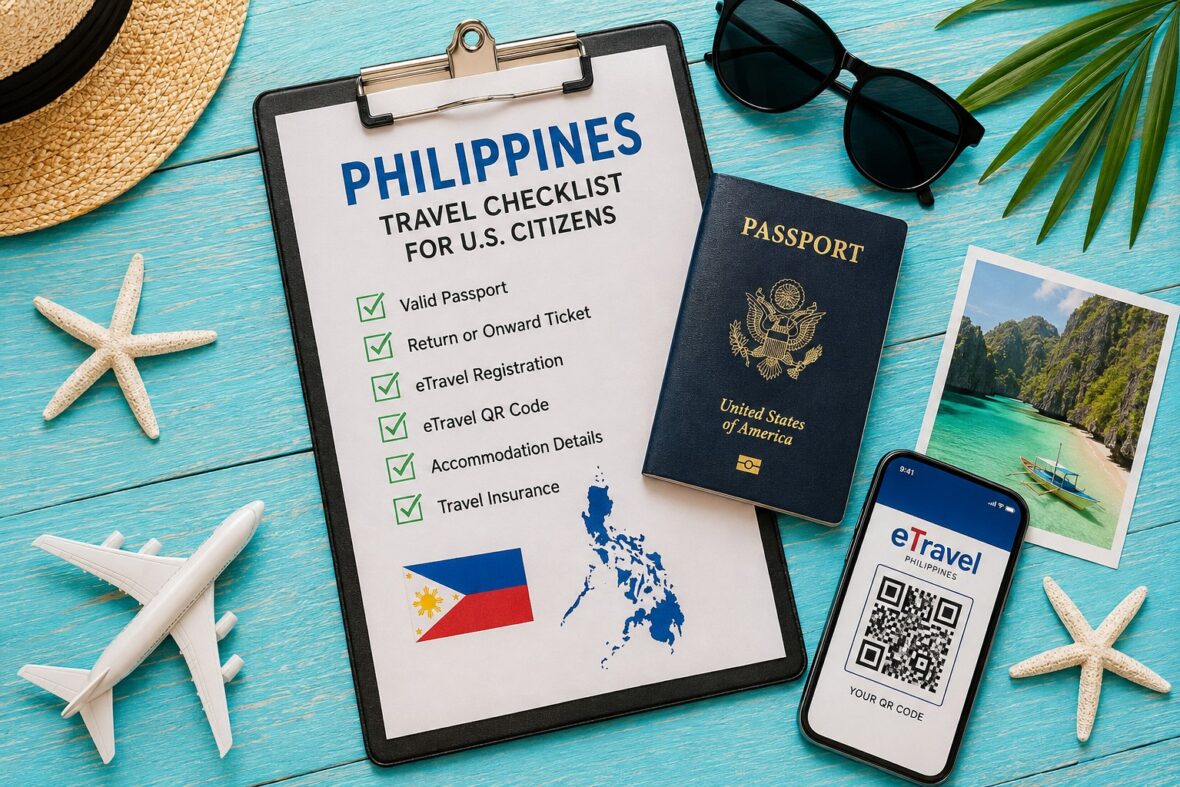
Planning a trip from the United States to the Philippines? The good news is that entry requirements for American tourists are relatively straightforward.
For most U.S. citizens visiting for a regular vacation, you do not need to apply for a Philippine tourist visa before your trip if you plan to stay for 30 days or less. However, there are still several important requirements you need to take care of before boarding your flight, including passport validity, a return or onward ticket, and the Philippines’ eTravel registration.
There are also different rules if you plan to stay longer than 30 days, if you are a former Filipino citizen, if you are traveling with children, or if your trip is for work or another purpose.
Here’s a complete guide to the Philippines travel requirements for U.S. citizens, updated for September 2026.
Content
Quick Answer: What Do U.S. Citizens Need to Travel to the Philippines?
For a typical U.S. tourist visiting the Philippines for 30 days or less, you should generally have:
- A valid U.S. passport
- Sufficient passport validity for your trip
- A return or onward airline ticket
- Completed eTravel registration
- Your eTravel QR code
- Travel details and accommodation information
- Any applicable health documentation if traveling from a country with special health requirements
U.S. citizens are among the nationalities eligible for visa-free entry into the Philippines for an initial stay of up to 30 days under the country’s visa-waiver rules.
Let’s go through each requirement.
Do U.S. Citizens Need a Visa to Visit the Philippines?
For most vacations, no.
U.S. passport holders may enter the Philippines without obtaining a visa in advance for a stay of up to 30 days, provided they satisfy the country’s other entry requirements.
The U.S. Department of State also currently lists tourist visas as not required for U.S. citizens visiting the Philippines for 30 days or less.
This makes the Philippines relatively easy to visit for Americans taking a two-week vacation, a three-week island-hopping trip, or even a month-long stay.
For example, an American traveling from Los Angeles to Manila for 18 days does not normally need to visit a Philippine embassy or consulate beforehand to apply for a tourist visa.
You simply arrive under the visa-free privilege, assuming you meet the requirements.
What if you want to stay longer than 30 days?
This is where things change.
The Philippine Bureau of Immigration allows eligible visa-free tourists to extend their initial 30-day stay. The first extension is commonly a 29-day visa waiver, potentially bringing the authorized stay to 59 days. The Bureau of Immigration currently offers this service through its immigration offices and eServices system.
If you already know that you intend to spend several months in the Philippines, however, don’t simply assume that your original 30-day admission automatically covers the entire trip.
Check your visa or extension options with the Philippine Embassy or Bureau of Immigration before traveling.
And once you’re in the Philippines, always pay attention to the date until which immigration has authorized you to remain.
Overstaying can result in fines and additional immigration procedures.
Passport Requirements for Americans Traveling to the Philippines
Your U.S. passport is one of the most important things to check before booking your trip.
Philippine authorities generally require a passport with at least six months of remaining validity beyond the relevant travel period. The U.S. State Department currently advises travelers that passports should have six months of validity beyond the planned stay, while Philippine visa-free guidance similarly requires sufficient six-month validity.
Your passport should also have enough blank space for immigration stamps.
Don’t wait until the last minute to check your passport
Imagine your trip is coming up in December and you suddenly realize your passport expires early the following year.
Even though your passport technically hasn’t expired, you could still have a problem because many international destinations impose additional passport-validity requirements.
So before buying a nonrefundable ticket to Manila, Cebu, Clark, or another Philippine gateway, check the expiration date printed on your passport.
If you’re anywhere close to the required validity window, renewing before your trip may save you a lot of trouble.
Do You Need a Return or Onward Ticket?
Yes. This is another requirement Americans sometimes overlook.
Travelers entering under the Philippines’ 30-day visa-free privilege are expected to have a ticket showing that they will leave the Philippines, either by returning home or continuing to another country.
Official Philippine visa-free guidance requires eligible visitors to possess a return ticket to their country of origin or an onward-bound ticket to another destination.
For example:
Los Angeles → Manila → Los Angeles
would clearly show that you’re returning home.
But this can also work:
San Francisco → Manila → Singapore
because Singapore is your next international destination.
What about one-way tickets?
A one-way ticket to the Philippines can create complications for someone relying only on the standard 30-day tourist admission.
The airline may ask for proof of onward travel before allowing you to board, and Philippine immigration can also ask about your departure plans.
If you’re entering under the normal 30-day visa-free arrangement, having confirmed onward travel is the safer approach.
Philippines eTravel Requirement for U.S. Citizens
One of the biggest things American travelers need to know before flying to the Philippines is eTravel.
The Philippine eTravel system is the government’s digital travel-registration platform used for border control, health surveillance, immigration, customs and related travel information.
Arriving foreign passengers, including U.S. tourists, are generally required to register.
When Should You Complete eTravel?
You can register within 72 hours, or three days, before your arrival in the Philippines.
The official eTravel FAQ specifically states that registration may be completed within 72 hours before arrival and that travelers should be prepared to present proof of registration before boarding their flight.
That means you don’t need to complete eTravel several weeks before your vacation.
In fact, you shouldn’t.
Do it during the final three-day window before arrival.
Example
Suppose your flight lands at Ninoy Aquino International Airport in Manila on October 10.
You would complete your eTravel registration during the 72-hour period before your arrival.
I would personally avoid leaving it until you’re already standing at the airport check-in counter. Complete it earlier within the allowed window while you have a stable internet connection.
What Is the Official Philippines eTravel Website?
This is important because scam websites exist.
The official Philippine eTravel website is:
Official Philippine eTravel website
The Philippine government specifically states that this is the official eTravel website.
And here’s something else you should remember:
eTravel registration is FREE.
There is no legitimate registration fee.
The official eTravel system warns travelers about fraudulent websites and services that attempt to charge money for eTravel registration.
So if a website asks you to pay $20, $40 or some other amount simply to register your eTravel information, double-check where you are.
Do You Need to Download an eTravel App?
No.
You can complete eTravel through a web browser using a:
- Smartphone
- Tablet
- Laptop
- Desktop computer
The official platform is web-based, so downloading a separate app isn’t required.
What Information Does eTravel Ask For?
Be prepared to provide basic information related to your identity and trip.
This can include details such as your:
- Passport information
- Citizenship
- Flight information
- Arrival date
- Philippine destination
- Accommodation
- Travel history or health information when applicable
- Customs information
The system combines information used by several Philippine border agencies, making it essentially a one-stop electronic travel declaration.
Make sure the information you submit matches your passport and airline itinerary.
Save Your eTravel QR Code
Once you’ve successfully registered, save the QR code generated by the system.
The official eTravel FAQ recommends taking a screenshot or downloading the QR code before leaving the website because an airline representative may ask to see it before you board.
I would save it in at least two places.
For example:
- Screenshot it on your phone.
- Save another copy in your photos or files.
- If you want extra backup, print it.
The Philippine government confirms that travelers can also present a printed copy of the QR code.
This is useful because international travel has a funny way of making your phone battery disappear exactly when you need it most.
Do Americans Need a COVID Test or Vaccination to Enter the Philippines?
The current U.S. Department of State Philippines travel requirements do not list a routine COVID-19 vaccination or COVID testing requirement for ordinary American tourists entering the Philippines.
The health requirement currently highlighted by the State Department concerns yellow fever vaccination for travelers arriving from certain countries where yellow fever risk applies.
That said, health regulations can change in response to outbreaks or public-health emergencies.
Always check the current Philippine eTravel and government entry guidance shortly before departure, particularly if you’re traveling through several countries before reaching the Philippines.
Yellow Fever Requirement
Most people flying directly from the mainland United States to the Philippines will probably never have to think about yellow fever.
However, proof of yellow fever vaccination may be required if you are arriving from certain countries or areas where yellow fever is a risk.
The U.S. State Department specifically lists yellow fever vaccination as required for travelers arriving from certain countries in South America or Africa.
This can matter if your Philippine trip is part of a larger international itinerary.
For example, someone traveling:
USA → South America → Philippines
may face different health-document requirements from someone traveling:
USA → Japan → Philippines.
What Happens When You Arrive in the Philippines?
For most U.S. tourists, arrival is fairly straightforward.
After your flight lands, you’ll generally proceed through the Philippines’ arrival process, including immigration and customs.
At immigration, be prepared to present:
- Your U.S. passport
- Your onward or return travel details if requested
- Your eTravel registration or QR code when applicable
- Information about where you’re staying
- Your purpose of travel
The immigration officer ultimately determines admission.
Having visa-free eligibility does not mean a traveler has an absolute right to enter. Philippine immigration authorities retain responsibility for deciding whether a foreign traveler is admissible.
For a normal tourist with a valid passport, clear travel plans and proper documents, however, the process is usually uncomplicated.
Know How Long You’re Allowed to Stay
This is important.
Don’t simply think:
“I’m an American, so I can stay for 30 days.”
What ultimately matters after arrival is the immigration status and authorized stay you are actually given.
If you decide during your vacation that you want to spend longer in Palawan, Cebu, Bohol or somewhere else, don’t simply remain beyond your authorized period.
Apply for the appropriate extension before your stay expires.
The Bureau of Immigration currently provides a 29-day visa-waiver extension for qualifying tourists initially admitted visa-free for 30 days.
Special Rule for Former Filipino Citizens
This is an important exception for Filipino-American travelers.
If you are an American citizen who was formerly a citizen of the Philippines, you may qualify for the Balikbayan privilege.
Eligible former Filipino citizens can receive significantly different treatment from an ordinary foreign tourist.
The Balikbayan program covers qualifying former Filipino citizens and, in certain circumstances, their foreign spouse and children when they travel together.
Eligible Balikbayans may generally receive a visa-free stay of up to one year.
This is a huge difference compared with the ordinary 30-day visa-free stay.
Bring proof of your former Philippine citizenship
If you’re hoping to use the Balikbayan privilege, don’t assume your U.S. passport alone automatically proves your eligibility.
Bring appropriate documents that can establish your previous Philippine citizenship, such as an old Philippine passport or other acceptable documentation.
If you’re traveling with a foreign spouse or children and expect them to receive the associated privilege, make sure you also have documentation proving your relationship.
This is one situation where preparing the paperwork before leaving the U.S. can make the arrival process much easier.
What About Filipino-American Dual Citizens?
A Filipino-American who currently holds both Philippine and U.S. citizenship is in a different situation from an American tourist.
If you’re a Philippine citizen, you have the right to enter the Philippines as a Filipino.
Ideally, dual citizens should travel with documentation establishing their Philippine citizenship, particularly if they intend to enter as Filipino citizens rather than rely on the 30-day tourist privilege attached to a U.S. passport.
This is especially important for travelers planning long stays, retirement or extended visits with family.
Special Rule for Children Under 15
Families should also know about the Philippines’ Waiver of Exclusion Ground, commonly called a WEG.
Under Philippine immigration law, a foreign child under 15 who is traveling to the Philippines without a parent or who is not traveling to join a parent can be subject to special entry requirements.
The Bureau of Immigration states that these children may require a Waiver of Exclusion Ground.
For example, this could affect a 13-year-old American child traveling to the Philippines with:
- Grandparents
- An aunt or uncle
- A family friend
- A school or tour group
but without either parent.
The BI currently provides an advance procedure, and its guidance says the guardian or legal representative can notify the Commissioner of Immigration at least 72 hours before arrival and submit the required documentation.
If you’re sending a child under 15 to the Philippines without a parent, this is something you should research well before the flight.
Customs Rules When Entering the Philippines
Immigration and customs are different processes.
Even after you’re admitted into the Philippines, you still have to comply with Philippine customs rules.
Travelers may need to declare certain:
- Goods purchased abroad
- Agricultural products
- Food or animal products
- Restricted goods
- Large amounts of currency
The Philippine Bureau of Customs recommends completing applicable baggage and currency declarations through the eTravel system.
How Much Cash Can You Bring Into the Philippines?
For foreign currency such as U.S. dollars, travelers carrying more than US$10,000—or the equivalent in other foreign currencies—must declare the full amount to Philippine Customs.
The Bureau of Customs reiterated this requirement in March 2026.
For Philippine currency, travelers may generally bring up to ₱50,000 per person without prior Bangko Sentral ng Pilipinas authorization.
Amounts exceeding the applicable limit require special authorization and declaration.
So bringing $11,000 into the Philippines isn’t automatically prohibited.
But it needs to be properly declared.
That’s an important distinction.
Can U.S. Citizens Work in the Philippines on Tourist Entry?
No.
Visa-free tourist admission is not permission to work in the Philippines.
The U.S. State Department advises American citizens intending to work in the Philippines to obtain the appropriate authorization.
If you’re traveling for employment, long-term business activity, study, residency or another specialized purpose, your immigration requirements may be different from those described in this tourist guide.
Philippines Travel Advisory for U.S. Citizens
Entry requirements and safety advisories are two separate things, but it’s worth checking both before your trip.
As of September 3, 2026, the U.S. Department of State lists the Philippines at:
Level 2: Exercise Increased Caution
The advisory was updated on September 1, 2026 and cites risks including crime, terrorism, unrest and kidnapping. Some areas carry stronger warnings.
The U.S. government specifically advises against travel to the Sulu Archipelago, including the southern Sulu Sea. Other parts of Mindanao may also carry elevated travel guidance.
This doesn’t mean tourists are being advised to avoid the Philippines as a whole.
Popular destinations such as Manila, Cebu, Boracay, Bohol and Palawan should be evaluated based on their specific circumstances rather than treating the entire archipelago as one risk category.
Before traveling, check the latest State Department advisory because security conditions can change.
Should You Register With STEP?
American travelers may also want to consider enrolling in the U.S. State Department’s Smart Traveler Enrollment Program, or STEP.
STEP allows travelers to receive information and alerts from the U.S. embassy or consulate and can make it easier for American authorities to contact travelers during emergencies. The State Department includes STEP as part of its international travel planning recommendations.
It’s especially worth considering if you’ll be:
- Staying for several weeks or months
- Traveling around multiple islands
- Visiting during typhoon season
- Going to less-touristed areas
- Living temporarily in the Philippines
Philippines Entry Checklist for U.S. Travelers
Here’s a simple checklist to save before your trip.
A Few Months Before
Check your passport expiration date.
If there is any question about whether you have enough validity, renew your passport early rather than hoping the airline or immigration officer will accept it.
After Booking
Make sure you have a return or onward ticket.
Keep copies of:
- Your airline reservation
- Hotel reservation
- Philippine address
- Travel insurance
- Passport information
Within 72 Hours Before Arrival
Complete your Philippine eTravel registration.
Use only the official government website.
Remember:
eTravel is free.
Save your QR code after registration.
At the U.S. Airport
Have easy access to:
- Passport
- eTravel QR code
- Return/onward flight
- Philippine accommodation information
Your airline may verify some of these before checking you in for the flight.
Upon Arrival in the Philippines
Proceed through the required border procedures, including immigration and customs.
Answer immigration questions clearly and truthfully.
Then check the authorized period of stay given to you.
Frequently Asked Questions
Can a U.S. citizen enter the Philippines without a visa?
Yes. U.S. citizens visiting for tourism can generally enter the Philippines visa-free for up to 30 days, subject to standard entry requirements.
How long can an American stay in the Philippines without a visa?
The standard initial visa-free stay is up to 30 days.
Eligible visitors who want to remain longer may apply for an extension through the Bureau of Immigration. The initial visa-waiver extension is generally 29 additional days.
Do Americans need eTravel to enter the Philippines?
Yes. Arriving foreign passengers are generally required to register or update their information in the Philippine eTravel system.
When should I fill out Philippines eTravel?
Within 72 hours, or three days, before your arrival in the Philippines.
Does Philippines eTravel cost money?
No.
Official eTravel registration is completely free. If a website demands payment merely to register you, make sure you’re using the official Philippine government platform.
Do I need to print my eTravel QR code?
Not necessarily.
You can keep a screenshot or downloaded copy on your phone, although printing a backup is also allowed.
Do Americans need a return ticket to enter the Philippines?
Travelers using the standard visa-free privilege are expected to have a return ticket or an onward ticket to another country.
Can I fly to the Philippines on a one-way ticket?
If you’re relying on the standard 30-day visa-free tourist admission, traveling without proof of onward travel can cause problems because an onward or return ticket is part of the visa-free entry requirements.
Does my U.S. passport need six months of validity?
Yes. Travelers should plan on having at least six months of passport validity beyond the applicable travel period.
Do U.S. green card holders automatically get the same Philippine entry rules as U.S. citizens?
No.
A U.S. permanent resident is not automatically a U.S. citizen.
Philippine visa requirements are generally based on the passport or nationality under which you’re traveling. Someone holding a Philippine visa-required passport does not automatically become eligible for the U.S.-citizen visa exemption simply because they have a U.S. green card.
Always check the rules for your actual passport nationality.
Can a former Filipino U.S. citizen stay longer than 30 days?
Potentially, yes.
Qualified former Filipino citizens may be eligible for the Balikbayan privilege, which can allow a stay of up to one year. Eligible foreign spouses and children may also qualify when traveling together with the Balikbayan.
Can Americans extend their stay while in the Philippines?
Yes. The Philippine Bureau of Immigration offers visa extensions for eligible foreign tourists, including a 29-day extension of the initial 30-day visa-free stay.
Final Thoughts
For most Americans, traveling to the Philippines isn’t complicated.
If you’re coming for a regular vacation lasting less than 30 days, the basic formula is simple:
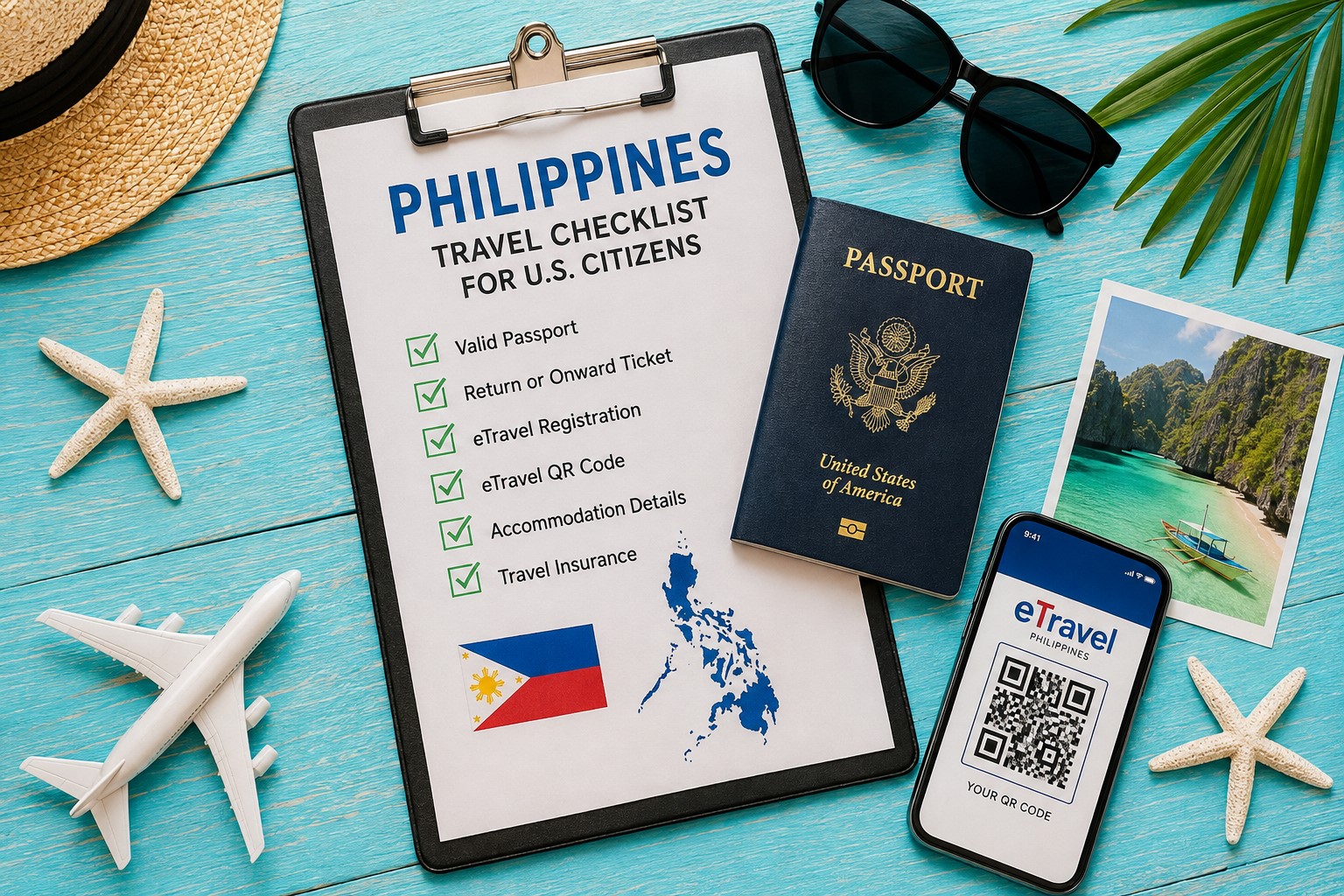
Valid passport + onward ticket + eTravel registration + normal immigration clearance.
The requirement most first-time travelers tend to overlook is eTravel, while the requirement that can cause bigger problems is passport validity or not having proof that you intend to leave the country.
So don’t wait until you’re checking in for your Manila flight to start looking at these things.
Check your passport well ahead of time. Book your onward travel. Complete eTravel during the 72-hour window. Save the QR code.
And if you’re staying longer, traveling as a former Filipino, entering as a dual citizen, or sending a child under 15 without a parent, take time to understand the special rules that apply to your situation.
Most importantly, check official sources again shortly before departure. Immigration, health and travel regulations can change, and an article you read months earlier should never replace the latest instructions from Philippine authorities.
Once the paperwork is sorted, you can focus on the much more enjoyable part of planning your trip: deciding whether Manila, Palawan, Cebu, Bohol, Boracay, Siargao—or perhaps all of them—belongs on your itinerary.