There are Philippine festivals that celebrate history, others that revolve around a patron saint, and some that were created around the livelihood that keeps an entire community moving.
In Victoria, Oriental Mindoro, that livelihood is closely tied to the land—and especially to fruit.
Every September, the town celebrates the Kapakyanan Festival, a colorful thanksgiving for Victoria’s agricultural abundance. Rambutan, lanzones, durian, citrus fruits and other farm produce become more than things you see at the market during the celebration. They inspire costumes, dances, displays and activities that tell the story of a municipality known as the “fruit basket of Oriental Mindoro.”
But Kapakyanan is more than a fruit festival.
It is also a celebration of Victoria itself: its farmers, its fertile lands, its communities and the blessings that have shaped the town through the years.
If you’re planning to experience Kapakyanan Festival someday—or you’re simply curious about one of Oriental Mindoro’s lesser-known but culturally meaningful celebrations—here’s everything you need to know.
Content
Kapakyanan Festival at a Glance
| Festival | Kapakyanan Festival |
|---|---|
| Location | Victoria, Oriental Mindoro |
| Usual date | September 18 |
| Main venue | Victoria Municipal Grounds and surrounding areas |
| Festival theme | Fruits, agriculture, harvest and abundance |
| Major highlights | Street dancing, agricultural fair, trade exhibits, fruit displays and harvest thanksgiving |
| Famous local produce | Rambutan, lanzones, durian, citrus fruits and other crops |
| Meaning of “Kapakyanan” | Abundance or “kasaganaan” |
| Celebration connected with | Victoria’s founding anniversary |
Current Oriental Mindoro tourism information identifies September 18 as the annual celebration date and the Victoria Municipal Grounds as the main venue.
What is the Kapakyanan Festival?
Kapakyanan Festival is the annual fruit and agricultural festival of Victoria, Oriental Mindoro.
The simplest way to describe it is as a celebration of a good harvest. But once you understand Victoria’s agricultural background, the festival makes much more sense.
Rice remains an important crop in the municipality, but significant areas are also planted with citrus and tropical fruits. Among the crops most associated with Victoria are rambutan, lanzones and durian, with produce from the municipality reaching markets outside Oriental Mindoro, including Metro Manila and neighboring provinces.
That agricultural identity eventually became the heart of Kapakyanan.
Instead of simply holding an anniversary program, Victoria turned the celebration into a showcase of what the land produces and of the people who make those harvests possible.
The result is a festival filled with fruit-inspired colors, lively performances, agricultural exhibitions and a strong sense of thanksgiving.
What Does “Kapakyanan” Mean?
The name itself tells you what the festival is about.
Official and provincial tourism materials describe “Kapakyanan” as a Mangyan term referring to “kasaganaan,” or abundance.
And “abundance” is probably the perfect word for this celebration.
It can refer literally to baskets of rambutan, piles of lanzones and other freshly harvested produce, but it can also be understood more broadly—the abundance of fertile land, livelihood, community, tradition and the blessings received by generations of Victoreños.
That’s why Kapakyanan doesn’t feel like a festival built around just one product.
Fruit may be its most recognizable symbol, but the bigger theme is gratitude for everything that agriculture provides.
The History of Kapakyanan Festival
Kapakyanan is also closely connected with Victoria’s own history as a municipality.
Victoria was once part of Naujan. On September 18, 1953, President Elpidio Quirino issued Executive Order No. 620 organizing a portion of Naujan into an independent municipality named Victoria.
That explains why September 18 remains such an important date in town.
According to a University of the Philippines digital archive entry documenting the festival, Kapakyanan has been celebrated annually since 2000 in connection with Victoria’s founding anniversary. The same documentation describes the festival as part of the town’s intangible cultural heritage.
So while Victoria’s municipal history goes back to 1953, Kapakyanan as an organized festival is considerably younger.
Over time, however, it has become one of the town’s most recognizable cultural celebrations.
Why Victoria is Called the “Fruit Basket of Oriental Mindoro”
You can’t really understand Kapakyanan without understanding Victoria.
Oriental Mindoro is already a heavily agricultural province, but Victoria developed a particular reputation for fruit production. Official provincial statistical publications continue to describe the municipality as the “fruit basket of Oriental Mindoro.”
Rambutan is perhaps one of the easiest fruits to associate with this image. Its bright red or yellow skin already looks festive on its own.
Then there’s lanzones, with its clusters of round yellowish fruits, and durian, unmistakable because of its large size and spiky exterior. Citrus crops add another layer to the town’s agricultural landscape.
Put those together and you suddenly understand why Kapakyanan can be such a visually interesting festival.
Nature has already provided the color palette.
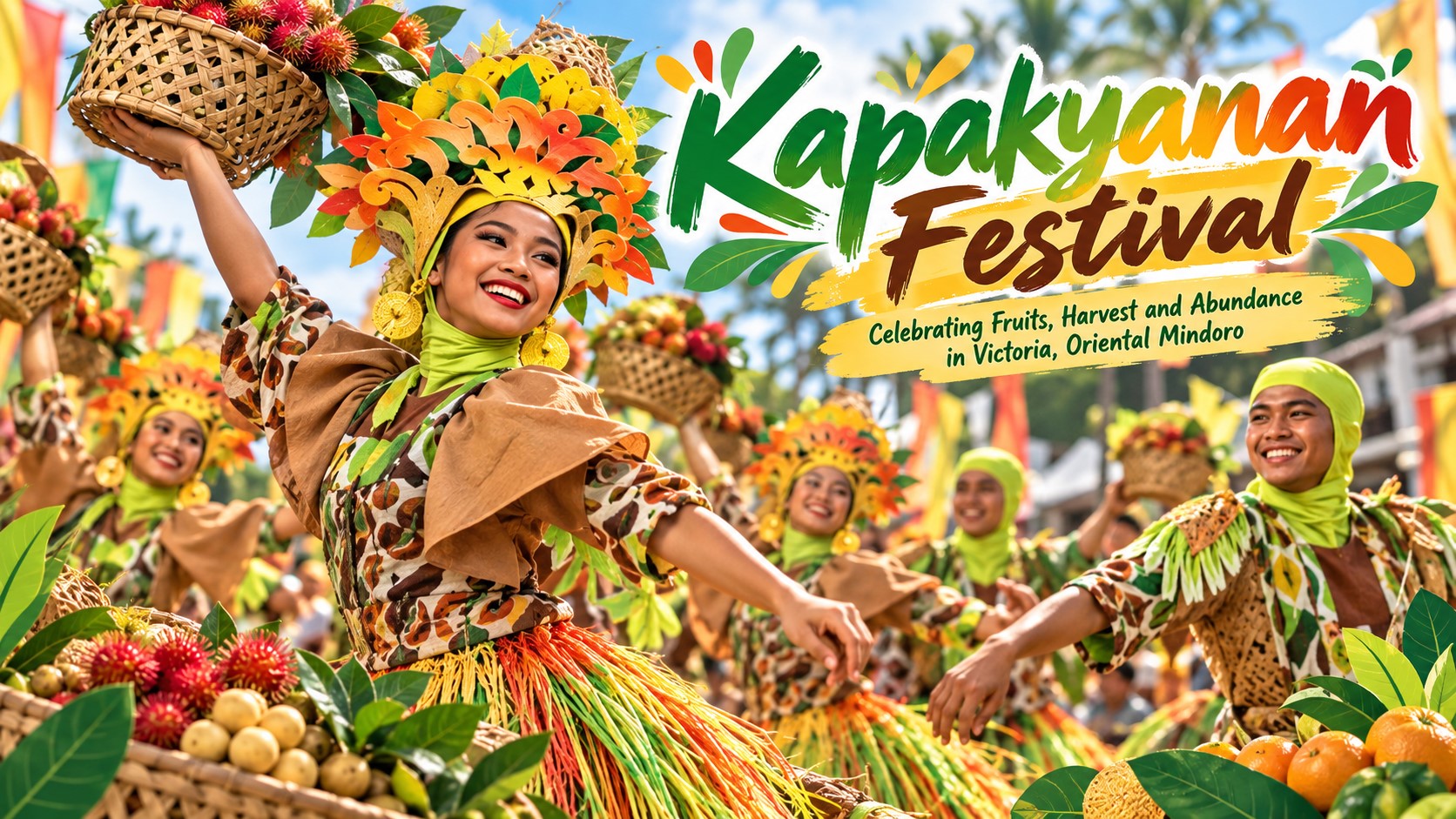
Greens, reds, yellows, oranges and earthy browns appear naturally in the fruits and crops being celebrated, and these themes frequently find their way into festival decorations, costumes and performance concepts.
Street Dancing: The Most Colorful Side of Kapakyanan
For many visitors, street dancing is likely to be the most memorable part of Kapakyanan Festival.
Groups of dancers move through the streets wearing elaborate costumes inspired by farming, fruits, leaves and the natural environment of Victoria. Official festival images show performers dressed in vivid combinations of green, orange, yellow and brown, sometimes with headdresses and accessories that clearly borrow their shapes and colors from local produce.
But festival street dancing isn’t only about creating something beautiful for spectators.
The choreography often works as a form of storytelling.
Through movement, props, costumes and music, dancers can portray planting, tending crops, harvesting and celebrating a successful farming season. What would normally happen quietly in fields and orchards becomes a performance in the middle of town.
That transformation is one of the things I love about agricultural festivals in the Philippines.
A farmer’s everyday work suddenly becomes something worthy of a parade.
And it should be.
A Festival Where Agriculture Takes Center Stage
Plenty of festivals have street dancing. What distinguishes Kapakyanan is what those performances are ultimately pointing toward.
Agriculture.
The official festival program description includes an agricultural fair, trade exhibits and harvest thanksgiving among Kapakyanan’s major highlights.
These activities give farmers, growers, entrepreneurs and local producers an opportunity to showcase what Victoria can produce.
For travelers, this side of the festival is worth exploring because it gives you something beyond the parade.
You get to see the actual products behind all those costumes.
That might include fresh fruits, crops, processed food products or locally produced goods, depending on that year’s festival program.
And when you’re attending a festival built around farming, visiting the agricultural displays isn’t just something to do while waiting for the street dancing.
It’s part of the experience.
Fruit, Fruit and More Fruit
If you enjoy tropical fruit, Kapakyanan is naturally an interesting festival to visit.
Rambutan, lanzones and durian are repeatedly identified as some of the produce associated with Victoria. Citrus is another important part of the municipality’s fruit-growing identity.
What makes this enjoyable for travelers is that the fruit isn’t hidden away behind the festival theme.
It’s the theme.
You may see fruit represented in costumes, decorations, stalls and agricultural exhibits. Depending on availability and the year’s activities, visitors may also have opportunities to buy local produce and other food products during trade fairs and community markets.
There’s something satisfying about attending a festival where the souvenirs can literally be eaten on the ferry ride home.
Agricultural and Trade Fairs
Another part of Kapakyanan worth spending time on is the trade fair.
Local fairs allow small producers and entrepreneurs to reach visitors who otherwise might never encounter their products.
Fresh agricultural produce is naturally important, but fairs can also provide a platform for processed food, handicrafts and other products from Victoria and nearby communities.
For tourists, this is a good opportunity to buy directly from local sellers instead of limiting your festival experience to watching performances from the roadside.
And if you’re visiting specifically because you’re interested in food, farming or local products, I’d actually make time for the fair instead of treating it as an afterthought.
Harvest Thanksgiving
At its core, Kapakyanan is a thanksgiving celebration.
Official tourism information specifically identifies harvest thanksgiving as one of the festival’s highlights.
That’s important because the festival isn’t simply saying, “Look how much fruit we have.”
The message is closer to, “Look at what our land and our people have given us, and let us be thankful for it.”
That may sound like a small distinction, but it explains why harvest festivals have survived in farming communities throughout the Philippines.
A successful harvest is not abstract when agriculture provides your family’s livelihood.
Weather matters. Soil matters. Labor matters. Markets matter.
So when abundance finally comes, celebration feels appropriate.
Pageants and Other Community Activities
Kapakyanan has also been associated through the years with community competitions and pageants.
Older tourism descriptions of the festival mention an agriculture-themed beauty pageant alongside street dancing as one of its highlights.
Exact events can change from one edition to another, so visitors shouldn’t assume every activity will return every year.
That’s actually common with Philippine festivals.
The main identity remains the same, while organizers may add concerts, competitions, sports activities, cultural presentations, pageants, livelihood programs or evening entertainment depending on that year’s celebration.
If you’re traveling specifically for one event, always check the official program shortly before your trip.
Kapakyanan and Victoria’s Founding Anniversary
One detail that can be confusing when researching Kapakyanan online is the date.
Some older online references place Kapakyanan around October 14 or 15.
However, the current official Oriental Mindoro tourism calendar lists Kapakyanan Festival every September 18, while historical records identify September 18 as Victoria’s founding anniversary. Provincial records have separately identified October 14–15 with Victoria’s town fiesta.
So for travelers using current information, September 18 is the date to remember for Kapakyanan.
This is also why checking recent government or tourism announcements is better than relying on old festival calendars that may still appear in Google results.
Why Kapakyanan Festival Matters
Kapakyanan may not have the nationwide fame of Sinulog, Dinagyang or Panagbenga, but that doesn’t make it less meaningful.
In some ways, smaller local festivals can give travelers a clearer picture of the community they’re visiting.
Here, the connection is easy to see.
Victoria has fertile agricultural land.
Farmers cultivate it.
The municipality becomes known for its fruits.
Those fruits support livelihoods.
And once a year, an entire festival celebrates that abundance.
There’s nothing manufactured about that story.
Kapakyanan grew out of something that already mattered to the community.
More Than a Tourist Attraction
It’s tempting to judge every festival by how impressive it looks in photos.
But Kapakyanan makes more sense when you look beyond the costumes.
Agricultural festivals help give visibility to people whose work usually happens far from tourist areas.
Farmers aren’t necessarily the people standing on a stage or leading a parade. Yet without them, the reason for Kapakyanan would disappear completely.
The festival puts their livelihood at the center of the town’s identity.
For a few days, fruit production isn’t merely an agricultural statistic.
It becomes culture.
When is the Best Time to Visit?
Kapakyanan Festival is currently celebrated annually on September 18.
If you want to experience the festival properly, I’d recommend arriving in Victoria before the main celebration rather than traveling on the morning of the biggest events.
Festival dates can bring heavier local traffic, road closures or changes in public transportation routes, particularly around street dancing and civic activities.
Coming earlier also gives you more time to explore the town, check the event venues and find out exactly where that year’s parade or competitions will take place.
September is also within the Philippines’ rainy season, so bring something for sudden rain even when the morning starts beautifully sunny.
An umbrella, lightweight rain jacket and waterproof protection for your phone or camera can make a surprisingly big difference.
Where is Kapakyanan Festival Held?
The festival takes place in Victoria, Oriental Mindoro.
The current official festival listing identifies the Victoria Municipal Grounds as its principal venue. Street dancing and other public activities may naturally extend into roads and other spaces around the town proper depending on the year’s program.
For first-time visitors, staying somewhere within or reasonably close to the town center makes things easier, particularly if several events are scheduled throughout the day.
How to Get to Victoria, Oriental Mindoro
For travelers coming from Metro Manila and other parts of Luzon, the usual gateway is Batangas Port.
From Batangas, ferries and RORO vessels travel to Calapan City. Oriental Mindoro’s tourism office estimates the Batangas-Calapan sea journey at around two to three hours, depending on the vessel and conditions.
Once you arrive in Calapan, vans and jeepneys connect the capital with other municipalities in Oriental Mindoro, including communities along the main highway. Tricycles are commonly used for shorter trips within towns.
If you’re traveling during Kapakyanan, give yourself extra allowance between ferry arrival and festival events. Missing an afternoon street dance because your ferry departed late would be a painful way to start the trip.
What to Expect if You’re Attending for the First Time
Expect a celebration that feels much more local than commercial.
You’ll likely be sharing the streets with residents, students, families, farmers, performers and visitors from nearby municipalities.
Street-dancing areas can become crowded, especially once major contingents begin performing. Arrive early if photography is important to you.
Also bring cash.
Smaller stalls and vendors may not offer cashless payment, and part of the fun of agricultural festivals is buying directly from vendors when you find something interesting.
Most importantly, don’t rush from one major attraction to another.
Walk around.
Check the fruit displays.
Talk to sellers.
Try something grown locally.
Watch the performers preparing before the parade.
Those quieter moments can sometimes tell you more about a festival than the official program does.
Kapakyanan Festival 2026
For travelers planning specifically for 2026, the Oriental Mindoro tourism calendar currently lists the Kapakyanan Festival for Friday, September 18, 2026, at the Victoria Municipal Grounds.
September 18, 2026 has also been officially declared a special non-working day in Victoria through Proclamation No. 1419 in connection with the municipality’s 73rd Founding Anniversary.
As of this writing, it’s still best to check the Municipality of Victoria or Oriental Mindoro tourism channels closer to the celebration for the detailed program of activities, including exact street-dancing times, competitions, concerts and other events.
Final Thoughts
Kapakyanan Festival tells a very simple story, and that’s exactly what makes it beautiful.
Plant.
Grow.
Harvest.
Give thanks.
Celebrate.
In Victoria, Oriental Mindoro, those ideas have become a festival filled with fruit, color, dancing and community pride.
You can come for the street dancing and the elaborate costumes. You can come because you love rambutan, lanzones or durian. You can come simply because you want to experience a festival that hasn’t yet become overwhelmingly touristy.
But spend enough time in Victoria during Kapakyanan and you’ll probably realize that the festival isn’t really about fruit alone.
It’s about abundance—and the people, land and hard work behind it.
And for a town proudly known as Oriental Mindoro’s fruit basket, there probably couldn’t be a more fitting celebration.