There are festivals named after flowers, fruits, patron saints and local products.
Bansaulog is different.
Its name is essentially an invitation for an entire town to celebrate.
Every September, the municipality of Bansalan in Davao del Sur marks its founding anniversary with several days of cultural performances, agriculture-related activities, music, competitions, pageants, community programs and one of the festival’s most colorful attractions—street dancing.
This is the Bansaulog Festival.
And if you look beyond the costumes and drums, you’ll find that the celebration tells several stories at once.
It tells the story of Bansalan becoming an independent municipality in 1952.
It recognizes a farming community whose crops and livestock remain important to the local economy.
It provides space for schools and young performers to present dances and cultural themes.
It remembers the indigenous Bagobo communities who lived in the area before modern Bansalan developed.
And perhaps most importantly, it creates a reason for Bansaleños—whether they still live in town or have moved elsewhere—to come together and celebrate where they came from.
That is essentially what the festival’s name means.
Bansaulog is a celebration of Bansalan.
And every year, everything builds toward one important date:
September 18.
Content
Bansaulog Festival at a Glance
| Details | Information |
|---|---|
| Festival | Bansaulog Festival |
| Location | Bansalan, Davao del Sur |
| Region | Davao Region / Region XI |
| Usual festival period | Mid-September |
| Traditional dates | Around September 12–18 |
| Main date | September 18 |
| Celebration | Founding anniversary / Araw ng Bansalan |
| Festival character | Cultural, historical, agricultural and civic |
| Meaning of Bansaulog | Celebration in Bansalan |
| Major attractions | Street dancing, agriculture activities, music and cultural competitions |
| Important agricultural event | Farmers’ Day / Agri Day |
| Municipality created | 1952 |
What Is Bansaulog Festival?
Bansaulog Festival is the annual founding-anniversary celebration of the Municipality of Bansalan in Davao del Sur.
The celebration normally takes place during the middle of September and culminates on September 18, the date Bansalan observes as its founding anniversary.
Past festival programs have included street dancing, folk dancing, drum-and-lyre performances, agricultural activities, Indigenous Peoples’ Day, pageants, youth competitions and community events. More recent editions have continued expanding the celebration with concerts and other activities.
That makes Bansaulog different from a traditional patronal fiesta.
It isn’t primarily organized around one religious feast.
Instead, the centerpiece is the town itself.
Bansalan’s history.
Its people.
Its farms.
Its schools.
Its cultural communities.
Its progress.
And its anniversary.
In many ways, Bansaulog is the town saying:
This is Bansalan. Let’s celebrate it together.
What Does “Bansaulog” Mean?
The name is a combination of Bansalan and saulog.
Saulog is a Cebuano/Visayan term connected with celebrating or commemorating something.
The Philippine Carabao Center explains that Bansaulog combines the name Bansalan with saulog, producing the idea of “Kasaulogan sa Bansalan”—a celebration in or of Bansalan.
It is one of those festival names that makes more sense once you separate the pieces.
Bansalan + saulog = Bansaulog.
Simple.
But that simplicity also works well because the festival isn’t limited to one product or one performance.
The subject of the celebration really is the entire municipality.
When Is Bansaulog Festival Celebrated?
The most important date is:
September 18
That is Bansalan’s founding-anniversary celebration.
Traditional festival calendars have commonly placed Bansaulog activities between September 12 and September 18, although actual programs can begin earlier or vary from year to year.
September 18 has become even more formally associated with the municipality’s anniversary.
Republic Act No. 12247, approved in 2025, declares September 18 of every year a special working holiday in Bansalan, Davao del Sur, in commemoration of its foundation anniversary.
For travelers, the lesson is simple:
If you’re interested in the full festival atmosphere, don’t plan only for September 18.
Try to be in Bansalan during the days immediately before it.
Some of the best cultural and agricultural activities may happen earlier in festival week.
Why Does Bansalan Celebrate Its Anniversary on September 18?
This part of the history can be a little confusing.
Legally, President Elpidio Quirino signed Executive Order No. 506 on June 6, 1952, organizing part of the Municipality of Digos into a new independent municipality called Bansalan.
So why isn’t Bansaulog celebrated every June 6?
Because September 18 became associated with the actual organization and beginning of the new municipal government.
Historical accounts of Bansalan say Apolonio Ilagan, a Philippine Constabulary captain, assumed office as the first mayor on September 18, 1952. The town consequently adopted September 18 as the anniversary it celebrates.
That distinction is worth explaining.
June 6 represents the executive order creating the municipality.
September 18 became the anniversary date Bansalan recognizes and celebrates locally.
And that is the date around which Bansaulog developed.
A Short History of Bansalan
Long before there was a municipality called Bansalan, the area was inhabited by indigenous communities, particularly Bagobo people.
The Bansalan municipal government’s own historical account describes the area as once being heavily forested and inhabited by Bagobo communities who practiced hunting, fishing, agriculture and distinctive cultural traditions.
Eventually, roads, migration, trade and settlement changed the area considerably.
Bansalan first formed part of a larger jurisdiction.
Historical accounts say it had once been within Santa Cruz and later became part of Digos.
Then came 1952.
Executive Order No. 506 separated the western portion of Digos and created the new municipality of Bansalan.
The territory was once much larger than the Bansalan we know today.
Matanao was later separated into its own municipality in 1957, while Magsaysay followed in the 1960s.
So Bansaulog is really celebrating one chapter in a much longer local history.
Where Did the Name Bansalan Come From?
There are different stories.
And this is one area where it’s better not to pretend there is only one unquestioned explanation.
The municipality’s official historical account preserves a tradition that Bansalan was named after a farmer called Bansalan, who discovered a spring that developed into an important water source for the community.
Another frequently repeated local account says the name may have been connected with an indigenous leader or datu and subsequently altered through early recording or surveying.
A recent feature about the municipality also mentions a tradition involving a Bagobo chieftain whose name was rendered differently before eventually becoming Bansalan.
These stories are best understood as local naming traditions rather than one definitively proven etymology.
What matters for Bansaulog is that the name Bansalan itself carries generations of local memory.
When Did the Modern Bansaulog Festival Begin?
This is another important distinction.
Bansalan’s founding anniversary dates to 1952.
But Bansaulog as a named festival is much younger.
A 2016 BusinessMirror feature quoting Bansalan’s then-designated tourism officer explained that Bansaulog had only been established within the previous decade.
The idea was to create something memorable that could represent the town, including for Bansaleños who had moved away or were living abroad.
That likely places the organized Bansaulog identity somewhere in the 2000s.
So Bansaulog isn’t an ancient festival unchanged for generations.
It is a relatively modern cultural celebration built around a much older community.
And that’s perfectly normal.
Many Philippine festivals were formalized only in recent decades as towns began using cultural events to preserve heritage, promote tourism and strengthen local identity.
Bansaulog Street Dancing
This is usually the part that produces the most colorful photographs.
Schools and community contingents take over Bansalan’s streets in elaborate costumes while drums and music set the rhythm.
Recent descriptions of Bansaulog characterize the celebration as culminating in street dancing involving elementary and high-school participants.
Older festival accounts likewise describe the streets becoming especially lively during the street-dancing day.
And the performances aren’t simply random choreography.
Bansaulog has traditionally encouraged participants to highlight Bansalan’s culture and history.
Some presentations incorporate agricultural imagery.
Others reference indigenous artistic elements or Mindanao cultural traditions.
Another group might build a performance around unity, community development or the story of Bansalan itself.
Indayog sa Bansaulog
More recent editions have used Indayog sa Bansaulog for major dance or street-dancing competitions.
The idea fits naturally with a festival increasingly driven by school contingents and younger performers.
These competitions give students an opportunity to perform large-scale choreography while representing their schools and communities.
And because schools return year after year, the festival becomes a training ground for:
dancers,
musicians,
choreographers,
costume makers,
props designers,
and young cultural performers.
That is an underrated part of local festivals.
They’re not just producing a show.
They’re producing the next group of people who know how to create the show.
Bansaulog Costumes
Don’t expect every Bansaulog contingent to look the same.
Unlike festivals built around one strictly standardized costume, Bansaulog gives performers considerable creative freedom.
Depending on the yearly theme, you may see:
bright blues,
reds,
yellows,
greens,
beaded designs,
large headdresses,
agricultural motifs,
tribal-inspired patterns,
feather-like shapes,
plant imagery,
and dramatic props.
The strongest designs usually have something to say about Bansalan.
They might represent agriculture.
Nature.
Indigenous cultural heritage.
Unity.
Growth.
Or the municipality’s history.
That variety gives each Bansaulog edition a different visual identity.
Bagobo Heritage and Bansaulog
The Bagobo story belongs to Bansalan’s history and should be treated with care rather than used simply as decorative festival imagery.
Bansalan’s official history identifies Bagobo communities among the original inhabitants of the area.
Older Bansaulog programs recognized that heritage through activities such as Indigenous Peoples’ Day, during which indigenous communities were invited to present aspects of their culture and arts.
That distinction matters.
There’s a big difference between a school wearing a costume loosely inspired by indigenous designs and an indigenous community presenting its own traditions.
Visitors should avoid assuming that every feather, bead or geometric pattern used in festival choreography is an exact representation of authentic Bagobo ceremonial clothing.
Festival design is theatrical.
Actual indigenous heritage is much deeper.
Salinta Monon and the Weaving Heritage of the Area
Bansalan also has an important connection to one of the Philippines’ celebrated traditional textile artists.
Salinta Monon, known for preserving the Bagobo inabal weaving tradition, lived in the Bansalan area and was recognized as a National Living Treasure or Gawad sa Manlilikha ng Bayan.
A 2026 feature on Bansalan specifically highlights her connection with Barangay Bitaug and the town’s wider Bagobo cultural heritage.
That gives visitors another perspective on the patterns they encounter during local cultural celebrations.
The textile traditions of Mindanao aren’t simply festival decorations.
They come from real communities, real artists and generations of knowledge.
Agriculture: One of the Most Important Parts of Bansaulog
If street dancing is the most photogenic side of Bansaulog, agriculture may be the most practical.
Bansalan is strongly connected with farming.
And festival organizers have repeatedly used Bansaulog to recognize local farmers and showcase agricultural production.
Older Bansaulog programs included an Agriculture Day where farmers displayed crops and joined competitions.
More recently, Farmers’ Day has remained an important part of the festival.
During the 2024 celebration, the Philippine Carabao Center reported that Bansalan opened Farmers’ Day with a carabao parade, with decorated animals moving through town to represent the municipality’s agricultural industry and farming community.
Now that is something you don’t see at every festival.
The Carabao Parade
Picture nine carabaos walking through the streets of Bansalan, each decorated for the festival.
It might look playful at first.
But the symbolism is straightforward.
For generations, carabaos have been closely associated with Philippine farming.
They represent work.
Fields.
Food production.
Rural livelihood.
And resilience.
During the 2024 Bansaulog Farmers’ Day, nine decorated carabaos were paraded through town while agriculture agencies also distributed livestock to support local farmers.
That makes the event more than a photo opportunity.
It’s the festival publicly acknowledging the people who produce food.
Agriculture Is Part of Bansalan’s Identity
Bansalan’s agricultural connection goes beyond Bansaulog.
One interesting site in the municipality is the Mindanao Baptist Rural Life Center, where the well-known Sloping Agricultural Land Technology, or SALT, was developed to help farmers cultivate upland land more sustainably.
The agricultural work there became internationally recognized, and Harold Watson received the Ramon Magsaysay Award in 1985 for his contributions.
Bansalan also has farms involved in coconut products and other agricultural enterprises.
So when Bansaulog gives an entire day to farmers, it isn’t adding agriculture merely because every festival needs another activity.
Agriculture belongs to the town’s story.
Folk Dancing and Cultural Competitions
Street dancing isn’t the only dance tradition associated with Bansaulog.
Older programs included a Folk Dance Competition intended to encourage young Bansaleños to learn dances passed down through generations.
Festival organizers described the activity as part of keeping cultural traditions alive among younger residents.
That gives Bansaulog another dimension.
Modern festival choreography can be spectacular.
But traditional dance competitions remind participants that not every cultural performance needs enormous props and a hundred dancers.
Sometimes preservation begins by learning the steps correctly.
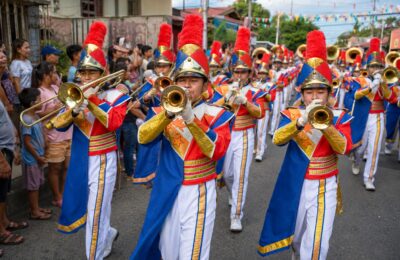
Drum and Lyre
If you’re attending Bansaulog with children, this can be one of the most enjoyable parts.
Drum-and-lyre groups bring school energy into the festival.
Uniformed students march together while percussion establishes the rhythm and lyres carry the melody.
Older Bansaulog celebrations consistently included drum-and-lyre presentations among the week’s major activities.
And like street dancing, these competitions do something useful beyond entertainment.
They give students a reason to learn music.
Mutya ng Bansalan and Festival Pageants
Pageants have also formed part of Bansaulog through the years.
The Mutya ng Bansalan competition appeared in older festival programs alongside cultural and community activities.
Like many local Philippine pageants, the competition isn’t simply about appearance.
Contestants often become representatives of barangays, schools or communities and may be asked about local issues, tourism and culture.
The exact pageant format can change depending on the year.
Bansaulog as a Homecoming Festival
One reason Bansaulog was deliberately created was to give Bansaleños something they could identify with even after moving away.
That idea remains important.
Municipal anniversaries naturally become homecoming occasions.
Former residents visit.
Families reunite.
Old classmates meet again.
People working in Davao City, elsewhere in Mindanao, Manila or overseas return home.
A festival gives those people a date to remember.
September 18.
It becomes:
“When are you going home?”
“For Bansaulog.”
That’s how a relatively young festival can quickly become tradition.
Bansaulog vs. Dorongan Festival
Visitors researching Bansalan may encounter another festival:
Dorongan Festival.
They’re different celebrations.
Bansaulog takes place in September and commemorates Bansalan’s founding anniversary.
Dorongan is associated with the town’s Santo Niño celebration and is held around the beginning of the year. Bansalan’s official 2026 materials show Dorongan activities, including inter-school Sinulog dance competitions, taking place in January.
So if you see photos of Bansalan dancers carrying Santo Niño images, don’t automatically assume you’re looking at Bansaulog.
That may be Dorongan.
Bansaulog’s central subject is the municipality itself.
What Does Bansaulog Feel Like?
Imagine arriving in Bansalan during the middle of September.
Banners already hang across roads.
Schools are rehearsing.
Farm products begin appearing in exhibits.
Government offices and community groups prepare their activities.
At some point during festival week, farmers and agricultural workers take center stage.
Another day belongs to music or dance.
Pageant candidates appear around town.
Then the street-dancing day arrives.
Participants gather early.
Costumes that took weeks to prepare finally come out.
Drums begin.
Parents line the streets with phones ready.
Vendors sell drinks and snacks.
The first contingent starts moving.
By September 18, everything reaches the anniversary celebration.
That is Bansaulog.
It isn’t one parade.
It’s several days of a town paying attention to itself.
When Is the Best Time to Visit Bansaulog?
If you want the widest range of events, I would target the final few days before September 18.
A trip around September 15–18 has historically placed visitors close to many of the largest festival activities.
However, the exact street-dancing date isn’t permanently fixed.
Some editions hold it the day before the anniversary.
Agricultural activities can happen earlier.
Concerts may have their own dates.
So always check the current official schedule before booking specifically for one competition.
Getting to Bansalan
Bansalan is in Davao del Sur, west of Digos City.
A recent profile places it roughly 22 kilometers west of Digos and around 72 kilometers south of Davao City, with road transportation providing the main access.
For travelers arriving by air, Davao City is the major gateway.
From there, the trip continues overland toward Davao del Sur and Bansalan.
Travelers already in Digos can make the much shorter westward journey.
Bansalan also sits along routes connecting this part of Davao del Sur with areas toward Kidapawan and Cotabato.
During Bansaulog, allow additional time.
Parades, ceremonies and road closures can affect normal traffic.
Bansalan Beyond Bansaulog
If you’re traveling all the way to Bansalan, don’t leave immediately after the festival.
The municipality has a surprisingly interesting combination of nature and agriculture.
A recent travel profile highlights several waterfalls around the area, particularly in Balutakay, including Tinago Falls and Kalanggaman Falls.
Bansalan’s agricultural sites can also interest travelers curious about sustainable farming.
That makes the town quite different after festival day.
One moment you’re surrounded by drums and street dancers.
The next, you’re somewhere much quieter surrounded by farms or waterfalls.
The “Green Town” Side of Bansalan
Bansalan has increasingly been promoted as a kind of green or agricultural destination.
Part of that reputation comes from its farming history and the development of sustainable agricultural techniques such as SALT.
The municipality is also surrounded by landscapes shaped by the foothills and agricultural areas of southern Mindanao.
That gives festival visitors another reason to stay longer.
Bansaulog shows you the people.
The countryside shows you the environment supporting many of their livelihoods.
Tips for First-Time Bansaulog Visitors
Come earlier than the announced street-dancing start time.
Once spectators line the route, finding a good view becomes difficult.
Wear comfortable shoes.
You’ll probably walk much more than expected.
Bring water and sun protection, but prepare for rain too. September weather in Mindanao can change quickly.
Keep some cash for small vendors.
If you’re photographing indigenous participants or cultural presentations, do so respectfully and avoid treating sacred or traditional elements as costume props.
And if Farmers’ Day is part of your visit, make time for it.
It may not receive as much online attention as street dancing, but it probably tells you more about everyday Bansalan.
Bansaulog Festival Frequently Asked Questions
Where is Bansaulog Festival celebrated?
Bansaulog Festival is celebrated in Bansalan, Davao del Sur, in the Davao Region of Mindanao.
When is Bansaulog Festival?
The festival is traditionally held during mid-September and commonly associated with September 12–18.
The main anniversary date is September 18.
What does Bansaulog mean?
The name combines Bansalan with the Visayan/Cebuano word saulog, meaning to celebrate or commemorate.
It expresses the idea of Kasaulogan sa Bansalan—the celebration of Bansalan.
Why is Bansaulog celebrated?
It commemorates Bansalan’s founding anniversary while showcasing the municipality’s culture, agriculture, youth, history and community life.
When was Bansalan founded?
President Elpidio Quirino signed Executive Order No. 506 creating the Municipality of Bansalan on June 6, 1952. The municipality observes September 18 as its founding-anniversary date, associated with the organization of the local government and assumption of office of its first mayor.
Is Bansaulog a religious festival?
Not primarily.
Bansaulog is a civic, cultural and historical festival commemorating Bansalan’s founding anniversary.
Bansalan has separate religious celebrations, including Dorongan Festival connected with Santo Niño devotion.
What is Bansaulog famous for?
Its attractions have included street dancing, folk dancing, drum-and-lyre presentations, pageants, Farmers’ Day, agricultural exhibits, indigenous cultural activities and entertainment programs.
Is agriculture important to Bansaulog?
Very much so.
Agriculture Day or Farmers’ Day has been a recurring part of the festival. In 2024, the celebration included a decorated carabao parade honoring the municipality’s farming community.
Are there indigenous cultural elements in Bansaulog?
Yes.
Bagobo communities form an important part of the area’s history, and older Bansaulog programs included an Indigenous Peoples’ Day showcasing indigenous culture and arts.
Is Bansaulog Festival the same as Dorongan Festival?
No.
Bansaulog celebrates Bansalan’s founding anniversary in September.
Dorongan is a separate celebration associated with Santo Niño devotion and is held earlier in the year.
Bansaulog Festival 2026
This guide is designed to remain useful year after year, but 2026 is a particularly important Bansaulog edition.
Bansalan is celebrating its:
74th Founding Anniversary
The Municipal Government of Bansalan is officially promoting the celebration as the 74th Araw ng Bansalan – Bansaulog Festival.
The most important date is:
September 18, 2026
President Ferdinand Marcos Jr., through Proclamation No. 1418, series of 2026, declared September 18 a special non-working day in Bansalan so residents could participate in the municipality’s 74th founding-anniversary celebration.
This is separate from Republic Act No. 12247, which makes September 18 an annual special working holiday unless a presidential proclamation provides otherwise for a particular year.
At least one major new 2026 event has also been announced: the 1st Mayor Edwin G. Reyes Bansalan Music Festival, being staged as part of the 74th Araw ng Bansalan celebration.
The broader Bansaulog tradition usually places events throughout the days leading to September 18, but anyone traveling for the 2026 street-dancing competition, Farmers’ Day, concerts or pageants should check the final LGU Bansalan timetable because specific event times and venues can still vary.
Final Thoughts
Bansaulog is one of those festivals that becomes easier to understand once you stop looking for one single symbol.
There isn’t one.
Bansaulog is not only about a particular crop.
It isn’t only about street dancing.
It isn’t centered exclusively on one patron saint.
The symbol is Bansalan itself.
That is why one day can belong to farmers.
Another can belong to students.
Another can showcase indigenous heritage.
Another can fill the streets with dancers.
And eventually everyone arrives at September 18.
The festival remembers a municipality that officially emerged from Digos in 1952, but it also acknowledges stories that go much further back—to Bagobo communities, old settlements, farming traditions and the people who gradually built modern Bansalan.
For visitors, street dancing will probably be the easiest part to remember.
The costumes are colorful.
The music is loud.
The energy is infectious.
But if you stay for Farmers’ Day, learn a little about Bansalan’s indigenous heritage, visit the surrounding agricultural areas and understand why September 18 matters, the festival begins to look different.
You realize that “Bansaulog” really does describe the entire event perfectly.
It is not a celebration of one thing found in Bansalan.
It is Bansalan celebrating itself.