As darkness settles over Alfonso, Cavite, a bed of glowing embers becomes the center of everyone’s attention.
The crowd grows quieter. Ritual performers dressed in red gather near the fire while prayers and chants create an atmosphere very different from an ordinary street-dancing competition.
Then, one of the performers steps forward.
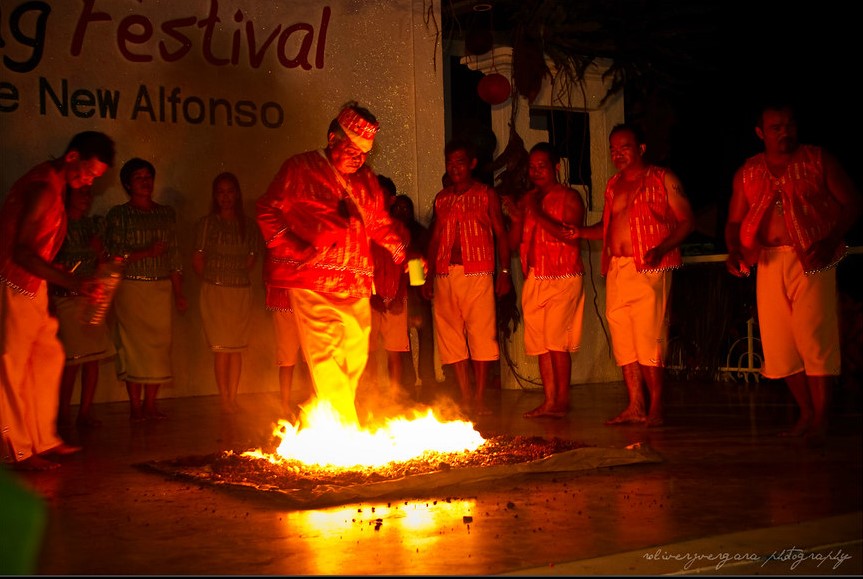
Barefoot, the dancer moves across the burning coals. Others follow, circling the fire and continuing the ritual without showing the panic most of us would feel simply standing close to the flames.
This is Sayaw sa Apoy, the most dramatic and widely photographed part of the Sanghiyang tradition.
However, Sanghiyang is much more than fire dancing.
It is a thanksgiving and healing ritual preserved in Alfonso, Cavite. It reflects the meeting of older folk beliefs, community spirituality and Christian faith. Traditionally, families performed it to express gratitude, seek protection, bless a home, ask for healing or mark an important moment in community life.
Over time, this intimate ritual became the inspiration for a public cultural festival featuring street dancing, traditional music, red costumes and demonstrations of Sayaw sa Apoy.
For visitors, the celebration offers a rare opportunity to witness a tradition that cannot be understood by appearance alone. The fire is spectacular, but the deeper story is about faith, gratitude, healing and the relationship between Alfonso’s present-day residents and the beliefs of earlier generations.
Content
What Is the Sanghiyang Festival?
The Sanghiyang Festival is a cultural celebration associated with the traditional Sanghiyang ritual of Alfonso, Cavite.
The Philippine News Agency describes Sanghiyang as a local dance ritual combining folk belief, religion and magic. It was traditionally performed as thanksgiving for an abundant harvest and is preserved as part of Alfonso’s cultural heritage.
Festival presentations have included:
- Ritual-inspired street dancing
- Cultural parades
- Traditional costumes
- Chants and musical performances
- Thanksgiving presentations
- Community feasts
- Heritage demonstrations
- Sayaw sa Apoy
Older festival programs involved schools and barangays presenting their interpretations of the Sanghiyang tradition through choreographed performances.
These public presentations should be distinguished from the ritual itself.
A street-dancing contingent may use red costumes, fire-inspired props and theatrical choreography to represent Sanghiyang. The actual ritual, however, carries spiritual meaning for its practitioners and may be performed separately from the festival competition.
Sanghiyang Is Not the Same as Sayaw sa Apoy
One of the most important things to understand is that Sanghiyang and Sayaw sa Apoy are not interchangeable names.
Sayaw sa Apoy is only one part of the wider Sanghiyang tradition.
Alfonso Turismo explains that the fire dance is an additional or culminating presentation connected with Sanghiyang. The preliminary ritual must come first when the two are performed together, although Sanghiyang may also be conducted without fire dancing.
Think of Sanghiyang as the entire spiritual practice.
Sayaw sa Apoy is its most dramatic physical expression.
Focusing only on the flames can cause visitors to miss the ritual’s deeper purpose. The performance is not simply meant to show that someone can walk over burning coals.
For practitioners, it represents faith, devotion and a state of spiritual preparedness.
What Does “Sanghiyang” Mean?
The exact linguistic origin of the word is not firmly documented in easily accessible historical records.
A popular modern explanation combines the Tagalog words isa, meaning one, and hiyang, referring to compatibility, harmony or being suited to something. Under this interpretation, Sanghiyang represents a unified or harmonious whole.
This explanation appears frequently in school presentations and local festival materials, but it should be treated as a community interpretation rather than an unquestionably proven etymology.
What is clearer is the concept associated with the tradition.
Sanghiyang seeks harmony among the body, mind, spirit, household and community. It is connected with gratitude, protection, healing and the desire to restore balance when something feels wrong.
The name therefore fits the ritual even when its exact linguistic history remains uncertain.
The Folk and Religious Roots of Sanghiyang
Sanghiyang is often described as a precolonial or indigenous-influenced practice that later absorbed Christian prayers, symbols and beliefs.
This blending is common in Filipino folk religion.
Before Christianity arrived, communities already performed rituals connected with ancestors, nature, illness, harvests and household protection. When Catholicism spread during the Spanish period, older practices did not always disappear completely.
Instead, people sometimes incorporated:
- Christian prayers
- Biblical passages
- Images of saints
- The sign of the cross
- Candles
- Holy water
- Belief in God
These were combined with inherited chants, healing practices and rituals associated with ancestors or unseen spiritual forces.
Sanghiyang reflects this layered history. It has been described as a ritual involving folk spirituality, religious belief and healing rather than fitting neatly into only one category.
This does not mean every Alfonseño practices or interprets it in exactly the same way.
Some residents view it primarily as cultural heritage. Others understand it through family faith and spiritual experience. Still others appreciate it as a historical tradition even when they do not personally share all its beliefs.
What Was Sanghiyang Traditionally Performed For?
Sanghiyang was not originally created as a tourist performance.
It was conducted for particular household or community purposes.
These could include:
Thanksgiving
Families might perform Sanghiyang after receiving a blessing, recovering from hardship or completing a successful harvest.
Food, prayer and communal participation expressed gratitude for what had been received.
Healing
The ritual could be connected with a person experiencing illness or a condition believed to have a spiritual dimension.
Practitioners might pray, chant and perform symbolic actions intended to restore harmony.
This historical role should not be confused with modern medical care. Anyone experiencing illness should still seek qualified health professionals.
House Blessing
Sanghiyang could be performed when entering a new home or when a household was experiencing repeated difficulties.
The ritual sought safety, peace and protection for the people living there.
Ancestral Offering
Some versions involved remembrance or acknowledgment of ancestors.
Alfonso Turismo describes Sanghiyang as a preliminary ritual that may precede ancestral offerings, healing practices, house-blessing traditions and Sayaw sa Apoy.
Agricultural Thanksgiving
The ritual became strongly associated with gratitude for a bountiful harvest.
This agricultural connection helped make Sanghiyang suitable for a public festival in a farming town such as Alfonso.
The Sanghiyang Ritual
The exact form of Sanghiyang may differ according to the practitioners, family tradition and reason for conducting it.
It should not be reduced to a fixed sequence copied from a tourism program.
A traditional gathering may involve:
- Preparatory prayers
- Chants or orasyon
- Candles
- Offerings of food
- Ritual movement
- Musical accompaniment
- Blessing of participants or a household
- A communal meal
- Sayaw sa Apoy when appropriate
The atmosphere may shift gradually.
A gathering can begin quietly with prayers and preparation. Music and repetitive movement may follow, creating a rhythm that allows performers to concentrate deeply on the ritual.
Participants may enter a state that observers interpret as intense spiritual focus or trance.
Visitors should avoid making sensational claims about possession or supernatural events they do not understand. What one person calls a trance may be understood by practitioners as devotion, spiritual openness or ritual concentration.
The respectful approach is to describe what can be observed without mocking the participants or declaring their beliefs to be proven facts.
Sayaw sa Apoy
Sayaw sa Apoy is the fire-dancing component that made Alfonso nationally known.
Barefoot practitioners move over or around a prepared bed of glowing coals. They may carry candles, continue chanting or perform repeated movements while the fire illuminates the ritual space.
Alfonso Turismo describes the practice as a manifestation of the performers’ faith in God.
The visual impact is unforgettable.
The dancers’ red garments reflect the orange light. Smoke moves through the air, and spectators react each time a bare foot touches the embers.
However, the performers do not approach the fire casually.
The dance comes after ritual preparation and is conducted by people familiar with the tradition. It should not be copied by spectators or treated as an open challenge.
Is Sayaw sa Apoy a Trick?
Visitors sometimes assume that the coals must be fake or that performers secretly protect their feet.
Others immediately conclude that the dancers’ safety proves supernatural protection.
Neither conclusion should be made without evidence.
Firewalking can be influenced by factors such as the type and condition of the fuel, the surface of the embers, the duration of contact and the way a person moves. Those factors do not make it harmless.
Serious burns remain possible.
The Sanghiyang fire dance also carries spiritual and cultural meaning that cannot be explained solely as a physical demonstration.
A respectful visitor does not need to choose between ridiculing the ritual and making exaggerated supernatural claims.
You can recognize both realities:
The performance involves real physical danger, and its practitioners understand it through faith and inherited tradition.
Never Attempt Firewalking Yourself
Sayaw sa Apoy should never be copied after watching a festival video.
Do not:
- Step onto remaining embers after the ritual
- Touch the coals
- Challenge friends to cross the fire
- Bring children into the performance area
- Assume ordinary footwear provides protection
- Attempt your own backyard version
- Distract performers while they are near the flames
Burn injuries can be severe and may require emergency medical treatment.
Only authorized ritual practitioners and event personnel should enter the fire area. Spectators must remain behind the safety boundary established by organizers.
Cultural appreciation means respecting the limits of your role as a visitor.
The Original Fire Dancers of Alfonso
Alfonso’s fire dancers gained attention beyond Cavite during the second half of the 20th century.
Older accounts recall a period when the town became widely associated with fire dancing and performers were invited to demonstrate the tradition before guests and visitors. A photograph documenting the 2011 festival describes Alfonso as once being promoted as the “home of the fire dancers.”
The attention helped place Alfonso on the cultural map.
However, publicity can also change how a ritual is perceived.
When a sacred or household practice is moved onto a public stage, audiences may focus on spectacle. The most visually dramatic portion is repeated, while quieter prayers and preparations receive less attention.
This is why Alfonso Turismo’s clarification that Sayaw sa Apoy is only part of Sanghiyang is important.
Without the ritual context, the dancers can be reduced to entertainers performing a dangerous stunt.
Sanghiyang as Intangible Cultural Heritage
Unlike a historic church or ancestral house, Sanghiyang cannot be preserved simply by repairing a building.
It is an example of living or intangible heritage.
Its survival depends on people who know:
- The prayers and chants
- The meaning of ritual objects
- The order of activities
- The musical patterns
- The responsibilities of participants
- The proper conditions for performance
- The stories associated with the tradition
Alfonso Turismo continues to document Sayaw sa Apoy under its intangible-cultural-heritage materials, emphasizing that the practice remains part of the town’s cultural identity even as public festival formats evolve.
Recording videos and writing articles can help, but documentation alone is not enough.
The tradition survives only when knowledge is passed responsibly to younger community members and when practitioners are treated with dignity.
From Household Ritual to Public Festival
The transition from private ritual to public festival allowed more people to learn about Sanghiyang.
Schools and barangays created performances inspired by the traditional practice. Dancers wore red, used fire imagery and presented stories of thanksgiving, healing and agricultural life.
Public staging also created tourism and educational opportunities.
Visitors who might never be invited to a private ritual could witness a respectful cultural presentation. Students could study their town’s traditions, and older practitioners could explain the difference between authentic Sanghiyang and theatrical interpretation.
However, festival organizers face an important responsibility.
They must avoid changing a sacred practice into a competition where the winner is simply the group with the biggest flames or most dangerous stunts.
Cultural preservation should prioritize meaning, safety and community authority over spectacle.
Street-Dancing Presentations
Festival street dancing gives schools and barangays a safer way to interpret Sanghiyang.
Instead of placing every participant near real fire, choreographers can use:
- Red and orange fabric
- Flame-shaped props
- Candles or battery-powered lights
- Baskets and agricultural tools
- Harvest symbols
- Traditional clothing
- Percussion instruments
- Ritual-inspired formations
The dancers may begin with scenes of farmers preparing land and planting crops.
Other performers represent sunlight, rain and a successful harvest. The group then offers thanksgiving before transitioning into movements inspired by Sanghiyang and Sayaw sa Apoy.
Red is commonly used because of its association with fire, energy and the clothing seen in ritual presentations.
The performance becomes an interpretation rather than a reproduction of the entire spiritual practice.
Music, Chants and Rhythm
Rhythm helps shape the Sanghiyang atmosphere.
Repetitive percussion and vocal patterns can help participants maintain movement and concentration. Chants may include prayers, ritual phrases or community responses.
In a festival setting, musicians may combine traditional patterns with more modern arrangements.
The music often begins slowly before becoming more intense as the performance approaches its fire-inspired climax.
Visitors should listen to the complete progression rather than recording only the moment when the dancers cross the coals.
The quiet beginning and gradual preparation are part of the story.
Traditional Clothing
Ritual performers are commonly photographed wearing red clothing, sometimes paired with light-colored trousers, head coverings or simple decorative details.
The clothing is visually striking beside the fire, but its purpose is not merely theatrical.
In festival street dancing, designers may expand the basic palette with:
- Gold
- Orange
- Black
- Brown
- White
- Green
Gold and orange suggest flame and light. Brown and green connect the performance with agriculture, while white can represent prayer, healing or spiritual purity.
Costumes should remain respectful.
Designers need to avoid turning ritual practitioners into exaggerated fantasy characters unrelated to Alfonso’s actual tradition.
Community Feasting
Thanksgiving rituals in the Philippines are often connected with food.
Families prepare meals not only for their immediate household but also for relatives, neighbors and ritual participants.
Sharing food turns spiritual gratitude into a social experience.
The gathering reinforces relationships because people pray, prepare, eat and remember together.
During a public festival, this communal element may appear through food stalls, local-product booths and meals shared after performances.
The menu is not necessarily fixed, but visitors may encounter familiar Caviteño dishes, rice delicacies, coffee, fruit products and food made from Alfonso’s agricultural harvests.
Sanghiyang and Alfonso’s Agricultural Roots
Alfonso’s countryside has long supported farming, orchards, livestock and other rural livelihoods.
Thanksgiving for a successful harvest therefore has practical meaning.
A farmer depends on rain, soil, labor and conditions that cannot be controlled completely. Even after months of work, storms, pests or unstable prices can affect the result.
A ritual of gratitude acknowledges both effort and uncertainty.
This agricultural identity is also reflected in Alfonso’s newer Organiko Festival, which emphasizes organic farming, local products and support for farmers.
Recent official tourism promotion has focused more strongly on Organiko as the municipality’s major annual public festival, while Sanghiyang continues to be documented as an important heritage practice.
The two should not be treated as rivals.
Organiko celebrates modern agriculture and livelihood. Sanghiyang protects an older spiritual tradition connected with thanksgiving, healing and community harmony.
When Is the Sanghiyang Festival Celebrated?
This question does not have one simple answer because the public festival schedule has changed over time.
Older references placed Sanghiyang around the third weekend of January. Some festival materials described a Saturday parade followed by Sayaw sa Apoy, while others identified the third Sunday.
A documented 2018 edition was held in December alongside other Cavite municipal festivals.
In more recent years, Alfonso’s large December celebration has generally been promoted under the Organiko Festival name. Sanghiyang and Sayaw sa Apoy may appear as heritage presentations, special cultural programs or independently arranged rituals rather than a guaranteed standalone festival every year.
As of July 2026, I could not verify a complete official schedule for a separate 2026 Sanghiyang Festival from readily accessible municipal announcements.
Travelers should therefore avoid booking a trip based solely on an old January or December festival calendar.
Check current announcements from:
- Alfonso Turismo
- The Municipal Government of Alfonso
- Cavite Tourism
- Organiko Festival organizers
- Local cultural groups
Ask specifically whether the program includes an authentic Sanghiyang presentation or Sayaw sa Apoy.
Where Is the Festival Held?
Public presentations have traditionally been associated with Alfonso town proper, schools, municipal activity areas and community venues.
The exact location can change depending on whether the event is:
- A street-dancing competition
- A public heritage demonstration
- A cultural presentation during Organiko
- A privately organized community ritual
- A tourism or educational event
A private Sanghiyang ceremony should not be treated as an attraction that visitors can enter without invitation.
When a public performance is officially announced, follow the venue and registration information provided by organizers.
Do not rely on asking random residents to lead you to a ritual household.
What the Festival Feels Like
A Sanghiyang presentation feels different from a typical agricultural festival.
During the afternoon, the atmosphere may still be bright and festive.
Street dancers move through Alfonso wearing red costumes. Drums play, crowds gather and groups present colorful interpretations of harvest and thanksgiving.
As evening arrives, the mood changes.
The ritual area is prepared. Spectators are kept at a distance while authorized practitioners gather.
The flames become the main source of light.
Conversation grows quieter, and the event feels more intimate even when a large crowd is present.
When the fire dancing begins, excitement mixes with uneasiness.
You can feel the heat from a distance. Every movement across the embers appears dangerous, but the performers remain focused.
The most meaningful moment may come after the fire.
The dancers step away, prayers conclude and the crowd slowly returns to ordinary conversation. What looked like a dramatic climax becomes one part of a larger expression of gratitude and faith.
Respectful Etiquette for Visitors
Observe Quietly During Prayers
Do not talk loudly, laugh or provide your own commentary while ritual prayers are underway.
Follow Photography Rules
Organizers or practitioners may restrict flash, video or close-up photography.
Stay Behind the Boundary
The restricted area protects both performers and spectators.
Do Not Touch Ritual Objects
Candles, food, clothing and other materials may have specific ceremonial roles.
Avoid Mocking Language
Terms such as “witchcraft show,” “crazy stunt” or “fake magic” are disrespectful and oversimplify the tradition.
Do Not Make Supernatural Claims for Practitioners
Avoid presenting a performer as someone who can cure every illness, guarantee luck or provide magical services unless that person has personally and publicly made such a claim.
Ask Before Interviewing
Practitioners are not obligated to explain private beliefs to every visitor.
Dress Appropriately
Ordinary comfortable festival clothing is acceptable, but avoid disruptive costumes or behavior intended to draw attention away from the ritual.
Fire Safety for Spectators
An organized event should have a controlled performance space and personnel responsible for public safety.
Visitors should:
- Keep children close
- Follow barriers and marked viewing areas
- Avoid loose clothing near the fire
- Never throw anything onto the coals
- Keep flammable items away
- Follow instructions from marshals
- Know where the nearest exit is
- Avoid crowding performers after the dance
- Report unsafe behavior immediately
People with respiratory conditions may also need to remain farther away because smoke can irritate the lungs.
Anyone who feels dizzy, overheated or unwell should leave the crowded area and seek assistance.
Bringing Children to the Festival
Sanghiyang can be educational for older children, but parents should prepare them before attending.
Explain that the ritual is not a circus act.
The performers are practicing a tradition connected with their faith and community history.
Children should understand that they must:
- Stay with their guardian
- Remain behind barriers
- Avoid shouting during prayers
- Never touch the fire
- Follow instructions from organizers
- Avoid copying the dance at home
Young children may become frightened by darkness, smoke, loud percussion or the sight of people walking over fire.
There is nothing wrong with leaving early when a child feels uncomfortable.
Food and Local Products to Explore
A Sanghiyang trip can also introduce visitors to Alfonso’s agricultural and culinary products.
Depending on the venue and accompanying fair, you may find:
- Locally grown vegetables
- Coffee
- Fruit preserves
- Herbs and seedlings
- Native rice delicacies
- Baked products
- Farm-made condiments
- Fresh produce
- Garden and ornamental plants
Recent Alfonso festivals have increasingly incorporated food bazaars and producer booths, giving local farmers and small businesses opportunities to meet visitors directly.
Buying from legitimate sellers is one practical way to support the community hosting the cultural tradition.
How to Get to Alfonso from Metro Manila
From PITX
PITX serves buses traveling toward Tagaytay, Mendez and Alfonso.
Its current route information lists Tagaytay–Amadeo–Alfonso services at Gate 2, along with buses traveling toward Alfonso and Nasugbu through Aguinaldo Highway. Gate and operator assignments can change, so check the live schedule before boarding.
Tell the conductor that you are going to:
- Alfonso town proper
- Alfonso Central School
- The municipal center
- The specific cultural-event venue
Some buses may stop at Alfonso Crossing without entering the poblacion.
Ask whether you will need to transfer to a jeepney or tricycle.
Via Tagaytay or Mendez
You may also take a Tagaytay-bound bus and transfer to a vehicle traveling toward Mendez, Alfonso or Nasugbu.
This can be practical when a direct Alfonso trip is unavailable, but public transportation may become limited later in the evening.
Plan the return journey before attending a nighttime fire-dance presentation.
By Private Vehicle
Drivers from Metro Manila usually travel through Aguinaldo Highway, passing Bacoor, Imus, Dasmariñas, Silang and Tagaytay before continuing to Alfonso.
Another route uses SLEX and Santa Rosa before passing through Tagaytay and Mendez.
Use live navigation and check festival traffic announcements.
Parking near the town center may be limited during cultural presentations, so arrive early and use only designated areas.
Nearby Places to Visit
St. John Nepomucene Parish
St. John Nepomucene Parish serves Alfonso proper and forms part of the municipality’s Catholic heritage.
The Diocese of Imus identifies both St. John Nepomucene Parish in Alfonso proper and St. Joseph Parish in Kaytitinga as separate parish communities within the municipality.
Visitors should confirm Mass schedules and observe ordinary church etiquette.
Farms and Garden Destinations
Alfonso is known for farms, garden restaurants, wellness properties and countryside accommodations.
Some accept walk-in visitors, while others require reservations.
A farm visit can complement a Sanghiyang article or heritage trip by showing the agricultural environment connected with the ritual’s thanksgiving tradition.
Organiko Festival Attractions
When Sanghiyang is presented during the December festival season, visitors may also find agricultural booths, local products, Christmas displays and community entertainment connected with Organiko.
Tagaytay and Mendez
Alfonso’s location makes it easy to combine the trip with Tagaytay or Mendez.
However, avoid scheduling too many stops before a fixed evening presentation. Weekend traffic can be heavy, and arriving late may mean missing the ritual preparation.
Why Sanghiyang Matters
Traditional spiritual practices are particularly vulnerable to disappearing.
A building can remain standing even when no one remembers its original use. A ritual survives only when people continue learning and practicing it.
Several pressures can weaken a tradition like Sanghiyang:
- Older practitioners may pass away without successors
- Younger residents may feel embarrassed by folk traditions
- Public performances may replace deeper ritual knowledge
- Tourism may emphasize spectacle over meaning
- Misleading online content may distort the practice
- Safety concerns may discourage authentic demonstrations
- Community members may disagree about religious interpretation
Preservation requires more than scheduling an annual fire dance.
It requires documentation, respectful education and direct involvement from the people who inherited the tradition.
Balancing Faith, Culture and Tourism
Tourism can help Sanghiyang survive by creating public interest and support.
Visitors spend money in Alfonso, local performers receive recognition and younger residents see that their heritage matters beyond the town.
However, tourism can also create pressure.
Organizers may feel tempted to make the fire larger, the performance longer or the ritual more dramatic for cameras.
That approach can endanger participants and weaken cultural meaning.
A responsible festival should allow practitioners to determine which parts may be performed publicly and which should remain private.
Visitors are guests, not owners of the tradition.
Sanghiyang in a Changing Alfonso
Alfonso is changing rapidly.
Farms now exist beside resorts, restaurants, subdivisions and properties serving the Tagaytay tourism market.
New residents may have little familiarity with Sanghiyang. Younger Alfonseños may grow up knowing Organiko more clearly than the older ritual tradition.
This makes cultural education increasingly important.
Sanghiyang gives Alfonso a story that cannot be recreated by simply constructing another garden café or resort.
It connects the town with an inherited way of expressing gratitude, healing and faith.
The practice can evolve, but its meaning should not be erased.
More Than Walking on Fire
The easiest way to advertise Sanghiyang is to show a photograph of a barefoot person crossing flames.
The image immediately gets attention.
But the fire is only the surface.
Behind it are prayers, family stories, community relationships and beliefs about harmony between the physical and spiritual parts of life.
A person who watches only the fire sees a daring performance.
A person who understands Sanghiyang sees an act of thanksgiving shaped by generations of Alfonseño experience.
That difference is what makes responsible cultural writing important.
Final Thoughts
The Sanghiyang Festival is one of Cavite’s most fascinating and spiritually layered cultural traditions.
Its Sayaw sa Apoy performance is dramatic, but the flames should never distract us from the ritual’s deeper meaning.
Sanghiyang is about gratitude.
It is associated with healing, protection, household harmony, ancestral remembrance and thanksgiving for the blessings received by a family or community.
Attend a public presentation with curiosity, but also with humility. Listen to the prayers, follow the instructions of organizers and resist the temptation to treat the fire dance as an ordinary stunt.
Never attempt to copy the performers.
Take photographs only when permitted, support local businesses and allow the people of Alfonso to explain their own tradition in their own words.
The fire may be the part everyone remembers, but Sanghiyang’s true strength comes from something less visible: the faith, memory and community knowledge that have kept the ritual alive.
In Alfonso, the dancers eventually step away from the embers and the flames disappear.
What remains is the tradition—and the responsibility to carry it respectfully into the next generation.


