San Jose del Monte is one of the fastest-changing cities in Bulacan.
New subdivisions appear.
Commercial areas grow.
Families arrive from different parts of Metro Manila and neighboring provinces.
Communities that may not have existed a few decades ago suddenly become home to thousands of people.
And in one corner of the city, that story of different people coming together eventually became a festival.
Sambuklod Festival.
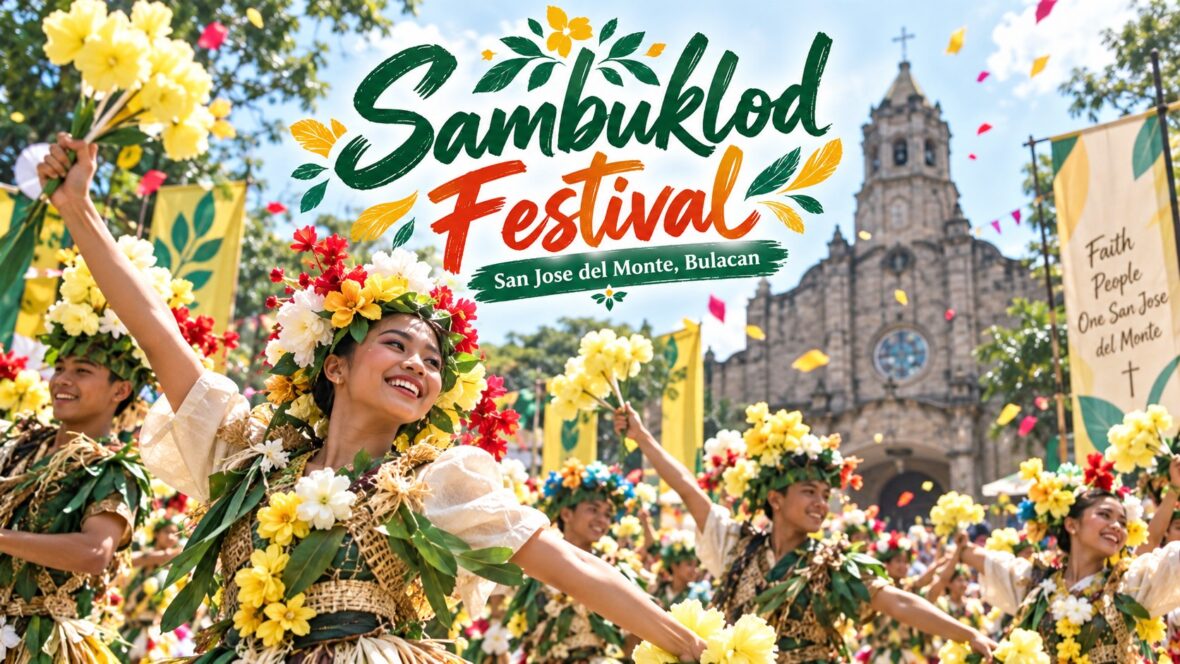
Held every September around San Lorenzo Ruiz de Manila Parish in Barangay San Manuel, Sambuklod combines Catholic devotion, community thanksgiving, street dancing, colorful floats, Filipino games, music and the simple idea of people learning to live together as one community.
The festival honors San Lorenzo Ruiz, the first Filipino saint.
But the name Sambuklod tells an equally important part of the story.
“Buklod” means to bind or unite.
And that idea of unity is exactly what this festival tries to celebrate.
Here’s everything you need to know about Sambuklod Festival in San Jose del Monte, Bulacan.
Content
Sambuklod Festival at a Glance
| Festival | Sambuklod Festival |
|---|---|
| Location | Barangay San Manuel / Pleasant Hills, City of San Jose del Monte, Bulacan |
| Main venue | San Lorenzo Ruiz de Manila Parish |
| Usual month | September |
| Traditional culmination | Fourth Sunday of September |
| Patron | San Lorenzo Ruiz de Manila |
| Feast day of San Lorenzo Ruiz | September 28 |
| Main theme | Faith, thanksgiving, unity and community |
| Major highlights | Masses, novena, float parade, street dancing, Palarong Pinoy, performances and other parish activities |
| Festival origin | Around 2001 |
| Meaning of Sambuklod | Sambayanang Buhay at Umuunlad Kasama si Lorenzong Dakila |
The City of San Jose del Monte officially describes Sambuklod as a festival dedicated to San Lorenzo Ruiz and held annually at San Lorenzo Ruiz de Manila Parish in Barangay San Manuel. Its major attractions include a parade of floats created by different sub-parishes and organizations and a themed street-dancing competition.
What Does Sambuklod Mean?
The festival name is actually an acronym.
Sambuklod stands for:
Sambayanang Buhay at Umuunlad Kasama si Lorenzong Dakila.
In English, you could loosely understand that as a community that is alive and growing together with the example and guidance of the great Lorenzo Ruiz.
The name also plays on the Tagalog word “buklod,” which refers to binding or uniting people together.
Historical descriptions of the festival explain that this idea of unity was particularly meaningful because the parish community was relatively new and included residents who had come from different cultural and geographical backgrounds.
And that makes a lot of sense in San Jose del Monte.
This is a city shaped heavily by migration.
Families move here because housing is more affordable than in many parts of Metro Manila.
Workers commute.
Former Manila residents settle permanently.
New subdivisions create entirely new neighborhoods.
People arrive from different provinces.
Sambuklod essentially asks:
How do all these different people become one community?
Where is Sambuklod Festival Celebrated?
The festival is centered on San Lorenzo Ruiz de Manila Parish in Pleasant Hills Subdivision, Barangay San Manuel, City of San Jose del Monte.
The Diocese of Malolos currently identifies the parish as part of the Vicariate of San Jose del Monte and lists its establishment in 2001.
That date is interesting because historical descriptions also trace the birth of Sambuklod Festival to 2001.
So the parish and the festival essentially grew together.
The community was building its identity.
The parish was developing.
And the festival became one of the ways residents expressed their shared devotion and belonging.
The History of Sambuklod Festival
Sambuklod Festival traces its beginnings to around 2001.
Older accounts say the celebration developed alongside the newly established San Lorenzo Ruiz de Manila Parish and evolved each year around different themes.
From the beginning, it wasn’t designed simply as entertainment.
It was meant to be thanksgiving.
A celebration of blessings.
A celebration of community.
And a celebration of the patron saint whose story had particular meaning for Filipinos.
That patron is San Lorenzo Ruiz.
Who is San Lorenzo Ruiz?
San Lorenzo Ruiz is widely recognized as the first Filipino saint.
He was born in Binondo, Manila, to a Chinese father and Filipino mother and lived during the 1600s.
Lorenzo eventually traveled with Dominican missionaries to Japan, where Christians were facing persecution.
He and his companions were arrested and tortured because of their faith.
Lorenzo refused to renounce Christianity and was eventually martyred in Nagasaki in 1637.
He was canonized by Pope John Paul II in 1987, becoming the first Filipino officially recognized as a saint by the Catholic Church. His feast day is celebrated on September 28.
For Filipino Catholics, his story carries obvious emotional weight.
He wasn’t a king.
He wasn’t a bishop.
He wasn’t a wealthy nobleman.
He was a Filipino layman.
A husband.
A father.
A church worker.
Someone whose life looked much closer to that of ordinary people.
That makes him very easy for Filipino communities to identify with.
“A Thousand Lives”
San Lorenzo Ruiz is especially remembered for his declaration that he was willing to give his life for God repeatedly rather than abandon his faith.
That spirit of courage became central to his identity as a Filipino martyr.
And during Sambuklod, his story becomes a moral reference point for the community.
The festival isn’t simply saying:
Here is our patron saint.
It’s also asking:
What can we learn from him?
Faith.
Courage.
Family.
Sacrifice.
Service.
And remaining committed even when life becomes difficult.
Why Sambuklod is About More Than Religion
Sambuklod is clearly a Catholic festival.
The novena, Masses, procession and devotion to San Lorenzo Ruiz form its spiritual foundation.
But the festival also functions as a community event.
People who may belong to different subdivisions, organizations and sub-parishes participate together.
Children dance.
Young people perform.
Families prepare.
Church organizations build floats.
Residents gather in the streets.
That’s where the word “buklod” becomes visible.
People are literally brought together.
Unity in a Growing City
The idea of unity is particularly relevant in San Jose del Monte because the city grew dramatically through migration and urban expansion.
Historically, San Jose del Monte began as a much smaller agricultural settlement. The city government’s own historical account describes an early population of farmers and stonecutters before the municipality gradually expanded over generations.
Modern San Jose del Monte is completely different.
Large residential areas dominate parts of the city.
Former rural communities have urbanized.
New residents continue arriving.
And when people from different places suddenly become neighbors, community identity doesn’t automatically appear overnight.
It has to be built.
Churches.
Schools.
Barangay events.
Fiestas.
Festivals.
These are some of the places where that identity begins forming.
Sambuklod is part of that process.
The Novenario
Before the dancing and parade comes prayer.
Traditional Sambuklod celebrations begin with a novenario—a nine-day period of prayer leading toward the feast of San Lorenzo Ruiz.
Older festival accounts describe the novena as the spiritual opening of the celebration before community activities begin.
This is important because if you arrive only for street dancing, you see just one layer of Sambuklod.
The festival doesn’t start with drums.
It starts in church.
Mass.
Prayer.
Devotion.
Then the public celebration expands outward into the community.
The Street Dancing Competition
For most visitors, street dancing is the most visually exciting part of Sambuklod Festival.
Colorful groups perform along the streets surrounding the parish.
Music gets louder.
Costumes become more elaborate.
Choreography tells stories based on the year’s theme.
And the entire area suddenly feels very different from an ordinary Sunday in Pleasant Hills.
The City of San Jose del Monte identifies the Street Dancing Competition, also described as Mardi Gras, as one of Sambuklod’s main highlights.
One thing that makes Sambuklod interesting is that the street-dancing theme can change from year to year.
That gives participating groups room to interpret faith, family, community, Filipino values and local life in different ways.
Street Dancing as Storytelling
The best festival dances aren’t just fast.
They tell you something.
During Sambuklod, performances can revolve around the life of San Lorenzo Ruiz, Filipino faith, unity, migration, family or the struggles and hopes of ordinary residents.
Think about what San Lorenzo represents.
A Filipino leaving his homeland.
A man facing danger abroad.
A person holding onto his beliefs far from home.
That story naturally resonates with Filipino families who know what it means to have relatives living or working overseas.
Historical Sambuklod descriptions even highlighted gratitude for blessings received by Filipinos abroad and the community’s devotion to San Lorenzo as a patron associated with Filipinos and migrants.
That gives festival choreography a lot of emotional material.
The Float Parade
Another Sambuklod tradition is the parade of floats.
Different sub-parishes and organizations participate, creating floats connected with the year’s theme and the celebration of San Lorenzo Ruiz.
But there’s one detail that makes these floats particularly interesting.
Recycled materials.
The City of San Jose del Monte specifically notes that organizations traditionally create floats using recyclable materials.
That turns float-building into a creativity challenge.
Instead of relying entirely on expensive commercial decorations, communities work with what they have.
Plastic.
Cardboard.
Paper.
Old containers.
Scrap material.
Then transform them into something festival-worthy.
Why Recycled Floats Matter
You could easily dismiss this as just a practical way to save money.
But I think it actually fits Sambuklod perfectly.
This is a community festival.
Not everything needs to be professionally fabricated.
Sometimes the fun is seeing what residents create together.
Someone collects materials.
Someone designs.
Someone paints.
Someone cuts.
Someone builds the frame.
Someone brings food while everyone else works.
By the time the float enters the parade, dozens of people may have contributed to it.
Again:
Buklod.
People brought together.
Palarong Pinoy
Older Sambuklod programs have also included Palarong Pinoy.
Traditional Filipino games can be deceptively simple.
You don’t need giant LED screens.
You don’t need expensive equipment.
You mostly need people willing to embarrass themselves in front of their neighbors.
And that is usually enough.
Palarong Pinoy activities give younger residents a chance to experience community games that may not be part of everyday urban childhood anymore.
At the same time, adults inevitably become competitive.
Which makes everything better.
Singing Contests and Variety Shows
Singing competitions and variety shows have also traditionally formed part of Sambuklod activities.
This is probably one of the most Filipino parts of the festival.
Give us a microphone.
Someone will sing.
Give us a stage.
Someone’s aunt already knows who’s competing.
Community performances may not have the production scale of national television, but that’s exactly why people care.
The performers are neighbors.
Students.
Relatives.
Friends.
People you actually know.
Fireworks and Evening Activities
Historical descriptions of Sambuklod also mention fireworks and other nighttime entertainment.
Evening events change from one edition to another, so I wouldn’t assume every past activity appears every year.
But the general rhythm is familiar:
Prayer during the religious part.
Community activities during the day.
Music and entertainment later.
That’s how a parish fiesta gradually becomes something the entire neighborhood looks forward to.
The Grand Healing Mass
One of the more distinctive events historically associated with Sambuklod is the Grand Healing Mass.
Older accounts of the festival specifically list this alongside the novena, procession and other religious activities.
Its presence reinforces the fact that Sambuklod is fundamentally connected to parish life.
Even when the streets are full of costumes and dancers, the church remains the center of the celebration.
Processions
The procession is another important Catholic element of the festival.
Images and symbols connected with San Lorenzo Ruiz are brought into the community while devotees accompany them through the streets.
For residents, this is different from simply watching a parade.
A procession is prayer in motion.
People walk together.
Pray together.
Sing together.
And bring the patron saint outside the church walls and into the neighborhood.
That’s especially fitting for a festival built around unity.
Sambuklod Festival and OFW Families
There’s another layer to San Lorenzo Ruiz devotion that resonates strongly with Filipino communities.
He died far from home.
Japan.
Today, millions of Filipino families know what it feels like to have someone far away.
OFWs.
Seafarers.
Migrants.
Nurses.
Engineers.
Domestic workers.
Hospitality workers.
Caregivers.
Parents raising children while one spouse works overseas.
San Lorenzo has long been popularly associated with overseas Filipinos and migrant workers.
So Sambuklod isn’t difficult to connect with modern Filipino experience.
A festival about family, faith and people separated by distance makes sense in a community where many households have relatives working elsewhere.
The Festival’s Thanksgiving Character
One word keeps appearing in historical descriptions of Sambuklod:
Thanksgiving.
The festival was conceived as a joyful way for residents to give thanks for blessings received through their devotion to San Lorenzo Ruiz.
That explains the mood.
Sambuklod isn’t supposed to be solemn from beginning to end.
Catholic fiestas in the Philippines have always mixed devotion with celebration.
Prayer.
Then food.
Mass.
Then music.
Procession.
Then dancing.
Faith and joy aren’t seen as opposites.
They’re part of the same celebration.
Is Sambuklod Festival the Main Festival of San Jose del Monte?
No.
This is an important distinction.
San Jose del Monte has several festivals.
Tanglawan Festival is the city’s major citywide celebration associated with its cityhood anniversary and was launched in 2016.
The city also recognizes Indakan Festival, Kakanin Festival and Pipigan Festival, among others.
Sambuklod is more localized.
Its identity is specifically tied to San Lorenzo Ruiz de Manila Parish and the San Manuel/Pleasant Hills community.
That doesn’t make it less important.
It simply means Sambuklod represents one particular community within a very large city.
Sambuklod vs. Tanglawan Festival
This is probably the easiest way to remember the difference.
Tanglawan Festival = citywide celebration associated with San Jose del Monte’s cityhood.
Sambuklod Festival = parish and community celebration honoring San Lorenzo Ruiz in Barangay San Manuel.
Both happen in San Jose del Monte.
Both feature colorful activities.
But they come from different traditions.
Don’t combine them into one festival when writing an itinerary.
Barangay San Manuel and Pleasant Hills
Older festival listings often identify the location simply as Pleasant Hills.
Current city and diocesan records identify San Lorenzo Ruiz de Manila Parish in Pleasant Hills Subdivision, Barangay San Manuel.
So if you’re looking for Sambuklod, this is the area you need.
The parish is the easiest landmark.
And because the festival is centered around the church, major events naturally take place in nearby roads and community spaces.
When is Sambuklod Festival Celebrated?
Traditionally, Sambuklod culminates on the fourth Sunday of September.
Older festival calendars sometimes list September 25 because that was the date of the last or fourth Sunday in the particular year being documented.
The better evergreen rule is:
Fourth Sunday of September.
Historical descriptions say the festival builds through the novena and community activities before culminating with Mass, the grand parade and street-dancing competition.
San Lorenzo Ruiz’s official feast day itself is September 28.
Depending on the year, the Sambuklod culmination and September 28 may fall very close together.
What to Expect as a First-Time Visitor
Don’t arrive expecting Sinulog-sized crowds.
Sambuklod is much more community-oriented.
That’s part of the appeal.
You could be watching dancers whose families are standing only a few meters away.
Participants may come from nearby sub-parishes.
People recognize each other.
Children run between family members.
Parish volunteers manage activities.
It’s a different atmosphere from a nationally marketed tourism festival.
Smaller.
Closer.
More personal.
Arrive Early for Street Dancing
If you want good photos, arrive before the dancers do.
Local roads around the parish can become crowded once performances begin.
Find the route.
Look for performance areas.
Choose a spot that doesn’t block residents or organizers.
And don’t stand directly in front of a judging area unless you’re supposed to be there.
Festival photographers have a remarkable ability to become obstacles.
Don’t become one of them.
Dress for September Weather
September is rainy season.
So expect both sun and sudden rain.
Sometimes within the same ten minutes.
Bring:
An umbrella.
Water.
Comfortable shoes.
Something to protect your phone.
Light clothing.
And patience.
You are attending a street festival in Bulacan.
Traffic and weather don’t care about your itinerary.
Respect the Religious Side
This should go without saying, but Sambuklod isn’t merely a cultural performance.
People are celebrating their patron saint.
Masses and processions have religious meaning.
If you’re inside the church, dress appropriately and avoid treating worship as a photo shoot.
During processions, give devotees space.
During prayer, keep noise down.
You can enjoy the celebration without forgetting why it exists.
What Else to See in San Jose del Monte
If you’re already visiting SJDM, Sambuklod can be combined with other parts of the city.
San Jose del Monte has grown tremendously, so the experience varies depending on where you go.
There are busy commercial areas.
Large residential communities.
Churches.
Upland areas near the Bulacan-Rizal side.
And access toward natural areas such as Mt. Balagbag, which appears in city tourism records as one of SJDM’s ecotourism destinations.
If you want the festival trip to feel more complete, give yourself time to explore beyond Pleasant Hills.
How to Get to Sambuklod Festival
San Jose del Monte can be reached from Metro Manila through several northern routes.
Public transportation serving SJDM commonly comes from areas such as Quezon City, Novaliches and other northern Metro Manila hubs.
Exact routes change frequently, so check current transport options before traveling.
Once in San Jose del Monte, your destination is:
San Lorenzo Ruiz de Manila Parish
Pleasant Hills Subdivision
Barangay San Manuel
City of San Jose del Monte, Bulacan
The Diocese of Malolos currently lists the parish in Pleasant Hills Subdivision, San Manuel.
During festival day, expect rerouting or heavier traffic close to the church.
Why Sambuklod Festival Matters
You could describe Sambuklod in one sentence:
A parish festival honoring San Lorenzo Ruiz.
That’s accurate.
But incomplete.
The deeper story is community building.
People arrived from different places.
A parish was established.
Residents needed something that could represent who they were becoming.
They chose a Filipino saint.
Then they chose a name built around unity.
Sambuklod.
And every September, that idea becomes visible.
Sub-parishes build floats together.
Young people dance.
Families pray.
Organizations participate.
Neighbors watch.
The entire community gathers around the same streets.
That’s what makes the festival meaningful.
A Festival for a Migrant City
There’s something particularly appropriate about honoring San Lorenzo Ruiz in a community shaped by migration.
San Lorenzo left the Philippines.
Many San Joseños have family members who leave home for work.
San Jose del Monte itself grew partly because families moved into the city from elsewhere.
Movement is part of the story.
Leaving.
Arriving.
Building another home.
Finding another community.
And then trying to stay connected.
Sambuklod responds to that with one word:
Unite.
Sambuklod Festival 2026
For 2026, the fourth Sunday of September falls on September 27, 2026.
That is the date that would match Sambuklod’s traditional culmination schedule if the parish follows its long-established fourth-Sunday pattern.
San Lorenzo Ruiz’s feast day follows on Monday, September 28, 2026.
As of September 14, 2026, I could verify that San Lorenzo Ruiz de Manila Parish remains active in Pleasant Hills, San Manuel, and that the City of San Jose del Monte continues officially listing Sambuklod among its festivals.
However, I could not find a complete publicly indexed official 2026 Sambuklod program yet showing the exact times for the parade, street dancing, Masses and other activities.
So if you’re attending this year, check the latest announcements from San Lorenzo Ruiz de Manila Parish or the City of San Jose del Monte before traveling.
Treat September 27 as the traditional expected culmination date rather than an unqualified confirmed event schedule until the parish publishes the detailed program.

Final Thoughts
Sambuklod Festival doesn’t revolve around a famous food.
It doesn’t celebrate a giant harvest.
It isn’t built around a natural attraction.
It celebrates something harder to photograph.
Unity.
And maybe that’s why the festival name works so well.
Communities don’t automatically become communities just because houses are built next to each other.
People have to meet.
Work together.
Pray together.
Argue.
Make peace.
Raise children.
Help one another.
Build traditions.
Come back every year.
That’s how a neighborhood becomes something more than a collection of addresses.
Sambuklod Festival is one of the traditions helping do that in Barangay San Manuel.
Its floats may be made from recycled materials.
Its dancers may change every year.
Its theme may evolve.
The community itself continues growing.
But underneath all of that is the same idea that inspired the festival in the first place:
Sambayanang Buhay at Umuunlad Kasama si Lorenzong Dakila.
A community alive.
A community growing.
A community inspired by San Lorenzo Ruiz.
And most importantly—
a community choosing to remain bound together.