If you’ve ever looked closely at a beautifully embroidered Barong Tagalog and wondered who actually made all those tiny flowers, leaves and geometric patterns, there’s a good chance the story could lead you to a small town in Laguna.
Lumban.
Here, embroidery isn’t simply something people do for decoration.
It’s livelihood.
It’s craftsmanship.
It’s family tradition.
And every September, the town brings all of that artistry into the streets during the Burdang Lumban Festival.
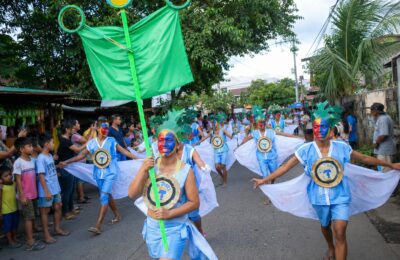
For several days, the usually quiet town becomes a celebration of thread, fabric and Filipino fashion. Young dancers wear costumes inspired by the Barong Tagalog and Filipiniana. Experienced burdaderas compete to prove their skill with a needle. Designers transform traditional embroidery into contemporary clothing. Shops display hand-embroidered pieces that can take days or even weeks to complete.
Even giant embroidery hoops and needles can become festival props.
But Burdang Lumban isn’t really a celebration of clothes.
It’s a celebration of the people behind them.
The women and men who draw the designs.
The burdaderas who carefully stitch them.
The artisans who create calado.
The tailors who turn embroidered fabric into finished Barong Tagalog, gowns and Filipiniana.
And the families who have passed those skills from one generation to another.
Welcome to Burdang Lumban Festival—one of Laguna’s most distinctive cultural celebrations.
Content
Burdang Lumban Festival at a Glance
| Festival | Burdang Lumban Festival |
|---|---|
| Location | Lumban, Laguna |
| Region | CALABARZON |
| Usual celebration | Third week of September |
| Traditional festival date in older calendars | Around September 21 |
| Main theme | Hand embroidery and Barong Tagalog |
| Major highlights | Street dancing, embroidery competition, fashion events, trade fairs |
| Signature competition | Timpalak Galing sa Pagbuburda |
| Street dance | Paseo at Pasayaw sa Kalye |
| Fashion/cultural event | Parada ng Baro at Saya |
| Known as | Embroidery Capital of the Philippines |
| Town anniversary | Celebrated around September 22 |
Government and tourism-related sources describe Burdang Lumban as an annual September celebration centered on Lumban’s embroidery industry, with street dancing traditionally serving as one of its biggest attractions.
And unlike some festivals where the main product feels almost like a marketing theme added later, embroidery really is woven into everyday life here.
Literally.
Where is Lumban, Laguna?
Lumban is a municipality in the eastern part of Laguna.
It’s located beyond Santa Cruz and Pagsanjan if you’re traveling from Metro Manila, in an area where the landscape gradually changes from busy Laguna towns into greener communities, rivers and upland areas around Lake Caliraya.
Lumban is one of Laguna’s old settlements and is also home to the historic San Sebastian Parish Church. The church’s roots go back to the Franciscan missionary period in the late 1500s, and the stone church was completed around 1600.
But ask many Filipinos today what Lumban is famous for and you’ll probably hear a different answer.
Barong.
Embroidery.
Burda.
That’s the identity the Burdang Lumban Festival celebrates.
What Does “Burdang Lumban” Mean?
This one is straightforward.
“Burda” is the Filipino word for embroidery.
So “Burdang Lumban” essentially refers to the embroidery of Lumban.
And that embroidery has become so closely associated with the municipality that Lumban is widely known as the Embroidery Capital of the Philippines.
The Department of Trade and Industry describes Lumban’s hand-embroidery tradition as centuries old and recognizes the town for generations of artisans producing intricate embroidered work.
That’s why the festival name works so well.
You don’t need to invent a complicated meaning.
The craft is the identity.
Why Lumban is Called the Embroidery Capital of the Philippines
Walk into some parts of Lumban and embroidery doesn’t feel like a souvenir industry.
It feels like part of the town.
There are shops selling Barong Tagalog.
Homes where embroidery work is being done.
Small businesses specializing in wedding gowns and Filipiniana.
Artisans working with delicate fabrics.
Families who have spent years in the industry.
Lumban’s municipal council has even formally pursued national recognition of the town as the “Embroidery Capital of the Philippines,” while the designation is already widely used by government and industry organizations.
The reputation is particularly connected with hand embroidery used on formal Filipino clothing.
Barong Tagalog.
Baro’t saya.
Filipiniana gowns.
Wedding dresses.
Formal shirts and dresses.
You may see the finished piece hanging beautifully inside a boutique.
But getting there requires a lot more work than most buyers ever see.
The People Behind a Lumban Barong
One of the most fascinating parts of Lumban’s embroidery tradition is that a single Barong Tagalog may pass through several skilled hands before it’s finished.
Traditional production can involve different specialists.
First comes the design.
A pintor outlines or draws the pattern onto the fabric.
Then the piece goes to the burdadora, who creates the embroidery itself.
More elaborate designs may involve a caladera, who removes selected threads from the fabric to produce the delicate openwork technique known as calado.
Finally, the embroidered fabric is assembled into the finished garment by a tailor or sewer.
So when you buy a hand-embroidered Barong Tagalog, you’re not necessarily buying the work of one person.
You’re buying the result of a small chain of craftsmanship.
That’s part of what Burdang Lumban Festival tries to make visible.
The Burdadera
If there is one person at the center of Burdang Lumban, it is the burdadera.
Usually seated with fabric stretched tightly across an embroidery hoop or bastidor, a burdadera can spend hours working on tiny portions of a design.
One flower.
One leaf.
One line.
One section at a time.
Then repeat.
Again.
And again.
Until what began as plain fabric becomes something worthy of a wedding, graduation, government ceremony or national event.
It’s patient work.
There isn’t much room for rushing.
That’s why watching experienced embroiderers during festival competitions can be surprisingly interesting.
You’re seeing years of muscle memory.
Timpalak Galing sa Pagbuburda
One of the festival’s most meaningful events is the Timpalak Galing sa Pagbuburda.
Basically, an embroidery competition.
Experienced artisans demonstrate their technical ability while judges evaluate their work.
During a documented edition of the festival, around 30 expert burdaderas participated in the competition.
I like this event because it puts the actual craft at the center.
Street dancing is fun.
Fashion shows are beautiful.
But without the burdadera, there would be no Burdang Lumban Festival.
This competition makes sure visitors remember that.
The History of Burdang Lumban Festival
The embroidery tradition itself is much older than the festival.
The exact beginning of the modern festival, however, is a little less clear.
Different historical accounts give slightly different timelines.
One detailed account says Lumban first held a Barong Tagalog Festival in 1996 before renaming and moving the celebration to September.
Another local travel account based on an interview with a former mayor says a Barong Tagalog festival began around 1998 and later expanded into a full embroidery festival around 2001.
Meanwhile, Lumban’s own municipal government officially referred to the 2025 celebration as the 23rd Burdang Lumban Festival.
Rather than pretending those records perfectly agree, the safest conclusion is that the festival evolved during the late 1990s and early 2000s from earlier efforts to promote Lumban’s Barong Tagalog and embroidery industry.
And honestly, that makes sense.
Festivals don’t always appear overnight with a perfect founding document.
They evolve.
A trade event becomes a celebration.
A fashion show becomes a festival.
A local industry becomes an identity.
Eventually everyone simply knows:
September means Burdang Lumban.
Why the Festival is Held in September
Burdang Lumban traditionally takes place during the third week of September.
Older tourism calendars specifically list September 21, while other accounts describe several days of activities around the same period.
The timing also brings the festival close to Lumban’s town founding-anniversary celebrations around September 22. A 2015 observance, for example, marked the municipality’s 437th founding anniversary on September 22 alongside Burdang Lumban festivities.
So September becomes more than an embroidery event.
It’s also a celebration of Lumban itself.
Paseo at Pasayaw sa Kalye
For visitors, this is probably the most exciting part.
The street dance.
Often presented as Paseo at Pasayaw sa Kalye, the event transforms Lumban’s streets into a moving showcase of embroidery-inspired costumes, choreography and giant props.
School contingents perform in outfits drawing heavily from Barong Tagalog, Filipiniana and familiar embroidery patterns.
And then designers take those ideas much further.
Sleeves become exaggerated.
Embroidery designs become huge.
Flowers appear everywhere.
Bastidors—the hoops normally used to hold fabric while embroidery is being done—can become oversized festival props.
Needles, thread and textile patterns are transformed into visual storytelling.
It’s basically the entire embroidery process turned into dance.
Why Children and Schools Play Such a Big Role
Schoolchildren have traditionally formed many of the festival’s street-dancing contingents.
That’s important.
Embroidery is a heritage craft facing the same problem many traditional industries eventually encounter:
Will younger generations continue it?
Young people have more career options today.
Factory-made embroidery is faster.
Machine embroidery is cheaper.
Fashion trends change.
So involving schools in Burdang Lumban isn’t only about finding dancers for a parade.
It helps introduce another generation to the story of their own town.
A child may not become a professional embroiderer.
But after weeks of rehearsing a dance about burda, that child at least knows why the craft matters.
That’s how cultural memory survives.
The Costumes Are Part of the Story
Burdang Lumban is one of those festivals where you really need to look at the costumes carefully.
The embroidery isn’t simply decoration.
It is the subject.
Patterns may be enlarged or exaggerated so spectators can see them from a distance.
Designers borrow ideas from traditional Barong Tagalog and Filipiniana while adding the dramatic proportions needed for street performance.
Bright colors make embroidery-inspired patterns visible.
Sleeves move with the choreography.
Skirts open during spins.
Panels mimic embroidered fabric.
A costume becomes a moving canvas.
And because Lumban already has generations of textile experience, the festival has an advantage many places don’t.
The people here understand fabric.
Traditional Lumban Embroidery Patterns
Traditional embroidery artisans use different layouts and pattern arrangements.
Older documentation of Lumban’s embroidery industry identifies terms such as pitchera, where embroidery forms a U-shaped or vertical front arrangement; batok, where decoration concentrates around the upper portion; and raya, which incorporates lines or stripes with embroidery.
You’ll also hear terms describing scattered or heavily embroidered designs covering much of a garment.
You don’t need to memorize every pattern before visiting.
But knowing that these designs have names helps you understand something important:
Lumban embroidery isn’t random decoration.
There is a vocabulary behind it.
Barong Tagalog: The Garment That Made Lumban Famous
The Barong Tagalog is one of the most recognizable pieces of Filipino formal clothing.
Presidents wear it.
Grooms wear it.
Graduates wear it.
Government officials wear it.
Filipinos overseas wear it during cultural celebrations.
And a significant part of Lumban’s embroidery industry has grown around creating beautifully decorated barongs.
Depending on the garment, artisans may work on cotton, linen, jusi, piña and other fabrics.
The finer the fabric and the more complicated the embroidery, the more labor-intensive the finished piece becomes.
That means a Barong Tagalog isn’t just clothing.
For the people making it, it’s hours of work.
Piña, Jusi and Other Fabrics
If you’re shopping during Burdang Lumban, you’ll probably hear different fabric names.
Piña is among the most prestigious materials used in Filipino formalwear, traditionally derived from pineapple fiber.
Jusi is another material widely associated with Barong Tagalog.
There are also cotton, linen and blended fabrics at more accessible price points.
The important thing is not to assume every embroidered garment is made from the same material.
Ask.
Feel the fabric.
Look at the embroidery.
If you’re investing in a formal Barong Tagalog or Filipiniana, understanding the material helps you understand what you’re paying for.
Parada ng Baro at Saya
Another activity associated with Burdang Lumban is the Parada ng Baro at Saya.
This puts Filipino formalwear itself in the spotlight.
Barong Tagalog.
Filipiniana.
Baro’t saya.
Contemporary interpretations of traditional clothing.
Instead of embroidery remaining on tables and inside shops, the clothing becomes something worn, displayed and celebrated publicly.
And really, that’s exactly where Lumban embroidery belongs.
On people.
Moving.
Living.
Not locked away behind glass.
Fashion Shows and Designer Collaborations
Fashion has always been a natural partner for the festival.
Local artisans produce the embroidery.
Designers interpret it.
Models wear it.
Visitors see what traditional craftsmanship can become.
Earlier festivals included fashion shows organized with the Lumban Embroidery Association, and established Filipino designers have also participated in showcasing local craftsmanship.
This matters because traditional crafts survive more easily when they continue evolving.
If embroidery is treated as something that must always look exactly the way it did decades ago, younger customers may eventually stop buying it.
Fashion gives heritage room to change.
Traditional Craft, Modern Fashion
This is probably one of the most interesting things about Lumban today.
The embroidery can be traditional without the finished clothing looking old-fashioned.
You can have a classic Barong Tagalog.
A minimalist modern barong.
A dramatic Filipiniana gown.
A contemporary wedding dress.
A formal blouse.
Even fashion pieces designed for younger consumers.
The thread technique connects everything.
That’s why Burdang Lumban isn’t simply nostalgic.
It also asks:
What can embroidery become next?
Bazaar sa Lumban
If street dancing is the festival’s showpiece, the bazaar is where visitors can actually participate economically.
Bazaar sa Lumban and similar trade-fair events provide space for local businesses, embroidery producers and other community enterprises to showcase their products.
This is where I’d spend time after watching the parade.
Look at the barongs.
Compare the embroidery.
Talk to shop owners.
Ask whether pieces are hand-embroidered or machine-embroidered.
Look at Filipiniana.
Check smaller embroidered products if you’re not ready to buy formalwear.
Supporting local artisans is a much more meaningful festival souvenir than buying something generic imported from somewhere else.
Hand Embroidery vs. Machine Embroidery
This is an important distinction if you’re shopping in Lumban.
Not every embroidered item is completely handmade.
And that’s okay.
Machine embroidery has its place.
It can make decorative clothing more affordable and allow businesses to serve larger markets.
Hand embroidery, however, requires far more time and individual skill.
The stitches won’t always have the almost mechanical uniformity of machine work.
That’s part of the charm.
You’re seeing someone’s hand in the finished piece.
The festival has historically recognized both hand and machine embroidery while placing special emphasis on preserving traditional artisanal skill.
Embroidery as Livelihood
This is the part that makes Burdang Lumban much more than a pretty festival.
Embroidery feeds families.
The Department of Trade and Industry continues to support Lumban embroidery enterprises because the craft remains both cultural heritage and economic activity.
DTI has highlighted businesses such as FashioNoble, which began in 2000 and has worked to preserve traditional Lumban embroidery while building a modern fashion enterprise.
That’s the challenge facing many heritage industries.
Preserving the craft isn’t enough.
It also needs customers.
Artisans need income.
Young people need a reason to learn.
Businesses need markets.
Burdang Lumban helps create visibility for all of those things.
The Festival Isn’t Only for Tourists
One of the biggest mistakes in writing about Philippine festivals is describing everything as though it exists for visitors.
Burdang Lumban belongs to the Lumbeños first.
Children rehearse.
Parents help with costumes.
Artisans join competitions.
Designers create pieces.
Businesses prepare inventory.
Local officials organize programs.
Families watch relatives perform.
The tourists arrive afterward.
That’s why the celebration feels authentic.
The community already has a reason to care about embroidery even if nobody from Manila ever shows up.
An Award-Winning Festival
Burdang Lumban has also gained recognition beyond Laguna.
In 2025, the Municipality of Lumban announced that the 23rd Burdang Lumban Festival won Grand Winner for Best Tourism Event – Cultural Festival at the Association of Tourism Officers of the Philippines Pearl Awards.
That’s a significant recognition.
It suggests the festival has moved beyond being merely a small-town celebration and has become a recognized cultural-tourism event.
The award also reflects what makes Burdang Lumban distinctive.
Plenty of towns have street dancing.
Very few can build an entire festival around a centuries-old embroidery industry that is still economically active.
Burdang Lumban vs. Lumban Town Fiesta
Here’s another distinction worth making.
Burdang Lumban Festival is not Lumban’s main religious fiesta.
The town’s patron saint is San Sebastian the Martyr, and that religious celebration traditionally takes place in January.
Lumban’s San Sebastian festivities include the famous Paligong Poon tradition associated with the Lumban River and the practice of splashing water during the celebration.
Burdang Lumban, meanwhile, is the cultural festival associated with embroidery and the September civic celebration.
So:
January = San Sebastian religious fiesta.
September = Burdang Lumban and embroidery celebration.
Both are important.
But they’re different.
When is Burdang Lumban Festival Celebrated?
The safest evergreen answer is:
The third week of September.
Older national festival calendars often identify September 21 as the main Burdang Lumban date, while other programs extend over several days surrounding the town’s September celebrations.
Recent editions have also staged major street-dance performances around September 22–23. The 2025 Paseo at Pasayaw sa Kalye performances, for example, were documented on September 23.
So if you’re planning a future trip, don’t treat September 21 as an immovable date.
Think:
third week of September, around Lumban’s founding-anniversary period.
Then check the year’s official schedule.
What to Expect as a First-Time Visitor
Expect color.
A lot of it.
The Barong Tagalog may have a reputation for being elegant and understated, but festival dancers don’t exactly do understated.
You’ll see bright fabrics.
Large embroidery patterns.
Giant hoops.
Flowers.
Props.
Music.
Crowds.
School contingents.
And lots of people taking photos.
Arrive early for the street-dancing route if that’s your priority.
Small-town streets fill quickly.
Bring an Umbrella
September falls within the rainy season.
That means you can have blazing sunshine during lunch and heavy rain an hour later.
Welcome to Laguna.
Bring an umbrella or lightweight raincoat.
Use waterproof protection for your phone or camera.
Wear comfortable shoes.
And don’t dress as though the entire festival happens inside an air-conditioned convention center.
You’ll probably be walking.
Go Shopping for Embroidery
If there’s one festival where I would deliberately budget for shopping, it’s this one.
You’re already in the embroidery capital.
Look around.
You don’t necessarily need to buy an expensive piña Barong Tagalog.
There are pieces at different price levels.
Formal shirts.
Blouses.
Dresses.
Accessories.
Decorative products.
If you’re planning a wedding, you could even turn your festival trip into research for wedding attire.
Just remember:
Hand embroidery takes time.
If you’re ordering something customized, don’t expect artisans to magically finish it tomorrow.
Ask Who Made It
Here’s a simple thing that can make shopping more meaningful.
Ask about the artisan.
Who embroidered the piece?
Was it hand embroidered?
Where was it made?
What kind of fabric is this?
How long does something like this take?
Suddenly, the shirt stops being merely merchandise.
It has a story.
That’s exactly what Burdang Lumban Festival is trying to preserve.
Lumban Church
While you’re in town, visit San Sebastian Parish Church.
The church traces its roots to 1578, with the stone structure completed around 1600, making it one of the historically significant early churches of Laguna.
Even though Burdang Lumban itself isn’t the San Sebastian fiesta, the church helps you understand how old the settlement is.
Embroidery is only one layer of Lumban’s history.
There are many others underneath.
Lake Caliraya
If you want to turn the festival into a weekend trip, Lake Caliraya is the obvious addition.
The man-made lake is shared by areas including Lumban and neighboring municipalities and has become known for resorts, watersports, fishing and cooler upland scenery.
The atmosphere is completely different from the festival streets.
One day:
Drums, dancers and embroidery.
Next day:
Lake views and cool air.
That’s a good combination.
Add Pagsanjan to the Trip
Pagsanjan is next door, so combining the two towns is easy.
You can explore Pagsanjan’s historic center or use the area as another base for exploring eastern Laguna.
Lumban is also well positioned for a wider Laguna loop including places such as Paete, Pakil and Lake Caliraya.
If you enjoy heritage towns and local crafts, this whole part of Laguna deserves more than a quick day trip.
How to Get to Lumban
From Metro Manila, travelers usually head toward Laguna through Calamba and continue east toward Santa Cruz and Pagsanjan before reaching Lumban.
Public-transportation travelers can generally make Santa Cruz or Pagsanjan their main transfer point and continue toward Lumban using local transport.
Exact bus and jeepney routes can change, so check current terminal information before leaving.
If you’re driving, the route through the eastern Laguna towns gives you plenty of opportunities to combine Lumban with Pila, Santa Cruz, Pagsanjan, Paete or Caliraya.
During Burdang Lumban Festival, allow extra time.
Street dancing plus narrow town roads equals traffic.
That’s not exactly a shocking festival prediction.
Where to Stay
Lumban has accommodations in and around the Caliraya area, while nearby Pagsanjan and other eastern Laguna towns provide additional choices.
If you’re attending specifically for the street dancing, staying relatively close to the town center can make things easier.
If you’re turning it into a relaxing weekend, the Caliraya area may be more appealing.
Either way, book early once the official festival program is released.
What to Eat
Unlike festivals built around food, Burdang Lumban doesn’t revolve around one signature dish.
So treat this as an opportunity to explore Laguna food more broadly.
Look for local kakanin.
Native delicacies.
Small-town bakeries.
Restaurants around Lumban and Pagsanjan.
Festival stalls naturally change from year to year.
My usual rule applies:
If a booth is crowded with locals, investigate.
There is probably a reason.
Why Burdang Lumban Festival Matters
There’s a much bigger question underneath this festival.
What happens to traditional skills when the world changes?
Machine embroidery gets faster.
Imported clothing gets cheaper.
Young people choose different careers.
Customers move toward mass-produced fashion.
A heritage craft can disappear surprisingly quickly once the generation practicing it stops.
That’s why Burdang Lumban matters.
It tells the community:
This skill has value.
These artisans matter.
This work deserves recognition.
This isn’t merely what our grandparents did.
This is part of who we are.
Heritage Has to Pay the Bills
We often talk about preserving heritage as though admiration alone is enough.
It isn’t.
A burdadera can’t feed a family with compliments.
People need to buy the work.
Designers need to use it.
Businesses need to sell it.
Young artisans need to believe there is an economic future in learning the craft.
That’s why the trade-fair and fashion components of Burdang Lumban are just as important as the cultural ones.
Preservation works better when heritage remains economically useful.
Fashion Can Keep the Tradition Alive
One way Lumban can keep embroidery relevant is by allowing it to evolve.
The Barong Tagalog will always be important.
But embroidery doesn’t have to stop there.
Modern Filipiniana.
Contemporary shirts.
Bridal wear.
Women’s formalwear.
Accessories.
Experimental fashion.
New colors.
New silhouettes.
Traditional technique doesn’t require traditional design forever.
And when younger customers find something they actually want to wear, artisans gain another reason to continue stitching.
2026 Burdang Lumban Festival
As of September 9, 2026, Burdang Lumban is approaching its traditional third-week-of-September celebration period.
Historical festival calendars place the festival around September 21, with activities typically extending around Lumban’s September town-anniversary celebrations.
However, I could not verify a complete official 2026 Burdang Lumban program publicly indexed online yet showing the exact dates and times for Paseo at Pasayaw sa Kalye, Timpalak Galing sa Pagbuburda, Parada ng Baro at Saya and other major activities.
Lumban’s official municipal website is active with 2026 announcements and continues promoting Burdang Lumban’s fashion and cultural identity, including its participation in Laguna’s Anilag Festival earlier this year.
If you’re planning specifically for 2026, check the Municipality of Lumban’s official announcements before traveling.
Once the detailed program is released, that should take priority over older September 21 listings.

Final Thoughts
There’s something almost poetic about Burdang Lumban Festival.
Most festivals get bigger by creating bigger things.
Bigger floats.
Bigger speakers.
Bigger costumes.
Bigger stages.
Lumban’s festival begins with something tiny.
A needle.
A piece of thread.
One stitch.
Then another.
And another.
Eventually those tiny stitches become a flower.
The flower becomes a design.
The design becomes a Barong Tagalog.
The Barong Tagalog becomes livelihood.
The livelihood becomes a town’s identity.
And that identity becomes a festival.
That’s Burdang Lumban.
Come for the street dancing and you’ll see the color.
Come for the fashion shows and you’ll see the creativity.
Visit the embroidery shops and you’ll see the products.
But watch a burdadera carefully pushing a needle through fabric one stitch at a time and you’ll see the real festival.
Because Burdang Lumban isn’t ultimately celebrating embroidery.
It’s celebrating the hands that keep embroidery alive.
And in a world where almost everything can now be produced faster by machines, there is something incredibly meaningful about a town gathering every September to say that work done slowly, carefully and beautifully by human hands still matters.