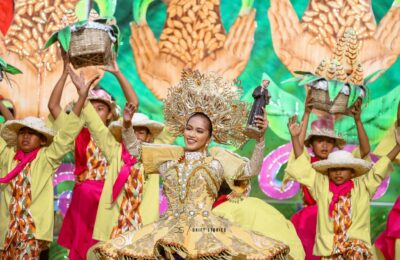
Some Philippine festivals celebrate what a community grows.
Others celebrate what people make.
Patabang Festival celebrates something much harder to photograph:
people helping each other.
Every September, the inland municipality of Tapaz in Capiz enters one of its most important periods of the year. The parish begins its religious observances. Families prepare for visitors. Community activities fill the calendar. Cultural programs, sports competitions, trade fairs and civic events bring people into the poblacion.
Everything eventually leads toward September 30 and the feast of Tapaz’s patron saint, St. Jerome.
For many years, tourism references called this September celebration the Patabang Festival.
And the idea behind the name is beautifully simple.
You help me today.
I’ll help you when you need me.
Planting rice?
Neighbors come.
Harvesting?
People help.
Moving an entire house?
Call the community.
Preparing huge amounts of food for a thanksgiving celebration?
Everybody gets involved.
That tradition of cooperation—similar to the Filipino idea of bayanihan—is what Patabang was created to celebrate.
Older tourism material describes Patabang as reflecting the generosity of Tapaznons and their belief in mutual assistance, particularly during demanding activities such as planting, harvesting, transferring houses and preparing food for community thanksgiving.
Today, the Municipality of Tapaz officially calls its September 21–30 celebration the Tapaz Municipal Religious Town Fiesta rather than listing Patabang as a separate festival. But the older name remains important because it tells us something the modern schedule alone cannot explain:
how Tapaznons traditionally understand community.
And once you know that, the celebration becomes much more interesting.
Content
Patabang Festival at a Glance
| Details | Information |
|---|---|
| Traditional festival name | Patabang Festival |
| Current official LGU name | Tapaz Municipal Religious Town Fiesta |
| Location | Tapaz, Capiz |
| Region | Western Visayas / Region VI |
| Traditional dates | September 21–30 |
| Main feast day | September 30 |
| Patron saint | St. Jerome / San Geronimo |
| Main religious venue | St. Jerome Parish, Poblacion |
| Meaning of Patabang | Mutual help, cooperation and community assistance |
| Cultural idea | Similar to bayanihan |
| Current fiesta activities | Novena Masses, procession, cultural presentations, sports, trade fairs and civic programs |
| Major local industry | Agriculture |
| Indigenous heritage | Panay Bukidnon communities |
| Separate Tapaz festival | Sirinadya Festival, January–February |
| Municipality’s official founding date | 1673 |
The Municipality of Tapaz currently describes the September 21–30 fiesta as a religious and cultural celebration honoring St. Jerome and emphasizing spiritual reflection, thanksgiving, community unity, heritage and local development.
What Is Patabang Festival?
Patabang Festival is the traditional cultural name associated with Tapaz’s late-September town festivities.
Older Capiz tourism references specifically list:
Patabang Festival — September 21–30 — Tapaz, Capiz
and explain that the celebration was conceived to give a distinct identity to Tapaznon festivities.
The central idea was not a crop, costume or product.
It was a value.
Helping one another.
The festival took inspiration from the way communities cooperated during work that would be difficult for one household to complete alone.
Over the years, this cultural concept became intertwined with Tapaz’s annual Catholic fiesta honoring St. Jerome.
So Patabang developed several layers.
It is cultural because it celebrates a Tapaznon community tradition.
It is agricultural because many examples of pagpatabang come from farm life.
It is religious because the wider celebration leads toward the feast of St. Jerome.
And it is social because the entire concept depends on people working together.
What Does “Patabang” Mean?
The easiest translation is:
help.
Or in the context of the festival:
helping one another.
Older tourism descriptions summarize the idea almost as:
“You help me, and I’ll help you.”
That captures the spirit better than a dictionary definition.
Patabang isn’t supposed to describe one person receiving charity from everyone else.
It is reciprocal.
Today your family needs assistance.
The community comes.
Tomorrow your neighbor needs help.
You show up.
That’s the cycle.
Pagpatabang in Everyday Tapaz Life
Older festival descriptions give several very specific examples.
Planting
Planting crops can require many people working within a short period.
Neighbors can help one household finish.
Later, that household returns the favor.
Harvesting
The same applies when crops are ready.
Timing matters.
More hands mean the harvest can be completed faster.
Moving a House
The classic Filipino image of bayanihan is an entire nipa house being lifted by people using bamboo poles.
Patabang tourism descriptions specifically mention house transfer among the occasions when Tapaznons traditionally helped one another.
Preparing Food
Anyone who has attended a provincial fiesta knows how much work goes into cooking for dozens—or sometimes hundreds—of guests.
One person chops.
Someone cooks.
Another prepares rice.
Relatives arrange tables.
Neighbors lend equipment.
Children are sent to buy whatever ingredient someone forgot.
Eventually, the food appears as if it happened effortlessly.
It didn’t.
That is patabang too.
Patabang and Bayanihan
The two ideas are closely related.
Bayanihan is the broader Filipino concept of communal cooperation.
Patabang expresses a similar idea in a way associated specifically with Tapaz’s festival story.
And perhaps that’s why this is one of the more meaningful festival concepts in Capiz.
Anyone can decorate a float.
Anyone can create a catchy festival name.
Patabang came from something people actually practiced.
The festival took an existing community value and gave it a public identity.
Why Agriculture Is Important to Patabang
Tapaz remains strongly agricultural.
The municipal government identifies agriculture as its major industry and lists rice, corn, sugarcane, banana and abaca among the important crops grown in the municipality.
That makes the planting-and-harvesting stories behind Patabang especially appropriate.
Agriculture teaches people very quickly that nobody works completely alone.
Someone prepares land.
Someone supplies seeds.
Others help plant.
Farm workers maintain crops.
Harvesters gather produce.
Drivers transport it.
Traders bring it into markets.
One plate of rice sits at the end of a long chain of human effort.
So when Tapaz celebrates cooperation, farming provides some of the most obvious examples.
Is Patabang Festival Still the Official Name?
This needs an important update.
The answer today is:
not on Tapaz’s current official tourism portal.
The Municipality of Tapaz now lists its September celebration as:
Tapaz Municipal Religious Town Fiesta
The official page gives the dates as September 21–30 and identifies St. Jerome as the patron saint. It describes novena Masses, prayer services, a solemn procession, cultural presentations, sports competitions, trade fairs, civic programs and other community festivities.
Patabang does not currently appear as a separate official festival entry.
That doesn’t mean the older name was invented.
It appears in longstanding Capiz and Philippine tourism references.
It simply means the municipality’s modern branding has changed.
For a timeless article, the most accurate way to explain it is:
Patabang Festival is the traditional cultural identity historically associated with Tapaz’s September festivities, while the current LGU officially calls the celebration the Tapaz Municipal Religious Town Fiesta.
Both pieces of information matter.
Why September 21 to 30?
September 30 is the feast of St. Jerome.
The days immediately before the feast naturally form the novena period.
Tapaz’s official tourism office confirms that the annual religious fiesta lasts from September 21 through September 30 and includes novena Masses and prayer services leading toward the main celebration.
So the calendar has a religious logic.
September 21 begins the major devotional period.
September 29 is fiesta eve and the final novena day.
September 30 is the principal feast.
At the same time, civic and cultural activities take place around that religious calendar.
Who Is St. Jerome?
St. Jerome—or San Geronimo—is one of the most important early Christian biblical scholars.
He lived during the fourth and early fifth centuries and is best remembered for translating much of the Bible into Latin.
That translation became known as the Vulgate.
Because of his scholarship, St. Jerome became particularly associated with:
Bible study,
translation,
libraries,
scholarship,
and theological learning.
The Catholic Church recognizes him as a Doctor of the Church.
His feast is celebrated on September 30.
Philippine Catholic coverage specifically identifies Tapaz among the communities where Masses are offered in honor of St. Jerome on his feast day.
St. Jerome Parish in Tapaz
The spiritual center of the September fiesta is St. Jerome Parish in Barangay Poblacion.
Tapaz’s municipal tourism office lists the parish among the municipality’s heritage attractions and identifies it with the Roman Catholic Archdiocese of Capiz.
During fiesta season, the church becomes a focal point for:
novena prayers,
Masses,
devotional gatherings,
and the solemn procession honoring St. Jerome.
If you’re visiting the festival for the first time, I would definitely spend some time here.
The plaza shows you the public celebration.
The parish explains why September 30 matters.
Patabang as Thanksgiving
There is another word woven throughout the current Tapaz fiesta description:
thanksgiving.
That fits beautifully with the old Patabang idea.
Because cooperation creates gratitude.
Someone helped your family harvest.
You remember.
Neighbors helped prepare a wedding.
You remember.
Someone carried materials when your house needed repairs.
You remember.
Your family later returns the assistance.
The cycle continues.
The modern Tapaz fiesta still describes itself as an occasion for thanksgiving and community unity.
So even as the festival’s official branding has changed, the old Patabang philosophy still fits.
What Happens During the Tapaz September Fiesta?
The exact schedule changes each year.
But Tapaz’s official tourism page identifies several recurring components.
Novena Masses and Prayer Services
These lead toward September 30.
For many Catholic families, this is the most important part of the entire celebration.
Solemn Procession
The image of St. Jerome is brought through the community as devotees participate in the patronal celebration.
Cultural Presentations
These give performers, schools and community groups space to showcase Tapaz heritage and local talent.
Older descriptions and documentary footage of the September fiesta also show festive public performances and dancing during the celebration.
Sports Competitions
Like many Philippine town fiestas, Tapaz uses sports to bring barangays and organizations together.
Basketball and other competitions can stretch across days or weeks.
Trade Fairs
These allow local businesses, farmers and producers to showcase products.
In an agricultural municipality, fairs can be more than simple souvenir markets.
They become a window into what people actually produce.
Civic Programs
Government agencies and local organizations also hold programs around the fiesta period.
Community Festivities
And then there is everything that doesn’t fit neatly into an official category.
Food.
Music.
Reunions.
Nighttime gatherings.
Visiting relatives.
The simple feeling that the poblacion is much busier than usual.
That is fiesta.
Is There Street Dancing During Patabang?
This is where it helps to be careful.
Older accounts and more recent documentary footage of the Tapaz September fiesta show dancing, parades and cultural performances.
However, Tapaz’s current official tourism description uses the broader phrase “cultural presentations” rather than specifically promising a permanent annual competitive street-dancing event.
So I wouldn’t describe Patabang today as primarily a street-dancing festival in the same way as Sinulog or Dinagyang.
Cultural dance can certainly form part of the celebration.
But the heart of Patabang is cooperation and the St. Jerome fiesta.
For large competitive street dancing in Tapaz, another festival is even more important.
Sirinadya.
Don’t Confuse Patabang With Sirinadya Festival
This is probably the biggest source of confusion when searching for Tapaz festival photos.
Tapaz has another major celebration:
Sirinadya Festival
And this one is explicitly identified by the municipality as a major street-dancing festival.
The current tourism portal says Sirinadya runs from the third week of January through the first Sunday of February and honors the Santo Niño with colorful street dancing, music and thanksgiving. The LGU dates the festival to 1954.
So remember:
September
St. Jerome fiesta / historically associated with Patabang.
January to February
Sirinadya Festival / Santo Niño / major street dancing.
This distinction is especially important if you’re looking for images online.
A dramatic photo of huge Tapaz contingents in elaborate costumes may actually be Sirinadya rather than Patabang.
A Short History of Tapaz
Tapaz itself has a long history.
The municipal government officially gives 1673 as the municipality’s founding date. It traces the earlier settlement to 1637, when Tapaz was a barrio under Dumalag.
The municipality’s official local history preserves a familiar Philippine place-name story.
According to tradition, Spanish visitors asked a local resident the name of the place while he was cutting tall grass. Not understanding the question, the man supposedly replied that he was naga tapaz—cutting talahib.
The Spaniards interpreted “Tapaz” as the place name.
As with many old Philippine naming stories, this is best understood as local tradition rather than a linguistically proven historical fact.
But it remains part of the way the municipality tells its story.
Tapaz Is Different From Coastal Capiz
When many travelers hear “Capiz,” they think immediately of Roxas City.
Seafood.
Coastline.
Oysters.
Fish.
Tapaz gives you a completely different landscape.
It is landlocked.
The municipal tourism office describes Tapaz as a place of mountains, rivers, indigenous culture and warm hospitality.
Travel inland and the province changes.
Rice fields appear.
Mountains rise.
Roads enter upland communities.
Rivers cut through the landscape.
This geography is important to understanding Patabang.
A community built around agriculture and far-flung barangays naturally developed traditions of mutual assistance.
Tapaz and the Panay Bukidnon
One of the most important parts of Tapaz’s cultural identity is its Panay Bukidnon heritage.
The Philippine Information Agency continues to recognize Panay Bukidnon communities in Tapaz as part of Capiz’s living indigenous culture.
These communities have traditions involving oral literature, music, dance, embroidery, agriculture and indigenous knowledge.
This cultural history deserves more than being reduced to festival-costume inspiration.
If indigenous communities participate in local events, visitors should understand that their traditions belong to living communities, not simply to stage design.
Festival Costumes vs. Indigenous Clothing
This distinction matters.
A choreographer might design something “tribal-inspired.”
That does not automatically make the clothing an authentic Panay Bukidnon ceremonial garment.
Festival costumes are theater.
Indigenous dress, weaving, music and ritual carry cultural meanings of their own.
So if you’re photographing community members, especially during cultural demonstrations, ask permission when appropriate and avoid treating sacred or traditional elements merely as props.
The Tapaz tourism office itself advises visitors to respect indigenous communities and cultural sites.
The Battle of Tapaz
Tapaz also played a role in Capiz revolutionary history.
The Province of Capiz identifies the Battle of Tapaz on February 24, 1897 as one of the important early revolutionary conflicts in the old province.
Macario Lukso—popularly called Papa Macario—led Pulahan fighters against a Spanish garrison in the town.
The provincial government considers the battle an important episode in the revolutionary movement in the Ilaya section of Capiz.
That history adds another layer to a festival already built around cooperation and community identity.
Tapaz is not simply an agricultural municipality with a fiesta.
It has stories stretching through indigenous history, Spanish colonial rule, revolution and modern development.
Patabang as Community Identity
The more you look at Tapaz, the more appropriate the festival name becomes.
The municipality has 58 barangays.
Twenty-two are upland communities and 36 are classified as lowland barangays.
Agriculture remains the major industry.
In places where communities can be geographically separated, cooperation matters.
People cannot always solve everything individually.
Road access.
Farm work.
Emergencies.
Community celebrations.
Religion.
Family events.
The idea of patabang becomes practical.
Not symbolic.
What Does the Festival Feel Like?
Imagine Tapaz during the final part of September.
The parish is already in its novena period.
Banners hang across roads.
The plaza is becoming busier.
Sports competitions are underway.
Food stalls begin appearing.
People who now live elsewhere return home.
School groups prepare performances.
Local businesses decorate.
Farmers visit trade activities.
Nighttime entertainment brings more people into the poblacion.
Then fiesta eve arrives.
September 30 follows.
The church fills.
The procession begins.
Families return home afterward to tables prepared for visitors.
That is the rhythm of Patabang.
It isn’t necessarily one giant four-hour spectacle.
It’s a town gradually building toward its most important September day.
Patabang and the Filipino Fiesta Table
The old Patabang descriptions specifically mention helping prepare food during thanksgiving celebrations.
Anyone who has watched a Filipino household prepare for fiesta knows exactly what this means.
Cooking starts early.
Sometimes the day before.
One relative handles meat.
Another chops vegetables.
Someone is responsible for desserts.
Somebody keeps checking the rice.
Children are sent on emergency errands.
Neighbors lend cooking equipment.
An aunt gives instructions nobody asked for.
By lunchtime, guests arrive.
And somehow, the enormous amount of work disappears behind a full table.
That’s patabang in one of its most delicious forms.
Returning Home for Fiesta
Provincial fiestas are also homecoming events.
Tapaz’s current municipal tourism description specifically mentions returning Tapazeños joining residents and visitors during the celebration.
That matters.
People may move to Roxas City.
Iloilo.
Metro Manila.
Cebu.
Overseas.
But everyone knows the fiesta date.
September 30 becomes a point on the calendar around which people can plan a trip home.
That creates another type of cooperation.
Families coordinate.
Houses reopen.
Extra food gets prepared.
Old classmates meet again.
The town briefly feels fuller.
Patabang and Modern Tapaz
The old festival concept is about mutual assistance.
Tapaz’s modern civic language emphasizes something similar.
The municipality currently uses the phrase:
Bakas kag Asenso Tapaz
and its official fiesta theme centers on faith, unity and progress.
You can see the connection.
Patabang says:
work together.
Modern municipal branding says:
move forward together.
Different wording.
Same basic community idea.
Things to Do in Tapaz During Festival Season
If you’re traveling all the way inland for the fiesta, spend more than a few hours in the poblacion.
Visit St. Jerome Parish
Start with the religious heart of the celebration.
Even outside Mass, the church helps explain why the final ten days of September matter.
See Marugo Lake
Marugo Lake is one of Tapaz’s most prominent nature attractions.
The municipal tourism office describes it as an 18.62-hectare man-made lake in Barangay San Antonio fed by mountain water.
Visitors can swim, kayak, boat and fish, while floating cottages and accommodation are also available.
The scenery gives you a completely different experience from fiesta crowds.
One day:
music, food and people.
The next:
water and hills.
Artuz Waterfalls
Tapaz’s official tourism portal also lists Artuz Waterfalls, a rainforest waterfall area in Barangay Artuz.
Check current accessibility and local guide requirements before going.
Hanging Footbridge in Aglinab
The LGU lists the hanging footbridge in Barangay Aglinab as a viewpoint over the Pan-ay River and surrounding greenery.
Historical Artesian Well
In the poblacion itself, an older artesian well at the public plaza is recognized by the municipality as a pre-World War II cultural landmark.
These smaller places make the fiesta trip feel more connected with Tapaz rather than simply being a drive-in, drive-out festival visit.
Getting to Tapaz
Tapaz is accessible overland from both Roxas City and Iloilo.
The municipal tourism office says public vans and buses serve routes into the municipality, while recommending that visitors confirm current transportation details before traveling.
From Roxas City, the journey takes you away from the coastal side of Capiz and into the province’s interior.
From Iloilo, Tapaz can also be approached overland through routes into central Panay.
Fiesta week can affect traffic, so allow extra time.
Where to Stay
Tapaz has local lodging and accommodation options, although choices are naturally more limited than in Roxas City or Iloilo.
If your main reason for visiting is the fiesta, staying closer to the poblacion is usually more practical.
You’ll have easier access to:
the church,
the plaza,
community events,
food stalls,
and nighttime activities.
Roxas City gives you more hotel choice but requires considerably more travel back and forth.
What to Eat During Patabang Festival
Don’t go to a Filipino town fiesta with a strict plan to eat lightly.
That’s just unnecessary suffering.
The exact foods vary by household, but familiar fiesta dishes can include:
pancit,
lumpia,
chicken dishes,
pork,
grilled food,
rice cakes,
native sweets,
and whatever specialties a particular family is proud of.
Trade fairs can also be good places to discover locally produced agricultural goods and processed food.
And because Tapaz is inland, this is a chance to experience a different side of Capiz cuisine from the seafood-heavy identity associated with Roxas City.
Tips for First-Time Visitors
Come before September 30 if you can.
The final day is important, but arriving earlier lets you experience the buildup.
Bring cash.
Tapaz’s official tourism office specifically notes that ATM access may be limited in remote barangays.
Wear comfortable footwear.
Bring rain protection.
September can be wet in Western Visayas.
Respect church activities.
And if you’re traveling into Panay Bukidnon communities or more remote attractions, coordinate properly rather than arriving as though every village is an open tourist attraction.
Is Patabang Festival Worth Visiting?
Yes, particularly if you like festivals where the local story matters more than sheer size.
Patabang isn’t trying to compete with Dinagyang.
It isn’t MassKara.
It isn’t Sinulog.
Its strongest symbol isn’t a giant costume.
It’s people helping one another.
That is a quieter festival idea.
But it’s also one that almost anyone can understand.
Patabang Festival Frequently Asked Questions
Where is Patabang Festival celebrated?
Patabang Festival is traditionally associated with Tapaz, Capiz, in Western Visayas.
When is Patabang Festival?
Older tourism references list Patabang from September 21 to 30.
Those dates match the Municipality of Tapaz’s current official September religious-town-fiesta schedule.
What does Patabang mean?
Patabang refers to helping or asking for help.
In the festival context, it expresses mutual cooperation—neighbors assisting one another with planting, harvesting, house moving, food preparation and other demanding community work.
Is Patabang similar to bayanihan?
Yes.
The festival concept closely resembles bayanihan because both emphasize voluntary cooperation and community assistance.
Who is the patron saint of Tapaz?
Tapaz honors St. Jerome, also known locally as San Geronimo.
When is St. Jerome’s feast?
September 30.
Is Patabang Festival still officially called Patabang?
Older tourism sources use the name Patabang Festival.
Tapaz’s current official tourism portal instead calls the September event the Tapaz Municipal Religious Town Fiesta and does not presently list Patabang separately.
What happens during Tapaz’s September fiesta?
The municipality currently lists novena Masses, prayer services, a solemn procession, cultural presentations, sports competitions, trade fairs, civic activities and community festivities.
Is Patabang mainly a street-dancing festival?
Not primarily.
Dance and public cultural performances can form part of the celebration, but the current official September-fiesta program is broader and places strong emphasis on religion, thanksgiving, community unity and heritage.
What is Sirinadya Festival?
Sirinadya is Tapaz’s separate Santo Niño festival held from the third week of January through the first Sunday of February.
Unlike the current September-fiesta description, the LGU explicitly highlights colorful street dancing and music as key Sirinadya features.
Is Tapaz agricultural?
Yes.
The municipal government identifies agriculture as the municipality’s major industry, with rice, corn, sugarcane, banana and abaca among its major crops.
Does Tapaz have indigenous communities?
Yes.
Panay Bukidnon communities form an important part of Tapaz’s living cultural heritage.
What tourist attraction should I visit in Tapaz?
Marugo Lake is one of the most developed local attractions, with boating, kayaking, swimming, fishing, floating cottages and accommodation listed by the LGU.
Patabang Festival 2026
This article is intended to remain useful beyond one year, but the core 2026 dates are officially confirmed.
The Municipality of Tapaz lists:
September 21–30, 2026
Tapaz Municipal Religious Town Fiesta
with the celebration culminating on:
September 30, 2026
Feast of St. Jerome
The official tourism page identifies religious activities, cultural presentations, sports, trade fairs, civic programs and community festivities as part of the established celebration.
As of September 9, 2026, the municipality’s public event calendar also already shows broader September activities including:
| Date | Event |
|---|---|
| September 15 | Opening of Namit Food Festival |
| September 16 | Tapaz Singing Idol |
| September 21–30 | Official religious town-fiesta period |
| September 30 | St. Jerome feast / main religious date |
The first two events are currently visible on the Municipality of Tapaz’s official events calendar, while the September 21–30 fiesta period comes from its tourism portal.
A complete final day-by-day 2026 timetable for every cultural program, sports event, procession and evening activity had not yet been surfaced in the official sources reviewed for this article.
Anyone traveling specifically for one particular event should therefore check the newest Municipality of Tapaz announcements closer to the date.

Final Thoughts
Patabang Festival is built around something almost too ordinary to notice.
Someone asks for help.
People come.
That’s it.
No complicated legend.
No giant product required.
No historical battle needs to be reenacted.
Just people helping each other.
But think about what that simple tradition allows a community to accomplish.
A field gets planted.
A harvest gets finished.
A house gets moved.
A fiesta meal gets cooked.
A neighbor gets through a difficult day.
Then the next time somebody else needs assistance, the same cycle begins again.
That is Patabang.
Today, Tapaz officially presents its September celebration as the Municipal Religious Town Fiesta honoring St. Jerome.
The name may have changed in current tourism branding.
The idea behind Patabang, however, still fits almost perfectly.
Faith.
Thanksgiving.
Community.
Unity.
Progress.
All of those things become easier when people work together.
So if you’re in Tapaz during the final days of September, enjoy the cultural programs.
Visit St. Jerome Parish.
Explore Marugo Lake.
Learn about the Panay Bukidnon heritage of the uplands.
Eat well.
Watch the town prepare for September 30.
But remember the word that once gave the entire celebration its identity.
Patabang.
You help me.
And when your turn comes, I’ll be there too.