You usually hear the Bakood Festival before you see it.
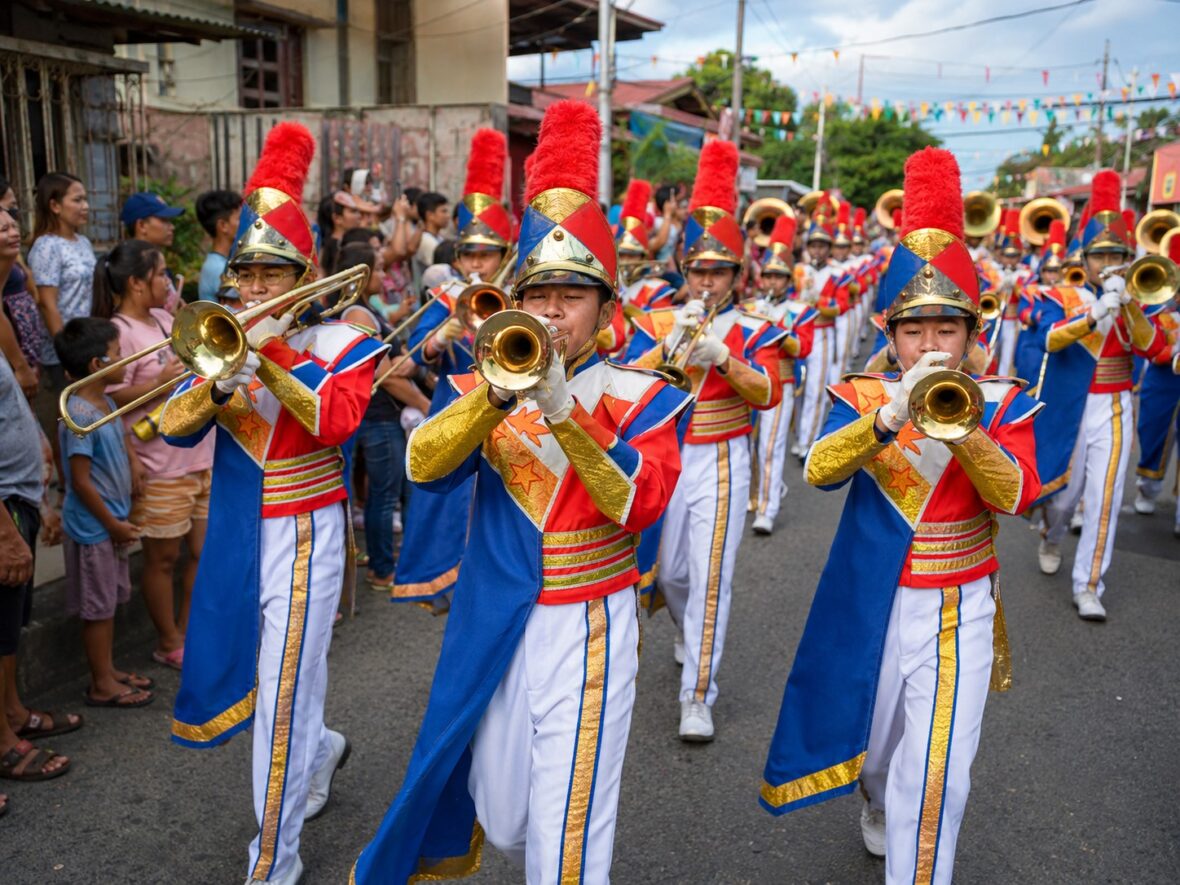
From a distance, the steady beat of drums begins to echo through Bacoor’s streets. Brass instruments grow louder, majorettes raise their batons and marching bands in elaborate uniforms appear one after another.
Within minutes, an ordinary city road becomes a moving stage.
Musicians perform while maintaining perfectly spaced formations. Color guards wave enormous flags, drum majors command the attention of the crowd and spectators cheer as their favorite bands pass.
This is the Bakood Festival, Bacoor City’s annual celebration of its founding anniversary, cultural heritage and devotion to St. Michael the Archangel.
Although the festival includes community programs, concerts and civic activities, its most recognizable attraction is Musiko, Bacoor’s enormous marching-arts celebration. The event reflects the city’s long relationship with community bands and helps explain why Bacoor is officially recognized as the Marching Band Capital of the Philippines.
For visitors, Bakood Festival is not simply another Cavite fiesta. It is an opportunity to experience powerful live music, discover Bacoor’s revolutionary history and see how an old marching-band tradition continues to bring generations of Bacooreños together.
Content
What Is the Bakood Festival?
The Bakood Festival is an annual cultural, civic and religious celebration held in Bacoor City, Cavite, generally during September.
The City Government of Bacoor describes it as a celebration honoring St. Michael the Archangel, the city’s patron saint. It also aims to promote tourism and trade, strengthen camaraderie among residents and encourage appreciation for Bacoor’s cultural and historical heritage.
The festivities are connected with two important occasions:
- Bacoor’s founding anniversary
- The September 29 feast of St. Michael the Archangel
Although older city tourism information describes Bakood as a weeklong festival ending near the final Sunday of September, modern celebrations may spread activities throughout much of the month. The exact program changes annually.
Depending on the year, activities may include marching-band competitions, concerts, community contests, trade exhibits, job fairs, cultural presentations, religious services and public-service programs.
However, the festival’s biggest attraction remains Musiko—the massive display of marching bands that transforms Bacoor into one of the most exciting musical destinations in Cavite.
Is It Bakood, Bacood or Bakod?
The similar spellings can be confusing.
The official festival is generally written as Bakood Festival, while historical records have used several forms of the city’s name, including Bacoor, Bacor, Bacood, Bakod and Vacol.
Bacoor’s official historical account notes that bakod, the Tagalog word for a fence, and Bacood were among the traditional names associated with the area. It also cites an 1874 Spanish-Tagalog manual that translated Bacood as tierra alta, meaning high ground.
This means the festival name reaches back to Bacoor’s older identity rather than simply being a modern word created for tourism.
The precise origin of Bacoor’s name remains open to several interpretations. Some residents connect it with fences or enclosed land, while historical references also associate Bacood with elevated ground.
Instead of selecting only one explanation, the festival embraces the older-sounding name as a symbol of the city’s roots.
When Was Bacoor Founded?
The City Government of Bacoor traces the city’s founding to 1671, when Bacoor was separated from Cavite El Viejo, now known as Kawit.
The official account says the separation resulted from a petition submitted by members of Bacoor’s local principalia or noble class during the reign of Spain’s King Charles II.
This makes Bacoor one of Cavite’s long-established communities.
The city celebrated its 354th founding anniversary in 2025, together with the 19th Bakood Festival. Based on the historical count, 2026 marks Bacoor’s 355th year.
As of July 15, 2026, a complete official schedule for the 2026 Bakood Festival was not yet available in the reliable public sources reviewed for this article. Visitors planning to attend should wait for announcements from the City Government of Bacoor and its Culture, History, Arts and Tourism Department.
How the Modern Bakood Festival Began
Bacoor has held religious fiestas and community celebrations for generations, but the modern Bakood Festival was developed as a more organized promotion of the city’s culture, products, tourism and history.
The city’s official historical account credits the local government administration of the late 2000s with initiating the festival as part of a broader effort to renew Bacoor’s identity and strengthen appreciation for its heritage.
The celebration gradually became larger.
Community events were joined by cultural competitions, commercial activities and increasingly ambitious marching-band programs. Musiko, launched in 2011, eventually developed into the festival’s most anticipated event and a nationally recognized gathering of marching bands.
Today, Bakood Festival represents several sides of Bacoor at once.
It honors the city’s patron saint, remembers its history, creates opportunities for local organizations and businesses and displays the musical talent for which Bacoor has become famous.
The Connection to St. Michael the Archangel
Bakood Festival is closely connected with St. Michael the Archangel, the patron of Bacoor’s historic parish.
The Diocese of Imus lists September 29 as the feast day of St. Michael the Archangel Parish in Bacoor.
St. Michael is traditionally portrayed as a heavenly warrior defeating evil. Images commonly show him wearing armor, carrying a sword or spear and standing over a dragon or demon.
This warrior identity has special meaning in a city connected with revolutionary history.
Bacoor was once given the revolutionary name Gargano, referring to the Italian mountain associated with an ancient shrine dedicated to St. Michael. The city’s historical narrative connects this name with the people’s devotion to their patron and their participation in the struggle against Spanish rule.
During the festival season, religious activities may include novena Masses, thanksgiving services and the patronal feast.
The entertainment may attract the largest crowds, but St. Michael remains the spiritual figure behind the celebration.
Visitors should remember this when entering the church or observing a religious procession. Bakood Festival may be festive and loud, but parts of it remain acts of faith for local devotees.
Why Bacoor Is the Marching Band Capital of the Philippines
Marching bands have a long and visible place in Bacoor’s community life.
They accompany religious fiestas, civic ceremonies, parades, school programs and important family occasions. Musicians often begin training when they are young, learning from school instructors, relatives and older members of community bands.
The national government formally recognized this heritage through Proclamation No. 939, signed on April 6, 2020, declaring Bacoor the Marching Band Capital of the Philippines.
The proclamation recognizes the city’s historical contribution to Philippine culture and encourages the preservation of marching bands through cooperation among local governments, public institutions and private organizations.
Bacoor is also described as the birthplace or home of some of the country’s oldest active marching bands. It continues to support community ensembles, school-based drum-and-lyre groups and programs that encourage musical education.
This musical culture is not preserved only through museum displays or historical books.
It remains alive because people continue to play.
Young musicians carry instruments through the streets, former members return to support their bands and families invest time and resources in rehearsals, uniforms and performances.
Musiko: The Festival’s Grandest Attraction
Musiko is the event most closely associated with Bakood Festival.
The City Government of Bacoor describes it as a centuries-rooted marching-band tradition that now attracts participants from different parts of the country. Its purpose is to showcase musical heritage, preserve band culture and encourage continued education within the marching-arts community.
Musiko is much more than bands walking down a road while playing music.
Modern editions may include several competitive categories, such as:
- Marching street parade
- Marching field show
- Drumline battle
- Color guard competition
- Drum-major and majorette awards
- Best uniform and visual-performance categories
The exact categories depend on the annual program.
During Musiko 2025, 52 marching bands from across the Philippines participated in the festival’s main competition. The event formed part of the 19th Bakood Festival and Bacoor’s 354th founding anniversary. It was sanctioned by the Asian Marching Band Confederation and the World Marching Band Organization.
That scale explains why the streets become crowded long before the first band arrives.
Spectators are not watching a small local parade. They are seeing some of the country’s most dedicated marching ensembles compete before judges, fellow musicians and thousands of festivalgoers.
Marching Street Parade
The street parade is the part of Musiko that most visitors can easily experience.
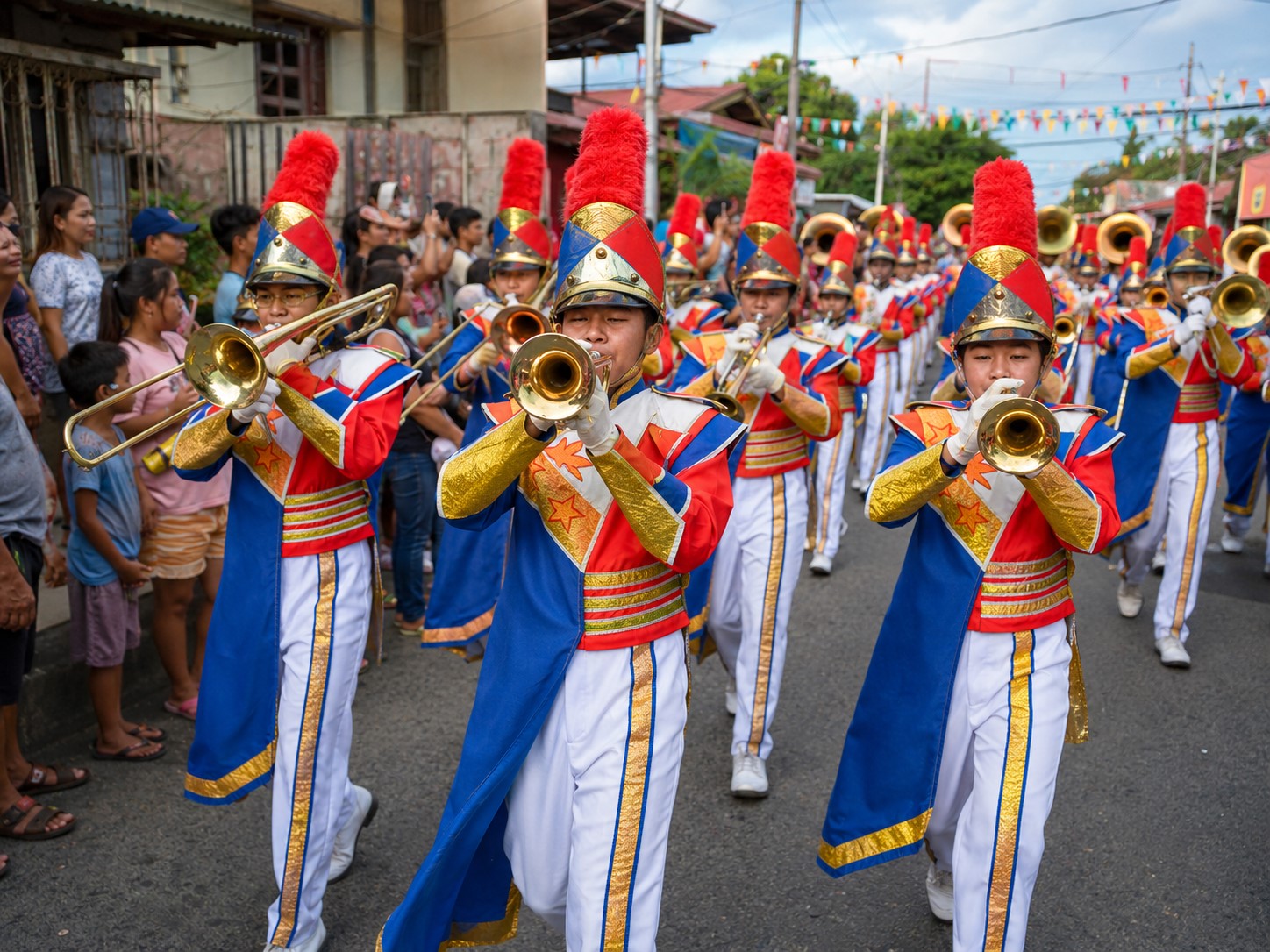
Bands move through a designated route while performing in formation. Brass instruments shine beneath the sun or streetlights, drums create a powerful rhythm and uniformed musicians must continue playing even while walking long distances.
The difficulty is easy to underestimate.
Players must control their breathing, produce a clean musical sound and remain aware of the people around them. At the same time, they must maintain equal spacing and follow instructions from the drum major.
One person moving too quickly or turning in the wrong direction can disturb the entire formation.
The 2025 marching street parade was scheduled along General Evangelista Road, while the accompanying field-show competition took place at the STRIKE Gymnasium.
Routes and venues may change each year, so visitors should always confirm the current map rather than assuming that the parade will pass the same location.
Marching Field Show
The marching field show allows bands to present more complex programs inside a defined performance area.
Unlike a street parade, where musicians must continue moving toward a destination, a field show gives them enough space to form shapes, create visual effects and combine music with detailed choreography.
A band may begin in several straight lines before separating into circles, diagonals or symbols. Musicians continue playing while shifting positions, sometimes moving backward or sideways without breaking formation.
Color guards add another visual layer by waving flags, spinning rifles or using theatrical props.
The strongest performances combine three elements:
Music, movement and visual storytelling.
A technically excellent band must still create an emotional impact. The arrangement, formations and costumes should work together so the audience feels that it has watched a complete production rather than a collection of drills.
Drumline Battle
The drumline battle focuses attention on percussion.
Without the full brass and woodwind sections, every beat becomes more noticeable. Performers use snare drums, bass drums, cymbals and other percussion instruments to create complex rhythms while maintaining synchronized movements.
The competition can feel like a musical conversation.
One section plays a sharp pattern, while another responds with a deeper rhythm. Performers may spin sticks, shift formations and use dramatic pauses before returning with an even louder sequence.
The audience often reacts immediately.
A clean and unexpected rhythmic break can produce cheers before the routine is even finished.
Drumline performances are especially exciting for younger spectators because the energy is direct and easy to feel. You do not need formal musical training to appreciate the discipline required when dozens of players strike their instruments at exactly the same moment.
Color Guard Competition
Color guards combine dance, athletics and visual performance.
Participants wave and spin large flags while moving to music. More advanced routines may include rifles, sabres or other performance equipment.
The flags create broad areas of color that can be seen from across the field. When every performer moves together, a simple formation can become one of the most beautiful moments of the competition.
Timing is critical.
A flag released a second too early can collide with another performer or fall outside the intended formation. Wind and rain can make equipment heavier and less predictable.
Color-guard members must appear graceful while performing physically demanding movements, catching equipment and staying aware of musicians moving around them.
Majorettes and Drum Majors
Majorettes and drum majors are among the most recognizable figures in a marching parade.
A majorette may twirl a baton, dance and lead visual routines while wearing an elaborate uniform. A drum major commands the band, gives signals and helps control tempo, spacing and movement.
Their confidence sets the tone for the entire group.
When the drum major raises a mace or baton, musicians must respond immediately. The crowd may see only a dramatic gesture, but band members understand it as a precise instruction.
Awards may recognize outstanding drum majors, majorettes and uniforms. However, their importance goes beyond individual competition.
They become the public faces of their bands.
The Costumes and Uniforms
Marching-band uniforms are part of the performance.
Bright jackets, polished boots, tall hats, metallic braiding and colorful feathers help bands create an identity that spectators remember. Some ensembles choose military-inspired designs, while others incorporate local symbols or modern theatrical elements.
The uniforms must look impressive while remaining practical enough for hours of movement.
That is not easy in Philippine weather.
Heavy jackets can become uncomfortable under the sun, and rain may make fabric, footwear and equipment more difficult to manage. Performers must stay disciplined even when conditions are far from ideal.
The appearance of hundreds of musicians wearing different uniforms is one of Bakood Festival’s greatest visual attractions.
Every arriving band changes the colors and atmosphere of the street.
International and National Participation
Although Musiko is rooted in Bacoor, its ambitions have extended beyond the city.
The 2018 Bacoor International Music Championships welcomed 34 bands from the Philippines and countries including Thailand, Indonesia, Malaysia, Taiwan and Japan.
More recent competitions have continued working with regional and international marching-band organizations.
This exposure benefits local musicians.
Bacooreño performers can observe different approaches to musical arrangement, costume design, drill writing and judging. Visiting bands also experience the city that has placed marching music at the center of a major cultural festival.
The exchange helps Bacoor’s tradition grow rather than become trapped in one familiar style.
More Than a Marching-Band Festival
Musiko receives much of the attention, but Bakood Festival usually includes a wider calendar of activities.
The city describes the festival as both service-oriented and entertaining, with events designed to encourage tourism, local trade and community participation.
Depending on the year, the program may include:
- Trade exhibits and business booths
- Job and livelihood activities
- Community sports
- Student competitions
- Cultural performances
- Environmental programs
- Religious services
- Public concerts
- Fireworks displays
- Civic recognition ceremonies
The 2025 celebration, for example, concluded with a free concert at the Bacoor Town Plaza on September 29. The event featured local acts, Silent Sanctuary and a fireworks display as part of the city’s anniversary and patronal feast.
Not every activity returns in exactly the same format, so festival visitors should review the complete official calendar once it is released.
What the Bakood Festival Feels Like
The streets begin changing hours before the parade.
Band members arrive carrying instrument cases, uniform bags and equipment. Some find shaded areas where they can tune instruments, while others practice small sections of music beside their buses.
Majorettes adjust costumes and test their batons. Drum majors review the route and give final instructions.
Along the roadside, families begin claiming places.
Children sit on plastic stools, vendors prepare drinks and snacks and photographers walk around searching for the best angle.
Then a distant drumbeat begins.
The crowd turns toward the road. The rhythm grows louder until the first band appears, led by a drum major walking with complete confidence.
Brass instruments enter next, followed by percussion, color guards and performers in carefully spaced rows.
Once the band passes, the sound slowly fades—but another rhythm is already approaching from behind.
This continues for hours.
Each band has a different personality. One may be known for powerful brass, another for complicated formations and another for eye-catching uniforms.
By the end of the parade, you may feel physically tired from standing, walking and listening. Yet the energy of the performers makes it difficult to leave early.
When Is the Bakood Festival Celebrated?
Bakood Festival is held during September, with the largest anniversary and religious activities generally taking place near September 29.
September 29 is both Bacoor’s traditional founding-anniversary date and the feast of St. Michael the Archangel in the city’s festival calendar. Recent editions have scheduled Musiko during the final weekend of the month, followed by anniversary programs and religious celebrations.
However, the festival may begin much earlier in September.
Trade fairs, sports competitions, community programs and smaller cultural events can be spread across several weeks.
The safest plan is to wait for the official schedule from the Bacoor City Government. Check carefully for:
- Date of the marching street parade
- Field-show competition schedule
- Drumline and color-guard events
- Parade route
- Road-closure hours
- Concert dates
- Religious services
- Trade-fair locations
The largest event may not fall exactly on September 29 when the date conflicts with weather conditions, logistics or another major program.
Where Is the Festival Held?
Festival activities are distributed across several parts of Bacoor.
Important venues in recent editions have included:
- General Evangelista Road
- STRIKE Gymnasium
- Bacoor Oval Track and Field
- Bacoor Town Plaza
- Bacoor government facilities
- Roads around the poblacion
The 2025 field show was held at the STRIKE Gymnasium, while the street parade used General Evangelista Road. The anniversary concert took place at the Bacoor Town Plaza in Barangay Poblacion.
Because Bacoor covers a large area, festival venues can be far apart.
Bacoor Bayan, Zapote, Molino and the Bacoor Government Center are not interchangeable destinations. Always show your driver or conductor the specific venue listed on the current poster.
How to Get to Bacoor from Metro Manila
From PITX
PITX is one of the easiest starting points for travelers coming from Metro Manila.
Its current transportation guide lists modern jeepneys and buses connecting PITX with SM Bacoor and destinations traveling through Aguinaldo Highway. It also lists services between PITX and the Molino side of Bacoor through routes continuing toward General Mariano Alvarez.
The correct vehicle depends on the festival venue.
For events near Aguinaldo Highway, SM Bacoor or Zapote, take a service passing through that corridor.
For Molino-area activities, use a route serving Molino or SM Molino.
For events around Bacoor Poblacion or General Evangelista Road, you may need to transfer to a local jeepney or other public vehicle after reaching a major Bacoor stop.
Ask the conductor before boarding and show the exact event location.
From Las Piñas
Bacoor is directly accessible from Las Piñas through Alabang–Zapote Road and the Zapote area.
Jeepneys and modern public vehicles serve routes connecting Zapote, Bacoor and nearby communities. Festival road closures may shorten routes or change regular loading areas.
From Alabang
Travelers from Alabang can travel through Alabang–Zapote Road toward Molino, Zapote or other parts of Bacoor.
Choose the route according to the specific festival venue, since Molino is far from the old town center.
By Private Vehicle
Drivers may enter Bacoor through CAVITEX, Aguinaldo Highway, Daang Hari, Molino Boulevard or Alabang–Zapote Road.
Festival traffic can become extremely heavy around major parade routes. Several roads may close before the performance begins.
Use live navigation, follow official traffic advisories and avoid trying to park immediately beside the competition venue.
Arriving early and walking from an authorized parking area is usually easier than attempting to enter the city center shortly before the parade.
What to Wear and Bring
Comfort is more important than dressing formally.
Wear lightweight clothes and shoes that can handle several hours of standing and walking. September can be hot and humid, but it is also within the rainy season.
Bring:
- Drinking water
- Compact umbrella or raincoat
- Sunscreen
- Small towel
- Portable fan
- Power bank
- Cash in small denominations
- Secure crossbody bag
- Ear protection for sensitive children
Avoid carrying too much. Crowded sidewalks can make large backpacks inconvenient.
A folding stool may be useful when permitted, but do not place it where it blocks pedestrian movement or emergency access.
Tips for Watching Musiko
Arrive Several Hours Early
Popular sections of the parade route fill quickly. Early arrival gives you time to find food, use the restroom and choose a position before road restrictions become stricter.
Choose Between the Parade and Field Show
The street parade provides a lively public atmosphere, while the field show offers more complete choreography.
Attending both can make for a long day, so study the schedule and plan your energy accordingly.
Stay Outside the Performance Area
Musicians need enough room to carry instruments and maintain formations. Do not step into the street for a closer photograph.
Protect Your Hearing
Marching percussion and brass instruments can be extremely loud at close range.
Young children and people sensitive to noise may benefit from earplugs or protective earmuffs.
Bring Rain Protection
Bands may continue preparing even when the weather is uncertain. A sudden downpour can quickly soak spectators and belongings.
Respect the Musicians
Avoid distracting performers, touching instruments or interrupting groups while they are tuning and preparing.
Plan Your Exit
Thousands of spectators may leave at roughly the same time. Decide where you will meet your companions and how you will reach your return transportation.
Visiting with Children
Children can enjoy the uniforms, flags, drums and baton twirling, but parents should prepare for noise and crowds.
Choose a location away from speakers and the strongest percussion sections. Keep children behind barriers and do not allow them to run toward performers.
Write a parent or guardian’s contact number on a card placed securely in the child’s pocket.
Bring water, snacks and a light raincoat. Young children may not have the patience to watch every participating band, so it is perfectly reasonable to leave after seeing several groups.
The event can also become a valuable introduction to music.
Point out the different instruments and explain how musicians must listen to one another to remain together. A child who becomes fascinated by the parade may eventually want to join a school band or drum-and-lyre group.
Food to Try in Bacoor
A festival visit is also a good excuse to explore Bacooreño food.
Digman Halo-Halo
Bacoor is famous for the halo-halo tradition of Barangay Digman.
The city government promotes Original Digman Halo-Halo as one of Bacoor’s distinctive food attractions.
A cold serving is especially satisfying after spending hours beside a warm and crowded parade route.
Different establishments have their own combinations of sweetened beans, fruits, gelatin, leche flan, ube, milk and shaved ice. Rather than debating which shop is the only “original,” try an established local store and enjoy the neighborhood’s halo-halo heritage.
Tahong and Seafood
Bacoor’s coastal environment has long been associated with mussels and seafood.
The city promotes tahong prepared in numerous styles, alongside other seafood dishes, as part of Bacoor’s culinary identity.
Depending on the restaurant, you may find:
- Baked tahong
- Grilled tahong
- Sinabawang tahong
- Adobong tahong
- Tahong sisig
- Fried or stuffed mussels
- Seafood noodles
- Mixed seafood platters
Confirm restaurant hours before making a special trip, particularly during festival road closures.
Other Places to Visit in Bacoor
St. Michael the Archangel Parish
The parish church is the spiritual center of Bacoor’s September feast.
Its patronal celebration takes place on September 29. Visitors may attend Mass or see the church, but should remain respectful during services.
Zapote Bridge
Zapote Bridge is one of Bacoor’s most historically significant landmarks.
The NHCP recognizes the site as a National Historical Landmark connected with two major battles: the Filipino victory against Spanish forces on February 17, 1897, and the battle against American forces on June 13, 1899. General Edilberto Evangelista died during the first battle.
The site provides an important reminder that Bacoor was not only a gateway into Cavite but also a strategic location during two wars.
Bahay na Tisa
Bahay na Tisa is an ancestral structure associated with Bacoor’s history and the revolutionary period.
The City Government includes it among Bacoor’s notable heritage attractions and identifies it with the early revolutionary government of Emilio Aguinaldo.
Public access may depend on current ownership, restoration work or local arrangements. Check before visiting rather than entering the property without permission.
Bacoor Riverwalk and Bike Lane
The city tourism directory lists the Bacoor Riverwalk and Bike Lane among its recreational attractions.
Operating conditions and access may change during weather disturbances or public events, so confirm locally before including it in your itinerary.
Barangay Digman
A trip to Digman allows visitors to experience one of Bacoor’s best-known food traditions.
It is an easy addition to a festival itinerary, particularly after a hot afternoon of watching marching bands.
Bacoor’s Revolutionary History
Bakood Festival celebrates modern Bacoor, but the city’s story is deeply connected with the Philippine Revolution.
Bacoor served as an early capital of the revolutionary government under Emilio Aguinaldo. It was also the site of the Battle of Zapote Bridge, where Filipino revolutionaries fought Spanish forces in February 1897.
In May 1898, Bacooreño forces under Gil Ignacio secured the surrender of hundreds of Spanish soldiers, after which the Philippine flag was raised at the church belfry.
Marching bands also have connections with the revolutionary era.
The national proclamation recognizing Bacoor’s musical heritage notes that bands were present not only during fiestas and civic occasions but were also used in some revolutionary situations as diversionary tools.
This creates an interesting connection between the city’s past and its modern festival.
The instruments now used for entertainment and competition belong to a musical tradition that has accompanied both celebration and struggle.
Why Marching Bands Still Matter
In an age of streaming music and digital entertainment, maintaining a community marching band requires commitment.
Instruments are expensive. Uniforms need repair, and rehearsals require time and suitable spaces. Young musicians must balance practice with school, work and family responsibilities.
Yet marching bands provide something that recorded music cannot replace.
They teach cooperation.
A musician cannot simply play louder or faster without affecting everyone else. Each person must listen, follow instructions and understand how an individual part fits into a larger arrangement.
The same is true of marching formations.
Success depends on discipline, trust and attention to the people around you.
These values make marching-band education useful beyond performance. Musicians learn patience, confidence, responsibility and the importance of contributing to a team.
A Tradition Passed Between Generations
Many community bands survive because knowledge is passed personally.
An older musician teaches a child how to hold an instrument, control breathing or read a difficult rhythm. Former performers return as trainers, conductors or supporters.
Parents who once marched may eventually watch their children follow the same route.
Bakood Festival makes this continuity visible.
The parade includes young beginners, experienced performers and musicians whose families have been connected with bands for decades. The musical arrangements and costumes may become more modern, but the process of teaching and learning remains deeply personal.
This is how tradition stays alive.
Not by remaining exactly the same, but by giving every generation a role in carrying it forward.
Why the Bakood Festival Matters
Bacoor is now a highly urbanized gateway between Metro Manila and Cavite.
New roads, subdivisions, shopping centers and businesses have changed the landscape. Many residents were not born in the city and may have moved there only recently.
Rapid development can make local identity difficult to preserve.
Bakood Festival gives both longtime and newer residents a shared celebration.
A family that recently moved into Bacoor may discover the city’s musical culture through Musiko. A child may become interested in history after visiting Zapote Bridge. A visitor may associate Bacoor not only with traffic and busy highways but also with music, faith and heritage.
The festival turns local history into something people can see, hear and experience.
Final Thoughts
The Bakood Festival is one of Cavite’s loudest, grandest and most energetic celebrations.
Its concerts and community activities create an enjoyable fiesta atmosphere, but Musiko gives the festival its unmistakable identity. Watching dozens of marching bands perform one after another is an experience that few other Philippine cities can offer on the same scale.
The drums are powerful, the uniforms are colorful and the formations are impressive. Yet the real value of the celebration lies in the work behind the performance.
Every clean note represents hours of practice. Every synchronized step requires discipline. Every young musician continuing the tradition helps preserve an important part of Bacoor’s culture.
Attend Bakood Festival for the parade, music and excitement. While you are there, visit St. Michael the Archangel Parish, explore Bacoor’s revolutionary landmarks and cool down with Digman halo-halo.
Most importantly, listen closely.
The music filling Bacoor’s streets is more than festival entertainment. It is the sound of a city remembering its history, celebrating its people and proudly marching toward its future.