
Christmas in Cavite City has its own collection of unforgettable characters.
They are much taller than ordinary carolers, with oversized heads, brightly painted faces and bodies created from baskets, bamboo, paper, fabric and other lightweight materials.
Some resemble superheroes, cartoon characters or famous personalities. Others are completely original creations shaped by the imaginations of students, teachers, barangay groups and local artists.
As night falls, these giant figures move through the streets alongside illuminated lanterns and glowing rabbit-shaped carts.
This is the Bangenge Festival, one of Cavite City’s most distinctive Christmas traditions.
What began as a simple form of neighborhood caroling eventually developed into an organized parade and competition. Today, the bangenge shares the spotlight with two other important holiday creations: the kuneho, a lighted rabbit figure traditionally pulled on a small cart, and the parol, the star-shaped lantern that has become one of the Philippines’ best-known Christmas symbols.
The celebration is now commonly presented as part of Navidad, Cavite City’s month-long Christmas program. In December 2025, the city again held its Parada ng mga Kuneho, Parol at Pasiklaban ng mga Bangenge, bringing these traditional creations onto the streets for residents and visitors to enjoy.
For travelers, the festival offers something different from the usual Christmas light show. It is handmade, playful and closely connected with the childhood memories of Caviteños.
Content
What Is the Bangenge Festival?
The Bangenge Festival is a Christmas-season parade and creative competition held in Cavite City, usually during the middle of December.
Its main attractions are large papier-mâché mascots called bangenge. These figures are designed, built and operated by participating schools, barangays and community organizations.
The modern celebration may include:
- Bangenge-making competitions
- Giant mascot parades
- Kuneho-making contests
- Parol competitions
- School and barangay delegations
- Marching bands
- Christmas performances
- Exhibits of finished entries
- Lighting ceremonies
- Food stalls and holiday activities
Cavite City’s tourism office has organized annual competitions for bangenge, kuneho and parol entries, followed by a parade along major city roads. One documented edition included senior-high-school, junior-high-school and barangay categories.
In 2018, 46 giant characters and nine kuneho entries were displayed at Montano Hall before being paraded along San Antonio’s streets. Local tourism officials described bangenge-making as a Yuletide tradition dating to the 1970s.
What Is a Bangenge?
A bangenge is a large, human-operated mascot traditionally made from papier-mâché and lightweight recycled materials.
Its appearance can vary widely.
One bangenge may resemble a comic-book hero, while another looks like a princess, animal, Christmas character or exaggerated version of a familiar public personality. Some have humorous expressions, enormous ears or colorful hair.
A performer stands inside the structure and carries it through the parade. The figure sways, turns and sometimes dances as the hidden operator walks.
From a distance, a bangenge can look like an animated giant moving through the crowd.
The tradition has been compared visually with the higantes of Angono, Rizal, but bangenge has its own Cavite City history, construction practices and Christmas context. It developed through local caroling and school activities rather than as part of Angono’s feast of San Clemente.
Where Did the Bangenge Tradition Begin?
Local heritage accounts trace bangenge to an older Cavite City Christmas-caroling custom.
Children created homemade paper mascots and brought them from house to house while singing Christmas songs. Families would open their doors to find not only ordinary carolers but also a funny homemade character dancing outside.
The earliest versions were created from simple and inexpensive materials.
Large fruit and vegetable baskets discarded from the public market could be reused as body frames. Newspapers were attached using cooked starch paste, locally called gawgaw, and the figures were painted using whatever colors were available.
These were not polished commercial mascots manufactured inside a factory.
They were handmade neighborhood creations. Their imperfect shapes and exaggerated faces were part of their charm.
As the practice became more popular, schools and the city government helped transform it into a public competition and parade. By the 1970s, bangenge had become an established part of the local Christmas season.
Where Did the Word “Bangenge” Come From?
The precise origin of the festival name is not completely settled in easily accessible official records.
A Cavite heritage account published in 2025 connects the term with a comic character from the early 1970s called Bangenge. Children reportedly imitated the character by creating rough homemade figures from baskets, boxes, paper and available household materials.
Other residents remember the figures being called bondying or by similar informal names before bangenge became the more widely recognized festival term.
Because the tradition was passed largely through neighborhoods, schools and childhood experience, different generations may remember its early terminology differently.
What is certain is that bangenge now refers to the enormous paper characters associated with Cavite City’s Christmas parade.
How a Bangenge Is Made
Creating a giant festival mascot requires more engineering than visitors might initially realize.
The figure must be visually impressive, but it also needs to be light enough for a person to carry and stable enough to survive an entire parade.
Designing the Character
Builders begin by selecting a concept.
The character should be recognizable from a distance and have proportions that work in a large format.
Small details that look attractive in a drawing may disappear once the figure is several meters tall. Designers therefore emphasize:
- Large facial features
- Strong colors
- Clear outlines
- Recognizable clothing
- Distinctive hair or accessories
- A simple but expressive pose
Originality is important in competitions, but safety and mobility must remain part of the design.
Building the Frame
Traditional builders used baskets, bamboo, wire and reused containers.
Modern entries may combine bamboo with lightweight plastic tubing, wire mesh or other materials. The frame needs enough strength to hold the head and clothing without becoming too heavy.
The shoulder section is particularly important because this is where much of the weight rests on the operator.
Uneven weight can cause the bangenge to lean or become difficult to turn.
Creating the Head
The large head is commonly shaped from a basket, wire frame or lightweight molded structure.
Paper strips are dipped into paste and layered over the form. Once dry, the material becomes firm enough to paint.
Several layers may be needed, but excessive paper makes the head heavier.
Eyes, noses, mouths and ears are added using cardboard, shaped paper or foam. The finished face is then painted in bright colors so it remains visible at night and from across the street.
Making the Body and Clothing
The body may be covered with fabric resembling the chosen character’s costume.
Loose cloth helps hide the operator and frame while allowing air to circulate.
Designers need to avoid fabric that drags on the road or becomes tangled around the performer’s feet.
Arms may hang freely or be attached to lightweight rods so they move as the figure walks.
Creating the Viewing Opening
The person carrying the bangenge needs a safe way to see.
An opening may be hidden behind mesh, fabric, clothing or part of the character’s design. Visibility can still be limited, particularly at night or inside a crowded parade.
Helpers often walk beside large figures to guide the operators and keep spectators at a safe distance.
Testing the Figure
A bangenge should be tested before parade day.
The operator needs to practice:
- Walking in a straight line
- Turning at corners
- Bending beneath wires or decorations
- Stopping safely
- Dancing without losing balance
- Removing the structure quickly in an emergency
A beautiful entry that cannot be carried safely is not a successful design.
What Is the Kuneho Tradition?
The kuneho is another beloved Cavite City Christmas creation.
Kuneho means rabbit.
Traditionally, a rabbit-shaped frame was covered with thin white paper and illuminated from inside. The glowing figure was placed on a wheeled cart and pulled by children during the Christmas parade.
Older versions reportedly used candles as their light source. Modern organizers may use electric or battery-powered lights for greater safety.
The rabbit may have:
- Long upright ears
- A rounded illuminated body
- Painted facial features
- Wheels beneath its base
- Christmas ribbons and decorations
- A pulling handle or cord
When dozens of lighted kuneho move together after dark, the procession becomes one of Cavite City’s most charming holiday sights.
Why a Rabbit?
The exact reason the rabbit became a Cavite City Christmas figure is not consistently documented.
It is not a standard religious symbol of the Filipino Christmas season, which makes the local custom even more distinctive.
The form may have become popular because it was easy for children and teachers to construct from wire, paper and a small wheeled frame. Long ears make the animal immediately recognizable, while the rounded body provides enough space for a light.
Older Caviteños remember kuneho and other illuminated animal figures being made and sold in neighborhoods near the city center. Over time, the rabbit became the form most strongly associated with the official Christmas parade.
Parol: The Filipino Christmas Star
The third major element of the parade is the parol.
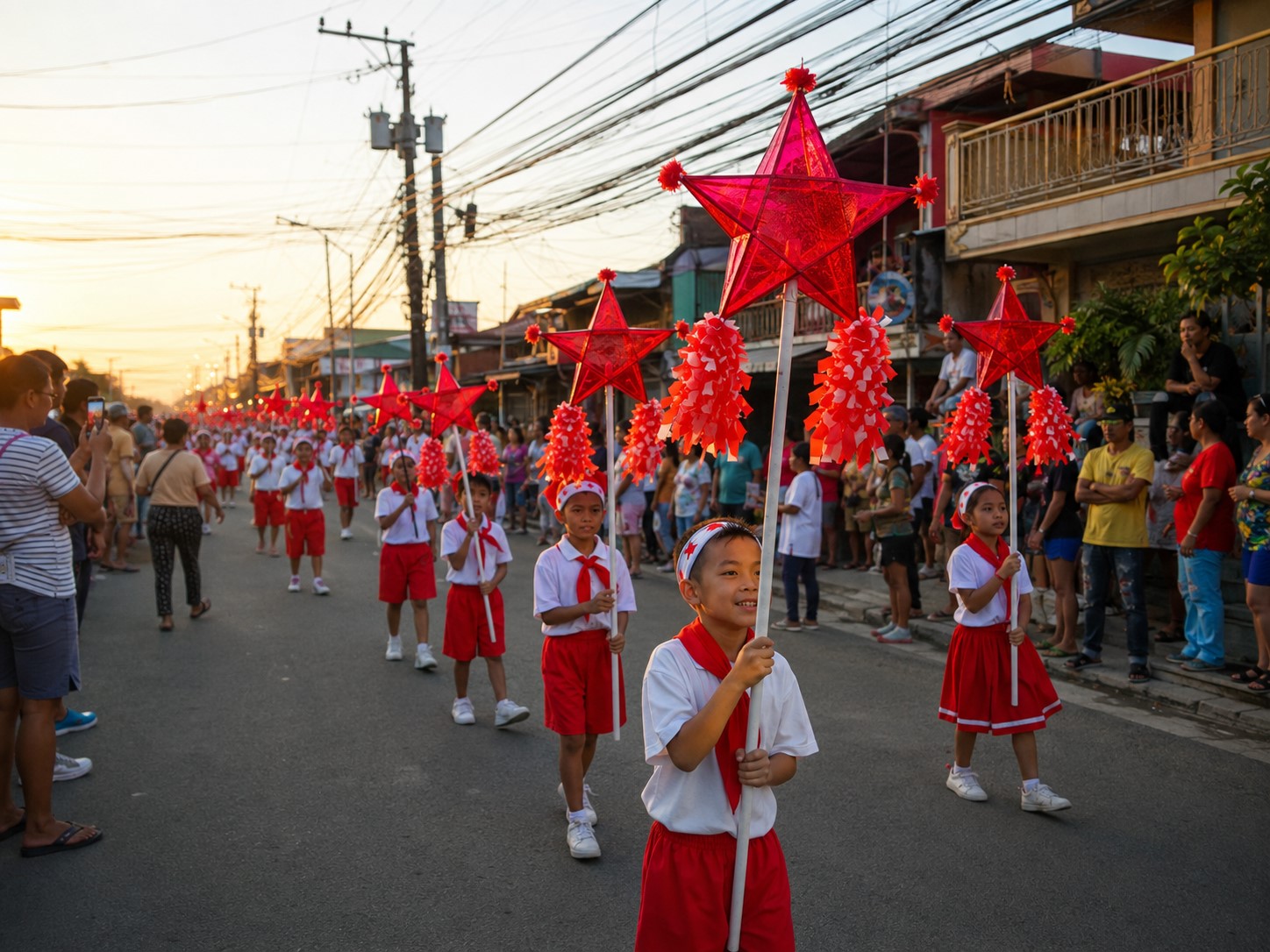
A parol is a Filipino Christmas lantern traditionally shaped like a five-pointed star. It symbolizes the Star of Bethlehem that guided the Magi toward the infant Jesus.
Cavite City schools and community groups create parol entries using materials such as:
- Bamboo
- Colored paper
- Plastic
- Fabric
- Recycled packaging
- Wire
- LED lights
- Shells and natural materials
- Scrap decorations
Some are carried on poles, while larger versions may be mounted on wheeled frames.
The parol brings an explicitly Christmas and religious meaning to the parade. While bangenge figures may come from popular culture and kuneho add childlike charm, the star lantern points back toward the Nativity.
Bangenge, Kuneho and Parol Together
Each of the three parade elements represents a different side of Cavite City’s Christmas culture.
Bangenge represents creativity and humor.
The giant figures show how discarded baskets, newspapers and simple materials can become public art.
Kuneho represents childhood tradition.
Its glowing form recalls generations of elementary-school pupils pulling small illuminated carts through the streets.
Parol represents Filipino Christmas faith.
The star lantern connects the festivities with the story of Christ’s birth.
Together, they create a parade that is playful, artistic, nostalgic and religious at the same time.
Navidad: Cavite City’s Wider Christmas Festival
The Bangenge Festival is increasingly promoted within Navidad, Cavite City’s larger Christmas-season celebration.
Navidad is the Spanish word for Christmas, which fits naturally in a city known for its Spanish-influenced history and Caviteño Chabacano heritage.
Cavite City’s government has organized month-long Navidad activities, including a Christmas village and events scheduled throughout December.
The December 12, 2025 program included the Parada ng mga Kuneho, Parol at Pasiklaban ng mga Bangenge. Giant papier-mâché characters and bright lanterns were again displayed before the public as part of the annual Navidad celebration.
This broader branding allows the city to place several traditions under one Christmas calendar rather than treating every competition as an isolated event.
Pasiklaban ng mga Bangenge
The word pasiklaban suggests a lively competition in which participants attempt to outshine one another.
During the Pasiklaban ng mga Bangenge, entries may be judged according to criteria such as:
- Creativity
- Originality
- Construction quality
- Use of materials
- Visual impact
- Character design
- Movement
- Durability
- Relevance to the theme
- Overall presentation
A successful bangenge should look impressive when displayed and remain entertaining while moving through the parade.
Movement matters because the figure is not intended to function only as a stationary sculpture.
The operator gives it personality. A gentle sway can make a friendly character seem cheerful, while quicker movements can make a superhero or fantasy creature appear energetic.
School Participation
Schools play a major role in maintaining the tradition.
Students help conceptualize characters, collect materials, prepare papier-mâché, paint details and rehearse parade presentations. Teachers coordinate schedules and ensure that entries follow competition and safety rules.
The work creates opportunities to learn about:
- Visual art
- Recycled-material design
- Structural balance
- Local history
- Teamwork
- Public performance
- Project planning
- Christmas traditions
Different age groups may take responsibility for different creations.
Older students often build and carry larger bangenge or parol entries, while younger pupils may participate through smaller lanterns and wheeled kuneho.
The activity turns local heritage into something students physically create rather than simply read about.
Barangay Participation
Barangay categories allow the tradition to move beyond school grounds.
Residents can organize teams involving artists, youth councils, parent groups and local volunteers. A barangay entry may represent a community story, historic figure or theme connected with Cavite City.
Barangay participation also helps adults who remember making bangenge as children remain involved.
They can teach younger members how to build frames, mix traditional paste, balance the structure and paint expressive faces.
In this way, the festival becomes an intergenerational project.
The Use of Recycled Materials
Recycling has been part of bangenge construction since its earliest forms.
Discarded market baskets, old newspapers, scrap fabric and leftover paint were used because they were available and inexpensive.
Today, recycled materials can still give the festival environmental value.
Builders may reuse:
- Cardboard boxes
- Newspapers
- Plastic packaging
- Fabric scraps
- Bottles
- Wire
- Old baskets
- Broken decorations
- Leftover construction materials
However, recycled does not automatically mean safe.
Sharp metal, brittle plastic and contaminated containers should not be included. Heavy materials can also make the structure dangerous for the operator.
Entries should use clean, lightweight and securely attached components.
Why Papier-Mâché Works Well
Papier-mâché is ideal for giant festival figures because it is relatively inexpensive and light.
Wet strips of paper can be formed around curved surfaces. After drying, the material holds its shape and accepts paint easily.
It also allows students and community groups to build large objects without specialized industrial equipment.
The main disadvantages are moisture and fragility.
Rain can soften untreated paper, while accidental impacts may crack the surface. Organizers need a backup plan when bad weather is expected.
Builders may apply protective coatings, but these should be used in well-ventilated areas and handled according to product-safety instructions.
What the Festival Feels Like
The day begins with preparation in school grounds, covered courts and barangay spaces.
Bangenge figures rest against walls while artists complete last-minute repairs. Without operators inside them, they look like enormous sleeping characters waiting to wake up.
Students arrange lanterns and test their lights. Teachers check costumes, extension wires and battery packs.
As evening approaches, participants move toward the parade assembly area.
The city becomes brighter.
Parol stars rise above the crowd, and glowing rabbits line up on small carts. Marching-band music begins echoing through the streets.
Then the first bangenge starts moving.
Its oversized head turns toward the spectators, and the figure begins swaying as children laugh and point.
One giant is followed by another. Superheroes march behind funny animals, Christmas figures and characters inspired by television, games and local imagination.
The atmosphere is festive rather than formal.
People recognize students and neighbors among the participants. Parents walk beside school groups, while residents wait outside their homes to see the parade pass.
The finished spectacle feels large, but it remains deeply local.
When Is the Bangenge Festival Celebrated?
The festival is generally held during the middle of December.
Earlier accounts describe it as a mid-December parade, while the 2018 festival was held on December 17.
The 2025 Navidad parade was held on December 12.
The exact date changes annually.
As of July 2026, I could not verify a complete official Navidad 2026 schedule. Visitors should wait for announcements from the Cavite City Government and Cavite City Tourism later in the year.
Look specifically for event names such as:
- Bangenge Festival
- Pasiklaban ng mga Bangenge
- Parada ng mga Kuneho
- Parol Competition
- Navidad Cavite City
- Christmas Village
- Christmas Festival
Where Is the Festival Held?
The parade takes place along major streets in Cavite City, although the precise route may change.
Earlier editions displayed entries at Montano Hall Gymnasium before moving through streets in San Antonio. Other editions have used city roads, school grounds and public venues for judging and exhibition.
The 2025 parade was promoted as part of Navidad, with the city government inviting the public to the Parada ng mga Kuneho, Parol at Pasiklaban ng mga Bangenge.
Before traveling, confirm:
- Assembly area
- Parade starting time
- Route
- Judging or exhibition venue
- Road closures
- Parking areas
- Public-transport drop-off points
- Rain-related announcements
Cavite City has only one principal road entrance, making traffic planning especially important during a large parade. The city’s official tourism site identifies the Heroes Arch area as its road gateway.
How to Get to Cavite City from Metro Manila
From PITX
PITX is the most practical starting point for many public-transport travelers.
Its official route information lists buses operating between PITX and Cavite City, with stops through Kawit and Noveleta. The same guide identifies Aguinaldo Shrine, Kawit and Noveleta among the points served by the Cavite City–PITX route.
At PITX, look for a bus clearly marked:
- Cavite City
- Cavite City via CAVITEX
- Cavite City via Kawit and Noveleta
Ask where the route terminates and whether road closures will affect the normal drop-off point.
Show the conductor the current festival poster or parade venue.
From Bacoor or Kawit
Travelers from Bacoor can reach Kawit and transfer to a Cavite City-bound bus or jeepney, depending on current service.
From Kawit, use a vehicle continuing through Noveleta toward Cavite City.
Festival traffic may cause vehicles to stop outside their usual terminal.
From Tanza or Rosario
Travelers coming from western Cavite may pass through Noveleta before entering Cavite City.
Choose a jeepney, bus or local vehicle clearly marked for Cavite City and confirm the last trip when attending an evening parade.
By Private Vehicle
Drivers from Metro Manila usually take CAVITEX toward Kawit, continue through Noveleta and enter Cavite City through the city’s road gateway.
Because the city occupies a peninsula, alternate road access is limited.
Leave early and follow traffic advisories. A closure near the entrance or parade route can create long delays.
Park only in designated areas and avoid blocking narrow streets, residents’ gates or emergency access.
Tips for Festival Visitors
Arrive Before Sunset
Early arrival allows you to see the construction details while there is still natural light.
You can then watch the entries transform once the lanterns are illuminated.
Confirm the Parade Route
Do not rely on the route used in an older edition.
Wear Comfortable Shoes
You may need to walk from a temporary transport stop or distant parking area.
Bring Rain Protection
December is generally cooler and drier than the monsoon months, but rain can still affect papier-mâché entries.
Bring a compact umbrella or raincoat without blocking other spectators.
Carry Cash
Food stalls, local vehicles and temporary vendors may not all accept digital payment.
Keep Away from Moving Figures
Bangenge operators have limited visibility. Give them enough room to turn and stop.
Watch for Lantern Carts
Kuneho and large parol entries may have wheels, wires and extended decorations that are difficult to see in a crowd.
Avoid Touching the Entries
Papier-mâché can be damaged easily, especially after exposure to moisture.
Plan Your Return
Public transportation may become crowded after the parade. Ask about the temporary loading area and final evening trips before the event begins.
Safety Around Illuminated Entries
Modern lanterns should use safer electric or battery-powered lighting rather than exposed flames whenever possible.
Visitors should still be careful around:
- Batteries
- Extension cords
- Wiring
- Generators
- Wet pavement
- Wheeled structures
- Low decorations
- Crowded intersections
Do not pull wires or allow children to climb on lighted figures.
Report sparks, overheating batteries or exposed electrical connections to event personnel.
If rain begins, follow organizers’ instructions. Electricity and wet conditions require immediate attention.
Bringing Children to the Festival
Bangenge Festival is especially enjoyable for children.
The giant characters feel as though cartoons and storybook figures have entered the real world. The glowing kuneho and parol also create a gentle Christmas atmosphere.
Prepare children with a few simple rules:
- Stay beside an adult.
- Do not run into the parade route.
- Do not touch the mascots.
- Keep away from wheels and wires.
- Follow police and marshal instructions.
- Avoid blocking other spectators.
- Remember the family meeting point.
Write a guardian’s contact number on a card and place it securely in the child’s pocket.
Children sensitive to loud marching bands may benefit from hearing protection.
Photographing Bangenge Festival
The festival offers strong photography opportunities because of the contrast between enormous characters and ordinary city streets.
For better images:
- Photograph the figures during daylight and after illumination.
- Use a lower angle to emphasize their height.
- Include children or spectators to show scale.
- Capture builders completing last-minute repairs.
- Photograph operators only with permission when they are resting.
- Avoid standing directly in front of a moving bangenge.
- Do not use flash when it distracts an operator or performer.
A wide photograph can show the complete parade, while close-up images reveal newspaper textures, brushstrokes and handmade details.
The imperfections often make the figures more interesting.
Local Food to Try in Cavite City
A Christmas festival trip is also a good opportunity to explore Cavite City’s distinctive cuisine.
Bibingkoy
Bibingkoy is one of the city’s best-known rice delicacies.
It is made from glutinous rice dough filled with sweetened beans and served with a rich coconut-based sauce. It is strongly associated with Cavite City and can be difficult to find elsewhere.
Availability may be limited to particular sellers and hours, so ask residents for current recommendations.
Pancit Pusit
Pancit pusit is a dark noodle dish flavored with squid ink and seafood.
Its black appearance can surprise first-time visitors, but the dish reflects Cavite City’s coastal food heritage.
Pancit Puso
Pancit puso is served with a sour accompaniment made from banana blossom.
The acidity cuts through the richness of the noodles and gives the dish its distinctive Caviteño character.
Tamales
Cavite City has its own tamales tradition using rice flour, peanuts and savory ingredients wrapped for steaming.
Its flavor and texture differ from Mexican tamales despite the shared name and possible colonial-era culinary connections.
Bacalao
Bacalao is traditionally associated with Caviteño Holy Week and special family meals.
Versions may combine salted fish with potatoes, vegetables and tomato-based seasonings.
Not every heritage dish will be available from festival street stalls. Established local eateries or advance orders may be necessary.
Nearby Places to Visit
Diocesan Shrine of Nuestra Señora de la Soledad de Porta Vaga
The shrine and San Roque Parish house Cavite City’s deeply venerated image of Our Lady of Solitude of Porta Vaga.
The Diocese of Imus lists her feast on the second and third Sundays of November.
The devotion dates to the old fortified port of Cavite, where the Ermita de Porta Vaga once stood beside the city gate. The image was enthroned there in 1692 and became known as the protectress of Cavite.
Visitors should dress respectfully and avoid disrupting Masses or private prayers.
Fort San Felipe
Fort San Felipe is one of Cavite City’s most important historical structures.
The NHCP recognizes it as a National Historical Site. The fort is inside the Philippine Navy’s Cavite base, so ordinary public access may be restricted.
Do not attempt to enter a military compound without authorization.
1872 Cavite Mutiny Memorial
The Cavite Mutiny of 1872 became one of the defining events connected with the growth of Filipino nationalism.
The city’s official attractions directory includes the mutiny memorial among its historical sites.
Thirteen Martyrs Centennial Plaza
The plaza honors the thirteen Caviteños executed by Spanish authorities in 1896 for alleged involvement in the revolutionary movement.
It forms part of Cavite City’s collection of monuments and public historical spaces.
Julian Felipe Monument
Cavite City is the birthplace of Julian Felipe, the composer of the music that became the Philippine national anthem.
The city contains monuments and markers honoring his contribution to Philippine history.
Governor Samonte Park and the Porta Vaga Area
The city’s official site identifies Governor Samonte Monument Park with the former walls and entrance area of Porta Vaga, once the principal gateway to the fortified port city.
A visit helps explain why Cavite City’s urban shape and history differ from other Cavite municipalities.
Cavite City’s Spanish and Chabacano Heritage
Cavite City was one of the major Spanish ports and naval centers in the Philippines.
Its official history connects the area with Fort San Felipe, the port, naval facilities and the strategic peninsula extending into Manila Bay.
The city also developed its own variety of Chabacano, a Spanish-based creole language.
Caviteño Chabacano is one of the surviving Manila Bay Chabacano varieties, although the number of fluent speakers has declined significantly.
The use of the word Navidad for the Christmas festival reflects this Spanish-influenced cultural environment.
Bangenge itself is not necessarily a Spanish tradition, but it belongs to a city where local, Filipino, Spanish, religious and popular-culture influences have blended for centuries.
Why the Bangenge Festival Matters
Christmas decorations are increasingly mass-produced.
People can order inflatable characters, plastic lanterns and ready-made displays without creating anything themselves.
Bangenge Festival protects a different kind of celebration.
Its figures must be imagined, constructed, painted and carried by people from the community.
Students learn that a discarded basket can become a giant head. Newspapers can become a superhero, animal or Christmas character. Leftover fabric can turn into an elaborate costume.
The value lies not only in the finished object.
It lies in the process of working together.
Preserving a Handmade Tradition
Handmade community traditions can disappear when fewer people remember how to create them.
Older bangenge builders may possess practical knowledge that is rarely written down:
- Which basket shape works best
- How many paper layers are enough
- How to balance an oversized head
- Where to place the viewing opening
- How to keep fabric away from the operator’s feet
- How to repair cracks quickly
- How to make the figure dance safely
Schools and barangays give this knowledge a place to continue.
When an experienced builder teaches a student, the tradition moves into another generation.
A Celebration of Resourcefulness
The early bangenge did not require expensive craft supplies.
Children used what they could find: baskets from the market, newspapers, homemade paste and leftover paint.
That resourcefulness remains one of the festival’s strongest messages.
Creativity does not always begin with perfect materials.
It can begin with a discarded object and the question, “What else could this become?”
The resulting figure may not have the smooth finish of a commercial mascot, but it carries the work and personality of the people who made it.
More Than Giant Cartoon Characters
The easiest way to describe Bangenge Festival is to call it a parade of giant paper characters.
Yet the tradition represents much more.
It recalls children singing from house to house. It preserves the glowing kuneho remembered by older generations and places Filipino parol beside characters from modern popular culture.
It brings schools, barangays, artists and families into the same Christmas celebration.
Most importantly, it gives Cavite City a holiday identity that belongs specifically to the community.
Other places have Christmas villages and light shows.
Cavite City has bangenge.
Final Thoughts
The Bangenge Festival is one of Cavite’s most charming and unusual Christmas celebrations.
Its giant papier-mâché figures are funny, creative and impressive, but the tradition becomes even more meaningful once you understand how it began.
These characters grew from neighborhood caroling and simple materials.
Discarded baskets became bodies. Old newspapers became faces, while homemade paste and leftover paint transformed them into creatures large enough to walk through the streets.
The glowing kuneho and colorful parol complete the experience, connecting childhood play with the faith and warmth of Filipino Christmas.
Visit Cavite City in December to watch the parade, admire the craftsmanship and explore the wider Navidad festivities.
Arrive early, confirm the current route and give the operators enough room to move safely. Support local food sellers and take time to visit the city’s historical and religious landmarks.
Most importantly, look closely at the handmade details.
Behind every oversized smile is a team that cut, pasted, painted and practiced for weeks.
The bangenge may appear to come alive only when the parade begins, but its real life comes from the people of Cavite City—and from a Christmas tradition they continue carrying, one giant character at a time.


