If you live, work, study, or regularly travel around Metro Manila, you may want to mark November 16, 17, and 18, 2026 on your calendar.
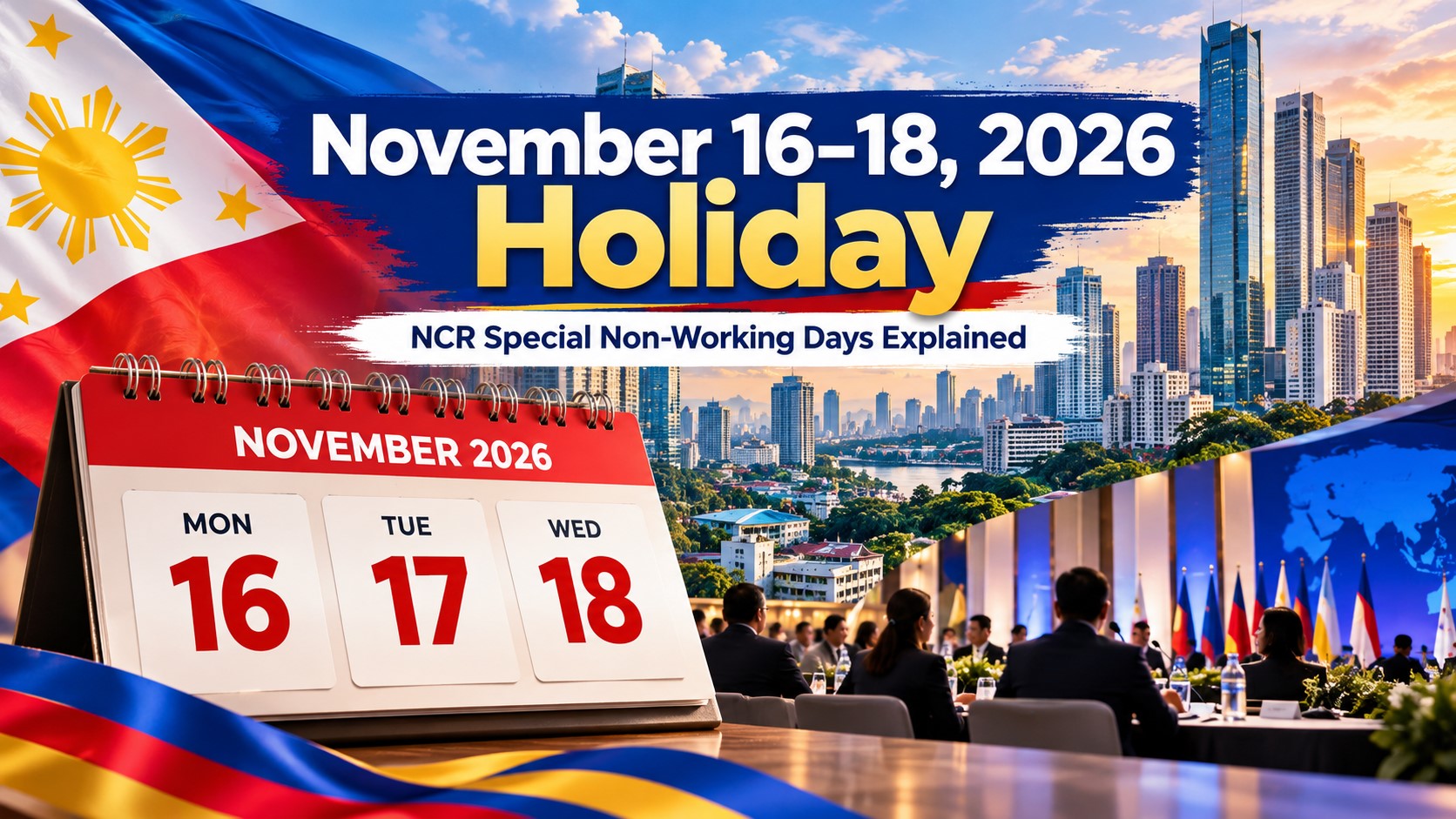
Malacañang has officially declared these three dates as special non-working days throughout the National Capital Region or NCR in connection with the Philippines’ hosting of the 49th ASEAN Summit and Related Summits.
The declaration was made through Proclamation No. 1447, signed on September 17, 2026 by Acting Executive Secretary Ralph G. Recto by authority of President Ferdinand Marcos Jr. The announcement was made public on September 22.
So yes, there will be three consecutive special non-working days in Metro Manila in November.
But there are a few important things to understand.
The declaration applies specifically to NCR, not automatically to the entire Philippines. And because these are special non-working days rather than regular holidays, the pay rules for private-sector employees are also different.
Here’s what you need to know.
Content
November 16–18, 2026 Are Special Non-Working Days in NCR
Under Proclamation No. 1447, the following dates have been declared special non-working days:
| Date | Day | Classification |
|---|---|---|
| November 16, 2026 | Monday | Special Non-Working Day in NCR |
| November 17, 2026 | Tuesday | Special Non-Working Day in NCR |
| November 18, 2026 | Wednesday | Special Non-Working Day in NCR |
The declaration covers the entire National Capital Region.
That means residents and workers in Metro Manila could potentially have a very long break beginning Saturday, November 14 and continuing until Wednesday, November 18, assuming they normally have Saturdays and Sundays off and are not required to work during the special days.
For many people, that effectively creates a five-day break.
Private-sector workers should remember, however, that special non-working days follow different wage rules from regular holidays.
Why Were November 16–18 Declared Holidays?
The reason is the 49th ASEAN Summit and Related Summits.
The Philippines is hosting the major regional gathering in Metro Manila as part of its ASEAN chairmanship in 2026.
According to the government, declaring the three days as special non-working days is intended primarily to reduce vehicular traffic and help authorities maintain the safety and security of delegates and participants attending the high-level meetings.
Anyone who has experienced Metro Manila during a major international summit probably understands the concern.
Events of this scale can involve visiting heads of government, senior officials, international delegations, security convoys and temporary traffic arrangements. Roads surrounding summit venues, hotels and transportation routes may also be affected.
Having fewer regular commuters on the road gives authorities more flexibility in managing traffic and security.
What Is the 49th ASEAN Summit?
ASEAN stands for the Association of Southeast Asian Nations.
The summit brings together leaders and officials from ASEAN countries, along with representatives of dialogue partners and other participating nations.
The Philippines is hosting the 49th ASEAN Summit and related meetings in Metro Manila in November 2026.
Several ASEAN-related activities are also scheduled around this period.
For example, the 16th ASEAN Maritime Forum is scheduled for November 17, while the 14th Expanded ASEAN Maritime Forum is scheduled for November 18.
This helps explain why the government did not declare just one day as non-working.
The special non-working period covers Monday through Wednesday.
Is November 16–18 a Nationwide Holiday?
No.
This is one of the most important details to remember.
The proclamation specifically declares November 16, 17 and 18 as special non-working days in the National Capital Region.
It is not a nationwide declaration.
The NCR covers Manila, Quezon City, Caloocan, Las Piñas, Makati, Malabon, Mandaluyong, Marikina, Muntinlupa, Navotas, Parañaque, Pasay, Pasig, San Juan, Taguig, Valenzuela and the Municipality of Pateros.
If you work or study in Cavite, Laguna, Rizal, Bulacan, Cebu, Davao or another province outside Metro Manila, the proclamation does not automatically make November 16–18 non-working days in your area.
Separate announcements could still be issued by government agencies, schools, employers or local authorities if necessary, so it is worth monitoring official announcements closer to the summit.
Are Government Offices Closed on November 16–18?
Because the dates are officially declared special non-working days in NCR, regular government operations in Metro Manila are generally expected to be suspended.
However, certain government agencies and personnel providing essential or emergency services may still need to operate.
Hospitals, emergency response agencies, security personnel, transportation-related offices and other essential services can have separate staffing arrangements.
Employees working in government should therefore watch for specific instructions from their respective agencies as the ASEAN Summit approaches.
Are There Classes on November 16–18?
Students in Metro Manila should generally expect regular classes to be affected by the declaration because the dates are special non-working days throughout the NCR.
Schools, colleges and universities may issue their own announcements regarding class schedules, online activities, examinations or other academic requirements.
Parents and students should monitor official announcements from DepEd, CHED and their individual schools closer to November 16.
This will be especially important for universities or institutions that may have already scheduled examinations or school activities during that week.
Are Private Companies Required to Close?
Not necessarily.
A special non-working day does not mean that every private business must physically shut down.
Some businesses may continue operating depending on the nature of their industry.
Shopping malls, restaurants, hotels, BPO companies, hospitals, transportation companies, airports, delivery services, tourism establishments and customer-service operations are examples of businesses that may continue functioning during holidays and special non-working days.
Companies may also implement work-from-home arrangements depending on operational requirements.
Employees should therefore wait for official instructions from their employer instead of automatically assuming that they do not need to report for work.
What Is the Pay Rule for November 16–18?
This is where the distinction between a regular holiday and a special non-working day becomes important.
For special non-working days, the general rule followed by the Department of Labor and Employment is:
“No work, no pay.”
That means an employee who does not work on a special non-working day is generally not entitled to wages for that day unless the company has a more favorable policy, practice or collective bargaining agreement providing payment.
For employees who do work, premium pay generally applies.
Based on DOLE’s existing rules for special non-working days, an employee who works during the first eight hours is generally paid 130% of the basic wage.
For example, if your basic daily wage is ₱1,000, the general computation for the first eight hours would be:
₱1,000 × 130% = ₱1,300
If the special non-working day also happens to be the employee’s scheduled rest day and the employee works, the general rule provides 150% of the basic wage for the first eight hours.
DOLE may issue a specific labor advisory covering the November special non-working days as the dates approach, so employees and employers should still check the latest DOLE announcement before finalizing payroll computations.
What About Overtime?
Under the existing DOLE rules for special non-working days, overtime work also carries additional premium compensation.
For ordinary special non-working days, overtime is generally paid with an additional 30% of the hourly rate for that day.
If the special non-working day also falls on the worker’s rest day, the rest-day special-day rate applies first before the overtime premium is added.
Because payroll situations can differ depending on schedules, company policies and collective bargaining agreements, employees with specific concerns should confirm the computation with their HR or payroll department.
Is November 16 a Regular Holiday?
No.
November 16 is a special non-working day in NCR for the ASEAN Summit.
The same classification applies to November 17 and November 18.
This distinction matters because regular holidays and special non-working days have different pay rules.
For a regular holiday, qualified employees who do not work may generally still be entitled to their basic daily wage.
For a special non-working day, however, “no work, no pay” generally applies unless a company policy or agreement provides otherwise.
Does the Holiday Include November 19?
As of the current proclamation, no.
Proclamation No. 1447 covers only November 16, 17 and 18, 2026.
Thursday, November 19 is not included in the three-day declaration.
Unless another proclamation or suspension is issued later, regular work and classes should resume on November 19.
This is something worth checking again closer to the ASEAN Summit because traffic, security arrangements or other government announcements could still change.
Is November 20 a Holiday?
No nationwide or NCR-specific ASEAN holiday covering November 20 is included in Proclamation No. 1447.
As things currently stand, the special non-working period ends on Wednesday, November 18.
November 19 and 20 remain regular working days unless another declaration is issued.
Will Banks Be Closed?
Bank schedules during special non-working days can vary.
Many physical branches may close or operate on adjusted schedules, while branches located inside shopping malls or other commercial establishments may follow different hours.
Online banking, ATMs and mobile banking services normally remain available, although interbank transfers and transactions that depend on banking-day processing could be affected.
If you have important payments, check deposits, remittances or business transactions scheduled around November 16–18, it may be better to complete them earlier.
Banks will likely publish individual operating schedules closer to the holiday.
What About Malls, Restaurants and Tourist Attractions?
Don’t automatically expect Metro Manila to completely shut down.
Shopping malls, restaurants, hotels, cinemas and tourist attractions often remain open during special non-working days.
In fact, some establishments may see increased visitors because many people are off work.
However, operating hours could change because of the ASEAN Summit.
Security zones and traffic restrictions could also affect establishments near summit venues, hotels used by delegations and major roads used for official convoys.
If you’re planning to visit attractions around Manila, Pasay, Makati or other parts of NCR during November 16–18, check the latest traffic and security announcements first.
Will There Be Road Closures During the ASEAN Summit?
Traffic restrictions are very possible.
One of the reasons cited for the special non-working declaration is to alleviate traffic congestion during the summit.
International summits involving foreign leaders usually require enhanced security arrangements.
This can mean temporary road closures, stop-and-go traffic, rerouting schemes and restrictions around certain venues.
Exact road closures and traffic schemes have not necessarily been finalized this far in advance, so motorists should monitor announcements from agencies such as the MMDA, PNP, local governments and other relevant authorities closer to November.
What About NAIA Flights?
The holiday itself does not mean Ninoy Aquino International Airport will close.
Flights should continue operating.
However, passengers traveling through NAIA during the ASEAN Summit should consider allowing additional travel time.
Foreign delegations may arrive or depart through Metro Manila airports, and security arrangements or official convoys could affect roads leading to the airport.
Passengers with flights from November 16 to 18 should monitor airline advisories and airport traffic conditions.
Leaving earlier than usual may be a good idea, especially if your route passes through areas affected by summit-related traffic restrictions.
Can You Turn It Into a Five-Day Vacation?
For workers who normally have Saturdays and Sundays off, yes, the calendar potentially creates a five-day stretch without regular work:
Saturday, November 14
Sunday, November 15
Monday, November 16 – special non-working day
Tuesday, November 17 – special non-working day
Wednesday, November 18 – special non-working day
Regular work is currently expected to resume Thursday, November 19.
That could make the period attractive for staycations or short trips outside Metro Manila.
But private-sector employees should remember the “no work, no pay” rule that generally applies to special non-working days. Taking advantage of the break could mean three unpaid days for some employees unless their company policy provides otherwise.
It’s worth checking your company’s holiday policy before booking anything.
Will Employees Working From Home Still Have the Holiday?
The proclamation declares the dates special non-working days in NCR, but individual situations can become more complicated with remote work.
For example, a company may be based in Metro Manila while an employee works from another province, or an employee living in NCR may work for an office located outside the region.
Employers may have specific policies for these situations.
If you’re working remotely, it’s best to confirm directly with HR or your manager whether the NCR holiday applies to your work schedule.
What Should BPO Employees Know?
BPO and customer-service operations are among the industries that frequently remain operational during Philippine holidays because they serve clients in other countries.
Employees working for US, Australian, Canadian, European or other international accounts may therefore still be scheduled to work from November 16–18.
If the employee is covered by the applicable special-day rules and reports for work, the corresponding premium pay should generally apply.
Employees should check their schedule, company policy and payroll guidance ahead of time.
Why Declare Three Days Instead of One?
The ASEAN Summit is not simply a single meeting lasting a few hours.
It involves multiple official meetings, international delegations, security preparations, transportation arrangements and related diplomatic events.
The government’s stated reasons for declaring November 16–18 special non-working are reducing Metro Manila traffic and helping authorities secure participants during the event.
By reducing the number of regular commuters traveling across NCR, authorities can more easily manage road movements and security around summit venues.
Frequently Asked Questions
Is November 16, 2026 a holiday?
Yes. November 16, 2026 is a special non-working day throughout the National Capital Region under Proclamation No. 1447.
Is November 17, 2026 a holiday?
Yes. November 17 is also a special non-working day in NCR.
Is November 18, 2026 a holiday?
Yes. November 18 is the third consecutive special non-working day in NCR.
Why are November 16–18 holidays?
The three days were declared special non-working days because Metro Manila is hosting the 49th ASEAN Summit and Related Summits. The government said the declaration is intended to reduce traffic and help maintain security during the meetings.
Is the November 16–18 holiday nationwide?
No. The declaration specifically covers the National Capital Region.
Is Cavite included?
No. Cavite is outside NCR and is not automatically covered by Proclamation No. 1447.
Is Rizal included?
No. Rizal Province is outside the National Capital Region.
Is Bulacan included?
No. Bulacan is not part of NCR.
Are private-sector employees paid if they don’t work?
Generally, the “no work, no pay” rule applies on a special non-working day unless the employer has a company policy, practice or collective bargaining agreement providing otherwise.
What if I work during the holiday?
Under existing DOLE special-day rules, employees who work during the first eight hours are generally entitled to 130% of their basic wage.
When will work resume?
Based on the current proclamation, regular work is expected to resume on Thursday, November 19, 2026, unless another announcement is issued.
Final Thoughts
The declaration of November 16 to 18, 2026 as special non-working days gives Metro Manila residents three consecutive days away from regular work and activities as the Philippines hosts the 49th ASEAN Summit.
For workers with weekends off, it could even create a five-day break beginning Saturday, November 14.
But remember that this is an NCR-only declaration and the dates are classified as special non-working days—not regular holidays.
That distinction is especially important for private-sector employees because the “no work, no pay” principle generally applies, while those required to report for work may qualify for premium pay under existing labor rules.
As November approaches, it’s also worth watching for additional announcements involving class schedules, government services, bank operations, MMDA traffic schemes, road closures, airport access and specific DOLE pay guidelines.
For now, though, Metro Manila residents can officially mark November 16, 17 and 18, 2026 as special non-working days on the calendar.