Baguio is one of those places in the Philippines that I think you can visit again and again without getting tired of it.
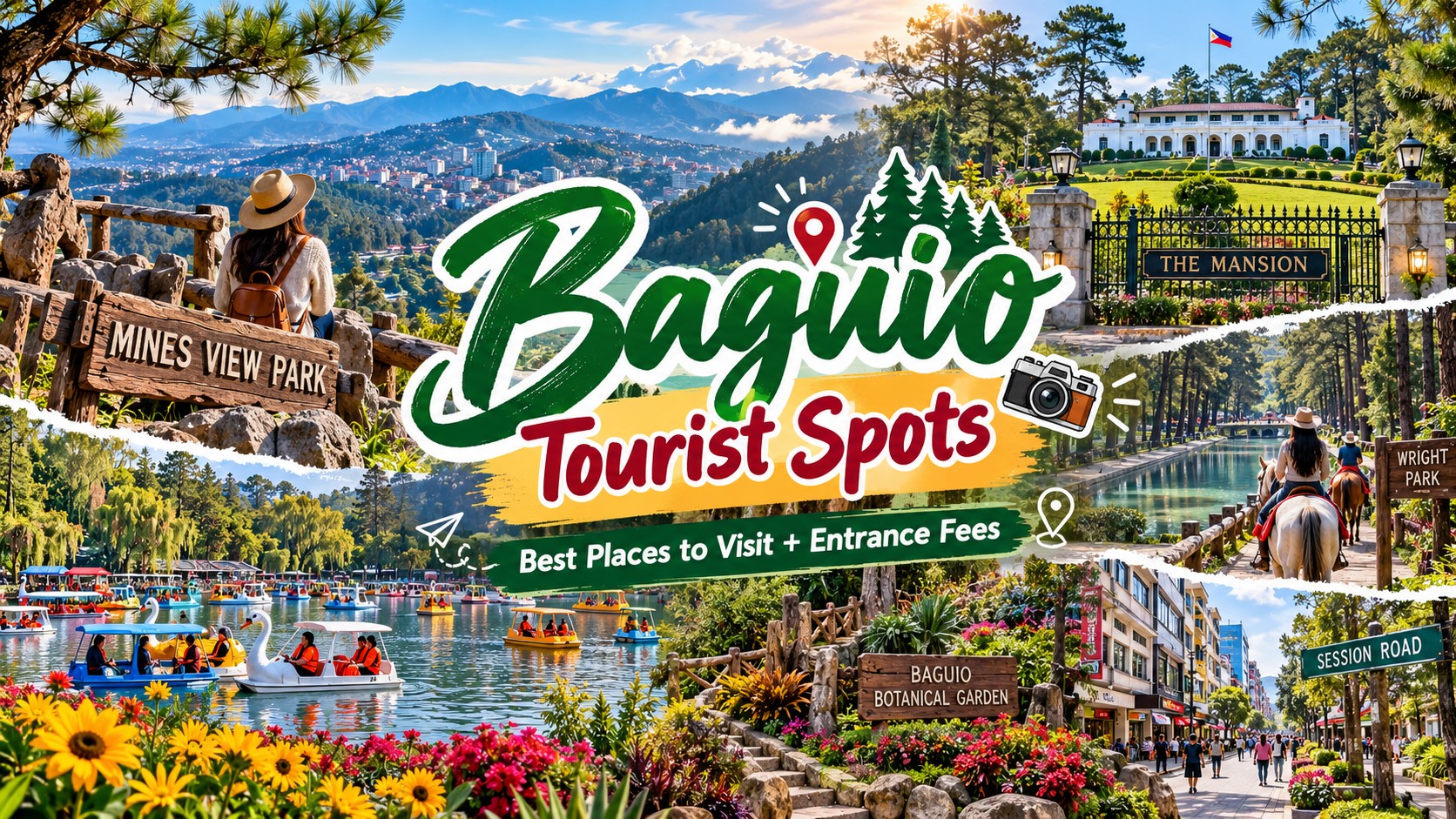
There are the classics we grew up hearing about—Burnham Park, Mines View Park, Wright Park, and The Mansion—but Baguio has also changed a lot over the years. You now have beautifully renovated gardens, museums, art spaces, cultural attractions, eco-parks, and newer destinations that give you more reasons to stay for two or three days instead of squeezing everything into one quick trip.
And the good news?
Many of Baguio’s best tourist spots are either free or surprisingly affordable.
If you’re planning a trip to the City of Pines, here’s my comprehensive guide to the best Baguio tourist spots, including entrance fees, what to expect, and some practical tips for planning your itinerary.
Note: Entrance fees below were checked against the latest information available as of October 2026. Rates, operating hours, discounts, parking fees, and activity charges can change, so it’s always a good idea to confirm with the attraction before your visit.
Content
Baguio Tourist Spots and Entrance Fees: Quick Guide
| Tourist Spot | Entrance Fee |
|---|---|
| Burnham Park | FREE |
| Session Road | FREE |
| Baguio Cathedral | FREE |
| Baguio Night Market | FREE |
| Baguio Botanical Garden | ₱100 adult tourist |
| Wright Park | FREE |
| The Mansion | FREE |
| Mines View Park | ₱10 adult |
| Good Shepherd Convent | FREE |
| Camp John Hay | FREE for general grounds; Historical Core has a fee |
| BenCab Museum | ₱200 regular |
| Mirador Heritage and Eco-Spirituality Park | ₱150 suggested standard stewardship offering |
| Lourdes Grotto | FREE |
| Heritage Hill and Nature Park / Diplomat Hotel | Around ₱10 adult |
| Tam-awan Village | Around ₱60 adult |
| Igorot Stone Kingdom | Around ₱130 adult |
| Baguio Museum | Around ₱100 adult |
| Museo Kordilyera | ₱60 adult |
Now let’s go through them one by one.
1. Burnham Park
If it’s your first trip to Baguio, Burnham Park is still one of the easiest places to start.
Located right in the middle of the city, the park is basically Baguio’s giant outdoor living room. You’ll see families having picnics, couples walking around the lagoon, kids riding bicycles, joggers making their rounds, and tourists taking photos practically everywhere.
The most recognizable section is Burnham Lake, where you can rent one of the colorful boats and paddle around.
Other parts of the park include the Rose Garden, Children’s Playground, skating area, picnic areas, Melvin Jones Grandstand, and several landscaped sections.
Entrance fee: FREE
You only pay for optional activities such as boating, bicycle rentals, skating, food, and other concessions. Following the 2026 rehabilitation of Burnham Lake, published rates listed boat rentals at around ₱250 for 30 minutes, although activity prices should still be confirmed on-site.
One reason I like recommending Burnham Park is its location. From here, you can easily walk to Session Road, Harrison Road, the Baguio Public Market, Baguio Cathedral, and several restaurants.
Best for: Families, first-time visitors, walking, boating and relaxing
Suggested time: 1–2 hours
2. Session Road
You don’t really “visit” Session Road the same way you visit an attraction. You experience it as part of Baguio.
This famous sloping road is essentially the heart of downtown Baguio. Restaurants, cafés, shops, pharmacies, bakeries and commercial establishments line both sides.
Walking from the lower section toward Baguio Cathedral is a good way to experience the city’s atmosphere, especially in the late afternoon.
On certain Sundays and special occasions, portions of Session Road may be closed to vehicles and transformed into a pedestrian area with performers, artists and community activities.
Entrance fee: FREE
Best for: Food trips, cafés, shopping and city walks
Suggested time: 1–2 hours
3. Our Lady of the Atonement Cathedral
More commonly called Baguio Cathedral, Our Lady of the Atonement Cathedral is one of the city’s most recognizable landmarks.
Its rose-colored façade and twin spires are easy to spot from downtown.
You can reach the cathedral directly from Session Road, making it an easy addition to a walking itinerary.
Aside from its religious significance, the cathedral grounds also provide a nice elevated view of parts of downtown Baguio.
Entrance fee: FREE
Remember that this remains an active place of worship, so sightseeing should be done respectfully, especially during Mass.
Best for: Architecture, religious visits and city views
Suggested time: 20–45 minutes
4. Baguio Night Market
Once nighttime arrives, head back toward Harrison Road.
The Baguio Night Market usually transforms part of Harrison Road into a huge open-air marketplace filled with ukay-ukay clothing, shoes, bags, accessories, souvenirs and street food.
This is one of my favorite kinds of Baguio experiences because it isn’t really a traditional tourist attraction. Locals shop here too, so it feels like part of everyday city life.
Entrance fee: FREE
The night market generally starts at around 9:00 PM. Current 2026 listings place its operating period at roughly 9:00 PM until around 1:00 or 2:00 AM, although schedules can change because of weather, road conditions or special events.
Bring small bills and keep an eye on your belongings because the area can become extremely crowded.
Best for: Ukay-ukay, bargain shopping and street food
Suggested time: 1–2 hours
5. Baguio Botanical Garden
The Botanical Garden has become one of Baguio’s most impressive mainstream attractions after extensive improvements.
Located along Leonard Wood Road, the garden combines landscaping, flowers, Cordillera-inspired cultural displays, traditional huts, international friendship gardens and plenty of photo spots.
You’ll find Japanese- and Korean-inspired sections, native plants, sculptures and walking paths under Baguio’s trademark pine trees.
Current tourist entrance fees reported by a City of Baguio tourism listing are:
Adults and visitors 13 years old and above: ₱100
Senior citizens and PWDs: ₱80 with valid ID
Children 12 years old and below: ₱25
Baguio and BLISTT residents receive discounted admission upon presentation of qualifying identification.
Opening hours are generally around 6:00 AM to 6:00 PM.
I’d recommend visiting in the morning before the tour groups arrive.
Best for: Gardens, photography, families and cultural displays
Suggested time: 1.5–2 hours
6. Wright Park
From Botanical Garden, you can continue toward Wright Park.
The most recognizable section is the long Pool of Pines reflecting pool lined with towering trees.
But for many Filipinos, Wright Park is most associated with horseback riding.
The riding area is located downhill from the main promenade, where horses and ponies are available for visitors.
Entrance fee: FREE
Horseback riding is paid separately. Published 2026 rates have been around ₱200 for 30 minutes and ₱300 for an hour, but prices may vary, so confirm the rate and duration before riding.
Best for: Families, horseback riding and classic Baguio photos
Suggested time: 45 minutes–1 hour
7. The Mansion
Right across from Wright Park is one of Baguio’s most famous landmarks.
The Mansion serves as the official summer residence of the President of the Philippines.
Its ornate gate is probably what most people recognize from photos, but the property itself has a long history going back to the American colonial period.
The City Government’s Baguio VISITA tourism portal currently lists entry as free. Public access, however, may be restricted or changed during official functions and presidential visits.
Entrance fee: FREE
Even if you don’t spend a long time here, it makes sense to stop because Wright Park is literally nearby.
Best for: History, architecture and photography
Suggested time: 20–45 minutes
8. Mines View Park
Mines View Park remains one of the classic Baguio tourist spots.
The main reason to come here is the viewpoint overlooking the mountains and former mining areas around Itogon, Benguet.
On a clear morning, the layered mountains can be beautiful.
The problem is that this is also one of Baguio’s busiest attractions.
Come early if you can.
Current admission fees commonly listed for 2026 are:
Adults and visitors 13 years old and above: ₱10
Children 12 years old and below: ₱5
Children 2 years old and below: FREE
Separate charges apply for souvenir photos, traditional clothing rentals and other activities.
The area outside the park is also packed with souvenir shops selling sweaters, woven products, strawberry goods, keychains and other Baguio pasalubong.
Best for: Mountain views, souvenirs and photography
Suggested time: 45 minutes–1 hour
9. Good Shepherd Convent
After Mines View Park, you can walk toward Good Shepherd.
Good Shepherd is famous for one thing above all else: pasalubong.
Its most famous product is probably the ube jam, but you’ll also find strawberry preserves, peanut brittle, cookies and other treats.
There is no general entrance fee to visit the premises or shop.
Entrance fee: FREE
Lines can become long during weekends and holidays, especially during peak travel seasons.
Best for: Pasalubong shopping
Suggested time: 30–60 minutes
10. Camp John Hay
Camp John Hay feels completely different from downtown Baguio.
The former American military recreation facility is now a huge mixed-use destination with pine forests, hotels, restaurants, walking trails, historical sites and leisure facilities.
You don’t need a ticket simply to enter the general Camp John Hay area.
Entrance fee for general grounds: FREE
However, individual attractions can have separate charges.
One of the most interesting sections is the Historical Core, which includes the Bell House, Bell Amphitheater, Cemetery of Negativism, Secret Garden, history trail and other heritage features.
Recent 2026 travel guides list Historical Core admission at approximately:
Regular adult: ₱85
BLISTT resident with qualifying ID: ₱55
Student / senior / PWD: ₱40
Children below four feet: FREE
Because Camp John Hay attractions are operated separately and fees have changed over time, I’d confirm the Historical Core rate upon arrival.
If you don’t want to pay anything, simply walking around Camp John Hay and enjoying the pine-covered surroundings can already be worthwhile.
Best for: Nature, history, walking, restaurants and families
Suggested time: 2–4 hours
11. BenCab Museum
If you’re interested in Filipino art, don’t skip BenCab Museum.
The museum was founded by National Artist Benedicto Cabrera, better known as BenCab, and is located along Asin Road just outside central Baguio.
Inside are galleries featuring BenCab’s works as well as pieces by other Filipino artists, Cordillera artifacts and changing exhibitions.
The museum complex also includes landscaped outdoor areas and views of the surrounding mountains.
Official admission rates are:
General admission: ₱200
Senior citizen / PWD: ₱150
Student with valid Philippine school ID: ₱120
Children no taller than 42 inches: FREE
BenCab Museum is open Tuesday to Sunday from 9:00 AM to 6:00 PM, with last admission at 5:30 PM. It is closed on Mondays, Christmas Day and New Year’s Day.
The EcoTrail is a separate paid experience.
Best for: Art, culture and photography
Suggested time: 2–3 hours
12. Mirador Heritage and Eco-Spirituality Park
Mirador has become one of the most popular newer attractions in Baguio.
Located on Mirador Hill, the park combines gardens, religious spaces, Cordillera heritage and scenic viewpoints.
Probably the most photographed parts are the bamboo grove and the Mirador Peace Memorial, which gives the area a distinctly Japanese-inspired visual character.
But there’s much more to see, including prayer areas, heritage gardens and panoramic viewpoints.
The official Mirador Jesuit Villa website currently describes the admission contribution as a suggested maintenance stewardship offering:
Standard offering: ₱150
Senior citizens, PWDs and students: ₱100
Children 7 years old and below: FREE
This is worth noting because older Baguio guides still show the previous ₱100 rate.
There’s plenty of uphill walking, so comfortable shoes are a must.
Best for: Photography, gardens, views and peaceful walks
Suggested time: 1.5–2.5 hours
13. Our Lady of Lourdes Grotto
You can easily combine Mirador with the nearby Lourdes Grotto.
The shrine has been part of Baguio’s religious landscape since the early 1900s.
The traditional route involves climbing around 252 steps to reach the grotto dedicated to Our Lady of Lourdes.
Entrance fee: FREE
Many visitors light candles and pray when they reach the top, while others come for the elevated views of Baguio.
The climb isn’t particularly long, but remember that you’re already at high elevation. Take your time if you’re not used to stairs.
Best for: Pilgrimage, religious visits and views
Suggested time: 30–60 minutes
14. Heritage Hill and Nature Park Garden / Old Diplomat Hotel
Few Baguio attractions have as many stories attached to them as the Old Diplomat Hotel.
Originally built as a retreat facility before becoming a hotel, the structure on Dominican Hill has developed a reputation for ghost stories and paranormal legends.
But you don’t have to be interested in ghosts to appreciate it.
The old structure, gardens and elevated location make it interesting for history and photography.
Recent 2026 visitor guides list admission at approximately:
Adult: ₱10
Child: ₱5
Parking is charged separately.
The area is now commonly referred to as Heritage Hill and Nature Park Garden.
Best for: History, architecture, views and curious travelers
Suggested time: 45 minutes–1 hour
15. Tam-awan Village
Tam-awan Village is an excellent stop if you’re interested in Cordilleran culture and local art.
The attraction was established by the Chanum Foundation and recreates the atmosphere of a traditional Cordillera village on a Baguio hillside.
You’ll find traditional Ifugao and Kalinga houses, galleries, artworks and forested walking paths.
The official Tam-awan website currently lists operating hours of 8:00 AM to 6:00 PM daily.
Widely published admission rates are around:
Adult: ₱60
Student / senior: ₱40
Children below 10: ₱30
Children 3 years old and below: FREE
Some newer listings have shown different rates, so this is one attraction where I’d definitely confirm the current ticket price before going.
Best for: Culture, art and traditional architecture
Suggested time: 1–2 hours
16. Igorot Stone Kingdom
One of Baguio’s newer and most photographed attractions is the Igorot Stone Kingdom in Pinsao Proper.
The property features huge stone walls, terraces, towers, bridges and passages inspired by Cordilleran themes.
It’s important to understand that this is a modern themed attraction—not an ancient Igorot archaeological site.
Think of it as a creative interpretation inspired by Cordilleran culture rather than a preserved historical village.
Recent 2026 visitor reports list admission at approximately:
Adult: ₱130
Child: ₱100
Senior / PWD: around ₱100
Children 3 years old and below: FREE
There are plenty of stairs, so this attraction may be challenging for visitors with mobility limitations.
Best for: Photos, families and architecture
Suggested time: 1–2 hours
17. Baguio Museum
If you’d like to understand more about the Cordillera before heading home, Baguio Museum is worth visiting.
Located near Governor Pack Road, the museum contains traditional artifacts, costumes, woodcarvings, artworks and exhibits connected with the provinces and indigenous communities of the Cordillera Administrative Region.
Published 2026 rates list:
Adult: ₱100
College student: ₱70
High school student: ₱60
Elementary student: ₱40
Senior citizen / PWD: ₱50
Operating hours are commonly listed as Tuesday to Sunday, around 9:00 AM to 5:00 PM.
Best for: History and Cordilleran culture
Suggested time: 1–1.5 hours
18. Museo Kordilyera
Another museum I’d recommend is Museo Kordilyera at the University of the Philippines Baguio.
This is an ethnographic museum focused on the peoples, cultures and heritage of the Cordillera.
Because it’s connected with UP Baguio, the approach feels more academic and research-oriented than a typical tourist museum.
Official UP Baguio rates for 2026 are:
Adult / visitor without qualifying ID: ₱60
Senior / PWD with ID: ₱45
Student with valid ID: ₱30
UP students, faculty, staff and alumni: FREE
It’s a good place to visit if you want something more educational than another photo stop.
Best for: Cordilleran history, anthropology and culture
Suggested time: 1–1.5 hours
Best Free Tourist Spots in Baguio
If you’re traveling on a budget, Baguio is actually a pretty affordable destination when it comes to attractions.
Some of the best free places include:
- Burnham Park
- Session Road
- Baguio Cathedral
- Wright Park
- The Mansion
- Good Shepherd Convent
- Lourdes Grotto
- Baguio Night Market
- General areas of Camp John Hay
You could easily spend an entire day exploring Baguio while paying almost nothing for entrance fees.
Best Baguio Tourist Spots for First-Time Visitors
If this is your very first trip and you don’t have time to visit everything, I’d prioritize:
Burnham Park for the classic Baguio experience.
Botanical Garden for gardens and photography.
Wright Park and The Mansion because they’re close together.
Mines View Park for the mountain views.
Good Shepherd for pasalubong.
Camp John Hay for pine trees and a completely different atmosphere.
Then choose either BenCab Museum, Mirador or Tam-awan depending on whether you’re more interested in art, scenery or Cordilleran culture.
How to Group Baguio Tourist Spots
One mistake first-time visitors make is jumping back and forth across the city.
Traffic can get bad, especially during weekends, Panagbenga, Christmas, Holy Week and long weekends.
Instead, group attractions by area.
Downtown Baguio
Burnham Park
Session Road
Baguio Cathedral
Baguio Public Market
Baguio Night Market
Baguio Museum
Museo Kordilyera
Eastern Baguio Tourist Route
Botanical Garden
Wright Park
The Mansion
Mines View Park
Good Shepherd
These attractions fit naturally together.
Camp John Hay Area
Camp John Hay
Historical Core
Bell House
Cemetery of Negativism
Forest trails
Restaurants and cafés
Mirador and Dominican Hill
Lourdes Grotto
Mirador Heritage and Eco-Spirituality Park
Heritage Hill / Old Diplomat Hotel
Pinsao and Asin Road Area
Tam-awan Village
Igorot Stone Kingdom
BenCab Museum
Grouping places this way can save a surprising amount of time.
Sample 2-Day Baguio Tourist Spots Itinerary
If you only have two full days, here’s a practical itinerary.
Day 1 – Classic Baguio
Morning:
Burnham Park
Session Road
Baguio Cathedral
Late morning:
Botanical Garden
Lunch
Afternoon:
The Mansion
Wright Park
Mines View Park
Good Shepherd
Evening:
Dinner around Session Road
Baguio Night Market
Day 2 – Culture, Art and Nature
Morning:
Mirador Heritage and Eco-Spirituality Park
Lourdes Grotto
Late morning:
Old Diplomat Hotel
Lunch
Afternoon:
Choose two:
BenCab Museum
Tam-awan Village
Igorot Stone Kingdom
Camp John Hay
If art is your priority, I’d choose BenCab.
If you’re traveling with children, Igorot Stone Kingdom or Camp John Hay may be easier to sell to the whole family.
How Much Should You Budget for Baguio Entrance Fees?
You actually don’t need a huge attraction budget.
For example, a first-time visitor doing:
Burnham Park – ₱0
Botanical Garden – ₱100
Wright Park – ₱0
The Mansion – ₱0
Mines View Park – ₱10
Good Shepherd – ₱0
Mirador – ₱150
BenCab Museum – ₱200
would spend roughly:
₱460 in basic admission fees
That’s already a very good selection of Baguio attractions.
Your bigger expenses will probably be food, accommodation, transportation, parking, shopping, horseback riding, boating, pasalubong and other optional activities.
Best Time to Visit Baguio Tourist Spots
Baguio can be visited year-round, but the experience changes depending on the season.
December to February generally brings some of the coolest weather and also some of the biggest crowds.
February is especially busy because of Panagbenga.
March to May attracts families escaping the summer heat.
The rainy season can bring foggy landscapes that are beautiful in their own way, but heavy rain can make outdoor attractions less enjoyable.
Whatever month you choose, weekday mornings are usually the best time for major attractions.
If you have to travel during a weekend, start early.
And by early, I mean really early.
Getting to your first attraction around 7:00 or 8:00 AM can make a huge difference compared with arriving at 10:00 AM when tour vans and weekend visitors are already moving around the city.
Getting Around Baguio
You don’t necessarily need your own car to explore Baguio.
Taxis are everywhere and fares are relatively reasonable because many attractions are only a few kilometers apart.
Jeepneys are much cheaper and can take you to virtually every major part of the city, although figuring out terminals can be confusing for first-time visitors.
Walking also works surprisingly well in the downtown area.
Burnham Park, Session Road, Baguio Cathedral, Harrison Road and the public market are all close enough to explore on foot.
For attractions farther away, combine walking with taxis or jeepneys.
If you’re bringing your own vehicle, remember that Baguio implements traffic and parking regulations that can affect visitors. Check the city’s current number-coding rules and parking information before driving around.
Baguio’s official VISITA tourism platform now provides information on registered attractions, establishments and current visitor information.
Frequently Asked Questions About Baguio Tourist Spots
What is the most famous tourist spot in Baguio?
Burnham Park, Mines View Park, Wright Park, The Mansion and Camp John Hay are among the city’s most famous traditional tourist attractions.
What tourist spots in Baguio are free?
Many are free, including Burnham Park, Session Road, Baguio Cathedral, Wright Park, The Mansion, Good Shepherd, Lourdes Grotto and the Baguio Night Market.
How much is the entrance fee to Botanical Garden Baguio?
For tourists, the current standard adult admission is ₱100. Tourist senior citizens and PWDs pay ₱80 with valid ID, while children 12 and below are listed at ₱25.
How much is Mines View Park entrance fee?
Current listings show ₱10 for adults or visitors 13 and older and ₱5 for children 12 and below. Very young children may enter free.
Is Wright Park free?
Yes. Entry to Wright Park itself is free. Horseback riding and other optional activities have separate charges.
How much is BenCab Museum?
General admission is ₱200. Seniors and PWDs pay ₱150, while students with valid Philippine school IDs pay ₱120.
How much is Mirador Baguio?
The official Mirador website currently lists a suggested standard maintenance stewardship offering of ₱150, with a ₱100 special rate for seniors, PWDs and students. Children 7 and below are free.
How many days do you need in Baguio?
Two days is enough for the major attractions.
Three days is better.
With three days, you won’t have to rush, and you’ll have enough time for cafés, restaurants, museums and attractions outside the traditional tourist circuit.
Final Thoughts
Baguio has changed over the years, but that’s probably one of the reasons it continues to be one of the Philippines’ most popular destinations.
You still have the nostalgic places—Burnham Park, Mines View, Wright Park, The Mansion and Camp John Hay—but they’re now joined by attractions like Mirador Heritage Park and Igorot Stone Kingdom, while places like Botanical Garden have been significantly improved.
And then there are the cultural destinations that deserve more attention: BenCab Museum, Tam-awan Village, Baguio Museum and Museo Kordilyera.
My biggest advice?
Don’t treat Baguio like a checklist.
You don’t need to visit 15 tourist spots in one day.
Spend a morning walking around Burnham. Drink coffee somewhere along Session Road. Give yourself time to enjoy the pine trees at Camp John Hay. Visit a museum instead of rushing to your next photo stop.
Baguio is one of those destinations where the atmosphere is part of the attraction.
Sometimes the best part of the trip isn’t the tourist spot itself.
It’s walking outside your hotel early in the morning, feeling that cold mountain air, smelling pine trees and coffee, and remembering exactly why Filipinos keep coming back to the City of Pines.