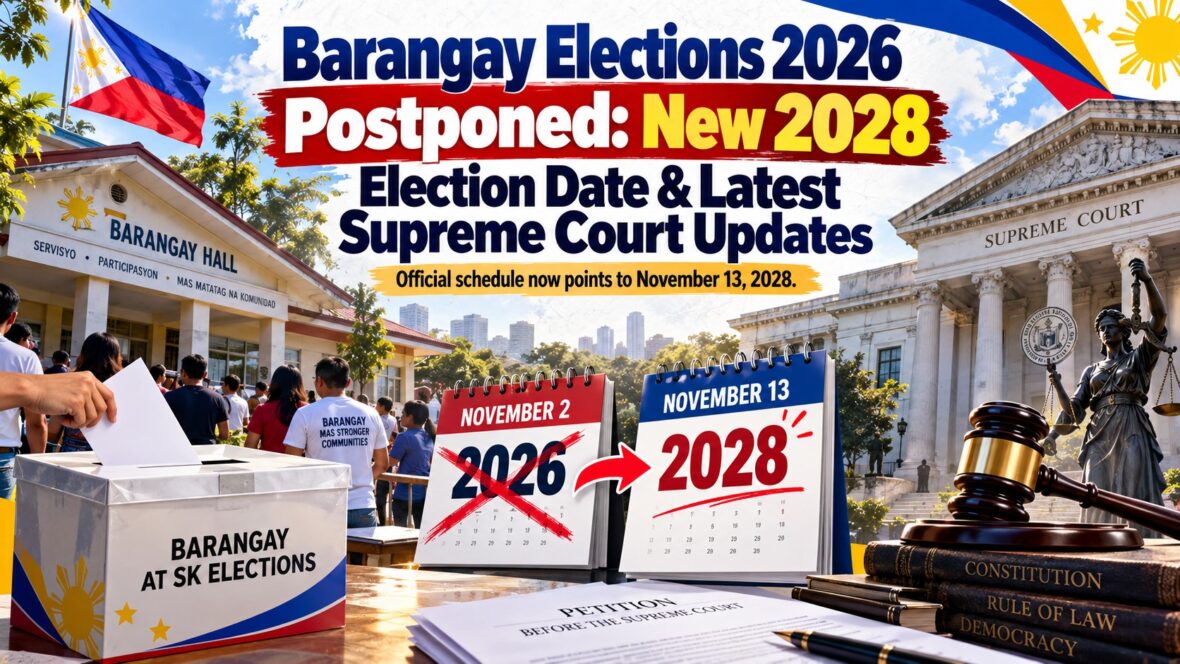
If you’ve been expecting to vote in the Barangay and Sangguniang Kabataan Elections this November 2026, there’s an important development you should know.
The elections have officially been postponed to 2028.
President Ferdinand Marcos Jr. signed Republic Act No. 12326 on September 24, 2026, moving the Barangay and Sangguniang Kabataan Elections (BSKE) originally scheduled for November 2, 2026, to November 13, 2028.
The new law also extends the terms of barangay and SK officials to five years, allowing current officials to continue serving their communities until the next elections, subject to the law’s holdover provisions.
But here’s the interesting part.
The postponement is now being challenged before the Supreme Court. Election lawyer Romulo Macalintal has filed a petition questioning the constitutionality of the new law, arguing that extending the terms of incumbent barangay officials violates the electorate’s right to vote.
The government, meanwhile, is defending the measure, maintaining that Congress has the constitutional authority to determine the terms of office of barangay officials.
So, will the barangay elections really happen in 2028? Can the Supreme Court still order the 2026 elections to proceed? And what happens to the barangay captains, kagawads, and SK officials currently serving their communities?
Let’s go through everything you need to know about the barangay elections postponement, the new 2028 schedule, and the latest Supreme Court updates.
Content
Are the Barangay Elections 2026 Really Postponed?
Yes. The November 2, 2026 Barangay and Sangguniang Kabataan Elections have officially been postponed.
Under Republic Act No. 12326, the next regular Barangay and SK Elections will instead take place on the second Monday of November 2028.
The Commission on Elections (COMELEC) has already acted on the new law.
On September 25, 2026, COMELEC issued Minute Resolution No. 26-0842, ordering the cessation of activities related to the previously scheduled November 2, 2026 elections.
This means election preparations, including activities related to the election calendar and filing of certificates of candidacy, have been stopped.
However, there’s an important distinction.
Although the law is currently in effect, the Supreme Court has been asked to examine whether it violates the Constitution.
As of October 11, 2026, the latest verified developments do not establish that the Supreme Court has issued a final decision invalidating Republic Act No. 12326.
Therefore, the November 2028 election schedule remains in effect unless a subsequent court ruling or other valid legal action changes it.
When Is the Next Barangay Election in the Philippines?
The next Barangay and Sangguniang Kabataan Elections are scheduled for Monday, November 13, 2028.
This is the second Monday of November 2028, the date specifically established under Republic Act No. 12326.
Here are the important dates to remember.
| Election Details | Date or Information |
|---|---|
| Last Barangay and SK Elections | October 30, 2023 |
| Previously Scheduled Elections | November 2, 2026 |
| Date RA 12326 Was Signed | September 24, 2026 |
| New Barangay Election Date | November 13, 2028 |
| Election Day | Monday |
| Regular Election Interval | Every five years |
| Next Regular Election After 2028 | November 2033 |
| Governing Law | Republic Act No. 12326 |
The law also establishes a new election cycle, with succeeding barangay and SK elections scheduled every five years.
For example, if the present schedule remains unchanged, the elections following November 2028 would take place in November 2033.
However, the specific election calendar for 2028, including candidate filing dates, the campaign period, and election-related restrictions, will still depend on COMELEC’s implementing regulations.
Filipinos should also remember that the November 2028 barangay elections are separate from the May 2028 national and local elections.
Why Were the Barangay Elections Postponed to 2028?
The postponement happened because Congress approved legislation changing the terms of office of elected barangay and SK officials.
To understand the situation, let’s look at what happened before the new law was signed.
In August 2025, President Marcos approved Republic Act No. 12232, establishing four-year terms for barangay and SK officials.
That law also scheduled the next regular Barangay and SK Elections for November 2, 2026.
However, lawmakers later approved another measure extending the terms of these officials from four years to five years.
The measure eventually became Republic Act No. 12326.
Under the new law, several significant changes were introduced:
- The term of elected barangay officials is set at five years.
- The term of elected SK officials is also set at five years.
- The November 2026 elections are moved to November 2028.
- Regular Barangay and SK Elections will be conducted every five years.
- Barangay officials are limited to two consecutive terms in the same position.
- SK officials remain limited to one term in the same position.
- New rules govern the filling of vacancies in SK membership.
- Continuing training and capacity-building programs for barangay and SK officials are institutionalized.
Supporters of the law argue that longer terms could give local officials more time to implement projects and deliver services.
For example, barangay officials responsible for community facilities, drainage improvements, disaster preparedness, peace and order, and livelihood programs may have additional time to complete their initiatives.
The longer election cycle may also reduce the frequency of nationwide barangay and SK elections.
However, the measure has also raised concerns about electoral accountability.
Critics question whether extending the service of current officials without holding another election unfairly delays voters’ opportunity to choose their local leaders.
This disagreement is now at the heart of the Supreme Court case.
Latest Supreme Court Updates on Barangay Elections 2026
The legal challenge against Republic Act No. 12326 is one of the most important developments to follow.
While the law has already been signed and COMELEC has suspended preparations for the 2026 elections, a petition is asking the Supreme Court to stop its implementation.
Here’s what has happened so far.
September 28, 2026: Election Lawyer Files Petition Against Postponement
Election lawyer Romulo Macalintal and several co-petitioners challenged Republic Act No. 12326 before the Supreme Court.
The petitioners argue that the law violates the electorate’s right of suffrage by moving the November 2026 elections to November 2028.
Macalintal contends that the legislation effectively extends the time incumbent barangay and SK officials remain in office without giving voters another opportunity to choose their representatives.
The petition also questions whether the extension amounts to an improper continuation of officials’ tenure through legislative action.
The petitioners requested a temporary restraining order (TRO) or status quo ante order to stop the implementation of the law.
They also asked the Supreme Court to direct COMELEC to continue preparing for the November 2026 elections should the Court rule in their favor.
September 30, 2026: Supreme Court Orders Government to Comment
On September 30, the Supreme Court directed government respondents to submit their comments on Macalintal’s petition.
The respondents included the Office of the President, the Senate, the House of Representatives, and the Commission on Elections.
The Court gave them a non-extendible period of five calendar days from receipt of notice to submit their responses.
This was an important development because it formally required the government to explain its position on the constitutionality of Republic Act No. 12326.
However, the Supreme Court’s order did not automatically stop the postponement.
An order requiring comments is not the same as a decision declaring a law unconstitutional.
October 5, 2026: Government Defends the Law
The Office of the Solicitor General (OSG), representing the government respondents, filed its comment before the Supreme Court on October 5, 2026.
The government asked the Court to dismiss the petition and reject the request for a temporary restraining order.
According to the OSG, Republic Act No. 12326 is primarily a law establishing the terms of office of barangay and SK officials.
The government argues that postponing the elections to 2028 is a consequence of establishing the new five-year terms.
Its position relies on Article X, Section 8 of the 1987 Constitution, which provides that the terms of barangay officials shall be determined by law.
The OSG also cited the Supreme Court’s previous 2025 ruling that recognized Congress’s authority to establish barangay officials’ terms.
In other words, the government maintains that Congress acted within its constitutional authority when it approved the new election schedule.
October 6, 2026: Macalintal Renews Request to Stop Postponement
On October 6, Macalintal filed an urgent omnibus motion and reply, renewing his request for the Supreme Court to stop the implementation of Republic Act No. 12326.
He again asked the Court to issue a temporary restraining order or status quo ante order and allow COMELEC to resume preparations for the November 2026 elections.
Macalintal disputed the government’s argument that the new law merely establishes the terms of barangay and SK officials.
He pointed to provisions extending the service of current officials and questioned whether these changes were consistent with the Constitution.
The renewed motion also raised concerns about the effect of repeated election postponements on the people’s right to vote.
October 7, 2026: Fact-Check Confirms Elections Are Postponed
On October 7, VERA Files published a fact-check addressing social media posts claiming that the barangay elections would still proceed in 2026.
The fact-check clarified that Republic Act No. 12326 had postponed the elections to November 2028 and that the Supreme Court had not yet ruled on the petition challenging the law.
This is worth emphasizing because outdated election calendars and misleading announcements can easily circulate online.
An old COMELEC election schedule does not mean the November 2026 elections are still pushing through.
October 11, 2026: Has the Supreme Court Issued a Final Decision?
As of October 11, 2026, no final Supreme Court ruling overturning Republic Act No. 12326 has been verified in the latest available official announcements and news reports.
The confirmed developments include the Supreme Court’s September 30 directive, the government’s October 5 response, and Macalintal’s renewed motion on October 6.
The constitutional challenge remains unresolved in the latest verified reports.
For now, the legal election schedule remains November 13, 2028.
Can the Supreme Court Still Reverse the Postponement?
Yes. The Supreme Court can still issue a ruling affecting Republic Act No. 12326.
However, that does not mean the November 2026 elections will automatically return.
Several legal outcomes are possible.
The Court could uphold the new law, leaving the November 2028 schedule in place.
It could also grant temporary relief affecting the implementation of the contested provisions while the case is being considered.
Alternatively, it could eventually find certain provisions unconstitutional, which might require COMELEC and other government agencies to adjust their actions.
Exactly what would happen to the election schedule would depend on the scope and wording of any Court order.
There’s also a practical issue.
COMELEC has already stopped preparations for the previously scheduled elections. If the legal situation changes, the election commission would need to determine how to implement the Court’s ruling.
COMELEC Chairman George Garcia has indicated that the election commission will comply with whatever decision the Supreme Court makes.
Until then, the public should not assume that the November 2, 2026 elections have been restored.
What Happens to Current Barangay Captains and Kagawads?
This is another major question for communities across the Philippines.
Will current barangay captains and kagawads have to step down in November 2026?
Under the law currently in effect, incumbent elected barangay and SK officials will continue serving until their successors are elected and qualified, unless they are lawfully removed or suspended earlier.
This includes barangay captains, barangay kagawads, SK chairpersons, and elected SK council members.
For example, if your barangay captain was elected in October 2023, that official may continue serving throughout the extended period under the applicable holdover provisions.
Residents should continue receiving ordinary barangay services, including certificates, community assistance, disaster coordination, and other local government programs.
However, the postponement does not mean officials can avoid accountability.
The Department of the Interior and Local Government (DILG) has emphasized that incumbent officials remain subject to administrative, civil, and criminal investigations and liabilities.
So even though the election date has been moved, barangay officials still have responsibilities to the people they serve.
How Long Is the New Term of Barangay Officials?
Under Republic Act No. 12326, elected barangay and SK officials will have five-year terms.
This changes the four-year term established under Republic Act No. 12232.
The law also changes term limits for barangay officials.
Previously, elected barangay officials could serve up to three consecutive terms in the same position.
The new law establishes a limit of two consecutive terms in the same position.
For SK officials, the one-term limit remains.
Here is a comparison of the previous and new laws.
| Provision | RA 12232 | RA 12326 |
|---|---|---|
| Term of Office | Four years | Five years |
| Barangay Officials’ Term Limit | Three consecutive terms | Two consecutive terms |
| SK Officials’ Term Limit | One term | One term |
| Next Election | November 2026 | November 2028 |
| Regular Election Cycle | Every four years | Every five years |
These changes affect both the length of public service and eligibility for future elections.
Can Barangay Officials Serving Their Third Term Run Again in 2028?
Under the transitional provisions of Republic Act No. 12326, incumbent elective barangay officials are considered to have completed one term despite the additional two years resulting from the extension.
The law also provides that current officials serving their final allowable term in the same position are not eligible to run again for that position in November 2028.
For example, a barangay captain already serving the final consecutive term allowed by law cannot simply treat the postponement as an opportunity to seek another consecutive term in the same position.
However, determining an individual candidate’s eligibility may require examining previous election records, the position held, and the applicable term-limit rules.
Prospective candidates should review the official law and future COMELEC regulations before making decisions about their eligibility.
Are the SK Elections Also Postponed to 2028?
Yes. The postponement covers both barangay and Sangguniang Kabataan elections.
This means current SK officials will continue serving under the applicable legal provisions.
The new law also introduces additional rules governing vacancies in SK membership.
For qualified vacancies in SK council membership, the city or municipal mayor with jurisdiction over the concerned barangay may appoint a replacement who meets the requirements under the Sangguniang Kabataan Reform Act.
The law also introduces continuing training and capacity-building programs intended to help barangay and SK officials perform their responsibilities.
For young Filipinos planning to participate in SK elections, the postponement also means checking the applicable age and residency requirements closer to November 2028.
Age requirements are particularly important because a person who would have been eligible to participate in 2026 may fall into a different age category by 2028.
COMELEC’s future implementing regulations should provide more guidance on these matters.
What Happens to the Filing of Certificates of Candidacy?
Aspiring barangay and SK candidates should be aware that the old 2026 election calendar is no longer the operative schedule.
COMELEC’s September 25 Minute Resolution No. 26-0842 stopped activities connected with the November 2, 2026 BSKE.
This affected election preparations, including candidate filing activities.
Those planning to run for barangay captain, kagawad, SK chairperson, or SK council member should wait for the election commission’s updated calendar.
The following details will require official announcements:
- Filing period for certificates of candidacy
- Campaign period
- Election-related prohibited acts
- Candidate eligibility and documentary requirements
- Voting procedures and election administration
- Other COMELEC deadlines
Do not rely on social media graphics showing the original November 2026 election calendar.
Unless COMELEC officially announces otherwise following a valid legal development, the next election preparations will be based on the 2028 schedule.
What About Voter Registration?
The postponement does not remove the importance of voter registration.
Qualified Filipino voters should continue monitoring COMELEC announcements regarding registration periods, changes of registration, transfers, and updating voter records.
For first-time voters, checking the applicable requirements early can help avoid problems closer to election day.
Barangay election voters must generally be at least 18 years old and satisfy the other legal qualifications, including applicable residence requirements.
Sangguniang Kabataan elections have separate eligibility rules for youth voters.
Voters should also remember that national and local elections are separate from Barangay and SK Elections.
If you’re preparing to vote in 2028, follow the relevant registration requirements and deadlines announced by COMELEC.
What Did the Supreme Court Previously Rule About Barangay Elections?
This is not the first time the Supreme Court has examined legislation affecting the barangay election schedule.
In June 2023, the Supreme Court declared Republic Act No. 11935 unconstitutional.
That law had moved the December 2022 Barangay and SK Elections to October 2023.
Although the Court declared the law unconstitutional, it allowed the October 2023 elections to proceed for practical reasons.
Then, in November 2025, the Supreme Court upheld Republic Act No. 12232.
That law established four-year terms for barangay and SK officials and scheduled the next elections for November 2026.
In its 2025 ruling, the Supreme Court recognized that Congress has the constitutional authority to determine the terms of barangay officials.
The decision distinguished laws setting terms of office from measures that merely postpone elections.
This history is important because the new challenge involving Republic Act No. 12326 raises related constitutional questions.
However, the 2025 decision concerned a different law.
It should not automatically be interpreted as a final decision on the constitutionality of Republic Act No. 12326.
The Supreme Court must still consider the specific provisions and arguments presented in the current case.
Timeline of the Barangay Elections Postponement
Here is a summary of the important developments.
| Date | Development |
|---|---|
| October 30, 2023 | Barangay and SK Elections held nationwide |
| August 13, 2025 | RA 12232 signed, setting four-year terms |
| November 11, 2025 | Supreme Court announces ruling upholding RA 12232 |
| September 24, 2026 | President Marcos signs RA 12326 |
| September 25, 2026 | COMELEC stops activities for November 2026 elections |
| September 28, 2026 | Macalintal’s legal challenge is publicly reported |
| September 30, 2026 | Supreme Court orders government respondents to comment |
| October 5, 2026 | Government files its defense of the new law |
| October 6, 2026 | Macalintal renews his request to stop the postponement |
| October 7, 2026 | Fact-check confirms elections remain postponed |
| October 11, 2026 | No final ruling overturning the law verified |
| November 13, 2028 | Next scheduled Barangay and SK Elections |
What Does the Postponement Mean for Ordinary Filipinos?
For most Filipinos, barangay elections are among the most personal elections in the country.
Unlike national elections, where candidates are often familiar mainly through television, news reports, and social media, barangay elections involve people who may live just a few streets away.
Your barangay captain could be someone you’ve known for years. Your kagawad might be a neighbor or someone you regularly see in the community.
And when everyday problems arise, the barangay is often the first government office residents approach.
Whether it’s requesting a barangay clearance, reporting a neighborhood dispute, asking for assistance during flooding, or seeking help with local concerns, barangay officials have a direct role in people’s daily lives.
That’s why changes to the barangay election schedule matter.
For residents satisfied with their local officials, the additional time in office may allow those officials to continue ongoing programs.
For residents hoping to elect new leaders, the postponement means a longer interval before they can express their choice through the ballot.
However, community participation doesn’t stop simply because elections have been postponed.
Residents can still attend barangay assemblies, raise concerns about local projects, and use existing accountability mechanisms.
The DILG has confirmed that October 2026 Barangay Assembly activities will proceed despite the election postponement.
This gives residents an opportunity to stay informed and participate in discussions about the needs of their communities.
Frequently Asked Questions About Barangay Elections 2026 and 2028
1. Is there a barangay election in November 2026?
No. Under Republic Act No. 12326, the November 2, 2026 Barangay and SK Elections have been postponed to November 2028.
2. What is the exact date of the next barangay election?
The next Barangay and Sangguniang Kabataan Elections are scheduled for November 13, 2028, a Monday.
3. Who postponed the barangay elections?
Congress approved the legislation, and President Ferdinand Marcos Jr. signed Republic Act No. 12326 on September 24, 2026.
4. Why were the barangay elections moved to 2028?
The law establishes five-year terms for elected barangay and SK officials and changes the corresponding election schedule.
5. Has the Supreme Court canceled the postponement?
As of October 11, 2026, no final Supreme Court ruling overturning Republic Act No. 12326 has been verified.
6. Can the Supreme Court still reverse the postponement?
Yes. The Court can issue orders or a decision affecting the law. However, no particular outcome is guaranteed.
7. Who filed the petition against the postponement?
Election lawyer Romulo Macalintal and several co-petitioners challenged the constitutionality of Republic Act No. 12326.
8. Will current barangay captains remain in office until 2028?
Incumbent officials will continue serving under the applicable holdover provisions until their successors are elected and qualified, unless they are lawfully removed or suspended earlier.
9. Are SK elections also postponed?
Yes. The November 2028 schedule applies to both Barangay and Sangguniang Kabataan Elections.
10. How long is the term of a barangay captain under the new law?
Republic Act No. 12326 establishes five-year terms for elected barangay officials.
11. How many consecutive terms can a barangay official serve?
Under the new law, elective barangay officials are limited to two consecutive terms in the same position.
12. Can an incumbent barangay official serving a final term run again in 2028?
The law’s transitional provision generally prohibits incumbents already serving their last allowable term from running for the same position in November 2028.
13. Will the May 2028 national elections also be postponed?
Republic Act No. 12326 does not postpone the May 2028 national and local elections. The law specifically addresses Barangay and SK Elections.
14. When will COMELEC announce the 2028 election calendar?
COMELEC will issue the applicable election calendar and implementing regulations. Voters and candidates should follow official announcements.
15. Where can Filipinos find official barangay election updates?
The most reliable sources include COMELEC, the Supreme Court of the Philippines, the DILG, and other relevant government agencies.

Final Thoughts
The postponement of the Barangay and Sangguniang Kabataan Elections from November 2026 to November 2028 is a significant development for local governance in the Philippines.
For incumbent officials, the new law means additional time to serve their communities and implement programs.
For voters, it means waiting longer before choosing their next barangay and youth representatives.
But while Republic Act No. 12326 is already in effect, the constitutional challenge before the Supreme Court means the legal situation is still worth following.
The government maintains that Congress has the authority to establish the terms of office of barangay officials. The petitioners, meanwhile, argue that extending the time incumbents remain in office affects the electorate’s right to vote.
Ultimately, it is up to the Supreme Court to resolve the constitutional questions raised in the case.
For now, the most important date to remember is November 13, 2028.
That remains the scheduled date of the next Barangay and Sangguniang Kabataan Elections under the law currently in force.
As Filipinos follow the legal developments, it’s also worth remembering that barangay governance continues regardless of when elections take place.
Barangay officials remain accountable to their communities, and residents still have opportunities to participate in local decision-making.
After all, barangay elections may involve the smallest units of government in the country, but the leaders chosen through these elections have a direct impact on the everyday lives of millions of Filipinos.