Tarlac is one of the most multicultural provinces in the Philippines consisting of Tagalogs, Ilocanos, Kapampangans, and Pangasinense. Due to the mixture of different ethnic groups, Tarlac has become a melting pot, offering a variety of the best local food in the country. It is also popular for having large sugar and rice plantations that were originally inhabited by the aboriginal settlers – Aetas.
The name of the province of Tarlac was derived from the Spanish word “Malatarlak” which means different types of grass. It is now celebrated as a festivity in Central Luzon. The Malatarlak Festival features traditional dancing, music, and drama using costumes inspired by grass.
Since the province is known for its vast fields, it is no surprise that there load of tourist spots in Tarlac involving outdoor activities, and eco-friendly tourist destinations such as the stunning Mount Damas, and the ANZAP Twin Falls.
Moreover, Tarlac offers lots of recreational areas for adrenaline rush experiences from go-kart racing to riding ATVs.
If you’re not into extreme sports, Tarlac has more in store for you. For a laid-back trip, you can visit a popular sanctuary the Monasterio de Tarlac, or look back into history at Capas National Shrine and Aquino Center Museum.
So if you’re up to a mixture of activities, here are the 12 best tourist spots in Tarlac.
Content
1. Monasterio de Tarlac
One of the most popular tourist destinations that religious devotees must visit is the Monasterio de Tarlac. Established in 2001, the monastery was built 300 meters uphill on the Zambales Mountain Range at Mount Resurrection Eco Park, Barangay Lubigan, San Jose, Tarlac. With its beautiful landscape and scenery, the Monasterio de Tarlac has become a sanctuary for reflecting and reconnecting faith.
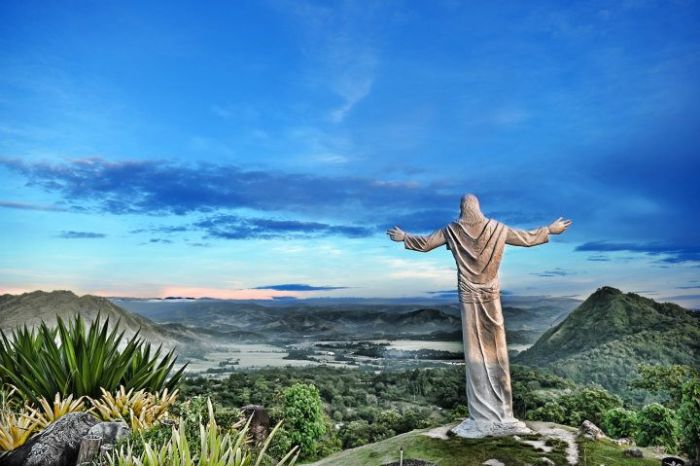
Monasterio de Tarlac
In addition to its beauty, the monastery is popular for having a 30 feet tall colossal statue of the Risen Christ similar to Brazil’s Christ the Redeemer statue. The monastery also holds a piece the Relic of the True Cross that was believed to be dug by St. Helena from the Calvary Hill, Jerusalem, and later on, passed to Germany and brought to the Philippines.
How to get to Monasterio de Tarlac
To get to Monasterio de Tarlac, take the SCTEX (Subic-Clark-Tarlac Expressway). When you reach Hacienda Luisita, take the exit and turn right onto MacArthur Highway towards the city center. Along the way, you’ll pass by SM City Tarlac. Just before reaching SM, you’ll notice a sign pointing towards the monastery, but don’t take that turn yet.
Keep following the road until you pass SM City Tarlac. Continue straight after the junction with McDonald’s and Mercury Drug on your left. Eventually, you’ll come across another McDonald’s. Turn left at that junction, and then follow the signs you see along the way.
Once you cross the bridge over the Tarlac River, make a left turn at the next intersection. From there, simply follow the road signs directing you to Monasterio De Tarlac.
MAP
2. Tarlac Recreational Park
For adrenaline junkies and fun-filled family adventures with friends or family, visit the Tarlac Recreational Park. The 78-hectare park offers a wide range of outdoor activities and is filled with different amenities such as a football field, race track, ovals, two large kids’ swimming pools, and an Olympic-size swimming pool. They also have pavilions, cottages, a sound system, barbeque grills, tables, and chairs that can be rented throughout the day.

Wikimedia Commons
And if you’re quite adventurous, you can try their Dune Buggy and ride an ATV navigating bumpy off-road tracks. Tarlac Recreational Park features other challenging activities like airsoft, mountain biking, fishing, kayaking, and zipline. For overnight trips, visitors can rent camping tents and enjoy sky gazing.
How to get to Tarlac Recreational Park
Tarlac Recreational Park is located in San Jose, Tarlac. To get there, take the Subic-Clark-Tarlac Expressway (SCTEx). Take Exit 118 and continue to Luisita Access Road in Tarlac City.
They’re open from Tuesday to Sunday, 9:00 AM to 5:00 PM. For advanced booking, you can contact them at (045) 493-2471 or through mobile numbers 09178579208 or 09998853981. You can also visit their Facebook page or website for more information and references.
Map
3. Capas National Shrine
A historic landmark in the province, the Capas National Shrine is the exact area where the Bataan Death March ended. The site was a former concentration camp, that now serves as a monument for the Allied forces of around 60,000-80,000 US and Filipino soldiers, as well as Czechs and Slovaks, who fought with the Japanese in 1942 at the Battle of Bataan during World War II.

The Capas National Shrine was built by the Philippine Government to remember the deaths of thousands of soldiers at Camp O’Donnell who were forced to walk over 83 kilometers, from Mariveles and Bagac, up to San Fernando.
The shrine features 54 hectares of parkland containing memorials for the dead, a 70-meter obelisk, and 3 memorial walls where the names of Filipino and American soldiers who died back then were engraved. The walls also have engraved poems of peace and a statistical count of total imprisoned people by the Japanese.
Map
4. Bulsa River
Another must-visit for the adrenaline junkies, Bulsa River is a 12.5-kilometer stream, running for about 3 to 4 hours, ideal for kayaking. It is rated as a Class II river, offering the perfect excitement for novice kayakers, with its smooth to slightly rapid flow and clear routes in between rocks.

Credit: Kayak Philippines
Bulsa River is operated by the professional team of Rapid Stream Ecotours, ensuring that adventurers are safe and complete with essential gears. The stream starts at Maamot mountain village, and increases its speed moderately after rowing a couple of hours, and reveals a breathtaking view of towering mountains afar.
5. Kart City Tarlac
Apart from outdoor adventures, Kart City Tarlac is another great tourist destination in town for thrill-seeker tourists located near SM City Tarlac. Established in 2005, the facility features a world-class 700-meter racing kart track, European go-karts, and lapse timer system for racing activities.

Credit: Kart City Tarlac
Before the race, riders are briefed in a waiting area and provided with racing suits, gears, and lockers to ensure that the guest’s belongings are secured and to avoid dropping any item during the race. Kart City Tarlac is also famous for serving mouthwatering pizzas, grilled foods, Filipino cuisine, beers, and features videoke rooms and Game Room Sports Bar.
6. ANZAP Twin Falls
Located at the Summer Capital of Tarlac at Mayantoc, Barangay Bigbiga, ANZAP Twin Falls is a natural gem hidden beyond Tarlac’s ASEAN-New Zealand Afforestation Project. The 200 feet high waterfall is considered the tallest waterfall in Tarlac, surrounded by abundant foliage and one of the three twin falls found in the Philippines.

Credit: Tarlac First
ANZAP Twin Falls is also a recommended spot for hikers and weekend warriors looking for a place to reconnect with nature. To reach the twin falls, cross the Nambalan River for 20 minutes and trek for about 4 hours to reach the Kawayan campsite. Rest for the night, and trek again the next day to reach ANZAP Twin Falls.
7. Mount Telakawa
Other than river adventures, Tarlac boasts the majestic beauty of Mount Pinatubo that erupted back in 1991. And if you’re in search of a thrilling activity in the area, there is no better place to visit than to hike and camp at Mount Telakawa. Located at the foot of Mount Pinatubo, Mount Telakawa measures 645-meter elevation, featuring the breathtaking view of Mount Pinatubo and the surrounding lahar land.

Credit: Paolo Beltran
A tour uphill will consist of trekking, exploring an Aeta village, visiting a goat farm where hikers get their water source, and camping at the summit. So a trip to Mount Telakawa is an exciting and refreshing experience.
8. Aquino Center Museum
For history enthusiasts, visit the Aquino Center Museum situated at Hacienda Luisita, San Miguel to learn and recollect Philippine history. The facility was designed by Francisco Manosa, a renowned Filipino architect, and built to pay tribute to the late couple Senator Benigno “Ninoy” Aquino Jr. and President Corazon “Cory” Aquino for fighting for Philippine democracy.

Credit: ABS-CBN News
The Aquino Center Museum features compilations of images and relics displaying the Aquino family’s legacy and contribution to Philippine history. It features the lives of Corazon and Ninoy and shows two videos regarding Ninoy’s journey. Also, there are artworks displayed and Ninoy’s personal belongings, including the jacket he wore when he was shot dead at the Manila International Airport.
9. JSJ Goat Farm
Whether you’re into goat farming or love to hoard goat cheese products, heading to JSJ Goat Farm is a whole new experience.
The 10-hectare pasture was established in 2001 and is a family-operated business that started as a hobby. The founders Jeffrey and Kathleen first had not more than 10 goats and now breeds around 300 goats and sheep, including Dorpers, Anglo Nubian, Boar, British Alpines, and Saanen.

JSJ Goat Farm
They also offer day tours at the farm educating visitors about goat farming, different breeds of goats, and watching the process of milking goats. Furthermore, JSJ Goat Farm offers top-of-the-line breed,s as they imported Australian goats in 2005, and sells specialty goat milk cheeses like Aussie Feta Cheese and Kesong Puti.
10. Mount Damas
If you’re looking for extreme outdoor activity, hiking up Mount Damas is the place to go. Mount Damas is one of the most picturesque mountains and a major hiking spot in Tarlac. The hike will take about 1-2 days or 4-5 hours, and will involve trekking at steep routes, rivers, rappelling down a waterfall, and crossing roped segments to the site. It is also rated with 6/9 difficulty to hike up Mount Damas, measuring 685 meters above sea level. So ensure that you’re all geared up before hiking.

Credit: Javespeaks
There are also rivers along the trail, nipa huts for resting and has a scenic view of the Central Luzon Mountains. Mount Damas is accessible through San Clemente Dueg Resettlement, the major jumpoff point, or can be accessed at the alternate route at Barangay Papaac, Camiling Tarlac.
11. Ubod Falls
A must-stop for all hikers heading to Mount Damas, Ubod Falls is a 120-foot tall straight waterfall hidden in the mountain. To reach the site, follow the river track upstream where you will see two small waterfalls. The one is shorter and the taller curvy one is known as Si-el Falls.

Credit: Leana L via TripAdvisor
It will require climbing rope segments on the left side of Si-el Falls to reach Ubod Falls, which will be challenging for the less physically fit. From Si- el Falls, it will take around 15 minutes to witness the enchanting beauty of Ubod Falls. This spot is the perfect place to cool off and enjoy a dip from the cold water before heading down the jumpoff point.
12. Calao Falls
Another natural wonder tucked at the Mayantoc town, Calao Falls or Kalaw Falls, located at Barangay San Jose, is a popular tourist destination for hikers.
The spot is ideal for a short stop-over that can surely relieve stress. Calao Falls’s name came from the local Kalaw bird, or Rufous Hornbill, that once resides in the area now reported as endangered, and only a few can be spot on the Calao Falls. There is also a small waterfall hidden behind the granite rocks, where visitors can dive on a deep ravine.
How to go to Tarlac Guide 2024
To reach Tarlac, you can opt for buses departing from Pasay or Cubao. The journey typically takes around 3 to 5 hours, though this may vary depending on traffic conditions.
During the trip, buses often make a stopover in Angeles City, specifically at Dau or Marquee Mall. The main bus companies servicing this route include Victory Liner and Five Stars, with their final destination being La Siesta Bus Terminal in Tarlac.
Upon arrival at La Siesta Bus Terminal, travelers will find themselves just a short 10-minute walk from the city center. Additionally, SM Tarlac, a popular shopping destination, is conveniently located within a 5-minute walking distance from the terminal.
FAQ: Tarlac Tourist Spots
1. What are the top tourist spots in Tarlac?
Tarlac boasts numerous attractions, such as the Monasterio de Tarlac, Aquino Center Museum, Capas National Shrine, and Kart City Tarlac. Each of these spots provides a unique experience for travelers.
2. Why is Monasterio de Tarlac famous?
Monasterio de Tarlac is renowned because it houses a relic of the True Cross. It’s also a serene place with panoramic views, making it perfect for spiritual reflection and relaxation.
3. Are there any historical sites in Tarlac worth visiting?
Absolutely! The Aquino Center Museum and Capas National Shrine are significant historical landmarks. The former showcases the life and legacy of the Aquino family, while the latter honors World War II heroes from the Bataan Death March.
4. I’ve heard about the ‘Isdaan Floating Resto-Fun Park.’ What can I expect there?
At Isdaan Floating Resto-Fun Park, you can enjoy a delightful combination of dining and entertainment. Picture dining on floating huts surrounded by fish-filled ponds and engaging in fun activities like the “Tacsiyapo” wall, where you can vent frustrations by throwing breakables!
5. Can I experience nature in Tarlac?
Definitely. The Mt. Pinatubo trek is a must-do for nature enthusiasts. Its majestic crater lake and awe-inspiring landscapes offer an unforgettable adventure.
6. Are there any festivals in Tarlac that tourists should look forward to?
The Malatarlak Festival in January is one of Tarlac’s grandest celebrations. It commemorates the province’s agricultural heritage with vibrant dances and colorful costumes.
7. Is Tarlac a good spot for foodies?
Tarlac offers a rich culinary journey. Make sure to try local specialties like the ‘chicharon camiling’, ‘batutay’ sausages, and ‘inuruban’ rice cake.
8. How accessible is Tarlac for tourists?
Tarlac is easily accessible, thanks to the Subic-Clark-Tarlac Expressway (SCTEX). It serves as a central hub in Luzon, making it a strategic stopover for travelers heading north or south.
9. Are there any eco-tourism spots in Tarlac?
Yes, the KCT Eco Adventure Farm is a perfect spot for eco-tourists. Here, you can indulge in organic farming, bamboo rafting, and eco-trail walks.
10. When is the best time to visit Tarlac?
While Tarlac is great to visit year-round, the dry season from November to May offers the best conditions, especially for outdoor activities.
More Tourist Spots in Luzon, Philipiines
- 10 Best Tourist Spots in Bataan
- 15 Best Tourist Spots in Baguio
- 10 Best Baler Tourist Spots
- 15 Best ABRA Tourist Spots (Waterfalls, Caves and More)
- 15 Best Batanes Tourist Spots


