Some festivals are easy to understand from the name alone.
A mango festival celebrates mangoes. A rice festival celebrates rice. A flower festival usually puts flowers at the center of everything.
Then there is Aloran’s Bunga Dag Tabinal Festival.
The name is unusual enough that even people from neighboring provinces may have to look it up first. Online, you’ll also encounter several spellings, including Bungag Dagtabinal, Bunga Dagtabinal and Bunga Dag Tabinal.
But once you start looking into the celebration, the idea behind it becomes much clearer.
This is a festival about the fruits of hard work.
Every September, the municipality of Aloran in Misamis Occidental celebrates its agricultural products, local talent, culture and community traditions through parades, performances and fiesta activities. The celebration is closely connected with the town’s September 21 feast of St. Matthew, while agriculture—particularly the work of local farmers—has become one of the strongest themes of the festival.
In 2019, when Aloran celebrated the 12th Bunga Dag Tabinal Festival, organizers used the phrase “Bunga sa kakugi,” or the fruit of hard work, to explain the celebration. Local officials emphasized that the festival was intended to promote Aloranon’s products, culture and talents while recognizing the contribution of farmers to the community.
And if there is one product that has become especially associated with modern Bunga Dag Tabinal, it is surprisingly refreshing:
watermelon.
So if you’re curious about one of Misamis Occidental’s lesser-known September festivals, here’s a closer look at Bunga Dag Tabinal and the town that celebrates it.
Content
Bunga Dag Tabinal Festival at a Glance
| Details | Information |
|---|---|
| Festival | Bunga Dag Tabinal Festival |
| Alternate online spellings | Bungag Dagtabinal / Bunga Dagtabinal |
| Location | Aloran, Misamis Occidental |
| Region | Northern Mindanao / Region X |
| Main fiesta date | September 21 |
| Patron | St. Matthew |
| Festival character | Agricultural, cultural, civic and religious |
| Signature attraction | Street-dancing parade and competition |
| Major local theme | Fruits of hard work / local products |
| One Town, One Product highlighted in 2019 | Watermelon |
| Local economy | Agriculture, fisheries and eco-tourism |
| Town established as an independent municipality | January 1, 1917 |
First, Is It Bungag Dagtabinal or Bunga Dag Tabinal?
You’ll see both versions online.
Older Philippine festival calendars sometimes use the spelling “Bungag Dagtabinal Festival” and list it as a September celebration in Aloran.
However, more specific sources connected with Aloran usually use:
Bunga Dag Tabinal Festival.
The Department of Social Welfare and Development’s Northern Mindanao office calls it the “Bunga Dag Tabinal Festival,” while a Philippine Information Agency report about Aloran’s 2019 celebration uses the same spelling.
Recent festival-related material from Aloran also uses “Bunga Dag Tabinal.”
So for accuracy, that’s the spelling I’ll use throughout this guide.
If you’ve searched for “Bungag Dagtabinal Festival,” though, you’ve reached the right celebration.
What Is the Bunga Dag Tabinal Festival?
Bunga Dag Tabinal Festival is Aloran’s annual cultural celebration held during its September fiesta season.
The festival showcases the municipality’s agriculture, products, culture and local talent.
Street dancing has traditionally been one of its main public attractions. Long-running Philippine festival calendars identify a street-dancing parade and competition as a signature Bunga Dag Tabinal event.
But the deeper meaning of the festival is not simply competition.
A Philippine Information Agency account of the 2019 edition explains that Aloran sustained the festival as part of its effort to promote homegrown products, culture and talent while recognizing the importance of farmers.
The same report records local officials describing the celebration as one of gratitude for continued blessings and a way of remembering Aloran’s roots despite development.
That gives Bunga Dag Tabinal a very practical identity.
It celebrates what people produce.
It celebrates the work required to produce it.
And it celebrates the community benefiting from that work.
What Does Bunga Dag Tabinal Mean?
The most useful explanation surfaced in the official reporting around the 2019 festival.
That year’s celebration was described as:
“Bunga sa kakugi.”
In Cebuano, this conveys the idea of the fruit or result of hard work.
That phrase fits the festival perfectly.
Farmers don’t plant today and harvest tomorrow.
A successful crop requires preparation, labor, weather cooperation, patience and risk.
The same is true for building a community.
Progress is something produced slowly.
So “bunga” works on two levels.
It can refer literally to fruit or produce.
But it can also represent results—the outcome of effort.
The festival therefore becomes a celebration of what Aloranons have produced through hard work.
As for the complete historical origin of the phrase “Dag Tabinal,” reliable official documentation explaining its exact linguistic derivation is surprisingly scarce online.
Some secondary websites offer explanations, but they don’t align cleanly with Aloran’s current barangay list and shouldn’t be repeated as established fact without stronger local documentation.
So the safest explanation is the one Aloran itself has emphasized:
Bunga Dag Tabinal celebrates the fruits of Aloranon hard work, local production and culture.
Aloran Is an Agricultural Town
Once you understand Aloran’s economy, the festival’s agricultural theme makes a lot of sense.
The municipal government describes its vision as becoming a progressive municipality driven by agri-fishery and eco-tourism.
Agriculture has long played an important role in local livelihoods.
Common products associated with Aloran include rice, coconut, vegetables, fish and other farm and food products.
And this isn’t merely festival imagery.
DSWD reporting from Aloran gives a very practical example of how important farming is to some communities. In Barangay Labo, the agency documented how poor road access made it difficult for residents to transport farm commodities to market.
That kind of detail is worth remembering when watching a harvest-themed dance performance.
Behind every colorful basket of crops is an actual supply chain.
Somebody planted it.
Somebody harvested it.
Somebody carried it.
Somebody transported it.
And somebody hoped the selling price would make all that work worthwhile.
Watermelon: Aloran’s Standout Festival Product
One of the most memorable developments in Bunga Dag Tabinal came during the 2019 celebration.
Aloran officially highlighted watermelon as its “One Town, One Product.”
The PIA report described Aloran as an agricultural area with abundant watermelon production and said the fruit was being used to symbolize the hard work of Aloranon farmers.
Watermelon is actually a great festival product.
Visually, you have:
dark green skin,
bright red flesh,
black seeds,
and strong color contrast.
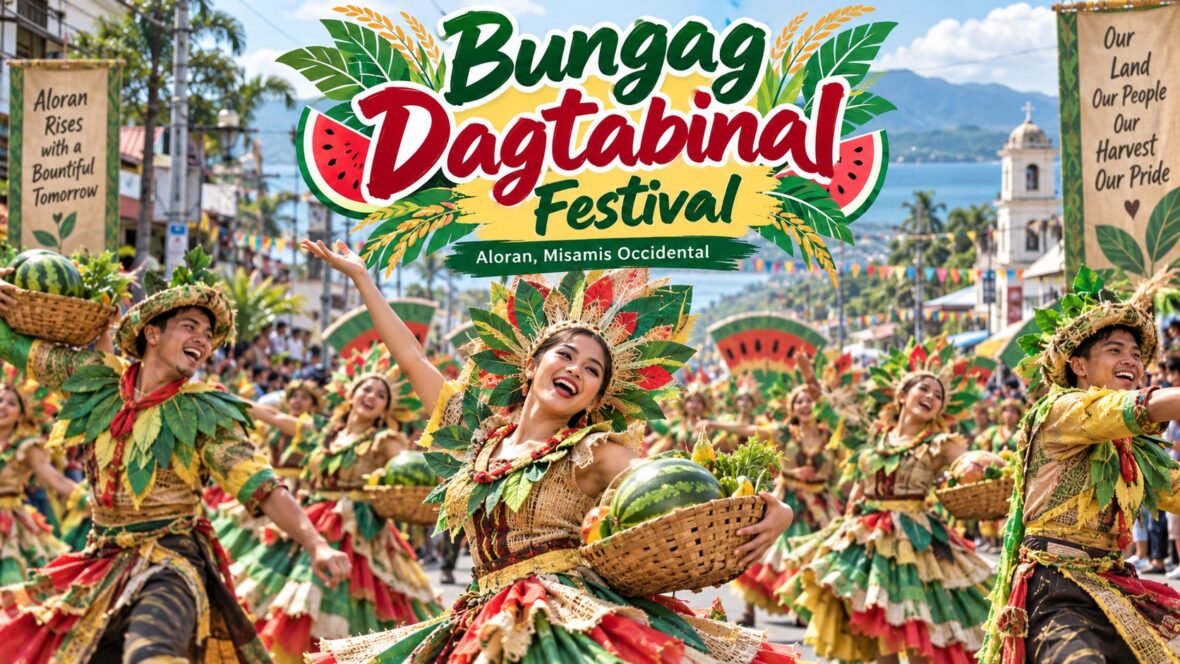
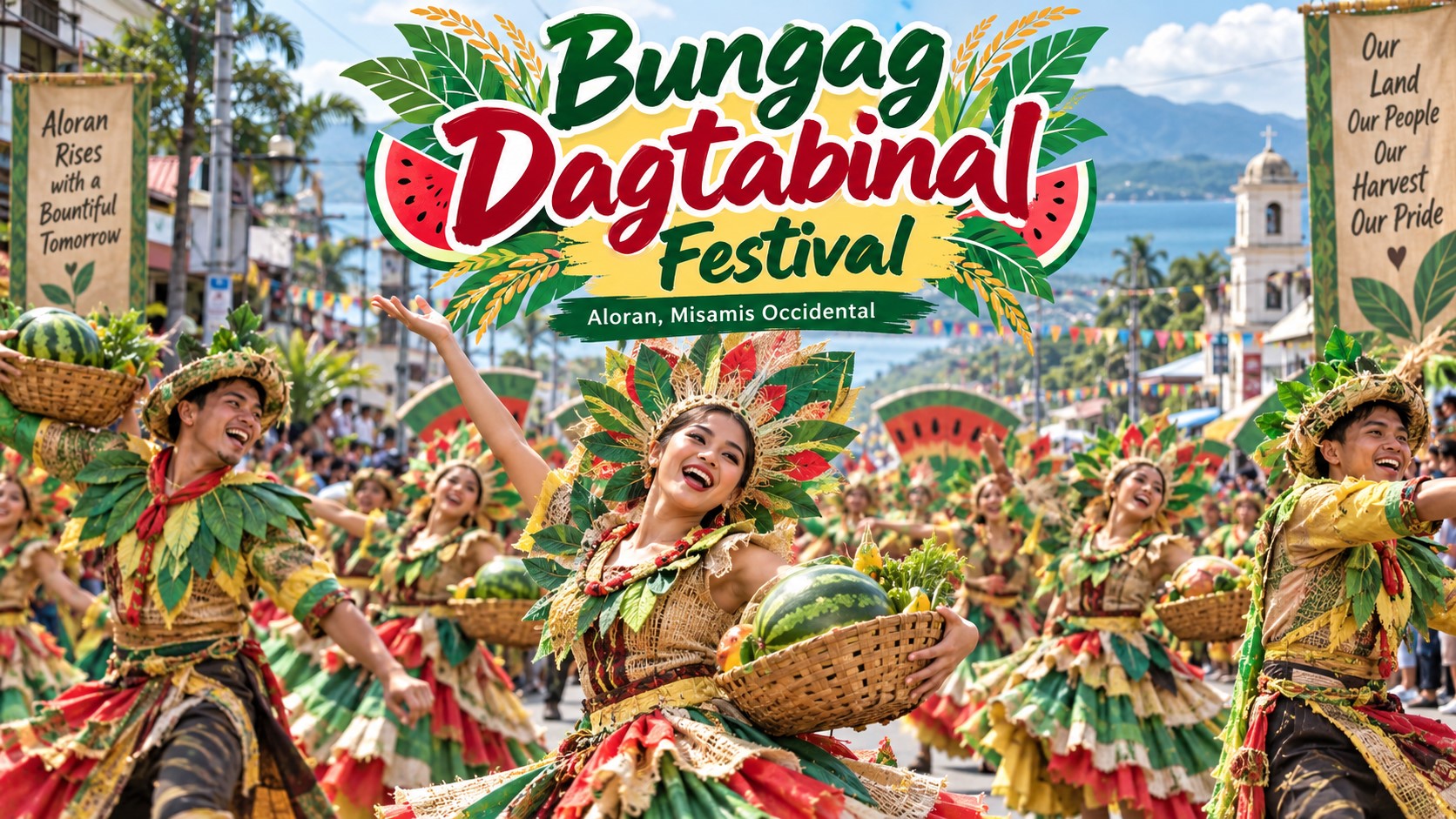
Those colors can easily become costumes, floats, stage decorations and promotional graphics.
More importantly, the fruit connects the festival with actual farmers rather than a symbol invented purely for tourism.
If you attend Bunga Dag Tabinal and see watermelon imagery, there is a reason for it.
Bunga Dag Tabinal Street Dancing
Street dancing remains one of the festival’s best-known activities.
Older national festival calendars list Bunga Dag Tabinal as a September 15 street-dancing parade and competition.
School records from 2012 also show a local drum-and-lyre corps preparing specifically to join the festival’s opening parade on September 15.
That gives us a useful picture of what festival day can feel like.
Students gather early.
Drummers prepare.
Majorettes and performers assemble.
Barangay or school groups wait for their turn.
Then music begins moving through the streets.
Depending on the year’s theme, costumes and routines can highlight farming, local products, Aloranon traditions or broader ideas about community progress.
The performance isn’t only entertainment.
It’s one of the festival’s biggest public showcases of local creativity.
What the Street Dancing Represents
Agricultural festivals give choreographers an enormous amount of material.
A routine might begin with farmers preparing the soil.
Other dancers portray planting.
Then crops grow.
Challenges arrive.
The rhythm changes.
Harvest comes.
The entire contingent eventually erupts into celebration.
Another group might focus on watermelon.
Another might present coconut farming, rice production, fishing or village life.
The story depends on the year and the competing group.
But the festival’s emphasis on the fruits of hard work gives street dancing a natural narrative:
effort first,
reward later.
That is much more meaningful than simply putting performers into colorful costumes and telling them to dance.
The Sound of Bunga Dag Tabinal
Like most Philippine street festivals, sound does a lot of the work.
You may hear drums long before the first dancers reach your part of the route.
School drum-and-lyre groups have historically participated in festival activities, showing the role student musicians play in building the atmosphere.
The percussion helps keep dancers together.
But it also signals something to the crowd.
The festival is coming.
People move toward the roadside.
Phones come out.
Children climb somewhere slightly higher so they can see.
Then the contingent appears.
For smaller municipal festivals, that sense of community participation can sometimes feel more personal than at the country’s giant city festivals.
Many of the spectators know the performers.
Parents are watching their children.
Former students recognize teachers.
Barangays cheer for their own entries.
The competition becomes local in the best possible way.
Festival Costumes
There does not appear to be one permanently standardized Bunga Dag Tabinal costume.
That gives designers room to interpret the year’s theme.
Agricultural imagery naturally works well.
Expect possible combinations of:
green,
yellow,
red,
earth tones,
leaf-shaped accessories,
woven textures,
fruit-inspired decorations,
native hats,
baskets,
and farming props.
If the theme emphasizes watermelon, green and red immediately become obvious choices.
If it focuses on harvest and farmers, gold, brown and green can dominate.
Festival costumes should be understood as theater rather than exact replicas of traditional daily clothing.
Their purpose is to turn an idea into something visible from across a crowded street.
Bunga Dag Tabinal and the Aloran Town Fiesta
The cultural festival is closely tied to Aloran’s September fiesta.
And this is where a common online error needs correcting.
Some secondary websites incorrectly associate the celebration with Our Lady of Sorrows.
However, Aloran’s Catholic parish is the St. Matthew Parish under the Archdiocese of Ozamis, with its feast observed on:
September 21.
The 2019 PIA report likewise states that the Bunga Dag Tabinal celebration opened the town-fiesta season honoring St. Matthew as Aloran’s patron.
So the religious reference to remember is:
St. Matthew.
Not Our Lady of Sorrows.
Who Is St. Matthew?
St. Matthew is traditionally identified in Christianity as one of the Twelve Apostles and as the evangelist associated with the Gospel of Matthew.
His feast is celebrated on September 21 in the Roman Catholic calendar.
That date lines up directly with Aloran’s parish fiesta.
This helps explain why you’ll see two dates repeatedly associated with Bunga Dag Tabinal online:
September 15 and September 21.
September 15 has historically been used for festival-opening and street-dancing activities.
September 21 is the established parish feast of St. Matthew and the town’s key fiesta date.
Different years may spread festival activities across the days between them.
September 15 or September 21?
If you’re planning a trip, this is an important distinction.
Older festival directories commonly list:
September 15 — Bunga Dag Tabinal street dancing.
Meanwhile, references specifically about Aloran itself commonly identify:
September 21 — Bunga Dag Tabinal / town-fiesta date.
Historical evidence supports the idea of a longer celebration rather than one single fixed event.
In 2012, a local school described September 15 as the Bunga Dag Tabinal Festival opening.
In 2019, the municipality launched its 12th festival in mid-September as part of the broader fiesta season leading toward St. Matthew’s feast.
So the easiest way to understand the schedule is:
September 15 is historically associated with the opening and cultural festival activities.
September 21 is the central town-fiesta and St. Matthew date.
Always check the current year’s official program if you’re traveling specifically for street dancing.
Bunga Dag Tabinal as Thanksgiving
Thanksgiving is one of the strongest themes in the festival.
In 2019, Aloran’s vice mayor described the celebration as the town’s way of thanking God for continued blessings while remembering its roots.
That idea is familiar throughout Philippine agricultural festivals.
Harvest is never guaranteed.
Too much rain can damage crops.
Too little rain can do the same.
Pests, disease, prices and transportation can all affect whether a season is profitable.
So once crops reach the market, there is a real reason to celebrate.
In a place where agriculture matters, thanksgiving is not abstract.
It is tied to livelihood.
Supporting Aloran’s Farmers
One of the strongest reasons for festivals like this is visibility.
Farmers usually work far away from the center of town.
Most people see the finished product in a market without thinking about where it came from.
Bunga Dag Tabinal brings agriculture into the center of public life.
The 2019 festival was explicitly used as a platform for Aloran’s farmers and homegrown products, while the local government highlighted its support for agricultural equipment and market visibility.
That is what a good local festival can do.
It turns a livelihood into something residents are proud to talk about.
Bunga Dag Tabinal and Local Talent
The festival isn’t limited to farmers.
Local officials have also described it as a way to promote Aloranon culture and talent.
That includes students.
Dancers.
Musicians.
Choreographers.
Costume makers.
Pageant candidates.
Community organizations.
Government workers.
Barangay officials.
Schools.
Business owners.
Every festival needs a lot of people working behind the scenes.
The audience sees the final parade.
What they don’t see are the weeks of practice.
Someone made the costumes.
Someone trained the dancers.
Someone repaired the drums.
Someone designed the backdrop.
Someone coordinated the road closure.
Someone found sponsors.
Those efforts are also part of the “bunga sa kakugi.”
When Did Bunga Dag Tabinal Festival Start?
There isn’t a readily available official document online giving a precise founding year.
However, Aloran celebrated the 12th Bunga Dag Tabinal Festival in 2019.
If the numbering was continuous, that would place the formal festival’s beginnings around the late 2000s.
But because I have not found an official Aloran ordinance or municipal history confirming the exact inaugural year, I would avoid stating a precise start date as established fact.
What we can say confidently is that Bunga Dag Tabinal was already a recognized Aloran community festival by at least the early 2010s.
A 2012 school activity plan explicitly recorded participation in the festival opening parade.
A Short History of Aloran
Aloran’s history goes much further back than the festival.
Historical accounts describe an early settlement known as Anuran, associated with a Subano leader and later with migration from other Visayan islands.
The modern municipality was formally separated from Oroquieta through Executive Order No. 67 during the American colonial period.
The reorganization became effective on:
January 1, 1917.
That makes Bunga Dag Tabinal a modern festival celebrating a community with a much older story.
Today, Aloran contains 38 barangays and stretches from coastal areas toward more mountainous interior communities.
Aloran’s Agri-Fishery Identity
One thing I like about Aloran is that its municipal vision tells you immediately how the town sees itself.
The LGU describes Aloran as an:
“agri-fishery and eco-tourism driven municipality.”
That’s basically the Bunga Dag Tabinal story in one sentence.
Agriculture provides food and livelihood.
Fisheries add another layer because Aloran is also coastal.
Then natural attractions create opportunities for eco-tourism.
The festival gives all of those local identities a public stage.
What Else Is Aloran Known For?
Bunga Dag Tabinal may be the cultural attraction, but Aloran also has natural destinations.
DSWD’s Northern Mindanao office specifically highlights Mimolan Falls in Barangay Roxas, describing a forested area with rich flora and fauna. It also mentions Macubon Shrine Natural Spring and beaches among Aloran’s natural assets.
That means a festival trip doesn’t need to end at the plaza.
You can experience the crowds and street dancing during fiesta season, then spend another day exploring a much quieter side of the municipality.
Mimolan Falls
Mimolan Falls is one of the more interesting names to remember if you’re putting together an Aloran itinerary.
The area around the falls is described as thickly forested, giving it a completely different atmosphere from the populated town center.
If you intend to visit, check road and local access conditions first.
Some interior Aloran communities have historically faced challenging road access, so don’t assume every natural attraction is as easy to reach as a city park.
Coastal Aloran
Aloran’s geography also includes coastal areas.
That gives the municipality an interesting mix:
farms,
upland communities,
rivers and springs,
and the sea.
Local economic profiles have long listed fish alongside rice and coconut among Aloran’s important products.
This combination of farming and fishing helps explain why the municipal government uses the term agri-fishery rather than focusing on agriculture alone.
Visiting Bunga Dag Tabinal for the First Time
If you’re visiting for the festival, don’t arrive assuming all activities happen on September 21.
The celebration has historically started earlier.
If possible, plan around the week leading toward the St. Matthew feast.
That gives you a better chance of catching the festival opening, street dancing, community events and fiesta atmosphere.
Check the Municipality of Aloran’s latest announcements before traveling.
Festival programs change.
Road routes change.
Competition times change.
Religious dates are more consistent.
Arrive Early for Street Dancing
This advice applies to almost every Philippine festival.
Once the parade begins, roads close and spectators fill the best viewing areas.
Coming early lets you:
find a better position,
see performers preparing,
photograph costumes before the dancers become exhausted,
and avoid getting trapped behind traffic restrictions.
If you’re serious about festival photography, preparation time can be as interesting as the actual competition.
Prepare for September Weather
Bring both sun and rain protection.
September can be wet in this part of Mindanao.
A sunny morning does not guarantee a dry afternoon.
Carry:
an umbrella or light rain jacket,
drinking water,
comfortable shoes,
and something waterproof for your phone or camera.
Festival costumes may look glamorous.
Standing beside the road in tropical weather for several hours usually isn’t.
Eat Local
If local agricultural products are part of the festival, try them.
Watermelon is the obvious one.
But don’t stop there.
Look for locally produced food, rice-based snacks, coconut products, seafood and other items sold during fiesta activities.
Agricultural festivals make much more sense when you actually taste what the town grows and produces.
Respect the Religious Side of the Fiesta
Remember that September 21 is not only a cultural event.
It is the feast of St. Matthew Parish.
Some people around you may be attending Mass or joining religious activities rather than participating in the street festival.
Give processions space.
Avoid blocking church entrances for photographs.
And remember that the cultural and religious celebrations overlap without being exactly the same thing.
Bunga Dag Tabinal Festival Frequently Asked Questions
Where is Bunga Dag Tabinal Festival celebrated?
Bunga Dag Tabinal Festival is celebrated in Aloran, Misamis Occidental, in Northern Mindanao.
The DSWD Northern Mindanao office specifically identifies Aloran as home to the festival each September.
Is Bungag Dagtabinal the same as Bunga Dag Tabinal?
Yes, “Bungag Dagtabinal” appears in some older festival listings, but sources specifically connected with Aloran generally use Bunga Dag Tabinal Festival.
When is Bunga Dag Tabinal Festival?
Different references use different dates because the festival is part of a wider fiesta period.
Older tourism calendars associate the street-dancing event with September 15, while Aloran’s principal fiesta in honor of St. Matthew falls on September 21.
Who is the patron saint of Aloran?
Aloran’s parish is dedicated to St. Matthew, with the feast celebrated on September 21.
What is Bunga Dag Tabinal Festival famous for?
It is particularly associated with its street-dancing parade and competition, local cultural presentations and promotion of Aloran’s agricultural products.
What does Bunga Dag Tabinal celebrate?
The festival celebrates Aloranon culture, products, local talent and the results of community hard work.
In 2019, the festival used the concept “Bunga sa kakugi,” meaning the fruit of hard work.
Is Bunga Dag Tabinal a harvest festival?
It has strong agricultural and thanksgiving themes, but it is broader than a simple harvest festival.
It also promotes local culture, community achievement and fiesta traditions.
Why is watermelon associated with Aloran?
During the 2019 Bunga Dag Tabinal Festival, Aloran proclaimed watermelon as its One Town, One Product, recognizing the abundance of watermelon production and the work of local farmers.
Is Bunga Dag Tabinal religious?
It has both cultural and religious dimensions.
The cultural festival promotes Aloran’s products and traditions, while the wider September celebration leads toward the September 21 fiesta of St. Matthew.
When did Bunga Dag Tabinal Festival begin?
The exact official inaugural year is not clearly documented in the sources available online.
Aloran celebrated the 12th edition in 2019, and records confirm the festival was already established by at least 2012.
Bunga Dag Tabinal Festival 2026
This guide is intended to stay useful year after year, but travelers planning specifically for 2026 should keep two dates in mind:
| Date | Significance |
|---|---|
| Around September 15, 2026 | Historically associated with Bunga Dag Tabinal opening and street-dancing activities |
| September 21, 2026 | Feast of St. Matthew / principal Aloran fiesta date |
St. Matthew Parish’s established feast date is September 21, while older festival calendars and local records show Bunga Dag Tabinal cultural activities beginning earlier in the month.
As of the sources reviewed for this article, a complete official 2026 day-by-day program covering street dancing, pageants, concerts and other events had not yet surfaced reliably online.
Anyone traveling specifically for the festival should therefore verify the final schedule through the Municipality of Aloran and local tourism or fiesta organizers before departure.
Final Thoughts
Bunga Dag Tabinal is the kind of festival that doesn’t need to be enormous to tell a good story.
Its story is actually very simple.
People work.
Farmers plant.
Families earn.
Students practice.
Businesses grow.
Communities slowly improve.
Then, once a year, Aloran stops and celebrates what all of that effort produced.
That is the idea behind “Bunga sa kakugi.”
The fruit of hard work.
Sometimes that fruit is literal.
A watermelon harvested from an Aloran farm.
Rice.
Coconut.
Vegetables.
Food brought to market.
Other times, the “bunga” is something less visible.
A student learning to perform in front of a crowd.
A family business surviving another year.
A barangay completing a project.
A town remembering where it came from even while trying to move forward.
That’s why Bunga Dag Tabinal makes sense as Aloran’s festival.
The dancers and costumes create the spectacle.
St. Matthew provides the religious center of the September fiesta.
Watermelon gives the celebration one of its most recognizable agricultural symbols.
But the real theme is work.
And every September, Aloran turns the results of that work into something worth celebrating.