
Chiang Mai has no shortage of markets.
There are night markets, street-food markets, walking streets, souvenir markets, and local neighborhood markets. But if you’re looking for something a little more relaxed—somewhere you can spend a slow weekend morning eating local food, browsing handmade products, drinking coffee, and seeing another side of Chiang Mai—Jing Jai Market is worth adding to your itinerary.
Jing Jai Market Chiang Mai is especially known for its weekend morning market, which brings together local farmers, food vendors, craftspeople, designers, and small producers in one leafy, open-air space.
The official Jing Jai Central website currently lists the weekend Farmers Market and handmade-products market every Saturday and Sunday from 6:30 AM to 3:00 PM.
I visited Jing Jai Market during my first morning in Chiang Mai, and funny enough, it wasn’t even part of my original plan.
I only ended up there because the guy running my hostel told me to go.
And I’m glad he did.
Content
What is Jing Jai Market?
Jing Jai Market, sometimes called JJ Market, is part of the wider Jing Jai Central creative district in Chiang Mai.
The Tourism Authority of Thailand describes Jing Jai Central as having different spaces that include Jing Jai Market, Jing Jai Village, and Jing Jai Gallery. The area isn’t only active during the weekend market—there are restaurants, cafés, shops, creative spaces, and other businesses operating beyond the Saturday-Sunday market hours.
But for travelers, the weekend morning market is probably the main attraction.
The market is essentially divided into two major sides: the Jing Jai Farmers Market and the handmade or craft-market area.
The Farmers Market focuses heavily on produce from farmers in Chiang Mai and surrounding areas, together with processed foods, ready-to-eat dishes, homemade baked goods, and other food products. The craft side brings together handmade products, home décor, clothing, accessories, vintage-style items, art, and locally designed goods.
So this isn’t the kind of market where you simply walk through rows of identical souvenir stalls.
It feels more curated and community-oriented.
And that was one of the things I immediately noticed when I visited.
Jing Jai Market Opening Hours
If you’re specifically going for the famous weekend market, remember these hours:
Saturday: 6:30 AM to 3:00 PM
Sunday: 6:30 AM to 3:00 PM
These are the current hours listed by Jing Jai Central for both the Farmers Market and handmade-products zone.
You may still find shops, cafés, restaurants, and other establishments around the Jing Jai complex outside these hours, but the full weekend-market experience happens on Saturday and Sunday mornings.
I’d recommend coming in the morning rather than waiting until close to 3:00 PM.
For me, Jing Jai Market really feels like a morning place.
People are having breakfast. Farmers are selling produce. Coffee is everywhere. Vendors are setting out handmade products. Families and friends are casually walking around.
You don’t really need to rush.
That’s part of the appeal.
Where is Jing Jai Market?
Jing Jai Market is located at:
45 Atsadathon Road
Pa Tan, Mueang Chiang Mai
Chiang Mai 50300, Thailand
The address is listed by Jing Jai Central itself.
It’s north of Chiang Mai Old City and isn’t particularly far from the historic center.
The Tourism Authority of Thailand describes Jing Jai Central as roughly five minutes from Tha Phae Gate and around ten minutes from Chiang Mai International Airport, although your actual travel time will naturally depend on traffic and your transportation.
You can get there by Grab, taxi, tuk-tuk, motorbike, bicycle, or even on foot if you’re staying relatively nearby.
I walked.
More about that in a bit. Haha.
My Experience Visiting Jing Jai Market
My visit to Jing Jai Market actually started with a small travel problem.
I had just arrived in Chiang Mai after taking an overnight bus from Bangkok. From the bus station, I took a tuk-tuk to my hostel.
I was tired.
All I wanted to do was leave my luggage, maybe rest for a while, and start exploring.
The owner had told me through email that even though check-in wasn’t until later in the afternoon, I could leave my bag at the hostel.
Sounds simple, right?
But when I arrived early that morning, the hostel was closed.
Apparently, the guy running the place normally arrived at around 8:00 AM.
So there I was in Chiang Mai with my bags and a couple of hours to kill.
Instead of just sitting outside, I decided to walk around the Old City.
The streets were still quiet. Shops were only beginning to open. I took photos around the old brick walls and even ended up having a local Thai man take some photos of me with doves flying around.
Eventually, it was almost 8:00 AM, so I went back to the hostel.
And finally, someone was there.
That’s when I met Nick.
He was the guy running the hostel, and after I told him that I planned to leave my bag and continue exploring, he gave me a suggestion.
Since it was the weekend, he told me:
Go to Jing Jai Market.
I checked the map.
It didn’t look that far.
So there I went.
Of course, what looked “not that far” on the map somehow felt farther once I actually started walking. Haha.
Still, the morning weather was nice, Chiang Mai was moving at a slower pace, and I wasn’t in a hurry.
Eventually, I arrived.
And I’m glad I walked all the way there.
The First Thing I Noticed: It Felt Relaxed
There are markets where you immediately feel overwhelmed.
People everywhere.
Vendors calling out.
Narrow walkways.
Music blasting from different directions.
Jing Jai felt different.
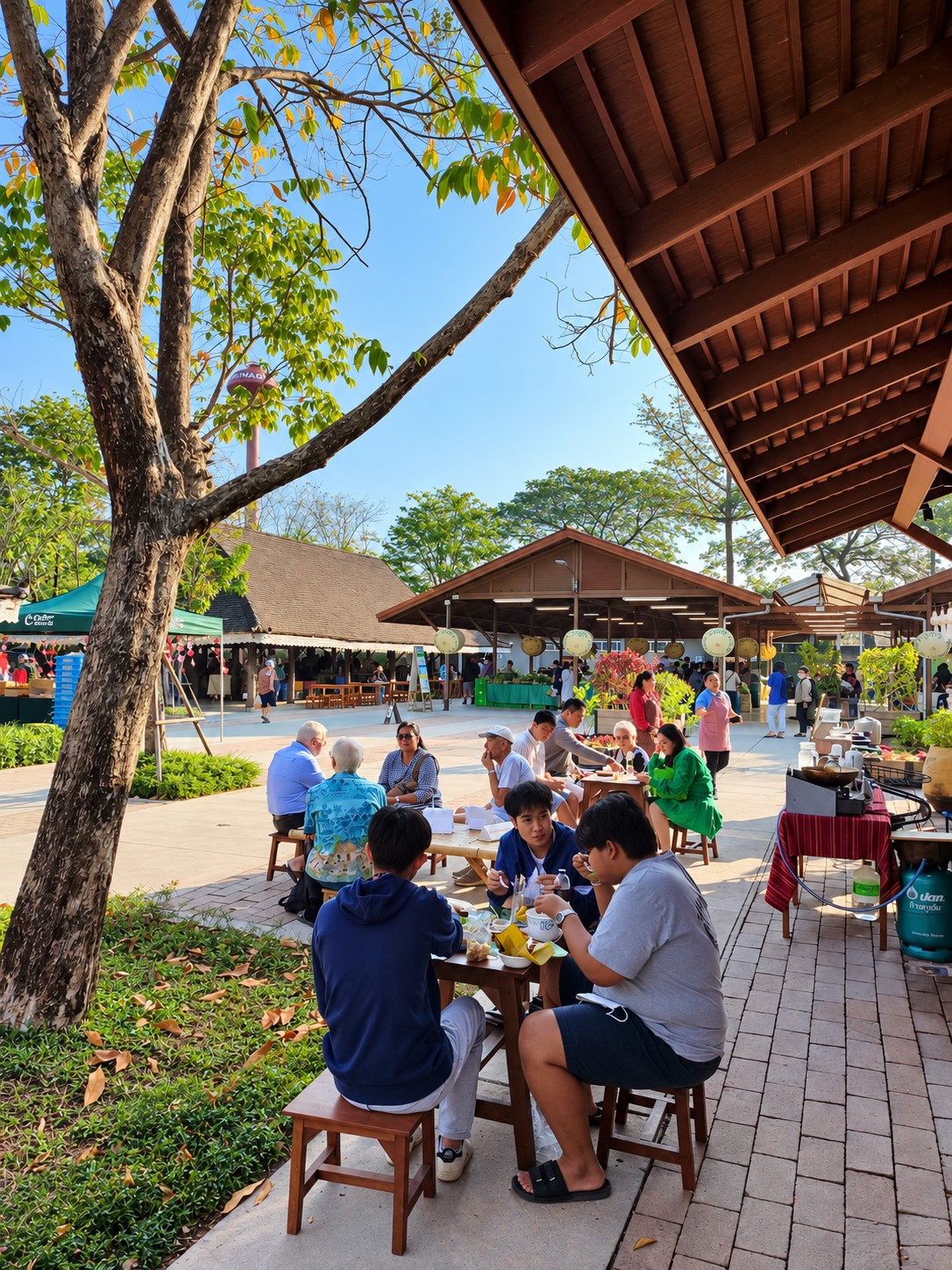
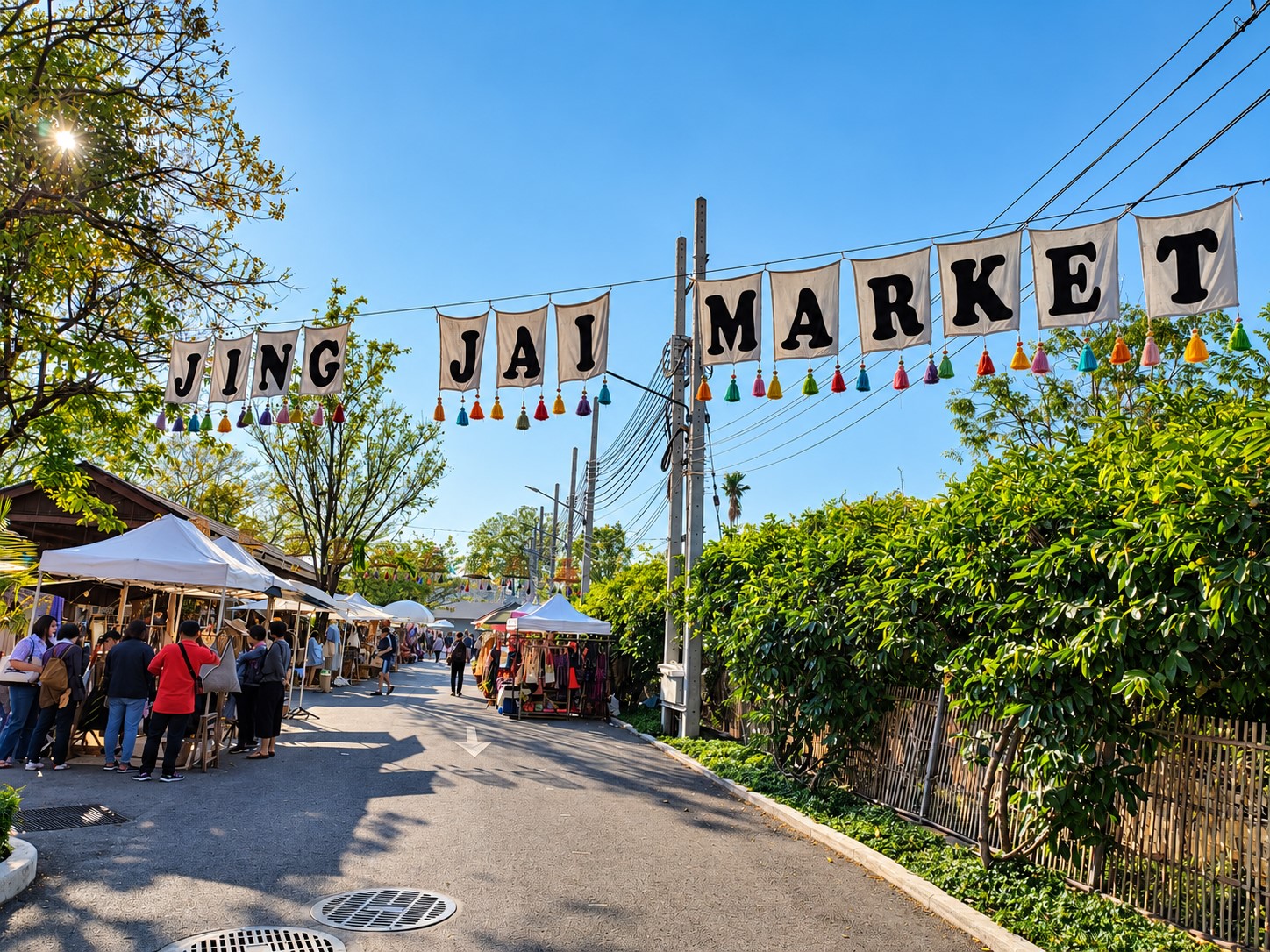
There were trees, open spaces, stalls arranged around the area, people casually browsing, and plenty of places where you could slow down.
It felt less like a tourist attraction you needed to “finish” and more like somewhere people actually wanted to spend their morning.
That relaxed atmosphere is one of Jing Jai Market’s biggest strengths.
Even the official descriptions of the project emphasize the greenery, community spaces, locally made goods, food, creativity, and crafts.
And once you start walking around, you’ll understand what they mean.
Jing Jai Farmers Market
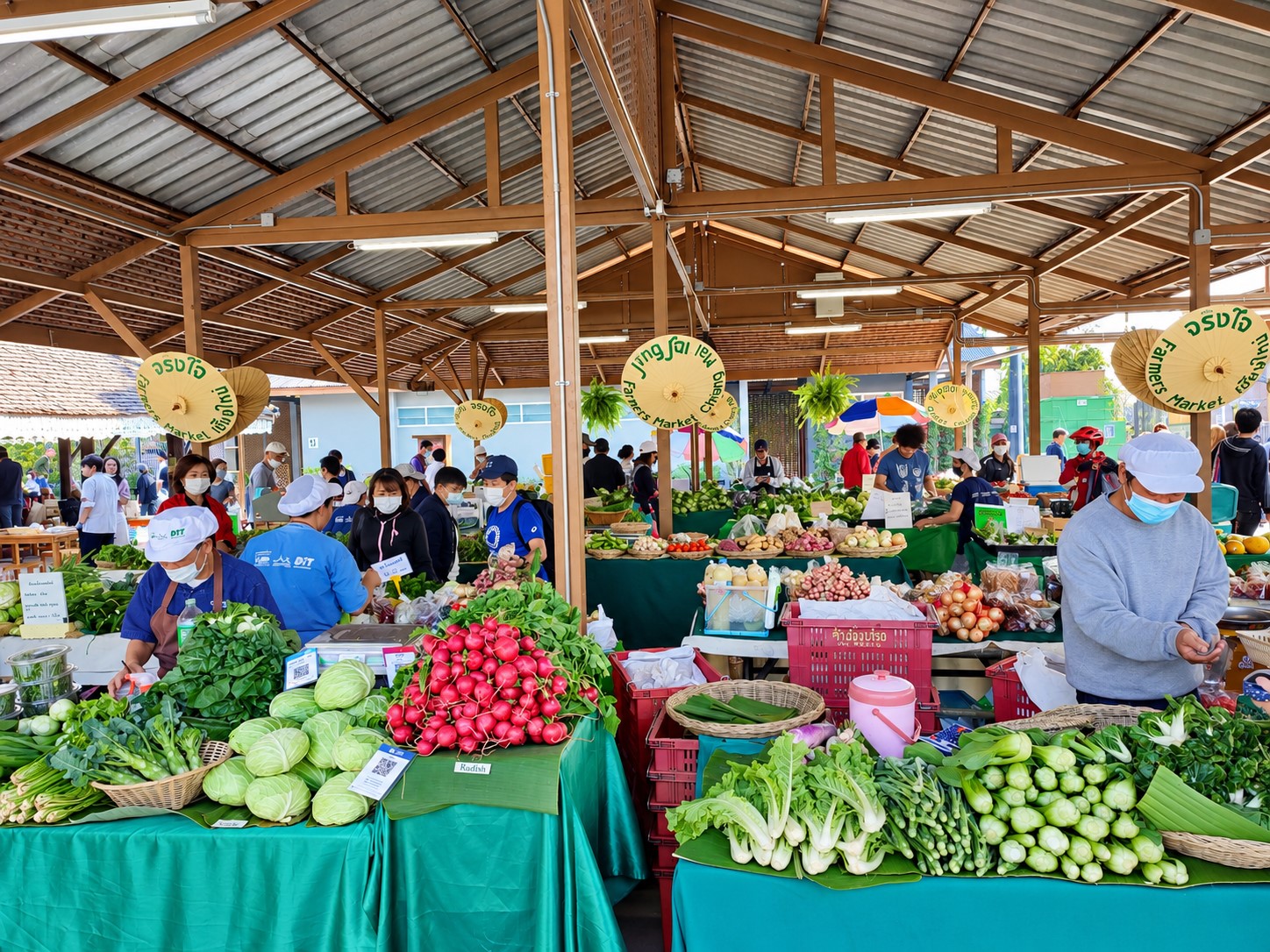
One of the most interesting parts of Jing Jai is the Farmers Market.
And you’ll know when you’ve reached this section.
Vegetables.
Lots and lots of vegetables.
When I visited, stalls were filled with leafy greens, herbs, fruits, vegetables, and other produce arranged beautifully across tables and baskets.
It was very different from walking around a regular tourist souvenir market.
You actually see the agricultural side of northern Thailand.
The Farmers Market has been operating since 2012 and was established to connect consumers directly with farmers selling organic and safety-certified produce from Chiang Mai and nearby areas.
Jing Jai also says participating farmers go through a screening process. Farms are inspected before vendors are accepted, and produce is subject to random testing for chemical residues.
That makes the Farmers Market more than just a colorful section for tourists to photograph.
It’s an actual community market.
And you’ll see locals shopping there too.
Handmade Products and Local Crafts
Move away from the produce and you’ll start seeing another side of Jing Jai.
Handmade bags.
Clothes.
Accessories.
Art.
Decorations.
Textiles.
Vintage-style products.
Crafts.
Small design pieces.
And plenty of things that are difficult to categorize but somehow make you stop and look anyway.
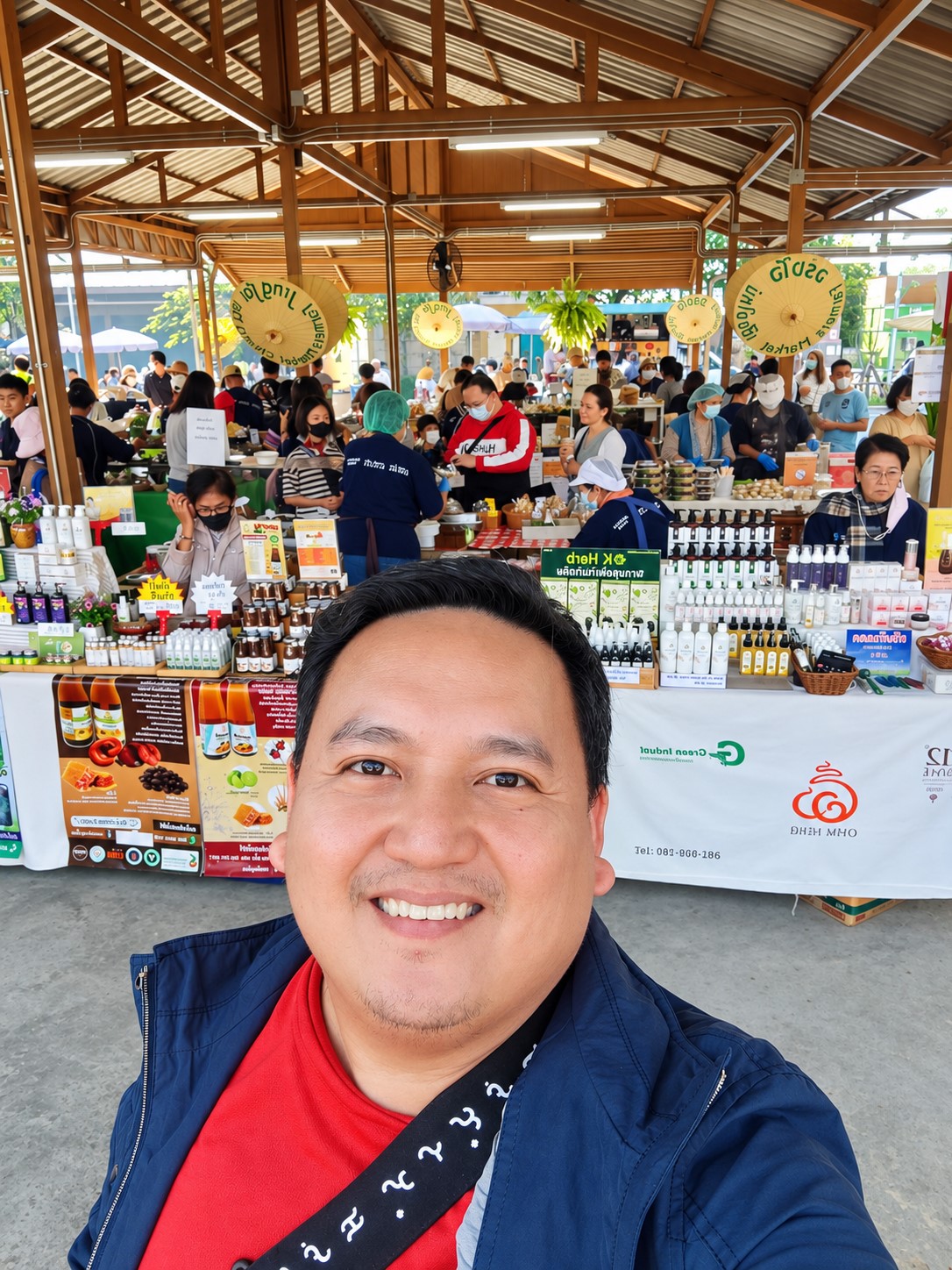
The official Jing Jai Market describes its handmade zone as a marketplace for local artisans who design and sell their own products. It also includes crafts, home décor, collectibles and vintage-style items.
This is probably one of the best parts of the market if you want to bring something home from Chiang Mai that doesn’t feel like a mass-produced souvenir.
Take your time browsing.
You may find something made by an independent designer or local craftsperson rather than another refrigerator magnet you’ve already seen twenty times.
Although there’s nothing wrong with refrigerator magnets either.
I buy those too. Haha.
And Then There’s the Food
Now we’re talking.
Because as much as I enjoyed looking at the vegetables and handmade products, I eventually reached the part of the morning where browsing was no longer enough.
I needed food.
There were many food stalls during my visit, and after walking around for a while, I stopped pretending I was “just looking.”
I started eating.
You’ll find prepared food, snacks, baked goods and drinks alongside the agricultural products sold at the Farmers Market. Exactly what’s available can change depending on the vendors and the day, so part of the fun is simply walking around and seeing what looks good.
My strategy?
Walk around once.
See everything.
Then go back and eat.
Of course, that strategy usually fails because you’ll smell something good halfway through.
Trying Moo Satay
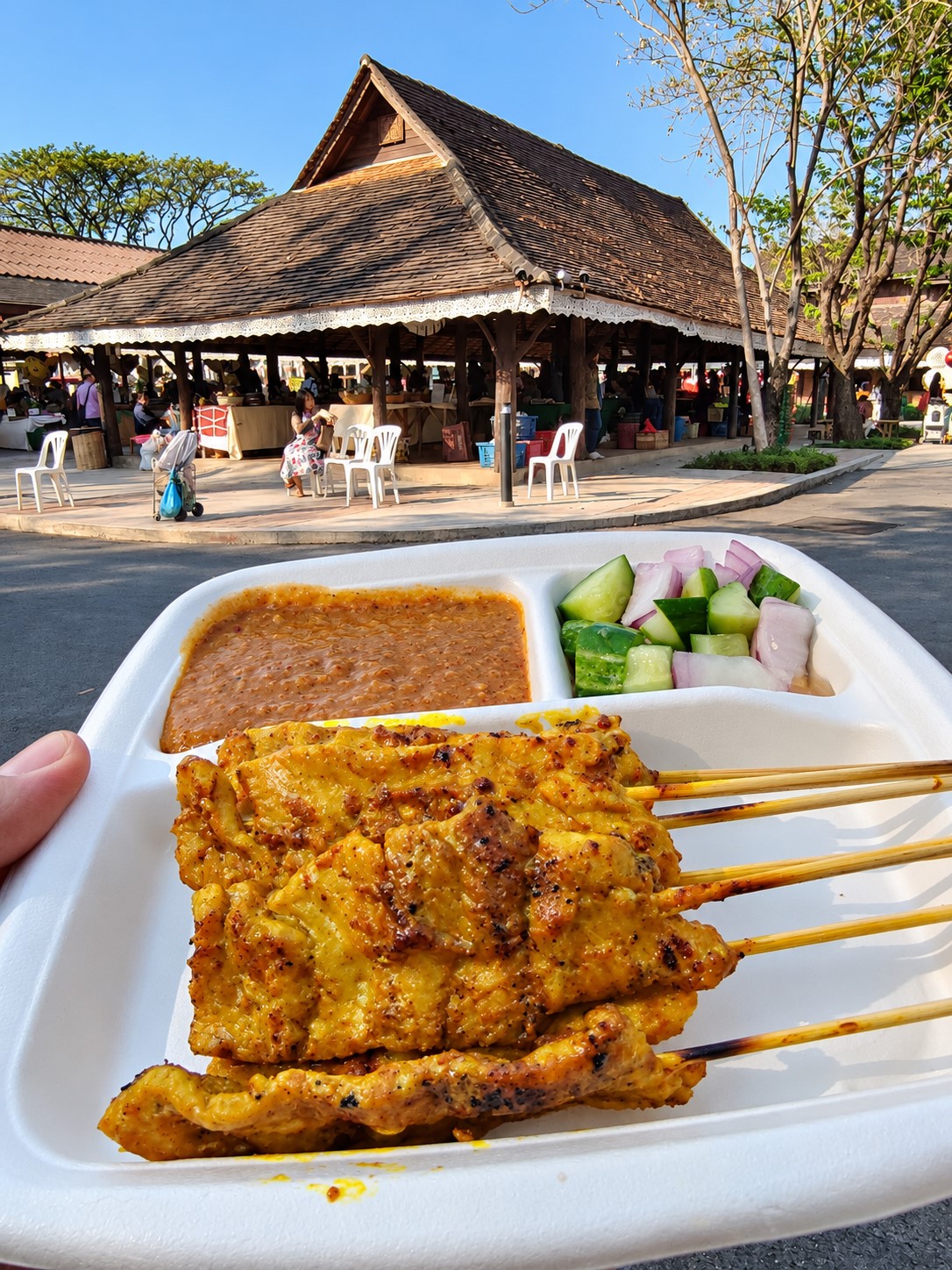
One of the foods I ate at Jing Jai Market was moo satay.
“Moo” means pork in Thai, so this is essentially Thai pork satay.
Thin pieces of marinated pork are placed on skewers and grilled until the edges start getting slightly smoky and caramelized.
It’s commonly served with a rich peanut sauce and a cucumber relish that adds sweetness, acidity and freshness.
Simple combination.
Very good.
You have the smoky meat, creamy peanut sauce and refreshing cucumber all in one bite.
I could easily eat several sticks without noticing.
Actually, I probably did.
Trying Sai Ua: Northern Thai Sausage
Then I tried something much more closely associated with northern Thailand.
Sai ua.
If you’re traveling around Chiang Mai, you’ll probably encounter this sausage sooner or later.
And you should try it at least once.
Sai ua is a northern Thai pork sausage seasoned with aromatic herbs and spices. Recipes vary, but ingredients can include lemongrass, galangal, makrut lime leaves, garlic, shallots, chilies, herbs and curry paste.
What really stood out to me was the smell.
You notice the herbs even before taking a bite.
It was very different from the sausages I was accustomed to back in the Philippines.
You still get the richness of the pork, but then all those herbs and spices come through.
Lemongrass.
Chili.
A little citrusy aroma.
Different layers of flavor.
It doesn’t need much.
Slice it.
Eat it.
Take another piece.
Haha.
That was probably one of the foods from that morning that made me feel, “Okay, I’m definitely in northern Thailand now.”


Coffee and Breakfast Culture
Coffee also fits perfectly into the Jing Jai experience.
You’ll see people sitting around with drinks, having breakfast, talking with friends or simply taking their time.
And I think that’s the right way to experience this market.
Don’t visit Jing Jai as if you’re trying to check another attraction off your Chiang Mai list.
Eat something.
Get coffee.
Find somewhere to sit.
Then continue walking.
It’s much more enjoyable that way.
When I eventually left Jing Jai, I stopped for another coffee near Chiang Mai’s moat.
Considering I had just survived an overnight bus, unexpectedly explored the Old City, walked all the way to Jing Jai Market and eaten a ridiculous amount of food, I definitely needed it.
Jing Jai Market and Sustainability
Another important part of Jing Jai Market is its focus on local producers and sustainability.
The Farmers Market directly supports farmers from Chiang Mai and surrounding areas, while the craft market provides a selling space for local artisans and designers.
The wider Jing Jai project has also introduced waste-separation and recycling programs. Its official site describes designated waste-sorting points and efforts to send different waste streams to appropriate recycling or reuse projects.
This environmental focus fits naturally with what you see around the market: farmers, organic produce, handmade goods, reusable products, open green spaces and small producers.
It gives Jing Jai a different identity from many of Chiang Mai’s more conventional shopping areas.
What Can You Buy at Jing Jai Market?
The selection changes, particularly because many vendors are independent producers, but expect a mixture of things like:
- Fresh vegetables, herbs and fruit
- Organic and safety-certified produce
- Prepared Thai food and snacks
- Northern Thai specialties
- Homemade baked goods
- Coffee and other drinks
- Handmade clothing
- Bags and accessories
- Local textiles
- Crafts and artwork
- Home décor
- Vintage-inspired products
- Gifts and souvenirs
- Products from independent Thai designers
The Farmers Market and handmade zone are the two defining sections of the weekend market.
If you’re buying produce, obviously that’s more useful for people staying in Chiang Mai long enough to cook.
But even if you’re a tourist staying in a hostel or hotel, there’s still plenty to eat and buy.
Best Time to Visit Jing Jai Market
I’d aim for around 7:30 AM to 10:30 AM.
That’s not an official “best time”—just the window I’d personally choose.
You’ll still get that morning-market atmosphere, you’ll have plenty of time to walk around, and you won’t be arriving near closing time.
If you’re someone who can happily wake up at 6:00 AM while traveling, then sure.
Go even earlier.
I respect you.
I’m usually only awake that early because I’ve been on an overnight bus. Haha.
The official weekend-market schedule begins at 6:30 AM and continues until 3:00 PM.
Saturday or Sunday: Which Day Is Better?
The main Jing Jai Farmers Market and handmade market currently operate on both Saturday and Sunday, so either day works.
If your Chiang Mai itinerary gives you only one free weekend morning, I wouldn’t overthink this.
Go on whichever day fits your schedule.
Events, pop-ups and vendor selections can change, so the two days won’t necessarily be identical.
That’s normal for this type of market.
How Much Time Should You Spend at Jing Jai Market?
I’d give yourself around two hours.
You could walk through much faster.
But why?
If you’re simply looking around, an hour may be enough.
If you want breakfast, coffee, shopping, photos and time to explore the different stalls, around two to three hours is more comfortable.
Jing Jai is much more enjoyable when you’re not constantly checking the time.
What to Bring
Bring a reusable bag if you’re planning to shop.
I’d also carry some Thai baht, especially for smaller stalls. Payment options can differ from vendor to vendor, so having cash available makes things easier.
Comfortable shoes are also a good idea.
Not because Jing Jai itself requires some massive amount of walking, but because this is Chiang Mai.
You’ll probably tell yourself you’re going to visit “just one more place” afterward.
And suddenly you’ve walked 20,000 steps.
Is Jing Jai Market Good for Families?
Yes.
The open-air layout and casual atmosphere make it relatively easy to explore at your own pace, and there’s enough variety to keep different kinds of travelers interested.
Parents can browse food and produce.
Others can look at crafts and clothing.
Kids can eat.
Everybody wins.
The wider Jing Jai district also mixes shopping, food, creative areas and community spaces rather than functioning only as a traditional market.
Is Jing Jai Market Worth Visiting?
For me, yes.
But not because it’s a place filled with huge landmarks or dramatic attractions.
That’s not really the point.
Jing Jai Market is enjoyable because it gives you a glimpse of Chiang Mai’s slower, more creative side.
You see farmers selling vegetables.
Local designers displaying their work.
People drinking coffee under the trees.
Families eating breakfast.
Travelers trying northern Thai food.
Friends walking around without seemingly being in any rush.
It’s simple.
And that’s exactly why I liked it.
Jing Jai Market vs Chiang Mai Night Markets
I wouldn’t choose one over the other because they offer very different experiences.
Chiang Mai’s night markets give you the nighttime energy people usually associate with Thailand: lights, street food, shopping, crowds and busy streets.
Jing Jai is more of a Saturday or Sunday morning experience.
Think:
Coffee instead of beer.
Farmers instead of nightlife.
Breakfast instead of late-night street food.
Trees and open spaces instead of neon signs.
Handmade crafts and local produce alongside souvenirs.
Ideally, experience both.
That’s one of the nice things about Chiang Mai.
Your morning and evening can feel completely different.
Tips for Visiting Jing Jai Market
Come on Saturday or Sunday if the Weekend Market is what you want to experience. The official hours are 6:30 AM to 3:00 PM.
Go relatively early. Chiang Mai mornings can be much more pleasant for walking around than the hotter part of the afternoon.
Don’t eat too much before arriving. There’s food.
Walk through the market before buying everything you see at the first few stalls.
Bring cash as a backup.
Take your time in the handmade-products section. Some of the more interesting finds aren’t immediately obvious.
If you’re interested in fresh produce, spend some time in the Farmers Market rather than treating it simply as a photo opportunity.
And come hungry.
I think I’ve already made that one clear.
Jing Jai Market Quick Guide
Location: 45 Atsadathon Road, Pa Tan, Mueang Chiang Mai, Chiang Mai 50300
Weekend Market: Saturday and Sunday
Current Weekend Market Hours: 6:30 AM–3:00 PM
Main Areas: Jing Jai Farmers Market and handmade/craft market
Known For: Organic and safety-certified produce, ready-to-eat food, coffee, handmade products, local designers, crafts and a relaxed weekend atmosphere
Recommended Visit Duration: Around 2–3 hours if you’re eating and shopping
Best Time to Visit: Morning
Good For: Foodies, couples, solo travelers, families, coffee lovers, photographers, shoppers and travelers interested in local products.

Final Thoughts
The funny thing about Jing Jai Market is that I wasn’t supposed to be there.
That morning was supposed to be simple.
Arrive in Chiang Mai.
Go to hostel.
Leave bag.
Maybe relax.
Instead, the hostel was locked.
I wandered around the Old City.
Met the guy running my hostel.
He told me about a weekend market.
I walked farther than I thought I would.
Then I ended up eating moo satay and sai ua while browsing vegetables and handmade products in a place I hadn’t even known about a few hours earlier.
And to think, if Nick hadn’t mentioned Jing Jai Market, I probably wouldn’t have gone there at all.
That’s one thing I love about traveling.
Some of the places you remember aren’t necessarily the ones you researched for weeks before your trip.
Sometimes somebody simply tells you:
“You should go there.”
So you go.
And somehow it becomes one of the best parts of your day.
That was Jing Jai Market for me.


