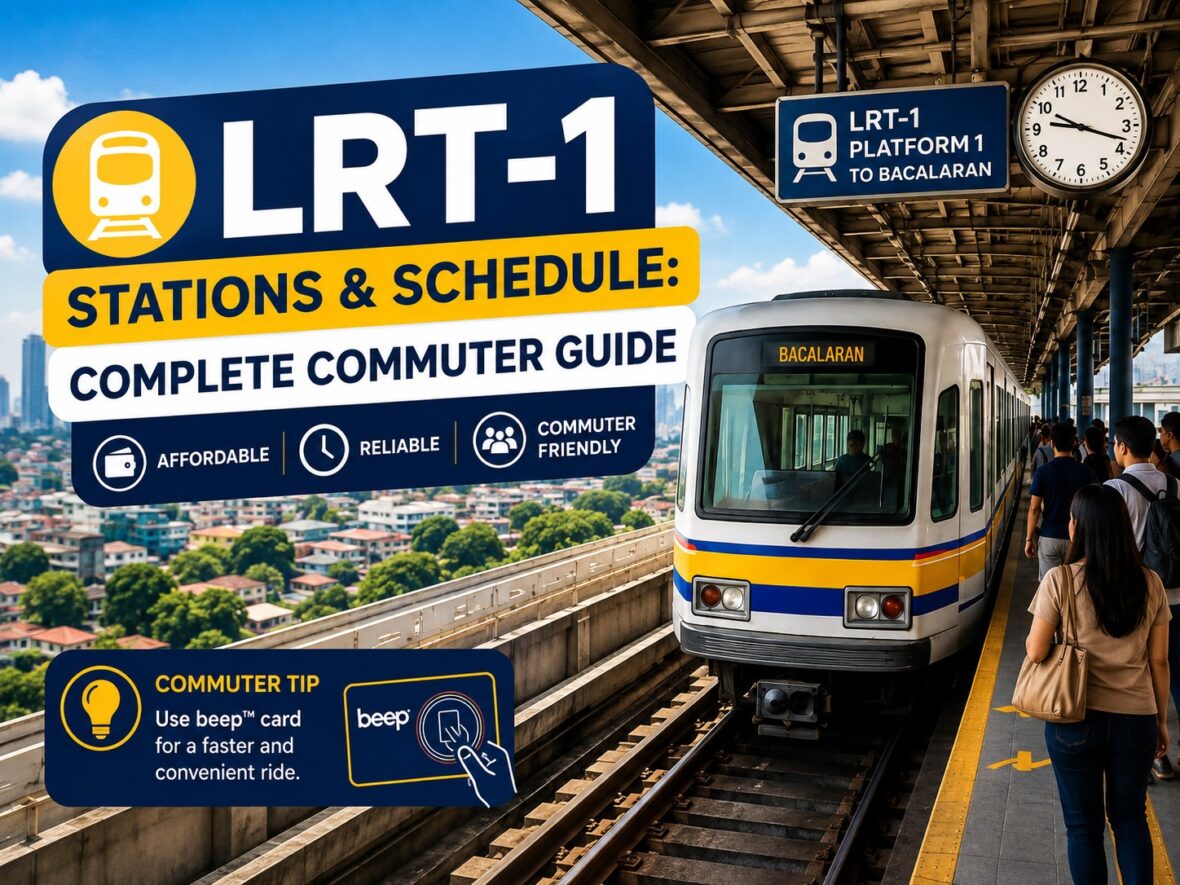
If you’ve ever commuted around Metro Manila, chances are you’ve ridden—or at least considered riding—the LRT-1.
For decades, the familiar train line has carried passengers through some of the busiest parts of Manila, Pasay, Caloocan, and Quezon City. But today’s LRT-1 is quite different from the line many Filipinos remember.
It no longer ends at Baclaran.
With the opening of Phase 1 of the LRT-1 Cavite Extension in November 2024, the line now continues farther south through Parañaque, with five additional stations: Redemptorist-Aseana, MIA Road, PITX, Ninoy Aquino Avenue, and Dr. Santos. LRT-1 now has 25 operational stations, running between Fernando Poe Jr. Station in Quezon City and Dr. Santos Station in Parañaque.
That expansion makes the train much more useful not just for everyday commuters but also for travelers heading to places such as PITX, Manila’s historic districts, universities, shopping areas, government offices, and transportation terminals.
So whether it’s your first time taking the train or you simply need an updated reference, here’s a comprehensive LRT-1 guide for 2026, including all stations in order, operating hours, fares, transfers, nearby landmarks, ticket options, and useful commuting tips.
Updated: August 2026. Train schedules and fares can change, especially during holidays, maintenance periods, severe weather, or special events. Check official LRT-1 advisories before traveling if your timing is critical.
Content
What Is LRT-1?
LRT-1, or Light Rail Transit Line 1, is one of Metro Manila’s major urban railway lines.
It runs generally north-south through:
- Quezon City
- Caloocan
- Manila
- Pasay
- Parañaque
The line is operated and maintained by Light Rail Manila Corporation or LRMC. Its current operational route stretches from Fernando Poe Jr. Station in Quezon City to Dr. Santos Station in Parañaque.
For many commuters, LRT-1 is particularly useful because it passes through some of the most important transport and commercial areas in Metro Manila.
You can use it to reach or connect to places such as:
- Monumento
- Avenida
- Quiapo
- Binondo area
- Manila City Hall
- Intramuros
- Rizal Park
- Taft Avenue
- Gil Puyat/Buendia
- Baclaran
- EDSA
- PITX
- southern Parañaque
And through transfer stations, you can continue to LRT-2, MRT-3, provincial buses, city buses, jeepneys, and the EDSA Carousel.
How Many LRT-1 Stations Are There in 2026?
There are currently 25 operational LRT-1 stations.
Before November 2024, LRT-1 had 20 operational stations.
Five stations were added when Phase 1 of the Cavite Extension opened:
- Redemptorist-Aseana
- MIA Road
- PITX
- Ninoy Aquino Avenue
- Dr. Santos
The new section extended the railway south from Baclaran into Parañaque.
LRT-1 Stations in Order
If you’re traveling southbound, you’ll travel from Fernando Poe Jr. toward Dr. Santos.
If you’re traveling northbound, you’ll go in the opposite direction—from Dr. Santos toward Fernando Poe Jr.
Here are all 25 stations in order from north to south:
| # | LRT-1 Station | City |
|---|---|---|
| 1 | Fernando Poe Jr. | Quezon City |
| 2 | Balintawak | Quezon City |
| 3 | Monumento | Caloocan |
| 4 | 5th Avenue | Caloocan |
| 5 | R. Papa | Manila |
| 6 | Abad Santos | Manila |
| 7 | Blumentritt | Manila |
| 8 | Tayuman | Manila |
| 9 | Bambang | Manila |
| 10 | Doroteo Jose | Manila |
| 11 | Carriedo | Manila |
| 12 | Central Terminal | Manila |
| 13 | United Nations | Manila |
| 14 | Pedro Gil | Manila |
| 15 | Quirino | Manila |
| 16 | Vito Cruz | Manila |
| 17 | Gil Puyat | Pasay |
| 18 | Libertad | Pasay |
| 19 | EDSA | Pasay |
| 20 | Baclaran | Pasay |
| 21 | Redemptorist-Aseana | Parañaque |
| 22 | MIA Road | Parañaque |
| 23 | PITX | Parañaque |
| 24 | Ninoy Aquino Avenue | Parañaque |
| 25 | Dr. Santos | Parañaque |
The five southernmost stations entered commercial operation on November 16, 2024.
LRT-1 Schedule 2026
As of the regular operating schedule in effect in 2026, LRT-1 starts earlier on weekdays than on weekends and holidays.
Weekday Schedule
First train
4:30 AM
from both:
- Fernando Poe Jr. Station
- Dr. Santos Station
Last train
From Dr. Santos: 10:30 PM
From Fernando Poe Jr.: 10:45 PM
LRMC extended its weekday operating hours beginning March 26, 2025, and the same regular weekday schedule was still being cited by LRMC in its 2026 service advisories.
Weekend and Holiday LRT-1 Schedule
For regular weekends and holidays:
First train
5:00 AM
from both ends of the line.
Regular last train
From Dr. Santos: approximately 9:30 PM
From Fernando Poe Jr.: approximately 9:45 PM
LRMC’s holiday scheduling advisories identify these as its normal weekend/holiday closing times, although special schedules may be announced for specific dates.
Quick LRT-1 Schedule Table
| Day | First Train | Last Train from Dr. Santos | Last Train from FPJ |
|---|---|---|---|
| Monday–Friday | 4:30 AM | 10:30 PM | 10:45 PM |
| Weekends/Holidays | 5:00 AM | 9:30 PM* | 9:45 PM* |
*Unless LRMC announces special extended or shortened hours.
Don’t Arrive Exactly at the Last-Train Time
Here’s an important detail.
LRMC says ticket booths close five minutes before the last train departure.
So if the last southbound train from Fernando Poe Jr. leaves at 10:45 PM, don’t plan on walking into the station at 10:44 PM.
Give yourself a reasonable allowance.
Personally, I’d aim to be inside the station at least 15–20 minutes before the last train, especially if:
- you’re buying a Single Journey Ticket
- you’re unfamiliar with the station
- you need to reload a Beep Card
- it’s raining
- there are long lines
- you’re making another train or bus connection
Special Holiday Schedules
LRT-1 schedules can change during holidays.
For example, LRMC suspended operations from Maundy Thursday through Easter Sunday in 2026 to conduct major maintenance work, then resumed regular operations afterward.
Special operating hours can also be announced for:
- Christmas Eve
- Christmas Day
- New Year’s Eve
- New Year’s Day
- Holy Week
- major national events
So if you’re traveling on an important holiday, always check first.
LRT-1 Fare 2026
LRT-1 uses a distance-based fare system.
That means you don’t pay one flat fare regardless of destination. Longer trips cost more.
The most recent general LRT-1 fare adjustment took effect on April 2, 2025. LRMC announced a boarding component of ₱16.25 plus a distance component of ₱1.47 per kilometer under the approved fare structure.
The exact amount you’ll pay depends on:
- your entry station
- destination station
- ticket type
The current fare matrix is published by LRMC for commuters.
For perspective, the fare increase approved in 2025 brought the end-to-end Dr. Santos–Fernando Poe Jr. Single Journey Ticket fare to ₱55.
Because individual station combinations differ, check the fare matrix displayed at the station or ticket machine for your exact trip.
Single Journey Ticket vs. Beep Card
There are two common ways to ride LRT-1.
1. Single Journey Ticket
A Single Journey Ticket or SJT is useful if you’re only riding occasionally.
You:
- Select your destination.
- Pay the corresponding fare.
- Receive a ticket.
- Tap it at the entry gate.
- Insert or surrender it at the exit gate.
If you’re a tourist or someone who rarely takes the train, an SJT is perfectly fine.
2. Beep Card
If you commute regularly, a Beep Card is usually more convenient.
Instead of lining up for a ticket every trip, you maintain stored value on the card and tap in and out.
Beep is especially useful if you’re transferring between compatible Metro Manila transport systems.
Make sure your card has enough balance before entering the station.
There’s nothing worse than rushing for work only to discover your Beep balance is almost zero while a long queue has formed behind you.
Student, Senior Citizen and PWD Discounts
Eligible:
- Students
- Senior citizens
- Persons with disabilities
receive a 50% LRT-1 fare discount under the current concessionary fare arrangement.
Since August 2025, LRMC has simplified the process for Single Journey Tickets: eligible passengers no longer need to complete a form at the station and can instead present the appropriate valid ID at the teller booth to receive the discount.
Always bring the valid identification required for your category.
LRT-1 Station Guide
Now let’s go through every station and what makes each one useful.
1. Fernando Poe Jr. Station
Former name: Roosevelt Station
Fernando Poe Jr., often shortened to FPJ Station, is the current northern terminus of LRT-1.
It’s located along EDSA in Quezon City and serves the Muñoz area.
Useful nearby destinations include:
- WalterMart North EDSA
- Muñoz Market
- Congressional Avenue area
- Roosevelt/FPJ EDSA Carousel stop
- northern Quezon City communities
Fernando Poe Jr. became the station’s official name after the former Roosevelt Station was renamed.
If you’re going south toward Manila, Pasay, PITX, or Parañaque, this is the starting point of the full southbound line.
2. Balintawak Station
Balintawak is useful for commuters around northern Quezon City and the Caloocan border.
Nearby establishments include major retail centers such as:
- Puregold Balintawak
- Ayala Malls Cloverleaf area
- Landers Balintawak
It’s also convenient for people coming from areas around the Balintawak interchange.
3. Monumento Station
Monumento is one of the busiest transportation areas in northern Metro Manila.
It’s useful for passengers transferring to jeepneys and buses toward:
- Malabon
- Navotas
- Valenzuela
- northern Caloocan
The station is close to the Bonifacio Monument, from which the area gets its familiar name.
Monumento also provides access to EDSA-based transport connections.
4. 5th Avenue Station
5th Avenue serves parts of Caloocan close to the Manila boundary.
It’s generally more of a neighborhood commuter station than a major tourist stop.
Still, it’s useful for residents and workers traveling along Rizal Avenue.
5. R. Papa Station
R. Papa is located in northern Manila.
The station primarily serves surrounding residential and commercial areas along Rizal Avenue.
If your destination is somewhere between Caloocan and the central Manila districts, this can save you from taking a longer jeepney ride along Avenida.
6. Abad Santos Station
Abad Santos serves the Tondo and northern Manila area.
It’s a useful transfer point for commuters heading deeper into neighborhoods away from Rizal Avenue.
7. Blumentritt Station
Blumentritt is an important transport area with plenty of jeepneys and local connections.
The station is useful for destinations around:
- Blumentritt Market
- Sampaloc
- Tondo
- Manila North Cemetery area
There’s also a Philippine National Railways corridor in the Blumentritt area, although actual rail service availability should always be checked separately.
8. Tayuman Station
Tayuman is commonly used by passengers heading toward:
- SM City San Lazaro
- Department of Health area
- San Lazaro district
- surrounding medical facilities
If you’re going to SM San Lazaro, Tayuman is usually the LRT-1 station people associate with that destination.
9. Bambang Station
Bambang is well known for the many medical- and laboratory-supply stores around the area.
If you’ve ever needed:
- medical equipment
- scrubs
- hospital supplies
- laboratory products
you may already know Bambang.
It’s also convenient for nearby university and hospital areas.
10. Doroteo Jose Station
This is one of the most important LRT-1 stations for transfers.
Why?
Because Doroteo Jose connects LRT-1 with LRT-2 Recto Station.
LRMC itself identifies Doroteo Jose as the interconnecting LRT-1/LRT-2 station.
Transfer here for LRT-2
From Doroteo Jose, follow the connecting walkway toward Recto Station.
LRT-2 then takes you east toward destinations including:
- Legarda
- Pureza
- V. Mapa
- J. Ruiz
- Gilmore
- Betty Go-Belmonte
- Araneta Center-Cubao
- Anonas
- Katipunan
- Santolan
- Marikina-Pasig
- Antipolo
This is one of the most useful train-to-train connections in Metro Manila.
11. Carriedo Station
Carriedo is one of my favorite LRT-1 stations in terms of access to old Manila.
From here, you’re close to:
- Quiapo Church
- Plaza Miranda
- Escolta
- Santa Cruz
- Binondo
- Ongpin
- Chinatown
If you’re planning a Binondo food trip, Carriedo can be a convenient station depending on where you want to start.
It also puts you close to some of Manila’s oldest commercial districts.
12. Central Terminal Station
Central Terminal is your station for many major Manila landmarks and government offices.
Nearby places include:
- Manila City Hall
- Mehan Garden
- Metropolitan Theater
- Lawton
- Arroceros Forest Park
- Intramuros
If you’re visiting Intramuros, Central Terminal is one of the most useful LRT-1 stations.
From here, you can walk toward the historic district or take a short local ride depending on your destination.
13. United Nations Station
United Nations or UN Avenue Station serves the Ermita area.
Nearby destinations include:
- Rizal Park
- National Museum area
- Department of Tourism vicinity
- United Nations Avenue
- Manila Doctors Hospital
- various hotels around Ermita
For tourists exploring Manila’s major cultural attractions, this is an extremely useful stop.
14. Pedro Gil Station
Pedro Gil serves the busy Ermita/Malate area.
Nearby destinations include:
- Philippine General Hospital
- University of the Philippines Manila
- Robinsons Place Manila
- Pedro Gil Street
This station gets especially busy because of the hospitals, universities, offices, and commercial establishments nearby.
15. Quirino Station
Quirino serves southern Manila and parts of Malate.
It’s useful for destinations along Quirino Avenue and surrounding residential areas.
Depending on your destination, this can also be an option for parts of Manila close to Osmeña Highway.
16. Vito Cruz Station
Vito Cruz is especially familiar to students.
Nearby institutions and destinations include:
- De La Salle University
- College of Saint Benilde
- Rizal Memorial Sports Complex
- Cultural Center area via onward transportation
This can be one of the busiest stations during school and rush hours.
17. Gil Puyat Station
Many commuters still call the surrounding area Buendia.
Gil Puyat Station is a major transportation hub because nearby bus terminals serve provincial destinations.
You’ll also find jeepneys, buses, and other transport connections around Taft Avenue and Gil Puyat Avenue.
If you’re catching a provincial bus from Buendia, check exactly where your bus company’s terminal is located and allow enough walking time.
18. Libertad Station
Libertad serves central Pasay.
It’s useful for:
- Libertad Market area
- Pasay neighborhoods
- local jeepney routes
The station is between Gil Puyat and EDSA, so it can sometimes be less hectic than the two major transport hubs on either side.
19. EDSA Station
This is another critical transfer station.
LRT-1 EDSA Station connects with MRT-3 Taft Avenue Station.
Transfer here for MRT-3
From EDSA LRT-1, follow the pedestrian connection toward Taft Avenue MRT Station.
MRT-3 travels along the EDSA corridor toward destinations including:
- Magallanes
- Ayala
- Buendia
- Guadalupe
- Boni
- Shaw Boulevard
- Ortigas
- Santolan-Annapolis
- Araneta Center-Cubao
- GMA-Kamuning
- Quezon Avenue
- North Avenue
So if you’re coming from Manila and need to get to Makati, Ortigas, Cubao, or North EDSA, this is one of the key transfer points.
20. Baclaran Station
For many years, Baclaran was the southern end of LRT-1.
Not anymore.
Trains now continue into Parañaque through the Cavite Extension Phase 1.
Still, Baclaran remains a very busy station.
It’s useful for:
- Baclaran Church
- Baclaran Market
- surrounding shopping streets
- jeepney and bus routes
If your destination is the famous National Shrine of Our Mother of Perpetual Help, better known as Baclaran Church, this station remains useful.
The Five New LRT-1 Stations
The next five stations are the most significant change to the line in decades.
They opened for commercial service on November 16, 2024.
21. Redemptorist-Aseana Station
Redemptorist-Aseana is the first station south of Baclaran.
It’s useful for the rapidly developing Aseana City area.
Nearby destinations include areas around:
- Redemptorist Road
- Aseana City
- Entertainment City
- Baclaran’s southern section
The station helps reduce dependence on jeepneys and buses for travelers moving between Baclaran and the Aseana corridor.
22. MIA Road Station
MIA Road Station serves parts of Parañaque around MIA Road and the Airport Road corridor.
Its location makes it useful for neighborhoods and businesses surrounding the airport area, although LRT-1 does not currently enter the passenger terminals of NAIA directly.
If you’re going to NAIA, you’ll normally still need another transportation connection after leaving the train.
The station was one of the five Phase 1 stations opened in 2024.
23. PITX Station
This is arguably the most important of the new stations for long-distance travelers.
PITX Station connects LRT-1 directly with the Parañaque Integrated Terminal Exchange.
That means you can arrive by train and transfer to buses or other public transportation heading toward destinations such as:
- Cavite
- Tagaytay
- Batangas
- Laguna
- Quezon
- Bicol
- Baguio
- Mindoro
- Visayas and Mindanao routes
- various Metro Manila destinations
The PITX connection was one of the key transport-integration features of the Cavite Extension.
For travelers with luggage, this direct rail-to-bus connection is a huge improvement.
24. Ninoy Aquino Avenue Station
Ninoy Aquino Avenue Station serves another important part of Parañaque.
It’s located between PITX and Dr. Santos.
The station improves railway access for communities around Ninoy Aquino Avenue and surrounding southern Metro Manila areas.
25. Dr. Santos Station
Dr. Santos Station is currently the southern terminus of LRT-1.
You may also see older references calling it the planned Sucat Station.
It serves southern Parañaque and is positioned near the Dr. A. Santos Avenue corridor. LRMC previously highlighted its connection with the vicinity of SM City Sucat and nearby transportation.
If you’re traveling north from southern Parañaque, this is where the full LRT-1 journey begins.
Important LRT-1 Transfer Stations
If you’re new to Manila’s railway system, remember these three stations.
Doroteo Jose
Transfer to: LRT-2 Recto
Best for going toward:
- Cubao
- Katipunan
- Marikina
- Antipolo
EDSA
Transfer to: MRT-3 Taft Avenue
Best for going toward:
- Makati
- Ortigas
- Cubao
- Quezon Avenue
- North EDSA
PITX
Transfer to: Provincial and city buses, modern jeepneys and other PITX transport
Best for going toward:
- Cavite
- Tagaytay
- Batangas
- Bicol
- Baguio
- other provincial destinations
These three connections alone make LRT-1 an important backbone for traveling around Metro Manila and beyond.
Which Direction Should You Take?
This sounds basic, but it’s one of the easiest mistakes for first-time riders.
Going toward Manila from Parañaque?
Take the Fernando Poe Jr.-bound / northbound train.
Going toward PITX or Dr. Santos from Manila?
Take the Dr. Santos-bound / southbound train.
Look at the terminal station displayed on the platform signs.
If the sign says:
Fernando Poe Jr.
the train is heading north.
If it says:
Dr. Santos
it’s heading south.
How to Ride LRT-1 for the First Time
Never ridden the train before?
Here’s the basic process.
Step 1: Enter the Correct Side of the Station
Look for signs indicating whether you need:
Fernando Poe Jr.
or
Dr. Santos.
At some stations, changing sides after entering may be inconvenient, so check before tapping.
Step 2: Buy a Ticket or Use Your Beep Card
If you don’t have a Beep Card, purchase a Single Journey Ticket.
Select your destination and pay the fare.
If you have a loaded Beep Card, go directly to the gate.
Step 3: Tap In
Tap your card or ticket on the reader.
Wait for the gate to open.
Step 4: Go to the Platform
Follow the directional signs.
When the train arrives, allow exiting passengers to leave first.
This sounds like common sense, but during rush hour it’s worth remembering.
Step 5: Ride to Your Station
Listen for announcements and watch the station displays.
If you’re unfamiliar with the route, count the stations or use the route map inside the train.
Step 6: Tap Out
At your destination:
- tap your Beep Card, or
- follow the exit procedure for your Single Journey Ticket.
Then follow the station’s exit signs.
Best Time to Ride LRT-1
If you have flexibility, avoid the busiest commuter hours.
Crowds are generally heavier during weekday:
Morning rush: roughly 6:00–9:00 AM
Evening rush: roughly 4:30–8:00 PM
The exact crowd level varies by station and day.
Stations such as:
- EDSA
- Doroteo Jose
- Monumento
- Gil Puyat
- Pedro Gil
can become especially busy because of transfers, schools, offices, and transport terminals.
If you’re sightseeing instead of commuting to work, mid-morning or early afternoon can feel much more comfortable.
Is LRT-1 Good for Tourists?
Absolutely.
In fact, LRT-1 can be one of the cheapest ways to explore old Manila.
LRMC’s own ikotMNL tourism campaign promotes using LRT-1 to rediscover places such as Intramuros, Binondo, and Quiapo.
For example:
Quiapo
Get off at Carriedo.
Binondo
Carriedo is a useful starting point.
Intramuros
Get off at Central Terminal.
Rizal Park / National Museum area
Use United Nations.
Malate
Consider Pedro Gil, Quirino, or Vito Cruz depending on your destination.
This makes it possible to build an entire Manila sightseeing itinerary around the train.
LRT-1 and PITX: A Big Improvement for Travelers
For travelers from Cavite and southern Luzon, PITX Station is one of the most practical additions to LRT-1.
Before the extension opened, many PITX passengers still needed a bus, jeepney, or another vehicle to connect to Metro Manila’s rail system.
Now you can go:
Provincial Bus → PITX → LRT-1
and continue directly toward:
Baclaran → Pasay → Manila → Caloocan → Quezon City
without first taking another long road journey.
That intermodal connection was a major design goal of the extension.
Does LRT-1 Already Reach Cavite?
Here’s a common source of confusion.
Despite being called the LRT-1 Cavite Extension, the currently operational Phase 1 stations only extend the line through Parañaque.
As of August 2026, the operating southern terminal is still Dr. Santos Station in Parañaque, not Cavite.
The full Cavite Extension project is planned to eventually expand LRT-1 to 28 stations and reach Bacoor, Cavite.
The original full extension plan includes additional stations beyond Dr. Santos:
- Las Piñas
- Zapote
- Niog in Bacoor
These are part of the broader extension plan rather than the currently operating Phase 1 section.
So for now:
LRT-1 to Cavite itself? Not yet.
But you can ride directly to PITX and transfer to buses bound for Cavite.
Accessibility at New LRT-1 Stations
The five Cavite Extension Phase 1 stations were designed with accessibility features including:
- Elevators
- Escalators
- Tactile guides
to assist passengers with mobility and accessibility needs.
If you’re traveling with someone who needs assistance, station personnel can also help guide you to accessible entrances and platforms.
Bringing a Bicycle on LRT-1
LRMC has installed bike racks at a number of LRT-1 stations as part of its bikeways program.
Stations named by LRMC as having bike facilities include places such as:
- Baclaran
- EDSA
- Libertad
- Gil Puyat
- Vito Cruz
- Quirino
- United Nations
- Central
- Pedro Gil
- Tayuman
- Doroteo Jose
and others.
Rules on bringing bicycles inside trains may vary depending on the type of bicycle and current operating guidelines, so check the latest LRMC policy before traveling with one.
LRT-1 Commuting Tips
A few simple habits can make your trip much easier.
1. Load Your Beep Card Before Rush Hour
Don’t wait until 7:45 AM on a Monday to discover you only have ₱3 left.
Reload earlier whenever possible.
2. Avoid Standing Directly in Front of the Door
Let passengers get off before you board.
It speeds things up for everyone.
3. Move Toward the Middle of the Train
People often cluster near the doors even when there’s more space farther inside.
If you’re traveling several stations, move inward.
4. Keep Bags Secure
Like any crowded public-transport system, stay aware of your belongings.
Keep:
- phones
- wallets
- passports
- valuables
secure, especially during crowded periods.
5. Know Your Transfer Before You Arrive
If you’re transferring:
Doroteo Jose → LRT-2
EDSA → MRT-3
PITX → buses
know that before your train reaches the station.
You’ll move through the crowd much more smoothly.
6. Check Advisories When It Rains Heavily
Metro Manila transportation can be affected by severe weather.
Even if LRT-1 itself continues operating, flooding or road conditions around your destination may affect your onward commute.
7. Don’t Assume Holiday Hours Are Normal
Holy Week, Christmas, New Year, and major national events can result in schedule changes. LRMC regularly publishes special advisories for these periods.
Frequently Asked Questions About LRT-1
How many LRT-1 stations are there in 2026?
There are currently 25 operational stations, from Fernando Poe Jr. in Quezon City to Dr. Santos in Parañaque.
What is the first LRT-1 trip?
On weekdays, first trains depart from both Fernando Poe Jr. and Dr. Santos at 4:30 AM.
On weekends and holidays, first departures are generally at 5:00 AM.
What is the last LRT-1 trip?
On regular weekdays:
Dr. Santos: 10:30 PM
Fernando Poe Jr.: 10:45 PM.
Regular weekend and holiday closing times are earlier, unless a special schedule is announced.
How much is the LRT-1 fare?
LRT-1 fares depend on distance.
The fare structure implemented from April 2, 2025 uses a ₱16.25 boarding component plus ₱1.47 per kilometer, with the exact ticket price determined by your origin and destination.
Check the official fare matrix for the exact station pair.
How much is LRT-1 from end to end?
Under the fare adjustment effective April 2025, the Single Journey Ticket from Dr. Santos to Fernando Poe Jr. costs ₱55.
Can I use a Beep Card on LRT-1?
Yes. LRT-1 supports stored-value fare payment, allowing regular commuters to tap in and out without purchasing a new Single Journey Ticket each time. The official fare matrix distinguishes between ticket types.
Which LRT-1 station connects to LRT-2?
Doroteo Jose Station connects to Recto Station on LRT-2.
Which LRT-1 station connects to MRT-3?
Use EDSA Station and transfer to MRT-3 Taft Avenue Station.
Which LRT-1 station goes to PITX?
Get off at PITX Station, one of the five Cavite Extension Phase 1 stations opened in November 2024.
Which LRT-1 station is closest to Binondo?
Carriedo Station is a convenient option for reaching the Binondo/Escolta area.
Which station should I use for Intramuros?
Central Terminal Station is generally one of the most convenient LRT-1 stations for Intramuros.
Which LRT-1 station should I use for Rizal Park?
United Nations Station is a convenient stop for Rizal Park and nearby museums.
Does LRT-1 go directly to NAIA?
No.
Although the extension includes MIA Road Station and passes closer to the airport area, LRT-1 does not currently take passengers directly into NAIA’s airport terminals.
You’ll still need an onward road connection.
Does LRT-1 go to Cavite?
Not yet directly.
The current southern terminus is Dr. Santos Station in Parañaque. The full Cavite Extension is planned to continue farther south toward Bacoor.
Are students discounted on LRT-1?
Yes. Students, senior citizens, and PWD passengers are eligible for a 50% fare discount under LRMC’s current discounted-fare program, subject to presentation of the required valid identification.
LRT-1 Contact Information
For official LRT-1 concerns, LRMC currently lists:
Light Rail Manila Corporation
Telephone: (02) 5318-5762
Email: feedback@lrmc.com.ph
For real-time advisories, LRMC also recommends following Official LRT-1 on its social channels or using its ikotMNL app.
Final Thoughts
LRT-1 remains one of the most useful public transportation options in Metro Manila, but the system is much more useful today than it was only a few years ago.
The biggest change is the extension south of Baclaran.
With Redemptorist-Aseana, MIA Road, PITX, Ninoy Aquino Avenue, and Dr. Santos now operating, passengers have a direct rail connection deeper into Parañaque and, importantly, directly into PITX.
That means the current LRT-1 journey can take you all the way from:
Fernando Poe Jr. → Balintawak → Monumento → Manila → Taft → Baclaran → PITX → Dr. Santos
with 25 stations in total.
For everyday commuters, the most important details to remember are simple:
Weekdays: first train at 4:30 AM
Weekends/holidays: first train at 5:00 AM
Weekday last train: 10:30 PM from Dr. Santos and 10:45 PM from Fernando Poe Jr.
And if you’re trying to navigate Metro Manila without spending hours stuck in road traffic, remember the three key transfer points:
Doroteo Jose → LRT-2
EDSA → MRT-3
PITX → provincial and city buses
Once you understand those connections, LRT-1 becomes much more than a single train line. It becomes a practical gateway to large parts of Metro Manila—and, through PITX, to destinations well beyond it.
For commuters and travelers alike, that’s what makes LRT-1 such an important part of getting around the Philippines in 2026.