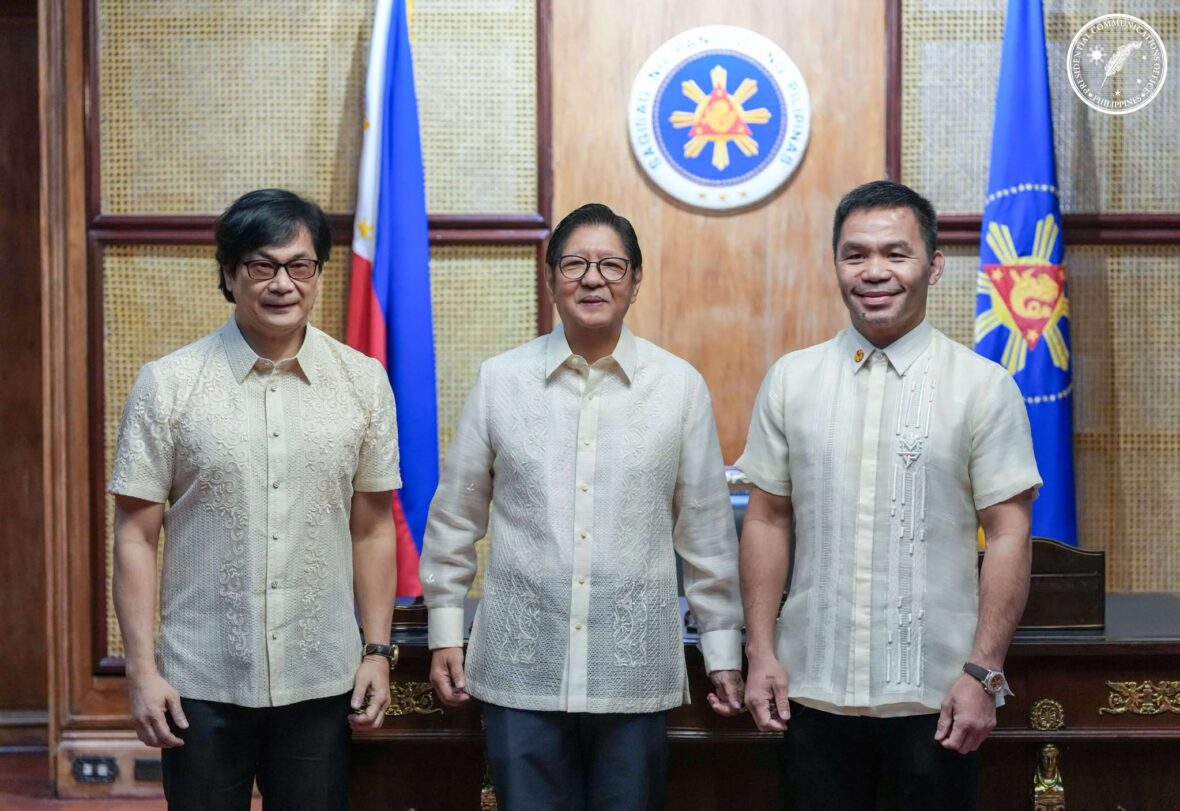
Manny Pacquiao is officially back in government.
But this time, the boxing legend and former senator isn’t returning to Congress.
President Ferdinand Marcos Jr. has appointed Emmanuel “Manny” Pacquiao as Secretary and Lead Convenor of the National Anti-Poverty Commission, or NAPC—placing one of the Philippines’ most recognizable public figures at the center of the government’s anti-poverty coordination efforts.
Pacquiao took his oath of office before President Marcos at Malacañang on Tuesday, September 8, 2026. He succeeds Lope Santos III, who had served as NAPC Secretary and Lead Convenor since January 2023.
So what exactly is NAPC?
What will Pacquiao actually do?
Does this mean he is now a Cabinet secretary?
Will he be distributing government financial assistance?
And why was he appointed at a time when official statistics show that millions of Filipinos are still living below the poverty line?
Here’s a closer look at Manny Pacquiao’s new government position and what the job actually involves.
Content
Manny Pacquiao’s New Government Position at a Glance
| Detail | Information |
|---|---|
| Official | Emmanuel “Manny” Pacquiao |
| New position | Secretary and Lead Convenor |
| Agency | National Anti-Poverty Commission |
| Abbreviation | NAPC |
| Oath-taking | September 8, 2026 |
| Appointed by | President Ferdinand Marcos Jr. |
| Rank | Cabinet Secretary |
| Predecessor | Lope Santos III |
| NAPC chairperson | President Ferdinand Marcos Jr. |
| Main role | Coordinate and advise on government anti-poverty and social reform efforts |
| Governing law | Republic Act No. 8425 |
| Current administrative supervision | Office of the President |
Pacquiao’s appointment marks his return to government service four years after his term in the Senate ended in June 2022.
What Happened?
On September 8, President Marcos administered Pacquiao’s oath of office at Malacañang.
The Palace announced that Pacquiao would serve as both Secretary and Lead Convenor of the National Anti-Poverty Commission.
The government said the appointment places Pacquiao at the helm of efforts to strengthen poverty reduction and social reform programs and improve the delivery of government initiatives to communities around the country.
It’s a significant political comeback for Pacquiao.
He previously spent 12 consecutive years in Congress:
- Representative of Sarangani from 2010 to 2016
- Senator from 2016 to 2022
He later ran for president in 2022, losing to Marcos.
Now the two former presidential rivals are working in the same administration.
What Is NAPC?
NAPC stands for:
National Anti-Poverty Commission.
It was created under Republic Act No. 8425, known as the Social Reform and Poverty Alleviation Act of 1997.
The law established NAPC as the government’s coordinating and advisory body for the implementation of the country’s Social Reform Agenda.
That wording is important.
NAPC isn’t simply another government office that hands out financial assistance.
Its broader job is to help make sure the different parts of government working on poverty reduction are moving in the same direction.
Think about how many agencies can be involved in fighting poverty:
Agriculture.
Employment.
Housing.
Education.
Healthcare.
Social welfare.
Local government.
Livelihood.
Infrastructure.
Microfinance.
Disaster recovery.
Indigenous peoples’ concerns.
Fisherfolk.
Farmers.
Urban poor communities.
NAPC is designed partly to bring these efforts together instead of having every agency operate independently.
What Does the NAPC Actually Do?
Republic Act No. 8425 gives NAPC several major responsibilities.
They include coordinating with national government agencies, local governments and the private sector to implement social reform and poverty alleviation programs.
NAPC can also:
- Coordinate with LGUs on local anti-poverty programs
- Recommend poverty-reduction policies
- Monitor government social reform programs
- Review how resources for poverty programs are allocated
- Promote participation by disadvantaged sectors
- Advocate funding for anti-poverty programs
- Support capability-building activities for people’s organizations
- Submit reports on its programs and operations
So Pacquiao’s new role is not centered on running one specific ayuda program.
It’s much broader.
His job involves coordinating policy and programs across different parts of government.
Is Manny Pacquiao Now a Cabinet Secretary?
Yes.
The lead convenor of NAPC carries the rank of Cabinet Secretary under Republic Act No. 8425.
The law states that the President appoints the NAPC Lead Convenor, who also serves as head of the commission’s secretariat and holds Cabinet Secretary rank.
The Philippine News Agency described Pacquiao’s appointment as his return to government and entry into the Marcos Cabinet.
So while his title isn’t “Secretary of Anti-Poverty” in the same way we have a Secretary of Health or Secretary of Finance, Pacquiao’s position carries Cabinet-level rank.
Is Manny Pacquiao the Chairman of NAPC?
No.
President Ferdinand Marcos Jr. is the chairperson of NAPC.
Pacquiao serves as:
Secretary and Lead Convenor.
Under the law, the President chairs the commission while the Lead Convenor manages the NAPC Secretariat and helps coordinate its work.
So the structure looks roughly like this:
President Marcos
→ NAPC Chairperson
Manny Pacquiao
→ Secretary and Lead Convenor
→ Head of the NAPC Secretariat
That’s an important distinction when trying to understand Pacquiao’s authority.
What Will Manny Pacquiao Actually Do?
This is probably the biggest question.
The title “anti-poverty chief” sounds straightforward, but poverty policy involves a huge number of government programs.
Pacquiao isn’t expected to personally manage every poverty-related program in the country.
Instead, his job is largely about coordination.
For example, imagine a government anti-poverty initiative involving:
DSWD providing social protection,
DOLE supporting employment,
DA working with farmers,
DILG coordinating with LGUs,
DOH handling community health,
and other agencies providing housing, education or livelihood assistance.
NAPC’s role is to help coordinate policies and make sure anti-poverty efforts aren’t unnecessarily duplicated or disconnected.
Under the law, the commission also has an oversight and monitoring role over social reform and poverty alleviation initiatives.
Pacquiao, as Lead Convenor, will therefore become one of the central officials connecting those different efforts.
Will Manny Pacquiao Be Giving Out Ayuda?
Not necessarily.
This is an important misconception to avoid.
NAPC’s statutory role is primarily:
coordination,
policy,
monitoring,
advocacy,
and basic-sector participation.
It isn’t primarily structured as a mass cash-assistance agency.
Government financial assistance programs are generally administered through agencies that have specific mandates and budgets for those programs.
So Pacquiao’s appointment does not mean Filipinos can simply go to NAPC and request money from him.
NAPC’s work is more about shaping and coordinating the policies that affect poor and marginalized Filipinos.
Why Is the NAPC Different From DSWD?
This is another useful distinction.
DSWD—the Department of Social Welfare and Development—directly manages major social protection and welfare programs.
NAPC has a different role.
It serves as a coordinating and advisory body for social reform and poverty alleviation.
That means NAPC can work with DSWD, but it doesn’t simply replace DSWD.
And there’s another recent development that’s especially relevant to Pacquiao’s appointment.
NAPC Has Recently Returned to the Office of the President
Pacquiao’s appointment came just weeks after a significant reorganization.
President Marcos issued Executive Order No. 123 transferring administrative supervision of NAPC and the Presidential Commission for the Urban Poor from DSWD back to the Office of the President.
The order was intended to strengthen policy coordination and improve the convergence of poverty-reduction and urban-development initiatives.
This is significant because it places NAPC closer to Malacañang administratively.
Pacquiao isn’t taking over an agency sitting quietly inside another department.
He’s becoming Lead Convenor shortly after the commission was placed back under direct Office of the President supervision.
Why Was NAPC Moved Back to Malacañang?
Executive Order No. 123 says the move is intended to:
strengthen policy coordination,
improve the convergence of poverty-reduction efforts,
connect anti-poverty and urban-development initiatives,
and make whole-of-government programs easier to implement.
That fits with what NAPC was originally designed to do.
Poverty isn’t something a single department can solve by itself.
A family’s financial situation can be affected simultaneously by:
- Employment
- Food prices
- Healthcare
- Education
- Housing
- Transportation
- Access to credit
- Agricultural productivity
- Disasters
- Infrastructure
- Inflation
Putting NAPC closer to the Office of the President potentially gives it a stronger position from which to coordinate across departments.
Whether that results in better outcomes, of course, will depend on how policies are implemented.
Who Does NAPC Represent?
One unusual feature of NAPC is the role given to basic sectors.
Under Republic Act No. 8425, representatives from disadvantaged and grassroots sectors participate in the commission.
The law provides representation from sectors including:
- Farmers and landless rural workers
- Artisanal fisherfolk
- Urban poor
- Indigenous peoples and cultural communities
- Formal-sector and migrant workers
- Informal-sector workers
- Women
- Youth and students
- Persons with disabilities
- Victims of disasters and calamities
- Senior citizens
- Nongovernment organizations
- Children
- Cooperatives
This is one of the most important parts of NAPC’s design.
Anti-poverty policy isn’t supposed to be created entirely from the top down.
The law specifically calls for meaningful participation by sectors directly affected by poverty and social inequality.
Why Does Basic-Sector Participation Matter?
Imagine government officials designing a program for fishermen without talking to fishermen.
Or creating a livelihood program for informal workers without understanding how informal workers actually earn money.
Or designing housing policy without hearing from urban poor communities.
That’s exactly the problem the basic-sector representation system is supposed to help address.
NAPC provides a formal mechanism for these groups to participate in planning, implementation, monitoring and evaluation of anti-poverty policies.
One of Pacquiao’s challenges will therefore be balancing national government priorities with the concerns raised by grassroots sector representatives.
What Is the National Anti-Poverty Action Agenda?
Another important part of NAPC’s work is the National Anti-Poverty Action Agenda, sometimes referred to as the N3A.
The government says NAPC is mandated under Republic Act No. 8425 to prepare and adopt the national anti-poverty agenda.
The framework takes a multidimensional approach to poverty, looking beyond income alone and considering social, economic, ecological and governance dimensions.
That concept is increasingly important.
A person can earn slightly above an official poverty threshold and still face major disadvantages involving healthcare, housing, education, sanitation or employment.
Which brings us to the current poverty situation in the Philippines.
How Many Filipinos Are Living in Poverty?
The latest full-year official poverty statistics from the Philippine Statistics Authority show substantial improvement—but poverty remains a major national challenge.
According to the PSA’s 2025 full-year estimates:
9.7% of Filipinos were considered poor.
That represents approximately:
11.08 million people.
Among families, poverty incidence fell to:
6.4%.
That represents approximately:
1.90 million poor Filipino families.
The PSA said this was the first time the country’s poverty incidence among families had fallen to a single-digit level.
That’s significant progress.
But 11 million Filipinos living below the official poverty threshold is still an enormous number of people.
Poverty Has Fallen Across All Regions
The PSA also reported that all 18 regions recorded statistically significant declines in family poverty incidence between 2023 and 2025.
BARMM posted one of the largest improvements, with family poverty incidence falling from 26.0% to 12.8%.
The National Capital Region had the lowest family poverty incidence at 0.6%.
The Bicol Region recorded the highest at 16.8%.
Those regional differences illustrate one of the difficulties facing NAPC.
The causes and experiences of poverty aren’t identical everywhere.
An urban poor family in Metro Manila may face very different problems from:
a coconut farmer in Bicol,
a fisherfolk family in the Visayas,
an indigenous community in Mindanao,
or an OFW family struggling with employment instability.
National policy has to account for those differences.
Poverty Isn’t Only About Income
There is another number worth knowing.
The PSA’s latest Multidimensional Poverty Index estimated that:
12.8% of Filipinos were multidimensionally poor in 2024.
The MPI measures deprivation across four broad dimensions:
- Education
- Health and nutrition
- Housing, water and sanitation
- Employment
This tells us something important.
Measuring poverty isn’t simply about asking:
“How much money does this family earn?”
You also need to ask:
Can the children attend school?
Does the family have decent housing?
Do they have clean water?
Do they have access to healthcare?
Is there stable employment?
That broader understanding of poverty is closely aligned with the multidimensional approach NAPC is expected to coordinate.
Why Pacquiao’s Background Is Relevant
Pacquiao’s life story will inevitably become part of the discussion around his appointment.
Long before the world titles, mansions and international fame, Pacquiao grew up in poverty.
His rise from a difficult childhood to becoming one of the most successful boxers in history has been central to his public image for decades.
That gives him personal familiarity with poverty that few Cabinet-level officials can match.
But personal experience and government policymaking are two different things.
Running an anti-poverty commission requires coordination with bureaucracies, local governments, economists, sectoral organizations and multiple government departments.
The effectiveness of Pacquiao’s appointment will therefore ultimately be judged not by his personal story but by what NAPC accomplishes under his leadership.
Manny Pacquiao’s Political Career
Pacquiao isn’t new to politics.
He served as representative of Sarangani from 2010 until 2016.
He then served one term as Philippine senator from 2016 until 2022.
In 2022, he ran for president.
He lost that election to Ferdinand Marcos Jr.
Pacquiao later sought another Senate term in the 2025 midterm elections but did not win a seat.
His new NAPC role therefore gives him a route back into national public service without being elected to Congress.
Is This Manny Pacquiao’s First Executive Government Position?
It represents a very different kind of role from his previous elected offices.
As a congressman and senator, Pacquiao worked in the legislative branch.
NAPC puts him inside the executive branch.
That means his responsibilities are no longer primarily about:
filing bills,
voting on legislation,
or participating in Senate investigations.
Instead, he’ll be working within the administration to help implement and coordinate government policy.
That’s a major change.
Does Manny Pacquiao Replace Larry Gadon?
No.
This is another detail that can cause confusion.
Pacquiao’s NAPC position is separate from Larry Gadon’s role as Presidential Adviser for Poverty Alleviation.
Pacquiao is:
NAPC Secretary and Lead Convenor.
Gadon holds a different advisory position under the President.
The two jobs may involve poverty-related concerns, but they are not the same office.
Who Did Manny Pacquiao Replace?
Pacquiao succeeds:
Lope B. Santos III.
Santos had served as NAPC Secretary and Lead Convenor since January 31, 2023.
Pacquiao’s appointment therefore represents a leadership change at the commission rather than the creation of an entirely new position.
What Are the Biggest Challenges Facing Pacquiao?
There are several.
1. Coordinating Many Government Agencies
This is probably the biggest institutional challenge.
NAPC doesn’t operate in isolation.
Meaningful poverty reduction can involve agencies dealing with:
agriculture,
labor,
finance,
social welfare,
health,
education,
local government,
environment,
housing,
infrastructure,
and economic planning.
Coordination sounds simple.
In a government bureaucracy, it rarely is.
2. Turning National Policy Into Local Results
A national anti-poverty program can look excellent on paper.
The real test is whether it reaches the barangay.
This is where coordination with LGUs becomes critical.
Republic Act No. 8425 specifically directs NAPC to work with local governments in formulating poverty-reduction programs appropriate to their areas.
So one of the practical questions for Pacquiao’s leadership will be:
Can national programs translate into visible improvements for families and communities?
3. Listening to Basic Sectors
NAPC isn’t supposed to be purely a government-to-government coordinating body.
It includes representatives from grassroots sectors.
That means Pacquiao will need to work with groups representing farmers, fisherfolk, workers, indigenous peoples, women, youth, persons with disabilities, senior citizens, urban poor communities and others.
Those groups won’t always agree with one another—or with the government.
Managing those relationships is part of the job.
4. Addressing More Than Income Poverty
Official income poverty has fallen significantly.
But that doesn’t mean every form of deprivation has disappeared.
The latest multidimensional poverty statistics still show millions of Filipinos experiencing disadvantages involving education, health, housing, sanitation or employment.
For an anti-poverty commission, success therefore can’t simply mean increasing household income.
Quality of life matters too.
5. Showing Measurable Results
Pacquiao is entering the role with enormous name recognition.
That guarantees attention.
But it also creates expectations.
The public will naturally want to know:
What programs changed?
Which policies improved?
How many families benefited?
Did access to jobs improve?
Did basic services reach marginalized communities?
Did government agencies become better coordinated?
Ultimately, those types of measurable outcomes will matter far more than the publicity generated by the appointment itself.
Can NAPC Create New Anti-Poverty Programs?
NAPC can recommend policies, coordinate programs and advocate for funding and improved implementation.
It can also work with national agencies and local governments on social reform and poverty-reduction initiatives.
However, major government programs still operate within the country’s normal legal, budgeting and administrative processes.
So becoming NAPC chief doesn’t give Pacquiao an unlimited fund that he can spend however he chooses.
Budgets still matter.
Laws still matter.
Other agencies still retain their own legal mandates.
Does Pacquiao Control the Entire Government Anti-Poverty Budget?
No.
Government spending related to poverty reduction is spread across many departments, agencies and programs.
NAPC has an important coordination and policy role, but it doesn’t simply take control of every peso spent on social welfare, employment, agriculture, housing or healthcare.
The commission can monitor, coordinate and recommend measures involving resources for anti-poverty programs, but implementing agencies retain their respective mandates.
Why Is Manny Pacquiao’s Appointment Getting So Much Attention?
There are several obvious reasons.
First, he’s Manny Pacquiao.
Very few Filipinos—politicians or otherwise—have comparable international recognition.
Second, this marks his return to national government after several years outside elected office.
Third, he is joining the administration of the man who defeated him in the 2022 presidential election.
And finally, the issue he’s being asked to handle couldn’t be more closely associated with Pacquiao’s own life story:
poverty.
That combination makes the appointment both politically interesting and personally symbolic.
Is Manny Pacquiao Still a Boxer?
Pacquiao’s government appointment comes after years of moving between boxing and politics.
He remains one of the most accomplished fighters in boxing history and was inducted into the International Boxing Hall of Fame in 2025.
But his new government appointment places him back into an official public-service role.
Whatever happens with his sporting activities, his NAPC responsibilities now come with Cabinet-level status and national policy responsibilities.
Manny Pacquiao NAPC FAQs
What is Manny Pacquiao’s new government position?
Pacquiao is the new Secretary and Lead Convenor of the National Anti-Poverty Commission.
He took his oath on September 8, 2026.
Who appointed Manny Pacquiao?
President Ferdinand Marcos Jr.
Is Manny Pacquiao now a Cabinet Secretary?
Yes. The NAPC Lead Convenor has the rank of Cabinet Secretary under Republic Act No. 8425.
Is Pacquiao the chairman of NAPC?
No. President Marcos serves as NAPC chairperson. Pacquiao is Secretary and Lead Convenor and heads the commission secretariat.
What does NAPC mean?
NAPC stands for National Anti-Poverty Commission.
What does NAPC do?
NAPC coordinates and advises on social reform and poverty alleviation policies and programs across government. It also promotes participation by marginalized and basic sectors.
Will Manny Pacquiao distribute ayuda?
NAPC isn’t primarily a cash-distribution agency. Its main statutory responsibilities involve coordination, policy, monitoring and sectoral participation.
Specific government assistance programs are generally administered by agencies with their own mandates.
Did Manny Pacquiao replace DSWD?
No.
NAPC and DSWD are separate government bodies with different responsibilities.
Who did Pacquiao replace?
He succeeded Lope Santos III, who had served as NAPC Secretary and Lead Convenor since 2023.
Is NAPC under DSWD?
Not anymore.
Executive Order No. 123 transferred administrative supervision of NAPC from DSWD back to the Office of the President.
Is Manny Pacquiao’s position the same as Larry Gadon’s?
No.
Pacquiao is NAPC Secretary and Lead Convenor, while Gadon serves in a separate role as Presidential Adviser for Poverty Alleviation.
How many Filipinos currently live in poverty?
The PSA estimated that 9.7% of Filipinos—or approximately 11.08 million people—were living below the official poverty threshold in 2025.
Among families, the poverty incidence was 6.4%, equivalent to approximately 1.90 million families.
Final Thoughts
Manny Pacquiao has spent most of his public life being introduced in very different ways.
Boxing champion.
Congressman.
Senator.
Presidential candidate.
Now he has another title:
Secretary and Lead Convenor of the National Anti-Poverty Commission.
The appointment brings Pacquiao back into national government, but this role will be different from the positions he’s held before.
He isn’t returning to Congress to write and vote on laws.
Instead, he’s joining the executive branch and taking responsibility for helping coordinate something far more complicated:
the government’s fight against poverty.
NAPC’s mandate covers everything from coordinating agencies and local governments to monitoring programs, recommending policies and ensuring that disadvantaged sectors actually have a voice in the decisions affecting them.
The timing is interesting.
The latest PSA numbers show that poverty has declined substantially, with family poverty incidence falling to 6.4% in 2025.
That’s good news.
But it still translates to around 1.90 million poor families and 11.08 million Filipinos living below the official poverty threshold.
And poverty itself is more complicated than income.
Millions of Filipinos continue to face challenges involving jobs, housing, healthcare, education, sanitation and access to opportunities.
That’s the environment Pacquiao is stepping into.
His story—from poverty to becoming a global sports icon—is undeniably connected to the mission of the office he now leads.
But his personal story won’t be enough to determine whether the appointment succeeds.
What matters next is implementation.
Can agencies work together more effectively?
Can grassroots sectors genuinely influence government policy?
Can programs reach the communities that need them?
And most importantly, can improvements on government reports eventually be felt in the everyday lives of Filipino families?
Those will be the real measures of Manny Pacquiao’s new fight.
This time, there is no boxing ring.
The opponent is poverty.