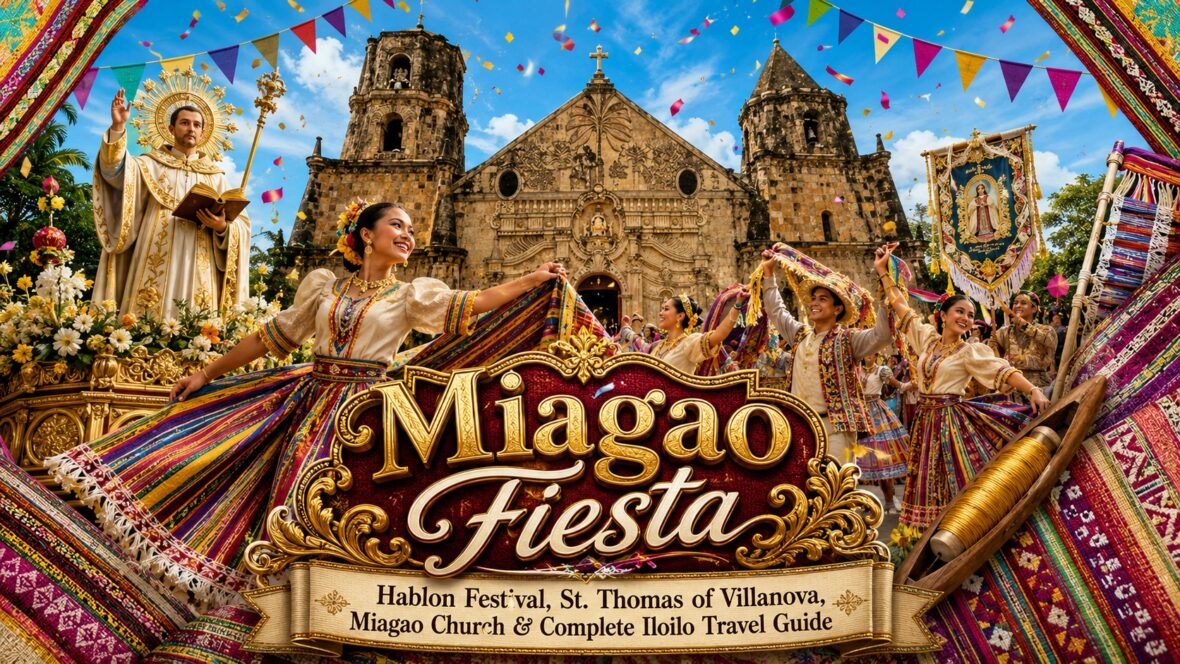
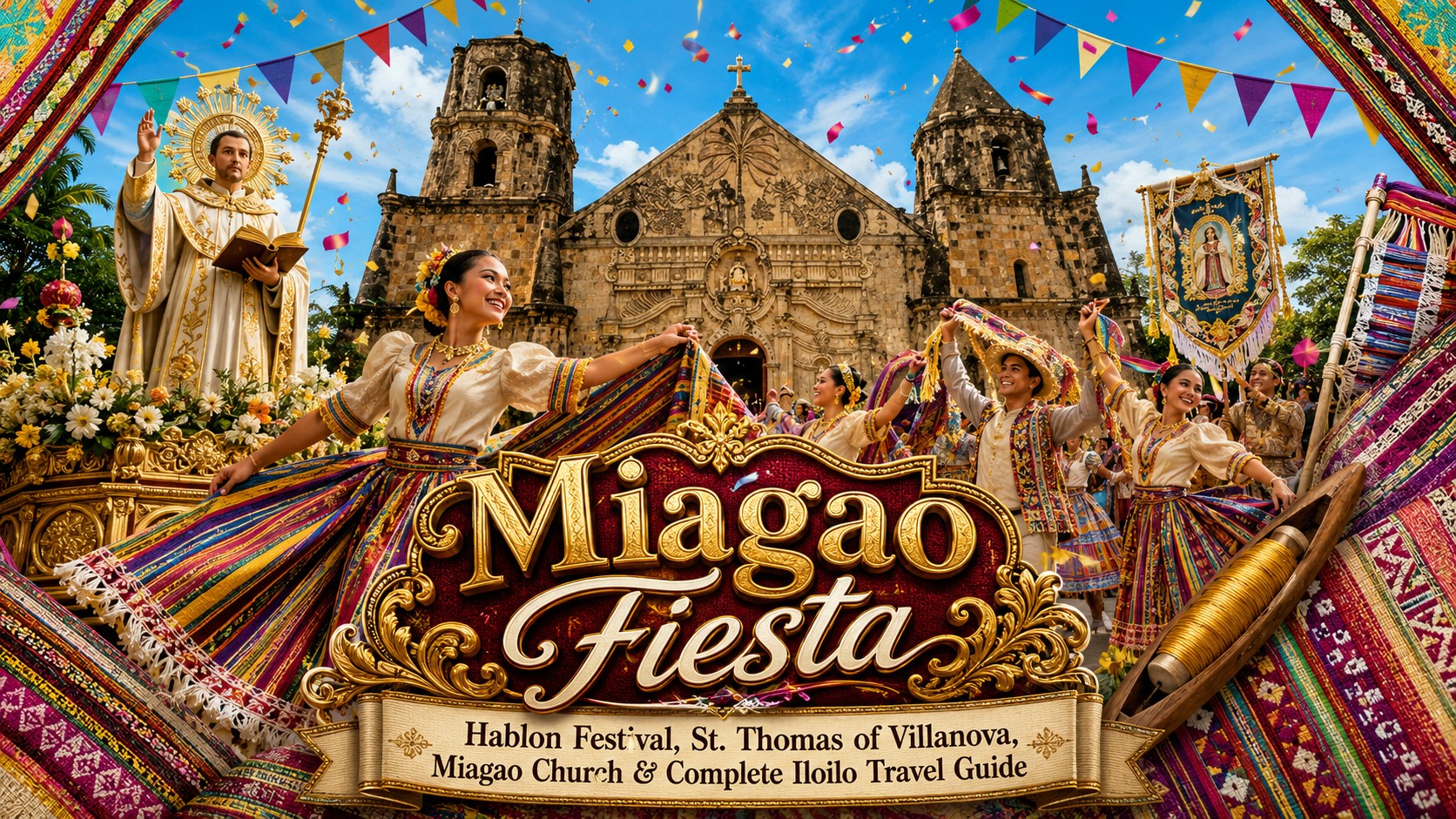
September is a special month in many Iloilo towns, but Miagao has something that immediately sets its fiesta apart.
Here, you have a traditional patronal celebration in honor of St. Thomas of Villanova, a festival built around the centuries-old art of hablon weaving, and one of the most important heritage churches in the Philippines standing right at the heart of town.
The main Miagao Fiesta is celebrated every September 22. In recent years, the religious feast has been accompanied by the weeklong Hablon Festival, bringing together weaving, fashion, pageants, performances, trade fairs, sports activities, religious events and community gatherings.
And for 2026, preparations are already underway.
Tourism Miagao has confirmed ongoing coordination for Hablon Festival 2026, while preparations for events such as Lin-ay Kang Hablon are already being organized. Procurement records in August 2026 also refer to this year’s celebration as the 13th Hablon Festival. (Facebook)
If you’re thinking of visiting Miagao this September, here’s everything you need to know.
Content
Miagao Fiesta 2026 Quick Guide
| Fiesta Information | Details |
|---|---|
| Town | Miagao, Iloilo |
| Main Fiesta Day | September 22, 2026 |
| Day | Tuesday |
| Patron Saint | St. Thomas of Villanova / Santo Tomas de Villanueva |
| Major Cultural Festival | Hablon Festival |
| 2026 Edition | 13th Hablon Festival |
| Main Heritage Attraction | Santo Tomas de Villanueva Parish Church / Miagao Church |
| Festival Highlight | Hablon weaving, fashion, culture and local products |
| Province | Iloilo |
| Distance from Iloilo City | Around 40 kilometers southwest |
| Best Time to Visit | Festival week leading to September 22 |
The Municipality of Miagao identifies the town as approximately 40 kilometers southwest of Iloilo City. (Municipality of Miagao)
When Is the Miagao Fiesta 2026?
The traditional Miagao patronal fiesta falls on September 22 and honors St. Thomas of Villanova.
For 2026, September 22 falls on a Tuesday.
This is the religious centerpiece of the celebration, regardless of when individual Hablon Festival activities are scheduled.
In recent years, the LGU has moved the main Hablon Festival activities close to the patronal feast. The 2024 festival ran from September 17 to 22, while the official 2025 celebration was scheduled from September 16 to 22. (Municipality of Miagao)
What about the complete Hablon Festival 2026 schedule?
As of late August 2026, Hablon Festival 2026 preparations are clearly underway, but a complete official day-by-day program has not yet appeared in the accessible Miagao LGU pages I could verify.
Tourism Miagao has reported coordination meetings for the 2026 celebration, and event committees are already working on activities such as Lin-ay Kang Hablon. Procurement notices also show preparations for lighting, sound systems and LED walls for the 13th Hablon Festival. (Facebook)
So travelers can safely mark September 22 for the patronal fiesta, while those planning to attend a particular Hablon event should watch Tourism Miagao and Municipality of Miagao announcements for the final 2026 calendar.
Based on the previous two editions, much of the celebration is likely to take place during the days immediately before September 22, but the exact 2026 dates should not be treated as final until announced by organizers.
What Is the Hablon Festival?
At first, you might assume Hablon Festival is simply another street festival.
It is actually much more closely tied to a real local industry.
Hablon refers to traditional handwoven textile produced on wooden looms. In Miagao, weaving is not something created only for festival performances or souvenir shops. It has provided livelihoods to generations of local families.
The municipal government considers hablon an important part of Miagao’s cultural identity, and the festival was established specifically to promote and sustain the weaving industry. The LGU has also worked with weaving communities, educational institutions and government agencies to strengthen the industry. (Municipality of Miagao)
That makes Hablon Festival particularly interesting.
The town isn’t merely celebrating a symbol.
It’s celebrating something people actually make.
What Does Hablon Mean?
The name comes from weaving itself.
Hablon is associated with the Hiligaynon word for weaving or woven fabric, and the finished textiles are known for their combinations of colors, patterns and fibers.
Depending on the product, hablon can be turned into clothing, shawls, scarves, bags, table runners, home décor and contemporary fashion pieces.
But behind every finished product is a process that can take considerable time.
Threads have to be planned and arranged according to a pattern. They are prepared, placed through the loom, wound, threaded and eventually woven manually as the weaver operates the loom’s pedals and shuttle.
It becomes easier to appreciate hablon once you actually see somebody making it.
Miagao’s Weaving Communities
Two important weaving centers today are found in Barangays Indag-an and Baraclayan.
In 2024, both weaving centers received additional equipment and materials through the Department of Trade and Industry’s Shared Service Facility program. (Municipality of Miagao)
The industry also remains part of Miagao’s tourism and economic-development efforts. In 2025, visitors from BARMM’s Ministry of Trade and Tourism toured the Indag-an Multipurpose Cooperative, Baraclayan weaving centers and the yarn-spinning facility at ISAT U Miagao Campus as part of a learning exchange. (Municipality of Miagao)
These aren’t museum displays pretending to be workshops.
They’re communities where weaving continues as a livelihood.
Why Hablon Matters to Miagao
One of my favorite things about festivals like this is that you can understand a town better once you understand what it chooses to celebrate.
For Miagao, hablon tells a story of craftsmanship, livelihood and survival.
Traditional weaving faced serious competition from machine-produced textiles. But instead of allowing the craft to disappear, local weavers, government agencies and community organizations worked to keep it alive.
Miagao eventually organized its weavers, developed weaving centers and established the Hablon Festival as another way of bringing attention to the craft. The municipality has described the festival as a way of celebrating the traditional handwoven textile that represents Miagao’s identity. (Municipality of Miagao)
Today, hablon has moved far beyond its traditional uses.
You can see it incorporated into formal wear, dresses, contemporary fashion, accessories and home products.
That’s one reason fashion plays such a major role during the festival.
What to Expect at Hablon Festival 2026
The final 2026 lineup may differ from previous editions, but recent festivals give us a very good picture of what visitors can expect.
Opening Parade
One of the most visual parts of the celebration is the opening parade.
During the 2024 Hablon Festival, representatives from Miagao’s 119 barangays participated in the opening parade, with contingents wearing hablon attire. (Municipality of Miagao)
Imagine the town proper filled with hundreds of people showing different interpretations of the same local textile.
For someone visiting primarily to take photos and experience the festival atmosphere, this is usually one of the events worth watching.
Lin-ay Kang Hablon
Beauty pageants remain a familiar part of Philippine fiestas, but Miagao gives its own version a local identity.
Lin-ay Kang Hablon places the town’s textile heritage front and center, with contestants appearing in clothing highlighting hablon and local design.
The event was among the major activities in the 2024 celebration, and Tourism Miagao has already reported preparations involving weavers for Lin-ay Kang Hablon 2026. (Municipality of Miagao)
So expect this to be one of the events to watch in 2026.
Little Miss Hablon
Another longtime festival activity is Little Miss Hablon.
The event introduces younger participants to the celebration while also giving designers another opportunity to showcase the fabric.
In 2025, Little Miss Hablon formed part of the festival’s second day, with the coronation night held on September 17. (Municipality of Miagao)
Hablon Pasundayag
If you enjoy fashion, Hablon Pasundayag may be one of the most interesting events of the week.
The 2024 edition featured collections from Miagao designers together with young fashion designers from Iloilo Science and Technology University. The show demonstrated how hablon could be transformed into modern designs rather than being limited to traditional clothing. (Municipality of Miagao)
For 2025, the event featured designer Nono Palmos and a modern interpretation of the patadyong. (Municipality of Miagao)
This is where Hablon Festival becomes more than a heritage celebration.
It becomes a conversation between tradition and modern Filipino fashion.
Sayaw Hablon
Dance has also become part of the festival program.
Sayaw Hablon was included among the major activities planned by the municipality in recent editions, along with Lin-ay Kang Hablon, Little Miss Hablon, Pasundayag and dancesport competitions. (Municipality of Miagao)
Expect performances that combine local creativity with the festival’s overall theme.
Agro-Trade Fair
I always recommend checking out a fiesta trade fair because this is often where you’ll discover things that don’t appear in the main program.
Miagao’s agro-trade fairs have showcased agricultural products, fisheries products, bamboo crafts and hablon items produced by local entrepreneurs, cooperatives and associations. (Municipality of Miagao)
If you’re looking for something to bring home, this is a good place to start.
And buying directly from local producers gives your fiesta trip a little more meaning.
Nighttime Entertainment
Provincial fiestas really change character once evening comes.
Families have finished dinner, younger residents head toward the plaza, visitors gather around entertainment areas and the streets become busier.
Recent Hablon Festivals have included concerts and major evening shows. In 2024, for example, Night with the Stars featured live musical performances on September 21. (Municipality of Miagao)
The exact artists for 2026 will depend on the final program.
The Religious Side of Miagao Fiesta
It’s easy to get distracted by pageants, fashion shows and entertainment, but September 22 is ultimately a patronal celebration.
Miagao honors Santo Tomas de Villanueva, or St. Thomas of Villanova.
Religious activities traditionally take place alongside the municipal festivities, particularly as the celebration approaches fiesta day.
During Hablon Festival 2024, for example, residents gathered for Mass and a caro procession honoring St. Thomas of Villanova on September 21. (Municipality of Miagao)
For local Catholic families, these religious traditions remain at the center of the fiesta.
And the setting could hardly be more impressive.
Because the parish church is Miagao Church.
Miagao Church: The Landmark at the Heart of the Fiesta
You can visit plenty of beautiful old churches around the Philippines.
Miagao Church belongs to a much smaller group.
The Santo Tomas de Villanueva Parish Church is part of the UNESCO World Heritage property known as the Baroque Churches of the Philippines.
It was included in the UNESCO inscription in 1993 together with San Agustin Church in Manila, Paoay Church in Ilocos Norte and Santa Maria Church in Ilocos Sur. UNESCO describes the group as an important fusion of European Baroque church design with Philippine and Chinese craftsmanship, local materials and decorative motifs. (UNESCO World Heritage Centre)
For Miagao, that makes the town fiesta quite unique.
You’re celebrating the patron saint inside a church recognized as part of humanity’s shared cultural heritage.
A Church Built in the 1700s
The Municipality of Miagao dates the construction of the church to the late 18th century, with work associated with Spanish Augustinian missionaries. (Municipality of Miagao)
The structure looks massive.
And that’s part of its character.
Thick stone walls and enormous buttresses give the church a defensive appearance, while its two bell towers flank the famous facade.
There is an interesting historical detail here.
Miagao Church is frequently called a “fortress church,” including in tourism literature. However, an interview published by the Municipality of Miagao with former parish priest Msgr. Claudio Sale argues that describing it literally as a fortress is misleading. He explained that the massive buttresses primarily reinforced the church against earthquakes and typhoons. (Municipality of Miagao)
Either way, standing in front of it, you’ll understand why generations of visitors have associated the building with strength.
Look Closely at the Facade
Don’t just walk inside immediately.
Spend a few minutes looking at the exterior.
One of the most recognizable elements is the large coconut tree carved into the facade. St. Christopher is depicted carrying the Child Jesus while holding onto the tree.
You can also see local vegetation and imagery incorporated into the stonework.
UNESCO specifically highlights Miagao Church’s use of local elements such as coconut, papaya and palm imagery, together with the depiction of St. Christopher dressed in local clothing. (UNESCO World Heritage Centre)
This is what makes the church fascinating.
It’s Christian Baroque architecture, but it doesn’t look as though somebody simply copied a European church and dropped it into Iloilo.
Miagao made it its own.
St. Thomas of Villanova: Patron Saint of Miagao
St. Thomas of Villanova was a Spanish Augustinian friar and bishop remembered for his religious life, preaching and generosity toward poor communities.
In Miagao, devotion to the saint became closely connected with the parish and the town itself.
That relationship is why September 22 remains so important.
The Hablon Festival can evolve. Events can be added. Concert performers can change. Pageants and competitions can take different forms.
But the patronal celebration is the tradition underneath all of it.
Hablon Festival and Salakayan Festival: What’s the Difference?
This can be confusing if you’re researching Miagao because the town has two major festivals.
They are not the same.
Hablon Festival
Hablon Festival centers on Miagao’s handloom weaving tradition and is now held around the September patronal fiesta.
It focuses on hablon textiles, local artisans, fashion, livelihood and community activities.
Salakayan Festival
Salakayan Festival is Miagao’s historical festival, traditionally held earlier in the year.
Its name comes from “salakay,” meaning to attack, and its performances have historically dramatized episodes involving attacks on Miagao and the defense of the community during the Spanish colonial period.
So if you’re visiting in September, Hablon Festival and the St. Thomas of Villanova fiesta are the celebrations you’re looking for.
Things to Do During Your Miagao Fiesta Trip
You can easily make the fiesta part of a longer day trip.
Visit Miagao Church
Start here.
Even if you’ve already seen photos online, the church feels different when you’re standing directly in front of that enormous stone facade.
During fiesta week, you’ll also get to see the church functioning exactly as heritage churches should: not simply as tourist attractions, but as living places of worship.
See Hablon Weaving
If possible, visit one of the weaving communities.
Indag-an and Baraclayan remain important centers for hablon production. (Municipality of Miagao)
Seeing the loom in operation adds context to practically everything you’ll see during Hablon Festival.
Suddenly those dresses, shawls and displays aren’t just pretty fabrics anymore.
You understand how much work went into them.
Visit the University of the Philippines Visayas
UP Visayas has its main campus in Miagao.
The large campus gives this otherwise provincial municipality an interesting university-town side as well.
Explore the Town Proper
During fiesta week, don’t rush from one scheduled activity to another.
Walk around.
Check the plaza, food stalls, shops, municipal grounds and areas surrounding the church.
This is where you get the everyday fiesta experience that isn’t written on any official schedule.
How to Get to Miagao from Iloilo City
Miagao is around 40 kilometers southwest of Iloilo City. (Municipality of Miagao)
Public transportation regularly connects the city with the towns of southern Iloilo.
If commuting, look for jeepneys, buses or other public utility vehicles heading toward Miagao and the southern Iloilo corridor. Transport arrangements and terminals can change, so ask locally for the current loading point when you travel.
With your own vehicle, the trip is fairly straightforward along the main coastal highway through southern Iloilo.
During fiesta week, however, give yourself extra time.
Traffic becomes heavier as you approach the poblacion, especially before major parades, religious activities and evening events.
Best Time to Visit Miagao Fiesta 2026
If your main reason for traveling is the fiesta, I’d consider three options.
Visit on September 22
Choose this if you want the actual patronal fiesta.
You’ll experience Miagao on the feast day of St. Thomas of Villanova and see the religious side of the celebration.
Visit during the Hablon Festival highlights
Choose this if you’re more interested in fashion shows, pageants, hablon displays, competitions and entertainment.
Wait for Tourism Miagao’s final 2026 program before deciding on your exact date.
Stay for two days
If your schedule allows it, staying around September 21–22 can be a good choice.
You get the atmosphere on the eve of the fiesta and the feast-day activities without having to fit everything into one rushed trip.
What to Buy in Miagao
You already know my first suggestion.
Hablon.
Rather than buying a generic souvenir, consider something produced by Miagao’s weaving communities.
Depending on availability, you may find scarves, shawls, fabric, bags, clothing, table runners and other woven products.
The festival’s trade fairs are also worth exploring for agricultural products, food and crafts made by local entrepreneurs.
Buying directly from local producers helps keep the livelihood side of the festival alive.
Tips for Visiting Miagao Fiesta 2026
September remains part of the rainy season in Western Visayas, so an umbrella is worth carrying even if the morning looks sunny.
Wear comfortable footwear. You’ll probably spend more time walking than you expect, especially if roads around the main event areas are temporarily closed.
Bring cash. Digital payments are common, but small stalls, transport operators and temporary fiesta vendors may still prefer cash.
If you’re photographing religious events, remember that Masses and processions are acts of worship rather than performances.
Most importantly, check the official schedule shortly before leaving. Fiesta programs can change because of weather, security arrangements or other local considerations.
Frequently Asked Questions About Miagao Fiesta 2026
When is Miagao Fiesta 2026?
The traditional patronal fiesta is celebrated on September 22 in honor of St. Thomas of Villanova. In 2026, September 22 falls on a Tuesday.
What festival is celebrated during Miagao Fiesta?
The major cultural celebration associated with the September fiesta is Hablon Festival, which promotes Miagao’s traditional handwoven textile and weaving industry.
Is Hablon Festival 2026 confirmed?
Yes. Tourism Miagao has reported preparations and coordination for Hablon Festival 2026, and current procurement records refer to the 13th Hablon Festival. (Facebook)
When is Hablon Festival 2026?
The complete official 2026 day-by-day calendar was not yet available in the sources I could verify as of August 29, 2026.
For comparison, the festival ran September 17–22 in 2024 and September 16–22 in 2025. (Municipality of Miagao)
Travelers should therefore watch for the final announcement rather than assuming the previous year’s exact dates.
Who is the patron saint of Miagao?
Miagao’s patron saint is St. Thomas of Villanova, or Santo Tomas de Villanueva.
Is Miagao Church a UNESCO World Heritage Site?
Yes. Santo Tomas de Villanueva Parish Church is one of the four churches included in UNESCO’s Baroque Churches of the Philippines World Heritage property, inscribed in 1993. (UNESCO World Heritage Centre)
What is Miagao famous for?
Miagao is especially known for its UNESCO-listed church, hablon weaving industry, Hablon Festival and Salakayan Festival. The town is also home to the main campus of the University of the Philippines Visayas.
Where can I see hablon weaving in Miagao?
Barangays Indag-an and Baraclayan have active weaving centers and are among the communities associated with Miagao’s hablon industry. (Municipality of Miagao)
Is Hablon Festival the same as Salakayan Festival?
No. Hablon Festival celebrates traditional weaving and is connected with the September fiesta season. Salakayan Festival focuses more on Miagao’s history and historical reenactments.
Final Thoughts
Miagao Fiesta is one of the more interesting September celebrations in Iloilo because several parts of the town’s identity come together at the same time.
There’s faith through the feast of St. Thomas of Villanova.
There’s heritage through Miagao Church, a building important enough to be included on the UNESCO World Heritage List.
Then there’s hablon.
And perhaps that’s the part that gives the festival its strongest local character.
The textile isn’t just something dancers wear during a parade. Behind it are looms, threads, cooperatives, designers and local weavers who have kept the craft going despite decades of change.
During Hablon Festival, that normally quiet process of weaving becomes something the whole town celebrates.
So if you’re traveling around Iloilo in September 2026, keep Miagao on your list.
Come for the fiesta. Spend time at the church. Watch the hablon events. Find the trade fair. If you can, visit the weaving communities and see the fabric being made.
And when September 22 arrives, you’ll see another side of Miagao entirely—the town gathering around the same patron saint whose name has been attached to its remarkable church for generations.
That combination of faith, weaving, history and everyday community life is what makes the Miagao Fiesta worth experiencing.