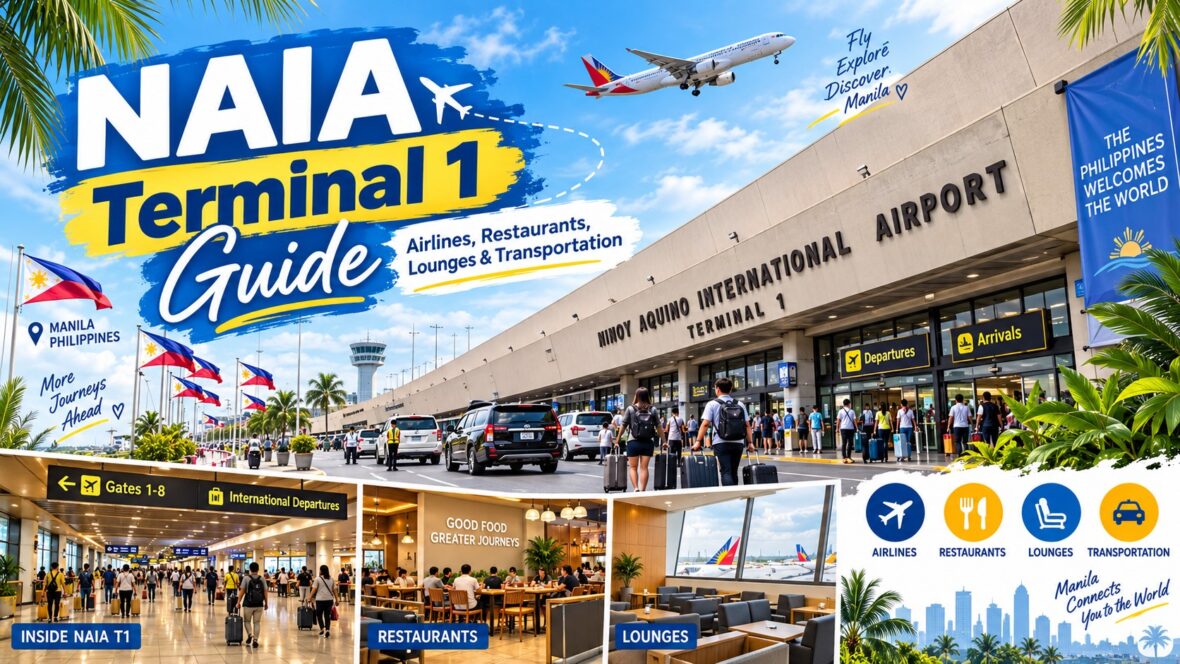
NAIA Terminal 1 has been around for decades, but if you haven’t flown from here recently, don’t assume that everything is still the same.
Airlines have moved between terminals, new restaurants and lounges have opened, the arrivals curbside has been reorganized, and the overall passenger experience has gradually changed as NAIA continues its modernization program.
Terminal 1 is now primarily an international terminal. It is the main international terminal of Philippine Airlines, while several other foreign carriers also operate here. AirAsia’s international flights are also assigned to Terminal 1, while its domestic flights use Terminal 2. NAIA’s official airline directory should always be your final reference because terminal assignments can still change.
If you’re flying internationally from Manila, arriving from abroad, meeting someone at the airport or transferring between terminals, here’s a practical guide to NAIA Terminal 1.
Content
Where Is NAIA Terminal 1?
NAIA Terminal 1 is on the Parañaque side of the Ninoy Aquino International Airport complex.
Unlike Terminal 3, which sits beside Newport City and has Runway Manila, Terminal 1 is more isolated from major commercial areas. That means most passengers arrive and leave by private vehicle, Grab or other accredited transport services.
Terminal 1 handles international flights only in the current NAIA setup, so if you’re flying domestically, your flight should normally be at Terminal 2 or Terminal 3 depending on your airline.
And this is important: Terminal 1, Terminal 2 and Terminal 3 are separate buildings. You cannot simply walk through an indoor corridor from one terminal to another.
Airlines at NAIA Terminal 1
This is one section worth checking every time you travel because NAIA’s terminal assignments have changed considerably.
As of September 2026, NAIA’s official airline directory lists the following airlines at Terminal 1.
| Airline | Code |
|---|---|
| Air Niugini | PX |
| Asiana Airlines | OZ |
| China Airlines | CI |
| EVA Air | BR |
| Korean Air | KE |
| Kuwait Airways | KU |
| Malaysia Airlines | MH |
| Oman Air | WY |
| Saudia | SV |
| Xiamen Air | MF |
| AirAsia Berhad | AK |
| VietJet Air | VJ |
| Air India | AI |
| Bamboo Airways | QH |
| China Central Airlines | I9 |
| Philippines AirAsia | Z2 |
| Philippine Airlines | PR |
The biggest airline presence here is Philippine Airlines.
PAL’s international services generally operate from Terminal 1, while its domestic services use Terminal 2. For example, NAIA’s September 2026 flight tracker shows PAL international flights such as Manila–Vancouver departing from Terminal 1 and international arrivals such as Hong Kong–Manila and Guam–Manila using Terminal 1.
AirAsia Terminal Assignment
This is another one that can confuse travelers.
AirAsia’s international flights now use Terminal 1, while domestic Philippines AirAsia flights operate from Terminal 2.
So if you’re flying AirAsia to somewhere like Kuala Lumpur or another international destination, don’t automatically go to Terminal 2 simply because you’ve taken an AirAsia domestic flight from there before.
Check your boarding pass.
Always Confirm Your Terminal Before Going to NAIA
Even with the airline list above, I would still make this part of your routine before every flight.
Open your airline app, check your booking confirmation or use NAIA’s official flight tracker.
This is especially important if you’re flying on a codeshare ticket. The airline printed on your ticket may not necessarily be the airline actually operating the aircraft.
And because Manila traffic can easily add an hour or more to your trip, discovering that you’re at the wrong terminal is not a mistake you want to make at the last minute.
What Is Inside NAIA Terminal 1?
Terminal 1 is smaller and more compact than Terminal 3.
For many travelers, that’s actually an advantage. Once you’ve checked in and passed through immigration and security, the walk to your gate is generally manageable.
The main areas you’ll encounter include:
- Level 1 – arrivals and ground transportation
- Level 2 – arrival facilities and some airside establishments
- Level 3 – international departures, check-in and most passenger facilities
- Level 4 – Philippine Airlines lounge area
The international boarding area is divided into East and West concourses.
There are shops, duty-free outlets, cafés, restaurants and several airport lounges once you’re inside the restricted departure area.
Restaurants at NAIA Terminal 1
Terminal 1 does not have a massive food hall like Terminal 3, but the selection has improved.
More importantly, you now have food choices both before and after immigration.
According to NAIA’s current dining directory, Terminal 1 has restaurants, cafés and snack counters across the arrivals area, public departure area and international pre-departure zones.
Restaurants Around the Arrivals Area
If you’ve just landed at Terminal 1 — or you’re waiting for someone to arrive — several restaurants are available around the Level 1 arrivals curbside.
Current establishments include:
- Chick N Juicy
- Chowking
- Kenny Rogers Roasters
- McDonald’s
Chick N Juicy, Chowking and McDonald’s are currently listed as operating 24 hours. Kenny Rogers Roasters is listed from 7:00 AM until 1:00 AM.
Having these restaurants outside the restricted area is useful if you’re meeting relatives or friends because you don’t need a boarding pass to eat there.
There is also an Air Cargo Food Kiosk around Parking B and Anika in the basement area, both currently listed as operating 24 hours.
Food Before Immigration
If you’re departing but haven’t passed immigration yet, Jollibee and Master Siomai are located on Level 3 in the public-side departure area.
Both are currently listed by NAIA as operating 24 hours.
This is worth remembering if you’re traveling with family members who aren’t flying.
You can still have a meal together before saying goodbye.
Restaurants After Immigration and Security
Once you’re airside, there are more options around the concourses.
The current NAIA directory lists establishments including:
- Starbucks
- Subway
- Ka Tunying
- Café Express Illy
- Casa Daza
- D’Food Market
- Piazza Café & Bar
- Banh Mi Kitchen
- Le Amoretto
- Nono’s Comfort Kitchen & Bakery
- Little Flour
Several of these — including Starbucks, Subway, Ka Tunying, D’Food Market, Piazza Café & Bar, Café Express Illy and Le Amoretto — are listed as operating 24 hours.
That’s particularly helpful for the many Terminal 1 flights departing late at night or very early in the morning.
Still, restaurant hours can change, so I wouldn’t count on one specific café being open until you’ve checked.
Shopping and Duty Free at Terminal 1
Terminal 1 also has quite a few places where you can pick up snacks, souvenirs or last-minute travel necessities.
NAIA currently lists Duty Free outlets on Levels 2 and 3, together with Travel Free Shop, Philippine Souvenirs, Philippine Treasures, Regalo by Angelique, Island Souvenir and several convenience stores.
There are also Big Sky counters for pocket Wi-Fi and SIM services.
For arriving international passengers, the Level 2 Duty Free and Travel Free Shop locations are currently listed as operating 24 hours.
NAIA Terminal 1 Lounges
Terminal 1 is actually one of the better NAIA terminals when it comes to lounge choices.
As of August 25, 2026, NAIA officially lists five lounge facilities at Terminal 1:
| Lounge | Location | NAIA-listed hours |
|---|---|---|
| PAL Lounge | Level 4, Pre-Departure | 24 hours |
| A Lounge | East Concourse | 24 hours |
| PAGSS Lounge | East Concourse | 24 hours |
| Marhaba Lounge | West Concourse | 24 hours |
| OFW Lounge | Level 3, Departure Area | 24 hours |
Access rules are different for each lounge, so don’t assume that simply having a premium credit card or business-class ticket will get you into every one.
Philippine Airlines Mabuhay Lounge
The PAL Mabuhay Lounge is Philippine Airlines’ flagship international lounge at Terminal 1.
It is intended primarily for eligible Philippine Airlines Business Class passengers and qualifying Mabuhay Miles elite members. PAL also sells myPAL Lounge access for eligible travelers.
As of 2026, PAL lists advance lounge access at Terminal 1 for ₱2,850 per person, with entry available beginning three hours before the scheduled departure time.
If you’re buying access specifically for the lounge, verify eligibility first because availability can depend on the flight and lounge capacity.
PAGSS Premium Lounge
PAGSS is another popular option, particularly for passengers who receive airport lounge access through a credit card or membership program.
Priority Pass currently lists the Terminal 1 PAGSS Premium Lounge as open 24 hours and located airside in the East Concourse beside Gate 2.
Priority Pass members are generally limited to a maximum three-hour stay under its current program rules.
Access arrangements with banks and airlines can change, so check your card’s benefits rather than assuming an old lounge-access perk is still active.
Marhaba Lounge
Marhaba Lounge is on the West Concourse near Gate 9.
NAIA’s own directory lists the facility as operating 24 hours, while Priority Pass currently shows member access from 7:00 AM to midnight. In other words, the lounge itself may operate longer than the access window offered by a particular lounge program.
That’s a small detail but an important one if your flight departs in the middle of the night.
EVA Air also identifies both PAGSS and Marhaba as lounge facilities available for eligible passengers at Terminal 1.
A Lounge
A Lounge is located in the East Concourse.
NAIA currently lists it as a 24-hour lounge.
Like PAGSS and Marhaba, entry can depend on airline arrangements, lounge memberships and eligible payment cards.
Because these partnerships change frequently, check your bank or lounge membership app on the day you’re traveling.
OFW Lounge
One of the most useful facilities at Terminal 1 is the OFW Lounge.
It is located on Level 3 in the departure area and is listed as open 24 hours.
The lounge is intended for departing Overseas Filipino Workers, providing them with a more comfortable area to wait before their flights.
If you’re an OFW flying out of Terminal 1, check the eligibility requirements when you arrive before paying for a commercial lounge.
Arriving at NAIA Terminal 1
If you’re arriving on an international flight, you’ll proceed through immigration before collecting your baggage and clearing customs.
Terminal 1 is among the NAIA terminals equipped with newer biometric immigration e-gates. NNIC says 78 biometric immigration e-gates have been deployed across Terminals 1 and 3 as part of the airport modernization program.
Once you leave customs, you’ll reach the arrivals area where transportation services and pickup zones are located.
Grab and Ride-Hailing From Terminal 1
Grab remains one of the easiest options for many arriving passengers.
The important thing is to follow the pickup location shown in your app rather than simply waiting outside any door.
NAIA’s transport system has been reorganized, and passengers at Terminals 1 and 2 are instructed to use official accredited services and designated ride-hailing pickup points. Grab and JoyRide Super Taxi are among the accredited TNVS services identified by the airport operator.
The Terminal 1 arrivals curbside was also reconfigured so private cars, ride-hailing vehicles and official transport services can be separated more efficiently.
Airport traffic arrangements can still shift while construction continues, so follow the signs you see after exiting customs.
Private Vehicle Pickup
One convenient change at Terminal 1 is that the main arrivals curbside is no longer restricted only to VIP passengers.
NNIC opened it to all passengers as part of the reorganization of the Terminal 1 pickup system.
This makes it easier if a family member or friend is picking you up.
My suggestion is to agree on a specific bay or pickup area before the driver reaches the terminal. Mobile signal and traffic congestion can make the typical “I’m outside, where are you?” conversation surprisingly stressful.
Taxis at Terminal 1
Be careful with taxis offered informally by drivers or people approaching you inside the airport.
NNIC specifically advises passengers to use accredited transport providers.
According to the airport operator, ordinary metered taxis may enter NAIA for drop-offs but are not authorized to solicit or accept passengers at the airport. Official airport transport booths and designated accredited services should be used instead.
If someone approaches you offering a ride for a fixed cash price, you don’t have to accept it.
Use the official transport counters or book through a recognized ride-hailing app.
UBE Express and Public Airport Bus
For travelers trying to save money, UBE Express remains useful — but the 2026 setup is slightly different from what older blogs may show.
As of August 2026, the main UBE Express routes operating at NAIA were:
- NAIA–PITX
- NAIA–Robinsons Santa Rosa
UBE Express also operates a paid NAIA Loop connecting the airport terminals. The published fare was ₱50 per person as of August 2026, with service generally running from 4:00 AM to 8:00 PM.
One important detail: Terminal 3 is the primary outbound pickup point for the longer UBE routes.
So if you’re at Terminal 1 and want to use UBE Express to PITX, you may need to use the airport loop to Terminal 3 and transfer there depending on the current route arrangement.
Schedules have changed frequently, so check the latest UBE Express schedule before relying on it.
For passengers traveling onward to Cavite, Batangas, Quezon, Bicol and other destinations south of Metro Manila, PITX can be a useful transfer point because of its extensive provincial bus network. PITX also connects with the LRT-1 extension.
How to Transfer From Terminal 1 to Terminal 2 or Terminal 3
NAIA’s terminals are separate.
There is no airside train linking them and no indoor walkway connecting Terminal 1 with Terminals 2 and 3.
For passengers with legitimate connecting flights, NAIA provides free inter-terminal shuttle buses.
NNIC states that these buses run approximately every 15 minutes on a continuous loop throughout the day.
At Terminal 1, shuttle services operate from the arrivals area.
If you’re transferring, show your onward booking or boarding pass if requested and ask airport staff where to board.
Give Yourself Plenty of Time
This is especially important.
A terminal transfer at NAIA is not the same as changing gates inside Singapore Changi, Hong Kong or Doha.
You may need to:
collect your luggage,
clear immigration and customs,
wait for transportation,
drive through airport traffic,
check in again,
drop your baggage,
pass security,
and go through immigration again.
If your tickets were booked separately, the risk is even greater because the second airline may have no obligation to rebook you if you miss the connection.
I would never schedule a tight self-transfer between NAIA terminals.
Departing From NAIA Terminal 1
Because Terminal 1 handles international flights, arriving around three hours before departure remains a sensible target.
NAIA itself advises travelers to arrive around three hours before international flights.
During Christmas, Holy Week, long weekends and other peak travel periods, I would add even more time.
After entering Terminal 1, you’ll normally go through:
airline check-in,
travel tax requirements if applicable,
immigration,
final security screening,
and then the international pre-departure area.
Keep checking the flight information screens once you’re airside.
NAIA has been moving toward a “quiet terminal” concept, meaning passengers are increasingly expected to monitor digital flight information displays instead of relying only on repeated boarding announcements.
Is NAIA Terminal 1 Open 24 Hours?
Terminal 1 handles flights throughout the day and night, and several passenger facilities operate around the clock.
NAIA currently lists the PAL Lounge, A Lounge, PAGSS Lounge, Marhaba Lounge and OFW Lounge as 24-hour facilities.
Many restaurants are also listed as open 24 hours, including McDonald’s, Chowking, Jollibee, Starbucks, Subway and several airside cafés and snack counters.
Still, individual counters may temporarily close or change operating hours.
NAIA Terminal 1 vs Terminal 3
If you’ve mostly used Terminal 3 lately, Terminal 1 feels quite different.
Terminal 3 is larger, newer and has more commercial space, including large food halls and direct pedestrian access to Newport City.
Terminal 1 is smaller and more straightforward.
Personally, the main advantage of Terminal 1 is that you don’t have to walk nearly as far once you’re through immigration. On the other hand, there are fewer restaurants and shopping options compared with Terminal 3.
Terminal 1 does have one major strength: lounges.
With PAL Mabuhay Lounge, PAGSS, Marhaba, A Lounge and the OFW Lounge, passengers actually have quite a few places to wait comfortably before an international flight.
Quick Tips for Using NAIA Terminal 1
The most important thing is to check your terminal before leaving home. Philippine Airlines operates international flights from Terminal 1 but domestic flights from Terminal 2, and AirAsia also uses different terminals depending on whether you’re flying domestically or internationally.
Arrive early, particularly if you’re checking baggage.
If you’re using Grab, follow the pickup point shown inside the app rather than listening to anyone offering an unofficial ride.
If you’re connecting to another NAIA terminal, build a large buffer into your itinerary.
And if you have lounge access through your credit card, check the benefit before your flight because lounge partnerships and guest rules can change.

Final Thoughts
NAIA Terminal 1 may be the oldest of Manila’s major international passenger terminals, but the experience today is different from what many travelers remember.
There are more restaurant choices, multiple 24-hour lounges, improved passenger-processing technology and a reorganized arrivals and transportation system.
It is also becoming increasingly important to understand NAIA’s terminal setup. Philippine Airlines international flights, AirAsia international services and a number of major Asian and Middle Eastern airlines use Terminal 1, while domestic flights are concentrated elsewhere.
So before heading to the airport, remember three things: confirm your terminal, arrive early and know how you’re leaving the airport once you land.
Do that, and navigating NAIA Terminal 1 becomes much easier.