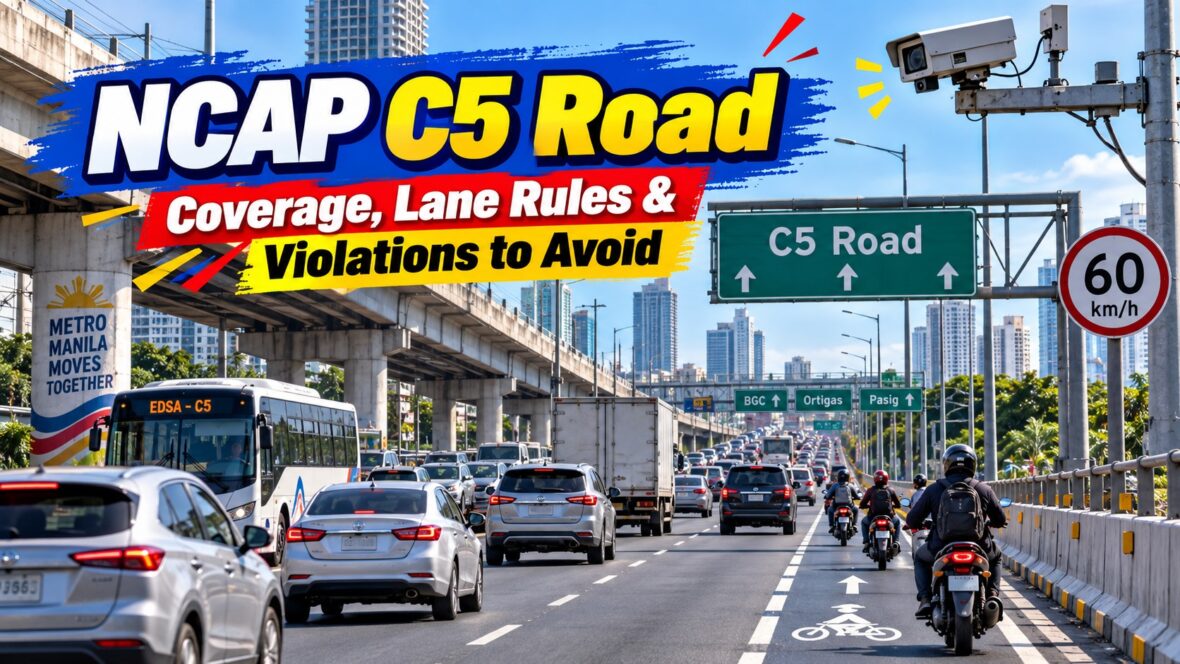
If you regularly drive along C5 Road in Metro Manila, you’ve probably noticed how challenging it can be to navigate the highway, especially during rush hour. Between the motorcycles, delivery trucks, buses, private vehicles, and motorists switching lanes to reach their exits, there’s always something happening along this busy road.
And with the implementation of the No Contact Apprehension Policy (NCAP), drivers now have another important reason to pay attention to traffic signs and road markings.
The Metropolitan Manila Development Authority (MMDA) has included C5 among the major Metro Manila thoroughfares covered by its camera-based traffic enforcement system.
This means traffic violations can be recorded without a traffic enforcer physically stopping your vehicle.
But what exactly are the traffic rules along C5? Where are the NCAP cameras located? Are motorcycles required to stay in designated lanes? What about the speed limit, truck restrictions, and illegal U-turns?
More importantly, how can you check whether your vehicle already has an NCAP violation?
Whether you’re traveling from Quezon City to BGC, driving through Pasig, or taking C5 to reach Taguig, this guide covers the important things motorists should know about NCAP on C5 Road, including the latest updates, camera coverage, traffic rules, violation checking, payments, and appeals.
Content
Is NCAP Active on C5 Road in 2026?
Yes. As of October 19, 2026, C5 Road remains among the major thoroughfares officially covered by the MMDA’s No Contact Apprehension Policy.
The MMDA resumed its NCAP operations on May 26, 2025, after the Supreme Court partially lifted the temporary restraining order that had prevented camera-based enforcement.
C5 was specifically included in the agency’s list of covered circumferential roads.
The MMDA’s published coverage includes the following C5 corridors:
- C.P. Garcia Avenue
- Katipunan Avenue
- Tandang Sora Avenue
These roads form part of the C5 network connecting different areas of Metro Manila.
The important thing to understand is that NCAP coverage does not necessarily mean cameras are installed at every intersection or that every CCTV camera is being used to issue traffic tickets.
However, motorists traveling along MMDA-covered portions of C5 should expect traffic regulations to be enforced through authorized camera systems.
The program operates without requiring traffic officers to physically apprehend motorists at the time of a violation.
This means you could commit a traffic offense, complete your trip, and only discover the recorded violation afterward.
Latest NCAP C5 Road Updates
NCAP has undergone several significant developments in recent years.
Here’s a quick look at the changes affecting motorists along C5.
August 2022: Supreme Court Issues NCAP Restraining Order
The Supreme Court issued a temporary restraining order affecting the implementation of NCAP by several Metro Manila local government units.
The order followed legal challenges involving due process, vehicle-owner responsibility, and other questions about the earlier city-level programs.
May 26, 2025: MMDA Resumes NCAP Enforcement
The MMDA resumed camera-based enforcement on major circumferential and radial roads, including C5.
The agency said violations detected through its camera system would undergo review by authorized personnel before a Notice of Violation was issued.
During the first day of implementation, the MMDA recorded more than 1,100 traffic violations across its covered roads.
Among the commonly recorded offenses were disregarding traffic signs, improper use of motorcycle lanes, and violations involving loading and unloading areas.
June 2025: Motorcycle Lane Clarification
The MMDA announced that motorcycles with engine displacements of 400cc and above would no longer be required to stay in designated motorcycle lanes.
However, the agency maintained its prohibition against lane splitting.
This clarification is particularly relevant to C5, which has designated motorcycle lanes along sections of the highway.
July 2026: Supreme Court Dismisses NCAP Petitions
On July 9, 2026, the Supreme Court announced its decision dismissing consolidated petitions challenging earlier NCAP ordinances.
The decision was promulgated on June 3, 2026.
The Court said the issues raised had been overtaken by the adoption of the Metro Manila Traffic Code of 2023, which provides a more uniform traffic enforcement framework.
The Court also lifted the remaining restraining order affecting the local government programs.
However, it clarified that dismissing the petitions did not amount to a declaration that all the previously questioned NCAP provisions were constitutional.
October 2026: Local NCAP Programs Resume
Several Metro Manila cities announced the resumption of their local NCAP programs beginning October 5, 2026.
These included Quezon City, Manila, Muntinlupa, Parañaque, and San Juan.
Meanwhile, MMDA enforcement on major roads such as C5 continued separately.
The MMDA also coordinated with local governments to prevent overlapping enforcement cameras and duplicate citations.
For C5 motorists, the important distinction is that MMDA NCAP already covers the highway, while separate local government programs may apply to designated city-controlled intersections.
Where Are the NCAP Cameras Along C5 Road?
This is one of the most frequently asked questions about NCAP.
Unfortunately, there is no publicly verified comprehensive list showing the exact location of every operational MMDA NCAP camera along C5.
In fact, the MMDA previously warned motorists about a viral list circulating online that supposedly identified the locations of NCAP cameras throughout Metro Manila.
The agency clarified that the list was fake and had not been officially released.
So, if you see a social media post claiming there’s an NCAP camera at a particular traffic light, pedestrian crossing, or elevated roadway along C5, don’t immediately assume the information is accurate.
What we can confirm is the road coverage officially announced by the MMDA.
1. C.P. Garcia Avenue
Carlos P. Garcia Avenue is one of the main sections commonly associated with C5.
It passes through important commercial and residential areas, including portions of Pasig and Taguig.
Motorists use this road to reach destinations such as:
- Bonifacio Global City
- Market! Market! and surrounding commercial areas
- McKinley Hill
- Bagong Ilog
- Ugong and nearby parts of Pasig
- The Ortigas Avenue and C5 interchange area
These locations are major destinations or access areas connected to the C5 corridor.
However, this is not an official list of NCAP camera positions.
Drivers should pay attention to lane markings, traffic signals, road signs, and restrictions throughout the covered road.
2. Katipunan Avenue
Katipunan Avenue is another major part of the C5 corridor.
It passes through portions of Quezon City, connecting important roads and destinations in the northeastern part of Metro Manila.
Some of its notable landmarks and connections include:
- Ateneo de Manila University
- Miriam College
- UP Town Center
- Aurora Boulevard
- Marcos Highway
- Major roads connecting to Libis and neighboring communities
Because Katipunan serves schools, residential neighborhoods, commercial establishments, and major intersections, motorists should be especially careful near pedestrian crossings, access roads, and traffic signals.
3. Tandang Sora Avenue
The MMDA also includes Tandang Sora Avenue among the named roads under its C5 NCAP coverage.
Motorists traveling through applicable sections should observe posted traffic restrictions and official road markings.
Like other portions of C5, camera enforcement coverage does not establish that every intersection contains an active NCAP device.
Is the Entire C5 Road Covered?
C5 is a broader road network made up of several connected roads, bridges, and extensions.
The MMDA’s published NCAP list specifically identifies C.P. Garcia Avenue, Katipunan Avenue, and Tandang Sora Avenue.
This should not be interpreted as confirmation that every road carrying the C5 name, including toll expressway extensions and connecting local roads, operates under the same camera system.
For example, C5 Southlink Expressway is a separate toll expressway facility with its own traffic and access regulations.
Motorists should identify the particular road they’re using and follow the authority responsible for that section.
How Does NCAP Work on C5 Road?
NCAP uses CCTV cameras, digital imaging systems, and other technologies to detect and document possible traffic violations.
Instead of stopping vehicles along the road, the MMDA reviews recorded evidence and issues a notice through its administrative enforcement process.
Here’s how it generally works.
Step 1: A Possible Violation Is Recorded
A traffic camera captures a vehicle allegedly committing an offense.
This might involve disregarding a traffic signal, violating a lane restriction, making a prohibited turn, or another offense that the available camera evidence can establish.
Step 2: MMDA Personnel Review the Evidence
The MMDA has clarified that its NCAP system does not automatically issue tickets simply because artificial intelligence identifies suspicious vehicle movements.
Authorized personnel manually review recorded violations before citations are issued.
Step 3: The Vehicle Is Identified
The vehicle’s plate number is checked against available registration information.
The registered vehicle owner is identified through the appropriate records.
Step 4: A Notice of Violation Is Issued
If the evidence supports an apprehension, a Notice of Violation may be issued to the registered vehicle owner.
The notice contains information about the alleged violation, applicable penalty, and the procedure for settlement or contesting the citation.
Step 5: The Vehicle Owner Reviews the Notice
The recipient may review the violation and follow the appropriate payment or contest procedure.
The MMDA’s online system also provides access to available photo or video evidence.
The key point is that you don’t need to be stopped on C5 to receive an NCAP ticket.
Traffic Violations to Avoid on C5 Road
While NCAP can help authorities document traffic offenses, motorists should remember that not every traffic regulation is necessarily enforced through every camera.
Detection depends on the equipment, evidence, and applicable enforcement rules.
Here are the important violations drivers should avoid along C5.
1. Disregarding Traffic Signs
Ignoring traffic signs is one of the common offenses recorded through NCAP.
Examples include entering a prohibited road, disregarding a no-left-turn sign, using an unauthorized U-turn opening, or violating a lane restriction.
C5 has numerous intersections and access roads where signs determine which movements are allowed.
Even if there are no traffic officers nearby, always follow the posted restrictions.
2. Motorcycle Lane Violations
C5 has designated motorcycle lanes intended to organize traffic and reduce motorcycle-related accidents.
Under the established lane regulations, motorcycle riders covered by the lane rules are expected to use the designated lane unless an authorized maneuver or other applicable exception permits them to leave.
Drivers should also observe current signs and lane markings, especially where road configurations have changed.
3. Illegal U-Turns
C5 has several intersections and access points where motorists need to turn or make U-turns.
However, not every opening is a legal U-turn slot.
Drivers should avoid making unauthorized U-turns or crossing road barriers and prohibited lane markings.
4. Beating the Red Light
Disregarding a red traffic signal can create dangerous situations, particularly where vehicles are entering C5 from a side road.
Always stop as required by the traffic signal.
An NCAP camera may document the movement even when there is no traffic officer directing vehicles at the intersection.
5. Illegal Lane Changes
C5 has sections where vehicles merge from service roads, intersections, elevated ramps, and commercial access points.
Abruptly cutting across multiple lanes can create serious safety risks.
Motorists should signal early, check mirrors and blind spots, and change lanes only when permitted.
Crossing solid lane markings or violating designated lane restrictions may also constitute a traffic offense.
6. Illegal Loading and Unloading
Stopping in a prohibited area to drop off or pick up passengers can obstruct traffic.
This can be especially problematic near busy commercial districts and intersections.
Public utility vehicles, transport network vehicles, and private cars should only load or unload passengers where permitted.
7. Illegal Parking
Parking along a restricted portion of C5 can interfere with the movement of other vehicles.
Motorists should avoid stopping or parking in no-parking areas, intersections, pedestrian crossings, and other prohibited locations.
8. Overspeeding
C5 is a major Metro Manila road covered by applicable speed regulations.
Drivers exceeding the prescribed limits can face traffic penalties when the offense is established using an authorized enforcement method.
Not every NCAP camera should be assumed to have speed-measuring capability.
9. Reckless Driving
Dangerous maneuvers, aggressive weaving, unsafe overtaking, and other actions that endanger road users can result in traffic apprehension.
Whether a particular reckless-driving allegation can be supported through camera footage depends on the circumstances and applicable legal requirements.
10. Number Coding Violations
C5 is among the major roads where Metro Manila’s Unified Vehicular Volume Reduction Program, commonly known as number coding, applies to covered vehicles.
Motorists should know their assigned restriction day and the relevant operating hours.
Number coding is a separate traffic rule, but a violation may be documented through authorized enforcement methods.
C5 Motorcycle Lane Rules: What Riders Should Know
Motorcycle lane regulations are especially important along C5 because of the large number of riders using the road.
The MMDA established a non-exclusive motorcycle lane along C5 through Resolution No. 12-22, issued in 2012.
The original regulation covered northbound and southbound traffic from East Service Road to Balara.
Unlike an exclusive lane, a non-exclusive motorcycle lane can also be traversed by other vehicles.
This is an important distinction because some riders assume that all motorcycle lanes in Metro Manila are reserved exclusively for motorcycles.
Where Is the Motorcycle Lane on C5?
Under the original MMDA regulation, the designated C5 motorcycle lane was the outermost lane, or the lane nearest the right sidewalk.
However, motorists should also follow current lane markings, road signs, and subsequent official traffic arrangements.
Some areas may have undergone road widening, intersection changes, or traffic reconfiguration.
The 2012 regulation should not be treated as proof that every section of today’s C5 has exactly the same lane layout.
Can Cars Use the C5 Motorcycle Lane?
Yes, the original C5 motorcycle lane was designated as non-exclusive.
This means private cars and other vehicles were not automatically prohibited from using it.
However, all motorists must still follow applicable lane signs, traffic markings, and any more recent restrictions.
A road segment marked as exclusively reserved for another category of vehicle must be treated according to its current designation.
Can Motorcycles Use Other Lanes?
Under the original lane regulation, motorcycles and scooters were generally required to remain in their designated lane except when making authorized turns, U-turns, or responding to emergencies.
Riders were also required to make gradual lane changes without swerving.
The regulation provided for advance lane positioning when preparing for a turn or U-turn.
However, riders should comply with the MMDA’s more recent guidance and the specific markings applicable to the road section.
What About Big Bikes?
In June 2025, the MMDA announced that motorcycles with engine displacements of 400cc and above would no longer be required to stay in motorcycle-designated lanes on major Metro Manila roads.
This allows qualifying large-displacement motorcycles to use general vehicle lanes, subject to applicable traffic regulations.
However, lane splitting remains prohibited under the MMDA’s announced policy.
Riders should still avoid unsafe weaving and sudden lane changes.
How Much Is the Motorcycle Lane Fine?
MMDA Resolution No. 12-22 originally specified a ₱500 penalty for violations of its C5 motorcycle lane provisions.
However, motorists should verify the currently applicable penalty under the Metro Manila Traffic Code of 2023 and the specific offense listed on a Notice of Violation.
Older lane regulations should not be used as the sole basis for calculating a current NCAP fine.
What Is the Speed Limit on C5 Road?
Under MMDA speed regulations for major Metro Manila roads, the general maximum speed limits are:
| Vehicle type | General maximum speed |
|---|---|
| Private cars | 60 km/h |
| Motorcycles | 60 km/h |
| Buses | 50 km/h |
| Trucks | 50 km/h |
MMDA Regulation No. 19-001 established the 60-kph maximum for applicable vehicles along major circumferential and radial roads, including C.P. Garcia Avenue.
MMDA Regulation No. 17-003 separately established a 50-kph maximum for buses and trucks on covered major roads.
These limits should be treated as maximum speeds, not target speeds that motorists must maintain.
Drivers are required to slow down whenever road conditions make the maximum speed unsafe.
For example, a lower speed may be necessary because of heavy traffic, approaching intersections, road construction, poor visibility, or pedestrians.
If a specific road segment has a lawfully posted lower speed limit, follow that restriction.
Also, do not assume that every NCAP camera on C5 is a speed camera. An allegation of speeding must be supported by evidence obtained through an appropriate authorized enforcement method.
Are Trucks Allowed on C5 Road?
Yes, trucks may use permitted sections of C5, subject to applicable truck bans, vehicle restrictions, and traffic regulations.
C5 is an important route for commercial vehicles and logistics operations within Metro Manila.
However, large trucks are subject to various restrictions intended to manage congestion and improve road safety.
These can include designated truck routes, restrictions during certain hours, and local rules affecting specific roads and business districts.
Not every section of the C5 network necessarily follows an identical truck restriction schedule.
Truck operators should verify the current MMDA and relevant local government advisories before scheduling trips, particularly during peak travel periods.
Truck drivers should also comply with the applicable 50-kph maximum speed on covered major roads and obey posted lane restrictions.
Are E-Bikes and E-Trikes Allowed on C5?
No. Certain light electric vehicles, particularly e-trikes, are prohibited from using C5 and other specified major Metro Manila roads under the restrictions being enforced in 2026.
The Land Transportation Office began enforcing the prohibition on January 2, 2026, including restrictions on C5, EDSA, and Roxas Boulevard.
The measure targets specified light electric vehicles that are not permitted to operate on these major thoroughfares.
Violators may face penalties and possible impounding, depending on the vehicle classification and circumstances.
It’s important to distinguish these restrictions from the NCAP program.
The electric vehicle restrictions are traffic regulations in their own right, and enforcement may also involve LTO officers and other authorized personnel.
Is There Number Coding on C5 Road?
Yes. C5 is included in Metro Manila’s number coding system for covered vehicles.
As of October 2026, the standard MMDA coding hours on covered major roads are:
- Morning: 7:00 AM to 10:00 AM
- Evening: 5:00 PM to 8:00 PM
- Days: Monday to Friday, excluding applicable holidays
The usual window hours between restricted periods allow covered vehicles to travel from 10:01 AM until 4:59 PM.
The coding schedule depends on the last digit of your vehicle’s plate number.
| Day | Restricted plate endings |
|---|---|
| Monday | 1 and 2 |
| Tuesday | 3 and 4 |
| Wednesday | 5 and 6 |
| Thursday | 7 and 8 |
| Friday | 9 and 0 |
Certain categories of vehicles may qualify for exemptions.
Also remember that some local government jurisdictions have separate number coding regulations, so motorists should check the rules when leaving C5 and entering connecting city roads.
How to Check NCAP Violations on C5 Road
If you frequently drive along C5 and want to know whether your vehicle has been recorded committing an MMDA NCAP violation, the easiest way to check is through the agency’s May Huli Ka online system.
The portal allows registered vehicle owners to search for NCAP records and access available violation information.
Step 1: Visit the Official MMDA May Huli Ka Website
Open your browser and go to:
mayhulika.mmda.gov.ph
This is the MMDA’s official NCAP violation checking portal.
Step 2: Prepare Your Vehicle Information
You will need identifying information such as your vehicle’s plate number and Motor Vehicle (MV) File Number.
The MV File Number can be found on your LTO Certificate of Registration.
If you already received a Notice of Violation, you may also use the available ticket-number search option.
Step 3: Enter the Required Details
The MMDA introduced additional search options in August 2026.
Motorists can now search using either:
- Plate number and MV File Number
- Plate number and ticket number
Make sure your information is entered correctly.
A wrong digit or letter may prevent the system from finding the corresponding record.
Step 4: Review Your Violation Record
After submitting your information, the system will display available matching records.
If the portal shows “No Record Found,” it means no matching violation was retrieved using the details provided.
However, this does not automatically guarantee that there is no recently recorded violation awaiting processing.
If you see a violation, review the available details carefully.
Step 5: Examine the Supporting Evidence
The upgraded May Huli Ka portal allows vehicle owners to access available photo or video evidence.
Check the date, time, location, and vehicle involved.
If you believe the violation is incorrect, use the agency’s official contest procedure rather than immediately paying a disputed fine.
Can I Check C5 NCAP Violations Using the eGovPH App?
Yes. The MMDA integrated its NCAP services with the eGovPH Super App in July 2026.
This makes it possible to check available NCAP records using a mobile phone.
Here’s how:
- Download or open the official eGovPH app.
- Sign in to your account.
- Look for the MMDA services section.
- Select the available NCAP verification feature.
- Enter the required vehicle information.
- Review any matching records and available transaction options.
The service is designed to make it easier for motorists to monitor traffic violations and payment information without visiting an MMDA office.
For people who frequently use C5 for work or daily commuting, having this option on a phone can be particularly convenient.
How Much Are NCAP Fines on C5 Road?
There is no single fixed fine for every NCAP violation on C5.
The amount depends on the particular offense and the applicable traffic regulations.
The MMDA uses standardized penalty rules under the Metro Manila Traffic Code of 2023.
Common traffic offenses may include disregarding traffic signs, illegal loading or unloading, illegal parking, lane restrictions, speeding, and number coding violations.
For reference, the MMDA’s published traffic enforcement penalty information in 2025 included the following amounts for selected offenses:
| Offense | Published reference penalty |
|---|---|
| Disregarding traffic signs | ₱150 |
| Number coding violation | ₱500 |
| Prohibited loading or unloading | ₱1,000 |
| Attended illegal parking | ₱1,000 |
| Unattended illegal parking | ₱2,000, with possible impounding |
| Motorcycle lane violation under original C5 rules | ₱500 |
These figures are reference amounts from published enforcement schedules and the earlier C5 lane regulation, not a guarantee of what every citation will cost in October 2026.
The amount and classification of the offense should always be checked against the current applicable rules and the official Notice of Violation.
Motorists should also remember that additional consequences may apply to certain serious offenses.
How to Pay an NCAP Violation on C5 Road
If your NCAP violation was issued by the MMDA, you can begin the payment process through May Huli Ka.
The upgraded portal provides electronic payment options.
Online Payment
First, verify the violation using your plate number and other required information.
Once you’ve confirmed the record, proceed to the available payment section.
Supported payment methods listed in the October 2026 MMDA portal guide include:
- GCash
- Maya
- Visa
- Mastercard
- QR Ph
- GrabPay
The available methods may vary depending on the transaction and payment platform.
Follow the official instructions and save your payment confirmation.
Over-the-Counter Payment
Motorists may also inquire about paying at designated MMDA payment locations.
Before visiting, verify the current office schedule, payment arrangements, and documents required.
Will Unpaid NCAP Fines Affect Vehicle Registration?
Unresolved traffic violations may result in administrative records or flags that could affect vehicle registration renewal.
If you discover an outstanding notice, verify its status and follow the proper settlement or contest procedure.
If you believe the citation was issued incorrectly, consider using the available adjudication process instead of assuming the fine must automatically be paid.
How to Appeal an NCAP Violation on C5 Road
What if you receive a Notice of Violation even though you’re certain you didn’t commit the offense?
Motorists have the right to contest citations through the applicable adjudication procedure.
For MMDA-issued violations, the agency provides an online E-Contest service through May Huli Ka.
The applicable rules generally allow motorists to contest a Notice of Violation within ten working days from receipt.
Common Grounds for Contesting a Violation
A citation may be disputed when supported by appropriate evidence, such as when:
- The camera incorrectly identified the vehicle.
- The plate number doesn’t match your vehicle.
- The alleged offense was not actually committed.
- Traffic officers directed you to make the recorded movement.
- Road markings were unclear or inconsistent with the alleged offense.
- An emergency affected the circumstances.
- The vehicle had already been sold before the incident.
- The vehicle had been stolen or used without authorization.
The outcome depends on the facts and the applicable traffic rules.
Simply claiming that another person was driving does not necessarily eliminate the registered owner’s administrative responsibility.
How to Contest Through May Huli Ka
- Visit the official May Huli Ka portal.
- Sign in or complete the required verification.
- Open the available E-Contest feature.
- Select the violation you want to question.
- Enter your explanation and required information.
- Upload relevant supporting documents.
- Follow the instructions for receiving updates about your case.
The MMDA’s Traffic Adjudication Division handles the contest process.
Motorists who need additional assistance may contact the MMDA hotline at 136.
How to Avoid NCAP Text Message Scams
With the expansion of NCAP, fraudulent messages about traffic violations have also become a concern.
The MMDA has repeatedly warned motorists about scam text messages that pretend to come from the agency.
These messages often claim that a driver has an unpaid traffic fine or an urgent vehicle registration problem.
Some include suspicious payment links or warnings about increasing penalties.
The MMDA has clarified that its legitimate NCAP text notifications use the sender ID:
MMDA_NCAP
Official notifications do not contain payment links, requests for replies, SMS contact numbers, or the registered owner’s name.
The agency has also warned that NCAP fines do not accumulate interest or late-payment penalties in the manner claimed by scammers.
If you receive a suspicious message, don’t click the link.
Instead, open the official May Huli Ka website yourself and verify the record.
MMDA NCAP vs. Local Government NCAP Along C5
Since C5 passes through several Metro Manila cities, motorists should understand which traffic enforcement agency is responsible for a particular violation.
MMDA NCAP
The MMDA is responsible for NCAP enforcement on the major circumferential and radial roads under its jurisdiction, including the identified C5 corridors.
MMDA-issued violations can be verified through May Huli Ka and the eGovPH app.
Local Government NCAP
Some local governments operate their own camera-based traffic enforcement systems under the applicable traffic enforcement framework.
These systems may cover designated city-controlled roads and intersections.
For example, Quezon City announced the return of its local NCAP program in October 2026, with cameras being tested and deployed progressively at selected intersections.
This is separate from the MMDA’s corridor-wide enforcement responsibilities.
Motorists should identify the issuing authority listed on their Notice of Violation before attempting to pay or contest the ticket.
Is NCAP on C5 Operating 24 Hours?
The MMDA implements NCAP as a continuous traffic enforcement program.
This means motorists should not assume that camera-based monitoring is limited to daytime or weekday rush hours.
However, this does not establish that every individual CCTV camera is operating as an NCAP enforcement camera at all hours.
Certain traffic rules also have their own schedules.
For example, number coding restrictions apply during designated periods, while the duty to obey traffic signals, signs, and applicable speed limits is not limited to number coding hours.
The safest approach is to observe traffic laws throughout your journey.
Practical Tips for Driving Along C5 Without Getting an NCAP Violation
C5 is a busy route, and even experienced drivers sometimes find it challenging, particularly when approaching interchanges or moving between lanes.
Here are some simple precautions that can help.
1. Know Your Exit Beforehand
Whether you’re heading to BGC, Ortigas, Katipunan, or another destination, identify your exit early.
Avoid suddenly crossing several lanes because you almost missed a turn.
2. Follow Current Lane Markings
Don’t rely entirely on old road layouts or descriptions of the original motorcycle lane rules.
Check the actual signs and pavement markings.
3. Stay Within the Speed Limit
Remember the general 60-kph maximum for private vehicles and motorcycles on covered sections, and the 50-kph limit for buses and trucks.
Drive slower when road conditions require it.
4. Check Your Number Coding Schedule
Before heading out during rush hour, confirm whether your vehicle is subject to the day’s coding restriction.
5. Avoid Sudden Lane Changes
Signal early, check surrounding traffic, and avoid unsafe weaving.
This is particularly important around intersections and ramps.
6. Use Authorized Loading Areas
Don’t stop in the middle of a lane just to drop off a passenger.
Look for a legal stopping or loading area.
7. Watch for Trucks and Other Large Vehicles
C5 carries many commercial vehicles.
Maintain enough space and avoid remaining unnecessarily in a truck driver’s blind spot.
8. Verify Your NCAP Records Through Official Channels
If you receive a violation notice or simply want to check your record, use May Huli Ka or the official eGovPH app.
Avoid unfamiliar websites and social media payment links.
Frequently Asked Questions About NCAP C5 Road
1. Is NCAP active on C5 Road?
Yes. C5 is included in MMDA NCAP coverage as of October 19, 2026. The agency resumed camera-based enforcement on covered major roads on May 26, 2025.
2. Where are the NCAP cameras on C5?
The MMDA has not publicly released a verified comprehensive list of individual NCAP camera locations. Its announced coverage includes C.P. Garcia Avenue, Katipunan Avenue, and Tandang Sora Avenue.
3. Are all C5 intersections covered by NCAP?
Not necessarily. NCAP coverage of a road does not establish that every intersection has an active enforcement camera. Some CCTV installations may be used for general traffic monitoring.
4. What is the speed limit on C5?
The general maximum speed limit for private vehicles and motorcycles on covered major roads is 60 kph. Buses and trucks are subject to a 50-kph maximum, while lawfully posted lower limits may apply to particular locations.
5. Is the C5 motorcycle lane exclusive?
The original MMDA regulation established a non-exclusive motorcycle lane along C5, meaning other vehicles could also use it. Drivers must still follow current lane signs and road markings.
6. Can big bikes use other lanes on C5?
The MMDA announced in June 2025 that motorcycles with engine displacements of 400cc and above were no longer required to remain in motorcycle-designated lanes. Lane splitting remains prohibited under the agency’s guidance.
7. Can I get an NCAP violation without being stopped?
Yes. NCAP allows authorities to document alleged traffic offenses through camera footage and issue notices without physically stopping the vehicle.
8. How do I check NCAP violations on C5?
For MMDA-issued violations, visit mayhulika.mmda.gov.ph and enter your plate number together with your MV File Number or the available ticket-number information.
9. How do I pay an NCAP fine?
The MMDA’s May Huli Ka portal provides online payment options, including GCash, Maya, Visa, Mastercard, QR Ph, and GrabPay. Verify the official record before paying.
10. Can I appeal an NCAP violation?
Yes. For MMDA-issued notices, motorists may file a contest through the agency’s adjudication process, generally within ten working days from receipt of the Notice of Violation.
11. Is there number coding on C5?
Yes. The standard MMDA coding schedule applies to covered vehicles on C5 during designated morning and evening hours on weekdays, excluding applicable holidays.
12. Are e-trikes allowed on C5?
Specified e-trikes and other restricted light electric vehicles are prohibited from using C5 under the major-road restrictions enforced beginning January 2, 2026.
13. Does NCAP apply to C5 Southlink Expressway?
C5 Southlink Expressway is a separate toll expressway with its own traffic and access regulations. The MMDA’s published NCAP coverage of C5 does not, by itself, establish that the toll expressway uses the same enforcement system.
14. Will my old NCAP violation automatically disappear?
No. The existence of a previous suspension or a new enforcement rollout does not automatically mean every earlier citation has been cancelled. The status of an outstanding notice should be checked with the issuing authority.
15. How do I know whether an NCAP message is legitimate?
The MMDA uses the sender ID MMDA_NCAP for official text notifications. Legitimate alerts do not contain payment links or request personal information through replies. Always verify through the official May Huli Ka portal.

Final Thoughts
C5 is one of Metro Manila’s most important roads, connecting major business districts, residential communities, schools, and commercial areas.
For thousands of motorists, it’s part of their everyday commute.
And because it’s such a busy highway, I can understand why the implementation of NCAP has generated so much attention.
Nobody wants to discover an unexpected traffic fine after a long day of driving.
But more importantly, nobody wants to be involved in an accident because another motorist disregarded traffic rules.
I think the bigger goal of camera-based enforcement should always be road safety, rather than simply increasing the number of traffic tickets.
That means clear road markings, properly maintained traffic signs, fair enforcement, and a reliable process for motorists who need to question an incorrect citation.
For drivers and motorcycle riders using C5, the best thing to do is to familiarize yourself with the rules and pay attention to what’s happening on the road.
Stay within the applicable speed limits, follow lane restrictions, avoid prohibited turns, and keep a safe distance from surrounding vehicles.
And if you receive an NCAP notice, don’t immediately pay through an unfamiliar text message or website.
Verify the record through the official MMDA system, review the evidence, and follow the appropriate payment or contest process.
With a little preparation and responsible driving, navigating C5 can become safer and less stressful.
Latest update: As of October 19, 2026, C5 remains covered by MMDA NCAP. The agency’s published coverage includes C.P. Garcia Avenue, Katipunan Avenue, and Tandang Sora Avenue. Motorists can check MMDA-issued violations through May Huli Ka or the eGovPH app. A verified comprehensive list of individual NCAP camera locations has not been publicly released.