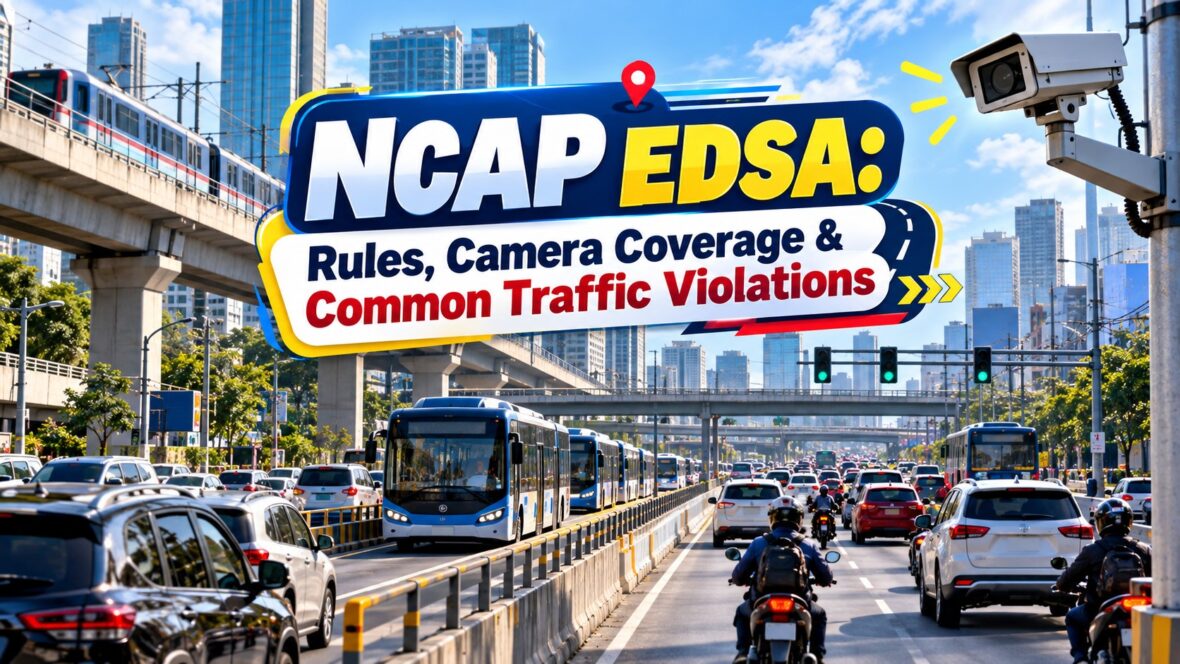
If you regularly drive along EDSA, there’s one thing you should always keep in mind: you don’t need to be stopped by a traffic enforcer to receive a violation ticket.
With the implementation of the No Contact Apprehension Policy (NCAP), traffic violations can now be recorded through surveillance cameras installed along Metro Manila’s busiest highway.
Whether you’re driving through Cubao, Ortigas, Guadalupe, Ayala, or Pasay, you could receive a Notice of Violation even if you didn’t notice any traffic enforcer nearby.
And yes, this applies to both private cars and motorcycles.
The Metropolitan Manila Development Authority (MMDA) resumed NCAP enforcement along EDSA and other major Metro Manila roads on May 26, 2025, following the Supreme Court’s partial lifting of the temporary restraining order that had previously suspended the program.
In 2026, NCAP remains an important part of the MMDA’s efforts to improve traffic enforcement and road safety.
But how exactly does NCAP work along EDSA? Where are the cameras located? What traffic violations can they detect? And how much are the penalties?
Here’s a comprehensive guide to NCAP EDSA, including camera coverage, traffic rules, common violations, fines, and how to check whether your vehicle has been recorded.
Content
What Is NCAP on EDSA?
NCAP stands for No Contact Apprehension Policy, also commonly called the No Contact Apprehension Program.
It’s a traffic enforcement system that uses CCTV cameras, digital cameras, and other monitoring technologies to detect and record vehicles violating traffic regulations.
Unlike traditional traffic apprehension, where a traffic enforcer physically stops your vehicle and issues a ticket, NCAP allows authorities to document the alleged violation remotely.
For example, imagine you’re driving along EDSA and accidentally make an illegal turn.
You might think nothing happened because no traffic enforcer flagged you down.
However, if an NCAP camera captured the incident, the MMDA may review the footage and issue a Notice of Violation to the registered vehicle owner.
The system can record important details such as the vehicle’s plate number, location, date, time, and the circumstances of the alleged violation.
It’s also worth noting that NCAP doesn’t rely entirely on artificial intelligence.
The MMDA has explained that violations detected by its cameras, including AI-assisted equipment along EDSA, are reviewed by authorized personnel before citations are issued.
This additional review is intended to help prevent motorists from being incorrectly penalized.
Is NCAP Active on EDSA in 2026?
Yes. NCAP is active along EDSA in 2026 under the Metropolitan Manila Development Authority.
The MMDA officially resumed enforcement on May 26, 2025, after the Supreme Court partially lifted the temporary restraining order affecting NCAP implementation.
The program had previously been suspended in August 2022 following legal challenges questioning aspects of its implementation.
There was another important development in 2026.
On July 9, 2026, the Supreme Court publicly announced its decision dismissing the consolidated petitions challenging NCAP ordinances in several Metro Manila cities.
The Court cited the adoption of the Metro Manila Traffic Code of 2023, which introduced a unified traffic enforcement framework, together with procedural grounds for dismissing the cases.
The remaining temporary restraining order was also lifted.
However, the decision did not declare that all previously challenged NCAP ordinances were constitutional.
For EDSA motorists, the important distinction is that the MMDA’s NCAP enforcement had already resumed in May 2025.
The October 5, 2026 resumption of NCAP by several local governments was a separate development.
NCAP EDSA Camera Coverage: Which Areas Are Monitored?
EDSA, officially known as Epifanio de los Santos Avenue, is one of the major thoroughfares covered by the MMDA’s NCAP.
It forms part of Circumferential Road 4, or C-4, in Metro Manila.
The MMDA’s coverage includes major circumferential and radial roads under its jurisdiction, with EDSA serving as one of its most important monitored corridors.
Major EDSA Sections Covered by the NCAP Enforcement Area
The following are familiar sections and landmarks along EDSA that fall within the highway’s MMDA enforcement corridor.
| EDSA Section | Major Landmarks and Intersections |
|---|---|
| Monumento, Caloocan | Monumento Circle and northern EDSA approaches |
| Balintawak, Quezon City | Balintawak interchange and nearby road connections |
| North Avenue, Quezon City | SM North EDSA, North Avenue and West Avenue |
| Quezon Avenue, Quezon City | Quezon Avenue intersection and nearby MRT stations |
| Kamuning, Quezon City | Kamuning and Timog Avenue approaches |
| Cubao, Quezon City | Aurora Boulevard, Araneta City and Cubao underpasses |
| Santolan and Ortigas area | Santolan Road, White Plains and Ortigas Avenue approaches |
| Shaw Boulevard, Mandaluyong | Shaw intersection and nearby commercial areas |
| Boni Avenue, Mandaluyong | Boni MRT station and connecting roads |
| Guadalupe, Makati | Guadalupe Bridge, Guadalupe MRT and nearby approaches |
| Buendia and Ayala, Makati | Gil Puyat Avenue, Ayala Avenue and nearby intersections |
| Magallanes, Makati | Magallanes Interchange and expressway connections |
| Pasay section | Taft Avenue and Roxas Boulevard approaches |
This table identifies major sections of the covered EDSA corridor. It is not an official list of individual camera locations, and it should not be interpreted as confirmation that every listed intersection has a dedicated NCAP camera.
Are There NCAP Cameras Along the Entire EDSA?
EDSA is included in the MMDA’s NCAP enforcement network, but that doesn’t mean cameras are positioned at every intersection or that every meter of the highway is under continuous camera observation.
In June 2025, GMA News reported that 162 cameras were installed along the EDSA corridor, with another 21 cameras monitoring the EDSA Bus Carousel.
These were reported figures from June 2025, not a newly verified inventory for October 2026. Equipment numbers and operational locations may have changed since then.
The MMDA has also made an important clarification regarding camera locations.
In June 2025, the agency warned that lists circulating on social media claiming to identify specific NCAP camera locations were not official.
The MMDA said it had not released an official camera-by-camera location list.
So, if you’ve seen Facebook posts listing every supposed NCAP camera along EDSA, be careful about treating those lists as accurate.
The more reliable approach is to assume that traffic regulations are enforceable throughout the covered highway.
How Do NCAP Cameras on EDSA Work?
The cameras used for NCAP are connected to the MMDA’s broader traffic monitoring and enforcement system.
Here’s how the process generally works.
1. A Camera Captures a Possible Traffic Violation
CCTV cameras and other recording equipment monitor road activity.
Depending on the location and available equipment, these systems may capture vehicles entering restricted lanes, disregarding traffic signs, making prohibited maneuvers, or committing other traffic violations.
2. MMDA Personnel Review the Footage
Not every camera-detected incident automatically results in a fine.
The MMDA has said that its personnel review recorded violations to determine whether a traffic regulation was actually violated.
The review helps establish the relevant circumstances and whether the available footage supports an apprehension.
3. The Violation Is Matched With Vehicle Records
Once a violation is validated, vehicle information may be matched against Land Transportation Office records.
This allows the MMDA to identify the vehicle’s registered owner.
4. A Notice of Violation Is Issued
The MMDA may send the registered owner a formal Notice of Violation (NOV).
The notice identifies the alleged violation and provides information about the applicable penalty and the available options for payment or contest.
The agency also operates electronic notification services using registered contact information.
5. The Motorist Pays or Contests the Citation
After receiving the notice, the vehicle owner may verify the violation through the official May Huli Ka portal.
If the citation is valid, the motorist can settle the fine.
If the vehicle owner disputes the citation, the MMDA provides an adjudication process.
Common NCAP Traffic Violations Along EDSA
EDSA has several traffic regulations designed to manage vehicle movement along one of the country’s busiest highways.
Here are some violations motorists should be particularly mindful of.
1. Unauthorized Use of the EDSA Busway
One of the most serious and expensive traffic violations along EDSA involves entering the exclusive EDSA Busway without authorization.
The EDSA Busway, also known as the EDSA Carousel lane, is primarily reserved for authorized buses.
Certain emergency, government, and operational vehicles may also use the busway under specific rules.
Private cars and motorcycles generally cannot enter the exclusive lane simply to avoid traffic.
The penalties are substantial.
| Offense | Penalty |
|---|---|
| First offense | ₱5,000 |
| Second offense | ₱10,000, one-month driver’s license suspension and road safety seminar |
| Third offense | ₱20,000 and one-year driver’s license suspension |
| Fourth offense | ₱30,000 and recommendation for driver’s license revocation |
These penalties follow MMDA Regulation No. 23-002.
The regulation applies to unauthorized users of the exclusive bus lane. An actual citation may also involve other offenses depending on the circumstances.
2. Disregarding Traffic Signs
This is among the most commonly recorded traffic violations in Metro Manila.
Examples include ignoring a No Left Turn sign, entering a prohibited road section, disobeying directional signs, or failing to follow lane restrictions.
According to the MMDA’s published list of common traffic violations, disregarding traffic signs carries a ₱1,000 fine.
If you’re driving through EDSA intersections or interchange approaches, always watch for traffic signs.
Some restrictions may not be immediately obvious, especially if you’re unfamiliar with the area.
3. Number Coding Violations
The Unified Vehicular Volume Reduction Program (UVVRP), commonly known as number coding, also applies to vehicles traveling along EDSA.
Under the standard MMDA schedule, vehicles are restricted based on the last digit of their license plate during designated weekday hours.
Here’s the familiar coding schedule:
| Day | Restricted Plate Endings |
|---|---|
| Monday | 1 and 2 |
| Tuesday | 3 and 4 |
| Wednesday | 5 and 6 |
| Thursday | 7 and 8 |
| Friday | 9 and 0 |
The standard MMDA coding periods are 7:00 AM to 10:00 AM and 5:00 PM to 8:00 PM, except when the restriction is suspended or an exemption applies.
Eligible vehicles may travel during the intervening window period under the standard MMDA scheme.
Motorists should also check for any special advisories or applicable local rules before traveling.
The MMDA’s published fine for a UVVRP violation is ₱500.
4. Illegal Turning
Illegal turning is another common traffic offense.
This includes making a prohibited left or right turn, turning from an improper lane, or executing a maneuver contrary to posted restrictions.
EDSA has several complicated intersections and flyover approaches.
If you’re unfamiliar with the route, it’s easy to find yourself in the wrong lane.
Rather than suddenly cutting across several lanes, continue safely and find an authorized alternative route.
5. Illegal Loading and Unloading
Stopping to pick up or drop off passengers in prohibited areas can also lead to a traffic citation.
This is particularly important along EDSA because the highway serves buses, private vehicles, motorcycles, taxis, and transport network vehicles.
Even a quick stop can obstruct traffic, especially near intersections, pedestrian crossings, and bus stations.
The MMDA’s published penalty for loading or unloading in a prohibited zone is ₱1,000.
6. Illegal Lane Use and Motorcycle Lane Violations
EDSA has several types of lanes serving different vehicles and traffic movements.
Motorcyclists should pay particular attention to applicable motorcycle lane restrictions and road markings.
The MMDA identified illegal use of motorcycle lanes among the violations detected after NCAP resumed in May 2025.
Drivers should also avoid entering lanes reserved for buses or other vehicle classes without authorization.
The applicable penalty depends on the specific violation recorded.
7. Traffic Obstruction
Traffic obstruction occurs when a vehicle unnecessarily interferes with the normal flow of traffic.
Examples include stopping in a prohibited location, blocking moving vehicles while waiting for passengers, or occupying a lane in a manner that obstructs traffic.
The MMDA’s published fine for traffic obstruction is ₱1,000.
Not every vehicle that slows down or stops because of legitimate traffic conditions is automatically committing an obstruction offense. The circumstances must support the citation.
8. Disobeying Traffic Lights and Stop Lines
Drivers should always obey traffic signals, stop lines, and pedestrian crossing markings.
Beating a red light, making a prohibited turn against a signal, or stopping beyond a designated stop line may result in enforcement action where the applicable offense is established.
At intersections, it’s best to slow down early and make sure you can stop safely before the line.
Also, avoid entering an intersection if traffic on the other side is already blocked.
9. Reckless Driving
Aggressive and dangerous maneuvers can result in reckless driving citations.
Examples may include excessive weaving, unsafe overtaking, and other driving behavior that endangers road users.
The MMDA’s published common-violation schedule lists penalties beginning at ₱1,000, with additional consequences for repeat offenses.
Reckless driving is not simply another name for every lane change. Authorities must establish the elements of the applicable offense.
10. Illegal Parking
Although EDSA is a major thoroughfare, motorists should also observe stopping and parking restrictions near its service roads and other controlled areas.
The MMDA’s published penalties include:
- Attended illegal parking: ₱1,000
- Unattended illegal parking: ₱2,000, with applicable towing or impounding procedures
Not all parking offenses are necessarily recorded through a fixed NCAP camera. Some may involve regular enforcement personnel or other authorized methods.
NCAP EDSA Fines: How Much Will You Pay?
Here’s a quick reference for several common MMDA traffic violations.
| Traffic Violation | Published Fine |
|---|---|
| Disregarding traffic signs | ₱1,000 |
| Number coding violation | ₱500 |
| Traffic obstruction | ₱1,000 |
| Illegal loading/unloading | ₱1,000 |
| Attended illegal parking | ₱1,000 |
| Unattended illegal parking | ₱2,000 |
| Failure to give proper signal | ₱150 |
| Stalled vehicle violation | ₱200 |
| First-offense failure to use seatbelt | ₱1,000 |
| First-offense reckless driving | ₱1,000 |
| Unauthorized EDSA Busway use, first offense | ₱5,000 |
These are published MMDA reference amounts for the identified violations, not a guarantee that every offense will be detected by NCAP.
Some offenses carry higher fines, repeat-offense penalties, towing charges, license suspensions, or other consequences.
The applicable fine depends on the specific violation code and governing regulation.
When you receive an actual citation, always verify the amount stated in the official MMDA record.
Does NCAP on EDSA Operate 24 Hours?
NCAP monitoring is not limited to ordinary office hours.
The MMDA operates traffic monitoring systems throughout the day and night, and violations may be recorded outside the usual morning and evening rush hours.
However, it’s important to distinguish between camera operation and the operating hours of particular traffic regulations.
For example, the standard number coding scheme applies only during its prescribed weekday restriction periods, unless a special rule provides otherwise.
A camera may be operating at midnight, but that doesn’t mean a vehicle is violating number coding rules at that hour.
Meanwhile, restrictions such as unauthorized use of the exclusive EDSA Busway continue to apply outside peak commuting hours.
In short, don’t assume that driving late at night automatically makes you exempt from NCAP enforcement.
How to Check NCAP Violations on EDSA Online
If you’re worried that a camera may have recorded a violation, the MMDA has an official online checker.
The platform is called May Huli Ka.
Official website: mayhulika.mmda.gov.ph
The portal allows motorists to check recorded NCAP violations and access available payment and contest options.
Step 1: Open the May Huli Ka Website
Using your mobile phone or computer, visit the official MMDA May Huli Ka portal.
Be careful with similarly named websites or unfamiliar links.
Step 2: Enter Your Vehicle Information
The portal offers several search options, including:
- Plate number and MV file number
- Plate number and ticket number
- An alternative MV file number search option, subject to the portal’s current verification requirements
Your MV file number is printed on your LTO Certificate of Registration.
Step 3: Search for Recorded Violations
Submit your information through the official search form.
The system will check for matching NCAP records.
Step 4: Review the Details
If a matching violation is available, carefully review the details provided.
These may include the recorded offense, date, location, penalty, and supporting photographs or video evidence.
Step 5: Choose Whether to Pay or Contest
After checking the record, you can proceed with the available payment process or initiate a contest if you believe the citation is incorrect.
What If the Website Says “No Record Found”?
A result showing no available record doesn’t necessarily guarantee that you have no pending or future violation notice.
Recently recorded incidents may still be under review or processing.
Also, the May Huli Ka portal primarily covers MMDA NCAP records. It should not be treated as a universal checker for every traffic ticket issued by a local government or other enforcement agency.
How to Pay an NCAP EDSA Violation
The MMDA provides both digital and physical payment options.
Online Payment
After finding your violation on May Huli Ka, follow the payment instructions displayed by the official system.
The MMDA lists several digital payment channels, including:
- GCash
- Maya
- Bayad App
- iCash
- LandBank LinkBizPortal
Accepted services, processing times, and convenience fees may vary.
Always confirm the transaction details before paying and save your receipt afterward.
Over-the-Counter Payment
For motorists who prefer paying in person, the MMDA identifies the following locations:
MMDA Head Office – Ground Floor, MMDA New Building, Julia Vargas Avenue corner Molave Street, Barangay Ugong, Pasig City.
Robinsons Galleria – MMDA Satellite Office.
Contact the MMDA beforehand to confirm office hours and applicable payment procedures.
How to Contest an NCAP Violation on EDSA
What if you receive a violation notice even though you believe you followed the traffic rules?
Motorists have the right to challenge an MMDA NCAP citation.
According to the official May Huli Ka portal, motorists may file a contest with the MMDA Traffic Adjudication Division (TAD) within 10 working days from receipt of the Notice of Violation.
The MMDA also provides online contest services.
Step-by-Step Contest Guide
- Retrieve your violation through the official May Huli Ka website.
- Examine the date, location, violation description, and supporting evidence.
- Prepare a written explanation of why you believe the apprehension is incorrect.
- Gather relevant supporting documents, including your vehicle registration, identification, and available dashcam recordings or photographs.
- Use the available online E-Contest process or coordinate directly with the MMDA Traffic Adjudication Division.
- Submit your contest within the prescribed period.
- Keep proof of submission and monitor the status of your case.
The MMDA Traffic Adjudication Division is located on the 11th Floor of the MMDA New Building in Pasig City.
Possible reasons for contesting may include incorrect vehicle identification, inaccurate violation details, insufficient evidence, or circumstances showing that the driver did not violate the applicable traffic rule.
However, every case is evaluated individually, and submitting a protest doesn’t automatically cancel the citation.
What Happens If You Don’t Pay an NCAP Violation?
Ignoring an NCAP citation isn’t a good idea.
Unresolved traffic violations may be referred through applicable enforcement procedures, potentially creating problems when renewing your vehicle registration or processing certain LTO-related transactions.
However, an unpaid violation does not automatically mean an immediate registration block in every situation.
The MMDA must still follow the applicable notice and enforcement procedures.
It’s also important to be cautious about messages threatening accumulating daily interest or unusually large late-payment charges.
In an August 2026 advisory, the MMDA clarified that NCAP fines do not carry interest or late-payment penalties.
If you’ve received a notice, verify the actual amount directly through the official portal instead of trusting a message claiming your fine is increasing every day.
Beware of Fake NCAP EDSA Text Messages
Another important concern is the growing number of fake NCAP notices circulating through text messages and other online platforms.
Scammers sometimes pretend to be traffic authorities and tell motorists they must pay an outstanding fine immediately.
The messages may include suspicious payment links or threats of additional penalties.
The MMDA has warned that legitimate NCAP text notifications use the sender ID MMDA_NCAP.
Official notifications do not contain direct payment links.
If you receive a suspicious message, don’t click the link or provide your banking details.
Instead, manually enter mayhulika.mmda.gov.ph in your browser and check the violation through the official system.
You can also report suspicious messages through the MMDA Hotline 136.
NCAP EDSA vs. Local Government NCAP
In 2026, motorists may encounter different NCAP systems across Metro Manila.
The MMDA operates NCAP on major roads under its jurisdiction, including EDSA.
Meanwhile, participating local governments operate their own NCAP programs on roads covered by their respective traffic enforcement systems.
For instance, if you’re driving along EDSA and receive an MMDA citation, you should check it through May Huli Ka.
But if you receive a citation issued by a city government for a different road, you may need to use that city’s official violation checker.
Always verify the issuing authority indicated on the Notice of Violation.
This will help you avoid confusion when checking records, paying penalties, or submitting a protest.
Tips to Avoid NCAP Violations Along EDSA
EDSA is already challenging enough because of the traffic, complicated intersections, and large number of vehicles.
Here are a few reminders that can help make your drive safer.
1. Stay Out of the EDSA Busway
Unless your vehicle is expressly authorized, never enter the exclusive busway simply to get ahead of traffic.
The fine for a first offense alone is ₱5,000.
2. Check Your Number Coding Schedule
Before leaving home, check whether your vehicle is restricted during your planned travel time.
If your route includes local roads with different restrictions, verify those rules as well.
3. Plan Your Lane Changes Early
EDSA has several flyovers, underpasses, and turning approaches.
Know your intended exit or turn before reaching it, and avoid sudden lane changes.
4. Follow Traffic Signs and Signals
Pay attention to directional arrows, prohibited turns, traffic lights, and lane-specific instructions.
5. Avoid Stopping Along the Highway
Don’t stop in prohibited areas to pick up passengers, wait for someone, or check directions.
Find an authorized and safe stopping location instead.
6. Maintain a Safe Distance
EDSA traffic can change quickly.
Leaving adequate distance between vehicles gives you more time to respond to sudden braking and unexpected hazards.
7. Keep Your Vehicle Registration Updated
Make sure your LTO registration details and contact information are current.
This helps ensure that important official communications reach the correct vehicle owner.
8. Use a Dashcam if Available
A dashcam can provide valuable context if you need to contest a disputed traffic citation.
It can help document road signs, traffic signals, instructions from authorities, and other circumstances that may not be visible from an enforcement camera.
Frequently Asked Questions About NCAP EDSA
Is NCAP implemented along EDSA in 2026?
Yes. The MMDA resumed NCAP enforcement along EDSA on May 26, 2025, and the highway remains within its NCAP coverage in 2026.
Where are the NCAP cameras on EDSA?
The MMDA monitors EDSA through its traffic camera network. However, the agency has not released an official intersection-by-intersection list of NCAP camera locations. Motorists should not rely on unofficial social media lists.
How many NCAP cameras are installed along EDSA?
In June 2025, GMA News reported 162 cameras along EDSA and another 21 monitoring the EDSA Bus Carousel. These figures should not be assumed to represent the exact operational camera count in October 2026.
Can NCAP detect EDSA Busway violations?
Yes. Unauthorized use of the EDSA Busway has been among the violations recorded through the MMDA’s camera-based enforcement system.
Can motorcycles be apprehended through NCAP?
Yes. Motorcycles are subject to applicable traffic laws and are not automatically exempt from NCAP enforcement.
Does NCAP operate at night?
MMDA traffic camera monitoring operates beyond normal daytime hours. Traffic regulations that apply at night may therefore be enforced through NCAP.
Can NCAP detect number coding violations?
Yes. Number coding violations are among the offenses identified by the MMDA in its traffic enforcement records.
How do I know if I have an NCAP violation on EDSA?
Visit mayhulika.mmda.gov.ph and use the official violation checker. You may also access MMDA NCAP services through the eGovPH app.
Can I pay my NCAP violation through GCash?
Yes. GCash is among the digital payment channels supported for MMDA traffic fines. Follow the official payment instructions and keep your confirmation.
Can I appeal an NCAP violation?
Yes. The MMDA allows motorists to file a contest with its Traffic Adjudication Division within 10 working days from receiving the Notice of Violation.
Will I receive a text message if I have a violation?
The MMDA operates an electronic notification system using the official MMDA_NCAP sender ID. However, not receiving a text message doesn’t guarantee that your vehicle has no recorded violation.
Is the NCAP camera location list on Facebook accurate?
Not necessarily. The MMDA previously warned against unofficial lists claiming to identify every NCAP camera location. Verify updates directly with the agency.
Is NCAP the same as the EDSA Busway enforcement program?
No. NCAP is a method of recording and enforcing traffic violations, while the EDSA Busway is a designated transport facility with its own access restrictions and penalties.
NCAP may be used to document busway violations, but busway enforcement can also involve traffic personnel and other authorized agencies.

Final Thoughts
NCAP has changed the way traffic rules are enforced along EDSA.
With cameras monitoring major sections of the highway, motorists can no longer assume that an absence of traffic enforcers means traffic violations will go unnoticed.
Whether you’re driving through Monumento, Cubao, Ortigas, Guadalupe, or Pasay, following traffic regulations is important not only to avoid fines but also to keep the road safer for everyone.
And while NCAP makes enforcement more convenient for authorities, motorists should also understand their rights.
A recorded incident should be properly reviewed, an official notice should identify the alleged violation, and vehicle owners should have a fair opportunity to contest an incorrect citation.
If you think your vehicle was recorded for a traffic violation along EDSA, the best thing to do is check the official MMDA May Huli Ka portal at mayhulika.mmda.gov.ph.
Verify the details, examine the available evidence, and settle or contest the citation through the proper process.
At the end of the day, the easiest way to avoid NCAP fines is still the simplest: follow the traffic rules, stay out of restricted lanes, and drive safely.
Because along EDSA, even if you don’t see a traffic enforcer, that doesn’t necessarily mean nobody is watching.