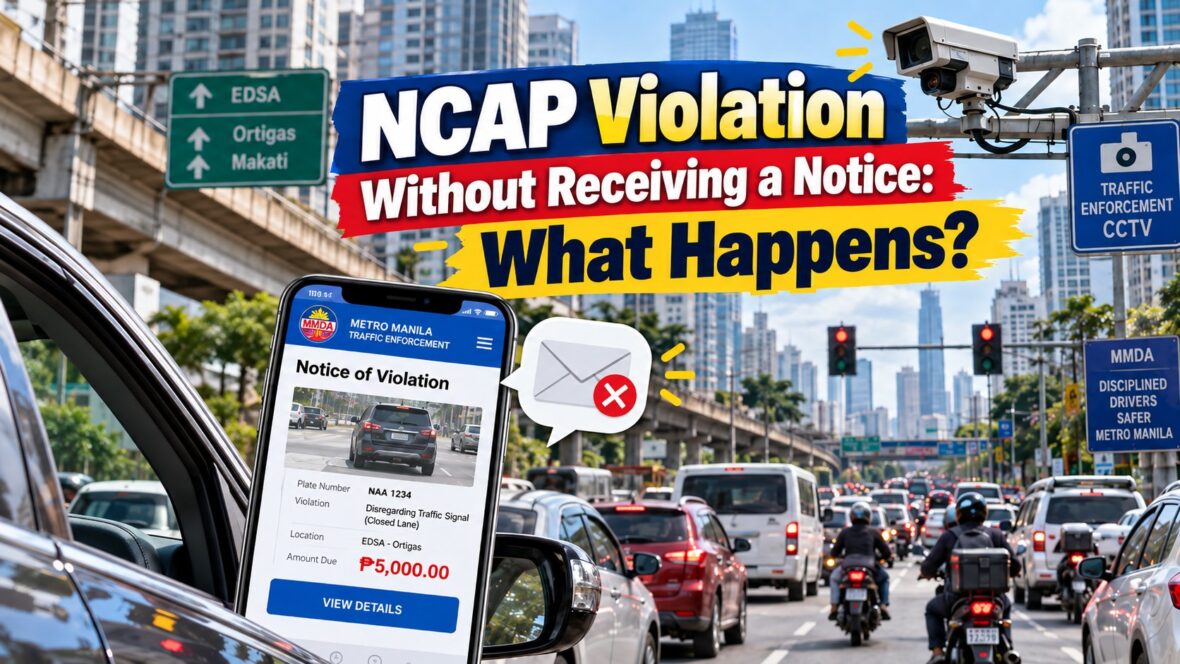
Imagine this. You’ve been driving around Metro Manila for weeks, going to work, running errands, or simply traveling from one city to another.
You haven’t received any traffic tickets. No traffic enforcer has stopped you, and there hasn’t been a letter or text message telling you that you’ve committed a violation.
Then one day, you decide to check your vehicle’s records online.
To your surprise, there’s an NCAP violation listed under your plate number.
Or worse, you discover several unpaid violations when you’re about to renew your vehicle registration with the Land Transportation Office (LTO).
Naturally, your first question would probably be: How can I have a traffic violation when I never received a notice?
And the next question is even more important: Do I still have to pay?
With the implementation of the No Contact Apprehension Policy (NCAP) across major Metro Manila roads and selected cities, this situation has become a concern for many Filipino motorists.
Unlike traditional traffic apprehensions, NCAP allows authorities to record violations through cameras without physically stopping a driver.
However, the system is also supposed to provide motorists with proper notification and an opportunity to contest an alleged offense.
So what happens when that notice never arrives?
In this guide, we’ll discuss what the rules say about NCAP violations without a Notice of Violation, whether you can be required to pay, how to check outstanding records, what happens to your vehicle registration, and what steps you can take if you believe your right to proper notification was affected.
Content
Do You Still Have to Pay an NCAP Violation If You Never Received a Notice?
The short answer is that not receiving a Notice of Violation does not automatically cancel an NCAP fine.
However, it also doesn’t mean the government can simply penalize you without following the required notification and adjudication procedures.
Under the NCAP framework, the issuing authority must comply with the applicable notice and due process requirements before treating a violation as final and enforceable.
This is an important distinction.
For example, let’s say an NCAP camera records your vehicle allegedly disregarding a traffic sign.
The recorded incident may be reviewed and entered into the enforcement system.
However, the registered vehicle owner must still be given the required notice and an opportunity to contest the violation.
If you genuinely never received notice, you may have grounds to question whether proper service occurred and whether the period for filing an appeal has already started.
But here’s where it gets a little complicated.
Under the traffic enforcement rules, a notice can sometimes be considered properly served even if the registered owner claims not to have personally received or read it.
This may happen when the notice was delivered through an authorized method to the registered address, when service was validly substituted, or when an owner failed to maintain correct registration information.
That’s why the first thing you should do is verify the actual status of the violation and how the notice was supposedly delivered.
Don’t immediately assume that the ticket is invalid.
At the same time, don’t immediately pay without checking the evidence and the applicable procedure.
What Is an NCAP Notice of Violation?
A Notice of Violation, commonly abbreviated as NOV, is the official notification issued to a registered vehicle owner after a traffic offense has been documented through the No Contact Apprehension Policy.
Unlike a traditional traffic ticket issued directly by an officer, an NCAP notice is generally sent to the registered owner using information from the LTO’s Land Transportation Management System (LTMS).
The notice should contain enough information for the recipient to understand the allegation and decide whether to settle or contest it.
Under the applicable LTO guidelines, a Notice of Violation should include information such as:
- The specific traffic offense and its legal basis
- Date and time of the alleged violation
- Exact location of the incident
- Images showing how the alleged violation occurred
- Instructions for accessing video evidence, if available
- Vehicle plate number and identifying details
- Name and address of the registered vehicle owner
- Amount of the applicable fine
- Instructions for payment
- Procedure and deadline for contesting the violation
These details are important because motorists should be able to verify that the recorded incident actually involves their vehicle.
For example, an incorrectly identified license plate could result in a citation appearing under the wrong vehicle.
Likewise, a notice might be issued to someone who sold the vehicle but has not yet completed the official transfer of ownership.
The NOV is intended to provide the information needed to address situations like these.
How Long Does the MMDA Have to Send an NCAP Notice?
Under LTO Memorandum Circular No. JMT-2023-2383, which established guidelines concerning NCAP apprehensions and the LTMS, the issuing authority is required to send a Notice of Violation within five working days from the date and time of apprehension.
The guidelines recognize several authorized ways of sending a notice.
These include:
- Personal service at the registered owner’s address
- Registered or ordinary mail through an authorized postal or courier service
- Electronic transmission to the owner’s registered email address
- Mobile messaging using the owner’s registered contact number
The Metro Manila Traffic Code framework also provides procedures concerning the issuance and service of notices.
However, there’s something important to understand about the five-working-day requirement.
It concerns the issuance or sending of the notice under the applicable regulations. It does not necessarily mean that every motorist will physically receive a mailed letter within five working days.
Postal delivery, courier schedules, and other administrative factors can affect when a notice actually arrives.
The timing of service and proof that service was completed are important when determining whether a motorist had a proper opportunity to respond.
Does a Delayed Notice Automatically Cancel the Violation?
Not necessarily.
If a notice was issued or served late, that may be relevant to a due process challenge.
However, a delay does not automatically establish that the underlying citation is void.
The effect of a notification problem depends on the applicable rules, the circumstances of service, and the determination of the authorized adjudication body.
If the notice was sent several weeks or months after the incident, request the official issuance and service records so you can determine whether the relevant procedures were followed.
Why You Might Have an NCAP Violation Without Receiving a Notice
There are several reasons why motorists might discover an NCAP violation even though they never saw the corresponding notice.
1. Your LTO Address Is Outdated
This is one of the most important possibilities to investigate.
NCAP notifications are generally based on the information recorded under the vehicle owner’s LTO registration.
If you’ve moved to another house or city but haven’t updated your registered address, the notice may have been sent to your previous residence.
For example, imagine that you previously lived in Quezon City but moved to Cavite.
If your LTO records still contain your Quezon City address, the issuing authority may send correspondence there.
Under applicable rules, failing to update your registered address can affect whether service of a notice is considered valid.
This means you should always make sure your LTO registration information is accurate.
2. Your Mobile Number or Email Address Is Incorrect
The MMDA introduced real-time SMS and email notifications for NCAP violations in July 2025.
These notifications use the contact details registered in the LTO’s LTMS.
However, if your phone number has changed or your email address is outdated, you may never receive the notification.
An email might also be filtered into your spam folder.
Remember that not seeing an SMS or email does not necessarily establish that no other authorized form of service occurred.
3. The Notice Was Delivered to Someone Else at Your Address
In certain circumstances, the applicable service rules permit substituted delivery.
For example, when a notice cannot be handed directly to the registered owner, it may be left with an appropriate person at the registered address in accordance with the governing procedures.
This means you could be unaware that the notice was delivered even though the issuing authority considers service valid.
If this happened, ask for documentation showing when, where, and to whom the notice was delivered.
4. There Was a Delivery Problem
A courier may have encountered an incorrect house number, incomplete address, unavailable recipient, or other delivery difficulty.
The notice might have been returned to the sender.
Whether the attempted delivery counts as valid service depends on the applicable rules and actual circumstances.
A returned letter does not always mean the citation disappears.
However, delivery records may be important when determining your opportunity to contest the violation.
5. The Vehicle Was Sold but Ownership Was Not Transferred
Another common situation involves secondhand vehicles.
Suppose you sold your car several months ago, but the buyer never completed the transfer of ownership with the LTO.
If an NCAP camera records that vehicle committing a violation, the notice may still be associated with the person listed as the registered owner.
This creates problems for sellers who are no longer using or possessing the vehicle.
A deed of sale and related documentation may help establish the circumstances, but the correct transfer and reporting procedures are still important.
6. The Violation Has Not Yet Been Fully Processed
NCAP systems record possible traffic offenses before the corresponding administrative procedures are completed.
A record may exist while review, verification, or notice preparation is still ongoing.
This means a motorist may discover an online record before receiving a physical notice.
The exact meaning of the displayed status should be confirmed with the issuing authority.
7. You Checked the Wrong NCAP Portal
Metro Manila has more than one NCAP enforcement system.
The MMDA operates its own program for covered major roads, while participating local government units maintain separate systems for designated roads and intersections.
For example, an MMDA-issued violation may be available through the May Huli Ka portal.
A notice issued by Quezon City may instead be found through the city’s NCAP platform.
Checking only one system does not guarantee that your vehicle has no records with another authority.
What Happens If You Ignore an NCAP Violation Because You Never Received a Notice?
Ignoring an outstanding record can create problems, particularly if the issuing authority considers the notice properly served and the applicable response period has expired.
Possible consequences include:
The Violation May Remain Outstanding
An unpaid or unresolved citation may remain associated with your vehicle.
Depending on the stage of the administrative process, the record may be pending notification, contestation, adjudication, or settlement.
Your Vehicle Could Be Flagged in LTO Records
Under the traffic enforcement framework, qualifying unresolved violations may be reported through the LTO system.
There are procedures intended to ensure that notice and due process requirements are followed before registration restrictions take effect.
An LTO alarm should not be confused with an automatic determination that every allegation is final.
You Might Encounter Registration Renewal Problems
A vehicle with a properly imposed unresolved traffic-related restriction may be prevented from completing certain LTO transactions until the issue is addressed.
This can become particularly inconvenient when you’re already processing your annual vehicle registration.
You Could Discover Multiple Recorded Violations
If a motorist continues committing the same traffic offense without realizing earlier incidents were recorded, multiple citations may result.
In July 2026, GMA News reported the case of a motorcycle rider who discovered approximately ₱200,000 in recorded NCAP penalties and complained that he had not received earlier notices.
The case illustrates why timely notification and regularly verifying your records can be important.
However, it does not establish that every alleged fine in a similar situation is legally final or beyond contest.
Can You Renew Your LTO Registration If You Have an NCAP Violation Without Notice?
This depends on the status of the violation and whether the applicable requirements for placing an LTO restriction have been satisfied.
LTO Memorandum Circular No. JMT-2023-2383 provides a staged approach to the handling of NCAP-related records.
The framework distinguishes between records undergoing the required notification and due process procedures and violations that have reached a stage where registration restrictions may apply.
The guidelines also provide for LTO transactions to remain possible while the record is still in the applicable staging process, subject to the governing conditions.
In practical terms, the mere existence of a newly recorded NCAP incident does not necessarily mean your vehicle should immediately be blocked from registration.
However, unresolved violations may ultimately result in a restriction.
If you discover an NCAP-related alarm during registration renewal, ask the LTO or issuing authority for the underlying violation details and the basis for the restriction.
If you never received the notice, request the service records and ask how you can exercise your right to contest the citation.
Do not assume that paying immediately is your only available option.
How to Check NCAP Violations Even Without a Notice
One of the useful improvements to the MMDA’s NCAP system is that motorists can check available records without needing to wait for a physical traffic ticket.
The agency expanded its May Huli Ka portal in August 2026, providing a search option that allows vehicle owners to check their records using their registration information.
Step 1: Visit the Official MMDA May Huli Ka Website
Open your browser and go to:
mayhulika.mmda.gov.ph
This is the official MMDA NCAP violation verification portal.
Step 2: Prepare Your Vehicle Information
You will need your vehicle’s plate number and Motor Vehicle (MV) File Number.
The MV File Number is printed on your LTO Certificate of Registration.
If you already have a ticket number, the portal also supports that search method.
Step 3: Choose the Appropriate Search Option
Starting August 24, 2026, the MMDA expanded the available search options to include:
- Plate number and ticket number
- Plate number and MV File Number
The second option is particularly useful if you have never received an NCAP notice.
Step 4: Review the Search Results
Enter the required information and check the available violation records.
If a record appears, review the details.
Pay attention to the incident date, location, offense, and citation status.
Step 5: Check the Supporting Evidence
The upgraded May Huli Ka platform allows motorists to review available photographic and video evidence.
Make sure the vehicle recorded in the footage is actually yours.
Check whether the alleged incident corresponds to the location, time, and traffic rule identified in the notice.
Step 6: Contact the MMDA If the Notice Never Arrived
If a violation is listed but you never received the NOV, contact the MMDA and request clarification.
Ask whether the notice was issued, how it was delivered, and what response options remain available.
Don’t rely only on the date displayed on the portal to determine whether your appeal period has expired.
Can You Check NCAP Through the eGovPH App?
Yes.
In July 2026, the MMDA integrated its NCAP checking services into the eGovPH Super App.
This gives motorists another way to access their MMDA traffic violation information.
Here’s the general process:
- Open the official eGovPH app on your smartphone.
- Sign in to your account.
- Find the MMDA service.
- Select the available NCAP checking function.
- Enter your vehicle information.
- Review any available violation records.
The integration is intended to make it easier for drivers and vehicle owners to monitor their records and access available services.
However, if an alleged violation was issued by a local government rather than the MMDA, you should check the relevant city portal.
What If Your NCAP Violation Shows “No Record Found”?
If you search using your vehicle information and the result says “No Record Found,” it generally means the system did not retrieve a matching record using the details provided.
However, it does not guarantee that you have absolutely no traffic violations anywhere.
There are several things worth checking.
First, make sure the plate number and MV File Number are correct.
Second, consider whether you are using the appropriate portal.
The MMDA has clarified that its May Huli Ka system displays NCAP records under its jurisdiction, not every possible traffic violation from every enforcement agency.
Third, remember that a very recent incident may still be undergoing the relevant administrative processes.
If you have received an official notice but cannot locate the corresponding record, contact the issuing authority rather than assuming the notice is invalid.
Can You Appeal an NCAP Violation If You Never Received the Notice?
Yes, you may raise a concern about the alleged violation and the lack of proper notification.
Whether the appeal is accepted, considered timely, or successful depends on the applicable regulations and the circumstances of service.
For MMDA-issued NCAP citations, the official May Huli Ka portal states that motorists may file a contest with the Traffic Adjudication Division within ten working days from receipt of the Notice of Violation.
The starting point is important.
It is generally based on receipt of the notice under the applicable service rules, not simply the date when a camera recorded the alleged offense.
However, service may be legally recognized even without the owner’s personal acceptance.
For this reason, if you discover an old NCAP record and believe no valid notice was served, you should raise that issue promptly with the issuing authority.
What Should You Do?
First, request a copy of the original Notice of Violation.
Next, ask for the issuing authority’s record of service.
This could include courier documentation, delivery records, transmission logs, or other evidence supporting the claimed service.
You should also confirm the address, email, or phone number used.
If the notice was sent to an incorrect address or delivery failed, explain the circumstances and provide supporting documents.
Ask whether the contest period is considered to have started and how you can seek a review if the system already shows the citation as overdue.
Don’t assume that an online status of “overdue” automatically resolves a dispute about proper notification.
At the same time, don’t ignore any deadline communicated by the adjudication office.
Step-by-Step: How to Contest an NCAP Violation Without Notice
If the citation was issued by the MMDA, here’s a practical process to follow.
Step 1: Verify the Violation
Use May Huli Ka to confirm that the violation is legitimate and recorded under your vehicle.
Take note of the ticket or reference number, date, location, and offense.
Step 2: Request the Notice and Proof of Service
Contact the MMDA and explain that you discovered a record despite not receiving the required notification.
Request the NOV and documentation showing when and how it was served.
Step 3: Gather Supporting Documents
Depending on your case, prepare:
- Vehicle Certificate of Registration
- Latest Official Receipt of registration
- Valid government identification
- Screenshot or copy of the NCAP record
- Proof of your actual address
- Relevant LTO record updates
- Supporting evidence concerning the alleged violation
- Deed of sale or ownership-transfer documents, if applicable
- Correspondence with the issuing authority
Only submit documents relevant to your case.
Step 4: File a Contest or Request for Review
The MMDA’s upgraded May Huli Ka platform includes an E-Contest feature.
Motorists can use the online process to submit applicable details and supporting documents.
You may also inquire directly with the Traffic Adjudication Division.
If the displayed contest period appears to have expired, specifically explain that you are questioning proper service and request guidance on how that procedural issue can be reviewed.
Step 5: Explain the Notification Problem Clearly
Your explanation should identify the notice you never received, the date you first discovered the record, and any evidence that may demonstrate a notification problem.
For example, if the issuing authority used an address that did not match the official LTO record at the time, that information could be relevant.
If you had already updated your registered details before the alleged notice was sent, include the corresponding documentation.
Step 6: Keep a Record of Your Submission
Save your confirmation number, acknowledgment, correspondence, and supporting files.
If the matter affects an LTO registration transaction, ask the issuing authority how the pending contest or review will be reflected in the system.
What Happens If the Notice Was Sent to Your Old Address?
This situation deserves special attention because many people change residences without immediately updating all their government records.
Under applicable NCAP service rules, notice may be considered valid in some situations where the registered owner failed to update the address recorded with the LTO.
For example, if your vehicle registration still contains your former address, sending the notice there may have legal consequences even if you no longer live at that location.
However, the exact circumstances still matter.
There’s a difference between an authority properly using the official address on record and an authority sending a notice to an address that was incorrectly entered or no longer matched the official record.
The best approach is to verify the LTO registration information that existed when the notice was issued.
If you’ve already moved, update your records through the appropriate LTO process as soon as possible.
This can help avoid future notification problems, although an address update today won’t necessarily undo an earlier validly served citation.
What If You Sold the Vehicle Before the Violation Happened?
This is another important scenario.
Suppose you sold your motorcycle or car in January, and an NCAP camera recorded the vehicle committing a violation in March.
If the buyer never completed the ownership transfer, the record might still identify you as the registered owner.
If this happens, gather your sale and transfer documents.
Useful evidence may include a notarized deed of sale, acknowledgment of delivery, transfer-related LTO records, and other reliable documentation.
You should also determine whether the seller and buyer complied with applicable LTO reporting and transfer requirements.
If a notice has been issued in your name, inform the issuing authority and ask about the correct contest procedure.
A deed of sale may support your position, but it does not automatically erase the registered-owner issues that arise when LTO records have not been properly updated.
Do NCAP Fines Increase If You Don’t Receive the Notice?
For MMDA-issued NCAP citations, the agency clarified in August 2026 that its NCAP fines do not carry accumulating interest or late-payment penalties.
This is important because fraudulent messages sometimes claim that traffic fines will increase dramatically unless motorists pay immediately.
However, the absence of accumulating interest does not mean an unresolved citation has no consequences.
A properly enforceable unpaid violation may still affect LTO transactions.
Also, motorists should not automatically apply the MMDA’s statement about its NCAP fines to every local government citation or older ticket governed by different rules.
Always check the issuing authority and the applicable penalty schedule.
Can Your License or Vehicle Be Placed on Alarm Without Proper Notice?
The traffic enforcement framework provides for the reporting and tagging of qualifying violations in the LTO system, together with procedures intended to protect motorists’ right to due process.
Whether a particular alarm or registration restriction is valid depends on the status of the citation and compliance with the applicable requirements.
A record should not be treated as conclusively enforceable simply because a camera captured an alleged violation.
If you discover that your vehicle has been placed under an LTO restriction and you never received a notice, ask the issuing authority for the record of service and the basis for the alarm.
You can also request clarification from the LTO about which authority submitted the record.
The important thing is to resolve the issue through the correct agency rather than allowing it to remain outstanding.
How to Avoid NCAP Notification Problems
While motorists cannot control every aspect of the delivery process, there are some practical steps that can help.
Keep Your LTO Information Updated
Check whether your registered address, contact number, and email are correct.
Complete any necessary updates when you move to a new residence or change contact information.
Check Your Records Periodically
If you regularly drive along major Metro Manila roads, periodically checking your official NCAP records can help you discover issues before vehicle registration renewal.
This is particularly useful for motorists who use several different routes.
Monitor Official Notifications
Watch for legitimate MMDA SMS or email notifications.
The MMDA uses the sender ID MMDA_NCAP for official text notifications.
However, be careful about fraudulent messages.
Keep Vehicle Ownership Records Accurate
If you buy or sell a secondhand vehicle, complete the required LTO reporting and ownership-transfer procedures.
Don’t rely solely on a private agreement without ensuring the relevant government records are properly handled.
Save Evidence When Necessary
A dashcam can be useful when questioning the circumstances of an alleged traffic violation.
Photographs, videos, delivery records, and official correspondence may also help support a case.
Beware of Fake NCAP Notices and Payment Messages
Another problem motorists should watch out for is the growing number of scams involving fake NCAP notices.
The MMDA has repeatedly warned the public about text messages impersonating the agency.
These messages often claim that a motorist has an unpaid fine and must immediately open a payment link.
The agency has clarified that legitimate SMS notifications use the sender ID MMDA_NCAP.
Genuine MMDA messages do not contain payment links, ask recipients to reply with personal information, or request payment through an unfamiliar website.
If you receive a suspicious message, don’t click the link.
Instead, manually open the official May Huli Ka website and check whether an actual violation is associated with your vehicle.
For additional assistance, motorists can contact the MMDA hotline at 136.
MMDA NCAP vs. City NCAP: Where Should You Ask About a Missing Notice?
This is another important distinction.
The MMDA operates NCAP on designated major roads under its jurisdiction.
Several Metro Manila local government units also maintain their own NCAP enforcement systems.
These systems may have different portals, support offices, and procedures for responding to individual notices.
For example, the Quezon City government directs motorists to its official NCAP website at:
nocontact.quezoncity.gov.ph
The city also allows motorists to contest citations through its online portal.
For an MMDA-issued citation, use:
mayhulika.mmda.gov.ph
Other participating cities have their own designated systems and adjudication offices.
The important thing is to identify which agency issued the violation before filing an inquiry or making a payment.
Checking the MMDA portal alone does not necessarily reveal a city-issued NCAP ticket.
Frequently Asked Questions About NCAP Violations Without Notice
1. Can I have an NCAP violation even if I never received a ticket?
Yes. An alleged offense may have been recorded and processed without you personally receiving a physical notice. However, the issuing authority must comply with applicable notification and due process procedures.
2. Do I still have to pay if no Notice of Violation arrived?
Not receiving a notice does not automatically cancel the fine. Whether it is enforceable depends on the validity of the citation, proper service, and the applicable procedures. Verify the record and request proof of service before deciding how to proceed.
3. How long does the MMDA have to issue an NCAP notice?
The applicable LTO guidelines require issuing authorities to send notices within five working days from apprehension. The actual receipt date and validity of service are separate considerations.
4. Can I contest a violation after discovering it months later?
You can raise the issue with the issuing authority. If you never received valid notice, explain that circumstance and request review of the service record and applicable contest period. Acceptance of a late contest is not automatic.
5. When does the 10-working-day appeal period begin?
For MMDA-issued NCAP violations, the stated contest period is ten working days from receipt of the Notice of Violation. However, the applicable rules may recognize authorized forms of service even when the owner did not personally read or accept the notice.
6. Can I check NCAP violations without a ticket number?
Yes. The MMDA’s May Huli Ka portal allows vehicle owners to search using a plate number and MV File Number without an existing ticket number.
7. Can NCAP affect my LTO registration even without notice?
Unresolved violations can result in LTO restrictions when the applicable conditions are met. If you were not properly notified, request the records supporting the citation and any resulting restriction.
8. Will my NCAP fine increase because I didn’t pay on time?
The MMDA has clarified that its NCAP fines do not accumulate interest or late-payment penalties. Nevertheless, unresolved citations can have other administrative consequences. Verify the rules for any local government-issued notice.
9. What if the notice was sent to my previous address?
The effect depends on the applicable service rules and whether you had properly updated your LTO records. Failure to maintain an accurate registered address may affect whether service is considered valid.
10. What if another person was driving my vehicle?
The registered owner may need to identify the actual driver and submit supporting documentation under the applicable contest procedure. Simply saying that another person was driving does not automatically cancel the notice.
11. What if I already sold the vehicle?
Gather your sale and transfer documents and contact the issuing authority. Also check whether the ownership transfer was properly completed with the LTO.
12. Does “No Record Found” mean I have no NCAP violations?
Not necessarily. It only indicates that no matching record was retrieved in the system using the search information provided. Other agencies may maintain separate records, and recent incidents may still be undergoing processing.
13. Can I request proof that the notice was delivered?
Yes. You can ask the issuing authority for the relevant service information, including the method and date of service, to help determine whether the notification requirements were followed.
14. Should I pay immediately if a violation appears online?
First, verify that the record is genuine and review the available evidence. If you believe the citation or service of notice was incorrect, inquire about contesting it before making payment.
15. What should I do if my LTO registration is blocked by an NCAP violation I never knew about?
Ask the LTO to identify the issuing authority and request the underlying violation and service records. Then contact the authority responsible for the ticket to determine the available settlement, contest, or review procedure.
Final Thoughts
One of the most frustrating things about any traffic enforcement system is discovering a violation you didn’t even know existed.
I can understand why motorists would feel concerned if they suddenly found several unpaid NCAP tickets despite never receiving a letter, email, or text message.
After all, how can someone correct a driving mistake or question an alleged offense if they don’t know that a violation has been recorded?
This is why proper notification is such an important part of the No Contact Apprehension Policy.
Camera-based traffic enforcement can help improve road safety and reduce the need for physical apprehensions, but it also needs to be implemented fairly.
Motorists should receive proper information about alleged violations, have reasonable access to the recorded evidence, and be given a meaningful opportunity to contest incorrect citations.
At the same time, vehicle owners also have responsibilities, particularly when it comes to keeping their LTO registration details updated.
For now, my advice is simple.
If you discover an NCAP violation but never received a notice, don’t ignore it.
Check the official violation record, contact the issuing authority, and request details about when and how the notice was served.
If you believe there was a notification problem or the citation itself is incorrect, use the available contest or review procedure.
And most importantly, don’t assume that an unpaid violation has automatically disappeared just because no physical letter arrived.
A few minutes spent verifying your records today could help you avoid much bigger problems when it’s time to renew your vehicle registration.
Latest update: As of October 19, 2026, motorists can check MMDA NCAP records through May Huli Ka using their plate number and MV File Number, even without a ticket number. MMDA contests are generally filed within ten working days from receipt of the Notice of Violation, subject to the applicable service rules. Unresolved citations may affect LTO registration transactions, but notification and due process requirements remain important.