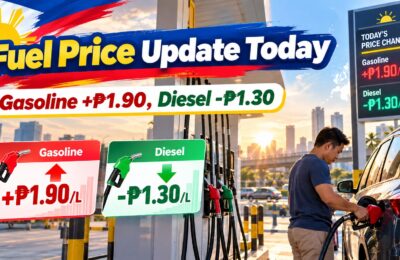
Filipino motorists may have to prepare for another painful trip to the gas station next week.
Another major oil price hike is expected on Tuesday, September 22, 2026, with diesel and gasoline prices projected to increase sharply once again as global petroleum markets continue to deal with supply disruptions and tensions in the Middle East.
Earlier estimates were particularly alarming.
Based on four days of Mean of Platts Singapore trading and foreign exchange movements, diesel was initially projected to rise by around ₱10 to ₱10.50 per liter, while gasoline was estimated to increase by ₱4.50 to ₱5 per liter. Department of Energy Oil Industry Management Bureau Director Rino Abad similarly said diesel could increase by “more or less ₱10” per liter.
There is some slightly better news, though.
After the full week of trading was included in the computation, the estimate was revised lower.
As of September 19, an industry source cited by GMA News estimated the following adjustments:
| Fuel | Latest Estimated Increase |
|---|---|
| Diesel | ₱8.50 to ₱9.50 per liter |
| Gasoline | ₱4.50 to ₱5.50 per liter |
| Kerosene | Final estimate still subject to confirmation |
The final increase has not yet been officially announced by oil companies.
Fuel companies normally announce their adjustments on Monday, with the new prices taking effect the following Tuesday.
So if you’re filling up this weekend, this is definitely one fuel-price update worth watching closely.
Content
Will Diesel Really Increase by More Than ₱10 Per Liter?
This is where some of the headlines can get confusing.
On Friday, September 18, the estimate for diesel was indeed as high as ₱10 to ₱10.50 per liter.
Jetti Petroleum president Leo Bellas gave that estimate based on four-day movements in the Mean of Platts Singapore, or MOPS, together with foreign exchange averages.
Gasoline at the time was projected to increase by ₱4.50 to ₱5 per liter.
However, fuel-price estimates continue to move as the trading week progresses.
By September 19, after the full September 14–18 trading period was included, the estimated diesel increase had eased to ₱8.50 to ₱9.50 per liter.
Gasoline was placed at ₱4.50 to ₱5.50 per liter.
So the situation as of September 20 is:
The ₱10-plus diesel hike was a legitimate earlier projection, but the latest available full-week estimate is now below ₱10.
That could still change slightly before oil companies make their official announcements on Monday.
When Will the Oil Price Hike Take Effect?
The expected adjustment is for Tuesday, September 22, 2026.
Philippine fuel companies generally announce their final price movements every Monday and implement them the following day.
Most adjustments take effect at around 6:00 AM Tuesday, although individual oil companies publish their own advisories.
That means motorists should watch for official announcements on Monday, September 21.
Until those announcements are released, all numbers being discussed remain estimates.
Why Are Fuel Prices Going Up Again?
Unfortunately, this is not just another normal weekly fluctuation.
Several international developments are putting pressure on petroleum supplies.
One of the biggest concerns continues to be the Middle East.
Industry sources cited attacks and disruptions affecting the Strait of Hormuz and the Red Sea, two of the world’s most important routes for moving crude oil and petroleum products.
There have also been concerns surrounding Saudi Arabian export infrastructure and disruptions involving Russian refineries.
All of these factors matter to the Philippines because we import most of the petroleum products that we consume.
When international prices rise, those increases eventually make their way to local gas stations.
What Is the Strait of Hormuz and Why Does It Matter?
You may have heard “Strait of Hormuz” mentioned repeatedly whenever fuel prices shoot up.
There’s a good reason.
The Strait of Hormuz is one of the world’s most important oil shipping routes.
Petroleum from major Middle Eastern producers passes through the waterway before reaching customers around the world, including refineries and markets in Asia.
When shipping through Hormuz becomes risky or disrupted, traders start worrying about whether enough oil will reach the market.
And sometimes, the fear of a future shortage is enough to drive prices higher even before an actual shortage happens.
That uncertainty has been one of the forces supporting high international petroleum prices this September.
Why Is Diesel Increasing More Than Gasoline?
This time, diesel has been under particularly strong pressure.
Asian diesel supplies have tightened because of a combination of refinery disruptions, maintenance, reduced exports and geopolitical problems affecting major supply sources.
The latest industry assessment cited tight physical supplies, refinery maintenance and strong demand as reasons diesel prices remained elevated even as some international oil prices began pulling back later in the week.
That’s why the projected diesel increase is significantly larger than the estimated gasoline hike.
And that matters beyond private motorists.
Diesel is widely used by buses, jeepneys, trucks, delivery vehicles, agricultural equipment and other parts of the Philippine economy.
So when diesel jumps by nearly ₱10 in one week, the effect isn’t limited to the person paying at the gas station.
Gasoline Could Still Rise by Around ₱5 Per Liter
Gasoline drivers aren’t getting much relief either.
The latest estimate places the increase between ₱4.50 and ₱5.50 per liter.
And remember, this would come just one week after a huge increase.
For the September 15 adjustment, gasoline went up by around ₱5.68 per liter, diesel by ₱4.31 and kerosene by ₱4.62, based on DOE figures.
In other words, if the latest estimate pushes through, gasoline could increase by roughly ₱10 or more per liter over just two consecutive weekly adjustments.
That’s a huge change in a very short period.
How Much More Could You Pay at the Pump?
Let’s put those numbers into something more practical.
If diesel rises by ₱9.50 per liter, filling a 40-liter tank would cost around ₱380 more than before the adjustment.
A 50-liter fill-up would cost approximately ₱475 more.
For gasoline, a ₱5.50-per-liter increase would mean an additional ₱220 for 40 liters or ₱275 for 50 liters.
And that’s from only one weekly adjustment.
It doesn’t include the major increase that already took effect on September 15.
For motorists who fill their tanks regularly, the accumulated increase is becoming very noticeable.
Fuel Prices Already Jumped Sharply Last Week
The upcoming adjustment is even more significant because motorists just experienced another big-time hike.
Beginning September 15, DOE reported increases of:
| Fuel | September 15 Increase |
|---|---|
| Gasoline | ₱5.68 per liter |
| Diesel | ₱4.31 per liter |
| Kerosene | ₱4.62 per liter |
Some companies posted slightly different amounts depending on their individual pricing.
Shell, for example, announced increases of ₱5.70 for gasoline, ₱4.40 for diesel and ₱4.60 for kerosene.
That was already the second consecutive week of major price increases.
In the two weeks leading to September 15, gasoline prices had risen by approximately ₱10.37 per liter, diesel by ₱9.49 and kerosene by ₱10.20.
Now another significant hike is expected.
Fuel Prices Above ₱100 Per Liter?
At some stations, certain fuel products have already crossed or approached the ₱100-per-liter mark.
The actual pump price depends on several factors, including the oil company, location, fuel grade and operating costs of the individual station.
Prices can differ considerably even between stations located in the same city.
Some Metro Manila stations were already expected to carry fuel products above ₱100 per liter following the September 15 adjustment.
Another increase of around ₱5 for gasoline or close to ₱10 for diesel could therefore push more products and stations into that range.
This is why it is important to remember that the projected increases are adjustments per liter, not the final retail prices.
Why Did the Latest Diesel Estimate Go Down?
At least there was one positive development toward the end of the trading week.
The original ₱10 to ₱10.50 diesel estimate was revised to approximately ₱8.50 to ₱9.50.
According to the industry source cited by GMA News, international oil prices eased somewhat after Saudi Arabia moved to restore part of its export capacity.
Saudi Arabia was reportedly working to bring back around half of its export capacity through its East-West pipeline while also offering additional cargoes to Asian refiners using ship-to-ship transfers near Oman.
Those developments helped ease some immediate worries about supply.
But the market remains far from normal.
Risks surrounding shipping routes, Middle East infrastructure, refinery operations and global supply remain.
That’s why the projected increase is still extremely large even after the downward revision.
Could Prices Still Change Before Tuesday?
Yes.
The numbers available during the week are estimates.
They are based largely on movements in international petroleum prices, MOPS and foreign exchange rates.
The final domestic adjustments are announced by individual oil companies.
That normally happens on Monday.
So we won’t know the exact September 22 increase until the oil companies release their advisories.
Still, considering the full-week trading data, another substantial increase appears likely.
The bigger question is simply how large it will be.
What Is MOPS?
You might also be wondering what “MOPS” actually means because it comes up every week in fuel-price reports.
MOPS stands for Mean of Platts Singapore.
It is a widely used benchmark for the prices of refined petroleum products traded in the Asia-Pacific region.
Since the Philippines imports petroleum products, movements in MOPS are an important factor in determining how local pump prices eventually move.
This is also why crude oil headlines do not always translate directly into the exact increase you see at Philippine gas stations.
Gasoline and diesel are refined products, and each has its own supply-and-demand situation.
Exchange rates and other market factors also affect the final local adjustment.
Government Can Now Consider Cutting Fuel Excise Taxes
There is another major development motorists should watch closely.
The Department of Energy has officially certified that the one-month average price of Dubai crude exceeded the threshold required for the government to consider reducing or suspending excise taxes on petroleum products.
According to the DOE, Dubai crude averaged $99.41 per barrel from August 13 to September 11.
That is well above the $80-per-barrel threshold.
Under Republic Act No. 12316, crossing that threshold allows the President, upon recommendation of the Development Budget Coordination Committee, to partially reduce or fully suspend petroleum excise taxes for a limited period.
But this is important:
The excise tax reduction is not automatic.
The DOE certification simply satisfies one of the requirements needed before the government can consider taking action.
Has the Fuel Excise Tax Been Suspended?
Not yet.
As of the latest official updates, the Development Budget Coordination Committee was still evaluating and finalizing its recommendation.
Malacañang said the recommendation would be submitted to President Ferdinand Marcos Jr. once the economic managers completed their assessment.
So motorists should not assume that next week’s prices will already reflect an excise-tax suspension.
Unless the government officially announces otherwise, the existing taxes remain part of pump prices.
This is another story worth monitoring alongside Monday’s fuel-price announcement.
Government Assistance for Affected Sectors
The government has also said it will continue supporting sectors directly affected by high oil prices.
Malacañang cited the Unified Package for Livelihoods, Industry, Food, and Transport or UPLIFT program as one of the mechanisms available to provide assistance.
The program is designed as a whole-of-government response to economic disruptions caused by the Middle East crisis.
Transport workers are naturally among the groups facing some of the strongest pressure because fuel represents a major operating expense.
And as diesel prices rise, the issue can eventually affect discussions surrounding public transportation fares as well.
What Motorists Can Do Before Tuesday
If the expected hike is confirmed, filling up before the adjustment takes effect could save some money.
But there is no need to panic-buy fuel.
If you were already planning to refuel, doing it before Tuesday morning may allow you to purchase at the current price.
It also helps to compare stations.
Even under the same weekly adjustment, actual retail prices can vary significantly depending on brand and location.
Using fuel rewards, discounts or legitimate promotional programs may also make a difference when prices are this high.
A few pesos per liter may not have felt significant before, but when diesel and gasoline prices are moving by several pesos in a single week, every discount matters.
Oil Price Hike Next Week: Quick Summary
Here is the situation as of September 20:
| Question | Latest Information |
|---|---|
| When is the next adjustment? | Expected Tuesday, September 22 |
| Diesel increase | Latest estimate: ₱8.50–₱9.50/L |
| Earlier diesel estimate | ₱10–₱10.50/L |
| Gasoline increase | Latest estimate: ₱4.50–₱5.50/L |
| Final prices confirmed? | No |
| Official announcements expected | Monday, September 21 |
| Why are prices rising? | Tight supply, Middle East disruptions, refinery issues and global market uncertainty |
| Fuel tax suspended? | Not yet |
| Dubai crude threshold reached? | Yes — average of $99.41/barrel from Aug. 13 to Sept. 11 |

What Happens Next?
Monday will be the key day.
That’s when fuel companies are expected to announce their official price adjustments for September 22.
At the moment, the latest full-week estimate points to an increase of as much as ₱9.50 per liter for diesel and ₱5.50 per liter for gasoline.
Those figures are lower than the earlier estimate of more than ₱10 for diesel, but there’s really no way to describe them as small.
They would still represent another major hit for motorists, transport operators and businesses after several weeks of rising fuel costs.
At the same time, another important decision is developing in government: whether to reduce or suspend petroleum excise taxes now that the legally required Dubai crude price threshold has been reached.
So there are really two things to watch over the next few days.
First, the official September 22 oil price hike.
Second, whether the government moves forward with fuel-tax relief.
For motorists, both could make a very real difference the next time they pull into a gas station.