If you’re looking for one of Mindanao’s biggest September street festivals, put Surigao City on your calendar.
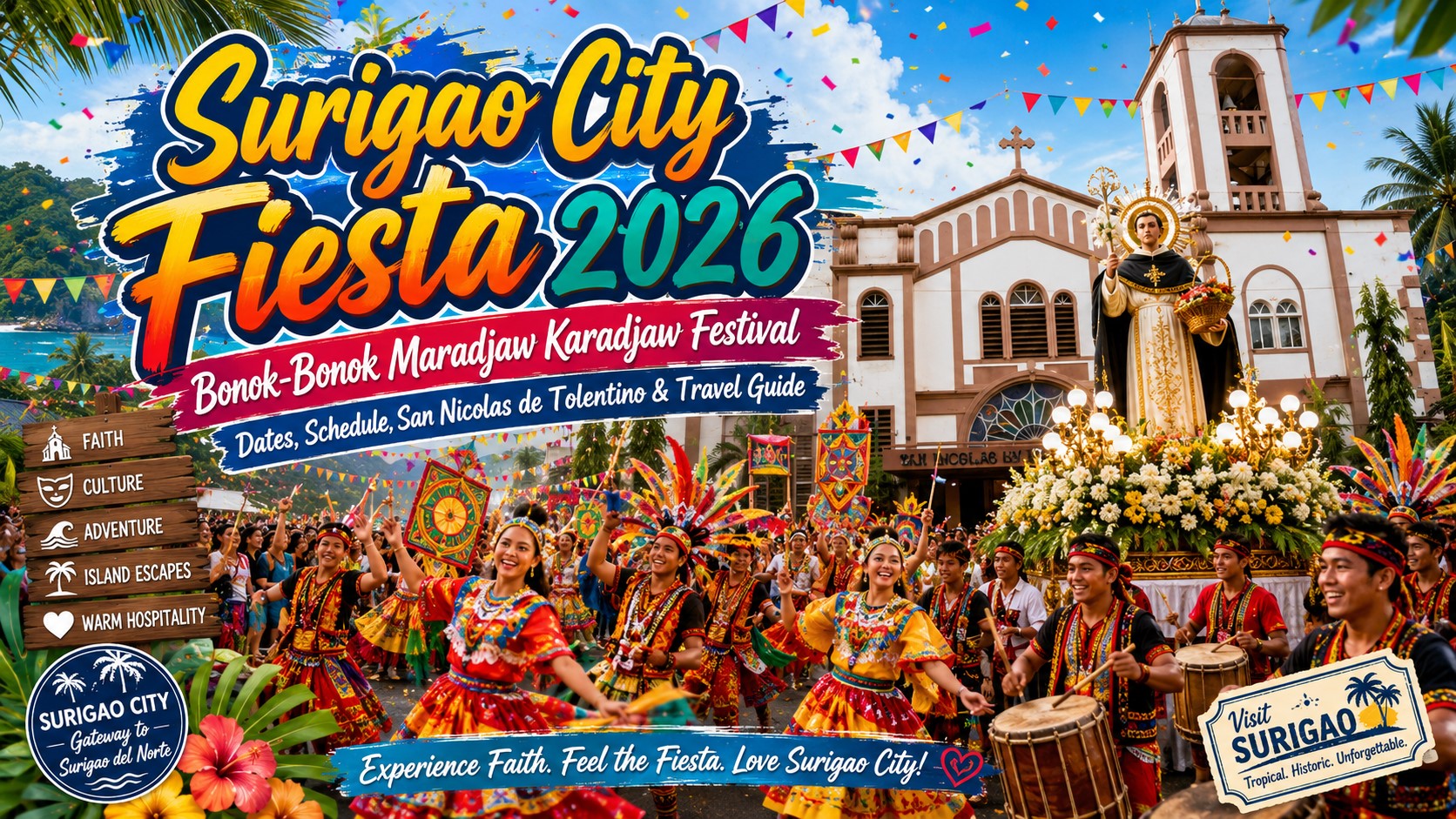
Every year, Surigaonons celebrate the Bonok-Bonok Maradjaw Karadjaw Festival, a cultural and religious thanksgiving celebration connected with the city’s patronal fiesta in honor of Señor San Nicolas de Tolentino.
Two dates matter most:
Content
September 9, 2026 – Bonok-Bonok Maradjaw Karadjaw Festival
and
September 10, 2026 – Surigao City Fiesta and Feast of San Nicolas de Tolentino
September 9 falls on a Wednesday, while September 10 is a Thursday in 2026.
Surigao City’s own development plan identifies September 9 as the annual Bonok-Bonok festival date, describing it as a day-long Mardi Gras and street-dancing celebration featuring Mamanwa-inspired dance. The following day, September 10, is the feast of San Nicolas de Tolentino.
And the 2026 fiesta season has already begun.
The 5th Tyanggehan sa Boulevard opened on August 15, 2026, bringing around 200 food and merchandise stalls to the Surigao City Boulevard. It is scheduled to continue until September 15, covering the Charter Day, Bonok-Bonok and fiesta period.
So if you’re planning a September trip to Surigao, here’s a comprehensive guide to the Bonok-Bonok Maradjaw Karadjaw Festival and Surigao City Fiesta 2026.
Surigao City Fiesta 2026 at a Glance
Festival: Bonok-Bonok Maradjaw Karadjaw Festival
Location: Surigao City, Surigao del Norte
Festival date: September 9, 2026
Main fiesta: September 10, 2026
Patron saint: San Nicolas de Tolentino
2026 Charter Day: August 31, 2026
Charter anniversary: 56th
Current fiesta-season activity: Tyanggehan sa Boulevard, August 15–September 15
Region: Caraga
Surigao City’s current tourism information continues to identify Bonok-Bonok as one of its major September cultural events, featuring Mamanwa ethnic dances in a street parade honoring San Nicolas de Tolentino.
When Is Bonok-Bonok Festival 2026?
The traditional festival date is:
Wednesday, September 9, 2026
This date is important because Bonok-Bonok is traditionally staged one day before the September 10 patronal feast.
Surigao City’s Comprehensive Development Plan officially lists:
September 9 – Bonok-Bonok Maradjaw Karadjaw Festival
and describes it as a day-long Mardi Gras featuring street dancing inspired by Mamanwa traditions.
This same September 9 pattern continued in 2025.
The 2025 street-dancing competition and grand showdown were held on September 9, attracting 11 contingents from Surigao City and other parts of Mindanao.
So for 2026, September 9 is the date festival travelers should prioritize.
When Is Surigao City Fiesta 2026?
The patronal fiesta is:
Thursday, September 10, 2026
This is the Feast of San Nicolas de Tolentino.
The Diocese of Surigao lists the San Nicolas de Tolentino Cathedral as having been established in 1754, with San Nicolas as its titular patron and September 10 as the feast date.
That distinction is useful:
September 9 = major Bonok-Bonok cultural festival
September 10 = religious patronal fiesta
The two form one larger Surigao fiesta celebration.
Is There Already a Complete Bonok-Bonok Festival 2026 Schedule?
As of August 24, 2026, I have not found one complete publicly searchable official program listing every Bonok-Bonok 2026 activity, exact parade time, route, participating contingents, showdown venue and concert lineup.
However, several parts of the 2026 celebration are already clearly happening.
The city is celebrating its 56th Charter Day season, and DepEd Surigao City has already issued a memorandum for participation in the Grand Float Parade for the 56th Surigao City Charter Day Anniversary.
The Tyanggehan sa Boulevard also opened August 15 and runs through September 15 as part of this year’s Charter-to-Fiesta festivities.
So the festival is not merely a future annual date. The wider 2026 celebration is already underway.
What we’re still waiting for is the detailed September 9 program.
Bonok-Bonok Festival 2026: Important Dates to Remember
For now, these are the dates I would mark:
August 15 – September 15
Tyanggehan sa Boulevard
A month-long night market with food, local products, merchandise and entertainment along Surigao City Boulevard. Around 200 stalls are participating in the 2026 edition.
August 31
56th Surigao City Charter Day
Surigao became a chartered city on August 31, 1970. The city’s development plan describes Charter Day as traditionally featuring parades, sports and evening activities.
September 7
Balik Surigao / homecoming period
The city’s tourism calendar traditionally identifies September 7 with Balik Surigao Duyom nan Balikbayan, a homecoming activity honoring Surigaonons returning from elsewhere.
Whether the 2026 edition uses the exact same format should be confirmed through the final schedule.
September 9
Bonok-Bonok Maradjaw Karadjaw Festival
This is the big street-dancing and cultural competition date.
September 10
Feast of San Nicolas de Tolentino and Surigao City Fiesta
This is the main religious celebration.
What Does Bonok-Bonok Mean?
The festival’s name is one of the things that makes it memorable.
Bonok means a heavy downpour or strong rain in Surigaonon usage.
During the festival, however, that rain becomes a symbol of something positive:
a downpour of blessings.
MindaNews described the same meaning during the 2025 festival, explaining that while heavy rain is something Surigao knows very well, Bonok-Bonok transforms the idea into thanksgiving for blessings.
The Philippine News Agency likewise explains that Bonok-Bonok is derived from “bonok,” meaning downpour, symbolizing blessings from the Creator.
What Does Maradjaw Karadjaw Mean?
Maradjaw is a Surigaonon word associated with something good.
“Maradjaw Karadjaw” is commonly translated along the lines of:
very good
or
all the very best.
PNA describes the phrase as representing positivity and abundance.
Put the ideas together and the festival’s name becomes a celebration of:
rain
blessings
abundance
thanksgiving
and
good fortune.
A Festival Born From Disaster and Resilience
Bonok-Bonok’s modern history makes that meaning even stronger.
The festival began in 1984, the same year Surigao was devastated by Typhoon Nitang, internationally known as Typhoon Ike.
The storm caused severe destruction throughout the area.
Yet instead of allowing that disaster to define the city only through tragedy, Bonok-Bonok developed into an expression of survival and thanksgiving.
The 2025 celebration marked the festival’s 41st year since its beginning in 1984.
The 2024 edition had formally celebrated its 40th year, according to both the Philippine News Agency and Surigao City’s legislative records.
If the numbering continues normally, the 2026 edition would therefore be the 42nd Bonok-Bonok Maradjaw Karadjaw Festival.
However, until Surigao City itself publicly uses “42nd” in its final 2026 festival materials, I would keep Bonok-Bonok Festival 2026 as the safest wording.
Mamanwa Culture and Bonok-Bonok
One of the most important cultural influences behind the festival is the Mamanwa community.
Surigao City’s official tourism information describes Bonok-Bonok as featuring Mamanwa ethnic dances, while its tourism inventory also recognizes a Mamanwa Tribal Village in Barangay Mat-I as part of the city’s cultural tourism resources.
The festival’s dancing draws inspiration from indigenous traditions connected with thanksgiving, harvest and nature.
That means Bonok-Bonok shouldn’t simply be described as performers wearing “tribal-looking costumes.”
There is an actual indigenous cultural reference behind the celebration.
Visitors and content creators should be careful to treat that heritage respectfully rather than turning indigenous identity into costume decoration alone.
Bonok-Bonok Street Dancing
The street-dancing competition is the event most visitors will want to see.
Expect:
large contingents
drums
bright costumes
festival queens
large props
group choreography
images of San Nicolas de Tolentino
and performances representing Surigao culture, blessings and resilience.
During the 2025 edition, the street-dancing competition brought together 11 contingents, including groups from Surigao City as well as Cagayan de Oro, Agusan del Norte, Misamis Occidental and other areas.
That shows how Bonok-Bonok has grown beyond a neighborhood street parade.
It’s a competitive regional festival.
The Grand Showdown
Don’t leave immediately after the street dancers pass.
The Grand Showdown is where groups present their larger choreographed performances.
In 2025, the festival had two major competitive categories:
Bonok-Bonok-Based Category
and
Festivals of Festivals Free Interpretation Category.
The Free Interpretation champion in 2025 received ₱1 million, while the Bonok-Bonok-Based champion received ₱500,000, illustrating the scale of the competition.
Whether the same categories and prize amounts will return in 2026 should be confirmed when this year’s mechanics are published.
The Bonok-Bonok-Based Category
This category is particularly interesting because it focuses more closely on the identity of the host festival.
Performances can incorporate:
Surigaonon culture
Mamanwa-inspired movement
the idea of rain
thanksgiving
harvest
local livelihood
San Nicolas de Tolentino
and the city’s history of overcoming hardship.
For someone watching Bonok-Bonok for the first time, this is probably the category where knowing the festival’s meaning helps the most.
The movements aren’t random.
The rain imagery isn’t random.
The saint’s image isn’t random.
They all belong to the story.
Festivals of Festivals Category
The Festivals of Festivals category allows participating groups to bring other festival identities and interpretations into the Surigao competition.
This gives Bonok-Bonok a much broader visual range.
In 2025, participants came from several communities beyond Surigao City, turning the event into a showcase of festival traditions from around Mindanao.
For festival photographers, this can make September 9 a particularly good event because you’re seeing multiple performance styles in one place.
Festival Queens
Festival queens traditionally play an important role in Bonok-Bonok performances.
They don’t simply walk ahead of the dancers.
They’re often integral to the choreography and religious symbolism.
One memorable image from the 2025 street dancing shows a festival queen performing while carrying an image of Señor San Nicolas de Tolentino.
Older festival formats have also used titles such as Rayna nan Bonok-Bonok.
The exact 2026 festival-queen categories will need to be checked against this year’s official competition mechanics.
Who Is San Nicolas de Tolentino?
At the religious center of the celebration is San Nicolas de Tolentino.
He was an Augustinian priest who lived during the 13th and early 14th centuries and became known for his life of prayer, preaching and service.
Devotion to him spread through Augustinian religious communities, eventually reaching many areas of the Philippines.
Surigao’s connection is centuries old.
The Diocese of Surigao identifies the San Nicolas de Tolentino Cathedral parish as established in 1754, with the saint as titular patron and September 10 as the feast date.
That makes the September fiesta tradition much older than Bonok-Bonok itself.
The festival began in 1984.
The devotion goes back centuries.
San Nicolas de Tolentino Cathedral
The main religious landmark is the San Nicolas de Tolentino Cathedral in Surigao City.
It is the cathedral of the Diocese of Surigao and the spiritual heart of the September 10 fiesta.
The city’s current tourism inventory calls the cathedral Surigao’s spiritual hub and specifically notes its September 10 fiesta.
During fiesta week, visitors should expect the cathedral area to be considerably busier.
Religious activities may include:
Novena Masses
devotions to San Nicolas
special fiesta Masses
processions
and other parish celebrations.
The exact 2026 Mass schedule should be checked directly through the cathedral once published.
September 10 Is Different From September 9
For travelers, it’s important to understand the change in atmosphere.
September 9
This is the big cultural spectacle.
You have dancers.
Drums.
Crowds.
Costumes.
Competition.
September 10
This is the feast day itself.
The focus shifts more directly toward:
Mass
religious devotion
family reunions
fiesta meals
and community celebration.
If possible, experience both.
You’ll understand Surigao’s fiesta much better than if you attend only the street dancing.
Tyanggehan sa Boulevard 2026
This is one 2026 activity that is already confirmed and underway.
The 5th Tyanggehan sa Boulevard opened on:
August 15, 2026
and runs until:
September 15, 2026.
Around 200 stalls are operating along the Surigao City Boulevard, offering local food, street food, refreshments, souvenirs and other merchandise. Live entertainment is also part of the night-market atmosphere.
For travelers attending Bonok-Bonok, this is perfect.
After the daytime festival, you already know where to go in the evening.
Fiesta Nights
Surigao City’s current tourism information also lists Fiesta Nights & Night Market among its established September activities, describing them as evenings filled with cultural shows, food stalls and a festive market atmosphere.
So even before the complete 2026 nightly program appears, the Boulevard area is already one of the best places to experience the fiesta atmosphere after dark.
Tilaw Food Festival
Another September activity associated with Surigao is the Tilaw Food Festival.
The city’s current tourism inventory describes Tilaw as a celebration of local food featuring cooking competitions and Surigaonon cuisine.
Older city tourism profiles mention competition categories involving dishes such as:
kinilaw
barbecue
native delicacies
and culinary-skills exhibitions.
The exact Tilaw 2026 date should be confirmed once the final event schedule is published.
But food travelers should definitely watch for it.
What to Eat in Surigao During Fiesta Week
Even if you miss Tilaw, the Tyanggehan gives you a long list of food options.
Look for:
grilled seafood
kinilaw
fish dishes
local barbecue
native kakanin
seafood snacks
and other Surigaonon specialties.
Surigao’s location facing productive coastal waters makes seafood an obvious part of the local food scene.
Fiesta week is also the time when families prepare the usual Filipino celebration dishes:
pancit
lumpia
lechon
chicken
pork dishes
cakes
and whatever special recipe the family brings out when relatives return home.
Surigao City Charter Day Comes Before the Fiesta
One reason Surigao feels like it’s celebrating for so long is that its Charter Day happens immediately before fiesta season.
Surigao became a chartered city on:
August 31, 1970.
The city’s development plan identifies August 31 as its annual Charter Day, traditionally marked with a grand parade, sports activities and evening affairs.
2026 therefore marks the city’s:
56th Charter Day Anniversary.
DepEd Surigao City has already issued instructions for schools to participate in the 56th Charter Day Grand Float Parade, confirming active 2026 preparations.
So in reality, Surigao’s celebration stretches from:
Charter Day → Bonok-Bonok → Fiesta.
Things to Do in Surigao City During Fiesta Week
One big advantage of attending Bonok-Bonok is that Surigao City isn’t simply a stop on the way to somewhere else.
There are plenty of local attractions worth adding to the trip.
1. Mabua Pebble Beach
Instead of fine white sand, Mabua Pebble Beach is covered with smooth stones.
Surigao City’s tourism office describes it as a kilometer-long pebble beach with coconut-covered hills and deep, cool water.
Late afternoon is an especially good time to visit.
After spending hours in a crowded festival, sitting beside the coast can feel like a complete change of pace.
2. Day-Asan Water Village
Day-Asan Mangrove Forest and Water Village is another distinctive Surigao attraction.
The city’s tourism information describes the community as having houses built on stilts among mangrove waterways, accessible by both land and sea.
Sometimes it’s called the “Little Venice of Surigao,” although I think it’s better to appreciate it on its own terms as a working coastal community rather than comparing it with Europe.
If visiting, remember that people actually live there.
Treat the community respectfully.
3. Battle of Surigao Strait Memorial and Museum
For history, visit the Battle of Surigao Strait Memorial and Museum in Punta Bilar.
The city says the museum contains World War II artifacts and commemorates the people involved in the historic naval battle fought in the Surigao Strait.
It’s a particularly useful stop if you want something completely different from beaches and festivals.
4. Surigao City Boulevard
During Fiesta 2026, you probably won’t have to make a special effort to visit the Boulevard.
The Tyanggehan is already there.
The city identifies the Boulevard as one of its main leisure spaces, with coastal views and easy access to food and evening activities.
For fiesta week, it becomes one of the city’s main gathering areas.
5. San Nicolas de Tolentino Cathedral
Naturally, include the cathedral.
It’s the best place to understand why the festival exists.
Visit before the main feast if you’d like to see the church with slightly fewer people.
Then return on September 10 if you want to experience the actual patronal celebration.
Surigao Is More Than the Gateway to Siargao
A lot of travelers arrive in Surigao City and immediately board another boat.
That’s understandable.
Surigao is a major gateway to Siargao and nearby islands.
But during Bonok-Bonok season, rushing straight through means missing one of the city’s biggest annual cultural events.
If you’re traveling toward Siargao in early September, consider adding:
one or two nights in Surigao City.
Better still, if you’re there around September 9–10, make the festival part of the trip.
How to Get to Surigao City
By Air
Surigao Airport is located in Barangay Luna, Surigao City. CAAP lists it among the airports under its Caraga-area administration.
Flight routes and frequencies can change, so check the airline’s current September timetable before booking.
From Butuan
Another common gateway is Butuan City.
From Butuan, travelers can continue by bus, van or private vehicle north toward Surigao City.
This can be useful when flight schedules into Surigao itself don’t fit your itinerary.
By Ferry
Surigao is also a major maritime transport hub.
Passenger services connect the area with island and regional destinations, while the port system supports travelers moving toward Siargao, Dinagat and Eastern Visayas.
Because September weather can affect sea travel, confirm ferry operations before heading to the terminal.
Where to Stay During Bonok-Bonok Festival 2026
If the festival is your priority, stay relatively close to central Surigao City.
That gives you easier access to:
festival streets
Cathedral
City Boulevard
Tyanggehan
restaurants
transportation
and evening programs.
Book ahead for September 8–10.
Bonok-Bonok attracts not only tourists but also:
returning Surigaonons
festival contingents
performers
government guests
and visitors from neighboring provinces.
Rooms close to the center can become harder to find.
Weather in Surigao in September
Here’s something to remember about a festival literally named after heavy rain:
Surigao gets rain.
September can bring:
sunny periods
high humidity
heavy showers
thunderstorms
and tropical weather disturbances.
Bring:
- Umbrella
- Rain jacket
- Waterproof phone pouch
- Comfortable walking shoes
- Quick-drying clothing
- Power bank
- Drinking water
- Sun protection
Street dancing can continue in light rain, but severe weather may force organizers to delay or modify outdoor programs.
Always check the official announcement on festival day.
Best Dates to Visit Surigao City Fiesta 2026
If you’re coming mainly for Bonok-Bonok, my preferred schedule would be:
September 8
Arrive and settle in.
Visit the cathedral.
Walk along the Boulevard.
Eat at Tyanggehan.
September 9
Bonok-Bonok Festival Day
Watch the street dancing and grand showdown.
Stay for evening activities.
September 10
Surigao City Fiesta
Attend the patronal activities, explore the city and experience the more traditional fiesta atmosphere.
September 11
Use this as your sightseeing day.
Visit Mabua, Day-Asan or another local attraction—or continue toward Siargao.
For a first-time visitor, September 8–11 would make a very good short itinerary.
Is September 10, 2026 a Holiday in Surigao City?
Several long-running holiday and festival references identify September 10 as a local holiday connected with the Feast of San Nicolas de Tolentino.
However, as of August 24, 2026, I have not located a new 2026 Malacañang proclamation specifically declaring September 10 a special non-working day in Surigao City in the current national proclamation list.
Because local-holiday status can involve older laws, local measures or later proclamations, residents should check the official Surigao City Government advisory before assuming there will be:
no classes
no government work
or specific private-sector holiday rules.
For employment and pay purposes, rely on the formal government announcement rather than unofficial festival calendars.
Frequently Asked Questions About Bonok-Bonok Festival 2026
When is Bonok-Bonok Festival 2026?
The festival’s established annual date is September 9, so Bonok-Bonok Maradjaw Karadjaw Festival falls on Wednesday, September 9, 2026. Surigao City’s official development plan identifies September 9 as the festival date.
When is Surigao City Fiesta 2026?
The main fiesta is Thursday, September 10, 2026, the Feast of San Nicolas de Tolentino.
Who is the patron saint of Surigao City?
The patron saint is San Nicolas de Tolentino.
What does Bonok-Bonok mean?
Bonok means a heavy downpour. In the festival, it symbolizes a downpour of blessings.
What does Maradjaw Karadjaw mean?
The expression is associated with something very good and represents positivity and abundance.
When did Bonok-Bonok Festival begin?
The modern festival began in 1984, following the devastation caused by Typhoon Nitang.
What number Bonok-Bonok Festival is 2026?
2024 was officially the 40th festival and 2025 was described as the 41st year. If the numbering continues without interruption, 2026 would be the 42nd edition, but wait for the city’s official 2026 branding before treating the ordinal as confirmed.
Is the complete Bonok-Bonok 2026 schedule available?
As of August 24, the traditional September 9 festival date is clear and the city’s broader 2026 fiesta activities are underway, but I have not found one final official public calendar containing the complete street-dancing time, parade route, showdown schedule and concert lineup.
Is Tyanggehan sa Boulevard open in 2026?
Yes.
The 5th Tyanggehan opened August 15, 2026 and is scheduled to continue until September 15, with around 200 stalls.
When is Surigao City Charter Day?
Surigao City Charter Day is August 31. In 2026, the city celebrates its 56th Charter Anniversary.
What happens during Bonok-Bonok?
The festival centers on street dancing and competitive cultural performances influenced by Mamanwa traditions. Recent editions also feature a grand showdown and multiple competitive categories.
Is Bonok-Bonok a religious festival?
It is both cultural and religious.
The street festival incorporates indigenous cultural influences, while the larger celebration honors San Nicolas de Tolentino and leads into the September 10 patronal feast.
What tourist attractions can I visit in Surigao City?
Good places to consider include:
Mabua Pebble Beach
Day-Asan Mangrove Forest and Water Village
Battle of Surigao Strait Memorial and Museum
Surigao City Boulevard
San Nicolas de Tolentino Cathedral
The city’s current tourism inventory identifies all of these among its established tourism products.
Final Thoughts
The Surigao City Fiesta and Bonok-Bonok Maradjaw Karadjaw Festival 2026 is one of the September celebrations I’d definitely watch.
The key dates are:
September 9, 2026 – Bonok-Bonok Maradjaw Karadjaw Festival
and
September 10, 2026 – Feast of San Nicolas de Tolentino and Surigao City Fiesta.
But the celebration has already started long before those two days.
The Tyanggehan sa Boulevard is open from August 15 to September 15, covering the wider Charter-to-Fiesta season.
August 31 brings Surigao City’s 56th Charter Anniversary.
Then September 9 brings the event festival travelers have been waiting for.
The drums begin.
The dancers fill the streets.
The costumes tell stories of nature, indigenous culture, harvest, faith and survival.
And that name—Bonok-Bonok—becomes especially meaningful in a city that knows very well what heavy rain and powerful storms can do.
In Surigao, the downpour becomes a symbol not simply of hardship but of blessings.
The city was devastated by Typhoon Nitang in 1984.
The festival began that same year.
More than four decades later, people are still dancing.
That’s probably the best way to understand Bonok-Bonok.
It’s celebration.
It’s thanksgiving.
It’s culture.
It’s devotion to San Nicolas.
But underneath all of it is a story of people who keep getting back up after the storm.
So if you’re headed toward Surigao or Siargao this September, consider arriving a few days earlier.
Be in Surigao City on:
Wednesday, September 9, 2026.
Stay for the fiesta on:
Thursday, September 10.
And when the drums start, you’ll understand why Surigaonons describe Bonok-Bonok as a downpour of blessings.