Traveling is exciting, but let’s be honest—it can also be expensive. Airfare, hotels, airport meals, baggage fees, foreign-exchange charges, and transportation costs can quickly eat into your travel budget.
This is where a good travel credit card can help.
The right card allows you to earn airline miles from everyday purchases, enter airport lounges, receive complimentary travel insurance, and pay lower fees when shopping abroad. Some cards even give you access to hotel privileges, concierge services, and international travel promotions.
However, not every card marketed for travel offers the same value. One card may earn miles quickly but charge an expensive foreign-currency fee. Another may provide several lounge visits but require a high annual income. Some cards are also tied to a particular airline, which can be excellent for loyal customers but limiting for everyone else.
To help make the decision easier, here is my ranking of the best travel credit cards in the Philippines for 2026.
Important: Card benefits, fees, airline partners, lounge arrangements, promotions, and application requirements may change. Always confirm the latest terms with the issuing bank before applying.
Content
Best Travel Credit Cards in the Philippines at a Glance
| Rank | Credit card | Best for | Annual fee | Foreign-currency fee |
|---|---|---|---|---|
| 1 | RCBC Airmiles Visa Signature | Best overall travel card | ₱5,500 | 1.50% promo; 1.70% standard |
| 2 | EastWest Singapore Airlines KrisFlyer World Mastercard | International and Singapore Airlines spending | ₱5,000 | 1.70% |
| 3 | Metrobank Travel Signature Visa | Simple and consistent miles earning | ₱5,500 | 1.68% |
| 4 | Chinabank Destinations World Mastercard | Flexible direct airline miles | ₱6,000 | 1.70% |
| 5 | BDO American Express Explorer Credit Card | Airline and hotel transfer partners | ₱4,000 | 1.85% |
| 6 | Security Bank World Mastercard | Worldwide airport lounge access | ₱5,000 | 2.50% |
| 7 | EastWest Singapore Airlines KrisFlyer Platinum Mastercard | More affordable KrisFlyer card | ₱4,000 | 1.70% |
| 8 | BPI Signature Card | BPI customers and NAIA lounge users | ₱5,500 | 1.85% |
| 9 | BPI Platinum Rewards Card | Occasional travelers | ₱4,000 | 1.85% |
| 10 | UnionBank Miles+ Visa Signature | Never-expiring internal miles | ₱5,000 | 3.525% |
This ranking considers ongoing miles earning, foreign-currency fees, lounge access, travel insurance, annual fees, airline flexibility, and how practical the card’s benefits are for Filipino travelers.
1. RCBC Airmiles Visa Signature
Best overall travel credit card
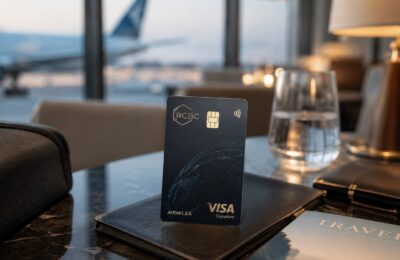
The RCBC Airmiles Visa Signature earns the top position because it offers a well-balanced combination of mileage earning, low foreign-currency costs, airport lounge benefits, insurance, and airline flexibility.
Cardholders earn:
- One Signature Airmile for every ₱25 overseas spend
- One Signature Airmile for every ₱48 local spend
Signature Airmiles do not expire and can be converted at a 1:1 ratio to participating programs that include Philippine Airlines Mabuhay Miles, Cathay Pacific Asia Miles, and AirAsia Rewards. (RCBC Credit Card)
The overseas earning rate is particularly appealing. If you regularly use your card for hotels, restaurants, shopping, and transportation while abroad, you can accumulate miles much faster than you would with many locally focused rewards cards.
Another major advantage is the foreign-currency fee. RCBC currently offers a promotional all-in rate of 1.50% until December 31, 2026. Its standard rate after the promotion is 1.70%, which is still competitive compared with many Philippine credit cards. (RCBC Credit Card)
Lounge benefits
Principal cardholders receive unlimited complimentary access to the PAGSS International Lounge at NAIA Terminal 1 when presenting an eligible card and international boarding pass.
The card also comes with Priority Pass membership and the opportunity to unlock as many as four complimentary international lounge visits per calendar year. However, there is an important condition: you must accumulate at least ₱250,000 in spending within a calendar quarter to unlock one free visit for that quarter. (RCBC Credit Card)
That spending requirement is quite high, so the Priority Pass benefit is most useful for big spenders. The unlimited local lounge access is easier to use.
Other travel benefits
The card provides international travel insurance of up to ₱20 million when the required conditions are met, including charging the eligible travel tickets to the card and completing the insurance registration process. It also includes Visa concierge and selected Visa Signature hotel privileges. (RCBC Credit Card)
The principal annual fee is ₱5,500. (RCBC Credit Card)
Possible drawbacks
The local earning rate of one mile per ₱48 is not the fastest in this ranking. Travelers who make most of their purchases in the Philippines may accumulate miles faster with Metrobank Travel Signature or Chinabank Destinations World.
The international Priority Pass visits also require substantial quarterly spending.
Who should get it?
The RCBC Airmiles Visa Signature is best for travelers who spend regularly overseas and want the freedom to transfer miles to more than one airline program.
2. EastWest Singapore Airlines KrisFlyer World Mastercard
Best for Singapore Airlines and overseas spending
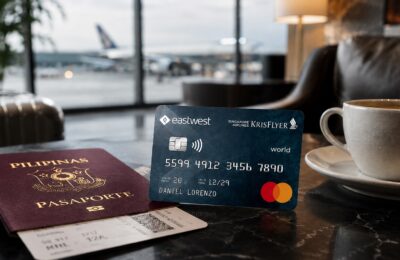
The EastWest Singapore Airlines KrisFlyer World Mastercard has one of the most aggressive travel-category mileage rates among Philippine credit cards.
You earn:
- One KrisFlyer mile per ₱12 spent on Singapore Airlines, Scoot, KrisShop, hotels, resorts, travel agencies, and qualifying cross-border transactions
- One mile per ₱38 spent on other airlines, local e-commerce purchases, and dining
- One mile per ₱78 spent on local essential categories (EastWest Bank)
That ₱12-per-mile rate can be extremely rewarding for someone who frequently books flights, hotels, or travel services. Even foreign transactions outside the traditional travel categories may qualify under the card’s cross-border category, subject to EastWest’s program rules.
Miles are automatically credited to your KrisFlyer account, removing the need to request a manual transfer.
Lounge benefits
The card includes Mastercard Travel Pass membership and ten complimentary airport lounge visits per year. The visits may be used by the cardholder or shared with a travel companion, subject to the program’s rules. (EastWest Bank)
Ten visits are generous enough for several international round trips, particularly if you travel alone.
Foreign-currency fee and insurance
The card has a low 1.70% foreign-currency conversion fee. It also offers comprehensive travel accident and inconvenience insurance of up to ₱20 million for eligible domestic or international trips purchased with the card. (EastWest Bank)
The principal annual fee is ₱5,000, while the first supplementary card is free for life. New-to-EastWest cardholders may also receive a first-year annual-fee waiver, subject to the bank’s conditions. (EastWest Bank)
Possible drawbacks
The biggest limitation is that your rewards go directly to Singapore Airlines KrisFlyer. Although KrisFlyer miles can be used for Singapore Airlines, Scoot, and eligible Star Alliance flights, they do not provide the same transfer flexibility as bank points that can be moved to several unrelated airline programs.
The card also has a relatively high published minimum gross annual income requirement of ₱2.6 million. (EastWest Bank)
Who should get it?
This is an excellent card for frequent international travelers who regularly fly Singapore Airlines, Scoot, or other Star Alliance carriers.
3. Metrobank Travel Signature Visa
Best for uncomplicated miles earning
Many travel cards use multiple categories, conversion formulas, and transfer ratios that make it difficult to calculate how many miles you are actually earning.
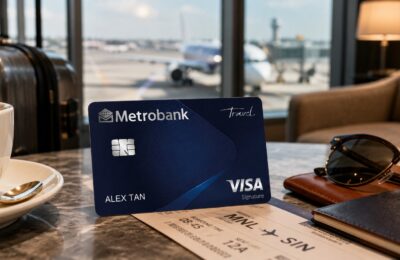
The Metrobank Travel Signature Visa keeps things simple: you earn one airline mile for every ₱30 spent on qualified purchases. The rate applies across purchases instead of being limited to a small group of travel merchants. (https://metrobank.com.ph)
This makes the card especially valuable for people whose everyday spending happens mainly in the Philippines. You can earn miles from groceries, dining, shopping, and other qualified transactions without having to remember which category offers the best rate.
Low foreign-currency fee
Metrobank charges a permanent 1.68% foreign-exchange service fee on qualifying foreign-currency purchases, making it one of the lowest ongoing rates among mainstream Philippine travel cards. (https://metrobank.com.ph)
That difference matters when you use your card frequently abroad. A card with a fee above 3% can charge more than twice as much on the same foreign-currency transaction.
Lounges and travel insurance
The card provides unlimited local airport lounge access at participating PAGSS and Plaza Premium lounges. It also includes complimentary travel insurance with coverage of up to ₱25 million when the eligibility requirements are met. (https://metrobank.com.ph)
The principal annual fee is ₱5,500 and is waived during the first year. Metrobank lists a minimum annual income requirement of ₱700,000 and may require an existing principal credit card from another bank with a qualifying credit limit and account history. (https://metrobank.com.ph)
Possible drawbacks
The regular headline benefit focuses more heavily on local lounges. Travelers looking for several automatic complimentary lounge visits abroad may prefer EastWest KrisFlyer World or Security Bank World.
Airline-mile redemptions must also follow Metrobank’s redemption increments and participating airline rules.
Who should get it?
Metrobank Travel Signature is ideal for travelers who want an easy-to-understand mileage rate and who make a large portion of their card purchases locally.
4. Chinabank Destinations World Mastercard
Best direct miles card with airline flexibility
The Chinabank Destinations World Mastercard earns one rewards point for every ₱30 spent, and each rewards point equals one airline mile.
The same earning structure applies to qualified local and international spending, so there is no need to manage different rates for dining, travel, groceries, and other purchases. (China Bank)
Depending on Chinabank’s current participating partners and transfer rules, accumulated miles may be redeemed through several airline programs. This makes it more flexible than a co-branded card that sends everything to just one frequent-flyer account.
Travel benefits
The card charges a low foreign-transaction fee of 1.70% and provides travel accident and inconvenience insurance of up to ₱20 million when eligible tickets are purchased using the card. (China Bank)
New cardholders may also receive a one-year Accor Plus Explorer membership after meeting the published spending requirement. The membership can provide participating hotel and dining privileges, although the exact inclusions and participating properties should be checked before relying on the benefit. (China Bank)
The principal annual fee is ₱6,000 and is waived for the first year under the published fee schedule.
Lounge access
The card comes with Mastercard Travel Pass membership, providing access to participating airport lounges. However, standard visits are not automatically free and are currently charged at US$32 per person per visit, or at the lounge provider’s prevailing rate. (China Bank)
Possible drawbacks
The ₱6,000 annual fee is relatively high for a card without automatic complimentary lounge visits.
That said, travelers who primarily care about earning miles and paying a low foreign-currency fee may still get strong value from the card.
Who should get it?
This card works well for travelers who want a simple ₱30-to-one-mile conversion and do not consider complimentary lounge access a priority.
5. BDO American Express Explorer Credit Card
Best for airline and hotel rewards
The BDO American Express Explorer Credit Card offers one of the most straightforward travel-rewards systems available locally.
You earn one Membership Rewards point for every ₱30 spent, and one Membership Rewards point is equivalent to one airline mile when transferred through eligible airline partners. Points do not expire. (American Express)
The card is particularly interesting because points can be converted not only to participating frequent-flyer programs but also to selected hotel loyalty programs. This gives you the option to use rewards for either flights or hotel stays.
Airport lounge access
Cardholders receive unlimited complimentary access to participating airport lounges whenever traveling overseas, subject to the current lounge-access conditions. (American Express)
Because lounge partners and access requirements may change, it is worth checking the current BDO American Express lounge list before going to the airport.
Other benefits
The card charges a 1.85% foreign-exchange conversion fee and offers complimentary family travel insurance of up to ₱10 million when the entire eligible travel fare is charged to the card. (American Express)
You can also receive 2,000 anniversary bonus points after reaching ₱600,000 in annual spending.
The principal annual fee is ₱4,000, but it is automatically waived when you spend at least ₱450,000 during the applicable year. The first-year fee is also waived. (American Express)
Possible drawbacks
American Express acceptance in the Philippines is not as universal as Visa or Mastercard acceptance. Major hotels, airlines, malls, and established merchants may accept it, but smaller shops and some online merchants may not.
It is sensible to carry a Visa or Mastercard as a backup, especially when traveling to smaller towns or less touristy destinations.
Who should get it?
The Explorer is best for travelers who want both airline and hotel transfer options and can meet the annual spending requirement to waive the fee.
6. Security Bank World Mastercard
Best for worldwide lounge access
The Security Bank World Mastercard is more attractive for its premium travel experience than for its direct mileage rate.
Cardholders receive six complimentary airport lounge visits annually, shared between the cardholder and guests, at participating lounges in the Mastercard airport network. (Security Bank Philippines)
Six visits can cover three round trips for a solo traveler or one to two trips when traveling with a companion.
Rewards earning
The World Mastercard earns three non-expiring BetterBanking Rewards points for every ₱20 spent on qualified transactions. Those points can be redeemed for participating airline miles, cash credits, electronic gift certificates, and other rewards. (Security Bank Philippines)
The final effective peso-to-mile rate varies because each participating airline can have its own conversion requirement. For that reason, it is not as easy to evaluate as a direct one-mile-per-₱30 card.
Fees and travel features
The card has a ₱5,000 annual fee after the first year. Its foreign-currency transactions are subject to a 1% Mastercard assessment fee plus a 1.5% Security Bank service fee, for a combined 2.50% before considering the network’s underlying currency-conversion rate. (Security Bank Philippines)
It also provides travel-related insurance and the option of dual-currency billing. Published eligibility requirements include a minimum gross annual income of ₱3 million. (Security Bank Philippines)
Possible drawbacks
The income requirement is one of the highest in this ranking.
Its 2.50% foreign-currency fee is also higher than those of RCBC Airmiles, Metrobank Travel Signature, EastWest KrisFlyer, Chinabank Destinations, and BPI’s premium travel cards.
Who should get it?
Security Bank World is best for higher-income travelers who value airport lounges and premium travel privileges more than having the lowest possible mileage or foreign-currency cost.
7. EastWest Singapore Airlines KrisFlyer Platinum Mastercard
Best mid-tier KrisFlyer card
The EastWest Singapore Airlines KrisFlyer Platinum Mastercard is a more attainable alternative to the KrisFlyer World Mastercard.
It earns:
- One KrisFlyer mile per ₱15 on Singapore Airlines, Scoot, KrisShop, travel agencies, hotels, resorts, and qualifying cross-border purchases
- One mile per ₱45 on other airlines, local e-commerce, and dining
- One mile per ₱88 on local essential spending (EastWest Bank)
The earning rates are slightly slower than those of the World card, but they remain strong for travel and international purchases.
Lounge access and insurance
The card provides four complimentary Mastercard Travel Pass lounge visits annually. It also offers travel accident and inconvenience insurance of up to ₱20 million when the required travel fare is purchased using the card. (EastWest Bank)
Its foreign-currency fee is 1.70%, while the principal annual fee is ₱4,000. The first supplementary card is free for life. (EastWest Bank)
EastWest currently publishes a minimum gross annual income requirement of ₱1.2 million for the card. (EastWest Bank)
Possible drawbacks
Like the World version, rewards are tied to KrisFlyer. The local essential-spending rate of one mile per ₱88 is also relatively slow.
The card makes more sense when a meaningful portion of your spending falls under travel or cross-border categories.
Who should get it?
This is suitable for Singapore Airlines and Scoot customers who want a lower annual fee and income requirement than the KrisFlyer World card.
8. BPI Signature Card
Best for existing BPI customers
The BPI Signature Card combines rewards, airport lounge access, travel insurance, and some of BPI’s strongest dining and lifestyle promotions.
Cardholders earn two BPI Rewards Points for every ₱20 spent. Points can be redeemed for airline miles, shopping credits, gift certificates, and other rewards. (Bank of the Philippine Islands)
The actual peso amount required per airline mile depends on BPI’s current airline-partner conversion rates. It is therefore not as simple as the direct earning systems of Metrobank Travel Signature or Chinabank Destinations World.
Travel benefits
The card offers complimentary access to the PAGSS International Lounge at NAIA Terminal 1 and free travel accident and inconvenience insurance of up to ₱20 million when the eligibility conditions are met. (Bank of the Philippine Islands)
It also comes with selected Visa Signature services, which can include concierge assistance, luxury-hotel privileges, airport transfers, and meet-and-greet arrangements. Some of these services may involve additional charges even though access to the booking platform is a card benefit.
The foreign-currency fee is 1.85%. The annual fee is waived during the first year and costs ₱5,500 from the second year onward. (Bank of the Philippine Islands)
Possible drawbacks
The card does not advertise several automatic free international lounge visits in the same way EastWest KrisFlyer World and Security Bank World do.
The rewards-to-airline-mile conversion also requires an additional calculation, so travelers must examine BPI’s current transfer ratios before deciding whether to use points for miles or another reward.
Who should get it?
BPI Signature is a strong option for BPI Preferred and other established BPI customers who value local dining, hotel promotions, NAIA lounge access, and premium banking convenience.
9. BPI Platinum Rewards Card
Best for occasional travelers
The BPI Platinum Rewards Card provides useful travel benefits without requiring the same annual fee as BPI Signature.
You earn:
- Two BPI Rewards Points per ₱30 local spend
- Two BPI Rewards Points per ₱20 foreign-currency spend at merchants outside the Philippines (Bank of the Philippine Islands)
This means the card rewards overseas purchases faster than local ones, which is appropriate for a travel-focused product.
Priority Pass benefit
The card comes with complimentary Priority Pass membership and the opportunity to receive up to four complimentary lounge passes per year.
There is a catch: each free pass requires an eligible single transaction of at least ₱30,000 with a participating airline, hotel, resort, or travel agency category. The lounge fee is initially billed and then handled according to BPI’s qualifying and reimbursement process. (Bank of the Philippine Islands)
This makes the benefit useful when booking an expensive flight or hotel stay, but not necessarily for people who travel using several smaller purchases.
Other travel benefits
The card provides complimentary travel insurance of up to ₱10 million when flights are booked using the card. Its foreign-currency fee is 1.85%. (Bank of the Philippine Islands)
The principal annual fee is ₱4,000 after a first-year waiver. (Bank of the Philippine Islands)
Possible drawbacks
The lounge passes are not unconditional. You must register for Priority Pass, make the qualifying travel transaction, and comply with BPI’s reimbursement rules.
It also uses BPI Rewards Points rather than giving one direct airline mile for a fixed peso amount.
Who should get it?
This card is suitable for occasional travelers who make a few substantial airline or hotel bookings each year and can use those purchases to unlock lounge visits.
10. UnionBank Miles+ Visa Signature
Best for never-expiring UB Miles
The UnionBank Miles+ Visa Signature earns one UB Mile for every ₱30 spent. UB Miles do not expire and can be converted to participating airline miles or redeemed for cash credits. (UnionBank)
The simple earning rate is attractive, especially for cardholders who prefer the UnionBank app and digital banking experience.
Lounge and insurance benefits
Cardholders receive free DragonPass membership with two complimentary lounge visits per membership year.
The card also includes travel insurance coverage of up to ₱1 million when eligible tickets are charged to the card. (UnionBank)
The principal annual fee is ₱5,000. (UnionBank)
The major drawback: foreign-currency fees
The standard foreign-currency transaction fee is 3.525%, which is substantially higher than the fees of most other cards in this ranking. (UnionBank)
UnionBank occasionally runs reduced-FX-fee promotions, but temporary rebates should not be treated as permanent card features. The bank’s previous 1.80% promotional rate for Miles+ transactions ended on July 31, 2026, while the standard fee continued to apply outside the promotion. (UnionBank)
Because of the regular fee, this card may be better for earning miles through local spending than for charging a large amount of foreign-currency purchases abroad.
Who should get it?
UnionBank Miles+ is best for people who value never-expiring internal miles, straightforward local earning, and UnionBank’s digital platform—but who do not expect to use the card heavily for foreign-currency transactions.
How to Choose the Best Travel Credit Card
The highest-ranked card is not automatically the best card for every traveler. Your choice should depend on how you travel and where you spend.
Consider your preferred airline
A co-branded card can be incredibly rewarding when you are loyal to its airline.
For example, the EastWest KrisFlyer cards make sense when you frequently use Singapore Airlines, Scoot, or Star Alliance redemption options. However, a flexible card such as RCBC Airmiles, Chinabank Destinations, Metrobank Travel Signature, or American Express Explorer may be better when you use different airlines.
Before applying, check the airline transfer partners and make sure they include programs you can realistically use.
Compare the true miles-earning rate
Do not assume that earning more “points” means earning more airline miles.
One card might award three rewards points per transaction but require several rewards points for one airline mile. Another might award only one point, but that point could already equal one mile.
Look for the card’s effective peso spend per airline mile, not just the number of rewards points shown in advertisements.
Check the foreign-currency fee
This is one of the most important considerations for international travelers.
Suppose you charge the peso equivalent of ₱100,000 during a trip:
- A 1.50% fee is approximately ₱1,500.
- A 1.70% fee is approximately ₱1,700.
- A 2.50% fee is approximately ₱2,500.
- A 3.525% fee is approximately ₱3,525.
The difference can easily cancel out the value of the miles you earned.
Also pay attention to how the terminal processes your payment. Review the displayed exchange rate carefully before accepting any merchant-provided conversion into Philippine pesos.
Understand the lounge conditions
“Airport lounge access” does not always mean free airport lounge access.
The benefit could be:
- Complimentary membership only, with every visit charged
- A limited number of free visits
- Unlimited access at selected Philippine lounges
- Visits unlocked only after meeting a spending requirement
- Complimentary access for the cardholder but paid access for guests
Read the lounge terms before assuming that your card gives you free entry.
Review the travel insurance activation rules
Complimentary travel insurance normally requires you to purchase an eligible airline ticket or travel fare using the card.
Some issuers may also require registration, a confirmation of coverage, or submission of the itinerary. Coverage limits can differ depending on the type of claim, the destination, the cardholder’s age, and whether the trip is domestic or international.
Do not rely solely on the large headline insurance amount. Read the policy coverage, exclusions, and claim requirements before traveling.
Calculate whether the annual fee is worth paying
A ₱5,000 annual fee may be reasonable when you regularly use several lounge passes, earn enough miles, and benefit from a low foreign-currency fee.
The same annual fee would be difficult to justify when you travel only once every few years and barely use the card.
Look at the benefits you actually used during the previous year—not the benefits you imagined you might use.
My Final Recommendations
For most travelers, these are the strongest choices:
Best overall: RCBC Airmiles Visa Signature
Best for straightforward local miles earning: Metrobank Travel Signature Visa
Best for Singapore Airlines: EastWest KrisFlyer World Mastercard
Best flexible ₱30-per-mile card: Chinabank Destinations World Mastercard
Best for airline and hotel transfers: BDO American Express Explorer
Best for international lounge access: Security Bank World Mastercard
Best mid-tier KrisFlyer card: EastWest KrisFlyer Platinum Mastercard
Best for existing BPI clients: BPI Signature Card
Best for occasional premium travel: BPI Platinum Rewards Card
Best for UnionBank users: UnionBank Miles+ Visa Signature
Final Thoughts
A travel credit card can make your trips more comfortable and rewarding, but only when it matches your actual spending habits.
There is little value in paying a premium annual fee for ten lounge visits when you travel only once a year. In the same way, an impressive mileage rate may not be worth it if the miles go to an airline you rarely use.
Start by identifying what matters most to you: faster miles, low foreign-currency fees, airport lounge access, travel insurance, or airline flexibility. From there, compare the cards based on the benefits you can realistically use.
Most importantly, always pay the entire statement balance by the due date. Travel miles and lounge visits can provide good value, but credit-card interest can quickly cost far more than the rewards you earn.
Information is based on publicly available issuer details checked in August 2026. Credit-card approval remains subject to each bank’s eligibility requirements and credit evaluation.