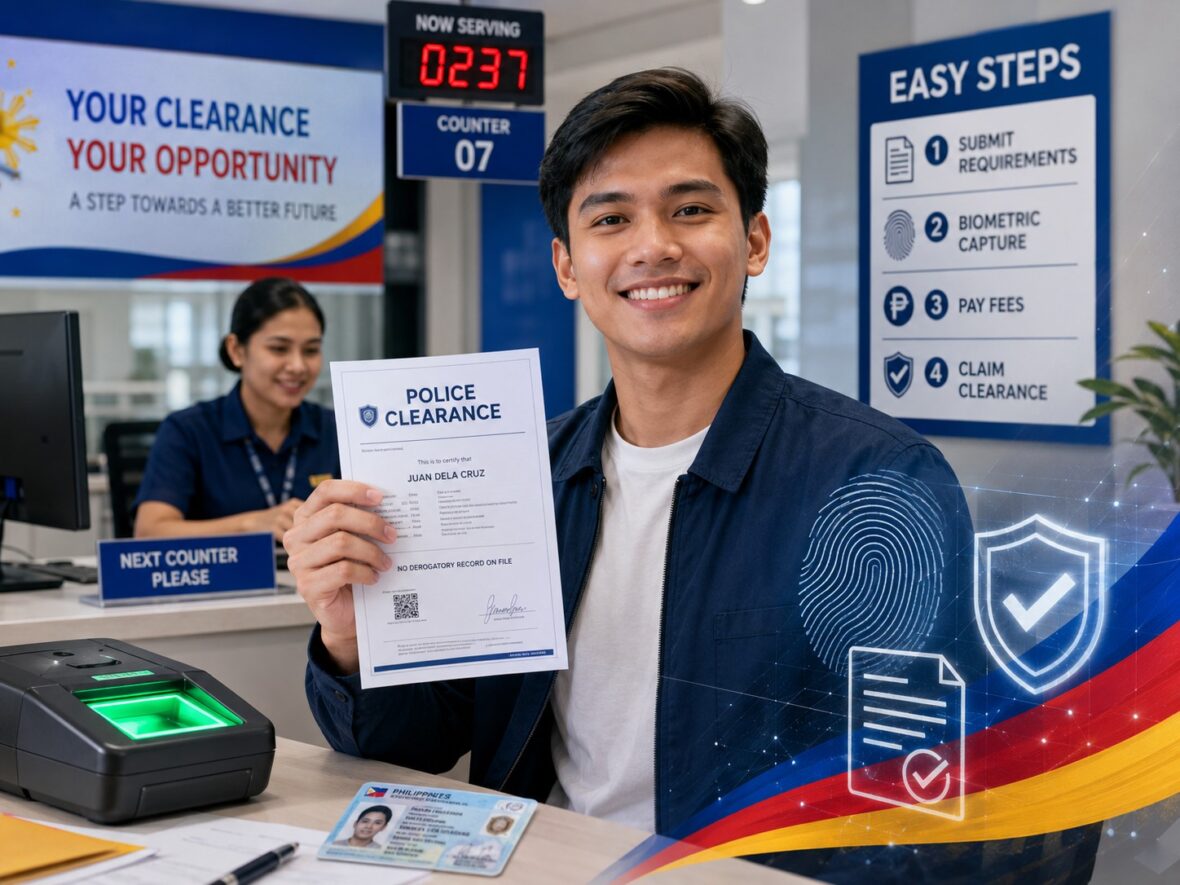
Getting a police clearance in the Philippines used to mean going directly to a police station, filling out forms, and hoping the line wasn’t too long. These days, the process is much more organized because much of the application starts online.
Through the Philippine National Police’s National Police Clearance System (NPCS), applicants can register, select a police station, schedule an appointment, and arrange payment before going to the station to complete the process. The PNP describes the NPCS as a nationwide system designed to make police-clearance issuance faster and more convenient.
Still, there’s an important thing to understand right away:
For most new applicants, getting a National Police Clearance is not completely online.
You start the application online, but you’ll normally need to visit your chosen police station on your appointment date for identity verification, biometrics, photo, signature, and final processing. The PNP’s current application tutorial specifically instructs applicants to proceed to their selected police station and bring their ID, payment proof, and appointment reference number.
If you’re applying for a job, government transaction, business requirement, or simply need a police clearance for your records, here’s a complete guide to getting one in the Philippines in 2026.
Updated: August 2026. Government procedures and payment options can change, so it’s always a good idea to check the official National Police Clearance System before your appointment.
Content
What Is a Police Clearance?
A Police Clearance is a document issued through the Philippine National Police that is used to certify the result of a police-record verification conducted through the PNP’s system.
Today, the more important document to know about is the National Police Clearance or NPC, which is processed through the National Police Clearance System.
Because the system is nationwide, you’re no longer dealing solely with the old-style clearance process tied to one local police station. The NPCS was created to provide a centralized and more convenient system for police-clearance issuance nationwide.
Police clearances are commonly requested for things such as:
- Job applications
- Pre-employment requirements
- Government transactions
- Business-related requirements
- Applications requiring background verification
- Other transactions in which an organization specifically requests a police clearance
However, always read the requirements given to you carefully.
If an employer says NBI Clearance, don’t automatically assume a Police Clearance can replace it. Likewise, if an agency specifically requests a Police Clearance, bring the document it actually asks for.
Police Clearance Requirements in the Philippines
One nice thing about the current system is that the basic requirements aren’t complicated.
According to the PNP’s National Police Clearance application instructions, an applicant going to the selected police station should prepare:
- One valid government-issued ID
- Proof of payment or Payment Confirmation
- Reference Number for the NPC appointment
- Personal appearance for biometrics, photo, and signature when required
That’s the basic checklist.
What valid ID should you bring?
The official application tutorial requires one valid government-issued ID.
It’s wise to use a current photo ID with your complete and correct name. Examples of government-issued IDs commonly used for identity verification include:
- Philippine National ID
- Philippine Passport
- Driver’s License
- PRC ID
- UMID or other applicable government-issued identification
The National ID, including the Digital National ID, is recognized as valid proof of identity for government and private transactions.
Even though the NPCS tutorial lists one valid government-issued ID as the basic requirement, I would personally bring another valid ID if you have one. It takes almost no extra effort and can be helpful if there’s an issue verifying your primary ID.
Most importantly, make sure the name and personal information you enter during online registration match your identification documents.
How Much Is Police Clearance in 2026?
The official National Police Clearance fee is ₱150.
The PNP’s application tutorial states that the clearance itself costs ₱150, while an additional convenience fee may be charged depending on the payment method you choose.
So your actual payment may look like this:
| Charge | Amount |
|---|---|
| National Police Clearance fee | ₱150 |
| Convenience/service fee | Varies by payment channel |
| Total | ₱150 + applicable convenience fee |
The exact convenience fee should be shown during the payment process.
Because payment partners and service charges can change, I’d rely on the amount displayed by the NPCS payment page rather than an old screenshot or blog post.
Is Police Clearance Free for First-Time Jobseekers?
Here’s some very good news if you’re applying for your first job.
Under Republic Act No. 11261, or the First Time Jobseekers Assistance Act, eligible first-time jobseekers can obtain certain government documents without paying the usual government fees.
And Police Clearance is specifically included.
The law states that no fees or charges should be collected from qualified first-time jobseekers when obtaining documents including:
- Police Clearance
- NBI Clearance
- Barangay Clearance
- Certain medical certificates
- Birth Certificate
- Marriage Certificate
- TIN
- UMID
- Other government-issued documentary requirements used for employment
There is one important requirement.
You must provide a barangay certification stating that you are a first-time jobseeker. The benefit can generally be used only once under the law.
So if this is your first time applying for work, don’t immediately pay for all your pre-employment documents.
Check whether you qualify for the First Time Jobseekers Assistance Act first.
How to Apply for Police Clearance Online in 2026
The process starts online and is fairly straightforward once you know what to expect.
Here’s the step-by-step guide.
Step 1: Go to the Official National Police Clearance System
Start at the official PNP National Police Clearance System.
Be careful when searching online because you’ll find plenty of websites offering guides about Police Clearance. Some are useful, but your actual account and application should be handled through the official PNP system.
The official NPCS website provides registration, login, application tutorials, clearance verification, and other police-clearance services.
Step 2: Register for an Account
If this is your first application, choose Register.
If you already have an NPCS account from a previous application, log in instead.
The PNP’s official tutorial instructs new applicants to click Register, while existing applicants should use the login option.
You’ll be asked to supply personal information.
Take your time here.
Don’t rush through your name, birthday, or other details because these will eventually appear in or be connected with your clearance record.
Double-check:
- First name
- Middle name
- Last name
- Suffix, if applicable
- Date of birth
- Mobile number
- Address and other required profile information
If your legal name contains a suffix such as Jr., Sr., II, or III, enter it correctly where the system provides the appropriate field.
Step 3: Complete Your Applicant Profile
After creating your account, complete the required information in your profile.
Again, use the same information shown on your government-issued IDs.
It’s worth reviewing everything before moving forward because correcting a typo later is much more inconvenient than spending an extra minute checking your application now.
Step 4: Start a Police Clearance Application
Once you’re logged in and your profile is complete, proceed with the National Police Clearance application.
You’ll then move into the appointment process.
Depending on the options displayed in your account, you’ll be able to choose the appropriate application or renewal process.
Step 5: Choose Your Police Station
Select an available police station where you want your clearance processed.
This is an important step because this is the station you’ll normally need to visit for your scheduled appointment.
Choose somewhere that’s actually convenient for you—not simply the first station that appears.
If several locations are available, consider:
- Distance from your home or workplace
- Transportation
- Available appointment slots
- Your schedule
- Operating days and hours
Save or screenshot the station details once you’ve confirmed your appointment.
Step 6: Select an Appointment Date
Choose an available appointment date and time.
Once your appointment has been generated, keep your reference number.
Don’t delete it.
The appointment reference number is one of the items the PNP instructs applicants to present during processing.
I recommend saving it in at least two places:
- Take a screenshot.
- Copy it into your phone’s notes.
That way, even if you accidentally close a browser tab or lose a printed copy, you still have it.
Step 7: Pay the Police Clearance Fee
Proceed to payment after completing the required application steps.
The current base Police Clearance fee is:
₱150
Additional convenience fees depend on the payment method.
Follow the payment instructions displayed in the system and complete the transaction through one of the available payment channels.
After paying, save your payment confirmation or electronic receipt.
Don’t assume the system will be the only place where you can retrieve it later.
Take a screenshot or save the electronic receipt on your phone.
Step 8: Prepare for Your Appointment
Before leaving home, check that you have everything.
Police Clearance appointment checklist
Bring:
- Valid government-issued ID
- Appointment/reference number
- Proof of payment
- Your phone with your NPCS information and screenshots
If you’re a qualified first-time jobseeker seeking the fee exemption, bring the applicable First Time Jobseeker barangay certification as required under RA 11261.
I’d also bring:
- An extra government ID if available
- Your own pen
- A little extra time before your appointment
Simple preparation can save you from having to make another trip.
Step 9: Go to Your Selected Police Station
Proceed to the police station you selected on your appointment date.
The PNP’s application instructions specifically tell applicants to proceed to the selected Police Station on the date of appointment and present the required documents.
Try to arrive a little earlier instead of showing up at the last minute.
At the station, follow the instructions of the NPCS or clearance personnel.
Step 10: Biometrics, Photo and Signature
One reason a first-time application generally can’t be completed entirely from home is that the PNP needs to complete identity and biometric processing.
The official NPCS instructions include:
- Biometrics
- Picture
- Signature
as part of the Police Clearance process.
This is usually the part where you’ll be asked to proceed to the appropriate counter or equipment for your information to be captured.
Step 11: Verification and Release
After your information and biometrics are processed, the system performs the required verification.
The PNP application tutorial tells applicants to wait for their name to be called either for the verification process or release of the National Police Clearance.
If there are no issues requiring additional verification, the process can move on to clearance release.
Keep your clearance somewhere safe once you receive it.
And before leaving the station, check the document carefully.
Look at:
- Your full name
- Date of birth
- Other personal details
- Issue date
- Any validity information printed on the clearance
If you spot an obvious error, it’s much better to raise it while you’re still at the station.
What Happens If Your Police Clearance Gets a “Hit”?
Don’t automatically panic if your application requires additional verification.
A possible system match or “hit” doesn’t by itself mean you’re guilty of a crime.
Names can be similar, records may need to be distinguished from one another, and additional verification can sometimes be necessary before a clearance is released.
The PNP’s clearance-certification process specifically includes checking and clearing applicable “hits” before approval.
If your application requires further verification, follow the instructions given by the clearance personnel.
It may mean your clearance takes longer than someone whose application moves straight to release.
How Long Does Police Clearance Processing Take?
There isn’t one processing time that will apply perfectly to every applicant and every station.
The online portion can be completed relatively quickly, but the actual appointment depends on:
- Appointment availability
- Number of applicants
- Police station workload
- Verification results
- Whether your application requires additional review
Once you’re at the station, the PNP’s standard process proceeds from document presentation and biometrics to verification and clearance release.
So if you’re applying because an employer needs the document, don’t wait until your final deadline.
Apply early.
Can You Get Police Clearance Without an Appointment?
For the National Police Clearance process, you should complete the required online registration and appointment procedure rather than simply assuming you can walk into any police station and be processed.
The official PNP application process includes online registration and a scheduled visit to your selected police station.
Individual stations may have different crowd-management procedures, so following the appointment generated by your NPCS account is the safest approach.
Can Police Clearance Be Applied for Completely Online?
For a regular new applicant, think of the process as:
Online application + physical processing
You can handle the early stages online:
- Registration
- Profile creation
- Application
- Appointment
- Payment
But the standard process then requires you to proceed to the selected police station for the in-person requirements, including biometrics, picture, signature, verification, and release.
So don’t apply expecting a new Police Clearance to simply arrive in your email without going through the required identity-verification process.
What About Police Clearance Renewal?
If you’ve obtained a National Police Clearance before, don’t create a brand-new account every time.
The PNP’s renewal instructions say applicants should use the existing NPC account from their previous application.
There’s also an important development for returning applicants.
The current NPCS website says that individuals who have completed an NPC clearance process in person within the last three years may be eligible to use its non-appearance process.
That’s potentially very convenient because qualified returning applicants may not need to repeat exactly the same process as a first-time applicant.
Eligibility and instructions should be checked inside your NPCS account because the system can determine which option applies to you.
Police Clearance vs. NBI Clearance: Are They the Same?
No.
A National Police Clearance is issued through the Philippine National Police, while an NBI Clearance is issued through the National Bureau of Investigation.
For ordinary applicants, the most important practical rule is simple:
Submit the document that was requested.
If your employer says:
“Please submit an NBI Clearance.”
Get an NBI Clearance.
If the requirement says:
“Police Clearance.”
Get the appropriate Police Clearance.
Some employers may accept either, while others specifically require one.
Never assume the documents are interchangeable unless the company or agency requiring them confirms that they are.
National Police Clearance vs. Local Police Clearance
The National Police Clearance System is designed for nationwide police-clearance issuance.
That makes the NPC different from the older idea of simply obtaining a clearance based only on a local police-station process.
However, you’ll occasionally encounter applications, LGUs, employers, or other transactions that use terms such as:
- Police Clearance
- Local Police Clearance
- National Police Clearance
If the requirement isn’t clear, ask the requesting organization exactly which document it wants before spending time and money applying.
Can I Use the National ID for Police Clearance?
The NPCS requires a valid government-issued ID.
The Philippine National ID is an official government proof of identity, and the PSA says the Digital National ID carries the same validity and functionality as the physical National ID and can be presented in government and private transactions.
Still, I recommend carrying another physical government ID if you have one, especially when visiting any government office.
It gives you a backup if there are technical or verification issues.
How Long Is a Police Clearance Valid?
Check the validity information indicated on the Police Clearance you actually receive and also check the requirements of the employer or agency asking for it.
This matters because organizations sometimes impose their own rule that a clearance must have been issued recently, even if the document itself has not yet reached the end of its stated validity.
So rather than relying on an old online article telling you a universal number of months, use the information on your current clearance and the requirements of whoever will receive it.
Can Someone Else Get My Police Clearance for Me?
For a standard new application, remember that biometrics, photograph, signature, and identity verification are part of the process.
That means you should expect to complete the personal-appearance requirements yourself unless the PNP specifically provides a different procedure for your situation.
The NPCS also publishes separate Clearance Certification procedures for special situations, including Filipinos working or based abroad, bedridden applicants, certain petitioners, and deceased persons.
If your situation falls into one of those special categories, follow that specific PNP procedure rather than the ordinary walk-in appointment process described here.
Tips Before Applying for Police Clearance
The process itself isn’t particularly difficult, but a few simple things can make the experience smoother.
1. Use the official NPCS website
Don’t enter your personal information into a random website just because it appears when you search “Police Clearance Online.”
Actual registration should be handled through the official PNP National Police Clearance System.
2. Match your application to your ID
Your spelling, middle name, suffix, birthday, and other important details should be consistent with your supporting documents.
3. Screenshot everything
Save copies of:
- Appointment
- Reference number
- Payment confirmation
- Transaction details
Phone screenshots have saved many people from having to hunt through emails while standing at a government counter.
4. Don’t forget your original ID
Having a screenshot of an ID on your phone shouldn’t be treated as a guaranteed substitute for the actual identification required for processing.
Bring the proper valid government-issued identification.
5. Arrive early
Government offices can get busy. Giving yourself extra time is much less stressful than arriving right before your appointment slot.
6. Apply before you urgently need it
If your name requires additional verification, you don’t want to discover that the day before your employer’s deadline.
7. First-time jobseekers should ask about the fee exemption
You may be entitled to obtain your Police Clearance free under RA 11261 if you meet the law’s requirements and present the proper barangay certification.
That’s money you don’t need to spend unnecessarily.
Frequently Asked Questions About Police Clearance
How much is Police Clearance in the Philippines in 2026?
The official National Police Clearance fee is ₱150, plus any convenience fee charged by the selected payment channel.
What do I need to bring to my appointment?
The PNP application instructions list one valid government-issued ID, proof of payment, and your NPC appointment reference number. Biometrics, photo, and signature are also part of the processing procedure.
Can I apply for Police Clearance online?
Yes. Registration, application, appointment scheduling, and payment begin online through NPCS. New applicants normally still need to go to the selected police station to complete the in-person processing requirements.
How much should a first-time jobseeker pay?
A qualified first-time jobseeker can be exempt from government fees for a Police Clearance under Republic Act No. 11261, subject to the law’s requirements, including presenting the required barangay certification.
Do I need two valid IDs?
The current PNP National Police Clearance application tutorial specifies one valid government-issued ID among the requirements to present at the selected police station.
Bringing a second ID as a backup is still a practical idea.
Is Police Clearance the same as NBI Clearance?
No. Police Clearance is processed through the Philippine National Police, while NBI Clearance comes from the National Bureau of Investigation. Follow whichever document your employer or agency specifically asks for.
Can I renew my Police Clearance online?
Returning applicants should use their existing NPC account. The current NPCS website also says applicants who completed an in-person NPC clearance process within the last three years may be eligible for its non-appearance process.
What if I forgot my NPCS password?
The NPCS provides an online password-reset function for registered applicants.
Where can I verify a Police Clearance?
The official NPCS includes a clearance-verification function that uses clearance information such as the transaction/serial details and the applicant’s surname.
National Police Clearance Contact Information
If you’re having a problem that can’t be resolved through the website, the official NPCS currently lists the following contact information:
NPCS One-Stop Shop
Telephone: (02) 723-0401 local 7663
Mobile: +63 927 964 6657
Office hours: Monday to Friday, 8:00 AM to 5:00 PM
Office hours and contact information can change, so check the NPCS website for the latest details before calling.
Final Thoughts
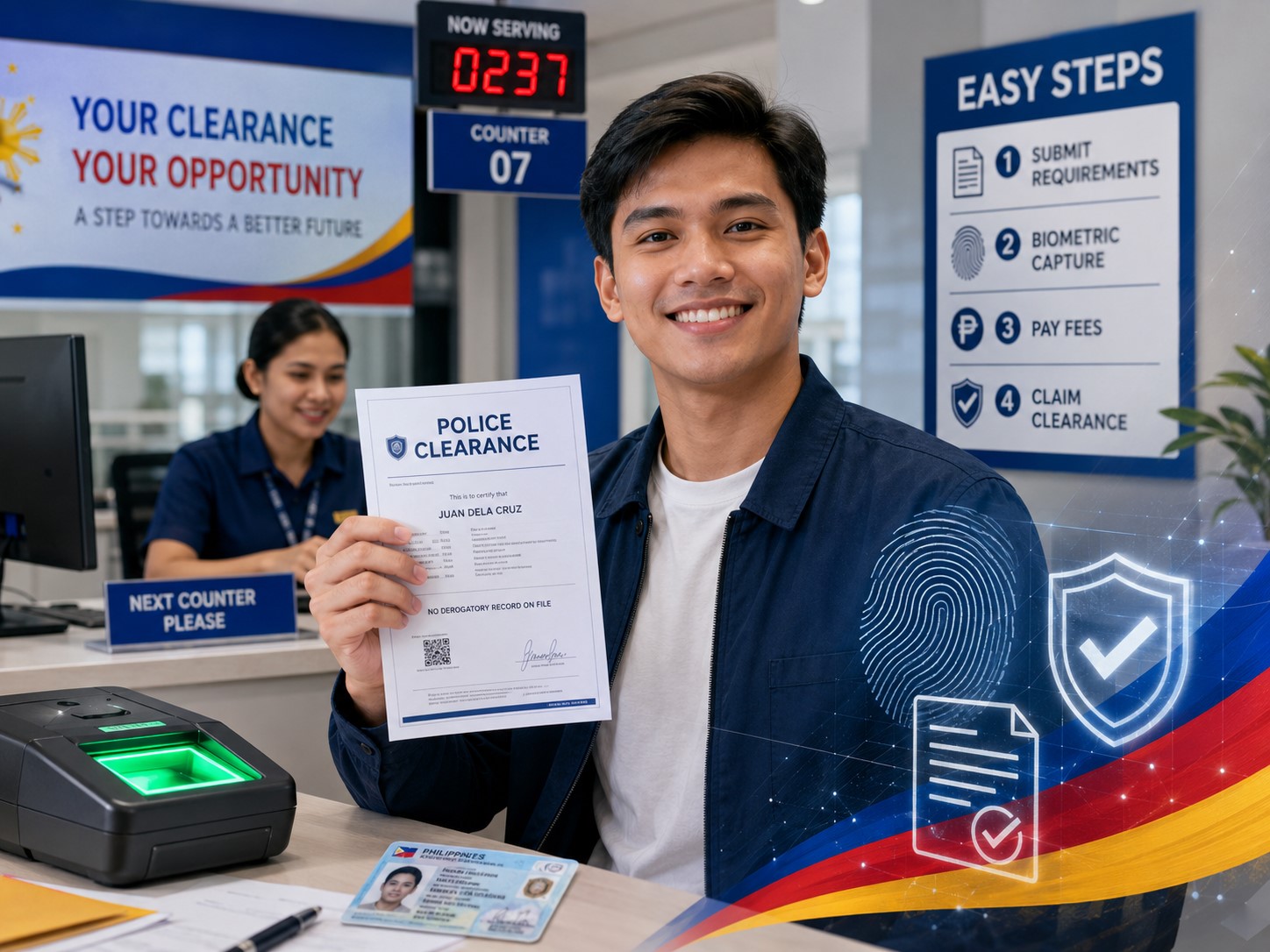
Getting a Police Clearance in the Philippines in 2026 is much easier once you understand that there are really two parts to the process.
First, you do the preparation online:
Register → complete your profile → apply → choose a police station → schedule → pay.
Then you complete the required processing at your chosen police station:
Present your requirements → biometrics/photo/signature → verification → clearance release.
For regular applicants, the official clearance fee is currently ₱150 plus any applicable payment-channel convenience fee.
And if you’re applying for your very first job, remember one particularly useful benefit: qualified first-time jobseekers can get a Police Clearance without paying the normal government fee under the First Time Jobseekers Assistance Act, provided they meet the requirements.
The biggest tip is simply to prepare everything before your appointment. Double-check your personal details, bring your valid ID, save your reference number and payment confirmation, and arrive with enough time to complete the process.
Once you’ve done the online application properly, the rest is much more straightforward.