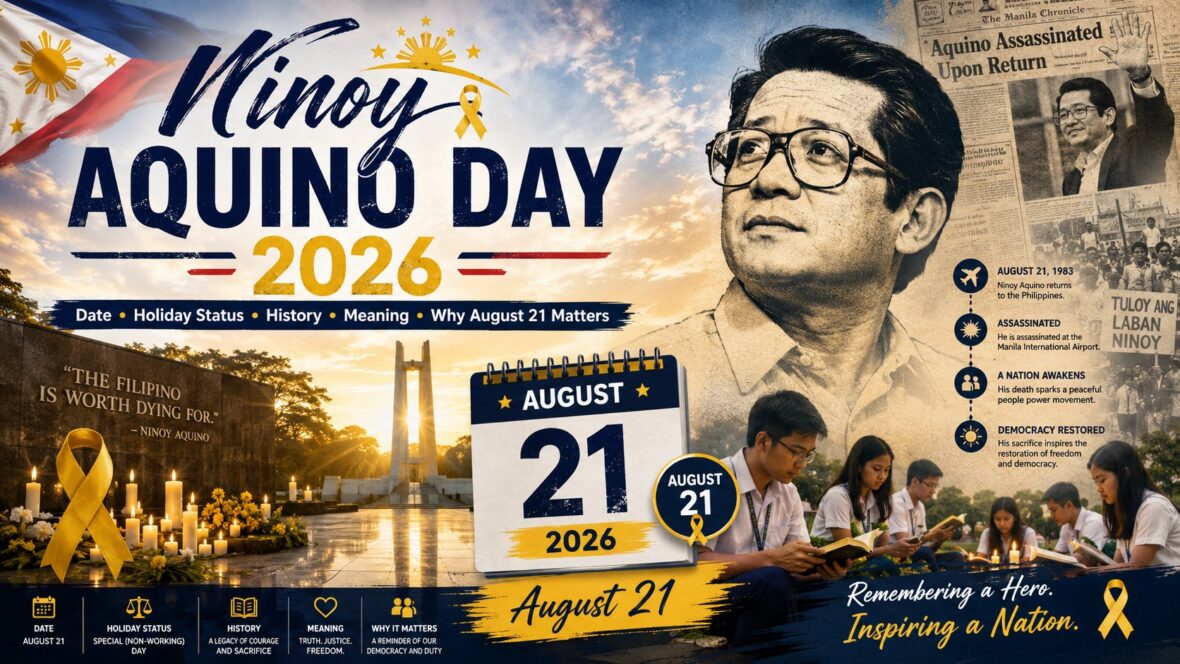
Every August 21, the Philippines observes Ninoy Aquino Day, a national holiday commemorating the death anniversary of former Senator Benigno “Ninoy” Aquino Jr.
For 2026, Ninoy Aquino Day falls on Friday, August 21, making it part of a potential three-day weekend for many Filipinos.
But beyond the practical questions—Is there work? Are there classes? Is it a regular holiday?—Ninoy Aquino Day marks one of the most consequential moments in modern Philippine history.
Aquino’s assassination on August 21, 1983 became a major turning point in the political crisis of the Marcos era and helped galvanize the opposition movement that eventually culminated in the 1986 EDSA People Power Revolution.
Here is a complete guide to Ninoy Aquino Day 2026, including its history, meaning, holiday classification, and what Filipinos need to know about August 21.
Content
When Is Ninoy Aquino Day 2026?
Ninoy Aquino Day is observed every year on August 21.
In 2026, it falls on:
Friday, August 21, 2026
The date commemorates the assassination of Benigno “Ninoy” Aquino Jr. on August 21, 1983.
Unlike holidays that sometimes move to the nearest Monday, the 2026 government holiday calendar specifically lists August 21 as the observance date.
President Ferdinand Marcos Jr.’s Proclamation No. 1006, which sets the national holidays for 2026, recognizes August 21 as a special non-working day.
Is Ninoy Aquino Day a Regular Holiday?
No.
Ninoy Aquino Day is a special non-working day, not a regular holiday.
This distinction matters particularly for employees because Philippine labor rules provide different pay computations for regular holidays and special non-working days.
Republic Act No. 9256 declares August 21 of every year as Ninoy Aquino Day and a national non-working holiday.
The government’s official 2026 holiday proclamation likewise includes Ninoy Aquino Day among the year’s special non-working days.
For students and many workers, the practical result is straightforward: August 21 is generally observed as a day without regular classes or government-office work, subject to applicable institutional and employment arrangements.
Is August 21, 2026 a Long Weekend?
For many Filipinos, yes.
Because August 21 falls on a Friday in 2026, people who normally have Saturdays and Sundays off may enjoy a three-day weekend:
Friday, August 21 – Ninoy Aquino Day
Saturday, August 22
Sunday, August 23
Regular school and office schedules would generally resume on Monday, August 24, unless another suspension or special announcement is issued.
That makes Ninoy Aquino Day one of the notable long weekends in the 2026 Philippine calendar.
Who Was Ninoy Aquino?
Benigno Simeon “Ninoy” Aquino Jr. was a Filipino politician who became one of the best-known opposition figures during the presidency of Ferdinand Marcos Sr.
He was born on November 27, 1932 in Concepcion, Tarlac.
Aquino entered politics at a young age and eventually held several positions in government, including mayor, vice governor, governor, and senator.
By the late 1960s and early 1970s, he had emerged as one of the country’s most prominent political figures and a leading critic of President Marcos.
His political career changed dramatically when Martial Law was declared in September 1972.
Ninoy Aquino During Martial Law
Following the declaration of Martial Law, Aquino was arrested along with other opposition figures.
He spent several years in detention and faced charges before a military tribunal.
During his imprisonment, Aquino became an increasingly important symbol for groups opposed to the Marcos government.
In 1980, after experiencing health problems, he was allowed to travel to the United States for medical treatment.
Aquino and his family lived in the United States for several years.
Despite warnings about the dangers of returning to the Philippines, Aquino eventually decided to come home.
That decision would lead to one of the most famous—and tragic—moments in Philippine political history.
What Happened on August 21, 1983?
On August 21, 1983, Ninoy Aquino arrived at what was then known as Manila International Airport after traveling from the United States through several Asian cities.
Aquino knew that returning to the Philippines carried serious risks.
Upon landing, he was escorted from the aircraft by security personnel.
Moments later, Aquino was shot and killed on the airport tarmac.
He was 50 years old.
The killing immediately became a major national and international story.
Another man, Rolando Galman, was also killed at the scene.
Questions surrounding the assassination, responsibility for the killing, and the circumstances that allowed it to happen became central issues in Philippine politics.
Why Was Ninoy Aquino’s Assassination So Important?
Aquino’s assassination dramatically changed the country’s political atmosphere.
Opposition to the Marcos government already existed before 1983, but Aquino’s death intensified public anger and political mobilization.
His funeral became one of the largest public gatherings of the period, attracting enormous crowds.
For many Filipinos, the assassination became a symbol of the country’s broader political problems.
In the years that followed, protests grew, opposition groups became more active, and pressure increased on the Marcos administration.
The Philippines also faced serious economic difficulties during this period.
Aquino’s death therefore became part of a much larger national crisis involving politics, the economy, public confidence, and democratic institutions.
From Ninoy Aquino’s Death to the EDSA People Power Revolution
The events following Aquino’s assassination ultimately contributed to the political conditions that led to the 1986 EDSA People Power Revolution.
In 1986, President Ferdinand Marcos Sr. called a snap presidential election.
Aquino’s widow, Corazon “Cory” Aquino, emerged as the principal opposition candidate.
The election became highly controversial, with competing claims over the results and widespread allegations of electoral fraud.
The political crisis eventually led to mass demonstrations along Epifanio de los Santos Avenue, or EDSA, in February 1986.
The four-day People Power uprising ended with Marcos leaving the Philippines and Corazon Aquino assuming the presidency.
For this reason, Ninoy Aquino’s assassination is often described as one of the major catalysts that helped accelerate the opposition movement leading toward EDSA.
It is important, however, to understand that the fall of the Marcos government resulted from many interconnected factors—including political opposition, economic problems, divisions within the military, civil-society movements, religious organizations, international pressure, and public demonstrations.
Why Is August 21 Called Ninoy Aquino Day?
Ninoy Aquino Day commemorates the anniversary of Aquino’s death, not his birthday.
The legal basis for the holiday is Republic Act No. 9256.
Signed into law on February 25, 2004, RA 9256 declared August 21 of every year as Ninoy Aquino Day in remembrance of the former senator’s death anniversary.
The law established the date as a national non-working holiday and provided for appropriate commemorative activities.
That means the holiday has now been officially observed for more than two decades.
Why Does Ninoy Aquino Day Matter?
The significance of Ninoy Aquino Day goes beyond remembering a single political personality.
The holiday is closely connected to broader themes in Philippine history, including:
- Martial Law;
- political opposition;
- civil liberties;
- freedom of expression;
- democratic institutions;
- human rights;
- the 1986 EDSA People Power Revolution; and
- peaceful political participation.
For many Filipinos, the holiday serves as a reminder of the country’s struggle to protect democratic institutions.
For students, it is also an opportunity to study one of the most important periods in contemporary Philippine history.
At the same time, Ninoy Aquino and the political era surrounding him remain subjects of intense debate.
Different Filipinos may have different interpretations of Aquino, the Aquino family, the Marcos family, Martial Law, and EDSA.
That makes careful historical research particularly important.
Primary documents, established historical records, court decisions, government archives, academic scholarship, and reputable news organizations are generally more useful than anonymous social-media posts when trying to understand the period.
Why Is NAIA Named After Ninoy Aquino?
The Philippines’ main international gateway in Metro Manila is officially called Ninoy Aquino International Airport, or NAIA.
That is particularly significant because it is the same airport where Aquino was assassinated in 1983.
At the time of the assassination, it was known as Manila International Airport.
In 1987, Republic Act No. 6639 renamed it Ninoy Aquino International Airport.
The airport’s name has periodically become a subject of political discussion, with proposals over the years seeking to change it.
But NAIA remains the airport’s official name as of 2026.
Are There Classes on Ninoy Aquino Day?
For most schools observing the national holiday, regular classes are not held on August 21.
Because Ninoy Aquino Day is a special non-working day nationwide, public schools generally do not conduct regular classes.
Many private schools, colleges, and universities also observe the holiday.
However, students should still check their institution’s official academic calendar.
Some universities may have special arrangements involving internships, hospital duties, make-up activities, or other programs.
For Friday, August 21, 2026, many Filipino students can therefore expect #WalangPasok because of Ninoy Aquino Day.
Are Government Offices Open on August 21?
Most government offices normally suspend regular operations during a nationwide special non-working day.
That means routine transactions at many government agencies may not be available.
However, essential government services continue operating.
These can include hospitals, emergency units, police and security services, disaster-response agencies, and other offices performing essential functions.
If you have an appointment involving an agency such as the DFA, LTO, NBI, SSS, Pag-IBIG, or another government office, check its official holiday advisory before traveling.
Are Private Companies Closed?
Not necessarily.
A special non-working holiday doesn’t mean every private establishment is required to shut down completely.
Businesses that may continue operating include:
malls, supermarkets, restaurants, hotels, hospitals, BPO companies, transportation operators, tourist attractions, and other establishments that operate during weekends and holidays.
Employees should check directly with their employers regarding August 21 work schedules.
What Are the Pay Rules on Ninoy Aquino Day?
Because Ninoy Aquino Day is a special non-working day, its pay rules are different from those applying to regular holidays.
In general, employees who do not work on a special non-working day may be subject to the “no work, no pay” principle unless a company policy, collective bargaining agreement, or other arrangement provides otherwise.
Employees who are required to work may be entitled to premium pay under applicable labor regulations.
Workers should consult the Department of Labor and Employment’s current holiday-pay guidelines or their company’s HR department for the exact calculation applying to their circumstances.
Are Malls Open on Ninoy Aquino Day?
Most major Philippine malls usually remain open during special non-working holidays.
Some may follow adjusted operating hours.
Restaurants, cinemas, supermarkets, entertainment centers, and retail stores are also commonly open.
Since Ninoy Aquino Day falls on a Friday in 2026, malls and tourist destinations may experience heavier crowds because of the three-day weekend.
Always check the establishment’s official page if you’re planning a visit.
Is Public Transportation Available?
Yes, public transportation generally continues operating during Ninoy Aquino Day.
Jeepneys, buses, taxis, UV Express vehicles, ride-hailing services, and many other transport options typically remain available.
Rail systems such as the MRT and LRT may also operate but can follow special holiday schedules.
Provincial buses, ferries, and airlines may experience higher passenger volumes because of the long weekend.
Travelers planning to leave Metro Manila for August 21-23 should consider booking transportation early.
How Is Ninoy Aquino Day Observed?
Unlike Christmas, New Year, or many religious holidays, Ninoy Aquino Day isn’t typically celebrated through large festivals.
The tone is primarily commemorative.
Activities may include wreath-laying ceremonies, historical programs, museum activities, speeches, educational discussions, documentaries, exhibits, and social-media commemorations.
Schools may also hold lessons or activities about Aquino, Martial Law, and Philippine democracy before or after the holiday.
Some people use the occasion simply as an opportunity to spend time with family or travel during the long weekend.
Ninoy Aquino Day vs. EDSA People Power Anniversary
These two commemorations are closely related but are not the same event.
Ninoy Aquino Day – August 21
Commemorates the assassination of Benigno Aquino Jr. in 1983.
EDSA People Power Revolution Anniversary – February 25
Commemorates the events of February 1986 that resulted in the end of the Marcos presidency and the assumption of Corazon Aquino as president.
Interestingly, Republic Act No. 9256 establishing Ninoy Aquino Day was itself approved on February 25, 2004, the anniversary of the People Power Revolution.
In the 2026 holiday calendar, February 25 is designated separately as a special working day, while August 21 is a special non-working day.
Ninoy Aquino Day Quick Facts
Here are some of the most important facts to remember:
- Date: August 21 every year
- 2026 date: Friday, August 21, 2026
- Holiday classification: Special non-working day
- Person commemorated: Benigno “Ninoy” Aquino Jr.
- Date of assassination: August 21, 1983
- Place: Manila International Airport
- Age at death: 50
- Legal basis: Republic Act No. 9256
- Law approved: February 25, 2004
- Major historical connection: Events leading toward the 1986 EDSA People Power Revolution
- Potential 2026 long weekend: August 21-23
Is Ninoy Aquino Day Celebrated Every Year?
Yes.
Republic Act No. 9256 establishes August 21 of every year as Ninoy Aquino Day.
The annual presidential proclamation listing regular holidays and special days confirms how the holiday will be observed for a particular calendar year.
For 2026, Proclamation No. 1006 confirms the observance of Ninoy Aquino Day as a national special non-working day.
Ninoy Aquino Day 2026: What You Need to Remember
If you’re mainly checking because you’re wondering whether there’s work or school on August 21, here’s the simplest answer:
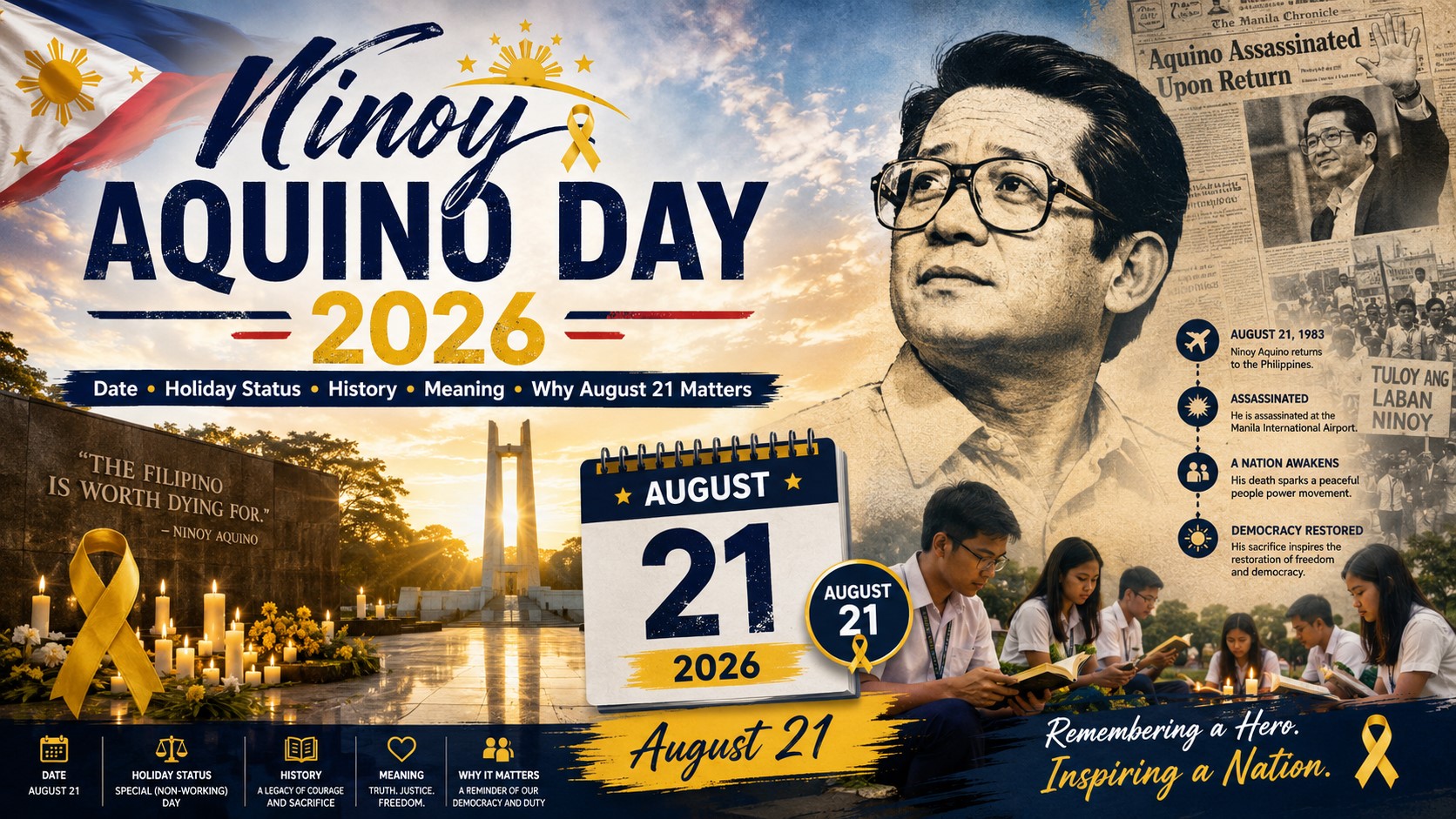
August 21, 2026 is Ninoy Aquino Day, and it is a special non-working day nationwide.
It falls on a Friday, giving many Filipinos a three-day weekend through Sunday, August 23.
Regular government-office operations and many school activities are generally suspended, while private companies may have different work arrangements.
But Ninoy Aquino Day is more than another date on the Philippine holiday calendar.
August 21 remembers an event that dramatically changed the direction of Philippine politics.
The assassination of Ninoy Aquino in 1983 intensified opposition to the Marcos government, became a powerful symbol during a period of political and economic turmoil, and formed part of the chain of events that culminated in the 1986 EDSA People Power Revolution.
More than four decades later, Filipinos continue to discuss—and sometimes strongly disagree about—the people and events of that era.
That makes August 21 particularly important.
It isn’t simply a day to remember one politician. It is also an opportunity to study Philippine history more carefully, understand how democratic institutions can be challenged, examine competing historical narratives, and appreciate why events from decades ago continue to influence Philippine politics today.
And for 2026, there’s one practical detail that’s especially easy to remember:
Ninoy Aquino Day falls on Friday, August 21—giving many Filipinos a long weekend while the country commemorates one of the defining events of its modern history.