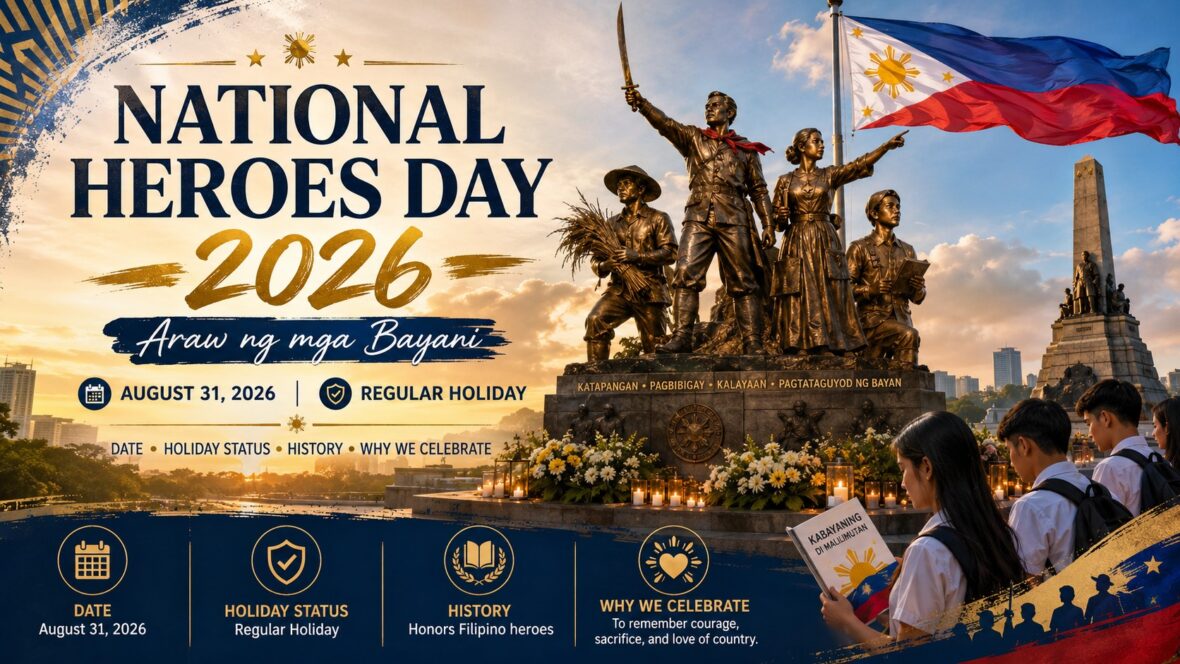
Every year, Filipinos observe National Heroes Day, or Araw ng mga Bayani, to honor the men and women who helped shape the Philippines through courage, sacrifice, patriotism, and service to the nation.
For 2026, National Heroes Day falls on Monday, August 31, 2026.
That makes it especially notable because it creates a three-day weekend from August 29 to 31 for many Filipinos.
But National Heroes Day is more than just another long weekend on the Philippine holiday calendar.
Unlike holidays dedicated to one specific historical figure, Araw ng mga Bayani honors all Filipino heroes—both the famous figures remembered in textbooks and the countless individuals whose contributions to the country may never have received the same recognition.
Here is everything you need to know about National Heroes Day 2026, including its date, holiday classification, history, meaning, classes and work arrangements, and why Filipinos continue to celebrate it.
Content
When Is National Heroes Day 2026?
National Heroes Day is observed on the last Monday of August.
In 2026, that falls on:
Monday, August 31, 2026
President Ferdinand Marcos Jr.’s Proclamation No. 1006, which lists the official Philippine holidays for 2026, specifically identifies August 31 as National Heroes Day.
Because the holiday falls on a Monday, many Filipinos will have a long weekend:
Saturday, August 29
Sunday, August 30
Monday, August 31 — National Heroes Day
Regular work and school schedules generally resume on Tuesday, September 1, unless another suspension or local announcement is issued.
Is National Heroes Day a Regular Holiday?
Yes.
National Heroes Day is a regular holiday nationwide.
This is an important distinction because regular holidays and special non-working days have different rules, particularly when it comes to private-sector holiday pay.
Under Proclamation No. 1006, National Heroes Day is included alongside other regular holidays such as New Year’s Day, Araw ng Kagitingan, Labor Day, Independence Day, Bonifacio Day, Christmas Day, and Rizal Day.
This means August 31, 2026 is not simply an observance or special day.
It is an official regular holiday throughout the Philippines.
#WalangPasok on August 31, 2026?
For most students, yes.
Because National Heroes Day is a nationwide regular holiday, regular classes in public schools are generally not held.
Most private schools, colleges, and universities also observe the holiday.
Students should still check their school’s official calendar, particularly if they have:
special academic activities,
clinical duties,
internships,
make-up classes,
or other institution-specific arrangements.
But for the typical student, Monday, August 31, 2026 is a #WalangPasok day because of National Heroes Day.
Are Government Offices Closed?
Regular government offices are generally closed during nationwide regular holidays.
That means routine transactions involving agencies such as government licensing offices, administrative departments, and many public-service counters are usually unavailable.
Essential services, however, continue to operate.
Hospitals, emergency responders, law enforcement personnel, disaster-response agencies, and other critical government services may remain on duty.
Anyone with an appointment on August 31 should check the concerned agency’s official announcement before traveling.
What Is Araw ng mga Bayani?
Araw ng mga Bayani literally translates to “Day of Heroes.”
The holiday is dedicated to remembering Filipinos who contributed to the country’s struggle for freedom, independence, sovereignty, democracy, and nation-building.
And this is where National Heroes Day differs from many other Philippine holidays.
Rizal Day commemorates José Rizal.
Bonifacio Day commemorates Andres Bonifacio.
Ninoy Aquino Day commemorates Benigno Aquino Jr.
National Heroes Day, however, isn’t centered on just one person.
It honors the country’s heroes collectively.
That includes famous figures from Philippine history as well as lesser-known revolutionaries, soldiers, reformers, community leaders, educators, workers, and ordinary citizens whose sacrifices contributed to the nation.
When Did National Heroes Day Begin?
The origins of National Heroes Day go back more than a century.
One of the earliest legal foundations was Act No. 3827, approved on October 28, 1931.
The law declared the last Sunday of August every year as an official holiday known as National Heroes Day.
For decades, the holiday was therefore celebrated on the final Sunday of August.
Historical government records show the government organizing official National Heroes Day ceremonies on dates such as August 30, 1953 and August 28, 1955, both of which fell on the last Sunday of their respective August calendars.
The observance eventually changed from Sunday to Monday.
Why Is National Heroes Day Celebrated on the Last Monday of August?
Today, National Heroes Day falls on the last Monday of August.
The modern scheduling is based on Republic Act No. 9492, approved in 2007.
The law amended the Administrative Code’s holiday provisions and designated National Heroes Day as the last Monday of August.
Before that change, Executive Order No. 203 in 1987 still listed National Heroes Day as the last Sunday of August.
The shift to Monday fits the government’s broader policy of moving certain holidays to Mondays to create longer weekends and provide more predictable holiday schedules.
That’s why National Heroes Day does not have one fixed numerical date every year.
It can fall anywhere near the end of August depending on the calendar.
For 2026, the last Monday happens to be August 31.
Why Is National Heroes Day Connected to the Philippine Revolution?
National Heroes Day is closely associated with the events that marked the beginning of the Philippine Revolution against Spanish colonial rule in 1896.
The final days of August were particularly important in the revolutionary movement led by Andres Bonifacio and the Katipunan.
One of the most symbolic events was the Cry of Pugad Lawin, traditionally associated with the open declaration of resistance against Spanish rule.
According to the National Historical Commission of the Philippines’ historical marker, Andres Bonifacio and about a thousand Katipuneros gathered in the Pugad Lawin area on the morning of August 23, 1896 and decided to revolt against the Spanish colonial government.
The Katipuneros tore their cedulas, symbolically rejecting Spanish authority and committing themselves to armed revolution.
The timing of National Heroes Day near the anniversary of these revolutionary events reinforces the holiday’s connection with the country’s struggle for independence.
The Cry of Pugad Lawin and Araw ng mga Bayani
If you’ve studied Philippine history, you’ve probably encountered the famous image of Katipuneros tearing their cedulas.
The cedula was a residence certificate required under Spanish colonial administration.
Tearing it became a symbolic act of defiance.
According to the NHCP marker at Pugad Lawin, the Katipuneros gathered under Bonifacio on August 23, 1896 and decided to begin the revolution against Spain.
Historical accounts surrounding the exact location and date of the “Cry” have been debated over the years, with references to Balintawak, Pugad Lawin, and nearby areas appearing in different sources.
But its broader historical significance is clear.
It represented the point when Filipino revolutionaries openly committed themselves to overthrowing Spanish colonial rule.
National Heroes Day therefore arrives at a particularly meaningful point on the calendar.
It comes during the anniversary period of the Philippine Revolution’s dramatic opening events.
Who Are the Filipino Heroes Honored on National Heroes Day?
This question sounds simple, but the answer is actually interesting.
National Heroes Day does not come with a short official list of people whom everyone is required to honor.
Instead, the celebration recognizes Filipino heroes collectively.
Some of the most commonly remembered historical figures include:
- José Rizal
- Andres Bonifacio
- Emilio Aguinaldo
- Apolinario Mabini
- Marcelo H. del Pilar
- Graciano López Jaena
- Sultan Kudarat
- Gabriela Silang
- Melchora Aquino
- Juan Luna
But the meaning of Araw ng mga Bayani extends beyond famous names.
It also recognizes revolutionary fighters whose identities aren’t widely known, soldiers who defended the country, resistance fighters during wartime, and ordinary Filipinos who contributed to national freedom and progress.
Is José Rizal the Official National Hero?
Here’s one of the most interesting pieces of Philippine-history trivia.
José Rizal is widely regarded as the Philippines’ national hero, and generations of Filipinos have learned about his writings, reform movement, imprisonment, and execution.
However, the subject of officially declaring particular Filipinos as “national heroes” is more complicated than many people assume.
Rather than National Heroes Day being legally dedicated only to Rizal—or even to a fixed list of officially designated heroes—the holiday is intentionally broad.
That’s one reason the name is National Heroes Day, in the plural.
Filipino heroism is not meant to belong to just one individual.
What Makes Someone a Hero?
This is also one of the most interesting questions students can explore during National Heroes Day.
Heroism isn’t necessarily limited to soldiers or revolutionaries.
A hero may be someone who:
defends freedom,
stands against oppression,
serves the community,
makes sacrifices for others,
advances education or social progress,
protects democratic institutions,
or contributes significantly to the development of the nation.
Many of the personalities traditionally associated with Philippine heroism expressed their patriotism in very different ways.
José Rizal primarily used writing, scholarship, and reform advocacy.
Andres Bonifacio organized a revolutionary movement.
Apolinario Mabini contributed political ideas and statecraft.
Gabriela Silang participated directly in resistance against Spanish colonial rule.
Melchora Aquino supported revolutionaries even though she wasn’t fighting on the battlefield.
There isn’t just one model of heroism.
Why Do We Celebrate National Heroes Day?
At its heart, National Heroes Day is about remembering sacrifice.
Modern Filipinos inherited a country shaped by generations of people who struggled for independence, political rights, self-government, and national identity.
Many paid extraordinary prices for those causes.
Some were imprisoned.
Some were exiled.
Some lost their livelihoods.
Others lost their lives.
Araw ng mga Bayani gives the country an opportunity to remember those sacrifices rather than treating freedom and national sovereignty as things that simply appeared on their own.
National Heroes Day Is Also About Ordinary Filipinos
One of the most meaningful interpretations of Araw ng mga Bayani is that heroism isn’t limited to the people whose statues stand in public plazas.
The Philippines was built by millions of people whose names will never appear in history textbooks.
Farmers supported revolutionary movements.
Women carried messages and supplies.
Local communities sheltered resistance fighters.
Teachers educated generations of Filipinos.
Workers helped build the country’s economy.
Doctors and nurses served communities during crises.
Soldiers, police officers, disaster responders, volunteers, and countless citizens have made sacrifices for other Filipinos.
National Heroes Day provides an opportunity to think about this broader idea of heroism.
Modern-Day Filipino Heroes
Today, the phrase “modern-day heroes” is often used much more broadly.
Filipinos frequently apply it to:
healthcare workers,
teachers,
soldiers,
emergency responders,
community volunteers,
athletes representing the Philippines,
scientists,
humanitarian workers,
and Overseas Filipino Workers.
During times of disasters, pandemics, economic hardship, or national emergencies, ordinary Filipinos frequently perform extraordinary acts of service.
National Heroes Day gives the country an opportunity not only to look backward at history but also to ask:
What does it mean to be a Filipino hero today?
OFWs and the Idea of Modern-Day Heroes
Overseas Filipino Workers are frequently described as “modern-day heroes” or bagong bayani because of their sacrifices for their families and their contributions to the Philippine economy.
Millions of Filipinos work abroad, often spending years away from spouses, children, parents, and communities.
Their remittances support households throughout the country and contribute significantly to economic activity.
The comparison is obviously different from the revolutionary heroism of Bonifacio or Rizal.
But it illustrates how the meaning of “hero” continues to evolve.
Heroism can involve sacrifice for the nation, but it can also involve extraordinary sacrifice for families and communities.
How Is National Heroes Day Celebrated?
National Heroes Day is usually commemorative rather than festive.
Government agencies typically organize ceremonies honoring Filipino heroes and veterans.
Activities may include:
wreath-laying ceremonies,
flag-raising programs,
military honors,
historical exhibits,
educational programs,
speeches,
community activities,
and commemorative events at historical sites.
Schools may conduct activities before the holiday focusing on Philippine heroes, history, patriotism, and citizenship.
Social media also becomes filled with quotes, historical photographs, tributes, and discussions about Filipino heroes.
Where Are National Heroes Day Ceremonies Usually Held?
One of the country’s most important sites connected with National Heroes Day ceremonies is the Libingan ng mga Bayani in Taguig.
The cemetery contains the graves and memorials of military personnel, presidents, national artists, national scientists, and other Filipinos recognized for service to the country.
Government officials commonly participate in commemorative ceremonies during National Heroes Day.
Other ceremonies may also take place at historical monuments, local plazas, schools, military facilities, and government institutions around the country.
National Heroes Day vs. Bonifacio Day
These two holidays can sometimes be confused.
They are very different.
National Heroes Day is observed on the last Monday of August and honors Filipino heroes collectively.
Bonifacio Day is observed on November 30, the birthday of Andres Bonifacio.
Bonifacio Day specifically honors the founder and Supremo of the Katipunan.
National Heroes Day celebrates a much broader group.
Interestingly, both holidays are classified as regular holidays.
National Heroes Day vs. Rizal Day
Rizal Day is another separate national holiday.
Rizal Day — December 30
commemorates the execution of José Rizal on December 30, 1896.
National Heroes Day — Last Monday of August
honors Filipino heroes collectively.
Both holidays therefore recognize heroism but serve different historical purposes.
National Heroes Day vs. Araw ng Kagitingan
Araw ng Kagitingan, observed on April 9, focuses particularly on the heroism and sacrifice associated with Filipino and American soldiers during World War II, especially the Fall of Bataan and the events surrounding the Bataan Death March.
National Heroes Day has a broader scope.
It recognizes heroism across Philippine history rather than focusing on one war or historical event.
National Heroes Day 2026 Holiday Pay
Because August 31 is a regular holiday, employees should pay attention to the applicable holiday-pay rules.
Regular holidays generally provide stronger pay protections than special non-working days.
Employees who do not work may still be entitled to their regular daily wage subject to applicable labor rules and eligibility requirements.
Employees who work during the holiday are generally entitled to additional compensation.
Exact computations can vary when overtime, rest days, or other circumstances apply.
The Department of Labor and Employment normally issues or reiterates holiday-pay guidelines, so workers should check the latest DOLE advisory closer to August 31.
Do Private Companies Have Work on August 31?
Some do.
A regular holiday does not mean every private business closes.
Hospitals, BPO companies, hotels, restaurants, supermarkets, malls, transportation companies, tourism establishments, media organizations, and many other businesses may continue operating.
Employees should check their work schedules directly with their employer.
The important difference is that appropriate regular-holiday pay rules apply.
Are Banks Open on National Heroes Day?
Most regular bank branches are typically closed on nationwide regular holidays.
However, online banking, ATMs, mobile banking applications, and some selected branches in commercial areas may remain available depending on the bank.
Transactions made during the holiday may also be processed on the next banking day.
If you need an important banking transaction, it’s safer to complete it before the long weekend.
Are Malls Open on National Heroes Day?
Major malls generally remain open during regular holidays, although they may implement adjusted schedules.
Restaurants, supermarkets, cinemas, and entertainment centers also often continue operating.
Because August 31 creates a long weekend in 2026, popular malls and leisure destinations could be busier than usual.
Check the mall’s official page for its exact holiday operating hours.
Is Public Transportation Available?
Public transportation generally operates during National Heroes Day.
Jeepneys, buses, taxis, ride-hailing vehicles, and other transport services may continue running.
MRT and LRT services usually continue as well, although rail operators may announce holiday schedules.
Provincial buses, ferries, and airports may see increased passenger volumes because of the three-day weekend.
Anyone traveling from August 28 to 31 should expect heavier demand in major transport terminals.
National Heroes Day and the Long Weekend
National Heroes Day could also become one of the more popular domestic-travel weekends of August 2026.
People working Monday-to-Friday effectively receive three consecutive days off:
August 29 — Saturday
August 30 — Sunday
August 31 — Monday
Destinations near Metro Manila such as Tagaytay, Batangas, Laguna, Rizal, Bataan, Zambales, and nearby beaches may see increased visitors.
Long-haul destinations such as Boracay, Palawan, Cebu, Bohol, Baguio, Siargao, and Iloilo could also experience increased demand.
Travelers should plan transportation and accommodations early if they intend to use the holiday weekend for a trip.
Why National Heroes Day Still Matters
For many people, holidays can easily become little more than extra days away from work or school.
But Araw ng mga Bayani asks Filipinos to think about something deeper.
What did previous generations sacrifice so that the Philippines could exist as an independent nation?
And equally important:
What responsibilities come with inheriting that freedom?
Patriotism isn’t limited to fighting a revolution.
In modern society, it can mean respecting democratic institutions, helping communities, participating responsibly in elections, protecting public resources, learning Philippine history, fighting misinformation, paying taxes honestly, respecting fellow citizens, and contributing positively to the country.
That is perhaps one of the most valuable lessons of National Heroes Day.
You don’t necessarily need a monument bearing your name to contribute to the nation.
National Heroes Day 2026 Quick Facts
Here are the key details to remember:
- Holiday: National Heroes Day / Araw ng mga Bayani
- 2026 date: Monday, August 31, 2026
- Holiday classification: Regular holiday nationwide
- Schedule: Last Monday of August
- Original legal observance: Last Sunday of August under Act No. 3827
- Current schedule: Last Monday of August under Republic Act No. 9492
- Purpose: To honor Filipino heroes collectively
- Historical connection: Philippine Revolution and revolutionary events of August 1896
- Classes: Generally no regular classes
- Government offices: Generally closed except essential services
- Potential long weekend: August 29–31, 2026
Is September 1, 2026 a Holiday Too?
No nationwide regular or special holiday automatically follows National Heroes Day on September 1.
So for most students and workers, Tuesday, September 1, 2026 is expected to be a regular school and working day.
However, local holidays, weather suspensions, or institution-specific arrangements could still affect certain areas.
Always check official announcements if conditions change.
Araw ng mga Bayani: More Than a Day Off
For students, employees, and travelers, August 31 may initially stand out because it means #WalangPasok, no regular government work, and a three-day weekend.
But National Heroes Day has a much bigger purpose.
The Philippines did not become a nation because of one person.
It was shaped by generations of Filipinos—some famous, many forgotten—who were willing to sacrifice something for a country they hoped future generations would inherit.
Some fought.
Some wrote.
Some organized.
Some taught.
Some cared for the wounded.
Some provided food and shelter.
Some resisted occupation.
Others simply continued serving their communities during extraordinarily difficult times.
National Heroes Day belongs to all of them.
Final Thoughts
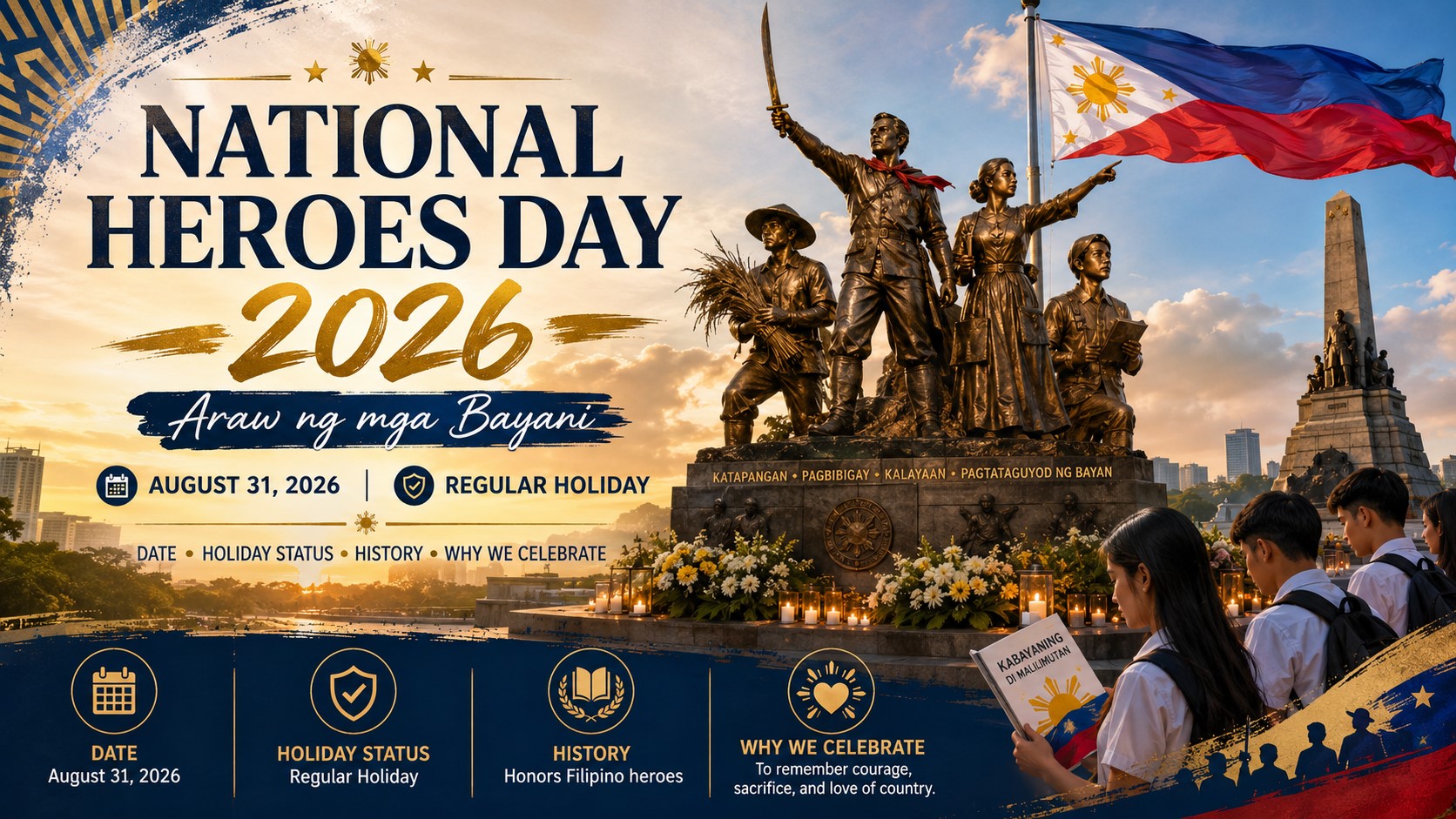
National Heroes Day 2026 falls on Monday, August 31 and is a regular holiday throughout the Philippines.
Its roots stretch back to Act No. 3827 of 1931, which originally established National Heroes Day on the last Sunday of August. The observance eventually moved to the last Monday of August, the schedule Filipinos follow today.
Its position near the anniversary of the revolutionary events of August 1896 also gives the occasion deep historical significance. The NHCP records that Andres Bonifacio and Katipuneros gathered at Pugad Lawin on August 23, 1896 and resolved to rise against Spanish colonial rule.
Yet perhaps the most important thing about Araw ng mga Bayani is contained in its name.
It is Heroes’ Day, not Hero’s Day.
The holiday reminds Filipinos that the country’s history was not created by a single extraordinary person.
It was built through the courage and sacrifices of many.
And every August, Araw ng mga Bayani gives a new generation the opportunity to remember them—and to consider what kind of contribution they themselves can make to the Philippines.


