The history of Philippine presidents is more than a list of names, dates and campaign slogans.
Each administration reflects a particular chapter in the country’s development—from the fight against Spanish rule and the creation of the First Philippine Republic to American colonization, World War II, independence, Martial Law, People Power and the modern democratic system.
Some presidents took office during war. Others inherited the position after a president died or resigned. Several were elected during periods of economic growth, while others governed through political crisis, rebellion, dictatorship or national recovery.
The Philippine presidency itself has also changed over time. Emilio Aguinaldo led a revolutionary republic. Manuel Quezon headed a Commonwealth under American sovereignty. José P. Laurel served during the Japanese occupation. Ferdinand Marcos governed first under the 1935 Constitution and later under an authoritarian system shaped by Martial Law and the 1973 Constitution.
Today, the president is directly elected for one six-year term and cannot run for reelection. This arrangement was created partly to prevent another president from remaining in office for decades.
Here is a comprehensive guide to the presidents of the Philippines and the political events that shaped their administrations.
Content
How Many Presidents Has the Philippines Had?
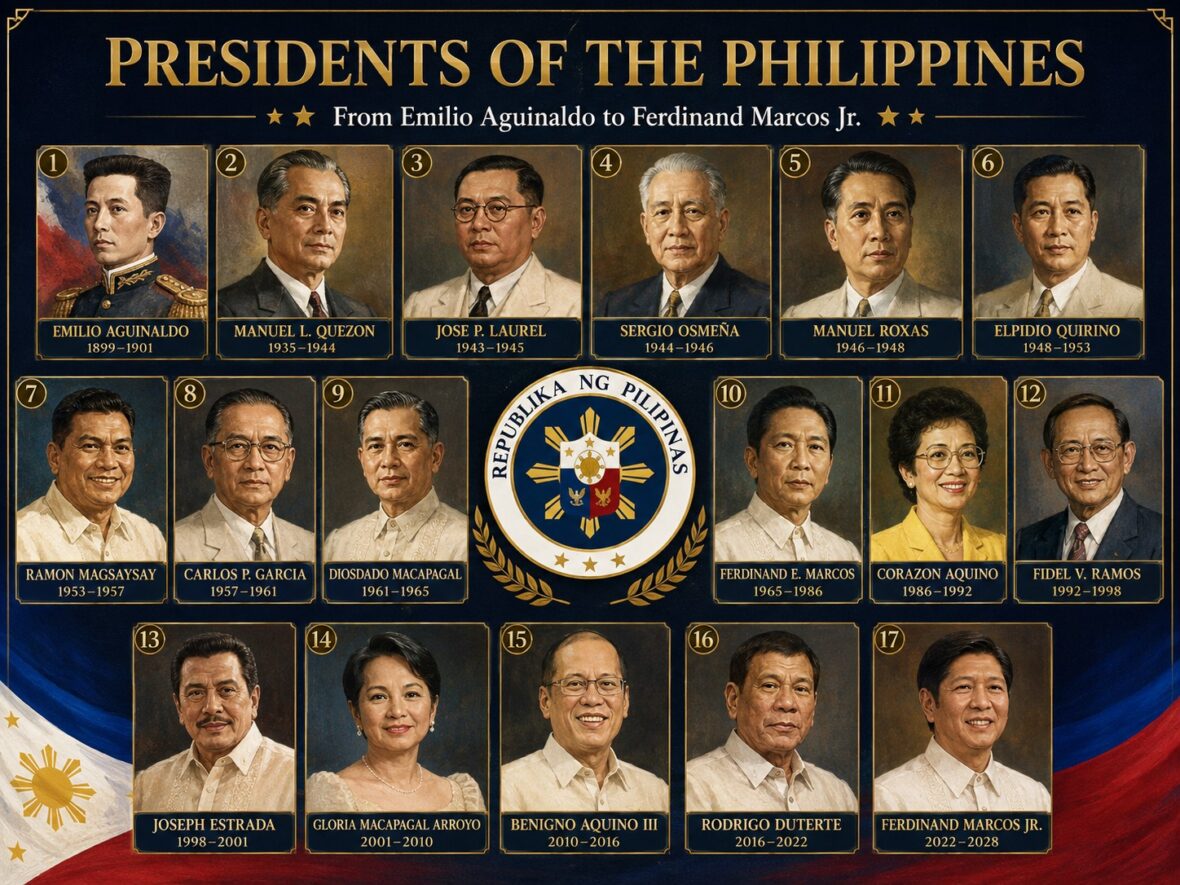
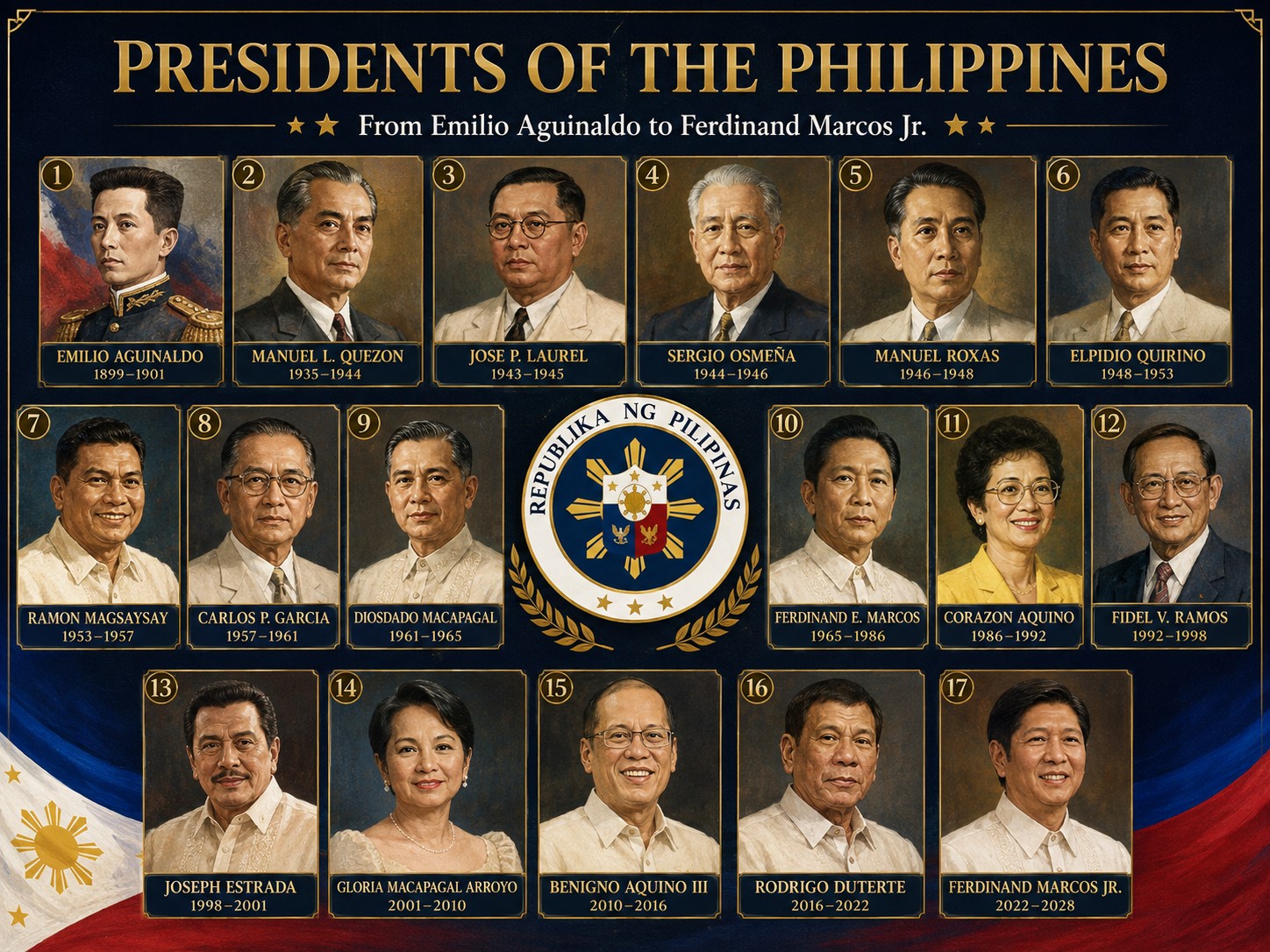
The Philippines officially recognizes 17 presidents, beginning with Emilio Aguinaldo and continuing with Ferdinand Marcos Jr.
The official Presidential Museum gallery presents the recognized succession beginning with Aguinaldo, followed by Manuel Quezon, José P. Laurel, Sergio Osmeña and the later presidents of the independent republic.
Here is the complete list:
| No. | President | Years in office | Historical period |
|---|---|---|---|
| 1 | Emilio Aguinaldo | 1899–1901 | First Philippine Republic |
| 2 | Manuel L. Quezon | 1935–1944 | Commonwealth |
| 3 | José P. Laurel | 1943–1945 | Japanese-sponsored Second Republic |
| 4 | Sergio Osmeña | 1944–1946 | Commonwealth restoration |
| 5 | Manuel Roxas | 1946–1948 | Commonwealth and Third Republic |
| 6 | Elpidio Quirino | 1948–1953 | Third Republic |
| 7 | Ramon Magsaysay | 1953–1957 | Third Republic |
| 8 | Carlos P. Garcia | 1957–1961 | Third Republic |
| 9 | Diosdado Macapagal | 1961–1965 | Third Republic |
| 10 | Ferdinand E. Marcos | 1965–1986 | Third and Fourth Republics |
| 11 | Corazon C. Aquino | 1986–1992 | Democratic restoration |
| 12 | Fidel V. Ramos | 1992–1998 | Fifth Republic |
| 13 | Joseph E. Estrada | 1998–2001 | Fifth Republic |
| 14 | Gloria Macapagal Arroyo | 2001–2010 | Fifth Republic |
| 15 | Benigno S. Aquino III | 2010–2016 | Fifth Republic |
| 16 | Rodrigo Roa Duterte | 2016–2022 | Fifth Republic |
| 17 | Ferdinand R. Marcos Jr. | 2022–present | Fifth Republic |
The overlapping terms of José Laurel and Sergio Osmeña can be confusing. Laurel headed the Japanese-sponsored government inside the occupied Philippines, while Osmeña succeeded Manuel Quezon as head of the Commonwealth government, which operated in exile before returning during liberation.
What Does the President of the Philippines Do?
Under the 1987 Constitution, executive power belongs to the president.
The president leads the executive branch, supervises government departments and is responsible for ensuring that laws are carried out. The president also appoints Cabinet secretaries and numerous government officials, prepares and implements national policies and represents the country in international affairs.
The president is also commander-in-chief of the Armed Forces of the Philippines.
Under specific constitutional conditions, the president may call on the military to suppress lawless violence, invasion or rebellion. Martial Law or the suspension of the privilege of the writ of habeas corpus may initially last no longer than 60 days, and the Constitution gives Congress and the Supreme Court important reviewing powers. These safeguards were shaped by the country’s experience under the Marcos dictatorship.
Qualifications to Become President
A presidential candidate must be:
- A natural-born Filipino citizen
- A registered voter
- Able to read and write
- At least 40 years old on election day
- A resident of the Philippines for at least ten years immediately before the election
The president and vice president are elected separately by direct vote.
The president serves one six-year term and cannot be reelected. A vice president may serve no more than two successive terms.
Why the Philippine Presidency Changed Over Time
The country has not always used the same political system.
Under the First Philippine Republic, the presidency emerged from a revolutionary movement fighting colonial control.
During the Commonwealth, the Philippines had an elected president but remained under American sovereignty.
The 1943 Constitution operated during the Japanese occupation, while the 1973 Constitution was created during the Marcos era and originally introduced a parliamentary framework. The present presidential system operates under the 1987 Constitution.
These constitutional changes explain why presidential terms, powers and methods of election have not always been the same.
The Presidents of the Philippines
1. Emilio Aguinaldo
Presidential period: 1899–1901
Emilio Aguinaldo is recognized as the first president of the Philippines and the leader of the First Philippine Republic.
He rose to national prominence during the Philippine Revolution against Spain. Revolutionary forces under his leadership gained control over much of Cavite, one of the strongest centers of the anti-Spanish struggle.
Political disagreements divided the revolutionary movement. At the Tejeros Convention in 1897, Aguinaldo was elected president of a new revolutionary government. Andrés Bonifacio challenged the proceedings and was later arrested, tried and executed by forces associated with Aguinaldo’s government.
After a temporary agreement with Spanish authorities, Aguinaldo went into exile in Hong Kong. He returned in 1898 as the Spanish-American War weakened Spain’s position in the Philippines.
Declaration of Independence
On June 12, 1898, Philippine independence was proclaimed in Kawit, Cavite.
A revolutionary congress later met in Malolos, Bulacan. The Malolos Constitution established a republican government and defined the powers of the president, legislature and other state institutions.
Aguinaldo formally became president of the First Philippine Republic when it was inaugurated in Malolos in January 1899.
Philippine–American War
The United States did not recognize the new republic.
Spain transferred the Philippines to the United States through the Treaty of Paris, even though Filipinos had already declared independence. Fighting between Filipino and American forces began in February 1899.
Aguinaldo initially led a conventional army before shifting to guerrilla warfare. American forces captured him in Palanan, Isabela, in 1901. His capture weakened the central revolutionary government, although resistance continued in different parts of the country.
Aguinaldo’s Legacy
Aguinaldo remains one of the most important—and debated—figures in Philippine history.
He is remembered for leading the First Republic and the struggle for national independence. At the same time, historians continue to examine his role in the deaths of Andrés Bonifacio and Antonio Luna, as well as the political divisions within the revolutionary movement.
The Long Gap Without a Filipino President
After Aguinaldo’s capture, the Philippines did not have another nationally recognized Filipino president until 1935.
The United States governed the country through military and civilian colonial administrations. American governors-general exercised executive authority, while Filipinos gradually gained representation through institutions such as the Philippine Assembly and the Philippine Senate.
The Senate was established in 1916, and Manuel Quezon became its first president—a position he held until the Commonwealth was created in 1935.
2. Manuel L. Quezon
Presidential period: 1935–1944
Manuel Luis Quezon was the first president of the Commonwealth of the Philippines.
The Commonwealth was a transitional government designed to prepare the Philippines for full independence from the United States.
Quezon had previously served in the revolutionary forces, practiced law, represented the Philippines in Washington and led the Philippine Senate. The NHCP identifies him as Senate president from 1916 to 1935 and Commonwealth president from 1935 until his death in 1944.
Major Priorities
Quezon’s administration focused on:
- Preparing the country for independence
- Building a stronger national government
- Promoting social justice
- Developing national defense
- Improving public administration
- Addressing land and labor concerns
- Creating a national language
His government established the Institute of National Language, which was tasked with selecting a language that could serve as the foundation for the national language.
Quezon is often called the Father of the National Language because of his support for the development and promotion of a common Filipino language.
Quezon and Malacañang
Quezon was the first Filipino chief executive to occupy Malacañang Palace as the official presidential residence. Before the Commonwealth, the palace had housed Spanish governors-general and American colonial officials.
Government in Exile
Japan invaded the Philippines in December 1941.
Quezon and other Commonwealth officials eventually left the country and established a government in exile in the United States. Although physically outside the Philippines, the Commonwealth government continued to represent the country internationally.
Quezon died in New York in August 1944, before the complete liberation of the Philippines.
3. José P. Laurel
Presidential period: 1943–1945
José P. Laurel served as president of the Second Philippine Republic during the Japanese occupation.
His presidency is one of the most complicated in Philippine history.
After Japanese forces occupied the country, they dissolved the existing political order and supported the creation of a new government. A 1943 Constitution established a republic, and Laurel was selected as president.
However, the government operated under the authority and military pressure of imperial Japan.
Collaboration or Survival?
Laurel and other wartime officials were later accused of collaborating with the Japanese.
Supporters argued that they accepted government positions to protect Filipinos and reduce Japanese abuses. Critics believed that participation helped provide political legitimacy to the occupation.
Both views remain part of the historical debate.
Laurel’s government faced severe shortages, inflation, guerrilla warfare and widespread hardship. Real power remained heavily influenced by the Japanese military.
After Japan’s defeat, Laurel dissolved the Second Republic. He was arrested and charged with treason but later received amnesty.
He eventually returned to public life and served as a senator.
4. Sergio Osmeña
Presidential period: 1944–1946
Sergio Osmeña became president after Manuel Quezon died in 1944.
He had served as Quezon’s vice president and was part of the Commonwealth government in exile.
Osmeña returned to the Philippines with General Douglas MacArthur during the liberation campaign. His administration faced the enormous responsibility of restoring civilian government after years of Japanese occupation.
Rebuilding a Devastated Country
The Philippines had suffered extensive wartime destruction.
Manila was left in ruins, transportation systems were damaged, farms had stopped producing normally and millions of Filipinos needed food, shelter and medical care.
Osmeña’s administration worked to:
- Reestablish national and local governments
- Restore public services
- Reopen schools
- Address food shortages
- Support reconstruction
- Prepare the country for independence
Osmeña ran for president in the 1946 election but lost to Manuel Roxas.
5. Manuel Roxas
Presidential period: 1946–1948
Manuel Roxas was the final president of the Commonwealth and the first president of the independent Third Republic.
He took office in May 1946. On July 4 of that year, the United States formally recognized Philippine independence.
Roxas therefore led the country through the transition from Commonwealth status to full sovereignty.
Postwar Reconstruction
His administration inherited a nation devastated by World War II.
Homes, factories, government buildings, roads and ports required reconstruction. The economy was weak, and many people were unemployed or displaced.
Roxas pursued close economic and military relations with the United States. His government accepted arrangements involving trade privileges, military bases and the rights of American citizens and companies to access certain Philippine resources and industries.
Supporters considered close ties necessary for reconstruction. Critics believed some agreements limited the country’s economic independence.
Roxas died suddenly in 1948 while still in office. The NHCP identifies him as the first president of the Republic of the Philippines after independence.
6. Elpidio Quirino
Presidential period: 1948–1953
Vice President Elpidio Quirino succeeded Roxas.
His presidency continued the difficult process of rebuilding the country after the war.
Quirino had previously worked as a teacher, lawyer and public official. He served in several government positions, including secretary of finance and secretary of the interior.
Reconstruction and Foreign Policy
The Quirino administration worked on:
- Economic recovery
- Industrial development
- Agricultural production
- Social welfare
- Foreign relations
- Rebuilding diplomatic ties with Japan
His government also faced the growing Huk rebellion in Central Luzon.
The Hukbalahap movement had fought the Japanese during World War II. After the war, conflict grew between the government and Huk supporters, many of whom raised concerns about land inequality, poverty and abuse by landlords and authorities.
Quirino’s presidency was also affected by allegations of corruption and questions about public confidence.
He lost the 1953 presidential election to Ramon Magsaysay.
7. Ramon Magsaysay
Presidential period: 1953–1957
Ramon Magsaysay became one of the most admired presidents in Philippine history.
He built his political image around accessibility, honesty and concern for ordinary citizens. His supporters called him the Man of the Masses.
Campaign Against the Huk Rebellion
Before becoming president, Magsaysay served as secretary of national defense.
He reorganized military operations against the Huks while also promoting community development, land settlement and assistance for rural residents.
As president, he attempted to bring government closer to farmers and working-class communities. He opened Malacañang to ordinary visitors and encouraged public officials to respond to citizen complaints.
His administration emphasized:
- Rural development
- Land reform efforts
- Resettlement programs
- Agricultural assistance
- Government accountability
- Strong relations with the United States
Sudden Death
Magsaysay died in a plane crash in Cebu in March 1957.
His death produced widespread national mourning. His reputation as an approachable and incorruptible leader continues to influence how Filipinos imagine an ideal president.
8. Carlos P. Garcia
Presidential period: 1957–1961
Vice President Carlos P. Garcia succeeded Magsaysay after the plane crash and later won a full presidential term.
Garcia is best remembered for the Filipino First Policy.
Filipino First Policy
The policy aimed to give Filipino citizens and Filipino-owned businesses greater opportunities in the national economy.
Garcia believed that foreign companies had gained too much influence over trade and industry. His administration promoted economic nationalism by giving preference to Filipino entrepreneurs in areas such as access to foreign exchange and business opportunities.
The policy was popular among nationalist groups but criticized by foreign investors and some business interests.
Garcia also promoted austerity, encouraging simpler government spending and reduced dependence on imported luxury goods.
His administration faced continuing problems involving corruption, economic inequality and public dissatisfaction. He lost the 1961 election to Diosdado Macapagal.
9. Diosdado Macapagal
Presidential period: 1961–1965
Diosdado Macapagal came from a poor family in Pampanga and used his personal story to present himself as a leader who understood ordinary Filipinos.
He became known as the Poor Boy from Lubao.
Independence Day Moved to June 12
One of his best-known actions was moving the official celebration of Philippine Independence Day from July 4 to June 12.
July 4 marked the date the United States recognized Philippine independence in 1946. June 12 commemorated Aguinaldo’s declaration of independence in Kawit in 1898.
The change emphasized that Philippine independence originated in the Filipino revolutionary struggle rather than as a gift from a former colonial power.
Economic and Land Policies
Macapagal introduced economic policies intended to reduce government controls and encourage market activity.
His administration also supported an agricultural land reform law that sought to replace share tenancy with leasehold arrangements and help farmers obtain land.
Implementation was limited by funding problems, landlord resistance and weaknesses in government enforcement.
Macapagal lost his reelection campaign to Ferdinand Marcos in 1965.
10. Ferdinand E. Marcos
Presidential period: 1965–1986
Ferdinand Marcos served longer than any other Philippine president.
He was elected in 1965 and reelected in 1969. His first years in office included major infrastructure programs and an ambitious image of national development.
However, government borrowing increased, political conflict intensified and allegations of corruption grew.
Declaration of Martial Law
Marcos placed the Philippines under Martial Law in September 1972.
He justified the decision by pointing to communist insurgency, violent unrest and threats to national security.
Martial Law allowed him to close Congress, arrest political opponents, restrict the press and govern through presidential decrees.
The country’s political structure was changed under the 1973 Constitution, which created a parliamentary framework on paper. In practice, Marcos retained extensive control over the government, military and political system.
Infrastructure and State Programs
The Marcos era produced roads, bridges, hospitals, cultural buildings and government institutions.
Supporters frequently emphasize these projects and programs in agriculture, energy and national infrastructure.
However, many initiatives were financed through heavy borrowing. Crony capitalism, monopoly privileges and corruption weakened the economy and concentrated opportunities among individuals and companies associated with the administration.
Human Rights Violations
Political opponents, activists, journalists, religious workers, students and suspected rebels were arrested during the dictatorship.
The Philippine government later enacted Republic Act No. 10368, officially recognizing victims of summary execution, torture, enforced disappearance and other gross human-rights violations committed during the Marcos regime. The law provided for recognition and reparations covering the period from September 21, 1972, to February 25, 1986.
Aquino Assassination and Political Crisis
Opposition leader Benigno “Ninoy” Aquino Jr. was assassinated after returning to the Philippines in August 1983.
His death intensified protests and contributed to a loss of confidence in the Marcos government.
Economic conditions worsened as debt, capital flight, political uncertainty and declining investment affected the country.
The 1986 Snap Election
Marcos called an early presidential election in February 1986.
He was challenged by Corazon Aquino, Ninoy Aquino’s widow.
Both sides claimed victory amid widespread allegations of fraud. Political tensions led Defense Minister Juan Ponce Enrile, General Fidel Ramos and military rebels to withdraw their support from Marcos.
The crisis led to the EDSA People Power Revolution.
11. Corazon C. Aquino
Presidential period: 1986–1992
Corazon “Cory” Aquino became president on February 25, 1986.
Thousands of citizens gathered around Camps Aguinaldo and Crame after a call from Cardinal Jaime Sin to protect military defectors. The nonviolent uprising ended two decades of Marcos rule and restored democratic government.
Aquino became the first woman to serve as president of the Philippines.
Restoring Democratic Institutions
Her administration abolished the Marcos-era legislature and initially governed under a temporary Freedom Constitution.
Aquino then appointed a 48-member Constitutional Commission led by former Supreme Court Justice Cecilia Muñoz Palma. The commission drafted the Constitution ratified in 1987.
The new Constitution restored:
- A bicameral Congress
- Regular national elections
- An independent judiciary
- Constitutional commissions
- Civil-liberty protections
- Presidential term limits
- Greater checks on executive power
The first congressional elections under the restored system were held in 1987.
Challenges of the Aquino Administration
Aquino inherited enormous problems:
- A weakened economy
- Large foreign debts
- Communist and separatist insurgencies
- Military rebellion
- Political violence
- Natural disasters
- Demands for land reform
Her government survived several coup attempts.
The Comprehensive Agrarian Reform Program was introduced during her administration, although its effectiveness and implementation became subjects of continuing debate.
Aquino left office peacefully in 1992, demonstrating an important difference from the dictatorship that preceded her.
12. Fidel V. Ramos
Presidential period: 1992–1998
Fidel V. Ramos was a former military officer who played a central role in withdrawing support from Marcos during the 1986 EDSA Revolution.
He won the 1992 presidential election and succeeded Corazon Aquino.
Economic Reform and Stability
Ramos inherited recurring power shortages that caused daily blackouts and disrupted businesses.
His administration addressed the electricity crisis by expanding power generation and encouraging private investment.
Ramos promoted:
- Economic liberalization
- Privatization
- Infrastructure development
- Telecommunications competition
- Foreign investment
- Peace negotiations
The economy grew during much of his administration, leading supporters to promote a vision called Philippines 2000.
Peace Process
His government reached a peace agreement with the Moro National Liberation Front in 1996.
It also held negotiations with communist rebels and military groups.
Ramos’s presidency ended during the Asian financial crisis, which affected currencies, banks and economies across the region.
13. Joseph E. Estrada
Presidential period: 1998–2001
Joseph “Erap” Estrada was a popular film actor who built his political appeal around the slogan Erap para sa mahirap, or “Erap for the poor.”
He won the 1998 election by a large margin.
Populist Presidency
Estrada’s administration emphasized food security, housing and programs for lower-income citizens.
His direct speaking style and movie-star image made him especially popular among working-class voters.
Impeachment and EDSA II
Estrada was accused of receiving illegal gambling payments and other forms of corruption.
The House of Representatives impeached him, and a Senate trial began.
When senators voted against opening an envelope believed to contain important evidence, prosecutors walked out and public demonstrations grew.
Large crowds gathered at EDSA. Estrada left Malacañang in January 2001, and Vice President Gloria Macapagal Arroyo took the presidential oath.
Estrada maintained that he had not resigned and described his removal as unconstitutional. The Supreme Court later recognized Arroyo as president.
Estrada was subsequently convicted of plunder but received a presidential pardon. He later returned to politics and served as mayor of Manila.
14. Gloria Macapagal Arroyo
Presidential period: 2001–2010
Gloria Macapagal Arroyo, the daughter of former president Diosdado Macapagal, became president after Estrada’s departure.
She completed the remaining portion of his term and won the 2004 presidential election.
Economic Record
Arroyo’s administration introduced tax measures, infrastructure projects and economic reforms.
The country experienced periods of economic growth, increased overseas remittances and expansion in industries such as business-process outsourcing.
Supporters credited her with strengthening economic fundamentals. Critics argued that growth did not sufficiently reduce poverty and inequality.
Political Controversies
Her administration faced:
- Allegations of election manipulation
- Corruption scandals
- Military coup attempts
- Street protests
- Questions about human-rights abuses
- Efforts to remove her through impeachment
The “Hello Garci” controversy emerged after recordings allegedly involving Arroyo and an election official became public. Arroyo apologized for speaking with an election official but denied manipulating the result.
Despite recurring calls for her resignation, she completed her term in 2010.
15. Benigno S. Aquino III
Presidential period: 2010–2016
Benigno “Noynoy” Aquino III was the son of Corazon and Benigno Aquino Jr.
He won the 2010 election on an anti-corruption platform summarized by the slogan Daang Matuwid, or “Straight Path.”
Governance and Economic Growth
Aquino’s administration emphasized:
- Government transparency
- Anti-corruption programs
- Responsible budgeting
- Public-private infrastructure projects
- Social-welfare expansion
- Economic growth
The Philippines received improved credit ratings and attracted stronger international investor interest during his term.
His government also expanded the Pantawid Pamilyang Pilipino Program, which provides conditional cash assistance to low-income families.
West Philippine Sea Case
Aquino’s administration brought a case against China under the United Nations Convention on the Law of the Sea.
The international tribunal issued its decision shortly after Aquino left office in 2016.
Major Controversies
His government faced criticism over:
- The response to Super Typhoon Yolanda
- Transportation and infrastructure problems
- The Disbursement Acceleration Program
- The death of 44 police commandos in the Mamasapano operation
Aquino completed his six-year term and transferred power to Rodrigo Duterte.
16. Rodrigo Roa Duterte
Presidential period: 2016–2022
Rodrigo Duterte served for many years as mayor of Davao City before becoming president.
His campaign presented him as a tough, unconventional leader who would fight crime, illegal drugs and corruption.
Anti-Drug Campaign
Duterte launched an aggressive national campaign against illegal drugs.
Thousands of people were killed in police operations and other drug-related circumstances. Human-rights organizations, religious groups and international institutions raised concerns about extrajudicial killings, due process and police accountability.
The administration argued that the campaign was necessary to address crime and protect communities.
Build, Build, Build
Duterte’s government pursued a large infrastructure program that included:
- Roads
- Bridges
- Railways
- Airports
- Flood-control projects
- Public transportation systems
His administration also signed laws involving free tuition in state universities and colleges, universal health care, the Bangsamoro Organic Law and a national identification system.
Bangsamoro Transition
The Bangsamoro Organic Law created the Bangsamoro Autonomous Region in Muslim Mindanao, replacing the former autonomous region.
The transition was a significant part of the long-running peace process in Mindanao.
Foreign Policy
Duterte sought closer relations with China while frequently criticizing the United States and European governments.
Nevertheless, the Philippines maintained its treaty alliance with the United States.
COVID-19 Pandemic
The final years of his presidency were dominated by the COVID-19 pandemic.
The government imposed some of the world’s longest community quarantines while trying to expand testing, hospital capacity, financial assistance and vaccination.
The pandemic caused significant economic disruption, school closures and job losses.
Duterte completed his term in June 2022.
17. Ferdinand R. Marcos Jr.
Presidential period: 2022–present
Ferdinand “Bongbong” Marcos Jr. is the son of former president Ferdinand Marcos and former first lady Imelda Marcos.
He won the 2022 presidential election and became the 17th president of the Philippines.
His victory returned the Marcos family to Malacañang 36 years after the 1986 People Power Revolution.
Major Priorities
The Marcos Jr. administration has focused on areas including:
- Infrastructure
- Agriculture and food security
- Renewable energy
- Digital transformation
- Foreign investment
- Tourism
- Defense modernization
- Relations with neighboring countries
- The West Philippine Sea
Marcos initially served concurrently as secretary of agriculture before later appointing a full-time department secretary.
Foreign and Security Policy
His administration has strengthened security cooperation with the United States and other partners while continuing economic relations with China.
Tensions in the West Philippine Sea have remained an important national issue, particularly involving maritime incidents, fishing rights and Philippine resupply missions.
Current Administration
As of August 2026, Ferdinand Marcos Jr. remains president.
His fifth State of the Nation Address in July 2026 reviewed his administration’s programs and outlined priorities for the final two years of his term. Official government communications continue to identify him as the sitting president.
His administration continues to face issues involving food prices, employment, transportation, public services, disaster preparedness, political accountability and regional security.
The Different Republics of the Philippines
Students often encounter terms such as First Republic, Third Republic and Fifth Republic. These names describe different constitutional and political periods.
First Philippine Republic
1899–1901
Established through the Malolos Constitution and led by Emilio Aguinaldo.
It emerged from the revolution against Spain and was defeated during the Philippine–American War.
Commonwealth of the Philippines
1935–1946
A transitional government preparing the country for independence from the United States.
It was led by Manuel Quezon, Sergio Osmeña and, during its final weeks, Manuel Roxas.
The Commonwealth was not normally counted as one of the numbered Philippine republics.
Second Philippine Republic
1943–1945
Established during the Japanese occupation and headed by José P. Laurel.
Its independence was severely limited by Japanese military control.
Third Philippine Republic
1946–1972 or 1981, depending on historical classification
Established when independence was recognized in 1946.
Its presidents included Roxas, Quirino, Magsaysay, Garcia, Macapagal and the early presidency of Ferdinand Marcos.
Some classifications end the Third Republic with the declaration of Martial Law in 1972. Others connect its formal end to later constitutional changes.
Fourth Philippine Republic
1981–1986
Associated with the later years of Ferdinand Marcos under the modified 1973 constitutional system.
Although Martial Law had been formally lifted in 1981, Marcos retained extensive political control.
Fifth Philippine Republic
1986–present
Began with the restoration of democratic government under Corazon Aquino.
The present constitutional order is based on the 1987 Constitution.
Presidents Who Took Office Through Succession
Not every Philippine president originally won the office through a presidential election.
Several vice presidents became president because of the death, resignation or removal of the sitting president:
| Successor | President replaced | Reason |
|---|---|---|
| Sergio Osmeña | Manuel Quezon | Quezon died in office |
| Elpidio Quirino | Manuel Roxas | Roxas died in office |
| Carlos Garcia | Ramon Magsaysay | Magsaysay died in a plane crash |
| Gloria Macapagal Arroyo | Joseph Estrada | Estrada left office during the 2001 political crisis |
The 1987 Constitution states that the vice president becomes president when the sitting president dies, becomes permanently disabled, is removed or resigns. The successor serves the remainder of the unfinished term.
Presidents Who Died While Serving
Three presidents died while holding office:
- Manuel Quezon in 1944
- Manuel Roxas in 1948
- Ramon Magsaysay in 1957
Quezon died of tuberculosis while the Commonwealth government was in exile.
Roxas died after suffering a heart attack at Clark Air Base.
Magsaysay died when his presidential plane crashed on Mount Manunggal in Cebu.
Philippine Presidents Elected to More Than One Term
Different constitutions allowed different presidential term arrangements.
Manuel Quezon was reelected under the amended 1935 Constitution.
Ferdinand Marcos won elections in 1965 and 1969 and remained in power after imposing Martial Law. He later participated in elections conducted under the authoritarian system.
Gloria Macapagal Arroyo first became president through succession in 2001 and later won a full term in 2004.
Under the present Constitution, an elected president cannot run for another presidential term. This restriction is intended to prevent the concentration and prolonged use of executive power.
The Two Women Presidents of the Philippines
The Philippines has had two women presidents:
Corazon Aquino
Aquino became president after the 1986 EDSA Revolution.
She led the restoration of democratic institutions and oversaw the creation of the 1987 Constitution.
Gloria Macapagal Arroyo
Arroyo became president in 2001 and later won the 2004 election.
She became the country’s second woman president and served for more than nine years.
Fathers and Children Who Became President
Two parent-child families have produced Philippine presidents.
Diosdado Macapagal and Gloria Macapagal Arroyo
Diosdado Macapagal served from 1961 to 1965.
His daughter, Gloria Macapagal Arroyo, served from 2001 to 2010.
Ferdinand Marcos and Ferdinand Marcos Jr.
Ferdinand Marcos served from 1965 to 1986.
His son, Ferdinand Marcos Jr., became president in 2022.
Benigno Aquino III was also the son of a president—Corazon Aquino—making the Aquino family another parent-child presidential family.
Major Turning Points in Philippine Political History
The Philippine Revolution
The revolution against Spain created the conditions for the First Republic and introduced the idea of an independent Filipino nation.
American Colonial Rule
The defeat of the First Republic ended the country’s first attempt at independence.
American rule introduced new political institutions but also denied immediate Filipino sovereignty.
The Commonwealth
The Commonwealth established a nationally elected Filipino presidency and prepared the country for independence.
World War II
The Japanese occupation divided political authority between the Commonwealth government in exile and the Japanese-sponsored Second Republic.
Independence in 1946
The Third Republic began as Filipinos assumed full legal responsibility for their national government.
Martial Law
The declaration of Martial Law transformed an elected presidency into an authoritarian regime.
Congress was closed, civil liberties were restricted and executive power became heavily concentrated.
EDSA People Power
The 1986 uprising removed Marcos and restored democratic institutions.
The NHCP describes EDSA as the culmination of a long struggle to restore democracy after 20 years of Marcos rule.
The 1987 Constitution
The Constitution rebuilt the separation of powers and imposed limits on the president.
It restored Congress, strengthened constitutional commissions and created mechanisms for reviewing emergency powers.
EDSA II
The 2001 uprising removed Joseph Estrada and elevated Vice President Gloria Macapagal Arroyo.
The event remains debated because it raised questions about popular protest, presidential succession and the constitutional process.
Return of the Marcos Family
The election of Ferdinand Marcos Jr. in 2022 represented one of the most significant political family comebacks in modern Philippine history.
It also renewed national discussions about Martial Law, historical memory, disinformation and the legacy of the 1986 revolution.
Recurring Issues in Philippine Presidential Politics
Political Dynasties
Many elected positions are held by members of established political families.
The Constitution calls for the prohibition of political dynasties as defined by law, but Congress has not passed a comprehensive enabling law.
Supporters of political families argue that voters should remain free to choose qualified candidates regardless of family background.
Critics believe dynasties concentrate power, restrict competition and make government positions less accessible to ordinary citizens.
Patronage Politics
Political support is sometimes built through personal favors, government appointments, local alliances and the distribution of resources.
This can weaken institutions when loyalty to individuals becomes more important than policy, competence or accountability.
Poverty and Inequality
Every president has promised to improve the lives of poor Filipinos.
Yet unequal access to land, education, health care, employment and political influence remains a continuing national concern.
Corruption
Nearly every administration has faced corruption accusations.
The repeated controversies have contributed to public distrust and demands for stronger transparency, auditing and prosecution.
Regional Inequality
Economic development has often been concentrated in Metro Manila and a limited number of urban centers.
Presidents regularly promise infrastructure and investment for Visayas and Mindanao, but large regional differences remain.
Foreign Influence
Philippine presidents must manage relations with major powers, particularly the United States and China.
Decisions involving defense agreements, trade, investment and the West Philippine Sea can strongly shape public opinion.
Historical Memory
How Filipinos remember past presidents affects present elections.
Debates about Martial Law, EDSA, colonialism and previous administrations are not simply academic. They influence how voters evaluate leadership, democracy and national identity.
Quick Timeline of Philippine Presidents
- 1899: Emilio Aguinaldo becomes president of the First Philippine Republic
- 1901: Aguinaldo is captured during the Philippine–American War
- 1935: Manuel Quezon becomes Commonwealth president
- 1943: José Laurel becomes president during the Japanese occupation
- 1944: Sergio Osmeña succeeds Quezon
- 1946: Manuel Roxas becomes president and independence is recognized
- 1948: Elpidio Quirino succeeds Roxas
- 1953: Ramon Magsaysay becomes president
- 1957: Carlos Garcia succeeds Magsaysay
- 1961: Diosdado Macapagal becomes president
- 1965: Ferdinand Marcos begins his presidency
- 1972: Marcos declares Martial Law
- 1986: Corazon Aquino becomes president after EDSA
- 1992: Fidel Ramos becomes president
- 1998: Joseph Estrada becomes president
- 2001: Gloria Macapagal Arroyo succeeds Estrada
- 2010: Benigno Aquino III becomes president
- 2016: Rodrigo Duterte becomes president
- 2022: Ferdinand Marcos Jr. becomes president
Why Learning About Philippine Presidents Matters
Learning about presidents should not be limited to memorizing names and dates.
Presidents make decisions that affect taxes, schools, transportation, health care, agriculture, national security and foreign relations. They appoint officials, influence budgets and shape how laws are implemented.
But presidents do not act alone.
Congress passes laws and controls appropriations. Courts interpret the Constitution. Local governments deliver many public services. Journalists investigate abuses. Civil-society groups organize communities. Citizens vote, protest, volunteer and demand accountability.
Understanding presidential history therefore helps us see both the power and the limits of political leadership.
It also teaches an important lesson: democratic institutions matter as much as individual personalities.
A popular or charismatic president may inspire citizens, but no leader should be above the Constitution, the law or public accountability.
Final Thoughts
The story of Philippine presidents is also the story of the country’s continuing search for freedom, stability and good government.
Emilio Aguinaldo led a republic fighting for recognition. Manuel Quezon prepared the country for independence. José Laurel governed under occupation. Sergio Osmeña and Manuel Roxas faced the enormous task of postwar reconstruction.
Later presidents dealt with rural rebellion, economic nationalism, land reform, dictatorship, democratic restoration, impeachment, globalization, terrorism, natural disasters, territorial disputes and a worldwide pandemic.
Some administrations are remembered for economic progress or important reforms. Others are associated with corruption, abuse, political violence or missed opportunities. Most produced a mixture of achievements, controversies and unintended consequences.
Presidents can influence the direction of the nation, but they cannot solve every problem alone.
The strength of the Philippines ultimately depends on institutions that enforce the law, citizens who participate thoughtfully and voters who examine evidence rather than relying only on personality, family name or campaign promises.
Studying presidential history is therefore not merely about looking back.
It helps Filipinos understand how power works, how democracy can be weakened and how responsible citizenship can shape the country’s next chapter.