There is a moment early in Forgotten Island when it becomes clear that DreamWorks isn’t simply going to place a few Filipino references in the background and call it representation.
The movie is Filipino from the ground up.
There are jeepneys. Karaoke. Lechon on the table. Relatives packed into a house party. Titas pointing with their lips. Tagalog words that aren’t immediately translated for international audiences.
And then there are the creatures.
Manananggal. Kapre. Tiyanak. Duwende. Aswang.
For many Filipino viewers, these aren’t monsters invented for a Hollywood fantasy movie. They’re creatures we’ve been hearing about since childhood.
That’s what makes Forgotten Island particularly interesting.
The movie doesn’t just feature Filipino characters. It attempts to build an entire DreamWorks adventure around Filipino family life, mythology, music, humor and memories.
And surprisingly, it goes much deeper than I initially expected.
This review focuses specifically on how Filipino culture is represented in Forgotten Island and stays as spoiler-free as possible.
Content
First, What Is Forgotten Island About?
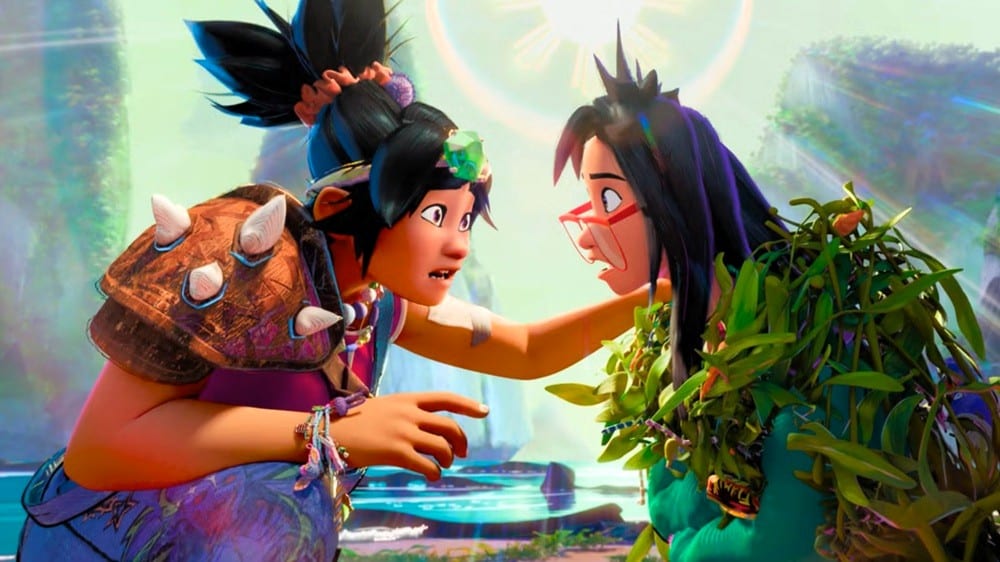
Forgotten Island follows lifelong best friends Jo and Raissa, voiced by H.E.R. and Liza Soberano.
The girls have been together since grade school, but their lives are about to move in different directions after high school.
During what is supposed to be one of their final nights together, they stumble across a mysterious portal and find themselves transported to Nakali, a fantastical island inhabited by creatures they recognize from stories told by their Filipino families.
But getting home comes with a terrible condition.
The memories of their friendship could be the price they have to pay.
DreamWorks describes the movie as a story about two friends trying to stay connected before they drift apart, with Philippine mythology forming the world around their adventure.
That friendship story is universal.
The world around it, however, is unmistakably Filipino.
Forgotten Island Doesn’t Treat Filipino Culture Like Decoration
This is probably the movie’s biggest achievement.
There have been Hollywood productions before where a Filipino character appears, somebody eats Filipino food, or a Filipino family gets a short scene.
Forgotten Island does something different.
The Philippines isn’t simply where the characters happen to come from.
Filipino culture shapes the movie’s:
- characters
- mythology
- visual design
- food
- music
- language
- humor
- family dynamics
- animation
- fantasy world
Reuters describes Forgotten Island as the first major animated feature to draw heavily from Filipino mythology and culture.
That’s an important distinction.
The movie isn’t telling a generic fantasy story and adding Filipino references afterward.
The mythology itself helps create the fantasy.
The Movie Is Set in the Philippines, Not Just Inspired by It
Another detail that matters is the setting.
Forgotten Island begins in the Philippines during the 1990s.
GQ Philippines describes the opening as beginning with the golden sun motif associated with the Philippine flag before moving into a provincial elementary school classroom.
That immediately establishes where we are.
And instead of presenting the Philippines through the usual postcard images of beaches and tourist destinations, much of the early cultural representation comes through ordinary life.
School.
Family.
Neighborhoods.
Parties.
Friends.
Food.
Transportation.
That may actually make the representation more meaningful for Filipino audiences.
The Philippines isn’t presented only as somewhere beautiful foreigners travel to.
It’s home.
The Filipino House Party Feels Very Familiar
One of the most frequently mentioned scenes in early reviews is a Filipino house party.
And apparently, DreamWorks went all in.
There are huge amounts of food.
There are relatives everywhere.
There is karaoke.
There are conversations happening all over the house.
And yes, there is lechon.
GMA’s Janet Susan Nepales highlighted details including karaoke, lechon, Filipino accents, jeepneys, a familiar religious image inside the home and even Filipino aunties pointing with pursed lips.
Another review noted that the sequence includes the kind of crowded, slightly chaotic atmosphere anyone who has attended a big Filipino gathering will recognize.
That’s the type of cultural representation that works because it isn’t necessarily something you would find in a textbook.
You experience it.
Someone brings another tray of food even though there’s already enough food for 40 people.
Somebody grabs the microphone.
An uncle starts singing.
Children are running around.
More relatives arrive.
Nobody seems entirely sure how everyone fits inside the house.
And somehow, everybody fits.
That kind of detail communicates Filipino culture without stopping the movie to explain Filipino culture.
Yes, There’s Lip-Pointing
This might be one of my favorite tiny details.
Filipinos sometimes point at something by pursing their lips instead of using a finger.
It’s completely normal if you grew up seeing people do it.
But try explaining it to somebody who didn’t.
Forgotten Island includes it.
GMA specifically called out the sight of Filipino Titas pointing with their lips as one of the small details captured in the movie.
It’s a small thing.
But small things are often what make representation feel lived-in rather than researched from a list.
A jeepney can be added because somebody Googled “Philippines.”
Lip-pointing probably gets included because someone in the room actually knows Filipinos.
The Movie Doesn’t Translate Every Filipino Detail for You
Another interesting choice is the use of Filipino language.
Forgotten Island includes Tagalog words and expressions without always stopping to provide an immediate translation.
One review praised the film for trusting international audiences to follow along rather than explaining every cultural reference.
I like that approach.
Filipino viewers don’t suddenly stop understanding an American movie when someone mentions Thanksgiving, prom or baseball without an explanation.
So why should an international movie grind to a halt every time somebody says something Filipino?
Sometimes context is enough.
And sometimes audiences can simply discover something new.
The Interesting Story Behind “Tayo Na”
There’s even an interesting example showing how carefully the filmmakers discussed the language.
“Tayo na” becomes a meaningful phrase between Jo and Raissa.
But Liza Soberano actually pointed out during production that Filipinos would more naturally say “tara na” in casual conversation.
The filmmakers discussed that concern with cultural consultant Kirby Araullo.
Ultimately, they kept “tayo na” because it functions specifically as a personal motto between the two characters rather than ordinary conversational Tagalog.
I think that story is worth knowing.
It demonstrates two things at once.
First, Filipino performers were actually giving input.
Second, cultural accuracy doesn’t necessarily mean every line has to sound exactly like a random everyday conversation.
Sometimes a character can deliberately speak differently.
What matters is that the filmmakers understood the difference.
Filipino Mythology Is the Heart of the Fantasy
Of course, the most obvious representation comes from mythology.
Jo and Raissa arrive in Nakali and discover that the creatures they heard about while growing up aren’t just stories.
They’re real.
Among the beings associated with the movie are:
- Manananggal
- Kapre
- Duwende
- Tiyanak
- Diwata
- Batibat
- Aswang
- Kataw
The Manananggal has one of the biggest roles.
Lea Salonga voices Manang, whom DreamWorks describes as the feared Dreaded Manananggal of Nakali.
Manny Jacinto voices Bungi, a character based on the Tiyanak.
Jo Koy voices Datu, a Kapre.
The movie also constructs communities and personalities around creatures that are often presented simply as monsters in Filipino horror stories.
That makes Nakali feel less like a collection of mythology references and more like a fantasy world with its own society.
DreamWorks Doesn’t Claim There Is One “Correct” Filipino Mythology
This was an important decision.
Philippine mythology varies enormously across regions, languages and communities.
Your grandmother’s version of an Aswang might be completely different from someone else’s.
A Kapre story in one province might differ significantly from one told hundreds of kilometers away.
Director Januel Mercado and co-director Joel Crawford have spoken about not wanting Forgotten Island to become a supposedly definitive version of Filipino mythology.
Instead, they wanted the real-world Philippines in the movie to feel culturally grounded while allowing Nakali to become a more imaginative interpretation of traditional creatures. They worked with Filipino American historian and cultural consultant Kirby Araullo while developing those elements.
I think that’s the right approach.
Because there really isn’t one Filipino folklore rulebook.
These stories survived precisely because generations kept retelling them.
Even Baybayin Appears in the Design
One detail many viewers might miss is Baybayin.
The precolonial Philippine script appears in visual elements associated with the Kapre characters.
When GMA asked the filmmakers about the writing visible on Datu, the Kapre voiced by Jo Koy, Crawford explained that Filipino artists working on the production researched those details, while cultural consultant Kirby Araullo helped the team check cultural elements.
This is another example where Forgotten Island rewards Filipino audiences who look closely.
Not everything has to be explained aloud.
Some things are simply built into the world.
Nakali Is Fantasy, But the Philippines Inspired Its Look
Nakali isn’t supposed to be a real Philippine island.
But the visual inspiration behind it has Philippine roots.
During their research trip, the filmmakers visited El Nido in Palawan.
According to Vogue Philippines, the landscapes there helped inspire Nakali’s environment, although the final fantasy world pushes those tropical landscapes into a much more colorful, surreal and almost neon direction.
That makes sense visually.
Anyone who has traveled around Palawan knows that parts of it already look like someone designed them for a fantasy movie.
Towering limestone formations.
Turquoise water.
Hidden lagoons.
Dense greenery.
DreamWorks apparently started with that kind of landscape and then asked:
What would this look like if Filipino mythology came alive inside it?
The result is intentionally exaggerated rather than realistic.
And that’s completely appropriate for Nakali.
Filipino Culture Is Also in the Music
This is another area where Forgotten Island goes further than expected.
The soundtrack isn’t simply a Hollywood score with one Filipino pop song inserted during the credits.
Filipino and Filipino-American artists are embedded throughout the project.
The official soundtrack includes music from:
- H.E.R.
- Liza Soberano
- Lea Salonga
- BINI
- SB19
- Sophia Laforteza of KATSEYE
- Ruby Ibarra
- Carl Angelo
- Guapdad 4000
- P-Lo
The score was composed by Filipino-American composer Nathan Matthew David.
BINI performs “A Parallel World.”
SB19 performs a version of Francis M.’s “Mga Kababayan.”
H.E.R. and Liza Soberano perform “BRB.”
Lea Salonga also contributes extensively to the soundtrack.
That mix feels very deliberate.
You have legendary Filipino voices.
You have contemporary P-pop.
You have Filipino-American musicians.
You have music associated with the 1990s.
It reflects the movie’s combination of memory, diaspora and modern Filipino culture.
The Score Was Researched in the Philippines
Even the instrumental music involved cultural research.
Composer Nathan Matthew David traveled around the Philippines while preparing the score, including visiting South Cotabato to study local musical traditions, instruments and communities.
Vogue Philippines reports that his research included Filipino indigenous musical traditions and sounds, while the finished score incorporates influences such as chanting and gongs.
This matters because music can easily become stereotypical in films about other cultures.
Throw in a vaguely “Asian” instrument and hope nobody notices.
Forgotten Island appears to have taken a more specific approach.
Filipino Animators Actually Worked on the Movie
This is one of the coolest things about the production.
Filipino culture wasn’t only represented in front of the microphone.
Filipino artists helped make the film.
Quezon City-based Snipple Animation Studios worked on hand-drawn 2D sequences used throughout Forgotten Island.
These sequences appear in flashbacks and memories, allowing the movie to jump between different animation styles.
Vogue Philippines reports that Snipple’s Filipino artists were treated as creative collaborators and contributed to the humor and artistry of those sequences.
The Australian also reports that the Manila-based studio contributed 2D animation to the production.
That’s significant.
Filipino animators have worked behind the scenes on international productions for decades.
But here they’re contributing to a major animated film whose actual story is about Filipinos.
There’s something nicely circular about that.
Filipino Artists Helped Shape the Entire Production
The involvement went beyond Snipple.
Filipino-American artists at DreamWorks reportedly volunteered their ideas and expertise even during early development because they wanted the project to happen.
Crawford told Vogue that Filipino-American employees and friends were actively asking how they could help while the film was still being developed.
Production artists with Filipino heritage worked on characters and environments.
Filipino performers contributed ideas.
A Filipino cultural consultant reviewed elements.
Filipino animators worked on sequences.
Filipino musicians contributed to the soundtrack.
That collaborative approach is probably one of the biggest reasons the cultural references feel so numerous.
They weren’t all coming from one person.
The Voice Cast Matters Too
Forgotten Island also assembled an unusually large group of Filipino and Filipino-heritage performers for a major Hollywood animated production.
H.E.R. voices Jo.
Liza Soberano voices Raissa.
Lea Salonga voices Manang.
Manny Jacinto and Dolly de Leon are part of the cast.
Jo Koy also lends his voice to the film.
DreamWorks’ official cast additionally includes Dave Franco, Jenny Slate and Ronny Chieng.
Having Filipino performers involved isn’t automatically enough to make a story culturally accurate.
But in this case, several cast members actually contributed feedback.
The filmmakers told GMA that Liza and other actors influenced their characters during rewrites and improvisations, bringing pieces of their own experience into the performances.
That’s much more meaningful than simply casting Filipino actors after everything has already been decided.
The Filipino Representation Goes Beyond Stereotypes
This might be the most important thing Forgotten Island gets right.
The characters aren’t constantly announcing that they’re Filipino.
They’re simply living Filipino lives.
And because of that, the movie gets to show many different parts of the culture simultaneously.
Religion appears.
Precolonial mythology appears.
Modern pop culture appears.
Traditional folklore appears.
Filipino-American identity appears.
Provincial life appears.
Karaoke appears.
Family gatherings appear.
Baybayin appears.
P-pop appears.
Those things don’t necessarily contradict each other.
That’s what contemporary Filipino identity actually looks like.
It’s layered.
The Philippines isn’t just one thing.
You can have a Santo Niño inside the house while your Lola tells you stories about Aswang.
You can listen to SB19 while believing your grandmother when she tells you not to disturb a mound because there might be Duwende inside.
You can use English, Filipino and regional languages in the same family.
Modern and traditional Filipino culture constantly overlap.
Forgotten Island seems comfortable with that contradiction.
The Movie Also Understands the Filipino Diaspora
There’s another layer underneath the monsters and comedy.
Leaving.
Raissa’s impending departure helps drive the story.
That’s deeply relevant to Filipino families.
Millions of Filipinos have relatives who left home for school, work or migration.
The emotional experience of somebody close to you moving abroad isn’t unusual.
Someone leaves.
Families stay connected through messages and calls.
Friends promise they’ll remain close.
Life changes anyway.
Forgotten Island takes that very recognizable experience and turns it into something fantastical.
The characters aren’t literally fighting migration.
They’re fighting the fear that distance and growing older might erase something important between them.
That’s why the movie’s central idea about memory works surprisingly well with its Filipino setting.
For a culture where migration and separation have shaped millions of families and friendships, the fear of forgetting home—or being forgotten by the people you leave behind—has real emotional weight.
The 1990s Setting Makes the Nostalgia Stronger
Setting Forgotten Island in the 1990s was intentional.
Januel Mercado spent significant time visiting family in the Philippines during that decade and drew from those memories and family photographs while creating the movie.
He told Vogue Philippines that those years were when he began forming a deeper connection with his relatives in the country.
That personal connection explains why the movie doesn’t simply use the ’90s as an excuse for old clothes and music.
The decade is tied to memory.
Which happens to be exactly what the movie is about.
One Criticism: Sometimes There Is Almost Too Much Filipino Detail
There is a downside to putting this much into one movie.
Some critics have argued that Forgotten Island can feel overloaded.
The Movie Buff noted that the film rarely misses an opportunity to include another recognizable Filipino element, sometimes making parts of it feel like an Easter egg hunt.
And I can understand that criticism.
When almost every frame contains something culturally meaningful, it can sometimes feel as though the filmmakers are trying to fit decades of Filipino childhood memories into less than two hours.
Jeepney!
Lechon!
Karaoke!
Manananggal!
Baybayin!
Kapre!
P-pop!
Another childhood reference!
For Filipino viewers, spotting all of those things will probably be fun.
But culturally specific detail works best when it feels naturally part of the story rather than something placed there to be recognized.
Forgotten Island occasionally comes close to that line.
The Movie’s Energy Can Also Be Exhausting
Another recurring criticism involves pacing.
Forgotten Island moves fast.
Really fast.
Early reviews generally praise its visual creativity and humor, but several critics have also described the movie as frenetic or overstuffed.
The Hollywood Reporter observed that there’s so much happening visually and thematically that audiences may struggle to keep up, even while praising the movie’s energy and imagination.
IndieWire critic David Ehrlich similarly described the film as heartfelt but hyperactive, arguing that its relentless energy can sometimes weaken the simpler emotional story underneath.
That’s probably the biggest weakness of the movie’s cultural ambition.
Forgotten Island has so much it wants to show us that sometimes it barely gives you time to appreciate one thing before throwing five more things onto the screen.
The Story Itself May Feel Familiar
For all the originality of the setting, the emotional structure isn’t necessarily revolutionary.
A friendship is changing.
One friend fears being left behind.
The characters go on an adventure.
They learn things about themselves and their relationship.
You can probably guess where some of that goes.
One review praised the cultural specificity while criticizing the plot as predictable.
But I don’t necessarily think familiarity is a major problem here.
The basic friendship story needs to be simple enough to hold together a movie already filled with Kapre, Manananggal, neon fantasy landscapes, musical numbers, flashbacks and chaotic Filipino parties.
The cultural world is unusual.
The emotional story underneath it is intentionally understandable.
What Forgotten Island Gets Right About Representation
What impresses me most about Forgotten Island isn’t any individual Filipino reference.
It’s the accumulation of them.
A Hollywood studio could easily have made this movie much safer.
Maybe give the protagonists Filipino heritage.
Include one Lola.
Add lumpia to a dinner table.
Put a jeepney in the background.
Done.
Forgotten Island doesn’t take that route.
Instead, it asks audiences around the world to enter a story where Filipino culture is normal.
The monsters have Filipino names.
Characters use Filipino words.
The food isn’t explained.
The gestures aren’t explained.
The mythology isn’t converted into Western equivalents.
The music includes Filipino artists.
Even the visual symbols contain things like Baybayin.
International audiences are expected to come along.
And that’s important.
Representation becomes much more interesting when a movie stops asking:
“How do we make Filipino culture understandable to everyone?”
and starts asking:
“How do we tell a Filipino story well enough that everyone will want to understand it?”
Forgotten Island feels much closer to the second approach.
Is Forgotten Island’s Filipino Representation Accurate?
“Accurate” is complicated when you’re dealing with folklore.
There isn’t one universally accepted version of the Kapre, Manananggal, Tiyanak or Duwende.
Stories differ among regions and families.
Forgotten Island also deliberately transforms these beings into DreamWorks characters.
A Tiyanak might become funny.
A Kapre gets a personality.
A mythical creature that terrified somebody’s grandmother becomes a supporting character in an animated comedy.
So Forgotten Island shouldn’t be treated as an encyclopedia of Philippine mythology.
But there is strong evidence that the filmmakers made a serious effort to ground the movie in Filipino experience.
They:
- conducted research in the Philippines;
- worked with Filipino cultural consultant Kirby Araullo;
- involved Filipino-American DreamWorks artists;
- collaborated with Philippine animators;
- incorporated feedback from Filipino actors;
- researched Philippine music;
- used Filipino mythology as the foundation of the fantasy world.
That doesn’t make every creative decision definitive.
But it does make the cultural representation far more than superficial.
Why Forgotten Island Matters for Filipino Representation
Hollywood animation has spent decades exploring mythology from other parts of the world.
Greek gods.
Norse gods.
European fairy tales.
Dragons.
Vampires.
Werewolves.
Trolls.
Those creatures have been reinterpreted again and again.
Meanwhile, Philippine mythology contains an enormous collection of supernatural beings that mainstream international audiences barely know.
Forgotten Island opens that door.
After this movie, someone in another country may know what a Manananggal is.
A child might Google Kapre.
Someone might hear “tayo na” and look up what it means.
A viewer might listen to BINI or SB19 for the first time.
Another person might become curious about Baybayin.
Reuters has described the production as a significant milestone in bringing Filipino folklore into a major Hollywood animated feature.
And that may ultimately be more important than whether every Filipino cultural reference is absolutely perfect.
The movie makes people curious.
Forgotten Island Review: Final Thoughts
Forgotten Island is loud.
Colorful.
Chaotic.
Emotional.
Occasionally overwhelming.
And extremely Filipino.
Not everything works perfectly.
The story can move so quickly that the emotional moments sometimes have to compete with another joke, another monster or another visual idea.
The plot itself also follows a fairly familiar friendship arc.
But when it comes to representing Filipino culture, Forgotten Island is unusually ambitious for a major Hollywood animated movie.
It doesn’t settle for a few recognizable symbols.
It gives us the Manananggal and the Kapre.
But it also gives us karaoke and lip-pointing.
It gives us Baybayin and jeepneys.
Lechon and house parties.
Filipino mythology and P-pop.
Filipino-American identity and provincial childhood memories.
It puts Lea Salonga beside BINI and SB19.
It brings DreamWorks artists together with Filipino animators in Quezon City.
And underneath all of that is a simple story about two friends afraid that growing up might mean losing each other.
That’s why the Filipino representation works best when the movie isn’t obviously trying to represent anything.
A Lola tells a scary story.
A Tita points with her lips.
Someone sings karaoke.
Relatives gather around food.
Friends say something to each other that only they completely understand.
Those little moments feel familiar.
And when you’re Filipino, seeing something ordinary from your own life treated as completely normal inside a huge DreamWorks movie can sometimes be more powerful than seeing another Philippine flag waving on screen.
Forgotten Island isn’t a definitive representation of Filipino culture.
No single movie could ever be.
The Philippines has too many regions, languages, traditions and versions of its own mythology for that.
What the movie does instead is tell one very specific Filipino story with confidence.
And maybe that’s the better kind of representation anyway.
Not trying to explain everything about Filipinos to the world.
Just inviting the world into the story.
Frequently Asked Questions
Is Forgotten Island a Filipino movie?
Forgotten Island is an American animated film produced by DreamWorks Animation and distributed by Universal Pictures. However, its story is set partly in the Philippines, its fantasy world is heavily based on Philippine mythology, and Filipino and Filipino-heritage actors, artists, musicians, consultants and animators contributed to the production.
What Filipino culture appears in Forgotten Island?
The movie includes Filipino mythology, Tagalog expressions, jeepneys, karaoke, lechon, Filipino family gatherings, lip-pointing, Baybayin, religious household imagery and other cultural references.
What Filipino mythical creatures are in Forgotten Island?
The world of Nakali includes beings inspired by Philippine folklore such as Manananggal, Kapre, Tiyanak, Duwende and other supernatural creatures.
Who is the Manananggal in Forgotten Island?
Lea Salonga voices Manang, the Dreaded Manananggal and one of the central creatures Jo and Raissa encounter in Nakali.
Are Filipino artists involved in the soundtrack?
Yes. The soundtrack includes H.E.R., Liza Soberano, Lea Salonga, BINI, SB19, Sophia Laforteza, Ruby Ibarra and other Filipino and Filipino-American artists. Filipino-American composer Nathan Matthew David composed the score.
Did Filipino animators work on Forgotten Island?
Yes. Quezon City-based Snipple Animation Studios contributed hand-drawn 2D animation to the movie, while Filipino and Filipino-American artists also worked elsewhere across the production.
Who was the cultural consultant for Forgotten Island?
Filipino-American historian and culture bearer Kirby Araullo served as a cultural consultant on the film and helped the filmmakers review aspects of Filipino mythology and cultural representation.
Is Forgotten Island worth watching for Filipino audiences?
The movie offers an unusually extensive portrayal of Philippine mythology and everyday Filipino culture in a major Hollywood animated production. Early reviews have particularly praised its cultural specificity, animation and emotional friendship story, while some critics have found its pacing overly frantic or the story predictable.