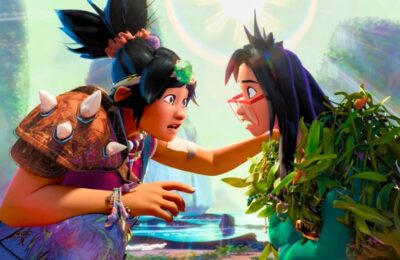
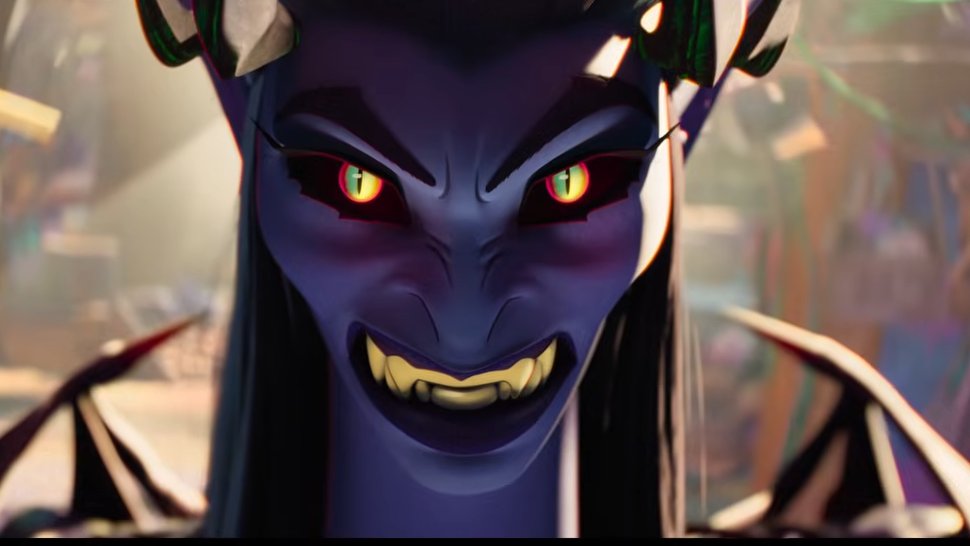
If there’s one character in Forgotten Island that Filipino viewers probably recognize almost immediately, it’s the Manananggal.
Huge wings.
A body that separates at the waist.
A terrifying presence.
And a voice that you probably weren’t expecting to hear coming from one of the most feared creatures in Philippine folklore.
That’s because the Dreaded Manananggal in DreamWorks’ Forgotten Island is voiced by none other than Lea Salonga.
Yes, the same Lea Salonga whose voice generations of audiences associate with Disney characters such as Princess Jasmine and Mulan is now playing one of the Philippines’ most frightening mythical creatures.
And DreamWorks doesn’t give her a small cameo either.
Her character, called Manang, is described by the studio as the most feared creature on the mysterious island of Nakali and becomes one of the biggest threats facing Jo and Raissa during their adventure.
But Manang isn’t simply a traditional manananggal copied directly from Filipino folklore.
DreamWorks takes the familiar creature and changes one very important thing:
Instead of feeding on the things traditionally associated with the manananggal legends, Manang feeds on memories.
And considering that Forgotten Island is fundamentally a movie about friendship, separation and the fear of forgetting someone important, that change makes her much more connected to the story.
So who exactly is Manang?
Why is Lea Salonga playing her?
And how different is the Forgotten Island Manananggal from the creature Filipinos have been hearing about for generations?
Let’s take a closer look.
Content
Who Is Manang in Forgotten Island?
Manang is the Dreaded Manananggal, one of the most powerful and feared beings living on Nakali.
DreamWorks officially introduces her as the creature Jo and Raissa eventually have to face while searching for a way home.
The basic setup of the movie follows lifelong best friends Jo, voiced by H.E.R., and Raissa, voiced by Liza Soberano.
With Raissa preparing to leave the Philippines to study in the United States, the two friends spend one of their final nights together before accidentally being transported to Nakali—a fantasy island populated by creatures inspired by Philippine mythology.
Among those creatures are Kapre, Tiyanak, Duwende and, most dangerously, the Manananggal.
And this isn’t just any Manananggal.
Manang has a reputation.
Other inhabitants of Nakali fear her.
The official trailer describes her as the island’s “most feared monster,” while DreamWorks calls her the Dreaded Manananggal.
That puts her in a very different position from many of the other Filipino mythical creatures Jo and Raissa encounter.
Some become friends.
Some are strange.
Some are funny.
Manang is the creature you don’t want chasing you.
Forgotten Island Manananggal Quick Facts
| Detail | Information |
|---|---|
| Character | Manang / The Dreaded Manananggal |
| Voice actor | Lea Salonga |
| Movie | Forgotten Island |
| Home | Nakali |
| Based on | Manananggal from Philippine folklore |
| Role | One of the primary threats facing Jo and Raissa |
| Special ability in the movie | Feeding on or taking memories |
| Traditional ability | Separating the upper body from the lower body and flying at night |
| Studio | DreamWorks Animation |
What Does the Manananggal Do in Forgotten Island?
This is where DreamWorks makes its biggest change to the mythology.
Traditional manananggal stories can be extremely dark.
But Forgotten Island is a PG animated family movie.
So instead of recreating some of the more gruesome elements of the old legends, the filmmakers connect Manang directly with the movie’s central idea:
Memory.
The trailer establishes that Manang consumes people’s memories until eventually there is nothing left for them to remember.
That’s actually a clever adaptation.
Because memory isn’t just some random magical power added to the character.
It’s what the entire movie revolves around.
Jo and Raissa’s friendship is built from years of shared experiences.
School.
Childhood adventures.
Private jokes.
Friendship bracelets.
Arguments.
Family gatherings.
Every little moment that turned two people into best friends.
Then Nakali introduces the possibility that all of those memories can disappear.
Suddenly the Manananggal isn’t frightening simply because she can attack you.
She’s frightening because she can take away part of who you are.
Why Does Manang Eat Memories Instead?
Traditional folklore obviously doesn’t describe the manananggal as a memory-eating creature.
That’s a DreamWorks invention.
And it makes sense within this particular story.
In many traditional accounts, the manananggal is depicted as a predatory night creature. A De La Salle University study of its representation in Philippine horror describes the familiar figure as a woman who appears human during the day before becoming a self-segmenting flying monster at night.
The darker legends can involve attacks on sleeping people and pregnant women—material that would obviously be extremely difficult to reproduce faithfully in a family-oriented DreamWorks movie.
So the filmmakers preserve the fundamental idea that the Manananggal takes something precious from her victims.
They simply change what she takes.
Memories.
That allows the character to remain threatening while tying her directly to Jo and Raissa’s emotional conflict.
What Is a Manananggal in Filipino Folklore?
Long before Forgotten Island, the Manananggal had already been frightening Filipinos for generations.
It is one of the most recognizable supernatural creatures in Philippine folklore.
The classic description goes something like this:
During the day, the Manananggal may look like an ordinary human being—often a woman.
At night, she transforms.
Her upper body separates from her lower body at the waist.
Large bat-like wings emerge.
The upper half flies into the darkness while the lower half remains somewhere hidden until she returns.
Reuters describes the Manananggal as a legendary Filipino creature distinguished by its ability to split its body, while academic research similarly identifies the self-segmenting flying monster as one of the most enduring figures in Philippine lower mythology.
For Filipinos who grew up hearing those stories, the image is instantly recognizable.
Honestly, DreamWorks probably doesn’t even need to explain it to Filipino audiences.
The moment that torso separates?
We know.
Where Does the Name Manananggal Come From?
Even the name tells you what the creature does.
“Manananggal” is associated with the Filipino root word “tanggal,” meaning to remove or separate.
In the context of the creature, the name refers to its defining ability to separate part of its body.
Academic discussions of the folklore commonly translate the term in connection with self-segmentation, while folkloric sources trace the name to that idea of removal or separation.
Which makes the creature even more interesting inside Forgotten Island.
The movie is about two best friends approaching separation.
Raissa is leaving.
Jo doesn’t want things to change.
Their lives are literally starting to split apart.
And the movie’s most frightening monster is a creature whose defining characteristic is that she physically splits herself in two.
Whether every viewer reads that as deliberate symbolism or simply an effective use of folklore, the parallel is hard to miss.
Is the Manananggal an Aswang?
This gets complicated.
Because Philippine folklore gets complicated.
The short answer is that the Manananggal is commonly associated with the larger tradition of creatures described as Aswang.
But “Aswang” isn’t necessarily one specific monster with one standardized appearance.
Filipino folklorist Maximo Ramos categorized beings such as the Manananggal among a broader complex of Philippine supernatural creatures, while later scholarship continues to discuss the Manananggal within the Aswang tradition.
Depending on the province, language and storyteller, the word Aswang can refer to different kinds of supernatural beings.
Some shapeshift.
Some fly.
Some resemble witches or vampires.
Some are described completely differently.
That’s why two Filipinos can grow up hearing very different Aswang stories and neither necessarily heard the “wrong” version.
Philippine folklore developed through oral storytelling across hundreds of communities.
There isn’t one official Monster Manual.
And Forgotten Island actually embraces that flexibility.
How Is Manang Different From the Traditional Manananggal?
This is probably the most important distinction to make.
DreamWorks’ Manang is inspired by Philippine folklore.
She isn’t supposed to be an academic reconstruction of every traditional Manananggal story.
There are several obvious differences.
Traditional Manananggal
Typically described as:
- appearing human during the day;
- separating at the waist at night;
- developing large wings;
- flying while the lower body remains behind;
- hunting victims after dark;
- being associated with the broader Aswang tradition.
Descriptions differ significantly across regions and storytellers.
Manang in Forgotten Island
DreamWorks retains:
- the separated body;
- the wings;
- the frightening appearance;
- the predatory nature;
- the association with darkness and fear.
But the movie gives her something new:
The ability to consume memories.
The gore traditionally associated with the creature is also considerably softened. Rolling Stone Philippines noted that the filmmakers retain the Manananggal’s threatening presence while dialing down the graphic nature of the traditional transformation for the animated movie.
That’s probably the only way a creature like this could realistically become a character in a family-oriented DreamWorks film.
Why Is She Called Manang?
The nickname is one of the movie’s funniest bits of Filipino wordplay.
The Manananggal is called Manang.
For Filipino audiences, “Manang” is already a familiar term generally used for an older sister or an older woman, particularly in certain Philippine languages and everyday usage.
But in the movie it’s also conveniently sitting right there at the beginning of:
Mana-nganggal.
The nickname makes an ancient horror creature sound almost like somebody’s neighborhood Ate.
GMA’s review even noted how unusual—and strangely fitting—it is to give the Manananggal the nickname Manang.
It’s exactly the kind of joke that plays differently for Filipino audiences.
International viewers hear a character name.
Filipinos hear the name and immediately get another layer.
Lea Salonga Voices Manang
Then we get to the casting.
Lea Salonga.
DreamWorks officially credits the Tony Award-winning Filipino performer as the Dreaded Manananggal.
And the contrast is fantastic.
Salonga has one of the most recognizable voices in musical theater.
She originated the role of Kim in Miss Saigon.
She played Éponine and Fantine in Les Misérables.
Disney audiences know her as the singing voice of Princess Jasmine in Aladdin and Mulan in Mulan and Mulan II.
And now DreamWorks has essentially said:
What if that voice belonged to a terrifying Filipino monster?
It’s inspired casting.
Lea Salonga Was Excited About the Filipino Story
Salonga told Vogue Philippines that the project immediately caught her attention because of how specifically Filipino the story was.
She also explained that the more culturally specific a story becomes, the more universal it can ultimately feel—an idea that fits Forgotten Island’s approach of not watering down its Filipino mythology for international audiences.
That’s an important part of the movie.
DreamWorks doesn’t rename the Manananggal something easier for American audiences.
It doesn’t turn the Kapre into a generic tree giant.
It doesn’t call the Duwende “elves.”
The creatures retain their Filipino identities.
And now millions of viewers outside the Philippines may hear the word “Manananggal” for the first time because Lea Salonga is playing one.
Manang Isn’t Just a One-Dimensional Monster
This is another difference between Manang and many traditional movie versions of the Manananggal.
She’s frightening.
But there’s more going on underneath.
Vogue’s behind-the-scenes coverage says Manang’s character is shaped by loss and tragedy, and that the emotional side of the character influenced Salonga’s spoken performance, musical passages and character theme.
That detail matters.
A traditional horror story doesn’t necessarily need to ask:
“Why does the Manananggal behave this way?”
It’s a monster.
Run.
DreamWorks has different storytelling requirements.
Animated characters generally need motivations, personalities and emotional arcs.
So Manang becomes more than simply a creature flying around Nakali looking for victims.
Her relationship with memories gives her a connection to the movie’s larger themes of loss, remembering and letting go.
That helps explain why Salonga’s performance needed more than a scary monster voice.
Lea Salonga Actually Sings as the Manananggal
Of course DreamWorks wasn’t going to cast Lea Salonga and completely ignore the fact that she can sing.
Music is incorporated into Manang’s characterization.
Vogue reports that the filmmakers used multiple parts of Salonga’s performance—dialogue, singing and other vocal elements—to build the character.
But don’t expect Manang to suddenly become a traditional Disney princess.
The musical approach surrounding her is intentionally darker.
Composer Nathan Matthew David created a musical identity for Manang using large brass gongs, helping make the character sound powerful and threatening while still grounding parts of the score in Philippine musical traditions.
That’s another particularly interesting part of Forgotten Island.
Even the scary monster music received a Filipino connection.
Manang’s Music Has Filipino Roots
The score deserves its own mention because DreamWorks didn’t simply reach for generic Hollywood horror music.
Filipino-American composer Nathan Matthew David traveled through the Philippines while researching musical traditions for Forgotten Island.
For Manang specifically, he turned to large brass gongs whose sound helped create a sense of danger and scale around the character.
The broader score involved research and recording connected with Philippine musical traditions, including work with indigenous performers.
That means the Filipino influence surrounding Manang isn’t limited to her name or her appearance.
It’s also in the way she sounds.
Even Manang’s Movements Were Carefully Designed
Here’s another detail that’s easy to overlook.
The way Manang moves.
The character doesn’t glide around like a generic animated villain.
Her movements can look sudden, unnatural and almost broken.
Vogue Philippines reports that choreographer Phil Tayag—co-founder of the Jabbawockeez—helped develop Manang’s movement vocabulary using jerky pop-and-lock-inspired motions.
That makes a lot of sense visually.
A Manananggal is already physically impossible.
Its body isn’t functioning according to normal human rules.
Making its movement slightly unnatural creates an uncomfortable feeling before the character even does anything frightening.
Some reviews have specifically highlighted that movement as one of the things that makes the character effective.
Is Manang the Villain of Forgotten Island?
Manang is certainly one of the movie’s major antagonistic forces and the central creature DreamWorks uses to threaten Jo and Raissa.
The studio’s own synopsis builds toward the girls having to face the Dreaded Manananggal.
But describing her simply as “the evil villain” misses some of the character’s complexity.
The filmmakers have given her a history connected to loss and tragedy.
Her relationship with memory connects her directly with the emotional mechanics of Nakali.
And without getting deeply into spoiler territory, the movie ultimately asks viewers to understand more about why certain characters behave the way they do rather than reducing every creature into hero or monster.
That makes Manang much more interesting than she would have been as a simple final boss.
Why the Manananggal Works So Well in a Movie About Friendship
This is where I think the choice of monster becomes particularly clever.
Think about what a Manananggal represents visually.
Separation.
Something once whole becomes divided.
Now think about Jo and Raissa.
They’ve spent most of their childhood together.
Then graduation arrives.
Raissa is preparing to leave for America.
Jo is afraid that their friendship will change.
They’re being separated.
Then they travel to a world where memories can disappear.
And stalking that world is literally a creature defined by separating itself into two pieces.
That’s a very effective combination of Filipino mythology and storytelling.
The filmmakers didn’t simply ask:
“What’s a scary Filipino monster?”
They found a creature whose defining characteristic fits surprisingly well with a story about two people afraid of being pulled apart.
Why Making the Manananggal a Memory Eater Is Clever
The other brilliant change is memory.
Traditional folklore makes the Manananggal terrifying because it threatens your body.
Forgotten Island makes Manang terrifying because she threatens your identity.
Imagine slowly forgetting:
Your childhood.
Your best friend.
The stupid things you laughed about together.
The arguments you eventually forgave.
The people you loved.
The places you came from.
At some point, if enough memories disappear, are you still exactly the same person?
That’s the larger idea Forgotten Island plays with.
And suddenly a Manananggal consuming memories isn’t simply a kid-friendly replacement for something gruesome.
It’s actually more relevant to this particular movie.
Why Lea Salonga as a Manananggal Is Such a Big Deal
For Filipino audiences, there’s another reason this casting feels special.
Lea Salonga has spent decades bringing Asian and Filipino talent onto some of the world’s biggest stages.
Many Filipinos grew up hearing her voice in Disney movies without necessarily seeing Filipino stories represented in those movies.
Now the situation has flipped.
She’s still lending her voice to a major Hollywood animated film.
But this time she isn’t voicing someone else’s mythology.
She’s voicing ours.
And not just any creature.
The Manananggal.
One of the most recognizable monsters in Philippine folklore.
Reuters specifically highlighted Salonga’s casting as part of Forgotten Island’s larger effort to bring Filipino mythology into a major studio animated feature.
There’s something satisfying about that.
The woman generations associate with the singing voices of Jasmine and Mulan now gets to introduce millions of international viewers to a creature Filipino kids have been hearing about for generations.
The Forgotten Island Manananggal Is Still Very Filipino
It’s important to remember that Manang is not a perfectly traditional Manananggal.
She shouldn’t be used as your only source if you’re trying to study Philippine mythology.
The filmmakers changed things.
They made the creature work inside their story.
They made her appropriate for younger audiences.
They gave her memory-related powers.
They built a personality and emotional history around her.
But the foundation remains recognizable.
The separated body.
The wings.
The frightening nighttime presence.
The Aswang connection.
The idea of an ordinary-looking being transformed into something extraordinary and terrifying.
DreamWorks didn’t erase the Filipino creature and replace it with something generic.
It reinterpreted it.
And folklore has been doing that for generations anyway.
Filipino Families Already Know This Monster
One of the best things about having the Manananggal in Forgotten Island is that Filipino viewers arrive with their own history.
H.E.R., who voices Jo and has Filipino heritage through her mother, recalled growing up hearing Manananggal stories from her family.
That experience will probably sound familiar to many Filipinos.
These weren’t necessarily stories we discovered in books.
Someone told us.
A Lola.
A parent.
An uncle.
An older cousin trying to scare everyone.
Maybe during a brownout.
Maybe while visiting relatives in the province.
Maybe right before bedtime, which was honestly a terrible time for anyone to tell a child about a flying upper torso.
That’s how folklore lives.
And now the same creature has moved from family storytelling into a DreamWorks movie.
Does Forgotten Island Accurately Portray the Manananggal?
Yes and no.
If by “accurately” you mean:
Does the movie preserve the most recognizable characteristics of the traditional Manananggal?
Yes.
The separated body, wings and terrifying supernatural presence are very much there.
Rolling Stone Philippines noted that the character remains recognizably frightening even though DreamWorks tones down the graphic aspects of the traditional creature.
But if you mean:
Does Manang behave exactly like the creature described in every traditional Filipino story?
No.
And she isn’t supposed to.
Traditional Manananggal stories vary anyway.
Folklore isn’t one fixed canon.
Different regions have different names, characteristics and stories for closely related supernatural creatures. Academic research has documented variations even in how self-segmenting creatures separate their bodies.
DreamWorks takes that storytelling tradition and creates its own version.
Is Lea Salonga’s Manananggal Scary?
For a PG movie?
Definitely.
Reviews have repeatedly singled out Manang as genuinely intimidating.
Rolling Stone Philippines praised the character’s frightening chase sequences, while other reviewers have highlighted Salonga’s ability to make the Dreaded Manananggal appropriately scary.
At the same time, this is still DreamWorks.
You’re not watching Shake, Rattle & Roll.
There’s no attempt to recreate the most disturbing versions of the traditional legends.
The filmmakers rely more on:
- Manang’s size;
- wings;
- movement;
- voice;
- music;
- shadow;
- pursuit sequences;
- her ability to steal memories.
That allows her to be frightening without transforming the movie into full Filipino horror.
Could Manang Introduce the Manananggal to International Audiences?
Very likely.
That’s one of the culturally interesting things about Forgotten Island.
Hollywood audiences already know:
Vampires.
Werewolves.
Zombies.
Trolls.
Greek monsters.
Norse gods.
Those creatures have appeared in international movies countless times.
The Manananggal has rarely received anything close to that level of global exposure.
Forgotten Island changes that.
Reuters called the film the first major animated feature to draw this extensively from Filipino myths and culture.
For someone watching in the United States, Europe or somewhere else, Lea Salonga’s character might genuinely be their first encounter with the word:
Manananggal.
And once you know what the creature does, you probably won’t forget it.
Which is somewhat ironic considering Manang’s particular talent in this movie.
Frequently Asked Questions
Who is the Manananggal in Forgotten Island?
The Manananggal is Manang, also known as the Dreaded Manananggal. She is one of the most feared creatures living on Nakali and one of the main threats facing Jo and Raissa.
Who voices the Manananggal in Forgotten Island?
Lea Salonga voices Manang.
What powers does Manang have?
In Forgotten Island, Manang can consume people’s memories. DreamWorks also retains the traditional Manananggal’s defining physical characteristics, including its separated body and wings.
Is Manang based on a real Filipino mythical creature?
Yes.
The Manananggal is a well-established creature in Philippine folklore and is typically described as a supernatural being whose upper body can separate from its lower half and fly during the night.
Is the Manananggal an Aswang?
The Manananggal is commonly discussed within the broader Aswang tradition, although classifications and descriptions vary across Philippine regions and folklore traditions.
Does the traditional Manananggal eat memories?
No.
The memory-eating ability appears to be a creative adaptation made specifically for Forgotten Island. Traditional stories portray the creature as a far more physically predatory supernatural being.
Why is she called Manang?
Manang is the character’s name or nickname in Forgotten Island, creating a playful connection with the beginning of the word “Manananggal” as well as the familiar Filipino term “Manang.”
Is Lea Salonga singing in Forgotten Island?
Salonga’s musical abilities are incorporated into the character. The filmmakers have described her performance as involving more than ordinary dialogue, with vocal and musical elements helping shape Manang.
Who created Manang’s movements?
Choreographer Phil Tayag, a co-founder of the Jabbawockeez, helped develop Manang’s unusual movement style, including jerky pop-and-lock-inspired motions.
Is Manang the main villain?
She is presented as one of the movie’s central threats and the most feared creature on Nakali. However, her character has more emotional complexity and history than a straightforward monster.
Final Thoughts
Of all the Filipino mythical creatures Forgotten Island could have chosen as its biggest threat, the Manananggal might be the perfect one.
It’s visually unforgettable.
It’s unmistakably Filipino.
And its defining characteristic—being physically separated into two pieces—fits beautifully into a movie about two best friends terrified that their lives are about to pull them apart.
Then DreamWorks adds another layer.
Memory.
Instead of simply hunting people in the traditional way, Manang threatens to take away the experiences that make people who they are.
That’s what transforms the character from a Filipino monster placed inside a Hollywood movie into something that actually belongs inside this particular story.
And casting Lea Salonga makes the whole thing even better.
For decades, Filipino audiences have heard her voice attached to some of animation’s most famous characters.
This time, international audiences get to hear that same voice attached to something unmistakably Filipino.
Not a princess.
Not a Western fairy-tale character.
A Manananggal.
There are Kapre, Tiyanak, Duwende and plenty of other creatures waiting around Nakali.
But when Lea Salonga’s Manang spreads her wings, you understand very quickly why everyone on the island is afraid of her.
Filipino audiences probably understood before the characters did.
We’ve been warned about the Manananggal our whole lives.