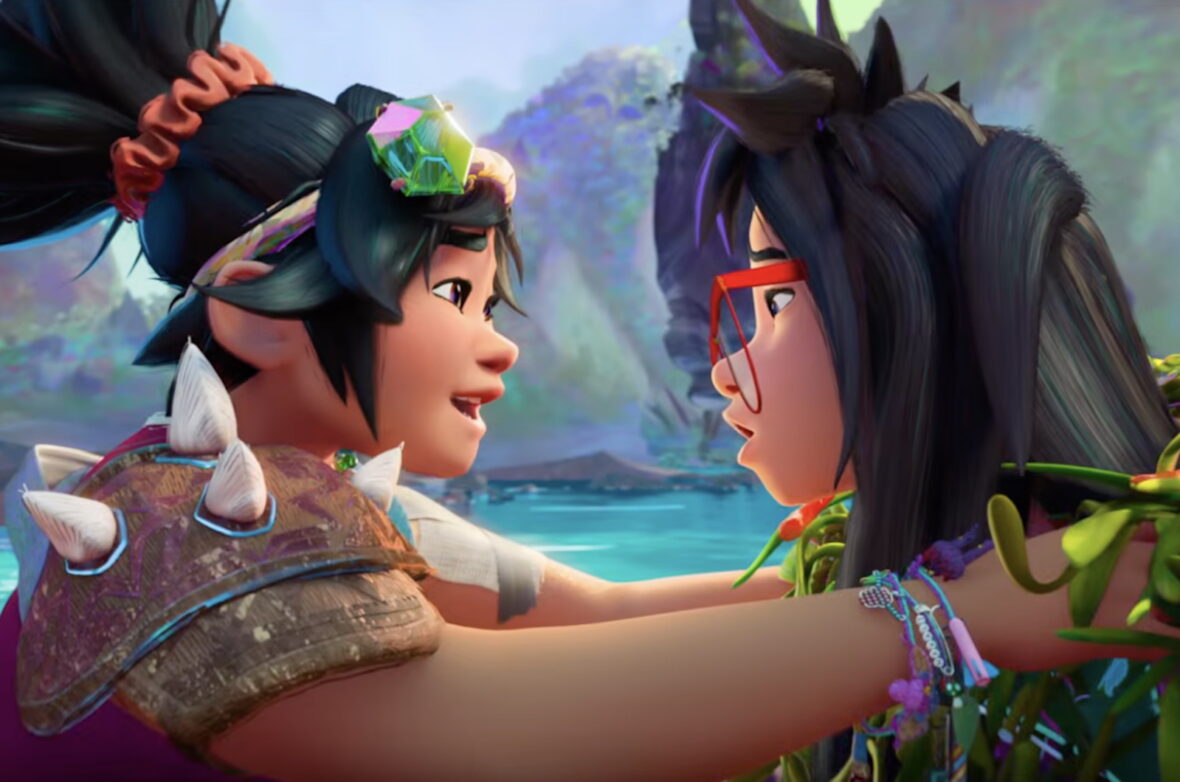
Warning: Major spoilers ahead for the entire ending of DreamWorks Animation’s Forgotten Island.
If you haven’t watched the movie yet and want to experience the surprises yourself, this is probably where you should stop reading.
Because Forgotten Island saves some of its biggest revelations for the final act.
For most of the movie, Jo and Raissa seem to have one straightforward problem: escape Nakali before their memories disappear and before Raissa misses the flight that will take her to a new life in America.
But by the ending, we discover that things are much more complicated.
Jo hasn’t been completely honest.
Raww hasn’t been completely honest either.
Batiba isn’t simply the strange memory-collecting creature she initially appears to be.
And even Manang—the terrifying Manananggal voiced by Lea Salonga—isn’t quite the villain the movie initially leads us to believe she is.
The final act turns what looks like a colorful fantasy adventure into something much more emotional: a story about accepting change, letting someone you love move forward, and understanding that holding onto a friendship too tightly can actually damage the thing you’re trying to protect.
So what exactly happens at the end of Forgotten Island?
Let’s break it down.
Content
First, What Is Really Happening on Nakali?
The basic rule of Nakali becomes increasingly important as the story moves toward its ending.
Memories have power.
Jo and Raissa’s friendship bracelets are especially important because the charms attached to them represent experiences the girls have shared throughout their lives. Those objects aren’t magical simply because they’re objects—the emotional memories attached to them give them their power. The filmmakers deliberately designed Batiba around this idea, transforming the folkloric Batibat into a creature who preys on memories.
And that’s dangerous for Jo and Raissa.
Their entire relationship is built around years of shared experiences.
If those memories disappear, what happens to their friendship?
That question is essentially the emotional engine of the entire movie.
Reuters’ description of the story captures the central dilemma clearly: Jo and Raissa become stranded in Nakali, where escaping could cost them a lifetime of memories.
At first, that sounds like a magical problem.
By the ending, we realize it’s also an exaggerated version of the problem Jo has been afraid of from the beginning.
Raissa is leaving.
Their lives are changing.
And Jo is terrified that eventually Raissa will forget her.
The Big Reveal: Raww Was Working for Batiba
Raww spends much of Forgotten Island appearing to be Jo and Raissa’s chaotic but lovable guide.
But late in the movie, the truth comes out.
He has been working for Batiba.
Batiba uses Raww to help bring stranded humans toward her, where their desperation to escape Nakali creates an opportunity for her to collect their memories.
That changes how we understand much of what happened earlier.
Raww wasn’t simply someone the girls happened to meet.
Batiba had an interest in them because their friendship contained exactly what she valued:
Powerful memories.
Feature First’s detailed recap confirms that Raww ultimately reveals his connection to Batiba during the final act.
But Raww isn’t portrayed as a cold-blooded villain.
By this point, he genuinely cares about Jo and Raissa.
That’s why the revelation hurts.
The girls thought they had found a friend on an island where almost everything was confusing.
Instead, they discover that their meeting wasn’t as accidental as they believed.
Batiba Gives Jo and Raissa Their Missing Memories Back
There’s another problem.
Jo and Raissa cannot fully remember what happened during their first chaotic night on Nakali.
Throughout the movie, they’ve been reconstructing those missing hours using clues, other characters and the strange evidence left behind.
Batiba eventually restores those memories.
That should be good news.
Finally, they can remember what happened.
Except one restored memory changes everything.
They discover what Jo did.
Why Did Jo Hide the Sand Dollar?
This is the betrayal at the center of Forgotten Island.
Jo hid the Sand Dollar.
The object is important because it can help them get home.
And Jo deliberately prevented Raissa from using it.
Why?
Because Raissa is leaving for America.
She has been accepted to Caltech, while Jo is staying behind in the Philippines. The movie establishes that Raissa’s future is pulling her away just as Jo is struggling to imagine what her own future will look like.
Jo is scared.
Not scared of Nakali.
Scared of being left behind.
Some part of her believes that if she can delay getting home, she can delay Raissa leaving.
It’s irrational.
It’s selfish.
But emotionally, you can understand where it comes from.
Jo doesn’t actually want to ruin Raissa’s future.
She wants to freeze their friendship in place.
If Raissa doesn’t leave, things don’t have to change.
If things don’t change, Jo won’t lose her best friend.
Except that’s not friendship.
That’s control.
And when Raissa discovers what Jo has done, she’s understandably furious.
Feature First’s ending recap confirms that the restored memory reveals Jo deliberately hid the Sand Dollar to prevent Raissa from returning home and going to Caltech.
This is probably Jo’s lowest point in the movie.
She spent the whole story afraid that Raissa would destroy their friendship by leaving.
Instead, Jo almost destroys it herself by refusing to let Raissa choose her own future.
Why Raissa Leaves Jo
Raissa decides to find the Sand Dollar on her own.
At this point, the emotional conflict has become more dangerous than anything happening around them.
Raissa isn’t simply angry that Jo lied.
She realizes that Jo was willing to interfere with something Raissa had worked toward because Jo couldn’t accept the idea of change.
And that’s difficult to forgive immediately.
So Raissa goes after the Sand Dollar without her.
But because this is Nakali, things get worse.
Why Does Manang Attack Raissa?
Raissa runs into Manang, the feared Manananggal voiced by Lea Salonga.
Throughout most of Forgotten Island, Manang has been presented as one of Nakali’s biggest threats.
She’s terrifying.
She’s powerful.
And the characters clearly don’t want to encounter her.
But the ending reveals that there’s another side to the story.
Manang wants something that was taken from her.
Her memories.
Raissa eventually tells Manang that Batiba has been stealing memories—including hers.
That revelation changes the entire conflict.
Feature First’s account of the ending confirms that Raissa tells Manang about Batiba’s role, stunning the Manananggal long enough for Jo and Batiba to intervene.
Suddenly Manang doesn’t look like the simple monster we were expecting.
She’s also a victim.
So Who Is the Real Villain?
Forgotten Island doesn’t ultimately give us one completely straightforward villain.
Manang certainly behaves like a threat for much of the movie.
Batiba manipulates humans and collects memories.
Jo betrays Raissa because of her fear.
Raww works for Batiba before developing genuine loyalty toward the girls.
Everyone has made questionable choices.
But the bigger enemy isn’t really one character.
It’s fear.
Jo is afraid of losing Raissa.
Raissa is afraid of disappointing her family and losing control of the future she has worked for.
Raww is driven by his own desire to matter.
Batiba treats memories like objects because she doesn’t fully understand what they mean to the people who created them.
And Manang has been damaged by having something fundamental taken away from her.
That makes the ending more interesting than simply having Jo and Raissa defeat a monster and run through a portal.
Jo Finally Makes the Opposite Choice
This is where Jo’s character arc comes together.
Earlier, she hid the Sand Dollar because she couldn’t let Raissa go.
Now she does the exact opposite.
Jo makes a deal with Batiba that allows Raissa to return home safely.
The price is devastating.
Jo’s friendship bracelet—and the memories connected to her friendship with Raissa.
Raissa is sent back to the human world.
Jo stays behind while Batiba begins taking her memories.
Think about how different that decision is from what Jo did earlier.
Before:
“I love you, so I won’t let you leave.”
Now:
“I love you, so I’ll let you go—even if I lose you.”
That is Jo finally understanding what she had been getting wrong.
Friendship isn’t keeping someone beside you at any cost.
Sometimes friendship means allowing someone to move forward even when their future doesn’t look exactly like yours.
Does Jo Forget Raissa?
Almost.
And this is one of the movie’s most emotional sequences.
Batiba begins absorbing Jo’s memories.
Everything represented by the friendship bracelet starts slipping away.
The years.
The jokes.
Their childhood.
The experiences that transformed two girls into best friends.
The film has spent a lot of time teaching us that memories aren’t simply information.
They’re part of identity.
That’s why Jo losing Raissa isn’t equivalent to forgetting somebody’s phone number.
She is losing a part of herself.
DiscussingFilm specifically highlights the third-act sequence of Raissa desperately trying to hold onto Jo’s dying memories as one of the emotional peaks of the film.
For a moment, it looks like Jo’s sacrifice is going to become permanent.
But Raissa refuses to accept it.
How Does Raissa Get Back to Nakali?
Raissa has been sent home.
Jo is still on Nakali.
And she no longer has the obvious route back.
Yet Raissa’s determination to return to Jo creates something extraordinary.
Their connection itself becomes powerful enough to bring her back.
Feature First describes Raissa’s love and regard for Jo as enabling her return to Nakali even without the Sand Dollar.
This is one of the movie’s clearest statements about memory.
For most of the story, characters treat memories almost like objects.
They can be collected.
Stored.
Exchanged.
Taken.
Attached to charms.
But Jo and Raissa’s friendship shows that the relationship between people creates something bigger than any single object.
Their memories matter because of what they mean.
Not because somebody possesses them.
How Does Raissa Save Jo?
Raissa reaches Jo before Batiba can completely erase their friendship.
The climax shifts away from the physical adventure and into Jo’s fading memories.
Raissa moves through the experiences that shaped their relationship and reaches the emotional core of why Jo has been behaving this way.
Jo wasn’t simply angry because Raissa was leaving.
She was terrified of being abandoned.
She was struggling with her own uncertainty.
She saw her best friend moving toward a clear future while her own life felt much less certain.
Raissa finally reaches Jo through the memories of their friendship rather than through brute force.
This matters.
You can’t punch somebody’s fear of abandonment until it disappears.
You can’t defeat growing up with a sword.
The only way through is understanding.
And Raissa eventually gets Jo to remember.
Jo’s memories survive.
Their friendship survives with them.
What Does Batiba Finally Understand?
Batiba also changes during the climax.
Throughout the movie, she has treated memories as valuable objects.
She knows they’re powerful.
But she doesn’t fully understand why.
Watching Jo and Raissa changes that.
She realizes memories aren’t valuable simply because they contain energy.
They’re valuable because they shape people.
The Nerds of Color’s reporting on the filmmakers explains the idea behind the movie beautifully: an ordinary object gains meaning because of the memories attached to it, and Jo and Raissa’s bracelet charms represent experiences that define their relationship.
Batiba finally understands the human side of that equation.
Taking someone’s memories isn’t like taking treasure.
You’re taking pieces of who they are.
And that’s when her relationship with Manang becomes important.
What Happened Between Batiba and Manang?
One of the ending’s biggest revelations is that Batiba took memories from Manang too.
That helps explain why the Manananggal has become such an angry and dangerous presence.
The feared monster has herself lost something important.
Batiba finally admits what she did.
She returns Manang’s memories.
According to Feature First, this happens during the final confrontation after Batiba realizes the damage caused by treating memories this way.
It’s a nice reversal.
For most of the movie, we’re conditioned to see Manang as the monster everybody needs to escape.
But the ending asks us to look at her differently.
What happens when you remove someone’s past?
What kind of person—or creature—might they become?
The same question has been hanging over Jo throughout the climax.
Do Jo and Raissa Escape Nakali?
Yes.
Once the conflict with Batiba and Manang is resolved, Jo and Raissa are able to leave Nakali together.
Their memories are intact.
Their friendship survives.
And they return to the human world.
But here’s what’s important:
The original problem hasn’t disappeared.
Raissa is still going to America.
Jo still has to figure out her own future.
The magical adventure doesn’t suddenly create a world where the two girls never have to be apart again.
That would completely undermine the movie.
Instead, they’ve changed how they understand separation.
Does Raissa Still Leave for America?
Yes.
And that’s one of the reasons the ending works.
Jo doesn’t “win” by getting Raissa to stay.
Raissa doesn’t abandon her opportunity to make Jo happy.
They accept that their lives can move forward.
DiscussingFilm notes that the entire conflict begins because Raissa has accepted a place at Caltech while Jo struggles with the prospect of life without her.
The lesson isn’t:
True friends never leave.
It’s closer to:
True friendships can survive change.
That difference matters.
What Happens After the Time Jump?
Then Forgotten Island surprises us again.
The movie jumps forward.
Jo and Raissa are now both living in America.
And Jo has become a writer.
Raissa attends a live reading of Jo’s newest novel.
What is Jo writing about?
Nakali.
Their adventure has been transformed into a story.
Of course, Jo has apparently taken some creative liberties—including a humorous fictional romantic triangle involving Raissa, Raww and Prince Mermahn.
That’s a funny ending.
But it’s also surprisingly meaningful.
Jo spent the beginning of the movie terrified that the past would disappear.
Now she does something storytellers have always done.
She preserves it by telling the story.
Why Jo Becoming a Writer Matters
This isn’t just a random “where are they now?” ending.
Stories have been part of Jo’s identity from the beginning.
Her connection with Nakali comes partly through the stories passed down by Lola Fatima.
The movie itself revolves around Philippine folklore—stories preserved because people told them repeatedly across generations.
Now Jo becomes part of that same tradition.
She takes something that happened to her and transforms it into a story other people can experience.
That feels particularly appropriate for a movie built around Filipino folklore.
The Manananggal.
Kapre.
Tiyanak.
Duwende.
Batibat.
These creatures didn’t survive for generations because somebody stored them in a magical vault.
They survived because people remembered them.
And people told the stories again.
Jo essentially does the same thing.
Can Jo and Raissa Return to Forgotten Island?
Yes.
And this is the movie’s final big reveal.
After Jo’s book reading, Jo and Raissa still have their friendship bracelets.
Together, they are able to open another portal.
Then they return to Nakali.
Not because they’re trapped.
Not because they’re desperate.
Not because Jo is trying to stop Raissa from leaving.
They go because they want to visit their friends.
The final moments show them returning voluntarily to the world that once nearly destroyed their friendship.
That’s a complete reversal of their first journey.
What Does the Final Return to Nakali Mean?
The first time they enter Nakali, their friendship is driven by fear.
Jo doesn’t want change.
Raissa wants to move forward.
Neither one fully understands what the other is feeling.
Nakali forces that conflict into the open.
By the final scene, they return under completely different circumstances.
They’re older.
They’ve moved on.
Their lives have changed.
And they’re still friends.
Jo has finally learned that she doesn’t need to trap Raissa in one version of their relationship.
Raissa has learned that moving forward doesn’t require abandoning the person who helped shape her.
They can leave.
They can come back.
They can live separate lives.
And they can still choose each other.
The Nerds of Color describes essentially the same idea at the heart of the movie: growing up means moving toward new things, but it doesn’t require abandoning the people, places and memories that helped make us who we are.
That’s Forgotten Island in one sentence.
What Do the Friendship Bracelets Really Represent?
The bracelets are probably the most important objects in the film.
Every charm represents something Jo and Raissa experienced together.
The movie makes those memories literally powerful.
But symbolically, the bracelet represents something very simple:
A life shared with another person.
One charm by itself might look meaningless to everyone else.
But Jo and Raissa know the story behind it.
That’s how real friendships work too.
A photo that means nothing to somebody else can immediately transport you back fifteen years.
An old song can remind you of someone.
A cheap souvenir might be worth more emotionally than something expensive.
The object isn’t important.
The memory is.
That’s why Batiba doesn’t understand the bracelets at first.
She sees valuable memories.
Jo and Raissa see themselves.
What Does Manang’s Ending Mean?
Manang gets an interesting ending because the movie deliberately changes our perspective on her.
She begins as the terrifying Manananggal.
The monster to avoid.
The thing everyone fears.
But after learning that her memories were stolen, we understand there is more behind her anger.
Batiba returning those memories doesn’t erase everything Manang has done.
But it restores something that had been taken from her.
That fits perfectly with the larger theme.
Jo nearly loses herself when her memories of Raissa are removed.
Manang has experienced her own version of that loss.
The movie essentially asks us:
How much of a person is contained in memory?
And what happens when those memories are taken away?
Is Batiba Actually Evil?
I wouldn’t describe the ending that simply.
Batiba does harmful things.
She manipulates people.
She takes memories.
She uses Raww to bring vulnerable humans to her.
Those actions aren’t suddenly okay because she changes her mind.
But Forgotten Island is more interested in growth than punishment.
Batiba genuinely doesn’t appear to understand the emotional consequences of what she’s collecting until she sees what happens to Jo.
Then she realizes something.
These aren’t just memories.
They’re people.
Or at least parts of people.
And once she understands that, she changes.
That parallels Jo.
Jo also hurts someone because she doesn’t fully understand what her actions mean.
Both characters eventually have to confront the damage they’ve caused.
Does Jo Forgive Raww?
The ending ultimately places Raww back among Jo and Raissa’s friends despite his earlier connection with Batiba.
Again, the movie isn’t interested in presenting characters as perfectly good or perfectly bad.
Raww made a bad choice.
But he also develops genuine affection and loyalty toward Jo and Raissa.
By the final conflict, he helps them rather than simply continuing to serve Batiba.
And because Jo and Raissa return to Nakali at the end, the movie clearly leaves those relationships open for the future.
Why Memory Is So Important in Forgotten Island
This is really what the whole movie is about.
Memory sounds like a fantasy concept because Nakali can magically remove it.
But the fear underneath that idea is completely ordinary.
What happens when your best friend moves away?
You talk every day.
Then maybe every few days.
Then once a week.
New people enter your lives.
New experiences happen separately.
Years pass.
Will you eventually become strangers?
That’s what Jo is terrified of.
Nakali simply makes that fear literal.
Instead of slowly losing the closeness of a friendship over ten years, the island threatens to remove those memories immediately.
But the movie’s answer isn’t:
Nothing will ever change.
Its answer is:
Change doesn’t automatically erase what mattered.
Why Raissa Going to America Matters
There is also a specifically Filipino layer to this story.
Leaving the Philippines for opportunities abroad is something countless Filipino families and friendships experience.
One person leaves.
Another stays.
The person leaving can feel excited and guilty at the same time.
The person staying can feel proud and abandoned at the same time.
The Nerds of Color points out that Raissa’s departure carries additional emotional weight in the Filipino context because overseas migration has stretched Filipino families and relationships across countries and time zones for generations.
That’s why Jo’s fear feels so recognizable.
She’s wrong to sabotage Raissa.
But the emotion underneath the mistake is real.
Is Forgotten Island’s Ending Happy or Sad?
It’s ultimately a happy ending.
Jo and Raissa survive.
Jo keeps her memories.
Batiba changes.
Manang gets her stolen memories back.
Jo and Raissa escape Nakali.
Raissa gets to pursue her future.
Jo eventually finds her own path as a writer.
And years later, the two remain close enough to return to Nakali together.
But there’s still something bittersweet underneath it.
Their childhood does end.
That’s unavoidable.
The movie doesn’t defeat growing up.
It simply teaches the characters how to accept it.
And I think that’s a much better ending.
Does the Ending Set Up Forgotten Island 2?
It certainly leaves the door open.
Literally.
Jo and Raissa can apparently return to Nakali.
Their friends are still there.
The island still exists.
And Philippine mythology contains far more creatures and stories than one movie could possibly explore.
But as of September 23, 2026, DreamWorks has not publicly confirmed Forgotten Island 2 in the reliable reporting available so far.
So the ending should be treated as an open possibility rather than proof that a sequel is coming.
The first movie also doesn’t need one.
Jo and Raissa’s central emotional story reaches a satisfying conclusion.
Forgotten Island Ending Explained in Simple Terms
If you just want the short version:
Jo secretly hid the Sand Dollar because she didn’t want Raissa to leave for America.
When Raissa discovers the truth, their friendship nearly collapses.
Jo eventually realizes she was wrong and sacrifices her own memories so Raissa can return home.
Raissa refuses to let Jo forget her, returns to Nakali and reaches Jo through their shared memories.
Jo remembers their friendship.
Batiba understands that stealing memories destroys part of a person’s identity and returns the memories she stole from Manang.
Jo and Raissa escape Nakali together.
Years later, both are living in America. Jo has become an author and turns their adventure into a novel.
Finally, Jo and Raissa use their friendship bracelets to open another portal and return to Nakali—not because they’re trapped there, but because they choose to go back and visit the friends they made.
Frequently Asked Questions
Does Jo forget Raissa at the end of Forgotten Island?
No. Jo comes extremely close to losing her memories when Batiba begins taking them, but Raissa returns to Nakali and reaches her before the process becomes permanent. Jo ultimately remembers their friendship.
Why did Jo hide the Sand Dollar?
Jo hid it because she was afraid of Raissa returning home and leaving for Caltech in the United States. Jo believed that stopping them from leaving Nakali could delay the separation she feared.
Who is the real villain in Forgotten Island?
The movie initially presents Manang as its biggest physical threat, but the ending reveals that Batiba has been collecting memories and even took memories from Manang. Rather than ending with one simple villain, the film gives Batiba a change of heart after she realizes what taking memories actually does to people.
What happens to Manang?
Batiba returns the memories she previously took from Manang, helping resolve their conflict.
Do Jo and Raissa return home?
Yes. They eventually leave Nakali together and return to their lives.
Does Raissa still go to America?
Yes. The ending doesn’t require Raissa to give up her future in order to remain Jo’s friend.
What happens to Jo later?
A time jump reveals that Jo is living in America and has become an author. She writes a novel inspired by their adventure on Nakali.
Do Jo and Raissa stay friends?
Yes. The time jump shows their friendship continuing as adults.
Can they go back to Nakali?
Yes. In the final sequence, the girls use their friendship bracelets to open another portal and return to Nakali.
Is there a Forgotten Island 2?
No sequel has been officially confirmed as of September 23, 2026. The ending leaves plenty of possibilities for another adventure, but it also works as a complete conclusion to Jo and Raissa’s story.
Final Thoughts
Forgotten Island begins with Jo desperately trying to stop change.
It ends with her embracing it.
That’s really the entire emotional journey.
At first, Jo believes keeping Raissa close is the only way to preserve their friendship.
So she hides the Sand Dollar.
She delays their escape.
She tries to control what happens next.
And nearly loses Raissa because of it.
By the climax, she finally understands something much harder:
Sometimes loving someone means letting them go.
That’s why Jo sacrificing her memories is so important.
It’s the opposite of everything she was doing before.
She stops asking:
“How do I keep Raissa here?”
And starts asking:
“How do I make sure Raissa gets where she needs to go?”
Then Raissa completes the lesson from the other side.
Leaving doesn’t mean forgetting.
She goes back.
She refuses to allow Jo’s memories to disappear.
And years later, she is still there.
The final return to Nakali makes the point beautifully.
The first time Jo and Raissa cross the portal, they’re terrified about their future.
The last time they cross it, they’ve already lived through change.
They’ve grown older.
They’ve moved.
Their lives aren’t identical.
And their friendship is still alive.
They don’t need to stay frozen in the past.
They can leave Nakali.
They can leave the Philippines.
They can pursue different dreams.
And they can still find their way back to each other.
For a movie called Forgotten Island, the ending is ultimately about the exact opposite.
Remembering.
Remembering where you came from.
Remembering the people who shaped you.
And understanding that moving forward doesn’t mean you have to leave all of that behind.