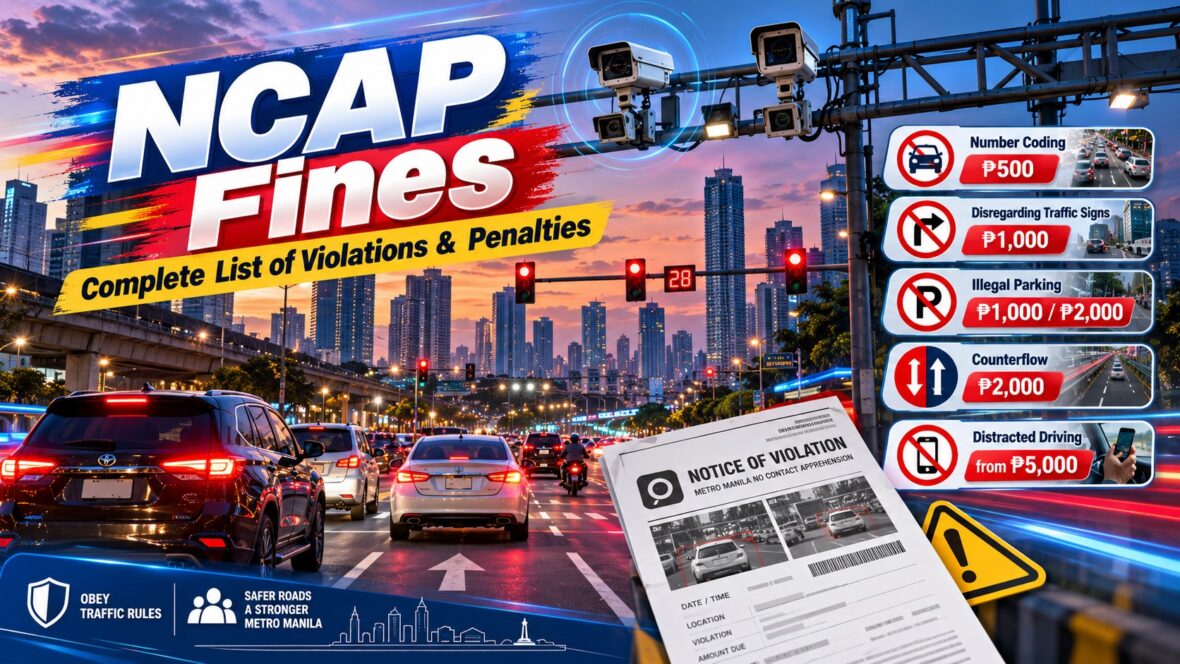
With the No Contact Apprehension Policy back in parts of Metro Manila, one of the first questions motorists are asking is pretty simple:
How much is the fine if an NCAP camera catches me?
The answer depends on what violation you committed.
There isn’t one fixed “NCAP fine.”
NCAP is simply the method used to detect and document a traffic violation. The actual penalty comes from the traffic rule or law you violated.
And this is where things are very different from the old NCAP system.
The renewed 2026 implementation follows the Metro Manila Traffic Code of 2023, which was created to harmonize traffic rules and penalties across Metro Manila instead of having wildly different fines from one city to another. The Supreme Court specifically noted that the newer framework provides a list of common violations that can be enforced through NCAP together with uniform fines and standardized procedures.
So if you’ve seen older articles saying that beating the red light automatically costs ₱2,000 in one city while the same offense costs something completely different somewhere else, be careful.
Many of those figures came from the old city NCAP ordinances.
The system being used in 2026 is based on the newer Metro Manila Traffic Code framework.
Here’s a comprehensive guide to NCAP fines, common violations, repeat-offense penalties and what happens if you don’t pay or contest your citation.
Content
NCAP Fines at a Glance
For motorists who just want the numbers, here are some of the most common penalties under the Metro Manila Traffic Code framework:
| Violation | Fine |
|---|---|
| Number coding / UVVRP | ₱500 |
| Tricycle ban | ₱500 |
| Motorcycle dress code | ₱500–₱1,000 |
| Disregarding traffic signs | ₱1,000 |
| Illegal parking – attended | ₱1,000 |
| Illegal parking – unattended | ₱2,000 + possible impoundment |
| Obstruction | ₱1,000 |
| Overloading | ₱1,000 |
| Defective vehicle accessories | ₱1,000 |
| Loading/unloading in prohibited zone | ₱1,000 |
| Overspeeding | ₱1,000 |
| Reckless driving | ₱1,000–₱2,000 + seminar for repeat offenses |
| Unauthorized vehicle modification | ₱2,000 |
| Light truck ban | ₱2,000 |
| Illegal counterflow | ₱2,000 |
| Counterflow causing injury/property damage | ₱5,000 + possible other liability |
| Truck ban | ₱3,000 |
| No motorcycle helmet | ₱1,500–₱10,000 |
| Child safety violation in motor vehicle | ₱1,000–₱5,000 |
| Children’s safety on motorcycles | ₱3,000–₱10,000 |
| Distracted driving | ₱5,000–₱20,000 |
| Certain distracted-driving cases involving PUVs/school zones | Up to ₱30,000 + license suspension |
These are not all necessarily violations that every NCAP camera can automatically identify.
Some offenses require additional evidence or physical enforcement.
But these are among the standardized traffic violations and special-law penalties incorporated into the Metro Manila Traffic Code framework.
Important: NCAP Doesn’t Have Its Own Separate Fine
This is probably the biggest misconception about the policy.
NCAP does not mean:
“Camera violation = ₱2,000.”
Instead, the process works more like this:
Camera records the incident.
Traffic personnel review the footage.
The specific violation is identified.
The applicable penalty under the traffic code or special law is imposed.
So if the camera captures you violating number coding, the penalty can be ₱500.
If it captures an offense classified as disregarding a traffic sign, the standard fine is ₱1,000.
If the case involves distracted driving under Republic Act No. 10913, penalties start at ₱5,000.
The method of apprehension doesn’t magically change the underlying fine.
San Juan Mayor Francis Zamora, who also heads the Metro Manila Council, explained during the October 2026 rollout that standardized fines apply regardless of whether the motorist is apprehended by an enforcer or detected through NCAP.
1. Disregarding Traffic Signs – ₱1,000
One of the most important violations under NCAP is Disregarding Traffic Signs, with a standard fine of:
₱1,000
The term is broader than many motorists realize.
The Metro Manila Traffic Code describes traffic signs as including not only physical signs but also:
- Road markings
- Lines
- Symbols
- Patterns
- Posted instructions
- Traffic-control structures
- Other devices controlling vehicle or pedestrian movement
Quezon City’s ordinance adopting the Metro Manila Traffic Code imposes a ₱1,000 fine for disregarding these traffic controls.
This means several behaviors commonly associated with NCAP can potentially fall under this category.
Beating the Red Light
Ignoring a red traffic signal is one of the clearest examples.
A camera can capture:
- Your vehicle
- Traffic signal
- Stop line
- Time
- Plate number
- Movement through the intersection
Don’t assume you need to see a traffic officer before the violation counts.
Illegal Turns
Signs saying:
No Left Turn.
No Right Turn.
No U-Turn.
One Way.
No Entry.
These are traffic-control instructions.
Ignoring them can result in a citation.
Crossing Solid Lane Markings
Solid lines are also road markings.
If you’re approaching an intersection and suddenly cut across a solid lane divider because you realized you’re in the wrong lane, that movement may be recorded.
Manila officials specifically identified improper lane changes and crossing solid lines as behaviors that its upgraded NCAP cameras can detect.
Pedestrian Crossing Violations
Stopping over pedestrian lanes or disregarding markings directing vehicles around crosswalks can also create traffic violations depending on the circumstances and classification of the citation.
The easiest rule is simple:
When you see markings, arrows, stop lines or traffic signs, assume they matter.
Because they do.
2. Number Coding Violation – ₱500
The standard penalty for violating the Unified Vehicle Volume Reduction Program or UVVRP is:
₱500
The basic Metro Manila plate schedule remains:
| Day | Restricted Plate Endings |
|---|---|
| Monday | 1 and 2 |
| Tuesday | 3 and 4 |
| Wednesday | 5 and 6 |
| Thursday | 7 and 8 |
| Friday | 9 and 0 |
The Metro Manila Traffic Code framework lists the coding restriction during prescribed morning and afternoon hours and sets the fine at ₱500.
However, this is one area where motorists need to pay attention to local exemptions and city-specific implementation.
Some LGUs have their own coding policies or exemptions.
For example, Taguig’s ordinance adopting the Metro Manila Traffic Code states that the standard UVVRP provision isn’t applicable there.
So before driving, check the current rules for the road and city you will actually use.
3. Illegal Parking – ₱1,000 or ₱2,000
Illegal parking has two standard penalties.
Attended Illegal Parking
₱1,000
This means you’re still with the vehicle.
But staying inside your car doesn’t automatically make stopping in a prohibited area legal.
Unattended Illegal Parking
₱2,000 plus possible impoundment
The Metro Manila Traffic Code identifies several areas where vehicles should not be parked, including intersections, crosswalks, sidewalks, fire lanes, certain areas near emergency facilities, private driveways and places with official parking prohibitions.
One important detail:
Some locations are illegal parking areas even without a visible “No Parking” sign because the prohibition already comes from the traffic code.
4. Obstruction – ₱1,000
The penalty for obstruction is:
₱1,000
This applies when a vehicle impedes the normal movement of traffic.
Examples can include:
- Stopping in an active travel lane
- Blocking traffic while loading passengers
- Blocking traffic while unloading passengers
- Improperly loading cargo on the road
- Operating in a manner that unnecessarily impedes faster-moving traffic
The Metro Manila Traffic Code specifically covers motorists who obstruct traffic while taking on or discharging passengers or freight.
5. Loading and Unloading in Prohibited Zones – ₱1,000
Separate from obstruction, loading or unloading where it isn’t allowed carries a fine of:
₱1,000
This is particularly important for:
- PUV drivers
- TNVS drivers
- Taxi drivers
- Delivery vehicles
- Private motorists picking up passengers
Just because your passenger says:
“Dito lang po.”
Doesn’t mean it’s automatically a legal place to stop.
6. Illegal Counterflow – ₱2,000
The standard penalty for counterflow is:
₱2,000
The Metro Manila Traffic Code defines illegal counterflow to include operating against the normal traffic flow, driving the wrong way on a one-way street or moving opposite the prescribed direction.
What if counterflow causes an accident?
If the illegal counterflow results in physical injury or property damage:
₱5,000
And that doesn’t necessarily end the matter.
The ₱5,000 traffic fine is without prejudice to possible:
- Civil liability
- Criminal liability
- Insurance claims
- Other administrative consequences
So counterflowing just to avoid a long queue can become extremely expensive if something goes wrong.
7. Overspeeding – ₱1,000
The standard Metro Manila Traffic Code fine for overspeeding is:
₱1,000
A violation occurs when you drive beyond the maximum speed allowed for the particular road.
LGUs may classify or reclassify roads and establish applicable maximum speed limits within their jurisdiction.
Camera technology can also be used to support speed enforcement.
So don’t assume an empty road gives you permission to ignore the posted limit.
8. Reckless Driving – ₱1,000 to ₱2,000
Under the Metro Manila Traffic Code framework:
| Offense | Penalty |
|---|---|
| First offense | ₱1,000 |
| Second offense | ₱1,000 + driver seminar |
| Third and subsequent | ₱2,000 + driver seminar |
The Code includes driving recklessly or without reasonable caution in a manner that endangers people, property or other road users.
It also specifically identifies illegal swerving—an abrupt or sudden lane change without proper caution—as a form of reckless driving.
That is worth remembering with NCAP.
Suddenly moving across several lanes before an intersection isn’t just annoying.
It can become a documented traffic violation.
9. Overloading – ₱1,000
The standard penalty for overloading is:
₱1,000
This applies when a vehicle carries passengers or cargo beyond what it can safely accommodate.
The rule applies across vehicle classifications.
Overloading becomes especially dangerous for motorcycles, vans and public-utility vehicles because the extra weight can significantly affect handling and braking.
10. Defective Motor Vehicle Accessories – ₱1,000
Driving with required vehicle equipment that isn’t working can result in a:
₱1,000 fine
Examples identified in the traffic code include defective:
- Headlights
- Tail lights
- Signal lights
- Brake lights
- Side mirrors
- Horn
This category isn’t necessarily something every NCAP camera will identify reliably.
But it remains part of the standardized traffic-violation framework.
11. Unauthorized Vehicle Modification – ₱2,000
Modifying a vehicle away from its approved original specifications without the necessary authorization or certification from LTO and DTI can result in a:
₱2,000 fine
This doesn’t mean every aftermarket modification is automatically illegal.
The issue is whether a modification requires approval and whether that approval was properly obtained.
12. Truck Ban – ₱3,000
Under the Metro Manila Traffic Code provision adopted by Quezon City, violating the truck ban carries a:
₱3,000 fine
The provision covers trucks using EDSA and other roads where truck restrictions are in effect.
Truck-ban routes, schedules and exemptions can change, so commercial drivers should always check the latest MMDA advisory.
13. Light Truck Ban – ₱2,000
Violation of applicable light-truck restrictions carries a:
₱2,000 fine
The Metro Manila Traffic Code includes restrictions applying to light trucks on certain portions of EDSA and other designated roads during prescribed hours.
14. Tricycle Ban – ₱500
Operating a tricycle on a restricted road can result in a:
₱500 fine
This can include:
- Roads where tricycles are specifically prohibited
- National highways
- Roads covered by applicable speed or vehicle restrictions
LGUs may designate specific portions where tricycles are permitted to cross or operate.
15. Motorcycle Dress Code – ₱500 to ₱1,000
Motorcycle riders should also pay attention to footwear requirements.
Under the Metro Manila Traffic Code:
| Offense | Fine |
|---|---|
| First | ₱500 |
| Second | ₱750 |
| Third and subsequent | ₱1,000 |
The provision covers riding a motorcycle or scooter while:
- Wearing flip-flops
- Wearing slippers
- Wearing sandals covered by the restriction
- Barefoot
The requirement applies to motorcycle operators and passengers under the wording of the Metro Manila Traffic Code provision.
16. No Motorcycle Helmet – ₱1,500 to ₱10,000
Helmet violations become significantly more expensive.
Under the Motorcycle Helmet Act:
| Offense | Fine |
|---|---|
| First | ₱1,500 |
| Second | ₱3,000 |
| Third | ₱5,000 |
| Fourth and succeeding | ₱10,000 + license consequences |
The rule applies to the driver and back rider.
The motorcycle driver also has an obligation to make sure the passenger is using a compliant helmet.
Substandard Motorcycle Helmet
Using, selling or distributing helmets that don’t meet applicable safety certification requirements can also carry penalties.
The Metro Manila Traffic Code adoption provides:
First offense: ₱3,000
Second offense: ₱5,000
Other penalties under consumer-protection laws may also apply.
17. Failure to Wear Seat Belt – ₱1,000 to ₱5,000
Seat-belt violations have escalating penalties:
| Offense | Fine |
|---|---|
| First | ₱1,000 |
| Second | ₱2,000 |
| Third and succeeding | ₱5,000 + one-week license suspension |
The driver can also be responsible for applicable passenger seat-belt compliance under the law.
18. Child Safety in Motor Vehicles – ₱1,000 to ₱5,000
Under the Child Safety in Motor Vehicles Act provisions incorporated into the Metro Manila Traffic Code:
| Offense | Fine |
|---|---|
| First | ₱1,000 |
| Second | ₱2,000 |
| Third and succeeding | ₱5,000 + recommendation for one-year license suspension |
The law generally requires covered children to use an appropriate child-restraint system unless the child meets the height requirement for the regular seat belt or an applicable exemption exists.
Using a Substandard or Expired Child Restraint
The penalties are slightly different:
| Offense | Fine |
|---|---|
| First | ₱1,000 |
| Second | ₱3,000 |
| Third and succeeding | ₱5,000 + possible one-year license suspension |
19. Children’s Safety on Motorcycles – ₱3,000 to ₱10,000
Republic Act No. 10666 regulates transporting children on motorcycles under certain road conditions.
The penalties incorporated into the Metro Manila Traffic Code are:
| Offense | Penalty |
|---|---|
| First | ₱3,000 |
| Second | ₱5,000 |
| Third | ₱10,000 + one-month license suspension |
| Subsequent | ₱10,000 + automatic license revocation |
The law considers factors such as whether the child can properly reach the foot pegs, hold the rider and wear an approved helmet.
20. Distracted Driving – ₱5,000 to ₱20,000
This is where the fines become much larger.
Under the Anti-Distracted Driving Act:
| Offense | Penalty |
|---|---|
| First | ₱5,000 |
| Second | ₱10,000 |
| Third | ₱15,000 + 3-month license suspension |
| Succeeding offenses | ₱20,000 + license revocation |
Distracted driving includes prohibited use of a mobile communications device while driving or while temporarily stopped at a traffic light.
This can include:
- Texting
- Reading messages
- Making handheld calls
- Browsing the internet
- Watching videos
- Playing games
- Using electronic entertainment devices
Hands-free operation and certain emergency uses are treated differently under the law.
Special Distracted-Driving Penalty – ₱30,000
Certain drivers face an even higher penalty.
A driver of a:
- Public utility vehicle
- School bus
- School service vehicle
- Vehicle carrying volatile, toxic or flammable materials
can face a recommended:
₱30,000 fine + three-month license suspension
The same enhanced penalty can apply to distracted driving within the prescribed radius of a school under the Code.
21. Arrogance or Discourteous Conduct – ₱500 + Seminar
The Metro Manila Traffic Code also contains a penalty for a driver behaving disrespectfully toward an apprehending traffic officer:
₱500 + driver’s seminar
Obviously, this isn’t really an NCAP-camera offense because it requires interaction with an enforcer.
But it is part of the same standardized traffic-code framework used under the Single Ticketing System.
That’s why it’s important to distinguish between:
the complete Metro Manila traffic fine schedule
and
violations realistically detectable through an NCAP camera.
They aren’t exactly the same thing.
So Which Violations Are Most Likely to Be Caught by NCAP?
In practical terms, cameras are particularly suited to identifying visible road behavior such as:
- Beating the red light
- Illegal turns
- Disregarding road signs
- Crossing prohibited lane markings
- Illegal swerving
- Counterflow
- Yellow-box obstruction
- Number coding
- Overspeeding where speed-detection technology is deployed
- Illegal parking in monitored areas
- Loading and unloading violations
- Obstructing traffic
- Entering restricted lanes
- Some motorcycle violations
- Using restricted bicycle lanes
The Supreme Court’s 2026 NCAP decision specifically discussed the technology’s ability to identify signal violations, counterflowing, yellow-box violations, lane and traffic-sign violations, speeding, pedestrian-crossing violations, number coding, motorcycle helmet violations and bicycle-lane violations.
The exact violation ultimately cited still depends on the footage and validation by authorized traffic personnel.
Is Beating the Red Light ₱1,000 or ₱2,000?
This is one of the questions you’re likely to encounter online.
You’ll see older pages saying:
First offense: ₱2,000.
Second offense: ₱3,000.
Third offense: ₱4,000.
Those numbers came from some of the old NCAP ordinances, including Manila’s previous system.
The Supreme Court’s 2026 decision reproduces those historical penalties when discussing the old ordinances.
But those older ordinances are precisely why the standardized framework matters.
The renewed 2026 system is being implemented under the Metro Manila Traffic Code of 2023, and participating cities have announced standardized penalties.
Under that framework, disregarding a traffic sign is generally:
₱1,000
So motorists need to be careful not to mix old NCAP fine tables with the new system.
What About Yellow Box Violations?
Older city NCAP ordinances sometimes had a specific standalone fine for “Driving Over a Yellow Box.”
Under the newer harmonized system, the violation may be cited according to the applicable standardized offense—such as disregarding traffic markings/signs, obstruction or another appropriate classification depending on what actually occurred.
That’s why the exact violation written on your Notice of Violation matters more than a generic online article.
Always check the offense code and assessed amount on the actual citation.
Can You Get More Than One Fine From One Incident?
Potentially, yes.
A single piece of driving behavior can sometimes involve multiple distinct violations.
Imagine a driver who:
Uses a prohibited lane.
Runs the red light.
Then counterflows.
Those aren’t necessarily the same offense.
However, authorities should not impose duplicate penalties for the exact same violation simply because both a physical traffic enforcer and a camera happened to record it.
If you believe you’ve been charged twice for the identical offense and incident, contest the duplicate citation.
Does the First NCAP Violation Automatically Mean a Higher Fine?
No.
One of the problems with old NCAP discussions is that people sometimes think anything caught by camera carries an additional NCAP surcharge.
It doesn’t.
The underlying violation determines the fine.
A ₱500 traffic offense remains a ₱500 traffic offense simply because a camera recorded it, unless another applicable law or rule creates an additional penalty.
Do NCAP Fines Increase Every Day If You Don’t Pay?
Be extremely suspicious of messages claiming:
“Your ₱500 fine will become ₱5,000 tomorrow. Click here immediately.”
MMDA has repeatedly warned motorists about fake NCAP payment text messages.
Scammers create urgency because they’re hoping you’ll panic and click the link.
Verify any violation using an official government channel.
For the current standardized NCAP framework, motorists generally have a defined period in which to settle or contest a Notice of Violation.
How Long Do You Have to Pay an NCAP Fine?
Under the Metro Manila Traffic Code framework, a person issued a non-contact traffic violation notice generally has:
10 working days from receipt of the Notice of Violation
to either:
- Pay the assessed penalty, or
- File a traffic violation contest/protest
The Supreme Court specifically highlighted this 10-day process in discussing the new uniform NCAP framework.
The ordinance also provides for a possible extension of the protest period on meritorious grounds, subject to its limits.
Always follow the deadline shown on your actual Notice of Violation.
What Happens If You Ignore an NCAP Ticket?
Ignoring the notice isn’t a good strategy.
Under the Metro Manila Traffic Code framework, if the motorist doesn’t settle or properly contest the violation within the prescribed period, the citation can become incontestable.
The vehicle’s plate or registration may then be endorsed to LTO for inclusion in an alarm list, which can create problems when renewing the vehicle registration until the issue is resolved.
So if you receive a legitimate notice:
Don’t ignore it.
Either pay it or contest it.
Can You Contest the Fine?
Yes.
The newer framework explicitly gives motorists a process for disputing an NCAP citation.
You may have grounds to contest if, for example:
- The plate was incorrectly identified
- The vehicle in the image isn’t yours
- The vehicle had already been sold
- The car was stolen
- Traffic signs weren’t visible
- Road construction forced the maneuver
- A traffic enforcer instructed you to proceed
- An emergency vehicle required you to move
- The footage doesn’t support the alleged violation
- You were charged for the wrong offense
The purpose of camera enforcement isn’t supposed to be:
Camera sees something → instant guilt.
The incident should be reviewed and the motorist should have an opportunity to challenge the citation.
What Should Be Included in the Notice of Violation?
The standardized framework calls for the notice to contain information such as:
- Date of violation
- Time
- Location
- Traffic offense
- Assessed fine
- Vehicle information
- Image or photo clip showing the alleged violation
- Instructions on payment
- Information about the right to contest
The framework also requires access to the relevant video footage within a reasonable period.
That’s important.
If you’re going to contest a citation, you need to be able to understand what the camera actually recorded.
How Are NCAP Fines Paid?
Payment depends on the agency that issued the violation.
Participating authorities can accept physical payment through designated government offices.
The Metro Manila Traffic Code also allows partnerships with electronic-payment providers such as:
- Banks
- GCash
- Maya
- Bayad centers
- Other authorized online platforms
The actual payment channels should be stated on the citation or official online portal.
Don’t send money to a random account simply because it was mentioned in a text message.
Where Do You Check NCAP Fines Online?
First determine which authority issued the citation.
MMDA
For MMDA NCAP violations, motorists can use MMDA’s official online NCAP checking service or the NCAP service integrated into the eGovPH Super App.
City Government
If an LGU camera recorded the violation, use the official portal of the city that issued it.
Don’t assume every city citation will appear in MMDA’s system.
Which Cities Are Currently Using NCAP?
As of October 6, 2026, the city-level situation is:
| City | NCAP Status |
|---|---|
| Manila | Active |
| Quezon City | Active |
| Muntinlupa | Active |
| San Juan | Active |
| Parañaque | Deferred until further notice |
| Valenzuela | Deferred until further notice |
Parañaque postponed its reimplementation for further study, while Valenzuela deferred its rollout because of ongoing road construction and frequently changing traffic conditions.
MMDA separately continues its NCAP enforcement on roads under its jurisdiction.
That means a city-level suspension doesn’t necessarily mean every road inside that city is free from camera-based enforcement if the particular thoroughfare falls under MMDA coverage.
Are NCAP Fines the Same Across Metro Manila?
The goal of the current system is standardization.
The Metro Manila Traffic Code was specifically created because motorists previously encountered different traffic rules and penalty amounts depending on which LGU apprehended them.
The renewed NCAP rollout follows this harmonized framework.
However, there can still be differences involving:
- Local traffic schemes
- Local exemptions
- Roads covered
- Operating hours
- Special ordinances
- Vehicle classifications
- Applicable national laws
So “standardized” doesn’t mean every traffic rule is identical everywhere.
It means common offenses are supposed to be handled under a harmonized Metro Manila structure.
Complete NCAP Fine Reference Table
Here’s the compact version you may want to bookmark:
| Violation | Fine / Penalty |
|---|---|
| Number coding | ₱500 |
| Tricycle ban | ₱500 |
| Motorcycle dress code – 1st | ₱500 |
| Motorcycle dress code – 2nd | ₱750 |
| Motorcycle dress code – 3rd+ | ₱1,000 |
| Disregarding traffic sign | ₱1,000 |
| Illegal parking – attended | ₱1,000 |
| Obstruction | ₱1,000 |
| Overloading | ₱1,000 |
| Defective vehicle accessories | ₱1,000 |
| Loading/unloading prohibited zone | ₱1,000 |
| Overspeeding | ₱1,000 |
| Reckless driving – 1st | ₱1,000 |
| Reckless driving – 2nd | ₱1,000 + seminar |
| Reckless driving – 3rd+ | ₱2,000 + seminar |
| Illegal parking – unattended | ₱2,000 + possible impoundment |
| Unauthorized modification | ₱2,000 |
| Light truck ban | ₱2,000 |
| Illegal counterflow | ₱2,000 |
| Truck ban | ₱3,000 |
| Counterflow resulting in injury/damage | ₱5,000 + possible other liability |
| No helmet – 1st | ₱1,500 |
| No helmet – 2nd | ₱3,000 |
| No helmet – 3rd | ₱5,000 |
| No helmet – 4th+ | ₱10,000 + license consequence |
| Seat-belt violation – 1st | ₱1,000 |
| Seat-belt violation – 2nd | ₱2,000 |
| Seat-belt violation – 3rd+ | ₱5,000 + 1-week suspension |
| Child-restraint violation – 1st | ₱1,000 |
| Child-restraint violation – 2nd | ₱2,000 |
| Child-restraint violation – 3rd+ | ₱5,000 + possible 1-year suspension |
| Substandard CRS – 1st | ₱1,000 |
| Substandard CRS – 2nd | ₱3,000 |
| Substandard CRS – 3rd+ | ₱5,000 + possible 1-year suspension |
| Child passenger on motorcycle – 1st | ₱3,000 |
| Child passenger on motorcycle – 2nd | ₱5,000 |
| Child passenger on motorcycle – 3rd | ₱10,000 + 1-month suspension |
| Child passenger on motorcycle – succeeding | ₱10,000 + license revocation |
| Distracted driving – 1st | ₱5,000 |
| Distracted driving – 2nd | ₱10,000 |
| Distracted driving – 3rd | ₱15,000 + 3-month suspension |
| Distracted driving – succeeding | ₱20,000 + revocation |
| Certain enhanced distracted-driving violations | ₱30,000 + 3-month suspension |
Frequently Asked Questions
How much is an NCAP fine?
There is no single NCAP fine.
The amount depends on the traffic violation. Common standardized fines range from ₱500 to ₱3,000, while offenses under national laws can reach ₱10,000, ₱20,000 or even ₱30,000.
How much is the fine for beating the red light?
Under the newer standardized Metro Manila framework, a violation of traffic-control signs or signals can fall under disregarding traffic signs, which carries a ₱1,000 standard fine.
The actual offense code on your Notice of Violation determines what you owe.
How much is the fine for crossing a solid line?
This can be classified according to the specific violation committed, potentially including disregarding traffic signs/road markings or reckless driving depending on the circumstances.
Check the violation written on the official notice.
How much is the fine for illegal swerving?
The Metro Manila Traffic Code identifies illegal swerving as a form of reckless driving.
The first-offense penalty for reckless driving under this framework is ₱1,000.
How much is the fine for yellow-box violation?
The exact citation depends on how the incident is classified under the standardized traffic code.
Older city NCAP tables listing separate yellow-box fines may no longer reflect the current 2026 framework.
How much is the NCAP number-coding fine?
₱500 under the standard Metro Manila UVVRP schedule.
Check local rules and exemptions because coding implementation can differ by LGU.
How much is counterflow?
₱2,000.
If illegal counterflow causes injury or property damage, the traffic fine can become ₱5,000, without preventing additional civil or criminal liability.
How much is overspeeding?
The standard Metro Manila Traffic Code fine is ₱1,000.
How much is illegal parking?
₱1,000 when attended.
₱2,000 when unattended, with possible vehicle impoundment.
How much is using a phone while driving?
Distracted-driving penalties start at ₱5,000 and increase for repeat offenses.
Do repeat NCAP offenses cost more?
Only when the underlying traffic rule provides escalating penalties.
For example, motorcycle helmet and distracted-driving violations increase significantly for repeat offenses.
A violation with a fixed ₱1,000 penalty doesn’t automatically become more expensive simply because NCAP detected it more than once unless the applicable law provides otherwise.
Can I contest the amount?
You can contest the traffic citation itself if you believe it was incorrectly issued.
Follow the instructions in your official Notice of Violation and file within the prescribed period.
Can an unpaid NCAP ticket affect registration?
Yes.
Under the Metro Manila Traffic Code framework, an unresolved citation may eventually be endorsed for an LTO alarm that can affect vehicle-registration renewal until the issue is settled.
Final Thoughts
The biggest thing motorists need to understand about NCAP fines in 2026 is that this isn’t the old system anymore.
You shouldn’t rely on a screenshot from 2021 or a five-year-old Facebook post showing different penalties for Manila, Quezon City or another city.
The renewed system operates under the Metro Manila Traffic Code framework, which is designed to standardize common traffic violations and fines.
For everyday drivers, the most useful numbers to remember are probably:
₱500 for number coding.
₱1,000 for many common offenses such as disregarding traffic signs, obstruction, overspeeding and loading or unloading in prohibited areas.
₱2,000 for illegal counterflow and several more serious violations.
₱3,000 for the standard truck-ban violation.
And much higher penalties for offenses covered by national laws such as helmet violations and distracted driving.
But the best strategy isn’t memorizing how much every mistake will cost.
It’s understanding the traffic rules well enough that you don’t receive the Notice of Violation in the first place.
Stop before the line.
Don’t enter an intersection you can’t clear.
Stay in the proper lane.
Don’t counterflow.
Don’t use your phone while driving.
Follow road signs.
And don’t assume that because there isn’t a traffic enforcer standing beside you, nobody is watching.
With NCAP, the camera may already be doing that job.