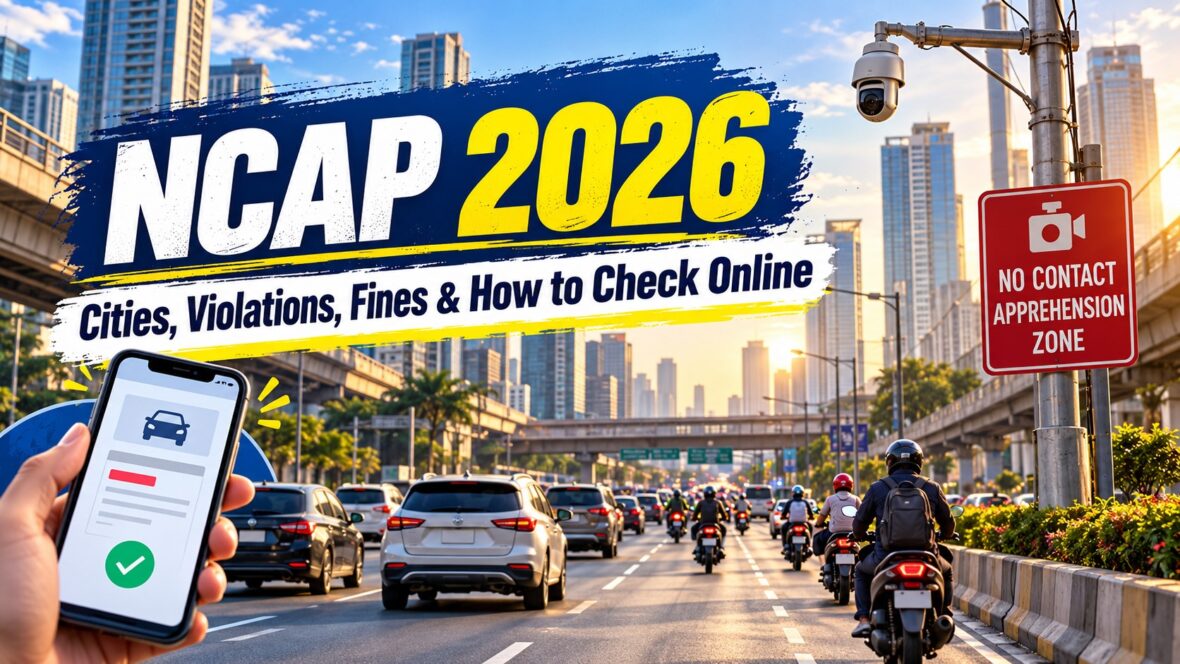
If you regularly drive around Metro Manila, NCAP is once again something you need to pay attention to.
The No Contact Apprehension Policy—or NCAP—allows traffic authorities to detect violations using CCTV cameras, high-resolution traffic cameras and other technology without having to physically stop you on the road.
So yes, you can make it all the way home without being flagged down by a traffic enforcer and still discover later that your vehicle was recorded committing a violation.
And in 2026, NCAP has become particularly important because the system has expanded again.
After years of legal uncertainty, the Supreme Court lifted the remaining temporary restraining order involving city-run NCAP systems. Several Metro Manila cities subsequently announced that they would restart camera-based enforcement beginning October 5, 2026.
But there have already been last-minute changes.
As of October 6, 2026, city-level NCAP has resumed in Manila, Quezon City, Muntinlupa and San Juan. Valenzuela postponed its implementation because of ongoing road works, while Parañaque also deferred its rollout for further study.
At the same time, MMDA has its own NCAP system covering roads under its jurisdiction.
That distinction is important because where you were caught determines where you need to check, pay or contest your violation.
Here’s a comprehensive guide to NCAP in 2026, including how it works, which cities are implementing it, common violations, fines, how to check if you have a violation online and what to do if you think the ticket is wrong.
Content
What Is NCAP?
NCAP stands for No Contact Apprehension Policy or No Contact Apprehension Program.
Instead of a traffic enforcer physically stopping a vehicle, cameras monitor roads and intersections for possible traffic violations.
The system can capture information such as:
- Vehicle plate number
- Date and time of the incident
- Location
- Type of violation
- Images or video of the vehicle
- Relevant traffic signals or road markings
The recorded incident isn’t supposed to automatically become a traffic ticket just because a camera captured something.
The evidence must be reviewed and validated before a Notice of Violation is issued.
For example, Manila officials said the upgraded system uses high-resolution cameras capable of capturing both the violation and the vehicle’s plate number, while authorized personnel review footage before issuing a Notice of Violation.
Is NCAP Back in 2026?
Yes.
But there are actually two layers of NCAP that motorists need to understand.
MMDA NCAP
The MMDA was allowed to resume its own NCAP enforcement in May 2025 after the Supreme Court partially lifted the 2022 TRO insofar as it applied to MMDA.
That meant NCAP could again be used on roads falling under MMDA jurisdiction.
City-Run NCAP
The separate NCAP programs operated by individual Metro Manila LGUs remained affected by the Supreme Court case until 2026.
On July 9, 2026, the Supreme Court announced that it had dismissed the consolidated petitions challenging NCAP ordinances in Manila, Quezon City, Valenzuela, Parañaque and Muntinlupa.
The Court also lifted the remaining TRO.
This cleared the way for participating LGUs to implement their newer NCAP frameworks.
Several cities announced October 5, 2026 as their restart date.
Did the Supreme Court Declare NCAP Constitutional?
This is an important distinction.
Not exactly.
The Supreme Court dismissed the cases primarily because the issues involving the old NCAP ordinances had become moot after the adoption of a newer and more uniform traffic enforcement framework under the Metro Manila Traffic Code of 2023.
The Court explained that the newer framework introduced uniform rules covering traffic adjudication, fines and penalties, payment systems, data privacy and procedures for contesting violations.
The old city ordinances challenged in the case had essentially been overtaken by these developments.
The Supreme Court specifically clarified that dismissal of the petitions should not be interpreted as a definitive ruling declaring all of the challenged NCAP issuances constitutional.
For motorists, however, the practical result is straightforward:
NCAP enforcement can operate under the newer framework.
Which Cities Have NCAP in 2026?
This changed almost immediately after the October rollout was announced.
Initially, six cities announced plans to resume NCAP:
- Manila
- Quezon City
- Muntinlupa
- Parañaque
- San Juan
- Valenzuela
But two later deferred implementation.
NCAP Status as of October 6, 2026
| City | Current Status |
|---|---|
| Manila | Implementing NCAP |
| Quezon City | Implementing NCAP |
| Muntinlupa | Implementing NCAP |
| San Juan | Implementing NCAP |
| Parañaque | Deferred until further notice |
| Valenzuela | Deferred until further notice |
Quezon City and Muntinlupa officially announced October 5 as the return of NCAP.
Valenzuela had originally planned to join them but postponed implementation because ongoing road construction and frequently changing traffic conditions could make camera-based enforcement unfair to motorists.
Parañaque then announced its own postponement on October 6 while the city further studies the system.
Because NCAP implementation is changing quickly, motorists should check the latest official announcement from the particular LGU before relying on an older list.
What About Other Metro Manila Cities?
Not every city operating under the Metro Manila Traffic Code automatically has its own active NCAP camera system.
This is where many motorists get confused.
All Metro Manila LGUs can follow harmonized traffic rules under the Metro Manila Traffic Code and Single Ticketing System, but that doesn’t automatically mean every city is currently issuing tickets through its own NCAP cameras.
There is also MMDA enforcement.
So even if you’re driving in a city that doesn’t operate a city-level NCAP program, you could still be recorded by an MMDA camera if you’re traveling on a road under MMDA jurisdiction.
MMDA NCAP Roads
MMDA’s camera-based enforcement generally focuses on major Metro Manila thoroughfares under its jurisdiction.
These can include portions of roads such as:
- EDSA
- C-5
- Commonwealth Avenue
- Roxas Boulevard
- Taft Avenue
- Ortigas Avenue
- Shaw Boulevard
- Aurora Boulevard
- Other radial and circumferential roads managed or monitored by MMDA
However, motorists shouldn’t depend on a list of camera locations.
Camera coverage can expand or change.
And more importantly, traffic rules apply whether you can see an NCAP camera or not.
Where Are the NCAP Cameras?
There isn’t currently one reliable public master list showing every active MMDA and LGU camera location throughout Metro Manila.
Participating cities operate their own traffic cameras, while MMDA has a separate network.
Quezon City, for example, says its traffic enforcement cameras are installed on primary roads.
Muntinlupa’s system similarly uses cameras on major thoroughfares.
Rather than trying to memorize individual camera poles or intersections, it’s much safer to assume major intersections and heavily monitored roads may have camera enforcement.
What Violations Can NCAP Detect?
Modern traffic-camera systems can detect far more than simply beating a red light.
The Supreme Court decision discussing the technology noted that NCAP systems are capable of identifying violations including traffic-signal offenses, counterflowing, yellow-box violations, disregarding lane markings or traffic signs, speeding, pedestrian-crossing violations, number-coding violations, motorcycle helmet violations and driving in bicycle lanes.
Here are some of the violations motorists should be particularly careful about.
1. Beating the Red Light
This is probably the most obvious NCAP violation.
If the traffic signal turns red and you continue through the intersection, cameras can record your vehicle.
That includes situations where a driver turns left, right or makes a U-turn despite a signal prohibiting the movement.
Don’t try to beat a yellow light if you still have plenty of distance to stop safely.
2. Disregarding Traffic Signs
Traffic signs matter even when there isn’t a traffic enforcer standing beside them.
Examples include:
- No Left Turn
- No Right Turn
- No U-Turn
- One Way
- No Entry
- Stop signs
- Lane-use signs
- Loading and unloading restrictions
Under the Metro Manila Traffic Code’s harmonized fine schedule, disregarding a traffic sign generally carries a ₱1,000 fine.
3. Improper Lane Changing
This is one of the violations drivers should watch very carefully under the expanded NCAP system.
High-resolution cameras can capture a vehicle changing lanes improperly or crossing solid lane markings.
Manila traffic authorities specifically identified improper lane changes and crossing solid lines as violations that upgraded cameras can detect.
If the lane marking is solid, don’t casually cross it simply because the next lane is moving faster.
4. Illegal Counterflow
Driving against the normal direction of traffic can be recorded through NCAP.
Counterflowing is particularly dangerous because you’re putting yourself directly into the path of vehicles traveling in the correct direction.
The applicable penalty can also become significantly higher for repeated offenses.
5. Yellow Box Violation
Those yellow boxes painted in major intersections aren’t decorations.
You’re generally supposed to enter only when there is enough space on the other side for your vehicle to completely clear the intersection.
If traffic ahead is stopped and you enter anyway, you can end up blocking cross traffic when the signal changes.
NCAP cameras can record this.
A good rule is simple:
If you can’t clear the yellow box, don’t enter it.
6. Number Coding Violation
MMDA’s Unified Vehicle Volume Reduction Program can also be enforced through NCAP.
The standard Metro Manila number-coding fine is ₱500.
The traditional weekday plate schedule is:
| Day | Plate Ending |
|---|---|
| Monday | 1 and 2 |
| Tuesday | 3 and 4 |
| Wednesday | 5 and 6 |
| Thursday | 7 and 8 |
| Friday | 9 and 0 |
Coding hours and exemptions can vary depending on current MMDA and LGU policies, so check the latest rules before traveling.
7. Obstruction
Stopping or positioning your vehicle where it obstructs traffic can result in a violation.
This can include blocking:
- Intersections
- Pedestrian crossings
- Travel lanes
- Driveways
- Designated traffic areas
Obstruction generally carries a ₱1,000 fine under the harmonized Metro Manila schedule.
8. Illegal Parking
Illegal parking remains one of the more common Metro Manila traffic violations.
The harmonized rates are generally:
| Illegal Parking Violation | Fine |
|---|---|
| Attended vehicle | ₱1,000 |
| Unattended vehicle | ₱2,000, with possible impoundment |
Don’t assume that staying inside the vehicle automatically makes parking legal.
If you’re stopped in a prohibited location, you can still be cited.
9. Loading or Unloading in Prohibited Areas
PUVs aren’t the only vehicles that need to worry about this.
Stopping in a prohibited loading or unloading area can block traffic and create dangerous situations.
The standard fine is generally around ₱1,000.
10. Overspeeding
Camera technology can also be used for speed enforcement.
Under the harmonized Metro Manila traffic schedule, the common overspeeding traffic fine is ₱1,000, although other laws or circumstances can result in additional penalties.
11. Reckless Driving
Reckless driving isn’t limited to driving extremely fast.
It can involve driving in a way that endangers other motorists, pedestrians or property.
Under the Metro Manila Traffic Code schedule, the standard fines include:
| Offense | Fine |
|---|---|
| First offense | ₱1,000 |
| Second offense | ₱2,000 |
| Third and subsequent offense | ₱2,000 plus required seminar |
Depending on the actual conduct involved, LTO or other authorities can impose additional consequences under applicable laws.
12. Driving in Restricted Bicycle Lanes
Motorists should pay attention to bike-lane markings.
NCAP technology is capable of identifying vehicles improperly using bicycle lanes.
Not every painted bike lane operates exactly the same way, so look at signs, road markings and whether the lane is protected or shared.
Don’t use a protected bicycle lane simply to skip a traffic queue.
13. Motorcycle Helmet Violations
Camera systems can also identify motorcycle riders or passengers who aren’t wearing helmets.
The penalties under the Motorcycle Helmet Act are considerably higher than many ordinary traffic violations.
| Offense | Fine |
|---|---|
| First offense | ₱1,500 |
| Second offense | ₱3,000 |
| Third offense | ₱5,000 |
| Fourth and subsequent offense | ₱10,000 plus additional consequences |
Motorcycle drivers are also responsible for ensuring their back rider complies with helmet requirements.
14. Distracted Driving
Using your phone while driving can fall under the Anti-Distracted Driving Act.
This is a national-law violation rather than simply an ordinary NCAP traffic-code offense.
Penalties can reach:
- ₱5,000 for the first offense
- ₱10,000 for the second offense
- ₱15,000 plus possible license consequences for later offenses
That means the frequently mentioned ₱500-to-₱3,000 range for standard NCAP traffic offenses doesn’t necessarily represent the maximum amount you could ever pay.
Special laws can impose much higher penalties.
Quick NCAP Fine Guide
Here are some of the most useful amounts to remember:
| Violation | Typical Fine |
|---|---|
| Number coding | ₱500 |
| Motorcycle dress-code violation | From ₱500 |
| Disregarding traffic signs | ₱1,000 |
| Obstruction | ₱1,000 |
| Overloading | ₱1,000 |
| Loading/unloading in prohibited zone | ₱1,000 |
| Overspeeding | ₱1,000 |
| Illegal parking – attended | ₱1,000 |
| Illegal parking – unattended | ₱2,000 |
| Unauthorized vehicle modification | ₱2,000 |
| Light truck ban | ₱2,000 |
| Truck ban | ₱3,000 |
| No motorcycle helmet | Starts at ₱1,500 |
| Distracted driving | Starts at ₱5,000 |
These should be treated as a planning guide.
The amount on your validated Notice of Violation is what matters because penalties can depend on the offense, repeat violations, special laws and other applicable regulations.
Are NCAP Fines the Same in Every City?
That is the goal of the newer system.
One of the biggest criticisms of the earlier NCAP programs was that a motorist could face very different penalties for similar conduct depending on which city issued the citation.
The Metro Manila Traffic Code of 2023 was designed to harmonize traffic rules and penalties.
Officials announcing the October 2026 rollout specifically said implementing LGUs would use standardized fines.
So, for example, the intention is that a common traffic offense shouldn’t suddenly become much more expensive simply because you crossed from one Metro Manila city into another.
Special laws and repeat-offense rules can still create different penalty amounts.
How to Check NCAP Violations Online
This is probably the most useful part of the guide.
First, identify who issued the violation.
Was it:
MMDA?
Or a city government?
They aren’t automatically the same system.
How to Check an MMDA NCAP Violation
MMDA operates the May Huli Ka online system.
You’ll generally need:
- Plate number
- MV File Number
Your MV File Number can be found on your LTO Certificate of Registration.
The updated portal also allows motorists who already have a Notice of Violation to search using:
- Plate number
- Ticket number
Once the information is entered, the system will tell you whether it has found an applicable NCAP record associated with the vehicle.
Step-by-Step: MMDA May Huli Ka
Step 1: Prepare Your Vehicle Information
Get your Certificate of Registration.
You’ll need your plate number and MV File Number.
Step 2: Go to the Official May Huli Ka Portal
Use only the official MMDA May Huli Ka service.
Do not simply click the first link sent to you through a text message.
Step 3: Enter Your Plate Number
Type your vehicle’s plate number correctly.
Vehicles without a permanent plate may need the applicable conduction-sticker information where supported.
Step 4: Enter Your MV File Number
This provides an additional security layer so that strangers can’t simply enter random plate numbers and access motorists’ records.
Step 5: Check the Result
If there is a valid NCAP violation, the system can provide the corresponding record and available next steps.
Payment options may appear once a valid record has been found.
Check NCAP Through the eGovPH App
MMDA NCAP services are also integrated into the eGovPH Super App.
Motorists can use the app to check MMDA NCAP records through their phones.
The integration was launched in 2026 to make checking violations more convenient without visiting MMDA offices.
This gives motorists two practical options:
May Huli Ka website.
Or eGovPH.
How to Check a City-Issued NCAP Violation
If the violation was recorded by an LGU camera rather than MMDA, use the NCAP service of the concerned city.
Don’t assume an LGU violation will automatically appear in MMDA’s May Huli Ka system.
The implementing cities are responsible for their own records, payment systems and adjudication processes.
Quezon City
Quezon City has an official NCAP portal where motorists can verify city-issued violations.
The city previously directed motorists to its No Contact Apprehension website to check traffic violation records, and its 2026 announcements confirm that online checking and payment form part of the reimplemented system.
Muntinlupa
Muntinlupa has an online traffic apprehension payment system operated through its traffic management services.
Its online payment portal allows motorists with an OVR number to view apprehension information and proceed with payment.
For NCAP-specific citations, follow the instructions contained in the official Notice of Violation or the city’s latest NCAP portal instructions.
Manila
Manila says motorists can contest violations through its NCAP process and settle valid penalties either online or through authorized in-person channels.
Because the 2026 system has only just restarted, use the portal or instructions identified in your official Manila Notice of Violation rather than old NCAP pages circulating online.
San Juan
San Juan is among the LGUs participating in the renewed NCAP framework.
If you receive a San Juan NCAP citation, follow the city’s official portal and Notice of Violation instructions for verification, payment and contesting the citation.
What If May Huli Ka Says “No Record Found”?
Don’t panic—but don’t interpret it too broadly either.
A “No Record Found” result in MMDA’s system doesn’t necessarily prove that you have no traffic violations anywhere.
The MMDA portal is intended for applicable MMDA NCAP records.
It doesn’t automatically mean:
- No city government has cited you
- You have no LTO violation
- You have no manually issued traffic ticket
- A very recent incident has already finished processing
MMDA itself has reminded motorists that a “No Record Found” result applies to records shown through its NCAP service.
Will You Receive a Notice of Violation?
Yes.
Once a violation has been reviewed and validated, a Notice of Violation can be sent to the registered vehicle owner.
This is one reason keeping your LTO records updated is extremely important.
If the LTO still shows your old address, email or phone number, important notices might not reach you promptly.
MMDA has also introduced SMS and email notifications connected with LTO records.
Be Careful With Fake NCAP Text Messages
This has become a serious issue.
Scammers have been sending fake traffic-violation text messages designed to make motorists panic and click fraudulent payment links.
MMDA says its legitimate SMS sender ID is:
MMDA_NCAP
More importantly, legitimate MMDA NCAP text notifications do not contain payment links.
If a text says something like:
“You have an unpaid traffic violation. Pay immediately using this link.”
Don’t click it.
Instead:
Open the official May Huli Ka portal yourself or use the eGovPH app.
Can You Contest an NCAP Violation?
Yes.
You are not automatically required to accept a citation just because a camera recorded your vehicle.
The newer framework includes a traffic adjudication process.
If you believe the citation is wrong, you can contest it before the appropriate Traffic Adjudication Board or the corresponding body designated by the issuing authority.
Current implementation guidance says motorists may file protests online through participating LGU systems.
How Long Do You Have to Contest?
The exact procedure should always be checked on your Notice of Violation.
During the October 2026 rollout, Manila traffic officials said motorists disputing a citation may file a protest within 10 days from receipt of the Notice of Violation.
Other LGUs also have adjudication procedures, but don’t assume every deadline is identical without checking your notice.
If you’re planning to contest, don’t wait until the last day.
What Are Valid Reasons for Contesting?
Whether your protest succeeds depends on the evidence and circumstances.
Possible issues worth raising may include:
- Wrong plate number
- Vehicle wasn’t yours
- Vehicle had already been sold
- Vehicle was stolen
- Incorrect identification of the violation
- Traffic signs were missing or obscured
- Road construction forced a lane change
- You were giving way to an emergency vehicle
- Traffic enforcer directed you to move contrary to a normal sign or lane marking
- Camera footage doesn’t actually show the alleged violation
Authorities are supposed to review context rather than treating every camera image as unquestionable.
Manila traffic officials have acknowledged cases where citations were voided after motorists explained that road construction forced them to change lanes.
What Evidence Should You Keep?
If you believe an NCAP citation is wrong, collect evidence quickly.
Useful documents may include:
- Dashcam footage
- Photos
- Registration documents
- Deed of sale
- Police reports
- Proof that your car was elsewhere
- Screenshots
- Road-construction advisories
- Delivery or parking receipts showing location
- Written explanation
- Copy of the Notice of Violation
Dashcams become particularly useful in cases where the camera shows what you did but not why you did it.
What Happens If Someone Else Was Driving Your Car?
NCAP records the vehicle first.
The Notice of Violation will normally be connected to the vehicle’s registered owner because the camera cannot necessarily identify who was behind the wheel.
The newer Metro Manila framework includes procedures dealing with registered-owner responsibility and authorization.
If another person was using your vehicle, read the Notice of Violation carefully for instructions on identifying or authorizing the actual driver where applicable.
What If You Already Sold the Car?
This is one of the strongest reasons to process the transfer of ownership immediately whenever you sell a vehicle.
If LTO records still show you as the registered owner, traffic notices can continue being connected to your information.
Don’t rely only on a handwritten deed of sale sitting in a drawer.
Complete the official transfer.
Can Unpaid NCAP Violations Affect Vehicle Registration?
The Metro Manila Traffic Code framework allows unresolved violations to interact with the LTO’s Land Transportation Management System after the appropriate procedures have been followed.
That is another reason you shouldn’t ignore a legitimate Notice of Violation.
Check it.
Verify it.
Pay it if it’s valid.
Contest it if it isn’t.
Do NCAP Fines Accumulate Interest?
For MMDA NCAP specifically, MMDA has warned motorists against scam messages falsely threatening rapidly increasing penalties.
The agency has stated that its NCAP fines are fixed and don’t carry the kinds of interest or late-payment penalties commonly claimed by fraudulent text messages.
For city-issued violations, always follow the rules printed on the Notice of Violation because LGU procedures and deadlines should be confirmed separately.
Does NCAP Replace Traffic Enforcers?
No.
NCAP supplements traditional traffic enforcement.
Traffic enforcers can still physically apprehend motorists for violations.
Police officers and LTO personnel can also enforce traffic laws within their respective authority.
The existence of cameras doesn’t mean everything is now automated.
Can You Be Caught Twice for the Same Violation?
The system is supposed to prevent duplicative penalties for exactly the same offense.
If a traffic enforcer already physically apprehended you for the same incident that was also captured through NCAP, keep the original ticket and payment records.
If you later receive what appears to be a duplicate NCAP citation, contest it and present your documentation.
Will There Be NCAP Signs?
You’ll see NCAP warning signs in many monitored areas.
But the absence of a sign shouldn’t be treated as permission to disregard a traffic law.
Traffic rules exist independently of the camera.
My approach would be simple:
Drive as though every major intersection has a camera.
Because eventually, many of them probably will.
Tips to Avoid NCAP Violations
Stop Before the Line
At red lights, don’t stop on top of the pedestrian crossing.
Leave the crosswalk clear.
Don’t Enter a Yellow Box Unless You Can Exit
Even if your light is green, don’t enter if traffic ahead has nowhere to go.
Change Lanes Early
If you’re turning, move into the correct lane well before the intersection instead of cutting across solid markings at the last moment.
Use Your Signal Lights
Communicate your intentions before turning or changing lanes.
Read Overhead Signs
Major Metro Manila roads can have lane-specific restrictions.
Don’t Follow the Car in Front Blindly
Just because another driver made an illegal turn doesn’t mean you should follow.
The camera can capture both of you.
Watch Your Speed
Empty roads don’t mean traffic rules disappear.
Don’t Use the Bike Lane as an Overtaking Lane
Especially when it’s clearly marked or physically protected.
Follow Number Coding
Know your plate-ending day before entering Metro Manila’s major roads.
Keep Your Plate Visible
Never intentionally cover, tilt, alter or obscure your plate to avoid camera enforcement.
That can create much bigger problems than the original traffic violation.
NCAP 2026: Quick Summary
If you only remember a few things from this guide, remember these:
NCAP is active again.
MMDA already has its own NCAP system.
As of October 6, 2026, city-level NCAP is operating in Manila, Quezon City, Muntinlupa and San Juan.
Valenzuela has postponed its rollout because of road construction.
Parañaque has also deferred implementation until further notice.
Standardized Metro Manila traffic fines generally start around ₱500 and can reach ₱3,000 for many common offenses, while repeat violations and offenses under national laws can cost considerably more.
MMDA violations can be checked using May Huli Ka or the eGovPH app.
LGU-issued violations should be checked through the concerned city’s official NCAP system.
And if you believe a ticket is wrong, you have the right to contest it through the proper adjudication procedure.
Frequently Asked Questions
Is NCAP active in 2026?
Yes.
MMDA NCAP is operating, while several Metro Manila LGUs restarted their own city-level systems in October 2026.
Which cities currently have NCAP?
As of October 6, 2026, Manila, Quezon City, Muntinlupa and San Juan have resumed city-run NCAP.
Valenzuela and Parañaque have deferred implementation until further notice.
How do I know if I have an NCAP violation?
For MMDA violations, use the official May Huli Ka service or the eGovPH app.
For LGU violations, use the concerned city’s official NCAP portal or follow the instructions on your Notice of Violation.
Can I check using only my plate number?
MMDA’s current May Huli Ka system generally requires additional information for privacy and security.
You can check using your plate number together with your MV File Number.
If you already have a ticket, plate number plus ticket number may also be available as a search option.
Where can I find my MV File Number?
Look at your LTO Certificate of Registration.
How much is an NCAP fine?
There isn’t one universal fine.
Common violations range from around ₱500 to ₱3,000 under the standardized traffic-code schedule.
Repeat offenses and violations under special national laws can be considerably higher.
How much is the number coding fine?
The standard Metro Manila UVVRP or number-coding fine is ₱500.
How much is illegal parking?
Generally:
₱1,000 for attended illegal parking.
₱2,000 for unattended illegal parking, with possible impoundment.
How much is disregarding a traffic sign?
The standard harmonized fine is ₱1,000.
Can NCAP detect lane violations?
Yes.
Modern NCAP cameras can record vehicles crossing solid lane markings, making improper lane changes and committing other lane-related violations.
Can motorcycles be caught by NCAP?
Yes.
Motorcycles aren’t exempt from camera enforcement.
Violations can include disregarding signals, improper lane use, counterflowing, speeding and failure to wear the required helmet.
Can I contest NCAP?
Yes.
Use the adjudication or protest procedure of the authority that issued the Notice of Violation.
Is the NCAP text message I received legitimate?
Don’t trust a message simply because it says “MMDA.”
The official MMDA sender ID is MMDA_NCAP, and legitimate MMDA text notifications don’t contain payment links.
Verify the violation yourself through the official May Huli Ka portal or eGovPH.

Final Thoughts
NCAP is one of those policies that completely changes the way you have to think about traffic enforcement.
Before, some drivers behaved differently when they could see an enforcer standing at the intersection.
With NCAP, that doesn’t really work anymore.
The traffic enforcer may be a camera mounted several meters above the road.
You won’t hear a whistle.
Nobody will wave you to the side.
You might not even realize that anything happened until the violation appears online or a Notice of Violation arrives.
But I also think the most practical way to look at NCAP is not to spend your entire drive worrying about where the cameras are.
Follow the road markings.
Respect traffic lights.
Don’t block intersections.
Use the proper lane.
Don’t counterflow.
Follow number coding.
And give pedestrians and cyclists the space they’re supposed to have.
Do those consistently, and whether there are ten cameras or ten thousand cameras shouldn’t really change how you drive.
For 2026, however, there’s one more habit motorists should add:
Check your NCAP records from time to time—especially if you regularly drive through major Metro Manila roads.
With both MMDA and city-operated systems now in the picture, knowing where to check your records can save you from discovering an unresolved traffic violation when you least expect it.