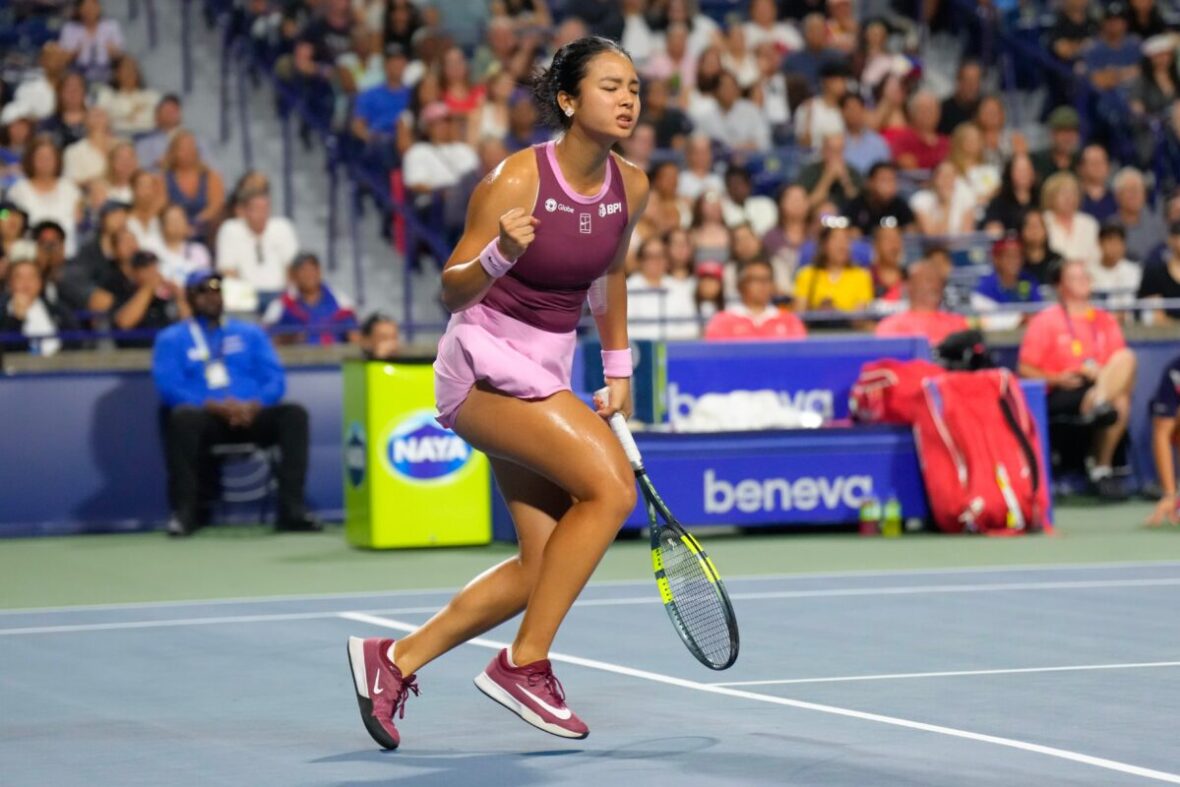
Alex Eala’s impressive run at the 2026 Canadian Open has come to an end.
The Filipina tennis star bowed out of the National Bank Open in Toronto after losing to Switzerland’s Belinda Bencic, 6–4, 6–0, in the Round of 16 on Monday morning, August 10, Philippine time.
It was certainly not the result Filipino fans were hoping for. After all, Alex arrived in the match riding a seven-match winning streak, fresh from winning her first WTA Tour title in Washington and surviving two difficult three-set battles in Toronto.
But Bencic was simply too good on this day.
The former Olympic champion and 2015 Canadian Open winner put Alex under constant pressure on serve, survived a competitive opening set, and then completely took control in the second. The match lasted only 1 hour and 13 minutes, with Bencic winning 57 of the 93 total points played.
So yes, Alex’s Canadian Open journey is over.
Still, when you look at the bigger picture, Toronto was another very good tournament for the 21-year-old Filipina.
She reached the fourth round of a WTA 1000 event immediately after winning a WTA 500 championship, extended her career-best winning streak to seven matches, strengthened her position among the world’s leading players, and once again attracted huge support from Filipino fans abroad.
Let’s take a closer look at what happened against Bencic, why the match turned so quickly, Alex’s complete Canadian Open run, what she earned from Toronto, and what comes next.
Content
Alex Eala vs. Belinda Bencic final score
Here is the result:
Belinda Bencic def. Alex Eala, 6–4, 6–0
Tournament: National Bank Open presented by Rogers
Location: Toronto, Canada
Level: WTA 1000
Round: Round of 16
Surface: Outdoor hard court
Eala seed: No. 25
Bencic seed: No. 12
Match duration: 1 hour, 13 minutes
The official WTA match page confirms Bencic’s straight-sets victory and Alex’s elimination in the fourth round.
It also ends Alex’s seven-match singles winning streak, the longest of her professional career so far. The WTA had confirmed that she reached seven consecutive victories after defeating Caty McNally in the previous round.
The first set was much closer than the final score suggests
Anyone who only sees the 6–4, 6–0 result might assume Bencic dominated from the beginning.
That was not exactly what happened.
The opening set was competitive.
Alex actually began positively and held the opening game. The set then developed into a battle filled with breaks of serve.
According to the official WTA statistics, Bencic converted three of six break points during the first set, while Alex converted two of four. That means there were five breaks of serve in only 10 games.
That tells you how little separation there initially was between the two players.
Alex repeatedly fought her way back into the set.
Unfortunately, every time she appeared close to stabilizing the match, Bencic managed to apply another round of pressure.
The Swiss eventually secured the decisive break and closed the set at 6–4.
For Alex, losing that opening set was frustrating because she had opportunities.
She was competitive.
She broke Bencic twice.
She was not being blown off the court.
But the difference was that Bencic was consistently stronger when Alex had to play behind her serve.
Alex struggled to protect her serve
This was probably the biggest story of the match.
Bencic attacked Alex’s service games relentlessly.
Across the full match, Alex faced 10 break points and was broken six times. She saved only four of those 10 opportunities. Bencic, meanwhile, faced four break points and was broken twice.
The serving statistics explain why Alex spent so much of the match under pressure.
She landed 58.3% of her first serves but won only 46.4% of the points behind them.
Even more concerning was her second serve.
Alex won just 35% of her second-serve points.
Bencic, by comparison, won 72.4% of her first-serve points and 50% behind her second serve.
That is a huge difference.
Against an excellent returner like Bencic, it is difficult to survive if you are winning fewer than half of your first-serve points and barely a third of the points behind your second serve.
Alex was constantly starting rallies under pressure.
And Bencic knew exactly how to take advantage.
Why Bencic’s return game was such a problem
This was one of the biggest concerns going into the matchup.
Bencic has always been known for taking the ball early.
She stands close to the baseline, reads serves well, and likes to redirect pace immediately rather than allowing an opponent time to recover.
That style was a particularly difficult matchup for Alex.
Normally, Alex likes to use her left-handed serve to create an opening before using her forehand to control the next shot.
Against Bencic, she often did not get that opportunity.
The return came back quickly.
Sometimes very quickly.
And once Bencic moved inside the baseline, Alex was forced to defend instead of dictate.
The official numbers show just how effective the Swiss was. Bencic won 53.6% of the points when returning Alex’s first serve and an even more damaging 65% against Alex’s second serve.
That is extremely difficult to overcome.
The second set changed completely
If the first set was competitive, the second was not.
Bencic won it 6–0.
Alex did not win a service game.
She did not create a single break point.
And the entire set moved very quickly.
According to the WTA statistics, Bencic converted three of four break opportunities in the second set while Alex never earned a break chance.
The point totals were even more revealing.
Bencic won 25 of 33 points in the second set.
Alex won only eight.
That means Bencic captured nearly 76% of all points played during the set.
At that point, the Swiss player was controlling almost every aspect of the match.
She was serving confidently.
She was attacking Alex’s serve.
She was taking the ball early.
And she was barely giving Alex enough time to establish her preferred baseline patterns.
The second set lasted only around half an hour.
Once Bencic built momentum, Alex simply could not find a way to slow her down.
Bencic wins 57 of 93 total points
The full-match statistics clearly reflect Bencic’s superiority on the day.
Alex won 36 of the 93 points played.
Bencic won 57.
That works out to:
Eala: 38.7% of total points
Bencic: 61.3% of total points
Bencic also won 64.4% of her service points compared with only 41.7% for Alex.
Those are significant margins.
This was not one of those matches decided by two or three important points.
Bencic was clearly the better player overall.
And sometimes in tennis, that happens.
Even the best players have days when an opponent finds the perfect combination of timing, confidence, and execution.
Belinda Bencic deserves plenty of credit
It would be easy to explain the result entirely by talking about Alex’s fatigue.
That would not really be fair to Bencic.
The Swiss played an excellent match.
Bencic entered Toronto as the No. 12 seed and world No. 14. She is a former world No. 4, an Olympic singles gold medalist, a 10-time WTA singles champion, and the 2015 Canadian Open champion.
She knows these courts.
She knows how to perform at WTA 1000 level.
And she knows how to take advantage when an opponent begins leaving openings.
Bencic repeatedly returned Alex’s serve deep, took control of the baseline, and prevented the Filipina from consistently creating the left-handed patterns that have caused problems for so many opponents this season.
The WTA officially described the victory as Bencic ending Eala’s winning streak and advancing to the Toronto quarterfinals.
But fatigue was certainly part of the background
Alex came into this match after an extraordinary amount of tennis.
Just think about what happened over the previous two weeks.
She played five singles matches in Washington.
The championship match against Jessica Pegula was interrupted by rain and had to be completed the following day.
Alex then traveled almost immediately to Toronto.
She played a three-set match against Alycia Parks.
She played doubles with Venus Williams.
She then played another exhausting three-set match against Caty McNally.
And finally came Bencic.
Before the Round-of-16 match, Alex openly acknowledged that she was tired after her recent workload. She had also rolled her right ankle during her victory over McNally, although she stressed afterward that there was no serious problem with the ankle.
That distinction is important.
There is no basis for saying an ankle injury caused the Bencic loss.
Alex herself had already indicated that the issue was not serious.
However, there is no question that the overall physical load was substantial.
Playing eight singles matches across two tournaments in roughly two weeks—plus doubles—is demanding for anyone.
Alex’s ankle scare happened against McNally
Filipino fans became concerned during Alex’s previous match when she landed awkwardly while hitting a forehand against Caty McNally.
She needed attention from the trainer, and her right ankle was taped.
Despite that scare, Alex continued playing and eventually defeated McNally 6–3, 5–7, 6–4.
Afterward, she explained that she had rolled the ankle but said there was nothing seriously wrong with it.
That was encouraging.
At this stage of the season, staying healthy becomes especially important because another major tournament is approaching quickly.
The seven-match winning streak is over
The loss to Bencic ends Alex’s longest professional winning streak at seven matches.
And what a seven matches they were.
Five came during her championship run in Washington.
Then came two victories in Toronto.
The streak included wins over some outstanding players and ultimately produced Alex’s first WTA Tour championship.
Her Washington title run featured victories over Zheng Qinwen, Leylah Fernandez, Elina Svitolina, Naomi Osaka, and Jessica Pegula. She defeated Pegula 4–6, 6–4, 6–0 in the final to become the first player representing the Philippines to win a WTA Tour-level singles championship.
Then, without much recovery time, Alex headed north to Canada.
She still managed to win two more matches.
That should not be overlooked simply because the streak finally ended.
Alex Eala’s complete Canadian Open singles results
Here is her 2026 Toronto run:
First round: Bye
Second round:
Alex Eala def. Alycia Parks
6–1, 4–6, 6–2
Third round:
Alex Eala def. Caty McNally
6–3, 5–7, 6–4
Round of 16:
Belinda Bencic def. Alex Eala
6–4, 6–0
Alex therefore finishes her Toronto singles campaign with a 2–1 match record after receiving a first-round bye. The official WTA draw confirms her progression through Parks and McNally before the loss to Bencic.
Her Toronto debut was still a success
It is important to put the loss into perspective.
Alex reached the Round of 16 of a WTA 1000 tournament.
That is a strong result.
WTA 1000 events sit immediately below the Grand Slams and WTA Finals among the most important tournaments on the women’s calendar.
The Toronto field included most of the world’s best players, including Aryna Sabalenka, Elena Rybakina, Iga Swiatek, Coco Gauff, Jessica Pegula, Naomi Osaka, and many others.
Alex was not playing a minor tournament.
She reached the final 16 of one of the biggest events of the season.
And she did it immediately after winning Washington.
Alex earns 120 ranking points from Toronto
Reaching the fourth round of the Canadian Open is worth 120 WTA ranking points.
The WTA also awards US$81,800 in prize money to players eliminated at that stage.
That means Alex leaves Toronto with another valuable points haul as she tries to establish herself permanently among the world’s elite.
It is worth remembering that ranking movement is not as simple as adding 120 points directly onto her existing total.
The WTA uses a rolling ranking system, and previous results can drop off or be replaced. The WTA itself notes that actual ranking movement depends on how a tournament result compares with the points being defended.
Still, reaching the Round of 16 is another useful result.
Alex remains world No. 20
As of today, the official WTA profile lists Alex at world No. 20, which is also her career-high ranking.
That position was achieved after her Washington championship.
Her WTA profile also now lists:
Current singles ranking: No. 20
Career-high ranking: No. 20
2026 singles record: 35–18
WTA singles titles: 1
Those numbers show just how quickly her career has developed.
At this point last year, entering the Top 20 would have sounded like an ambitious long-term goal.
Now she is already there.
The Washington-Toronto stretch was still remarkable
If you combine the two tournaments, Alex finished the stretch with:
Washington: Champion
Toronto: Round of 16
Singles victories: Seven consecutive before losing to Bencic
That is an excellent North American hard-court run.
More importantly, it provides evidence that the Washington championship was not simply one extraordinary week.
A common challenge for a young player is what happens immediately after a breakthrough.
Winning your first major title creates new attention.
More interviews.
More expectations.
More opponents studying your game.
More pressure.
And sometimes an emotional letdown.
Alex could easily have arrived in Toronto mentally and physically exhausted and lost her opening match.
Instead, she won twice.
That matters.
Alex’s doubles campaign with Venus Williams also ended early
Alex also competed in Toronto doubles alongside seven-time Grand Slam singles champion Venus Williams.
The popular pairing lost its opening match to Miyu Kato and Liudmila Samsonova 6–4, 6–3.
That doubles result meant Alex could concentrate completely on singles during the latter part of the tournament.
Although the partnership did not produce a deep run in Toronto, playing alongside a champion as experienced as Venus remains a valuable opportunity for Alex.
Why this loss could actually be useful
Nobody likes losing 6–4, 6–0.
Especially after building so much momentum.
But there is plenty Alex and her team can learn from this match.
Bencic exposed areas that become especially important against elite returners.
The first is the serve.
Alex’s serve has improved considerably, but matches like this show why it remains an important area of development.
When her first serve does not consistently produce an advantage, opponents like Bencic can immediately attack.
The second is protecting the second serve.
Winning only 35% of second-serve points makes it extremely difficult to hold against a world-class returner.
The third is finding ways to change the rhythm when an opponent begins taking the ball early.
Alex usually enjoys controlling the tempo herself.
Bencic took that away.
Learning how to disrupt players who rush her could become another important step in Alex’s development.
There will be more opponents like Bencic
This is what life inside the Top 20 looks like.
There are fewer easy matches.
You regularly face Grand Slam champions, Olympic champions, former world No. 1s, and players who have spent years competing at this level.
Alex is now entering that group.
The challenge is no longer simply proving that she can defeat elite opponents.
She has already done that.
She has beaten Iga Swiatek.
She has beaten Jessica Pegula.
She has beaten Naomi Osaka.
She has beaten Elena Rybakina.
She has won a WTA title.
The next phase is learning how to produce that level consistently over months rather than individual tournaments.
Losses like this are part of that process.
One bad set does not erase an excellent two weeks
The second-set 6–0 score will naturally attract attention.
But it should not overshadow everything Alex accomplished before it.
She had just won seven consecutive singles matches.
She had captured her first WTA Tour championship.
She had climbed to No. 20 in the world.
She had traveled from one tournament to another with almost no break.
She then reached the last 16 of a WTA 1000.
That is the larger story.
Even the world’s best tennis players occasionally lose sets 6–0.
What matters is what happens afterward.
What is next for Alex Eala?
The North American hard-court season is not finished.
Alex is listed in the main-draw field for the 2026 Cincinnati Open, another WTA 1000 tournament taking place from August 13 to 23 in Ohio. The official WTA player list includes Alexandra Eala among the competitors.
Cincinnati provides another opportunity to collect important ranking points and prepare for the final Grand Slam tournament of the year.
The tournament uses another 96-player singles field and offers 1,000 ranking points to the champion.
The timing also means Alex does not have a huge amount of recovery time.
Rest will probably be one of the most important priorities over the next few days.
And then comes the US Open
Everything in this part of the season eventually leads toward New York.
The 2026 US Open women’s singles tournament begins August 31, giving Alex another opportunity to compete on one of the biggest stages in tennis.
The US Open already has special meaning for Alex.
She won the junior girls’ singles championship there in 2022, and her performances since then have continued to strengthen her connection with Filipino fans in the United States.
This year, however, she arrives in a completely different position.
She is no longer simply a promising young player entering a Grand Slam hoping to produce an upset.
She is a Top 20 player.
A WTA champion.
And someone the rest of the draw will take very seriously.
Frequently asked questions about Alex Eala’s latest Canadian Open result
Did Alex Eala win against Belinda Bencic?
No. Belinda Bencic defeated Alex Eala 6–4, 6–0 in the Round of 16 of the 2026 Canadian Open.
How long did the Eala-Bencic match last?
The match lasted 1 hour and 13 minutes.
What round did Alex Eala reach in Toronto?
Alex reached the Round of 16, also called the fourth round.
She defeated Alycia Parks and Caty McNally before losing to Bencic.
Did Alex win a set against Bencic?
No. Bencic won in straight sets, 6–4, 6–0.
What happened in the second set?
Bencic dominated the second set, winning 25 of 33 total points. Alex did not create a break point and lost all three of her service games.
How many consecutive matches had Alex won before losing?
Alex entered the Bencic match on a seven-match singles winning streak, the longest of her career.
What is Alex Eala’s ranking now?
The WTA currently lists Alex at world No. 20, which is also her career-high ranking.
How much prize money did Alex earn in Toronto?
Reaching the Round of 16 carries US$81,800 in prize money.
How many ranking points did she earn?
The Canadian Open awards 120 WTA ranking points for reaching the fourth round. The actual impact on Alex’s ranking depends on the WTA’s rolling points system.
Was Alex Eala injured?
Alex rolled her right ankle during her previous match against Caty McNally and received treatment, but she later said there was no serious problem with the ankle.
Is Alex Eala playing in Cincinnati?
Yes. Alex is listed among the players for the 2026 Cincinnati Open, the next WTA 1000 event on the North American hard-court schedule.
What should Alex take away from Toronto?
Probably confidence more than disappointment.
Of course she wanted to beat Bencic.
Of course a 6–0 second set hurts.
Competitive athletes do not enjoy losses simply because the previous week went well.
But zoom out for a moment.
Alex arrived in Washington looking for her first WTA Tour championship.
She left as a champion.
She arrived in Toronto physically and emotionally coming down from the biggest moment of her career.
She still reached the Round of 16.
That is progress.
The question around Alex Eala is gradually changing.
It used to be:
Can she compete with the best players in the world?
We already know the answer.
Yes.
Now the question is:
How consistently can she do it?
That is a much more exciting question to be asking about a 21-year-old player.
Final thoughts
Alex Eala’s Canadian Open run did not end the way Filipino fans hoped.
Belinda Bencic was excellent.
The Swiss attacked Alex’s serve, controlled the baseline, and turned a competitive first set into a commanding straight-sets victory.
The 6–4, 6–0 score is clear.
Bencic deserved the win.
But this loss should be viewed as the end of a very successful two-week stretch rather than the end of Alex’s momentum.
Seven consecutive singles victories.
Her first WTA Tour championship.
A career-high ranking of world No. 20.
Another WTA 1000 Round-of-16 appearance.
And thousands of Filipino fans turning international tennis tournaments into something that increasingly feels like a home crowd.
Not bad at all.
Alex now gets a short opportunity to recover before Cincinnati, with the US Open waiting later this month.
There will be more matches.
More difficult opponents.
More victories.
And, inevitably, more losses like this one.
That is life on the WTA Tour.
What matters is that Alex Eala is no longer watching the world’s best players from a distance.
She is competing among them.
And after everything we have seen from her this season, there is every reason to believe that her biggest matches are still ahead.