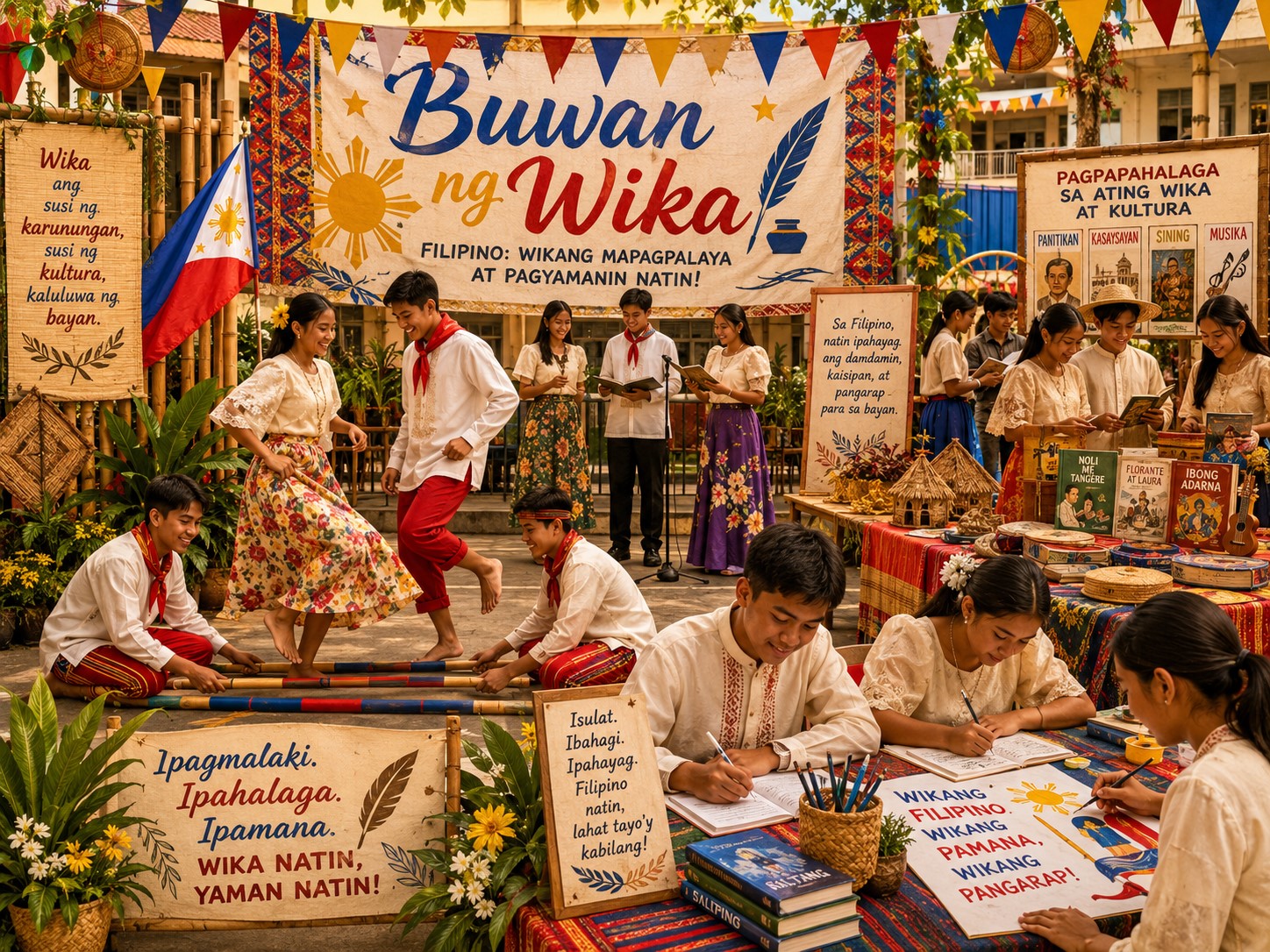
Tuwing Agosto, nagiging mas makulay ang maraming paaralan sa buong Pilipinas.
May mga batang naka-Barong Tagalog at Filipiniana.
May poster-making sa isang classroom.
May naririnig na sabayang pagbigkas sa kabilang building.
May naghahanda para sa quiz bee.
At siyempre, may mga estudyanteng biglang nagme-message sa group chat:
“Guys, ano nga ulit gagawin natin bukas sa Buwan ng Wika?”
Buwan ng Wika is one of those school celebrations where there are practically endless possibilities for activities.
You can make it educational.
You can make it competitive.
You can make it cultural.
And yes, you can make it genuinely fun.
For Buwan ng Wikang Pambansa 2026, the official theme is:
“Wikang Filipino at AI: Kasangkapan sa Pananaliksik at Tulay sa Yaman ng Impormasyon.”
The Komisyon sa Wikang Filipino has explained that the 2026 celebration gives particular attention to artificial intelligence as a tool that can support Filipino, research, and access to information while emphasizing responsible use of technology.
That means schools have an interesting opportunity this year.
You can still organize all the traditional Buwan ng Wika favorites—poster-making, slogan contests, poetry, Filipino games, traditional dances, costumes, and quiz bees—but you can also introduce activities involving AI, digital literacy, research, Filipino content, and technology.
If you’re a teacher, student leader, school administrator, or parent looking for ideas, here are 50+ Buwan ng Wika activities for 2026, from simple classroom games to major school-wide competitions.
Content
1. Poster-Making Contest
Let’s start with one of the classics.
A Buwan ng Wika poster-making contest is easy to organize and works for practically every grade level.
For 2026, students can illustrate the relationship between:
- Wikang Filipino
- Artificial intelligence
- Research
- Information
- Technology
- Filipino culture
- Education
One possible concept is a Filipino student holding a book on one side and using a computer on the other.
Another could feature a human hand and robotic hand working together.
The important thing is that the poster clearly communicates the theme rather than simply filling the page with Filipino symbols.
2. Slogan-Making Contest
Another classic activity is paggawa ng slogan.
Give students the official theme and ask them to create a short, memorable line related to it.
Examples of concepts they could explore include:
Wika + Teknolohiya
Filipino + Kinabukasan
AI + Pananaliksik
Wika + Kaalaman
Keep the slogans short.
A slogan that can be remembered after hearing it once is usually more effective than a long paragraph squeezed into one line.
3. Essay-Writing Contest
A sanaysay-writing contest is perfect for students who enjoy expressing ideas through writing.
Possible topics include:
- Kahalagahan ng Wikang Filipino
- Filipino sa Panahon ng AI
- Wikang Filipino at Teknolohiya
- Kabataan at Kinabukasan ng Wika
- Filipino Bilang Wika ng Pananaliksik
- Wika Bilang Tulay sa Kaalaman
For older students, encourage them to go beyond simply saying:
“Mahalaga ang Filipino.”
Ask them to explain why, where, and how Filipino can remain relevant in modern society.
4. Poetry-Writing Contest
Students can write an original tula tungkol sa Buwan ng Wika.
You can create different categories:
- Maikling tula
- Traditional rhyming poetry
- Malayang taludturan
- Tula tungkol sa Filipino
- Tula tungkol sa AI at wika
- Tula tungkol sa kultura
- Tula tungkol sa katutubong wika
The winning poems can later be performed during the culminating program.
5. Spoken Poetry Competition
Spoken poetry is especially appropriate for junior high, senior high, and college students.
Participants can write and perform original pieces about:
Filipino identity
language discrimination
regional languages
technology
AI
social media
culture
the future of Filipino
Unlike ordinary poetry recitation, spoken poetry allows students to use tone, movement, pauses, and emotion.
It can become one of the most powerful activities of the entire celebration.
6. Sabayang Pagbigkas
Of course, we can’t talk about Buwan ng Wika without Sabayang Pagbigkas.
Groups perform a Filipino literary piece together using coordinated:
- Voices
- Movements
- Facial expressions
- Formations
- Rhythm
For 2026, schools can commission or let students create an original piece centered on Wikang Filipino and AI.
This works particularly well as an inter-section competition.
7. Talumpati Competition
Hold a paligsahan sa talumpati.
Possible topics include:
“May Puwang Ba ang Wikang Filipino sa Panahon ng AI?”
“Wika at Teknolohiya: Magkalaban o Magkatuwang?”
“Kabataan at ang Kinabukasan ng Filipino”
“Wikang Filipino Bilang Wika ng Kaalaman”
Students should be encouraged to present an argument rather than simply memorize a speech.
8. Extemporaneous Speaking in Filipino
For a more challenging competition, organize extemporaneous speaking.
Give participants a topic on the spot and perhaps one or two minutes to organize their thoughts.
Possible prompts:
“AI sa Paaralan”
“Filipino sa Social Media”
“Bakit Mahalaga ang Sariling Wika?”
“Taglish: Mabuti o Masama?”
“Filipino sa Hinaharap”
This tests both communication skills and critical thinking.
9. Balagtasan
One of the most distinctly Filipino literary activities is Balagtasan.
Students debate opposing sides of a topic in poetic form.
For 2026, you can modernize the topics.
For example:
AI: Kaibigan o Banta sa Edukasyon?
Printed Book o Digital Learning?
English o Filipino Bilang Pangunahing Wika ng Teknolohiya?
The performance can be entertaining while also encouraging students to think deeply about current issues.
10. Buwan ng Wika Quiz Bee
A Quiz Bee is another activity almost every school can organize.
Questions can cover:
- Wikang Filipino
- Filipino grammar
- Philippine literature
- Philippine history
- Filipino authors
- National heroes
- Philippine languages
- Proverbs
- Idioms
- Folk literature
- Buwan ng Wika history
Divide questions into:
Easy
Average
Difficult
For younger students, use multiple-choice questions.
For older students, make the questions more challenging.
11. Filipino Vocabulary Challenge
Give students difficult or unusual Filipino words and ask them to identify their meanings.
For example, you could present several possible definitions.
Students choose the correct one.
This can be surprisingly fun, especially when the words sound unfamiliar.
You can call the activity:
“Alam Mo Ba ang Salitang Ito?”
12. Spelling Bee in Filipino
Yes, you can organize a Filipino spelling competition.
Prepare age-appropriate Filipino words and ask students to spell them correctly.
You can include:
- Common Filipino words
- Hiram na salita
- Compound words
- More difficult vocabulary
For younger students, keep the words simple.
For older students, gradually increase the difficulty.
13. Bugtong Contest
Bugtong is perfect for elementary students.
Teachers can read Filipino riddles and let students guess the answers.
You can organize it as:
- Individual competition
- Team competition
- Classroom game
- Rapid-fire challenge
Students can also create their own original bugtong.
That makes the activity even more interesting.
14. Salawikain Challenge
Present incomplete Filipino proverbs and ask students to complete them.
For example:
“Kung may tiyaga…”
Students answer:
“May nilaga.”
For older students, go one step further.
Ask:
“Ano ang ibig sabihin ng salawikaing ito?”
Now you’re testing comprehension rather than memorization.
15. Sawikain or Idiom Game
Give students Filipino idiomatic expressions and ask them to explain their meanings.
Examples can involve phrases that should not be interpreted literally.
You can turn this into a team game where groups earn points for every correct explanation.
16. Filipino Word of the Day
Choose one interesting Filipino word every school day during August.
Post it on:
- Classroom boards
- School Facebook page
- Bulletin boards
- Digital screens
- School announcements
Include:
Salita
Kahulugan
Halimbawa sa pangungusap
By the end of the month, students may have learned 20 or more new words without even realizing it.
17. “Malalim na Salita” Challenge
Students are given commonly used English or Taglish expressions and challenged to find an appropriate Filipino equivalent.
But make this fun—not an exercise in finding the most obscure word imaginable.
The goal should be to expand vocabulary while still recognizing how Filipino is actually used today.
18. Filipino Scrabble
Use Filipino words in a Scrabble-style competition.
Students can play individually or in teams.
Besides vocabulary, this involves strategy and spelling.
It’s also a great activity for a quiet classroom period.
19. Word Hunt
Hide Filipino words around the classroom or school grounds.
Students search for them and complete a worksheet containing:
- The word
- Its meaning
- A sentence using it
You can make this a race between teams.
It’s basically a scavenger hunt with a language-learning twist.
20. Filipino Crossword Puzzle
Create crossword puzzles related to:
- Philippine heroes
- Filipino words
- Literature
- Culture
- Festivals
- Traditional food
- Philippine geography
This is especially easy to incorporate into classroom activities.
21. Filipino Word Search
For preschool and elementary students, a word-search puzzle can be an easy Buwan ng Wika activity.
Words might include:
Bayan
Wika
Kultura
Pamilya
Paaralan
Bayani
Pilipino
Kasaysayan
Add colorful illustrations to make it more appealing to children.
22. Filipino Storytelling Competition
Let students tell a Filipino story in front of the class or school.
They can use:
- Folktales
- Legends
- Personal stories
- Original stories
- Children’s stories
Judging can consider:
Voice
Expression
Story structure
Language
Audience engagement
This works especially well for elementary students.
23. Kuwentong-Bayan Storytelling
Focus specifically on Philippine folk stories.
Students can research stories from different regions and retell them in Filipino.
This is a great way to connect language with local history and culture.
24. “Kuwento ng Lola at Lolo” Activity
Ask students to interview a grandparent or older family member.
Possible questions:
- Anong laro ang nilalaro ninyo noon?
- Anong mga salita ang ginagamit noon na bihira nang marinig ngayon?
- Ano ang kuwento tungkol sa inyong bayan?
- Anong tradisyon ng pamilya ang naaalala ninyo?
Students can present the story to the class.
This activity makes Buwan ng Wika much more personal.
25. Filipino Family Interview
Students interview a family member using Filipino.
They can ask about:
- Childhood
- School
- Work
- Traditions
- Food
- Family history
Then write a short summary in Filipino.
This simultaneously practices speaking, listening, and writing.
26. Local Language Interview
If students come from communities where another Philippine language is spoken, encourage them to interview relatives about it.
Ask:
What words are unique to your language?
Are younger generations still using it?
What expressions are difficult to translate?
This helps students appreciate the linguistic diversity of the Philippines rather than treating Buwan ng Wika as a celebration of Filipino alone.
27. Philippine Languages Map
Give students a map of the Philippines.
Ask them to identify languages associated with different regions.
The final map can be displayed in the classroom.
You can add speech bubbles containing greetings or simple words from different Philippine languages.
This turns geography, culture, and language into one activity.
28. “How Do You Say It?” Language Wall
Create a school bulletin board with a common word such as:
Salamat
Then show how similar expressions are said in different Philippine languages.
Students from different regions can contribute.
This can become a beautiful collaborative display.
29. Baybayin Workshop
Introduce students to the historical Philippine writing system Baybayin.
Teach them about its structure and historical context before letting them try writing simple words.
The activity should be educational rather than simply using random Baybayin symbols for decoration.
Students can create:
- Name cards
- Bookmarks
- Artwork
- Posters
using properly transliterated Baybayin.
30. Calligraphy or Filipino Lettering Contest
Students who love art can join a lettering competition.
Give everyone a Filipino phrase, proverb, or quotation to illustrate through creative lettering.
This can be displayed alongside the poster-making entries.
31. Filipino Bookmark-Making
Another easy elementary activity is making Buwan ng Wika bookmarks.
Students can decorate them with:
- Filipino words
- Philippine patterns
- Books
- Traditional designs
- Short slogans
It’s cheap, simple, and the finished output is actually useful.
32. Filipino Comic Strip
Ask students to create a short comic written primarily in Filipino.
Possible themes:
Buhay sa Paaralan
Pamilyang Pilipino
Alamat
Filipino Superhero
Wika at AI
Teknolohiya sa Hinaharap
This is excellent for students who enjoy drawing but may not love traditional essay writing.
33. Filipino Meme-Making Contest
Yes—a meme competition.
For older students, ask them to create school-appropriate Filipino memes connected with:
- Language
- Literature
- Filipino classroom experiences
- Culture
- AI
- Buwan ng Wika
This instantly makes the celebration more relatable.
Just set clear rules regarding appropriate content.
34. Filipino Social Media Caption Contest
Show students an image connected with Filipino culture.
Then ask them to write the best Filipino caption.
You can judge based on:
- Creativity
- Grammar
- Relevance
- Humor
- Message
It’s simple but surprisingly engaging.
35. One-Minute Filipino Video Contest
Students produce a short video, perhaps 60 seconds long, around a topic such as:
“Bakit Mahalaga ang Filipino?”
“Isang Salitang Pilipino na Mahalaga sa Akin”
“Filipino sa Panahon ng AI”
“Kulturang Ipinagmamalaki Ko”
Short-form video is already familiar to students, so why not turn it into an educational activity?
36. Buwan ng Wika Vlog Challenge
For high school students, let them produce a short vlog entirely or primarily in Filipino.
Possible vlog topics:
A Day in School
Filipino Food
My Hometown
Local Traditions
Buwan ng Wika Celebration
Students practice speaking naturally rather than simply memorizing a formal speech.
37. Podcast in Filipino
Small groups can record a short Filipino podcast.
Topics might include:
- Filipino culture
- School life
- Local history
- Technology
- AI
- Literature
- Filipino youth
Even a five-minute episode can become a meaningful project.
38. Filipino News Reporting
Turn the classroom into a newsroom.
Students become:
- News anchors
- Field reporters
- Weather reporters
- Sports reporters
All reporting is done in Filipino.
This is a fun way to practice formal communication while simulating a real-world setting.
39. Filipino Radio Drama
Students write and perform a short radio drama.
No elaborate costumes are necessary.
Everything depends on:
- Dialogue
- Voice acting
- Sound effects
- Storytelling
Possible themes include Filipino folklore, family life, history, or modern social issues.
40. Filipino Short Film Competition
For senior high or college students, organize a short-film competition.
Require the film to use Filipino or another Philippine language prominently.
Possible themes:
Pagkakakilanlan
Pamilya
Kultura
Wika
Teknolohiya
Kabataan
Katutubong Wika
This can become one of the major highlights of the celebration.
41. AI Prompt Challenge in Filipino
Here’s an activity particularly relevant to Buwan ng Wika 2026.
Give students access to an approved AI tool under teacher supervision.
Their task is to ask the same research question in Filipino using different prompts.
Then compare the answers.
Students can evaluate:
- Which prompt produced a better answer?
- Were there errors?
- Did the AI understand Filipino correctly?
- Were sources provided?
- How could the answer be verified?
This transforms AI from a shortcut into a critical-thinking exercise, matching the year’s emphasis on AI as a research tool.
42. “Tama Ba si AI?” Fact-Checking Challenge
This may be one of the most useful activities for 2026.
Give students several AI-generated statements about Philippine culture, history, or language.
Their task:
Verify whether each claim is correct.
Students must consult credible references.
They then classify the statement as:
Tama
Mali
or
Kailangan ng Mas Malalim na Pagsusuri
The lesson?
AI can help—but students still need to verify information.
43. AI vs. Library Research Challenge
Divide students into teams.
One group begins its research using AI.
Another begins with library or traditional sources.
Then both groups must ultimately verify their findings using credible references.
Compare:
- Speed
- Accuracy
- Detail
- Sources
- Understanding
The goal isn’t to declare a winner.
It’s to show that different research tools have strengths and limitations.
44. Filipino AI Translation Challenge
Give students a short Filipino passage and see how an AI translation tool translates it into English—or vice versa.
Then ask students to evaluate the result.
Did the AI understand:
- Idioms?
- Cultural references?
- Humor?
- Context?
- Deep Filipino words?
This can produce some very interesting classroom discussions.
45. “Teach the AI Filipino” Activity
Choose Filipino expressions such as:
Kilig
Pasalubong
Bayanihan
Pakikisama
Tampo
Students write their own explanations of what these words mean.
Then compare their descriptions with AI-generated explanations.
Ask:
Did the machine fully understand the cultural meaning?
This demonstrates how language contains culture—not just dictionary definitions.
46. Filipino Research Challenge
Give groups a research question related to the Philippines.
For example:
Where did a local tradition originate?
What is the history of our town?
What languages are spoken in our province?
Students must gather information and present it in Filipino.
This directly connects language with research.
47. Fake News Detection Game
Present several online-style headlines.
Some are factual.
Others contain misinformation or exaggerated claims.
Students determine which ones require verification and explain why.
This develops media literacy, which becomes increasingly important when information can be generated and shared so easily.
48. Source-Checking Competition
Provide students with different sources about the same topic.
For example:
- Government page
- News article
- Personal blog
- Social media post
- Anonymous screenshot
Ask them:
Which source would you trust most, and why?
This is an excellent companion activity to the 2026 theme’s focus on research and information.
49. Filipino Infographic Contest
Students create an infographic explaining a topic in Filipino.
Possible subjects:
- History of Buwan ng Wika
- Philippine languages
- Filipino literature
- AI and education
- Filipino cultural practices
- Famous Filipino writers
This combines research, writing, visual communication, and design.
50. Filipino Digital Poster Contest
Instead of traditional poster-making, allow students to create posters digitally.
They can use approved graphic-design tools.
The same judging criteria can apply:
- Relevance to theme
- Creativity
- Originality
- Visual impact
- Message
This is especially appropriate for ICT classes.
51. Traditional Filipino Games
Not everything has to involve writing.
Organize Palarong Pinoy.
Possible games include:
- Patintero
- Tumbang preso
- Piko
- Sipa
- Luksong tinik
- Luksong baka
- Agawan base
- Chinese garter
This is a great way to give students a break from formal competitions while celebrating childhood culture.
52. Larong Pinoy Tournament
Instead of simply allowing free play, create an actual tournament.
Different sections can compete.
Award points for each event and declare an overall Palarong Pinoy Champion.
This could easily become one of the most anticipated events of the month.
53. Traditional Filipino Dance Competition
Organize performances of Philippine folk dances.
Depending on what is appropriately taught and researched by the school, students may perform dances such as:
- Tinikling
- Cariñosa
- Pandanggo
- Itik-Itik
- Singkil
- Pangalay
Teachers should ensure dances are presented with appropriate cultural context, particularly those belonging to specific communities.
54. OPM Singing Contest
A Filipino music competition is another easy crowd-pleaser.
Require participants to perform songs in Filipino or another Philippine language.
You can divide categories into:
Solo
Duet
Group
Original composition
This is especially good for a culminating program.
55. Original Filipino Songwriting Contest
Instead of performing existing songs, challenge students to compose their own.
Possible themes include:
Wika
Kabataan
Pagka-Pilipino
Pamilya
Kultura
Kinabukasan
Older students could even write a song inspired by the 2026 theme.
56. Filipino Rap Battle
For high school students, organize a friendly, moderated Filipino rap or spoken-word battle.
Give competitors a topic rather than allowing personal attacks.
For example:
Traditional Learning vs. AI
or
Books vs. Digital Media
Keep it creative, respectful, and school-appropriate.
57. Filipino Costume Day
Designate one day when students may wear Filipino-inspired clothing.
Popular options include:
- Barong Tagalog
- Filipiniana
- Baro’t Saya
- Camisa de Chino
- Traditional-inspired clothing
Schools can also include a short classroom discussion about the history or cultural significance of what students are wearing.
58. Filipino Historical Character Day
Instead of general traditional clothing, students portray Filipino historical figures.
Examples include:
- Jose Rizal
- Andres Bonifacio
- Gabriela Silang
- Melchora Aquino
- Apolinario Mabini
Each student should give a short introduction:
“Ako si…”
followed by several facts about the person.
Now the costume becomes educational.
59. Filipino Literary Character Day
Students come dressed as characters associated with Philippine literature and folklore.
Possible inspiration includes:
- Maria Clara
- Crisostomo Ibarra
- Ibong Adarna
- Mariang Makiling
- Lam-ang
Ask students to explain which story their character comes from.
60. Filipino Festival Parade
Different classes can represent different Philippine festivals.
For example:
- Sinulog
- Pahiyas
- Panagbenga
- MassKara
- Dinagyang
- Ati-Atihan
Each group prepares a short presentation explaining the festival rather than simply wearing colorful costumes.
This could become a mini Philippine cultural parade around the school.
61. Filipino Food Festival
What better way to celebrate Filipino culture than food?
Classes can present dishes associated with different regions.
Examples might include:
- Adobo
- Pancit
- Kakanin
- Bibingka
- Puto
- Regional delicacies
Students can prepare a short information card explaining the dish and where it is commonly associated.
For younger students, food should be prepared and handled by adults where necessary, with school allergy and food-safety rules followed.
62. Kakanin Exhibit
Instead of a full food festival, focus specifically on Filipino rice cakes and traditional delicacies.
Display various types and provide information about them.
This can become both a cultural exhibit and, if school rules allow, a tasting activity.
63. Philippine Regions Booth Competition
Assign each classroom a Philippine region.
Students create a booth highlighting:
- Languages
- Food
- Clothing
- Festivals
- Literature
- Tourist attractions
- Traditions
Visitors can walk through the school and experience a miniature cultural tour of the Philippines.
This could easily become the centerpiece of a major Buwan ng Wika celebration.
64. Filipino Culture Exhibit
Create a school exhibit featuring:
- Traditional objects
- Filipino literature
- Old photographs
- Local history
- Regional languages
- Traditional clothing
- Filipino games
Families can contribute items or photographs where appropriate.
65. Local History Project
Ask students to research the history of their own:
Barangay
Town
City
or
Province
They can interview residents, consult local sources, and present their findings in Filipino.
This gives Buwan ng Wika a strong connection to the community.
66. “Proudly Local” Show and Tell
Elementary students bring an object connected with Filipino culture or their family’s hometown.
It could be:
- Local food packaging
- Woven product
- Traditional object
- Photograph
- Souvenir
The student explains it to the class in Filipino.
Very simple.
Very personal.
And much more meaningful than memorizing random facts.
67. Filipino Reading Day
Set aside time where students read Filipino books, stories, comics, essays, or poems.
Teachers can create reading corners filled with Filipino materials.
Older students can read stories to younger pupils.
This could even become a school-wide Filipino Reading Hour.
68. Filipino Book Review
Students choose a Filipino book or literary work and write or present a short review.
Ask:
Ano ang kuwento?
Ano ang nagustuhan mo?
Ano ang natutuhan mo?
This is particularly useful for Filipino classes.
69. Filipino Book Character Parade
Combine reading with costumes.
Students dress as characters from books and walk in a short parade.
Each gives a 30-second introduction to the character and story.
That gives the costume an educational purpose.
70. Filipino Classroom Door Decorating Contest
Each class decorates its door according to a Buwan ng Wika theme.
Ideas include:
Wikang Filipino
Philippine Literature
Regional Languages
Filipino and AI
Philippine Culture
This creates a festive atmosphere throughout the school without requiring a major event.
71. Buwan ng Wika Bulletin Board Contest
Give each section a bulletin board.
Students fill it with:
- Filipino vocabulary
- Poetry
- Quotes
- Artwork
- Local-language facts
- Historical information
- 2026 theme materials
Update it throughout August.
72. Buwan ng Wika Photo Booth
Create a Filipino-inspired photo area during the culminating program.
Props might include:
- Salakot
- Fans
- Filipino signs
- Books
- Jeepney-style decorations
- Traditional patterns
For 2026, you could create a half-traditional, half-futuristic photo booth connecting Filipino culture and technology.
73. “Isang Salita, Isang Kuwento”
Every student chooses one Filipino word that is personally meaningful.
Examples:
Pamilya
Pangarap
Bayan
Tahanan
Pag-asa
Students explain why they chose it.
This can produce surprisingly thoughtful responses.
74. “Paborito Kong Salitang Filipino”
This is a simpler version for younger children.
Ask every student:
“Ano ang paborito mong salitang Filipino at bakit?”
Put all the answers on a classroom wall.
By the end, you’ll have a colorful display created entirely from students’ own words.
75. Filipino Time Capsule
Ask students to choose words, expressions, memes, songs, or cultural trends that represent Filipino life in 2026.
Place them in a symbolic “time capsule.”
Students then write:
“Ano kaya ang ibig sabihin ng mga salitang ito sa mga Pilipino 20 years from now?”
It’s a fascinating way to show that languages constantly change.
Best Buwan ng Wika Activities for Elementary Students
For younger students, keep activities visual, interactive, and fun.
Some of the best choices are:
Poster-making
Coloring activities
Filipino word search
Bugtong
Storytelling
Filipino costume day
Palarong Pinoy
Traditional dances
Bookmark-making
Favorite Filipino word
Philippine map activity
Filipino songs
Younger children don’t need complicated lectures about language policy.
Let them experience the language positively.
Best Buwan ng Wika Activities for High School Students
High school students can handle more analytical activities.
Consider:
Essay writing
Spoken poetry
Balagtasan
Sabayang Pagbigkas
Extemporaneous speaking
Short films
Podcasting
AI fact-checking challenge
Research competition
Fake news detection
Filipino meme contest
Digital poster-making
Debates
These allow students to use Filipino in contexts that feel relevant to their everyday lives.
Best Buwan ng Wika Activities Related to the 2026 Theme
Because AI is explicitly part of the 2026 national theme, schools have a unique opportunity to introduce activities students may not have encountered during previous Buwan ng Wika celebrations.
My top choices would be:
1. Tama Ba si AI?
Students fact-check AI-generated claims.
2. Filipino AI Prompt Challenge
Students discover how wording changes AI responses.
3. AI Translation Challenge
Compare AI translations with human understanding.
4. Teach AI Filipino
Explore Filipino words with strong cultural meaning.
5. AI vs. Traditional Research
Compare research methods.
6. Filipino Digital Poster
Combine creativity and technology.
7. Filipino Research Challenge
Present research findings using Filipino.
8. AI Ethics Debate
Discuss when AI should and should not be used in school.
These activities fit particularly well because the 2026 theme doesn’t simply mention AI—it specifically connects it with pananaliksik and access to information.
Simple One-Day Buwan ng Wika Celebration Program
Not every school has the time or resources for a month-long series of activities.
If you only have one day, here’s a simple combination:
Morning
Opening ceremony
Filipino costume parade
Quiz Bee
Poster-making contest
Midday
Filipino food or classroom exhibits
Palarong Pinoy
Afternoon
Traditional dances
Tula or spoken poetry
Sabayang Pagbigkas
Awarding ceremony
That’s already enough for a full celebration.
One-Week Buwan ng Wika Activity Plan
If you have a full week, you could organize it like this:
Monday – Wika at Kaalaman
Opening program
Filipino Word of the Day
Essay-writing contest
Tuesday – Wika at Sining
Poster-making
Slogan-making
Poetry-writing
Wednesday – Wika at Teknolohiya
AI fact-checking challenge
Digital poster competition
Filipino research activity
Thursday – Wika at Kultura
Traditional Filipino games
Cultural exhibits
Traditional costumes
Friday – Araw ng Pagdiriwang
Quiz Bee finals
Spoken poetry
Sabayang Pagbigkas
Traditional dances
Awarding ceremony
Simple, organized, and every day has a clear identity.
Month-Long Buwan ng Wika Activities
Since Buwan ng Wikang Pambansa is celebrated throughout August, schools can spread activities across the month instead of squeezing everything into one day.
One approach is:
Week 1 – Wika at Pagkakakilanlan
Introduce Filipino language, culture, and linguistic diversity.
Week 2 – Wika at Panitikan
Focus on tula, sanaysay, storytelling, reading, and literature.
Week 3 – Wika at Teknolohiya
Introduce research, digital literacy, Filipino online, and responsible AI activities aligned with the 2026 theme.
Week 4 – Wika at Kulturang Pilipino
Hold costumes, traditional dances, Palarong Pinoy, exhibits, and the culminating program.buwan
That makes the entire month feel connected rather than becoming a random collection of contests.
How to Choose the Right Buwan ng Wika Activities
You don’t have to organize 20 contests.
In fact, fewer well-planned activities are often better.
Consider three things.
Age of the Students
Preschoolers will probably enjoy coloring, songs, costumes, and games more than an hour-long debate about AI ethics.
Senior high school students, on the other hand, may enjoy debates, filmmaking, research, or spoken poetry much more.
Match the activity to the participants.
Educational Goal
Ask:
Ano ba talaga ang gusto naming matutuhan ng students?
If you want vocabulary development, hold word games.
If you want cultural appreciation, organize regional exhibits.
If you want critical thinking, use debates and fact-checking.
If you want communication skills, use speeches and storytelling.
Enjoyment
Yes, learning matters.
But Buwan ng Wika is also a celebration.
Students are more likely to remember the experience if they genuinely enjoy participating.
Not everything has to feel like another graded assignment.
Don’t Make Buwan ng Wika Only About Costumes
Filipiniana and Barong Tagalog are beautiful parts of many celebrations.
But Buwan ng Wika can be much more than:
“Wear Filipino costume on Friday.”
Language is connected to:
- Literature
- Music
- History
- Family
- Regional identity
- Education
- Media
- Research
- Technology
- Everyday conversations
A good Buwan ng Wika program allows students to actually use the language, not simply dress for the occasion.
Make Buwan ng Wika Relevant to Students
One reason students sometimes lose interest in language activities is that everything feels disconnected from their lives.
So bring Filipino into things they already understand.
Social media.
Memes.
Videos.
Podcasts.
Music.
AI.
Gaming.
Technology.
School life.
Friendships.
Filipino doesn’t have to sound like something that exists only inside old textbooks.
It’s the language millions of people use to joke, argue, tell stories, create content, express emotions, and understand one another every day.
That’s worth showing during the celebration.
Frequently Asked Questions About Buwan ng Wika Activities 2026
What are some activities for Buwan ng Wika?
Popular activities include poster-making, slogan-making, poetry, essay writing, Quiz Bee, Sabayang Pagbigkas, Balagtasan, speeches, Filipino games, traditional dances, costume competitions, storytelling, and cultural exhibits.
Schools can also introduce digital and AI-related activities for 2026.
What are easy Buwan ng Wika activities for elementary students?
Some easy choices are:
- Bugtong
- Word search
- Coloring
- Poster-making
- Storytelling
- Costume day
- Filipino songs
- Palarong Pinoy
- Bookmark-making
- Filipino vocabulary games
These require relatively little preparation.
What are good Buwan ng Wika activities for high school?
High school students can participate in:
- Spoken poetry
- Balagtasan
- Essay writing
- Extemporaneous speaking
- Debate
- Short-film making
- Podcasting
- Digital poster-making
- Research competitions
- AI fact-checking activities
These give older students opportunities to think critically and communicate creatively.
What activities fit the Buwan ng Wika 2026 theme?
Activities involving Filipino, AI, research, technology, information literacy, and responsible use of digital tools fit particularly well.
Examples include an AI fact-checking challenge, Filipino prompt-writing activity, AI translation comparison, research challenge, digital poster contest, and debate on responsible AI use.
The official 2026 theme is “Wikang Filipino at AI: Kasangkapan sa Pananaliksik at Tulay sa Yaman ng Impormasyon.”
Can Buwan ng Wika activities involve technology?
Absolutely.
In fact, technology is particularly relevant in 2026 because AI forms part of the year’s official theme.
Schools can use digital storytelling, podcasting, video production, digital posters, research exercises, and supervised AI-literacy activities.
What is a unique Buwan ng Wika activity for 2026?
One of the most interesting options is “Tama Ba si AI?”
Give students several AI-generated claims about Philippine language, culture, literature, or history and require them to verify each statement using credible sources.
It connects perfectly with the themes of AI, research, and information while teaching a skill students can actually use outside the classroom.
Final Thoughts
There are so many possible Buwan ng Wika activities for 2026 that schools don’t have to repeat exactly the same program every year.
Yes, keep the classics.
Have the poster-making contest.
Let the students wear Barong Tagalog and Filipiniana.
Play patintero.
Perform Tinikling.
Recite poetry.
Hold the Quiz Bee.
Those traditions are part of what makes Buwan ng Wika fun.
But 2026 also gives schools an opportunity to try something new.
Let students investigate whether an AI answer is accurate.
Ask them to create content in Filipino.
Let them produce podcasts and videos.
Encourage them to research their hometown.
Have them interview their grandparents.
Let them discover the languages spoken by their classmates’ families.
Ask them what Filipino words they want future generations to remember.
Because Buwan ng Wika shouldn’t simply teach students that:
“Mahalaga ang wika.”
It should help them experience why it matters.
Wika is in the stories told by our grandparents.
It’s in the jokes we share with friends.
It’s in literature and songs.
It’s in classrooms and communities.
And increasingly, it’s also on our phones, computers, social media feeds, research tools, and AI systems.
The world around us will continue to change.
Technology will continue to improve.
New ways of communicating will appear.
But that doesn’t mean Filipino has to be left behind.
Perhaps the best Buwan ng Wika activity in 2026 is one that leaves students with this idea:
Ang wikang Filipino ay hindi lamang pamana ng nakaraan. Isa rin itong wikang maaari nating dalhin, gamitin, at pagyamanin sa kinabukasan.