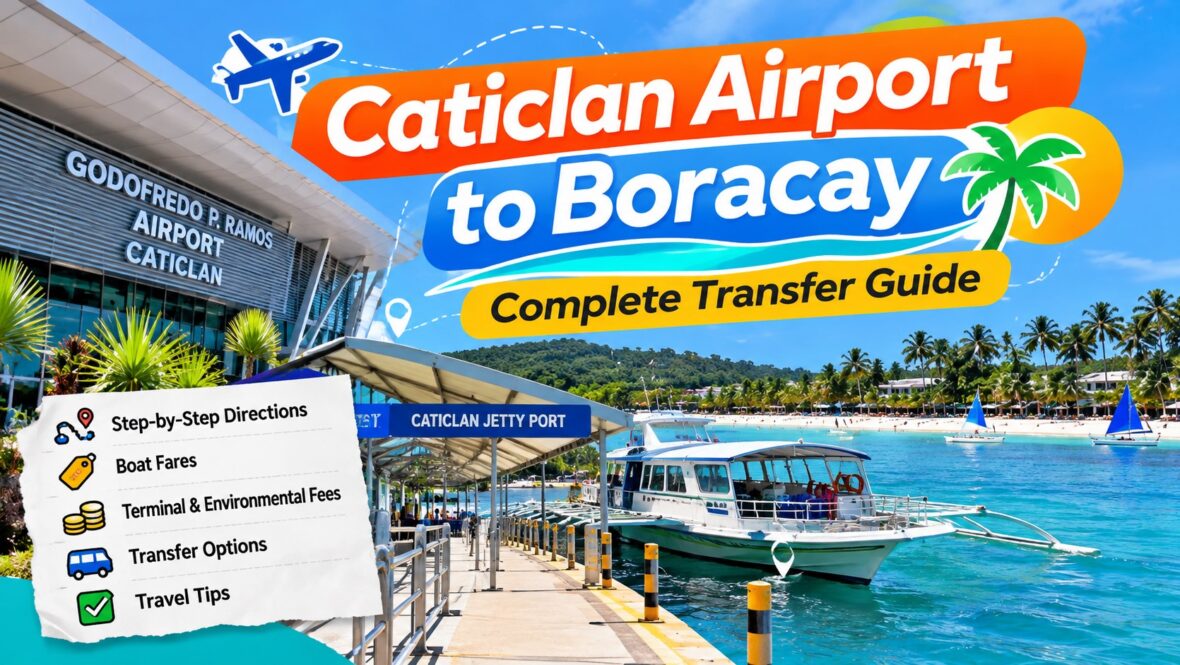
So, you’ve finally booked your flight to Boracay. Congratulations! Now comes another important part of planning your trip: figuring out how to get from Caticlan Airport to Boracay Island.
If it’s your first time visiting, you might be wondering whether you can go directly from the airport to your hotel, how much the boat ride costs, and where you’re supposed to pay the environmental and terminal fees.
Don’t worry. The process is actually quite simple once you understand the different steps.
Unlike some island destinations where the airport is already located near the main tourist areas, Boracay requires a combination of land and sea transportation.
After arriving at Caticlan Airport, you’ll need to travel to the jetty port, take a short boat ride to Boracay, and then ride another vehicle to your hotel.
The good news? Caticlan Airport is only a short distance from the port, so the transfer is much faster than traveling from Kalibo Airport.
In this guide, I’ll walk you through the entire process, including the transportation options, estimated costs, current port fees, registration requirements, and how to return to Caticlan Airport after your vacation.
Whether you’re traveling on a budget or prefer a hassle-free private transfer, here’s everything you need to know.
Last updated: November 1, 2026. Transportation fares and port charges are based on the latest available information and may change. Always confirm the final amounts before traveling.
Content
Caticlan Airport to Boracay: Quick Guide
| Details | Information |
|---|---|
| Airport | Godofredo P. Ramos Airport (Caticlan Airport) |
| Airport code | MPH |
| Location | Malay, Aklan, Philippines |
| Distance to Caticlan Jetty Port | Approximately 2 kilometers |
| Airport to jetty travel time | Around 5–15 minutes |
| Main boat departure point | Caticlan Jetty Port |
| Main arrival point in Boracay | Cagban Jetty Port |
| Boat travel time | Approximately 10–15 minutes |
| Boat fare | Around ₱50–₱60 per person |
| Environmental fee | ₱150 for Filipino tourists from outside Aklan; ₱300 for foreign tourists |
| Terminal fee | Around ₱150 per crossing |
| Estimated DIY transfer cost | ₱455–₱485 per Filipino tourist with shared rides |
| Estimated airport-to-hotel travel time | Around 45–90 minutes |
| Main transport options | DIY tricycle and boat, shared transfers, private transfers |
The estimated DIY cost assumes a shared airport tricycle, one-way port fees, a regular passenger boat, and a shared ride to the hotel. It does not include optional online service fees, baggage handling, or special transfers.
Where Is Caticlan Airport?
Caticlan Airport, officially known as Godofredo P. Ramos Airport, is located in the municipality of Malay in Aklan province.
It’s also commonly called Boracay Airport because it’s the closest airport to Boracay Island.
The airport serves travelers flying from Manila, Cebu, and other cities with available Caticlan flights.
However, here’s something first-time visitors should know.
Caticlan Airport is not actually on Boracay Island.
It’s located on the mainland of Panay, across a short stretch of water from Boracay.
This means that even after landing at the airport, you’ll still need to take a boat to reach the island.
Fortunately, the transfer is relatively quick.
Caticlan Jetty Port is approximately two kilometers from the airport, and the boat crossing usually takes just 10 to 15 minutes.
If everything goes smoothly, you could reach your hotel within about an hour after completing the arrival formalities.
Of course, you’ll need more time during peak travel periods or when there are long queues at the port.
How to Get From Caticlan Airport to Boracay
There are three main ways to arrange your transfer:
- DIY transfer: Take a tricycle to the port, buy your boat ticket and pay the necessary fees, then take an e-tricycle to your hotel.
- Shared airport transfer: Book a package that arranges the land transportation, boat crossing, and hotel transfer.
- Private airport transfer: Arrange private transportation and, depending on the package, a private or dedicated boat service.
For most budget travelers, the DIY option is a practical choice.
But if you’re traveling with children, senior citizens, or several pieces of luggage, a pre-booked transfer may be more convenient.
Let’s start with the cheapest and most common way.
Option 1: DIY Transfer From Caticlan Airport to Boracay
This is the option I’d recommend considering if you’re traveling on a budget and don’t mind handling the transfer yourself.
It’s fairly straightforward, and you don’t need to book an expensive tour package just to reach Boracay.
Here’s the step-by-step process.
Step 1: Arrive at Caticlan Airport and Collect Your Luggage
After your plane lands at Caticlan Airport, proceed to the arrival area and collect your checked baggage.
Before leaving, make sure you have your personal belongings, travel documents, and hotel booking information.
Outside the terminal, you’ll usually find transportation representatives, drivers, and staff assisting arriving passengers.
Some may offer packaged airport transfers to Boracay.
If you’ve already booked a transfer, look for your provider’s assigned meeting point or representative.
But if you’re traveling independently, head toward the authorized tricycle loading area.
One important detail: Caticlan’s arrival and departure terminal areas are not necessarily the same location. Follow the signs and instructions for the terminal you’re actually using.
Step 2: Ride a Tricycle to Caticlan Jetty Port
Your next destination is Caticlan Jetty Port.
This is the main passenger port where boats depart for Boracay.
The trip usually takes around 5 to 15 minutes, depending on traffic and the loading arrangements.
Estimated fare: Around ₱75 per person, or approximately ₱150 for a tricycle carrying two paying passengers, based on published traveler guides.
Before boarding, confirm the fare with the driver or the official transport dispatcher.
If you’re traveling alone, ask whether you can join other passengers to reduce the cost.
If you have large luggage, a private tricycle or shuttle may be easier.
The ride is short, so you won’t be traveling long before reaching the port.
Step 3: Register and Pay the Required Port Fees
Once you reach Caticlan Jetty Port, you’ll need to complete the passenger registration and ticketing process.
This is where first-time visitors sometimes get confused because there are several different charges.
Generally, visitors need to pay an environmental fee, terminal fee, and passenger boat fare.
You can complete some of these steps online before arriving.
LezzGo Boracay Registration
The Provincial Government of Aklan currently encourages travelers to use the LezzGo Boracay system.
It’s designed to simplify registration, fee payments, and ticketing for visitors traveling to the island.
Here’s how to register:
- Go to LezzGo Boracay.
- Select the tourist registration option.
- Enter your travel details, including whether you’re booking a one-way or round-trip journey.
- Provide your accommodation information. The system also has a “Walk-in” option.
- Enter or scan your valid identification details.
- Add other passengers if you’re traveling as a group.
- Choose an available payment method.
- Save your registration QR code and payment confirmation.
Accepted online payment methods include credit or debit cards, GCash, and Maya.
If you prefer to complete the process at the port, on-site payment options are also available.
Once your registration is complete, present the QR code at the designated jetty port ticketing counter for ticket issuance.
If your payment was successful but your QR code wasn’t generated, the provincial government’s guidance says you can present your valid ID and payment confirmation for manual verification.
You can read the official instructions on the Aklan Provincial Government’s LezzGo page.
Important: This is a ticketing and registration QR code, not the old pandemic-era Boracay tourist QR code.
Step 4: Pay the Environmental Fee
The environmental fee is collected from tourists entering Boracay.
It supports environmental protection and related local programs.
The commonly published rates are:
| Visitor Type | Environmental Fee |
|---|---|
| Filipino tourist from outside Aklan | ₱150 |
| Foreign tourist | ₱300 |
| Qualified Aklan residents | May be exempt, subject to documentation |
| Other eligible categories | Applicable exemptions or discounts may apply |
The environmental fee is generally collected once for the visit, rather than every time you pass through a passenger terminal.
If you’re claiming an exemption or discount, bring the required proof.
Step 5: Pay the Terminal Fee and Boat Fare
Aside from the environmental fee, you’ll also need to pay the passenger terminal fee and boat fare.
The commonly published Caticlan Jetty Port terminal fee is around ₱150 per passenger.
For the boat, older published guides commonly quote ₱50 per passenger.
However, the Caticlan-Boracay Transport Multi-Purpose Cooperative announced a temporary increase to ₱60 for regular passengers effective April 16, 2026, because of fuel costs.
That increase was intended to be temporary, so travelers should verify the prevailing fare when purchasing tickets rather than assuming that older ₱50 quotations remain accurate.
For budgeting purposes, prepare around ₱50–₱60 for a regular one-way passenger boat ticket.
Online processing charges, discounts, and other applicable fees may affect the actual amount paid.
Step 6: Proceed to the Boarding Area
Once you’ve completed the payments and received the necessary tickets, proceed to the passenger waiting or boarding area.
Follow the instructions of port personnel regarding the designated boat.
Depending on passenger volume, you might board fairly quickly or wait for the next available vessel.
During holidays and peak travel periods, there may be longer queues.
This is why I recommend allowing extra time when planning your arrival and departure transfers.
Keep your tickets and identification accessible until you’ve completed boarding.
Step 7: Take the Boat From Caticlan to Boracay
Now comes the exciting part: the boat ride to Boracay!
The crossing normally takes around 10–15 minutes.
Depending on the operator and conditions, you may ride a traditional outrigger passenger boat or another authorized passenger vessel.
During the crossing, you’ll get a glimpse of the surrounding water and coastline.
On a clear day, it’s a lovely introduction to the island.
Remember to wear your life jacket properly if instructed, keep your belongings secure, and follow the crew’s safety directions.
Although the crossing is short, sea conditions can change.
If you’re prone to seasickness, it’s worth preparing before boarding.
Step 8: Arrive at Cagban Jetty Port in Boracay
Under normal operating arrangements, your boat will arrive at Cagban Jetty Port on the southern side of Boracay.
Congratulations! You’re finally on the island.
However, your hotel is probably still several kilometers away.
Unless you’ve booked accommodation near the port, you’ll need another ride to reach Station 1, Station 2, Station 3, or another area.
The most common option is an e-tricycle.
Step 9: Ride an E-Tricycle to Your Hotel
After exiting the port, look for the authorized e-tricycle loading area or other designated transportation service.
Tell the driver the name of your hotel and where it’s located.
If you’re staying near White Beach, mention the correct station.
For example:
- Station 1 – Northern part of White Beach
- Station 2 – D’Mall and central White Beach area
- Station 3 – Southern part of White Beach
Depending on the type of service and exact destination, shared e-tricycle rides may cost around ₱30–₱50 per passenger on applicable routes.
Chartering an entire vehicle for a direct trip to your hotel can cost approximately ₱200–₱300 or more, depending on the destination and applicable fare schedule.
Make sure to confirm whether the quoted fare is per person or for the entire vehicle.
Also, not every beachfront hotel can be reached directly by vehicle.
Some properties require a short walk from the nearest main-road access point.
If you’re bringing large luggage, ask your hotel about the nearest practical drop-off area.
And that’s it! You’re finally ready to enjoy Boracay.
How Much Is the Transfer From Caticlan Airport to Boracay?
Let’s break down the expected cost for one Filipino traveler using the DIY method.
| Expense | Estimated Cost |
|---|---|
| Airport to Caticlan Jetty Port shared tricycle | ₱75 |
| Environmental fee | ₱150 |
| Caticlan Jetty Port terminal fee | ₱150 |
| Regular boat ticket | ₱50–₱60 |
| Shared e-tricycle to hotel | ₱30–₱50 |
| Total estimated one-way cost | ₱455–₱485 |
This is a planning estimate for a Filipino tourist from outside Aklan, traveling during normal operating conditions with shared transportation.
For foreign tourists paying the ₱300 environmental fee, a comparable estimated total would be around ₱605–₱635.
Special transfers, online service fees, private vehicle arrangements, and extra charges are not included.
How Much Is the Round-Trip Transfer?
You should also prepare money for the return journey from Boracay to Caticlan Airport.
Here’s a simplified round-trip DIY estimate for a regular Filipino tourist.
| Expense | Estimated Round-Trip Cost |
|---|---|
| Airport/port tricycles, both directions | ₱150 |
| Environmental fee, once | ₱150 |
| Terminal fees, two crossings | ₱300 |
| Regular boat fares, two crossings | ₱100–₱120 |
| Shared Boracay e-tricycles, both directions | ₱60–₱100 |
| Estimated Round-Trip Total | ₱760–₱820 |
For foreign tourists, the comparable amount would be around ₱910–₱970, because of the higher environmental fee.
These calculations assume that the same terminal and basic fare arrangements apply to both crossings. Actual port charges may differ during alternate-port operations.
To be safe, I’d recommend setting aside around ₱900–₱1,100 per Filipino traveler for a basic round-trip DIY transfer, allowing some room for fare changes, service charges, and minor additional expenses.
Option 2: Book a Shared Caticlan Airport to Boracay Transfer
If you don’t want to deal with the separate transportation arrangements, consider booking a shared airport transfer.
This option is popular among first-time visitors because someone coordinates the journey from the airport to the hotel.
Depending on the package, services may include airport meet-and-greet assistance, van transportation, boat tickets, port fees, and the final transfer to your accommodation.
The main advantage is convenience.
You won’t have to figure out each step entirely on your own.
How Shared Transfers Work
Generally, the process looks like this:
- Book a transfer through your chosen operator or booking platform.
- Provide your flight details, arrival date, hotel name, and passenger information.
- Upon arrival, locate the transfer company’s representative.
- Board the assigned vehicle to the jetty port.
- Complete the registration or ticketing procedures with the operator’s assistance.
- Board the designated passenger boat.
- Continue to your hotel using the provided island transportation.
Some packages include all government-related charges, while others sell the transportation service separately.
This is an important distinction.
How Much Does a Shared Transfer Cost?
Published prices vary depending on the provider, group size, and package inclusions.
For example, MyBoracayGuide advertises standard shared transfers from approximately ₱800–₱1,050 per person one way, with its listed package including terminal fees, environmental fees, and boat tickets.
Island Star Express advertises a lower one-way transport voucher, around ₱450 per adult, but clearly states that government fees are not included in that base price.
In other words, don’t automatically assume the cheaper advertised package is the cheaper overall option.
Compare the final amount after all required charges.
For most travelers, a reasonable starting budget for an all-inclusive shared one-way transfer is around ₱800–₱1,100 per person, subject to availability and current rates.
Where to Book Caticlan Airport Transfers
You can compare services through:
- Klook – Caticlan Airport Transfers
- MyBoracayGuide – Standard Airport Transfer
- Island Star Express
- Southwest Tours
You can also ask your hotel whether it offers a transfer arrangement.
Before paying, check the inclusions, baggage allowance, flight-delay policy, operating hours, and whether pickup is available at your specific hotel.
Option 3: Private Transfer From Caticlan Airport to Boracay
For families, couples who prefer more privacy, and travelers with plenty of luggage, a private transfer can be another option.
Private transfer arrangements may include a dedicated airport vehicle, coordinated port assistance, a private speedboat when available, and private transportation on Boracay.
However, not every package marketed as “private” includes a private boat.
Some only provide a private land vehicle while passengers still use a shared passenger vessel.
Make sure you understand exactly what you’re paying for.
Who Should Consider a Private Transfer?
A private transfer may be worth considering if you’re:
- Traveling with young children or senior citizens
- Staying at a luxury resort
- Carrying several large suitcases
- Traveling as a family or large group
- Arriving at an inconvenient hour
- Looking for a more comfortable door-to-door experience
Private packages can cost several thousand pesos depending on the number of passengers, boat arrangement, and type of vehicle.
For a group, compare the total package cost with the combined price of individual shared transfer tickets.
Sometimes a private transfer becomes more reasonable when the cost is divided among several people.
DIY vs. Shared vs. Private Transfer: Which Is Better?
Here’s a quick comparison to help you decide.
| Transfer Type | Estimated One-Way Cost | Best For |
|---|---|---|
| DIY transfer | ₱455–₱485 per Filipino tourist with shared rides | Budget travelers |
| Shared packaged transfer | Approximately ₱800–₱1,100 per person, all-inclusive options | First-time visitors and travelers wanting convenience |
| Private transfer | Several thousand pesos per group, depending on inclusions | Families, groups, and comfort-focused travelers |
If you’re traveling solo on a tight budget, DIY is usually the best starting point.
If you’re visiting Boracay for the first time and don’t mind paying extra, a shared transfer may be more relaxing.
And if you’re traveling with a family, especially with children or elderly companions, it’s worth comparing private transfer packages.
How Long Does It Take From Caticlan Airport to Boracay?
One of the biggest reasons travelers prefer Caticlan over Kalibo is the shorter travel time.
Here’s how long each part of the transfer may take.
| Transfer Stage | Estimated Time |
|---|---|
| Leaving airport and arranging transportation | 5–15 minutes after collecting luggage |
| Airport to Caticlan Jetty Port | 5–15 minutes |
| Registration, ticketing, and boarding | 15–45 minutes or more |
| Boat to Boracay Island | 10–15 minutes |
| Boracay port to hotel | 10–30 minutes or more |
For normal conditions, I recommend allowing approximately 45–90 minutes from the time you’re ready to leave the airport to your hotel.
If there are long queues, bad weather, or special operating arrangements, the transfer can take longer.
Sample Arrival Timeline
Let’s say your flight lands at Caticlan Airport at 10:00 AM.
Here’s what a relatively smooth arrival could look like:
| Time | Activity |
|---|---|
| 10:00 AM | Plane lands at Caticlan |
| 10:20 AM | Exit airport with luggage |
| 10:30 AM | Arrive at Caticlan Jetty Port |
| 10:30–10:50 AM | Complete port procedures and wait for boarding |
| 10:50 AM | Board passenger boat |
| 11:05 AM | Arrive at Boracay |
| 11:15 AM | Take island transportation |
| 11:30–11:45 AM | Arrive near hotel |
This is only an example, not a guaranteed schedule.
Still, it shows why Caticlan is such a convenient airport for Boracay visitors.
Caticlan Jetty Port vs. Tabon Port: What’s the Difference?
Here’s something many first-time visitors don’t realize.
The port used for your Boracay crossing can change depending on sea conditions.
During calmer conditions, the usual route is:
Caticlan Jetty Port → Cagban Jetty Port
However, during the southwest monsoon, locally known as Habagat, rougher seas can affect normal boat operations.
When this happens, authorities may use the alternative route:
Tabon Port → Tambisaan Port
Tabon Port is on the mainland, while Tambisaan Port is located on the eastern side of Boracay.
When Is Tabon Port Used?
The alternate route is commonly associated with the Habagat season, generally between June and October.
But port changes don’t follow a perfectly fixed calendar.
The Philippine Coast Guard and local port authorities determine which route is safe based on prevailing conditions.
So, if your driver brings you to Tabon instead of Caticlan Jetty Port, that doesn’t necessarily mean anything is wrong.
It may simply be the authorized operating port for that day.
Do Port Fees Change?
They can.
Terminal arrangements, transfer distances, service charges, and transportation costs may differ when boats operate through alternate ports.
Always follow the applicable official fee schedule at the operating terminal.
If you’re using a pre-booked transfer, confirm whether the company covers any additional expenses caused by a change of port.
Are Boats From Caticlan to Boracay Available 24 Hours?
You may come across websites advertising 24-hour transfers to Boracay.
However, there’s an important difference between a transfer company offering round-the-clock service and regular passenger boats departing frequently throughout the night.
During daytime and busy operating hours, boats generally depart more frequently.
Late at night or very early in the morning, passenger services may be less frequent, subject to operational restrictions, or require special arrangements.
Some transfer operators offer private or night-navigation services.
But these may have different prices and booking requirements.
For example, Island Star Express states that its regular shared-arrival transfers serve flights arriving between approximately 5:30 AM and 7:00 PM. Passengers outside those hours are directed to arrange chartered services.
Other operators advertise broader operating hours.
That means there’s no single schedule that can safely be assumed for every boat or transfer provider.
My advice: If your flight arrives late in the evening or departs very early in the morning, confirm the crossing arrangement before your travel date.
Don’t rely solely on a general claim that boats operate 24/7.
Caticlan Airport to Boracay Station 1, 2 and 3
Once you arrive on Boracay, your final travel time depends on where your hotel is located.
Caticlan Airport to Station 1
Station 1 is located toward the northern end of White Beach.
It’s known for beautiful beachfront areas and upscale resorts.
From Cagban Port, you’ll generally need an e-tricycle or arranged shuttle toward Station 1.
The road journey may take around 20–30 minutes under ordinary conditions, depending on the hotel and traffic.
Some properties require a short walk from the designated roadside drop-off.
If you’re carrying heavy luggage, ask the hotel whether it can arrange pickup assistance.
Caticlan Airport to Station 2
Station 2 is the busiest and most convenient part of White Beach.
This is where you’ll find D’Mall and many restaurants, cafés, and shops.
From Cagban Port, the road transfer usually takes approximately 15–25 minutes, depending on conditions.
If your hotel is near D’Mall, ask the driver for the appropriate main-road drop-off.
You may need to walk through a narrow lane to reach a hotel located along the beach.
Caticlan Airport to Station 3
Station 3 is located along the southern section of White Beach.
It’s generally quieter and has several affordable hotels and guesthouses.
Because Station 3 is closer to the southern part of the island, the transfer from Cagban Port can be shorter.
Allow around 10–20 minutes under normal road conditions, depending on your hotel.
Caticlan Airport to Bulabog Beach
If you’re staying around Bulabog Beach, your driver will travel toward the eastern side of the island.
Bulabog is popular among kitesurfers and visitors who prefer accommodation away from the busiest beachfront areas.
The estimated road travel time will depend on the specific property and traffic conditions.
Always provide the hotel name rather than simply saying “Bulabog” to avoid being dropped off too far from your accommodation.
How to Get From Boracay Back to Caticlan Airport
Your return journey follows essentially the same process, only in reverse.
However, I recommend being a little more careful with your schedule on departure day.
Unlike arriving at Boracay, where a delay may simply mean reaching your hotel later, a delay on your return journey could cause you to miss your flight.
Here’s how to return to Caticlan Airport.
Step 1: Leave Your Hotel With Enough Time
Arrange transportation from your hotel to the appropriate Boracay departure port.
For most normal operations, this will be Cagban Jetty Port.
If you’re using a pre-booked transfer, your provider should give you a pickup time and location.
If you’re arranging the transfer yourself, confirm the tricycle fare before leaving.
Step 2: Pay the Applicable Departure Fees
At the departure port, complete the ticketing process and pay any applicable terminal and boat charges that haven’t already been prepaid.
You generally do not pay the environmental fee again for the same visit.
Keep your ticket, payment confirmation, and ID accessible.
Step 3: Take the Boat to Caticlan
Board the designated passenger boat back to the mainland.
The crossing usually takes around 10–15 minutes under normal conditions.
If authorities have directed boats to use the Tabon–Tambisaan route, follow the current port instructions.
Step 4: Travel From the Port to Caticlan Airport
After arriving on the mainland, take a tricycle or your arranged shuttle to the airport.
Make sure you tell the driver that you’re heading to Caticlan Airport’s departure terminal.
Keep your flight details ready in case the driver asks which airline you’re flying with.
How Early Should You Leave Boracay for Your Flight?
For an ordinary domestic flight departing from Caticlan, I’d recommend leaving your hotel approximately three to four hours before the scheduled flight, depending on your location, airline requirements, and port conditions.
During peak seasons or questionable weather, allow even more time.
As a planning example:
If your flight is at 2:00 PM, arranging to leave your hotel at around 10:00 AM to 11:00 AM may be sensible, depending on the confirmed transportation schedule.
The goal is to arrive at the airport with enough time for check-in, baggage drop, and security procedures.
If your airline requires you to arrive two hours before departure, plan the sea and road transfers on top of that.
For very early departures, verify the first available boat or pre-book an appropriate transfer rather than assuming regular services will be running.
Caticlan Airport vs. Kalibo Airport: Which Is Better?
If you haven’t booked your flight yet, you might be comparing Caticlan and Kalibo airports.
Both serve travelers going to Boracay, but the transfer experience is quite different.
| Feature | Caticlan Airport | Kalibo Airport |
|---|---|---|
| Airport code | MPH | KLO |
| Distance to Caticlan Jetty Port | About 2 km | Roughly 60–70 km |
| Land transfer time | 5–15 minutes | Around 1.5–2 hours |
| Boat ride required | Yes | Yes |
| Convenience | Excellent | Requires longer journey |
| Airfare | Can be higher | Sometimes more affordable |
| Best for | Short vacations, families, first-time visitors | Travelers finding significantly cheaper flights |
Personally, I’d recommend Caticlan for most first-time visitors, especially if you’re spending only three or four days in Boracay.
Yes, flights can sometimes be more expensive.
But you’ll save time and avoid the long van or bus journey from Kalibo.
However, if you find a significantly cheaper flight to Kalibo, it can still be a practical option.
Just include the additional land transportation cost when comparing the total expenses.
Travel Tips for a Smooth Caticlan to Boracay Transfer
Before ending this guide, here are some practical tips that can save you time, money, and unnecessary stress.
1. Prepare Small Bills and Cash
Although digital payments are increasingly available, it’s useful to have Philippine pesos ready for transportation and smaller expenses.
Prepare smaller bills so you don’t have to worry about change.
2. Register Online Before Traveling
If the current system allows you to complete registration in advance, consider doing so.
Having your information and payment confirmation ready may reduce the amount of time you spend at the port.
3. Keep Your Hotel Details Accessible
Take a screenshot of your hotel confirmation and address.
This is especially helpful when explaining your destination to an e-tricycle driver.
4. Bring a Waterproof Bag for Valuables
The boat crossing is short, but water splashes can happen.
Keep your phone, wallet, important documents, and other valuables protected.
5. Watch Your Luggage During Boarding
Some passenger boats have narrow boarding areas or steps.
If you’re carrying large luggage, ask the crew or authorized porters for assistance.
Confirm whether porter services have an additional charge before accepting help.
6. Choose an Appropriate Transfer for Your Group
If you’re traveling with senior citizens, young children, or someone with limited mobility, consider arranging an assisted transfer.
Boat boarding may involve stairs, uneven surfaces, or stepping onto a vessel.
Ask your provider about accessibility arrangements before booking.
7. Don’t Book Extremely Tight Flight Connections
Sea travel depends on weather and port conditions.
Strong winds, rough seas, and safety advisories can cause delays or temporary suspension of boat operations.
Allow enough time, particularly if you’re connecting to another flight.
8. Check the Weather Before Departure
If you’re visiting during the rainy season, monitor weather and sea-travel advisories.
You can check updates from PAGASA, the Philippine Coast Guard, and your airline or transfer provider.
9. Compare the Total Cost of Packages
A transfer package advertised at a low price may not include environmental fees, terminal charges, or additional services.
Always ask what’s included before paying.
10. Confirm Your Return Transfer in Advance
Even if you arranged your arrival independently, don’t leave your departure transportation until the last minute.
Knowing your pickup time and departure port can make your final morning in Boracay much more relaxing.
Frequently Asked Questions About Caticlan Airport to Boracay
How do I get from Caticlan Airport to Boracay?
Take a tricycle or shuttle from Caticlan Airport to Caticlan Jetty Port. After completing registration and paying the necessary fees, board a passenger boat to Boracay. From the island port, take an e-tricycle or arranged vehicle to your hotel.
How much is the boat fare from Caticlan to Boracay?
Published regular boat fares have ranged from ₱50 to ₱60 per person one way. A provisional ₱60 fare was announced in April 2026, so confirm the current amount at the authorized ticket counter.
How much is the environmental fee in Boracay?
The commonly published fee is ₱150 for Filipino tourists from outside Aklan and ₱300 for foreign tourists. Eligible travelers may qualify for exemptions or discounts.
How much is the terminal fee at Caticlan Jetty Port?
The commonly published terminal fee is around ₱150 per crossing. Check the official fee schedule or ticketing system because alternate-port arrangements and other applicable charges may differ.
How long is the boat ride from Caticlan to Boracay?
The regular boat crossing usually takes approximately 10–15 minutes, depending on conditions and the operating route.
Can I walk from Caticlan Airport to the jetty port?
Although the port is relatively close, taking an authorized tricycle or shuttle is generally more convenient, especially if you’re carrying luggage.
Is there a direct taxi from Caticlan Airport to Boracay?
You cannot reach Boracay from Caticlan Airport entirely by road. A boat crossing is still required. Some private transfer packages arrange the road and sea portions together.
Is Grab available from Caticlan Airport to Boracay?
Don’t assume that Grab car services are available for this transfer. Most travelers use airport tricycles, local shuttles, or pre-booked transfer providers.
Do I need a hotel booking before entering Boracay?
Advance hotel booking is strongly recommended. The current LezzGo system allows travelers to enter “Walk-in” when they do not have a confirmed reservation, but accommodation and visitor rules should be checked before travel.
Do I need a passport to travel from Caticlan to Boracay?
Filipino travelers on domestic trips generally do not need a passport solely for the island transfer, but should bring an accepted valid ID.
Foreign visitors should have their passport available for verification.
Do I need a QR code to enter Boracay?
Aklan’s LezzGo registration system generates a QR code for the current ticketing process. This is different from the old pandemic-era tourist QR code requirement.
Can I pay Boracay fees using GCash?
The official LezzGo platform lists GCash among its online payment options. Other payment methods include credit or debit cards and Maya.
Are boats available from Caticlan to Boracay at night?
Some operators offer nighttime crossing arrangements, but regular boat departure frequency, schedules, and availability can differ.
Confirm with the operating port or transfer provider if your flight arrives late.
Is Caticlan Airport better than Kalibo for Boracay?
For convenience, yes. Caticlan is much closer to the jetty port and requires a shorter land transfer.
Kalibo may be preferable if you find a much cheaper flight and don’t mind the longer journey.
How much money should I prepare for Caticlan Airport to Boracay?
For a Filipino tourist making the journey independently with shared transportation, an estimated ₱455–₱485 covers the basic one-way transfer under the fare assumptions in this guide.
Preparing a little more is advisable for unexpected charges or changes in transport arrangements.
Final Thoughts
Getting from Caticlan Airport to Boracay might seem complicated when you’re planning your first trip, but the actual process is fairly straightforward.
You’ll take a short ride from the airport to the jetty port, complete the registration and payment process, cross to Boracay by boat, and continue to your hotel.
That’s really all there is to it.
If you’re traveling on a budget, doing the transfer yourself is a practical option and can save you money.
But if you prefer convenience, especially when traveling with family or carrying several pieces of luggage, a shared or private transfer package may be worth the additional expense.
The most important thing is to understand the different fees, prepare your travel documents, and give yourself enough time for the journey.
And once you’ve finally arrived at your hotel, you can leave all the transportation planning behind and focus on what you’ve been looking forward to.
White Beach, clear turquoise water, beautiful sunsets, and a relaxing vacation.
Enjoy your Boracay trip!
Sources and References
The following official resources, transport operators, and published travel references were consulted in preparing this guide.
- Aklan Provincial Government – LezzGo Boracay
- LezzGo Boracay Registration
- Aklan Provincial Government – Online Payment Information
- Department of Tourism Philippines
- MyBoracayGuide – Caticlan Transfer Guide
- Island Star Express – Shared Airport Transfers
- Klook – Caticlan Airport Transfer Services
- Philippine News Inquirer – April 2026 Boat Fare Adjustment
- PAGASA – Official Weather Advisories
Editor’s note: Information is current to November 1, 2026. Terminal charges, environmental fees, boat fares, routes, and transfer schedules are subject to change. The Philippine Coast Guard and relevant local authorities may adjust or suspend marine operations depending on weather and sea conditions.