If you’re planning to take the Civil Service Exam in 2027, one of the first questions you’ll probably ask is:
What exactly should I review?
Because let’s be honest. Saying you’re going to “study for the Civil Service Exam” sounds simple until you start looking at the coverage.
There’s English.
Filipino.
Math.
Reading comprehension.
Grammar.
Logic.
The Philippine Constitution.
RA 6713.
Human rights.
Environmental management.
Then, depending on which level you’re taking, you’ll also encounter either analytical ability or clerical ability.
That’s a lot.
The good news is that the Civil Service Examination isn’t something you need to study for like a four-year college course. Once you understand the official coverage and how the questions are usually structured, you can create a much more focused study plan.
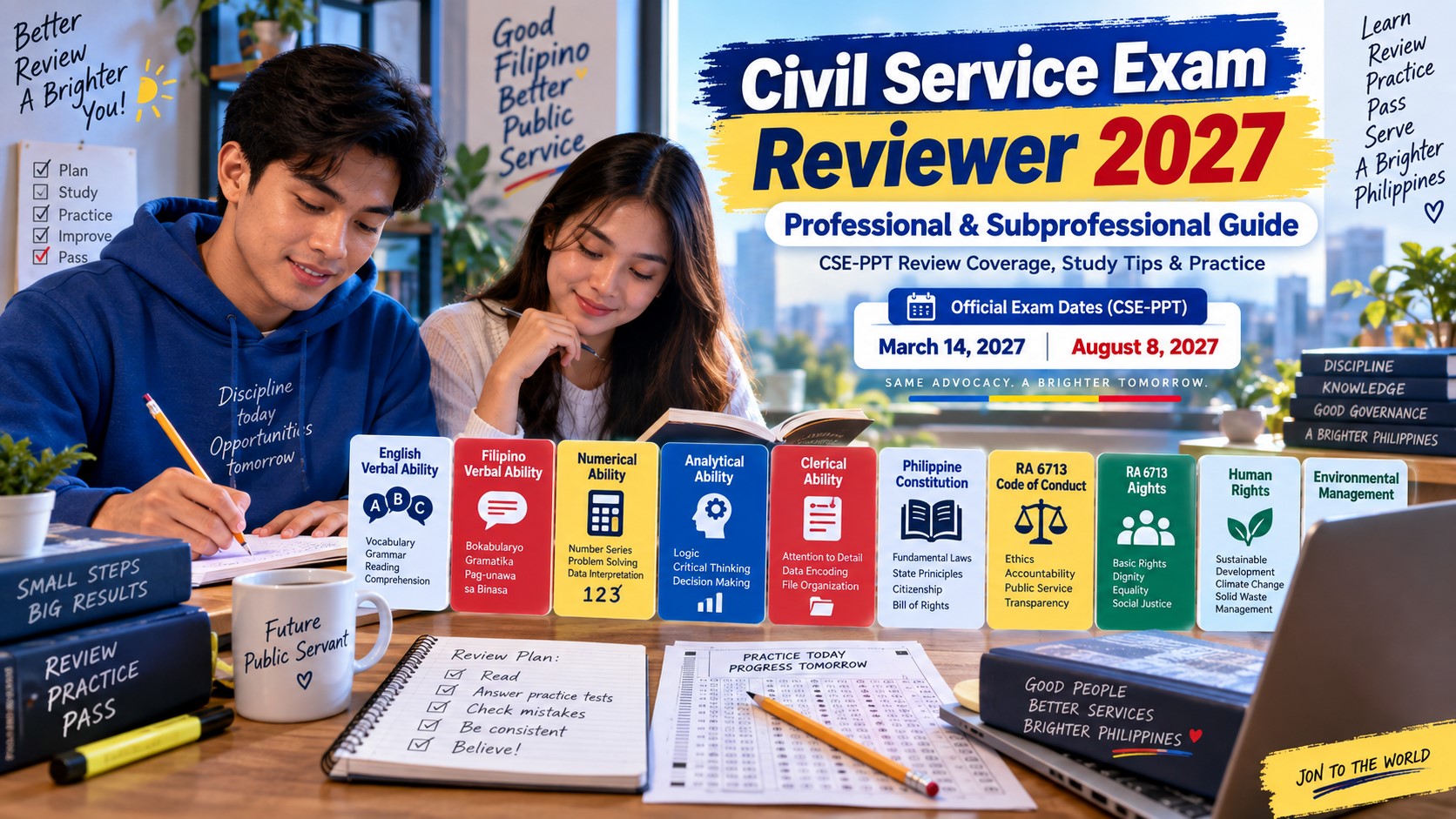
This guide breaks down what Professional and Subprofessional examinees should review for the 2027 Career Service Examination – Pen and Paper Test or CSE-PPT.
I’ve also included original practice questions toward the end so you can test yourself.
One important note before we begin: the sample questions in this guide are independently created practice questions. They are not actual CSC examination questions and should not be treated as leaked or reproduced test materials.
Content
Civil Service Exam 2027 Schedule
First, the dates.
The Civil Service Commission has already released the official calendar for the 2027 CSE-PPT.
There will be two regular Professional and Subprofessional examinations:
| Civil Service Exam | Exam Date | Application Starts | Target Result Release |
|---|---|---|---|
| First CSE-PPT | March 14, 2027 | November 2, 2026 | May 11, 2027 |
| Second CSE-PPT | August 8, 2027 | May 10, 2027 | October 5, 2027 |
For each examination, the CSC has set a target of 350,000 examination slots nationwide.
Unlike earlier schedules that had a fixed closing date, the 2027 calendar states that applications will be accepted on a continuous basis until available slots are filled or until otherwise announced by the CSC.
That last part is important.
Don’t assume you can wait several weeks after applications open.
Exam slots can fill quickly depending on the testing center and region.
Is the 2027 Civil Service Exam Coverage Already Official?
Not completely.
The CSC has officially announced the 2027 examination dates, but as of September 18, 2026, the detailed individual examination announcement for the March 14, 2027 CSE-PPT has not yet been released.
According to the CSC’s 2027 calendar, the Commission will issue a specific examination announcement about three weeks before the application period begins. That announcement will include the final testing centers, requirements, scope of examination, passing grade and other details.
So for now, the reviewer coverage in this guide is based on the latest official CSE-PPT coverage used by the CSC in 2026.
Unless the CSC announces changes for 2027, this is the most reliable material to use when starting your preparation.
Professional vs. Subprofessional: What’s the Difference?
Both examinations test many of the same core abilities.
The biggest difference is that Professional examinees take Analytical Ability, while Subprofessional examinees take Clerical Ability.
Based on the latest CSC examination scope, here’s the comparison:
| Area | Professional | Subprofessional |
|---|---|---|
| General Information | Yes | Yes |
| Verbal Ability | Yes | Yes |
| Numerical Ability | Yes | Yes |
| Analytical Ability | Yes | No |
| Clerical Ability | No | Yes |
The official 2026 examination announcement listed General Information, Verbal Ability and Numerical Ability for both levels. Professional examinees were additionally tested on Analytical Ability, while Subprofessional examinees were tested on Clerical Ability.
How Many Questions Are in the Civil Service Exam?
Under the current CSE-PPT format used by the CSC:
| Level | Test Proper | EDQ | Total Items | Time Limit |
|---|---|---|---|---|
| Professional | 150 | 20 | 170 | 3 hours 10 minutes |
| Subprofessional | 145 | 20 | 165 | 2 hours 40 minutes |
The additional 20 items are part of the Examinee Descriptive Questionnaire or EDQ, which asks for personal and descriptive information about the examinee.
The important number from a reviewer perspective is therefore the test proper:
150 items for Professional.
145 items for Subprofessional.
That’s why speed matters almost as much as knowledge.
You can’t spend five minutes solving every difficult math or logic question.
What Is the Passing Grade?
The CSC requires examinees to obtain a general rating of at least:
80.00
to qualify for civil service eligibility.
One common misunderstanding is to automatically interpret this as meaning that you simply need to answer exactly 80 percent of the questions correctly.
The CSC describes the requirement as a general rating of at least 80.00, so it is better to focus on maximizing your overall performance rather than trying to calculate a minimum number of correct answers while taking the exam.
Your goal should be to score as high as possible.
Civil Service Exam Professional Reviewer Coverage
Let’s start with the Professional level.
The latest CSC coverage consists of General Information, Verbal Ability, Numerical Ability and Analytical Ability.
Verbal Ability
Verbal Ability appears in both English and Filipino.
According to the CSC, the coverage includes:
| Topic | What You Should Practice |
|---|---|
| Word Meaning | Vocabulary, synonyms, antonyms, context clues |
| Sentence Completion | Choosing words or phrases that logically complete sentences |
| Error Recognition | Identifying grammar, agreement and usage errors |
| Sentence Structure | Grammar and correct sentence construction |
| Paragraph Organization | Arranging sentences into a logical paragraph |
| Reading Comprehension | Understanding passages and answering questions based on them |
This section isn’t just about memorizing difficult English words.
A lot of it comes down to context.
For example, you might not know the exact dictionary definition of a word, but the surrounding sentence can tell you whether it means something positive, negative, large, small, fast, slow or something else entirely.
For grammar, spend time reviewing subject-verb agreement, pronouns, modifiers, verb tenses, prepositions and common sentence errors.
For Filipino questions, practice reading Filipino passages as well.
Don’t focus exclusively on English reviewers.
Reading Comprehension
Reading comprehension deserves its own discussion because it can eat up a surprising amount of time.
You may receive a passage followed by several questions.
The questions could ask about the main idea, supporting details, conclusions, tone or information that can reasonably be inferred from the passage.
A useful habit is to separate what the passage actually says from what you personally know about the topic.
If the passage says:
“Most employees arrived before 8:00 AM.”
You can’t automatically conclude:
“All employees arrived before 8:00 AM.”
“Most” and “all” are not the same.
Small differences like that are often what make comprehension questions tricky.
Numerical Ability
Both Professional and Subprofessional examinees take Numerical Ability.
The official coverage includes:
| Numerical Topic | What to Review |
|---|---|
| Basic Operations | Addition, subtraction, multiplication and division |
| Number Sequence | Patterns and missing numbers |
| Word Problems | Translating written problems into mathematical operations |
This may sound basic, but remember:
You cannot use a calculator.
The CSC explicitly prohibits calculators during the CSE-PPT. Other aids such as books, dictionaries, tablets and similar devices are also prohibited.
That means you should practice doing calculations manually.
Review fractions.
Decimals.
Percentages.
Ratios.
Averages.
Simple proportions.
Basic algebra.
Distance, rate and time problems.
Age problems.
Discounts.
Markups.
And everyday arithmetic.
The exam isn’t necessarily about advanced mathematics.
The challenge is solving relatively simple problems accurately while under time pressure.
Number Sequences
Number sequence questions are usually about spotting patterns.
For example:
2, 4, 8, 16, ___
The answer is 32 because each number is multiplied by two.
But sequences can also involve addition, subtraction, alternating operations or differences that themselves form a pattern.
Consider:
3, 7, 13, 21, ___
Look at the differences:
+4, +6, +8.
The next difference would be +10.
So the next number would be 31.
When a sequence doesn’t immediately make sense, examine the difference between consecutive numbers before trying complicated formulas.
Analytical Ability for Professional Examinees
This is the major section that separates the Professional exam from the Subprofessional exam.
The latest CSC scope includes:
| Analytical Topic | Coverage |
|---|---|
| Word Analogy | Relationships between words |
| Symbolic Logic / Abstract Reasoning | Patterns and logical relationships |
| Identifying Assumptions | Recognizing ideas that must be accepted for a statement to work |
| Drawing Conclusions | Determining what logically follows from information |
| Data Interpretation | Reading and analyzing tables, charts and numerical information |
This section can feel difficult because memorization won’t help very much.
You have to reason through the information given.
Word Analogy
A word analogy tests relationships.
For example:
Doctor : Hospital :: Teacher : ______
The relationship is profession to common workplace.
So the answer would be School.
The trick is identifying the exact relationship before looking at the choices.
Other relationships could involve:
object and function,
cause and effect,
part and whole,
synonyms,
antonyms,
degree,
worker and tool,
or location.
Don’t just choose two words that seem related.
Identify how they are related.
Logic and Assumptions
Suppose you are given:
All accountants are employees.
Maria is an accountant.
What can you conclude?
Maria is an employee.
That’s straightforward.
But logic questions can become more complicated when words like some, all, none and only are involved.
If a statement says:
Some employees are accountants.
You cannot conclude that:
All employees are accountants.
Again, pay attention to the wording.
Logic questions reward careful reading.
Data Interpretation
You may be given a table or set of figures and asked to compare values, calculate percentages, determine increases or identify patterns.
The mathematics may not be particularly difficult.
The difficulty often comes from reading the data correctly.
Always check the labels.
Check the unit.
Check whether the figures represent totals, percentages, thousands, millions or something else.
A correct calculation using the wrong column is still a wrong answer.
Clerical Ability for Subprofessional Examinees
Subprofessional examinees take Clerical Ability instead of Analytical Ability.
The current CSC scope covers:
| Clerical Topic | What to Practice |
|---|---|
| Filing | Arranging information according to established order |
| Spelling | Identifying correctly and incorrectly spelled words |
Don’t underestimate this section just because it looks simpler.
Clerical questions can be easy to answer when you’re relaxed and surprisingly easy to get wrong when you’re rushing.
Filing Questions
Filing questions may require you to arrange names or information alphabetically.
For example:
Garcia, Anna
Garcia, Bernard
Gomez, Carlo
Gonzales, Diana
You need to compare letters carefully.
The same principle can apply to numbers, dates or other information depending on the format of the question.
Practice accuracy first.
Then work on speed.
Spelling
For spelling, focus on commonly confused English words.
Words with double consonants often cause problems.
So do words with -able and -ible endings.
Other common problems involve silent letters and words that sound similar but are spelled differently.
Instead of memorizing thousands of random words, review frequently used professional and academic vocabulary.
General Information
The latest CSC examination coverage identifies four General Information areas for the Professional and Subprofessional examinations:
| General Information Coverage |
|---|
| Philippine Constitution |
| Code of Conduct and Ethical Standards for Public Officials and Employees or RA 6713 |
| Peace and Human Rights Issues and Concepts |
| Environment Management and Protection |
This is where traditional studying becomes especially useful.
Unlike logic questions, many General Information questions depend on whether you know certain facts or concepts.
Philippine Constitution Reviewer
You don’t necessarily have to memorize every line of the Constitution.
Start with the structure.
Understand the three branches of government.
Know the basic roles of the Executive, Legislative and Judicial branches.
Review the Bill of Rights.
Understand constitutional commissions.
Know basic principles involving citizenship, suffrage, accountability of public officers and the separation of powers.
Also pay attention to fundamental constitutional rights such as due process, equal protection, freedom of speech and protection against unreasonable searches and seizures.
The goal isn’t simply memorization.
Try to understand what each provision means.
That makes application-type questions much easier.
RA 6713 Reviewer
Republic Act No. 6713 is the Code of Conduct and Ethical Standards for Public Officials and Employees.
This is one area I would definitely spend time reviewing.
RA 6713 establishes standards of conduct for people working in government.
Among the norms of conduct identified in the law are commitment to public interest, professionalism, justness and sincerity, political neutrality, responsiveness to the public, nationalism and patriotism, commitment to democracy and simple living.
The law also deals with ethical conduct, disclosure requirements and responsibilities of public officials and employees.
Rather than simply memorizing terms, imagine actual workplace situations.
If a government employee gives special treatment to someone because of political connections, what principle could be involved?
If an employee uses public resources for personal purposes, what ethical issue is involved?
Scenario-based thinking makes RA 6713 easier to remember.
Peace and Human Rights
For this area, understand fundamental human rights concepts.
Review civil and political rights.
Know the idea of equality before the law.
Understand due process.
Review basic concepts relating to freedom, human dignity, discrimination and protection of rights.
You should also understand that human rights apply regardless of a person’s status, background or personal characteristics.
Again, focus on concepts rather than trying to memorize thousands of unrelated facts.
Environmental Management and Protection
This area can include broad concepts related to environmental protection.
Know basic ideas involving waste management, pollution prevention, conservation of natural resources, environmental responsibility and sustainable development.
You may also encounter familiar Philippine environmental laws and government policies while reviewing.
The important thing is to understand the principles behind them.
For example, waste segregation is not simply about making trash look organized.
Separating biodegradable, recyclable, residual and other waste categories helps improve proper waste management and disposal.
Which Is Harder: Professional or Subprofessional?
Most people consider the Professional exam more challenging because of the Analytical Ability section.
But that doesn’t mean everyone should automatically take Subprofessional first.
It depends on your goal.
Passing the Professional Level gives you Career Service Professional Eligibility, which is appropriate for first-level clerical positions as well as second-level professional, technical and scientific positions, subject to the qualification standards of the job.
Passing the Subprofessional Level gives you Career Service Subprofessional Eligibility, which is appropriate for first-level positions.
So if you’re qualified to take the Professional exam and your long-term goal includes professional or technical government positions, the Professional level generally gives you broader eligibility.
However, eligibility by itself doesn’t automatically give someone a government job.
Government applicants still have to meet the required education, experience, training, competency and other qualification standards for the position.
Who Can Take the Civil Service Exam?
Under the CSC’s current requirements, CSE-PPT applicants must generally be Filipino citizens, at least 18 years old and of good moral character.
Applicants must also have no disqualifying criminal conviction involving moral turpitude, must not have been dishonorably discharged from military service or dismissed for cause from a civilian government position, and must not have taken the same level of Career Service Examination within three months of the previous examination.
Applicants for 2027 should still check the specific examination announcement once released because the CSC will publish the final requirements applicable to that examination.
Do You Need a College Degree?
The Civil Service Exam itself is not limited only to college graduates.
What matters is whether you meet the CSC’s admission requirements for the examination.
However, passing the exam doesn’t erase education requirements for government positions.
If a particular government job requires a bachelor’s degree, passing the Professional examination alone doesn’t replace that qualification.
Think of eligibility and job qualifications as two separate things.
You may have civil service eligibility but still need the required education, training and experience for the position you’re applying for.
How to Create a Civil Service Exam Study Plan
You don’t have to study every subject every day.
A more practical approach is to rotate your focus.
For example, you could dedicate several days to grammar and vocabulary, then spend another block of study time on numerical ability.
After that, move into analytical or clerical exercises.
But keep General Information in the rotation throughout your preparation.
Reading the Constitution once and forgetting about it for two months isn’t very effective.
Come back to it regularly.
The same applies to RA 6713.
A Simple 8-Week Reviewer Plan
Here’s one possible structure:
| Week | Main Focus |
|---|---|
| Week 1 | Diagnostic test + basic English and Filipino vocabulary |
| Week 2 | Grammar, sentence structure and error recognition |
| Week 3 | Reading comprehension and paragraph organization |
| Week 4 | Basic math, percentages, ratios and word problems |
| Week 5 | Number sequences + Analytical Ability or Clerical Ability |
| Week 6 | Constitution + RA 6713 |
| Week 7 | Human rights + environmental management + mixed practice |
| Week 8 | Timed mock exams + review of weak areas |
You can stretch this into 12 weeks or compress it into four weeks depending on how early you start.
But there’s one thing I wouldn’t recommend:
Trying to study everything the night before.
The CSE rewards familiarity.
If you’ve answered hundreds of practice questions before exam day, you’ll recognize patterns much more quickly.
Practice Without a Calculator
This deserves another reminder.
Practice math without using your phone.
It’s tempting to check every calculation on a calculator when you’re reviewing at home.
Don’t.
You’re training under conditions that won’t exist during the actual exam.
The CSC explicitly prohibits calculators during the CSE-PPT.
Practice long division.
Practice multiplying decimals.
Practice percentages.
Practice simplifying fractions.
It may feel slow at first.
That’s exactly why you should start doing it before exam day.
Civil Service Exam Reviewer Practice Questions
The questions below are original examples created for review purposes. They are not official CSC examination questions.
- VERBAL ABILITY — What word is closest in meaning to “abundant”?
A. Scarce
B. Plentiful
C. Limited
D. Empty - VERBAL ABILITY — Choose the grammatically correct sentence.
A. Each of the applicants have submitted the form.
B. Each of the applicants has submitted the form.
C. Each of the applicant have submitted the form.
D. Each of the applicants were submitting the form. - VERBAL ABILITY — Complete the sentence: “Neither the supervisor nor the employees ___ aware of the change.”
A. was
B. is
C. were
D. has - VERBAL ABILITY — The word “masinop” most nearly means:
A. Magastos
B. Maingat at matipid
C. Maingay
D. Makasarili - READING COMPREHENSION — A report states: “Most applicants completed the process before noon.” Which statement is supported?
A. Every applicant finished before noon.
B. No applicant finished after noon.
C. More than half of the applicants finished before noon.
D. Exactly half finished before noon. - NUMERICAL ABILITY — What is 15% of 840?
A. 116
B. 126
C. 136
D. 146 - NUMERICAL ABILITY — What comes next? 3, 6, 12, 24, ___
A. 30
B. 36
C. 42
D. 48 - NUMERICAL ABILITY — Two numbers are in the ratio 2:5. Their total is 84. What is the smaller number?
A. 12
B. 18
C. 24
D. 30 - NUMERICAL ABILITY — What is the average of 72, 81, 90 and 77?
A. 78
B. 79
C. 80
D. 81 - NUMERICAL ABILITY — An item costs ₱2,500 and is discounted by 20%. What is the sale price?
A. ₱1,800
B. ₱2,000
C. ₱2,100
D. ₱2,300 - ANALYTICAL ABILITY — Book is to Reading as Music is to:
A. Writing
B. Listening
C. Drawing
D. Printing - ANALYTICAL ABILITY — All analysts are employees. Maria is an analyst. Which conclusion must be true?
A. Maria is an employee.
B. All employees are analysts.
C. Maria manages all employees.
D. No analyst is an employee. - ANALYTICAL ABILITY — A town adds more buses because officials want to reduce long passenger waiting times. Which assumption most directly supports the decision?
A. All passengers prefer buses to trains.
B. Insufficient bus availability contributes to long waits.
C. Every resident uses public transportation.
D. Bus fares will decrease. - DATA INTERPRETATION — An office processed 400 applications in January and 500 in February. By what percentage did the number increase?
A. 20%
B. 25%
C. 40%
D. 100% - CLERICAL ABILITY — Which name should come first in alphabetical filing?
A. Gomez, Ana
B. Garcia, Carlo
C. Garcia, Benjamin
D. Gonzales, Maria - CLERICAL ABILITY — Which word is spelled correctly?
A. Accomodation
B. Acommodation
C. Accommodation
D. Accommmodation - GENERAL INFORMATION — Which are the three main branches of the Philippine government?
A. National, provincial and municipal
B. Legislative, executive and judicial
C. Civil, military and local
D. Congress, police and courts - GENERAL INFORMATION — Which is among the norms of conduct under RA 6713?
A. Political favoritism
B. Personal enrichment
C. Commitment to public interest
D. Preferential treatment for friends - GENERAL INFORMATION — Due process is most closely associated with:
A. Government acting according to established legal procedures and protections
B. Automatic conviction after accusation
C. Removing all court procedures
D. Allowing punishment without an opportunity to be heard - GENERAL INFORMATION — Which practice best supports proper solid-waste management?
A. Mixing all waste in one container
B. Burning plastic waste in an open area
C. Segregating waste at the source
D. Throwing biodegradable waste into waterways
Practice Test Answer Key
| Question | Answer | Quick Explanation |
|---|---|---|
| 1 | B | Abundant means plentiful or existing in large quantities. |
| 2 | B | “Each” is singular, so it takes “has.” |
| 3 | C | With neither/nor, agreement generally follows the nearer subject; “employees” is plural. |
| 4 | B | Masinop refers to being careful, orderly or economical. |
| 5 | C | “Most” means more than half, not necessarily all. |
| 6 | B | 0.15 × 840 = 126. |
| 7 | D | Each number doubles. |
| 8 | C | 2 + 5 = 7 parts; 84 ÷ 7 = 12; 12 × 2 = 24. |
| 9 | C | 72 + 81 + 90 + 77 = 320; 320 ÷ 4 = 80. |
| 10 | B | 20% of ₱2,500 is ₱500; ₱2,500 − ₱500 = ₱2,000. |
| 11 | B | Books are read; music is listened to. |
| 12 | A | If all analysts are employees and Maria is an analyst, she must be an employee. |
| 13 | B | Adding buses would logically reduce waiting time if insufficient bus availability contributes to the problem. |
| 14 | B | Increase = 100; 100 ÷ 400 × 100 = 25%. |
| 15 | C | Garcia comes before Gomez and Gonzales; Benjamin comes before Carlo. |
| 16 | C | Accommodation is the correct spelling. |
| 17 | B | The Constitution establishes legislative, executive and judicial branches. |
| 18 | C | Commitment to public interest is one of the norms under RA 6713. |
| 19 | A | Due process involves lawful procedures and protections before government may deprive a person of life, liberty or property. |
| 20 | C | Segregation at source is a basic principle of proper waste management. |
How to Use Practice Questions Properly
Don’t simply answer a reviewer once and move on.
Track your mistakes.
If you repeatedly miss percentage problems, that’s telling you where to study.
If you keep getting vocabulary questions wrong, build a vocabulary notebook.
If logic questions are slowing you down, practice logic every day until the patterns start feeling familiar.
Your mistakes are basically showing you what your personal reviewer should contain.
Time Management During the Exam
One of the biggest mistakes is allowing one difficult question to consume several minutes.
If a question is taking too long, mark it mentally and move forward when possible.
You want to reach the rest of the examination.
There may be easier questions later that you can answer immediately.
This is especially important in Numerical and Analytical Ability.
A complicated word problem can make you feel like you have to solve it before moving on.
You don’t.
Protect your time.
Accuracy Matters Too
Speed doesn’t mean rushing carelessly.
A surprising number of mistakes happen because the examinee knows the correct answer but misreads one word.
Look for words like:
NOT.
EXCEPT.
MOST.
LEAST.
ALWAYS.
SOME.
ALL.
BEST.
These can completely change the meaning of a question.
Read them carefully.
Exam-Day Rules You Should Know
Exact 2027 exam-day instructions will be issued closer to the examination, so always follow the current CSC advisory for your specific test date.
Under recent CSC rules, examinees are required to present the proper identification document, and the Commission strictly enforces its “No ID, No Exam” policy.
Calculators and other examination aids are not allowed in the CSE-PPT. The CSC has also prohibited electronic devices and materials that could assist examinees during the examination.
Recent CSC advisories have also told examinees to arrive early because testing-venue gates close before the examination begins. The exact reporting and closing times for 2027 should be confirmed once the relevant examination advisory is issued.
Be Careful With “Leaked” Civil Service Exam Questions
You’ll probably encounter social media posts claiming to contain “actual Civil Service Exam questions.”
Be careful.
Aside from the obvious problem that many of these posts may simply be inaccurate, the CSC expressly prohibits photographing examination materials and publishing or posting test questions or suggested answers taken from the examination.
You don’t need leaked questions to prepare effectively.
The official coverage already tells you what abilities to develop.
A good reviewer teaches you how to answer a type of question.
It shouldn’t depend on memorizing a supposedly leaked answer.
What Happens if You Pass?
Professional-level passers receive Career Service Professional Eligibility.
That eligibility can be used for permanent appointment to appropriate first-level and second-level career-service positions, except positions involving professional practice or those governed by special laws.
Subprofessional-level passers receive Career Service Subprofessional Eligibility, which applies to first-level positions.
Again, passing the exam does not automatically mean you’ll be hired.
Think of civil service eligibility as one qualification that opens the door to many government positions.
You still need to meet the other requirements of the job.
Where Can You Check the Results?
The CSC publishes official examination results through its website and examination systems.
After results are released, examinees can eventually access their individual ratings through the Online Civil Service Examination Result Generation System or OCSERGS.
The CSC has also warned the public against relying on unauthorized websites or social media pages pretending to represent the Commission.
For something as important as your eligibility, always verify information through official CSC channels.
Civil Service Exam 2027: Important Dates to Remember
For the March 2027 examination, applications begin November 2, 2026.
The exam itself is scheduled for March 14, 2027.
Results are targeted for release on May 11, 2027.
If you miss that examination, another CSE-PPT is scheduled for August 8, 2027.
Applications for the August examination begin May 10, with the target release of results set for October 5.
Because applications can stop once available slots are filled, it’s better to prepare your requirements early rather than waiting until the last minute.
Final Thoughts
If you’re preparing for the Civil Service Exam in 2027, don’t make the mistake of thinking you need to memorize everything.
You don’t.
What you need is a clear understanding of the coverage and a lot of practice.
For both Professional and Subprofessional levels, build your foundation in verbal ability, numerical ability and General Information.
If you’re taking Professional, spend extra time on logic, assumptions, analogies and data interpretation.
If you’re taking Subprofessional, practice filing and spelling until you can answer those questions accurately and quickly.
Then do timed practice.
That’s important.
Because the actual Civil Service Exam isn’t only a test of what you know.
It’s also a test of whether you can read carefully, think clearly and answer a large number of questions within a limited amount of time.
Start with the topics you struggle with.
Practice without a calculator.
Review the Constitution and RA 6713 more than once.
Read both English and Filipino.
And don’t wait until the week before the exam.
The March 14 and August 8, 2027 Civil Service Exams may still be months away, but that’s actually an advantage.
It means you have time.
Use it well.
A few focused study sessions every week can make a much bigger difference than one exhausting night of cramming before examination day.