There are few plants in the Philippines that can claim to be part of almost everything.
Food?
Coconut.
Dessert?
Coconut.
Cooking oil?
Coconut.
Roofing material, rope, charcoal, handicrafts, furniture, animal feed and a cold drink after spending hours under the tropical sun?
Somewhere along the way, you’ll probably find a coconut.
That’s why Filipinos have long called it the “Tree of Life.”
And in Sanchez Mira, Cagayan, where coconut farming has shaped livelihoods and the surrounding landscape, the tree gets an entire celebration of its own.
Welcome to the Coco Festival, also known as the Coconut Festival.
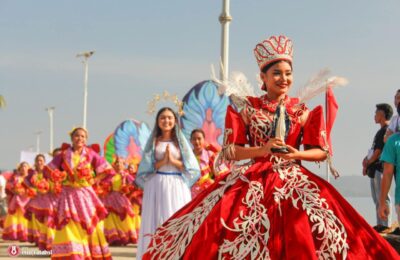
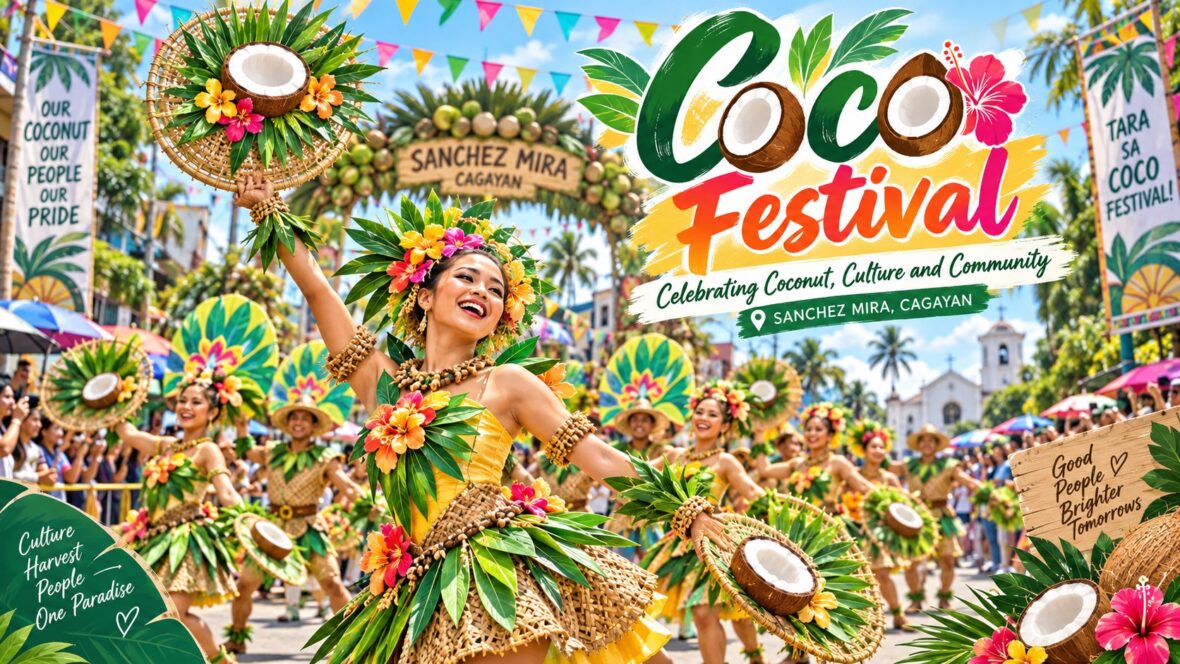
This colorful community celebration puts the coconut at the center of everything—from street dancing and costumes to traditional games, food products, handicrafts and livelihood activities.
But the festival isn’t really about a fruit.
It’s about the people whose lives are connected with it.
Farmers.
Processors.
Entrepreneurs.
Students.
Families.
Entire barangays.
The coconut becomes a symbol of Sanchez Mira’s resourcefulness, agricultural heritage and community pride.
And if you look closely enough, you’ll discover that even the migratory birds resting in the town’s coconut groves have become part of the festival story.
Here’s everything you need to know about Coco Festival in Sanchez Mira, Cagayan.
Content
Coco Festival at a Glance
| Festival | Coco Festival / Coconut Festival |
|---|---|
| Location | Sanchez Mira, Cagayan |
| Region | Cagayan Valley |
| Main theme | Coconut farming, livelihood and local culture |
| Signature attraction | Festival dancing and cultural performances |
| Other activities | Coconut games, product exhibits, food fairs, community performances and pageants |
| Important local product | Coconut and coconut-based products |
| Current tourism calendar date | July 17 |
| Older festival calendars | September 20–27 |
| Sanchez Mira founding anniversary | September 14 |
| Local cultural feature | Sawi or Grey-faced Buzzard conservation |
The current official Cagayan Tourism calendar lists the Coconut Festival in Sanchez Mira on July 17 and describes it as a thanksgiving celebration for the community’s coconut bounty featuring street dancing, costumes, music and cultural performances.
Older Philippine tourism calendars, however, placed Coco Festival from September 20 to 27. That change is worth remembering if you’re planning a trip based on an old blog post or festival list.
We’ll come back to the dates later.
First, let’s talk about the coconut.
What is Coco Festival?
Coco Festival is the agricultural and cultural festival of Sanchez Mira highlighting the economic and cultural importance of the coconut.
At its simplest, it’s a community saying thank you for something that has supported generations of families.
But modern editions go much further than thanksgiving.
The coconut becomes a source of inspiration for dances, games, exhibits, food products, handicrafts and business opportunities.
Recent festival documentation describes coconut-based food stalls, craft products, traditional coconut-related competitions and cultural performances filling Sanchez Mira during the celebration.
So if you’re expecting nothing more than dancers carrying coconuts, there’s a lot more happening behind the scenes.
Coco Festival is also about turning an agricultural product into opportunity.
Why Coconut?
Calling coconut the “Tree of Life” can sound like tourism marketing until you start listing how much of the tree can actually be used.
The meat can be eaten.
Young coconut provides juice and tender flesh.
Mature coconut can be processed for milk and cream.
Oil can be extracted.
The shell can become charcoal or craft material.
Husks provide coir.
Leaves have long been used in weaving and traditional household applications.
Wood can have construction and furniture uses.
Even coconut sap can be processed into various products.
Very little has to go to waste.
That’s exactly why coconut farming can support an ecosystem of livelihoods much larger than simply harvesting and selling whole nuts.
And Sanchez Mira continues to invest in that idea today.
Coconut is Still Part of Sanchez Mira’s Economy
One of the reasons Coco Festival remains relevant is simple:
The coconut industry is still alive here.
This isn’t a festival celebrating an agricultural past that has already disappeared.
In 2025 and 2026, Cagayan State University–Sanchez Mira was actively involved in several coconut-development initiatives.
The campus partnered with government agencies on coconut-industry mapping, seednut distribution, farmer support and research aimed at strengthening the sector throughout Cagayan Valley.
In August 2026, CSU-Sanchez Mira was recognized by the Department of Agriculture’s Agricultural Training Institute for its work supporting coconut development initiatives and the Coconut Farmers and Industry Development Plan.
So when festival organizers talk about coconut as part of Sanchez Mira’s identity, there’s a real agricultural economy behind the decorations.
The CocoPreneur Story
One project gives a particularly good picture of where Sanchez Mira’s coconut industry is heading.
CocoPreneur.
Launched by Cagayan State University–Sanchez Mira in 2022, the project was designed to help coconut-farming communities turn raw coconuts into higher-value products while providing entrepreneurship training, skills development and sustainable farming support.
The program has also worked toward reviving the local Sanchez Mira Tall coconut variety.
That’s an important shift.
Selling a raw coconut is one thing.
Turning that coconut into jam, food products, crafts or other processed goods creates another layer of income.
And this is one of the bigger stories hiding behind Coco Festival.
The festival celebrates abundance.
Programs such as CocoPreneur ask what communities can do with that abundance.
Street Dancing: The Most Colorful Part of Coco Festival
Naturally, the street dancing gets most of the photos.
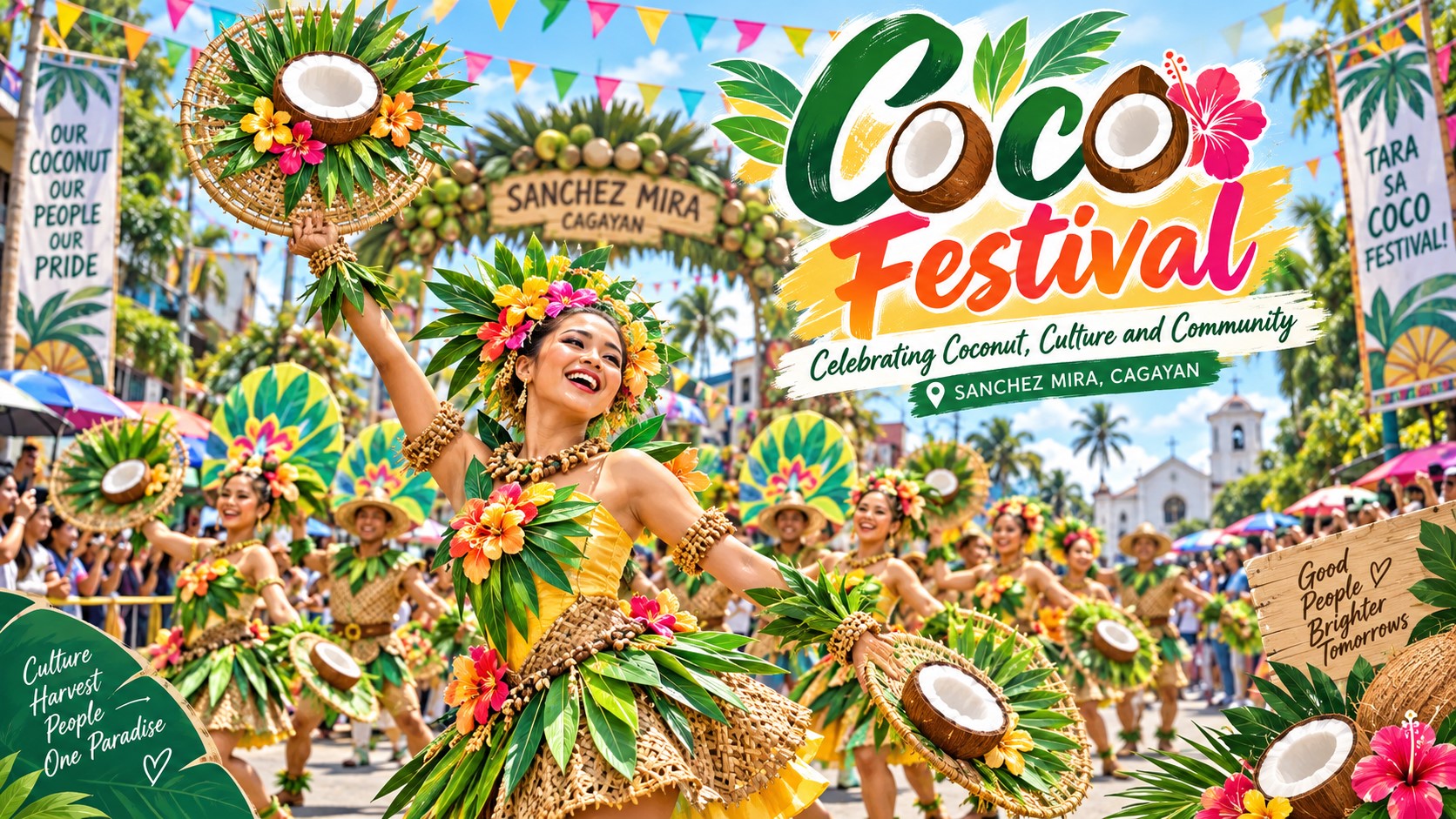
Groups of young performers fill the streets wearing colorful costumes inspired by coconut farming, local heritage and the natural environment of Sanchez Mira.
The current provincial tourism description specifically identifies lively street dancing, music and colorful performances as major parts of the celebration.
And coconut gives costume designers plenty to work with.
Brown shells.
Green leaves.
Golden husks.
Palm shapes.
Woven materials.
Farm imagery.
Even an ordinary coconut frond can become the inspiration for an elaborate headpiece once a festival designer gets hold of it.
But the best performances aren’t simply trying to look tropical.
They’re telling the story of a community.
From Farm Work to Choreography
Agricultural festivals often turn ordinary tasks into dance.
Coco Festival is no different.
Imagine the movement involved in coconut farming.
Reaching.
Climbing.
Cutting.
Carrying.
Gathering.
Husking.
Processing.
Transporting.
Those actions naturally lend themselves to choreography.
Something a farmer does every week suddenly becomes a coordinated movement performed by dozens of dancers.
That’s one of the reasons I enjoy festivals built around livelihood.
They’re reminders that the work we normally ignore can actually contain rhythm, skill and tradition.
The Coconut Games
Some of the most enjoyable Coco Festival activities aren’t choreographed at all.
They’re competitions based on practical skills.
A recent festival account from Cagayan State University’s student publication documented events such as traditional coconut plucking, coconut carrier races, karyada and a competition to find the biggest coconut.
These are the kinds of events you probably won’t encounter at a giant commercial music festival.
But in Sanchez Mira they make perfect sense.
How quickly can you handle coconuts?
How much can you carry?
Who has the largest harvest entry?
Skills that once seemed completely ordinary become something spectators cheer for.
And suddenly agriculture is fun to watch.
Coconut Plucking
Coconut harvesting takes experience.
A tree doesn’t conveniently place its fruit at eye level.
Harvesters need knowledge of the palms, the right tools and the ability to judge which coconuts are ready.
Turning coconut plucking into competition pays attention to a skill that is normally invisible to people who simply buy coconuts at a market.
That’s part of what Coco Festival does well.
It gives agricultural work a stage.
Coconut Carrier Races
Then there are races.
Anyone who has tried carrying several mature coconuts at once knows they aren’t exactly designed for comfortable transportation.
They’re round.
Heavy.
Awkward.
Now imagine doing it quickly while people cheer.
The coconut carrier race transforms a basic farming task into festival entertainment.
But underneath the laughter is another reminder of the physical labor behind the industry.
Every coconut has to move somehow.
The Search for the Biggest Coconut
This one is exactly what it sounds like.
Bring out the giant coconuts.
Competitions for unusually large produce are common in agricultural festivals because they’re simple, visual and fun.
You don’t need a long explanation.
Everyone immediately understands the challenge.
And for farmers, showing an exceptional harvest can also become a source of pride.
Coconut Products at the Festival
This is where I’d spend a lot of time if I were attending Coco Festival.
Product stalls.
Recent festival coverage has highlighted locally made coconut products ranging from coco jam to coir-based goods.
This is the practical side of the “Tree of Life” idea.
You don’t just hear someone explain that coconut has many uses.
You see those uses lined up on tables.
Food.
Crafts.
Processed products.
Household items.
Possibly things you would never have thought could come from coconut.
It’s one thing to celebrate a crop.
It’s another to show visitors how creative people can become with it.
Coco Jam
Coco jam is one of those foods that looks simple until you realize how dangerously easy it is to keep eating.
Sweet.
Rich.
Creamy.
Usually spread over bread or used with rice cakes.
A product like coco jam is also a good example of value-adding.
Instead of selling only a raw coconut, producers transform it into something branded, packaged and potentially sold to a much larger market.
For a coconut-growing community, that difference matters.
Suman Latik
And if you’re in Sanchez Mira, coconut isn’t limited to the festival.
Provincial tourism information specifically recommends suman latik as one of the municipality’s local foods. The delicacy combines sticky rice with latik or coconut caramel, with Barangay Nagrangtayan particularly associated with the dish.
This is the kind of festival food I’d go looking for.
Warm suman.
Sweet coconut topping.
Nothing complicated.
Nothing trying too hard.
Just good.
Buko Laddit
Then there’s something more unusual.
Buko laddit.
Cagayan Tourism describes it as a local dish that replaces conventional noodles with thin strips of young coconut meat, combined with vegetables, seasonings and toppings such as mussels, pork or chicken.
This is exactly the kind of dish a coconut town should have.
If you’ve already eaten three plates of pancit in the past week, here’s one that actually gives you something new.
Tinola sa Buko
The official Cagayan tourism guide also identifies tinola sa buko among foods to try in Sanchez Mira.
Again, coconut moves beyond dessert.
It becomes part of the savory food identity of the town.
That’s why a Coco Festival food trip can be much more interesting than buying a bag of dried coconut sweets and going home.
Coconut Crafts
The coconut’s usefulness isn’t confined to the kitchen.
Husks can become coir.
Shells can become decorative items.
Leaves can be woven.
Other parts of the tree can be transformed into functional products.
Recent Sanchez Mira festival coverage specifically mentioned coco coir poles among locally sold goods.
For travelers, these booths are worth exploring.
You’re seeing the intersection of agriculture and craftsmanship.
And if you buy something directly from a local producer, you’re also supporting exactly the kind of livelihood the festival is trying to promote.
The Agri-Industrial Trade Fair
Older tourism documentation specifically identified an agri-industrial trade fair as one of Coco Festival’s highlights.
This is one of the festival’s most important components, even if it doesn’t generate the dramatic photos that street dancing does.
Trade fairs connect farmers with consumers.
Entrepreneurs find customers.
Local producers test products.
Government agencies introduce programs.
Visitors discover things they didn’t know were produced locally.
For a festival built around agriculture, that’s arguably more important than any dance trophy.
Community Night
Coco Festival is also a community celebration.
Recent editions have featured evening cultural programs involving traditional dances, music and performances from different local groups and institutions.
These events might not attract tourists from hundreds of kilometers away on their own.
But they matter to residents.
Students perform.
Families watch.
Schools participate.
Friends cheer for one another.
A town festival doesn’t need every activity to become a national attraction.
Sometimes the purpose is simply bringing the town together.
Bb. Sanchez Mira
Pageants have also formed part of recent Coconut Festival programming.
A documented edition featured candidates representing Sanchez Mira’s barangays, with titles connected to tourism and the Coconut Festival itself.
Pageants remain a familiar feature of Philippine fiestas because they combine community representation, entertainment and advocacy.
Whether the same titles or format appear every year will depend on the official program.
That’s why visitors should always check the current festival schedule rather than assuming last year’s activities will return unchanged.
The Grey-Faced Buzzard: An Unexpected Coco Festival Connection
Now here’s where Sanchez Mira’s coconut story becomes much more interesting.
Look up.
The coconut groves aren’t important only to people.
They’re also connected with a migratory bird locally known as the sawi—the Grey-faced Buzzard.
Sanchez Mira is an important stopover site for these migratory raptors. Research and conservation groups have documented Grey-faced Buzzards using the municipality’s coconut landscapes as resting and feeding areas during their migration.
The birds usually appear during their spring migration, particularly around March and April.
And over time, Sanchez Mira has turned the sawi into an important symbol of local conservation.
Guardians of “Cocolandia”
This relationship even made its way into the Coconut Festival.
During the 2023 celebration, young street dancers featured the Grey-faced Buzzard as “guardians of Cocolandia,” integrating the bird into festival storytelling.
I love this idea because it gives the festival another dimension.
You start with coconut farming.
Then you discover that the coconut landscape supports wildlife.
Then that wildlife becomes part of conservation.
And finally conservation becomes part of the cultural performance.
That’s a much richer story than simply putting giant coconut decorations on a float.
From Hunting to Conservation
The relationship between Sanchez Mira and the sawi hasn’t always been about protection.
Conservation groups have documented how community education and monitoring helped reduce hunting and increase awareness of the Grey-faced Buzzard’s importance.
The Sagip Sawi project brought together residents, students, farmers, local government officials and conservationists.
Sanchez Mira has since become increasingly involved in international raptor conservation.
In 2024, the municipality hosted the Fourth International Summit on Grey-faced Buzzard and Migratory Raptors, attended by representatives and conservationists from several Asian countries.
By 2025, the town’s community-based approach was being showcased internationally as an example of linking conservation, tourism and agricultural benefits.
That’s a remarkable evolution.
A bird once hunted in the landscape becomes something the community helps protect.
Coconut Trees and Biodiversity
This connection also helps us see coconut farms differently.
A farm isn’t necessarily just an economic space.
Depending on how it’s managed, it can form part of a much broader landscape used by wildlife.
For Grey-faced Buzzards migrating thousands of kilometers, the coconut groves of northern Luzon can become temporary resting places.
And the birds themselves may help farmers by feeding on insects and other prey.
That creates an interesting relationship:
Farmers benefit from the land.
Birds use the landscape.
Conservation protects both.
Festival performances then tell the story.
That’s community culture evolving in real time.
Sanchez Mira’s Modern Coconut Research
Coconut agriculture in Sanchez Mira is also becoming more experimental.
In March 2026, Cagayan State University launched a climate-resilient integrated farming system combining coconut and pomelo with sheep and cattle production.
More than 1,500 seedlings were prepared for the project.
The idea reflects a broader shift away from thinking of coconut farming as simply rows of palms producing one crop.
Integrated farming asks:
What else can the land produce?
How can farmers diversify income?
How can farms become more resilient?
How can coconut landscapes adapt to environmental challenges?
These are modern questions.
But they’re connected directly to the same livelihood celebrated during Coco Festival.
The History of Sanchez Mira
The town itself has a long history.
A National Historical Commission marker documented by the National Commission for Culture and the Arts notes that Sanchez Mira was once a visita of Pamplona and became an independent municipality following efforts by local leaders during the Spanish colonial period.
Republic Act No. 7809 formally recognizes September 14, 1892 as the founding date of Sanchez Mira and declares September 14 each year as Aldaw ti Sanchez Mira, a local special non-working holiday.
The municipality was named after Spanish Brigadier General Manuel Sanchez Mira. Current Cagayan tourism information also commemorates the town’s founding every September 14.
That September anniversary is important when understanding why some older Coco Festival schedules also appeared in September.
Coco Festival Date: Why You’ll Find Different Dates Online
This is probably the most confusing part of researching the festival.
Search older festival calendars and you’ll commonly find:
September 20–27.
One older tourism listing described Coco Festival during that period and highlighted the town’s coconut products and agri-industrial fair.
More recent Cagayan Tourism information gives a different date:
July 17.
The current provincial festival calendar lists Coconut Festival in Sanchez Mira on July 17.
The tourism page also notes that in 2024 the festival formed part of celebrations running from September 7 to 14.
What does all this tell us?
The festival schedule has changed.
So I wouldn’t write:
“Coco Festival is always celebrated September 20–27.”
And I wouldn’t assume every future edition will follow exactly the same July schedule either.
The safest evergreen description is:
Coco Festival is the coconut-centered cultural celebration of Sanchez Mira, with dates determined by the municipality’s current festival calendar.
Always check before traveling.
Coco Festival vs. Aldaw ti Sanchez Mira
These are related to Sanchez Mira’s cultural calendar but shouldn’t automatically be treated as the same event.
Aldaw ti Sanchez Mira is the municipal founding anniversary observed every September 14 under Republic Act No. 7809.
Coco Festival celebrates the town’s coconut industry and culture.
Depending on the year, activities may be scheduled close together or within a larger celebration.
But from a travel-writing standpoint, it’s better to keep their identities clear.
And What About the Town Fiesta?
Sanchez Mira’s St. Roch Parish celebrates the feast of St. Roch on August 16, according to the Archdiocese of Tuguegarao directory.
That means Sanchez Mira can have several important dates on its local calendar:
Coco Festival.
The St. Roch religious fiesta.
Aldaw ti Sanchez Mira.
Programs can sometimes overlap or be grouped differently by organizers from year to year, which helps explain why online dates don’t always agree.
Again: check the current program.
What to Expect as a First-Time Visitor
Coco Festival isn’t simply something you stand beside the road and watch.
Walk around.
Visit the product stalls.
Try coconut food.
Watch agricultural games.
Check out the cultural performances.
Talk to vendors.
If there’s a festival dance competition, arrive early enough to find a good position.
And bring sun protection.
Northern Cagayan can be hot during daytime street events.
A hat, water and umbrella can save you from becoming the least festive-looking person in the crowd.
Bring Cash
This one is simple.
Bring cash.
Some booths and small vendors may accept digital payments.
Others won’t.
And the last thing you want is to find an interesting local coconut product and discover that your payment app is useless because the signal isn’t cooperating.
Festival shopping is easier when you have small bills.
What to Eat in Sanchez Mira
Aside from coconut-based products, Cagayan Tourism highlights several local foods worth seeking out.
Suman latik.
Buko laddit.
Tinola sa buko.
Sanchez Mira garlic longganisa.
Fresh oysters are also associated with the municipality’s coastal food scene.
If you’re building a food itinerary around Coco Festival, don’t limit yourself to one coconut dessert.
The local culinary scene gives you plenty to explore.
What Else to See in Sanchez Mira
Festival day doesn’t have to be the entire trip.
The Cagayan tourism office promotes Sanchez Mira as both a food and nature destination.
Among the places and experiences identified by the province are the local sand dunes, Minanga River, waterfalls and coastal areas.
Nagsimbaanan Ruins is another documented local attraction.
And if wildlife interests you, researching Sanchez Mira’s Grey-faced Buzzard conservation story can add a completely different dimension to the visit.
How to Get to Sanchez Mira
Sanchez Mira is in northwestern Cagayan, along the route connecting western Cagayan with the Ilocos side of northern Luzon.
That gives travelers two logical gateways.
From Tuguegarao
Tuguegarao City is the provincial capital and the main transportation hub for Cagayan.
The road distance to Sanchez Mira is roughly 156 kilometers. Driving generally takes around two and a half hours under favorable conditions, although public transportation and stops can make the journey longer.
Check current bus or van routes before traveling because schedules can change.
From Laoag
Sanchez Mira can also be approached from Ilocos Norte.
The road distance from Laoag is roughly 144 kilometers, making the municipality accessible as part of a northern Luzon road trip connecting Ilocos Norte and Cagayan.
This opens up an interesting itinerary:
Laoag.
Pagudpud.
Claveria.
Sanchez Mira.
Then onward into Cagayan.
That’s a great route if you have several days.
Why Coco Festival Matters
It’s easy to reduce agricultural festivals to a single sentence.
“Coco Festival celebrates coconuts.”
Technically true.
Also completely inadequate.
The coconut here represents work.
Income.
Food.
Craftsmanship.
Agricultural knowledge.
Small businesses.
University research.
Farmer organizations.
Conservation.
Community identity.
Even migratory wildlife.
That’s a lot for one tree to carry.
And yet somehow the coconut does.
A Festival About Resourcefulness
Perhaps the best word for Coco Festival is resourcefulness.
Take a coconut.
Drink the water.
Eat the meat.
Process the milk.
Extract the oil.
Use the husk.
Use the shell.
Use the leaves.
Grow another tree.
Build a business.
Create food.
Make crafts.
Then organize an entire festival around it.
That’s very Filipino when you think about it.
Don’t waste what you have.
Find another use for it.
Make something better.
Share it with the community.
Coco Festival 2026
As of September 9, 2026, the current Cagayan Tourism calendar lists the Coconut Festival in Sanchez Mira on July 17.
That date has already passed for 2026.
I could not verify a detailed official municipal 2026 program publicly available online showing every activity, performance time and venue, so I wouldn’t invent a schedule.
What can be verified is that coconut development remains very active in Sanchez Mira in 2026.
Cagayan State University launched a new climate-resilient integrated coconut farming project in March, while in August its Sanchez Mira campus received recognition for its work supporting coconut farmers and industry-development programs.
So even outside festival week, the coconut remains deeply connected with the town’s present-day development.
For future Coco Festival editions, check Cagayan Tourism and the Municipality of Sanchez Mira shortly before traveling because the date has changed several times historically.
Coco Festival in Sanchez Mira vs. Coconut Festival in San Pablo
One last clarification.
Sanchez Mira isn’t the only Philippine destination with a Coconut Festival.
San Pablo City, Laguna also has a famous Coconut Festival, and it tends to dominate online search results.
They are different celebrations in completely different places.
This article is about:
Coco Festival / Coconut Festival – Sanchez Mira, Cagayan.
Not:
Coconut Festival – San Pablo City, Laguna.
That’s worth mentioning because searching simply for “Coconut Festival Philippines” can easily send you to information about the wrong province.
Final Thoughts
Coco Festival starts with something familiar.
A coconut.
Something so common in the Philippines that we barely think twice when we see one.
But spend time in Sanchez Mira and that ordinary coconut begins to tell a much bigger story.
A farmer grew it.
Someone harvested it.
Someone carried it.
Someone processed it.
Another person turned it into food.
Someone else made a craft from the waste.
Researchers are finding new ways to improve the farms.
Entrepreneurs are creating new coconut businesses.
Migratory Grey-faced Buzzards are resting in the same coconut landscape.
Students are turning the entire story into dance.
And once a year, the town brings all those pieces together and celebrates them.
That’s what Coco Festival is really about.
Not simply coconut trees.
But the lives growing around them.
The food they provide.
The livelihoods they support.
The creativity they inspire.
And the community that continues finding new ways to make the Tree of Life live up to its name.