The Philippines has no shortage of colorful festivals.
From the spectacular street dancing of Sinulog to the elaborate costumes of MassKara, there’s always something happening somewhere in the country.
But in the Bangsamoro region of Mindanao, there’s a celebration that takes a different approach.
Instead of filling the streets with massive floats, its most recognizable spectacle happens on the water.
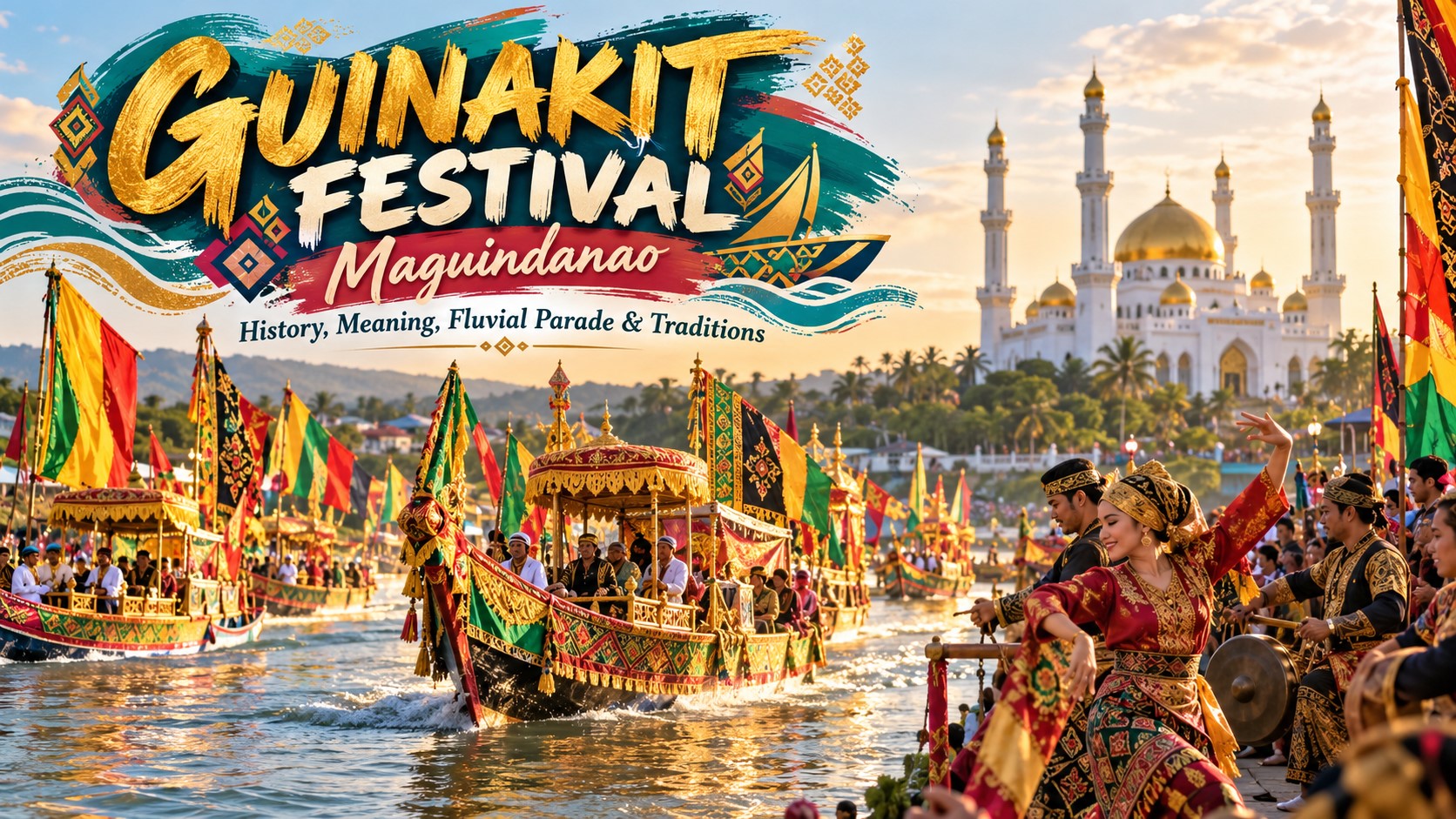
Imagine dozens of beautifully decorated boats sailing along a wide river. Colorful flags flutter above the vessels, traditional fabrics cover their sides, and participants wearing cultural attire bring a centuries-old story to life.
This is Guinakit.
Closely associated with the historical Maguindanao region and celebrated in Cotabato City, the Guinakit Fluvial Parade is one of the most meaningful cultural events in the Bangsamoro Autonomous Region in Muslim Mindanao (BARMM).
It commemorates the arrival of Shariff Muhammad Kabunsuan, the Muslim missionary traditionally credited with spreading Islam in mainland Mindanao and establishing the foundations of the Sultanate of Maguindanao.
But Guinakit is about more than a historical reenactment.
It celebrates faith, cultural identity, craftsmanship, community, and the important role rivers have played in the history of the Maguindanaon people.
And for travelers interested in discovering the cultural traditions of Mindanao, it offers a fascinating experience that is quite different from many other Philippine festivals.
Here’s everything you need to know about Guinakit, including its history, meaning, traditions, major activities, and how to experience the celebration.
Content
What Is Guinakit Festival?
Guinakit is a traditional fluvial celebration associated with Maguindanaon culture and the annual Shariff Kabunsuan Festival in Cotabato City.
Its most famous activity is the Guinakit Fluvial Parade, a procession of elaborately decorated boats that sail along the Rio Grande de Mindanao.
The parade reenacts the historical arrival of Shariff Muhammad Kabunsuan, an Arab-Malay Muslim missionary who traveled to mainland Mindanao in the early 16th century.
His arrival is regarded as a major turning point in the religious and political history of the Maguindanao region.
Over the centuries, Islam became deeply embedded in the area’s traditions, institutions, and cultural identity.
Today, the Guinakit Fluvial Parade brings that historical memory to life through an elaborate river procession featuring boats decorated with colorful textiles, flags, and traditional Maguindanaon designs.
Government agencies, local communities, cultural organizations, and other participating groups contribute to the celebration.
The fluvial parade is traditionally held on December 19, although the larger Shariff Kabunsuan Festival may include activities throughout December.
It is important to distinguish the two: Guinakit is the river procession and cultural tradition, while the Shariff Kabunsuan Festival is the broader celebration that includes street parades, cultural performances, competitions, exhibitions, and community activities.
Where Is Guinakit Festival Celebrated?
The Guinakit Fluvial Parade is primarily celebrated in Cotabato City, an important historical and cultural center of the Maguindanaon people.
Cotabato City is part of the Bangsamoro Autonomous Region in Muslim Mindanao and serves as the seat of the Bangsamoro regional government.
The city is located near the mouth of the Rio Grande de Mindanao, a major river system that has played an important role in the development of settlements, trade, transportation, and cultural exchange in Central Mindanao.
The river is central to the celebration because the arrival of Shariff Kabunsuan is traditionally associated with this waterway.
During the festival, participating boats travel along designated river routes before gathering at an official viewing or ceremonial area.
In previous editions, the procession has included areas around Barangay Kalanganan, the Tamontaka River, and the Cotabato City Port or Bangsamoro Ports Management Authority facilities.
The exact route and viewing locations can change from year to year.
Is Guinakit Festival in Maguindanao or Cotabato City?
This can be confusing, especially when older tourism calendars identify the event as “Guinakit of Maguindanao.”
Historically, Cotabato City and the surrounding areas were closely associated with the Sultanate of Maguindanao and the former Province of Maguindanao.
However, the former province was divided into Maguindanao del Norte and Maguindanao del Sur following the ratification of Republic Act No. 11550 in 2022.
Cotabato City is administratively independent of both provinces, although it remains part of the same wider historical and cultural area.
That is why Guinakit is frequently described as a Maguindanao festival even though its best-known celebration takes place in Cotabato City.
The connection is cultural and historical, not simply geographical.
What Does Guinakit Mean?
The word guinakit comes from the Maguindanaon language and means “a convoy of boats.”
It is also sometimes spelled ginakit.
Historically, the term has been associated with boats used by Maguindanaon royalty, including vessels that traveled along the rivers and coastal waters of Mindanao.
These boats were not just ordinary means of transportation.
They could also reflect status, ceremony, and the traditions of the communities that used them.
In the modern festival, the term refers to the colorful convoy of decorated boats that reenacts Shariff Kabunsuan’s journey.
The boats are usually adorned with bright fabrics, traditional ornaments, and flags.
Some feature elaborate platforms or canopies where participants gather or portray historical figures.
During the procession, the vessels travel together, creating one of the most visually distinctive festival scenes in the Philippines.
What makes Guinakit particularly interesting is that the boats themselves tell the story.
Instead of relying entirely on performances on a stage, the festival uses the river and the traditional vessels to connect the celebration with the historical journey it commemorates.
History and Origin of Guinakit Festival
To appreciate Guinakit, we need to understand the history behind the arrival of Islam in the Maguindanao region.
Mindanao Before the Arrival of Shariff Kabunsuan
Long before the Spanish colonial period, Mindanao was already home to established communities with their own political systems, customs, trading networks, and spiritual beliefs.
Rivers were especially important in many parts of the island.
They connected settlements, provided routes for transporting goods, and supported agricultural and fishing communities.
The area surrounding the Rio Grande de Mindanao was no exception.
Communities living along its waterways maintained relationships with neighboring settlements and participated in wider networks of exchange.
Islam had already reached parts of the southern Philippines before the arrival of Shariff Kabunsuan.
However, his missionary activities are particularly important in the history of mainland Mindanao and the development of the Maguindanao Sultanate.
Who Was Shariff Muhammad Kabunsuan?
Shariff Muhammad Kabunsuan, also written as Sharif Kabungsuwan or Shariff Mohammad Kabunsuan, is a major figure in the history of Islam in Central Mindanao.
Historical traditions describe him as an Arab-Malay Muslim missionary with connections to Johor in the Malay Peninsula.
He is associated with the early 16th century, a period when Islamic influence was expanding through trade, missionary activity, and political relationships across maritime Southeast Asia.
According to Maguindanaon historical traditions, Kabunsuan traveled to mainland Mindanao and eventually established relationships with local rulers and communities.
He is traditionally credited with helping establish the Sultanate of Maguindanao and spreading Islamic teachings in the region.
His influence became closely connected with the development of Maguindanaon political institutions, religious practices, and royal traditions.
The precise details of his journey are preserved through a combination of historical records and oral traditions, so individual dates and events may differ between accounts.
Nevertheless, his place in Bangsamoro cultural memory remains extremely important.
The Historical Arrival Along the River
One of the most enduring traditions surrounding Shariff Kabunsuan is the story of his arrival by boat along the waterway historically known as Masla Pulangi, associated with the Rio Grande de Mindanao.
His journey is remembered as a significant event in the spread of Islam across mainland Mindanao.
Local traditions connect his arrival with encounters involving existing community leaders, including Rajah Tabunaway.
The story has been passed down through generations and remains an important part of Maguindanaon historical identity.
Today, the Guinakit Fluvial Parade symbolizes this journey.
Decorated boats travel along the river to recreate the atmosphere of his arrival more than five centuries ago.
It is a symbolic reenactment rather than an exact reconstruction of every detail of the historical voyage.
The emphasis is on remembering the journey and recognizing its lasting influence on the region.
How the Modern Guinakit Celebration Developed
The Guinakit tradition eventually became the central attraction of the annual Shariff Kabunsuan Festival.
The larger festival developed into a public celebration involving local government institutions, cultural organizations, communities, and the Bangsamoro government.
Over time, the river procession became increasingly elaborate.
Participating groups began preparing highly decorated boats featuring Maguindanaon textiles, colorful flags, and traditional artistic designs.
The involvement of government ministries and community organizations helped expand the celebration.
For example, the 2021 Guinakit Fluvial Parade featured more than 200 decorated motorized boats, according to the Bangsamoro government.
The 2023 celebration included 94 boats, comprising both large and small vessels.
Although the number of participating boats changes, the historical meaning of the procession remains the same.
The festival continues to honor the arrival of Shariff Kabunsuan while celebrating the culture and traditions of the Bangsamoro people.
When Is Guinakit Festival Celebrated?
The Guinakit Fluvial Parade is traditionally celebrated every December 19.
This date is associated with the annual commemoration of Shariff Muhammad Kabunsuan’s arrival in mainland Mindanao.
However, the larger Shariff Kabunsuan Festival is not necessarily limited to a single day.
Previous celebrations have included several days or even a month of activities.
These may feature cultural performances, traditional competitions, exhibitions, trade fairs, and community programs.
The fluvial parade usually serves as one of the most anticipated highlights.
If you’re planning to attend, December 19 is the important date to remember.
However, you should always check the official festival schedule because the exact time, boat route, viewing area, and accompanying activities can change.
Guinakit Festival Activities and Highlights
What happens during the celebration?
Guinakit is primarily known for its spectacular river procession, but the surrounding Shariff Kabunsuan Festival includes several activities that highlight the culture and traditions of Maguindanao and the Bangsamoro region.
Here are some of the major highlights.
1. Guinakit Fluvial Parade
The Guinakit Fluvial Parade is undoubtedly the main attraction.
Imagine standing along the riverbank as one beautifully decorated boat after another makes its way across the water.
Some boats are covered with colorful cloth, while others feature large flags, ornamental designs, and traditional decorations.
Participants may wear cultural attire, and selected vessels may carry performers or historical representations.
The procession recreates the symbolic arrival of Shariff Kabunsuan.
In many editions, the participating boats have represented different Bangsamoro ministries, government agencies, community groups, and local organizations.
The parade transforms the river into a moving cultural exhibition.
For spectators, the combination of decorated boats and the natural river setting creates a particularly memorable experience.
It’s also an opportunity to appreciate the craftsmanship involved in preparing the vessels.
Some of the boats require several days of work before they are ready for the procession.
2. Traditional Boat Decorations
One of the things that makes Guinakit visually impressive is the amount of detail placed into decorating the boats.
Brightly colored fabrics are among the most recognizable decorations.
Red, yellow, green, and other vibrant colors appear throughout the procession.
Some vessels feature traditional textiles, ornamental structures, and flags inspired by Maguindanaon cultural heritage.
These decorations are not simply intended to make the boats attractive.
They also reflect artistic traditions associated with the communities that participate in the festival.
The preparation process can involve designers, craftspeople, organizers, boat owners, and volunteers.
For many participants, building and decorating a Guinakit becomes a collaborative community activity.
3. Pandala and Traditional Flags
Another important feature of the fluvial parade is the use of traditional flags.
Known as pandala, these colorful flags are associated with Maguindanaon cultural traditions.
Previous festival celebrations have included flags representing values such as bravery, royalty, hope, and peace.
Their bright colors also contribute to the distinctive appearance of the decorated boats.
As the vessels move along the river, the flags create a striking visual display.
They help turn the river procession into an expression of Bangsamoro heritage and identity.
4. Historical Reenactment of Shariff Kabunsuan’s Arrival
The festival is built around a historical narrative.
During the fluvial procession, participants symbolically recreate the arrival of Shariff Muhammad Kabunsuan in mainland Mindanao.
Some presentations have included performers portraying historical figures or representing the community members involved in the remembered arrival.
The reenactment provides a way for younger generations to learn about an important chapter of their history.
It also makes that history accessible to visitors who may not be familiar with the traditions of the Maguindanao Sultanate.
The celebration isn’t intended to replace historical study.
Rather, it serves as a cultural expression of how communities remember and interpret an event that helped shape their identity.
5. Kuyog Street Dancing Competition
Although Guinakit itself is a fluvial celebration, street dancing is another attraction associated with the broader Shariff Kabunsuan Festival.
One example is the Kuyog Street Dancing Competition.
The event features groups performing dances inspired by Bangsamoro cultural traditions.
Performers wear coordinated costumes and present choreographed routines that highlight local heritage.
Some performances incorporate traditional movements, cultural stories, and artistic elements associated with the participating communities.
In previous editions, the activity has also provided opportunities for young people to participate in preserving and promoting cultural traditions.
For visitors familiar with festivals such as Sinulog or Dinagyang, Kuyog offers another example of how street performances can become a platform for cultural storytelling.
However, its themes and historical background are different.
6. Traditional Music and Kulintang Performances
Music has an important place in the cultural traditions of the Maguindanaon people.
One of the best-known musical traditions associated with the region is kulintang.
Kulintang is an ensemble tradition featuring a row of small, horizontally arranged gongs, accompanied by other percussion instruments.
It is deeply connected with social gatherings, celebrations, and cultural expression in parts of Mindanao.
The Shariff Kabunsuan Festival has included kulintang ensemble competitions and other musical presentations in previous editions.
These activities provide opportunities for musicians to demonstrate their skills while introducing audiences to traditional Bangsamoro music.
For visitors, hearing kulintang performed in a cultural celebration can be an especially meaningful experience.
It provides another way to appreciate the artistic heritage of the region.
7. Bangkarrera and Traditional Boat Races
Since rivers play such an important role in the festival, it makes sense that boat-related competitions are also part of some celebrations.
Previous editions have included bangkarrera, or boat racing competitions.
Unlike the Guinakit procession, which emphasizes cultural presentation and historical reenactment, boat races focus on speed, coordination, and participants’ skills on the water.
These events also reflect the importance of boats in the everyday lives and traditions of river communities.
However, boat racing is part of the broader festival program and should not be confused with the ceremonial Guinakit Fluvial Parade.
8. Grand Pagana and Traditional Hospitality
Another interesting activity associated with previous Shariff Kabunsuan Festival celebrations is the Grand Pagana.
Pagana refers to a traditional Maguindanaon feast or banquet.
It is connected to the region’s customs of hospitality, celebration, and communal gathering.
Traditional presentations may feature culturally significant food arrangements, decorative trays, and ceremonial elements.
The activity offers a glimpse into the customs surrounding important gatherings in Maguindanaon society.
For visitors, it highlights a side of local culture that goes beyond music, dancing, and the river parade.
Food and hospitality are also important parts of cultural identity.
9. Trade Fairs and Local Products
The festival also provides opportunities to showcase local products and businesses.
Previous celebrations have included trade fairs featuring handicrafts, garments, food, agricultural products, and other goods produced by local entrepreneurs.
These activities help introduce visitors to the creative and economic contributions of communities across the Bangsamoro region.
They also provide an opportunity to discover traditional textiles and other products that may not be widely available outside Mindanao.
For small businesses and craftspeople, festival exhibitions can help promote their work to a larger audience.
The Cultural Significance of Guinakit
Guinakit is not simply a parade of colorful boats.
It carries several layers of cultural and historical meaning.
Remembering the Arrival of Islam in Mainland Mindanao
The most important reason for the celebration is the commemoration of Shariff Muhammad Kabunsuan.
His arrival is remembered as a significant turning point in the religious and political development of the Maguindanao region.
The festival provides an annual occasion for communities to reflect on that history.
It also introduces the wider public to a chapter of Philippine history that is not always given as much attention as events associated with the Spanish colonial period.
Preserving Maguindanaon Heritage
The festival highlights traditional designs, fabrics, music, ceremonial practices, and other cultural expressions.
Through these activities, younger generations are introduced to elements of their heritage.
The preparation of the decorated boats also creates opportunities for craftspeople and community members to participate.
This makes Guinakit an example of living heritage.
Traditions are not preserved only by placing objects in museums.
They can also continue through people who practice, reinterpret, and share them.
Celebrating Bangsamoro Identity
Guinakit has become an important expression of Bangsamoro identity.
Participants come from different communities and institutions, reflecting the cultural diversity of the region.
The parade provides a shared occasion to celebrate historical connections while recognizing the different traditions represented by the participating groups.
It is also an opportunity to highlight aspirations for peace, unity, and progress.
Recognizing the Importance of Rivers
One of the most distinctive aspects of Guinakit is its location.
The Rio Grande de Mindanao is more than a backdrop.
It is a vital part of the historical narrative.
For centuries, rivers have connected settlements, supported communities, and provided routes for transportation and commerce.
By holding the celebration on the water, Guinakit reminds people of the importance of these waterways.
It also reinforces the value of protecting the natural environment surrounding them.
The Traditional Guinakit Boats: What Makes Them Special?
The boats are undoubtedly the visual centerpiece of the celebration.
But what makes them different from an ordinary banca?
Traditionally, guinakit vessels were associated with Maguindanaon boat culture and royal transportation.
The modern festival uses decorated vessels that symbolically recall those traditions.
A large Guinakit may feature elaborate cloth coverings, ornamental canopies, flags, and designated spaces for participants.
Some vessels are accompanied by smaller boats.
When the procession begins, the different vessels move together to form a colorful convoy.
The decorations often draw inspiration from traditional Maguindanaon textiles and motifs.
One textile closely associated with the region is inaul.
Inaul is a handwoven fabric that has long been an important part of Maguindanaon culture.
It is known for its intricate patterns, vibrant colors, and association with cultural identity and prestige.
The use of traditional textiles and related decorative designs helps connect the festival with the area’s artistic heritage.
For travelers interested in Philippine traditional crafts, the boats are worth observing closely.
Each vessel can feature different design choices, making the river procession a moving display of local creativity.
Guinakit Festival and Shariff Kabunsuan Festival: What’s the Difference?
These two names are closely connected, but they aren’t exactly interchangeable.
Guinakit refers to the traditional boats and the fluvial procession that commemorates Shariff Kabunsuan’s arrival.
The Shariff Kabunsuan Festival, meanwhile, is the larger annual celebration.
It includes the Guinakit Fluvial Parade as well as cultural performances, competitions, street dancing, trade exhibitions, traditional activities, and community programs.
In short, the Guinakit Fluvial Parade is one of the main highlights of the Shariff Kabunsuan Festival.
This distinction is useful when researching the event because some tourism calendars refer to it simply as the Guinakit Festival of Maguindanao.
Both names point to the same cultural heritage, although the full festival offers more activities than the river parade alone.
How to Get to Guinakit Festival in Cotabato City
If you’re planning to experience Guinakit, your main destination is Cotabato City.
The city is accessible by air and land, depending on where you’re traveling from.
From Manila
Travelers coming from Metro Manila can look for flights serving Cotabato Airport, also known as Awang Airport.
The airport is located in Datu Odin Sinsuat, Maguindanao del Norte, near Cotabato City.
Flight availability and schedules can change, so it’s important to verify current airline services before planning your trip.
From the airport, travelers can continue to Cotabato City using available ground transportation.
From Other Parts of Mindanao
Cotabato City is connected by road to several destinations across Mindanao.
Travelers from areas such as Davao City, General Santos City, and other parts of Central Mindanao may be able to use provincial buses, vans, or private transportation.
Travel time depends on the point of origin, road conditions, and available services.
Before departing, confirm the route and current operating schedule with the transport provider.
Getting Around Cotabato City
Within the city, travelers can use locally available transportation to reach accommodations and festival venues.
However, road closures and special traffic arrangements may be implemented during major celebrations.
Some parts of the riverfront and port areas may also have restricted access.
It’s advisable to confirm the official viewing locations and transportation arrangements before heading to the parade.
Where to Watch the Guinakit Fluvial Parade
Choosing the right location can make a big difference in your festival experience.
Since Guinakit takes place on the river, spectators usually gather in designated areas along the procession route.
Previous celebrations have featured viewing areas around the Cotabato City riverfront and port facilities.
The route has included sections associated with Barangay Kalanganan and the Bangsamoro Ports Management Authority area.
However, these arrangements may change depending on the organizers’ plans.
If your main goal is to watch the decorated boats, arrive early at an officially designated viewing area.
This is especially important because the procession attracts residents, visitors, government representatives, and participating organizations.
For safety reasons, avoid going into restricted riverbank areas or boarding unauthorized vessels.
The best location is not necessarily the closest point to the water.
It’s a place where you can watch comfortably without obstructing the procession or putting yourself at risk.
Other Cultural Experiences in Cotabato City
A visit to Guinakit can also be an opportunity to discover more of Cotabato City’s history and culture.
The city is an important center of Bangsamoro political, religious, and cultural life.
One of its best-known landmarks is the Sultan Haji Hassanal Bolkiah Mosque, also called the Grand Mosque of Cotabato.
The mosque is particularly recognizable for its impressive architecture and large golden domes.
It is a significant religious landmark and one of the city’s best-known attractions.
Visitors should follow the mosque’s rules regarding appropriate clothing, photography, and access to prayer areas.
Cotabato City is also home to the Bangsamoro Government Center, where various regional institutions are located.
The area has served as a venue for official programs and festival-related activities, including cultural celebrations and trade exhibitions.
Beyond these landmarks, visitors may also want to explore local markets and food establishments offering Maguindanaon and other Mindanaoan specialties.
Food to Discover During the Festival
Food is another interesting part of traveling in the Bangsamoro region.
Cotabato City has a rich culinary culture influenced by Maguindanaon, other Muslim Filipino, and neighboring Mindanao communities.
Depending on availability, visitors can look for local dishes and delicacies such as pastil, a rice-based meal commonly served with seasoned shredded meat.
Another regional delicacy worth discovering is dudol, a sweet, sticky dessert associated with Maguindanaon and other Muslim Mindanao traditions.
You may also encounter traditional rice cakes, grilled dishes, and other local specialties.
During festival periods, food stalls and trade fairs may provide additional opportunities to sample regional products.
It’s always worth asking local vendors about the ingredients and cultural background of the dishes they serve.
Tips for Attending Guinakit Festival
If you’re visiting the festival for the first time, here are a few practical reminders.
- Check the official festival schedule before traveling, especially the date, time, and route of the Guinakit Fluvial Parade.
- Plan to arrive early because designated viewing areas may become crowded.
- Wear comfortable clothing suitable for warm weather and outdoor activities.
- Dress respectfully, particularly when visiting mosques, religious spaces, and ceremonial programs.
- Bring drinking water, sunscreen, and sun protection.
- Follow security instructions, road closures, and crowd-management measures established by local authorities.
- Avoid entering restricted port facilities or unsafe riverbank areas.
- Ask permission before taking close-up photos of performers, cultural participants, or religious activities.
- Dispose of waste properly and help protect the river environment.
- Allow additional travel time during major festival activities.
Most importantly, approach the celebration with curiosity and respect.
Guinakit has a religious and historical meaning that deserves appreciation beyond its colorful decorations.
Frequently Asked Questions About Guinakit Festival
What is Guinakit Festival?
Guinakit is a traditional Maguindanaon fluvial celebration best known for its decorated boat parade along the Rio Grande de Mindanao. It commemorates the historical arrival of Shariff Muhammad Kabunsuan and the spread of Islam in mainland Mindanao.
What does Guinakit mean?
Guinakit is a Maguindanaon word meaning “a convoy of boats.” The term is associated with traditional boats used in the region and the modern fluvial procession.
Where is Guinakit Festival celebrated?
The best-known Guinakit Fluvial Parade takes place in Cotabato City, within the Bangsamoro Autonomous Region in Muslim Mindanao.
It is closely associated with the historical Maguindanao region and Maguindanaon cultural heritage.
When is Guinakit Festival celebrated?
The Guinakit Fluvial Parade is traditionally held every December 19 as part of the Shariff Kabunsuan Festival.
The broader celebration may begin earlier in December and include several days of activities.
Who is Shariff Muhammad Kabunsuan?
Shariff Muhammad Kabunsuan was an Arab-Malay Muslim missionary traditionally credited with spreading Islam in mainland Mindanao and helping establish the Sultanate of Maguindanao during the early 16th century.
Why are boats used during Guinakit Festival?
The decorated boats symbolically reenact Shariff Kabunsuan’s historical arrival by water.
They also reflect the importance of river transportation and traditional boat culture in the history of Maguindanao.
Is Guinakit a religious or cultural festival?
Guinakit has both religious and cultural significance.
It commemorates a major event in the history of Islam in mainland Mindanao while showcasing traditional Maguindanaon arts, crafts, music, and community identity.
Is Guinakit Festival the same as Shariff Kabunsuan Festival?
Not exactly.
Guinakit is the traditional boat procession and one of the biggest attractions of the Shariff Kabunsuan Festival.
The larger festival includes additional cultural and community events.
Can tourists attend Guinakit Festival?
Yes. The festival includes public events and designated viewing areas where visitors may watch the parade.
However, certain port facilities, official functions, and ceremonial areas may have restrictions.
What are the main activities during the celebration?
The major attractions include the Guinakit Fluvial Parade, historical reenactments, cultural presentations, Kuyog street dancing, kulintang performances, boat races, trade fairs, and other activities organized as part of the Shariff Kabunsuan Festival.
The exact lineup changes each year.
Guinakit Festival 2026: Dates and Schedule
For travelers planning ahead, Guinakit is traditionally commemorated on December 19.
Based on previous celebrations, the 2026 Guinakit Fluvial Parade would normally be expected around December 19, 2026.
However, as of October 26, 2026, a complete official schedule for the 2026 celebration has not been independently confirmed.
The latest verified previous edition took place on December 19, 2025, when colorful boats sailed along the Rio Grande de Mindanao as part of the Shariff Kabunsuan Festival.
The 2025 celebration carried the theme “Grounded in Faith, Strengthened by Culture, Driven by Transformation.”
It featured participation from Bangsamoro government institutions, the Cotabato City government, and various community organizations.
The previous year’s wider celebration also featured cultural and recreational activities, including street dancing, kulintang competitions, trade exhibitions, and other community programs.
For the 2026 edition, visitors should wait for official announcements from the Cotabato City Government and the Bangsamoro Ministry of Trade, Investments and Tourism regarding the confirmed program, parade route, and public viewing areas.
Why Guinakit Is One of Mindanao’s Most Meaningful Festivals
When we think of Philippine festivals, we often imagine street dancers, colorful costumes, drums, and thousands of people celebrating in the streets.
Guinakit offers something different.
Its most important tradition takes place on a river that has been part of the region’s history for centuries.
And the beautifully decorated boats are not simply impressive festival attractions.
They represent a journey that became an important part of Maguindanaon historical memory.
The celebration honors the arrival of Shariff Muhammad Kabunsuan, recognizes the development of Islamic traditions in mainland Mindanao, and provides a space for communities to express their cultural identity.
It also highlights the creativity of local craftspeople, the importance of traditional music and textiles, and the value of preserving stories passed down through generations.
For visitors, Guinakit is an opportunity to discover another side of Philippine history.
It reminds us that the country’s cultural heritage is made up of many different traditions, including those that developed long before the Spanish colonial period.
And perhaps that’s what makes the celebration special.
Every decorated boat that travels along the Rio Grande de Mindanao is more than part of a colorful parade.
It’s a reminder of a story that continues to shape the identity of the Bangsamoro people.
For anyone interested in Philippine culture, history, and festivals, Guinakit is certainly a celebration worth learning about—and, if the opportunity comes, experiencing in person.