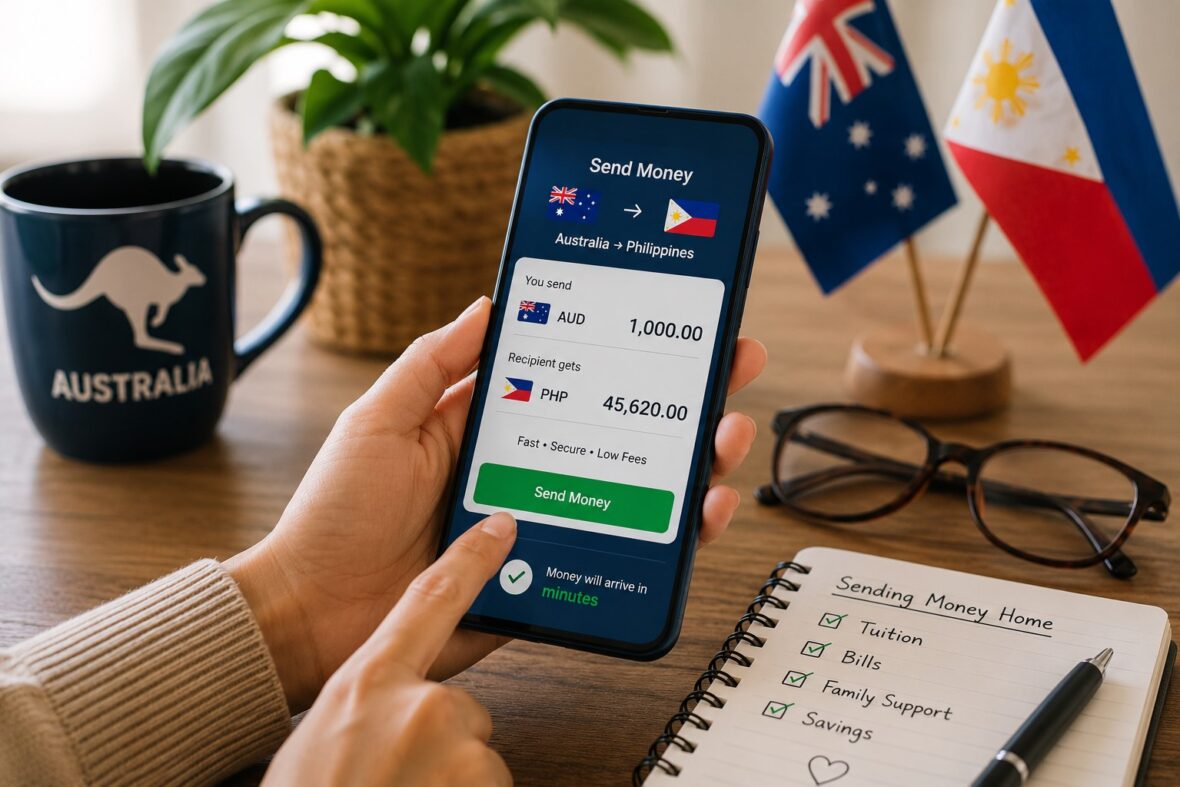
Sending money from Australia to the Philippines used to mean visiting a remittance shop, filling out forms and waiting for your family to collect the cash on the other end.
You can still do that if you want to.
But today, there are much easier options.
You can send Australian dollars from your phone and have the money deposited directly into a Philippine bank account, delivered to GCash or Maya, or made available for cash pickup at thousands of locations around the Philippines.
And in some cases, the transfer can arrive within minutes — sometimes even faster.
The bigger question is:
What is the cheapest way to send money from Australia to the Philippines?
That’s where things get interesting.
Wise may offer an attractive rate for a bank transfer. Remitly may have a promotion that makes your first transfer cheaper. WorldRemit may be more convenient for GCash. Western Union or MoneyGram may work better for someone who wants cash.
There isn’t one provider that is automatically the cheapest for everyone.
Australian Government financial guidance makes the same point: when sending money overseas, you should compare both the exchange rate and fees because providers can charge very different amounts.
So instead of simply looking for the biggest “$0 fee” advertisement, let’s compare how these services actually work.
This guide covers Wise, Remitly, WorldRemit, Revolut, Western Union and MoneyGram, along with GCash transfers, Philippine bank deposits, cash pickup, PayTo, Osko and some practical ways to get more pesos for your Australian dollars.
Content
Quick Answer: Best Ways to Send Money From Australia to the Philippines
Here’s a simple starting point.
| What you need | Options worth comparing |
|---|---|
| Cheap bank deposit | Wise, Revolut |
| Send directly to GCash | Remitly, WorldRemit, Western Union, MoneyGram |
| Fast transfer | Wise, Remitly, WorldRemit, Revolut |
| Cash pickup | Western Union, MoneyGram, Remitly, WorldRemit |
| Pay with PayTo | Remitly |
| Pay using Osko | Wise |
| Send to BDO or BPI | Wise, Remitly, Western Union and others |
| Multiple receiving options | Remitly, WorldRemit, Western Union |
| Mobile-wallet transfer | Remitly, WorldRemit, Revolut, MoneyGram |
But remember:
The provider with the lowest transfer fee isn’t necessarily the provider that gives your recipient the most money.
The number I would focus on is:
Recipient receives: PHP ______
Compare that figure across several providers before sending.
1. Wise
Wise is one of the first services I would check when sending money from Australia directly to a Philippine bank account.
Wise uses the mid-market exchange rate and shows its transfer fee separately rather than hiding the entire cost inside the exchange rate.
For Australia-to-Philippines transfers, recipients can receive Philippine pesos directly into a local Philippine account, and they don’t necessarily need their own Wise account.
How much does Wise cost from Australia to the Philippines?
Wise’s fees depend on how much you’re sending and how you fund the transfer.
When I checked a AUD 1,000 transfer, Wise showed approximate fees of:
- AUD 5.84 using a Wise balance
- AUD 5.89 using Osko
- AUD 5.89 using bank transfer
- AUD 8.66 using a debit card
- AUD 15.11 using a credit card
- Around AUD 15.40 through Apple Pay or Google Pay
Those figures are only examples and can change, but they demonstrate something important.
How you pay for the transfer can make a surprisingly large difference to the cost.
What is Osko?
If you bank in Australia, you’ve probably already encountered Osko even if you don’t think much about it.
Osko is part of Australia’s faster bank-payment infrastructure and is commonly used for quick transfers between Australian bank accounts.
Wise currently allows Osko as one of its funding methods for Australia-to-Philippines transfers.
For someone who wants to avoid the higher cost of card funding, this can be worth checking.
How fast is Wise to the Philippines?
Wise says 74% of its transfers globally arrive in under 20 seconds and 95% in less than a day.
For the Australia-to-Philippines transfer options shown when I checked, several funding methods displayed an estimated arrival in seconds, although actual delivery can vary depending on the transaction and any security or verification checks.
Wise may be best for:
- Direct Philippine bank deposits
- People who want transparent pricing
- Australians comfortable using online banking
- Osko-funded transfers
- Larger transfers where exchange-rate differences matter
- People who already use Wise
2. Remitly
Remitly is probably one of the most convenient all-around options for Filipino families in Australia because it supports several different ways of receiving money in the Philippines.
Current Philippine delivery options include:
- Bank deposit
- Cash pickup
- Mobile wallet
- Home delivery in eligible locations
Its Philippine network includes major names such as:
- BDO
- BPI
- Philippine National Bank
- Security Bank
- RCBC
- GCash
- Maya
- Cebuana Lhuillier
- M. Lhuillier
- LBC
- USSC
and many other banks and payment providers.
That flexibility is important.
Your parents might prefer receiving money in BDO.
Your younger sibling may prefer GCash.
Your grandparents may be more comfortable collecting cash.
Remitly can potentially cover all three.
Can You Send From Australia to GCash Using Remitly?
Yes.
Remitly has a dedicated Australia-to-GCash transfer option that allows AUD to be sent to a recipient’s GCash account in Philippine pesos.
GCash also officially lists Remitly among its remittance partners available from Australia.
This makes Remitly one of the first options I would check when the person in the Philippines tells you:
“GCash mo na lang.”
Remitly First-Transfer Promotions
Remitly frequently offers promotions for new customers.
When this article was checked, Remitly was advertising a special introductory exchange rate and no fee on the first eligible Australia-to-Philippines transfer, with the promotional exchange rate applying to the first AUD 700 when using PayTo.
Promotions change, however, so don’t assume the same offer will still be available when you send.
This is especially important when comparing services.
A provider may be cheapest for your first transfer because of a welcome promotion but become more expensive for your second or third transfer.
Always compare the regular rate afterward.
What Is PayTo?
PayTo is one of the payment methods Remitly offers customers in Australia.
Instead of entering card information every time, PayTo can allow you to authorize a payment through your participating Australian bank account.
Remitly currently promotes PayTo as one of its Australian payment options, along with bank accounts and eligible cards.
Depending on the offer available, PayTo may also qualify for certain promotional exchange rates.
Remitly may be best for:
- GCash
- Maya
- BDO or BPI deposits
- Cash pickup
- PayTo users
- People who want several delivery options
- First-time customers taking advantage of a legitimate promotion
3. WorldRemit
WorldRemit is another strong option for Australia-to-Philippines transfers.
It supports several receiving methods for the Philippines, including:
- Bank transfer
- Cash pickup
- Mobile wallet
- Mobile airtime
Mobile wallets are where WorldRemit becomes especially interesting.
WorldRemit to GCash Philippines
WorldRemit supports transfers to several Philippine mobile wallets, including:
- GCash
- Maya
- GrabPay
- ShopeePay
Its guidance states that eligible mobile-wallet transfers can be credited within minutes, although regulatory checks or requests for additional information can delay some transactions.
GCash’s official list of remittance partners for Australia also includes WorldRemit.
This can make WorldRemit attractive when you need to send money quickly to someone who already uses GCash every day.
WorldRemit may be best for:
- GCash transfers
- Maya
- Other supported Philippine wallets
- Cash pickup
- Recipients without a traditional bank account
- Relatively urgent transfers
4. Revolut
Revolut deserves a place on this list because it has become a much more significant financial service in Australia.
Its Australia-to-Philippines service currently supports several ways of transferring money, including:
- Philippine bank transfer
- Mobile-wallet transfer
- Revolut-to-Revolut transfer
- Payment links
How fast is Revolut from Australia to the Philippines?
Revolut says bank transfers in AUD from Australia to PHP accounts in the Philippines generally arrive within minutes, although you’ll see the estimated delivery time for your particular transfer inside the app before sending.
Revolut-to-Revolut transfers can be even faster when both parties have Revolut accounts.
Revolut fees and exchange rates
Revolut’s pricing works differently from a traditional remittance shop.
Depending on your plan, transfer size, timing and currency exchange, different fees or allowances can apply.
Revolut says eligible currency exchanges within plan limits can avoid additional exchange fees on weekdays, while international transfer fees and external-bank charges can still apply depending on the transaction.
The important thing is to check the final live quote before sending.
Revolut may be best for:
- Existing Revolut customers
- Philippine bank transfers
- Mobile-wallet transfers
- People who manage several currencies
- Australians who also use Revolut for travel
- Revolut-to-Revolut transfers
5. Western Union
Western Union is one of the oldest and most familiar names in international remittances.
Even with all the newer apps available today, it remains useful because of the number of ways your recipient can receive money.
In the Philippines, Western Union supports:
- Cash pickup
- Bank deposit
- Mobile wallet
For bank deposits, Western Union specifically lists major Philippine banks including BDO, BPI, Landbank and Metrobank.
Western Union to GCash
Western Union can also send or deliver money through GCash.
Western Union’s Philippine guidance says fully registered GCash users can receive eligible remittances through the wallet. Maya and other supported wallets are also available.
GCash separately lists Western Union as an official remittance partner available from Australia.
How does Western Union cash pickup work?
Your recipient generally needs:
- The sender’s details
- The Money Transfer Control Number or MTCN
- A valid government-issued photo ID
Once the information is verified and the transfer is available, the recipient can collect the cash at a participating location.
Cash pickup remains useful for:
- Parents who don’t use apps
- Recipients without bank accounts
- People in areas where cash remains the easiest way to pay
- Emergency situations where the recipient needs physical cash
Western Union may be best for:
- Cash pickup
- GCash
- Maya
- Direct-to-bank transfers
- People who prefer an established remittance network
- Recipients who don’t have a bank account
6. MoneyGram
MoneyGram is another established remittance service available from Australia.
For the Philippines, available receiving methods may include:
- Cash pickup
- Bank account
- Mobile wallet
- Other digital methods depending on eligibility
MoneyGram’s Australian service lets customers review the exchange rate, transfer fee, expected delivery time and amount the recipient will receive before confirming the transaction.
Cash-pickup partners shown for the Philippines include familiar names such as:
- Cebuana Lhuillier
- M. Lhuillier
- LBC
- Palawan Express
- USSC
GCash also lists MoneyGram as an official remittance partner available from Australia.
MoneyGram may be best for:
- Cash pickup
- Mobile wallets
- Philippine bank deposits
- People who prefer a traditional remittance provider
- Recipients who live near a MoneyGram partner outlet
What Is the Cheapest Way to Send Money From Australia to the Philippines?
There is no permanent cheapest provider.
And I wouldn’t trust any article that says one service is always cheapest without checking a live quotation.
There are too many variables.
Your total cost depends on:
- Transfer amount
- AUD-to-PHP exchange rate
- Transfer fee
- Funding method
- Receiving method
- Promotional offers
- Delivery speed
- Possible bank or card charges
Australia’s Moneysmart specifically recommends shopping around and comparing the exchange rate, conversion margins, transfer fees, payment method, transfer time and receiving method before sending money internationally.
Here’s why.
Imagine you want to spend exactly AUD 1,000.
| Service | Transfer fee | Recipient receives |
|---|---|---|
| Provider A | AUD 0 | PHP 44,000 |
| Provider B | AUD 6 | PHP 44,450 |
| Provider C | AUD 3 | PHP 44,200 |
At first glance, Provider A looks cheapest because the transfer fee is zero.
But your family receives PHP 450 more with Provider B.
That’s the figure that matters.
The Exchange Rate Matters More Than You Think
Let’s say the market exchange rate is roughly:
AUD 1 = PHP 45
Provider A gives you:
AUD 1 = PHP 44.90
Provider B gives you:
AUD 1 = PHP 44.20
That difference is only 70 centavos per Australian dollar.
It doesn’t sound like much.
But if you’re sending AUD 2,000:
At PHP 44.90:
AUD 2,000 = PHP 89,800
At PHP 44.20:
AUD 2,000 = PHP 88,400
Difference:
PHP 1,400
Suddenly that tiny exchange-rate difference doesn’t look so tiny.
That’s why looking only at the transfer fee can be misleading.
Fastest Way to Send Money From Australia to the Philippines
If speed is your priority, several options are worth checking.
Wise
Wise says many transfers can arrive in seconds, depending on the payment method and transaction.
Remitly
Remitly says many funded transfers are delivered in under an hour globally, with many arriving in seconds. Exact timing depends on your payment and delivery method.
WorldRemit
Eligible mobile-wallet transfers to services such as GCash and Maya can arrive within minutes.
Revolut
Revolut says Australia-to-Philippines bank transfers can generally arrive within minutes.
Western Union
Eligible transfers can also become available quickly, particularly certain cash-pickup and digital transfers, although processing depends on the specific transaction.
Remember that none of these timeframes is a guarantee for every customer.
A transfer advertised as “minutes” can be delayed because of:
- Identity verification
- First-time sender checks
- Recipient information errors
- Large transfer amounts
- Bank maintenance
- Philippine banking holidays
- Security reviews
- Wallet limits
- Compliance checks
If the money is needed for something important like tuition, rent, medicine or a bill deadline, send it earlier when possible.
How to Send Money From Australia to GCash
For many Filipinos, GCash is now one of the easiest ways to receive money from abroad.
GCash’s official Australia remittance-partner list currently includes services such as:
- Remitly
- WorldRemit
- MoneyGram
- Western Union
- Panda Remit
- WireBarley
- Ria
- Taptap Send
- Skrill
- Rocket Remit
and several additional international remittance partners.
The basic process is usually similar.
Step 1: Choose a remittance provider
For example:
Remitly, WorldRemit, MoneyGram or Western Union.
Step 2: Select the Philippines
Set Australia as your sending country and the Philippines as your destination.
Step 3: Enter the amount in AUD
The service should show you how many Philippine pesos your recipient is expected to receive.
Step 4: Choose GCash
Select mobile wallet or GCash as the delivery method.
Step 5: Enter your recipient’s information
You will typically need:
- Recipient’s full name
- GCash-registered Philippine mobile number
The information should match the recipient’s verified GCash account.
Step 6: Review the transaction
Check:
- Exchange rate
- Transfer fee
- Total AUD cost
- Final PHP amount
- Estimated arrival
Step 7: Fund the transfer
Depending on the provider, you may be able to use:
- Bank account
- PayTo
- Debit card
- Credit card
- Other supported digital methods
Step 8: Track the transfer
Most major remittance apps now provide status updates.
Make Sure the GCash Account Is Verified
This is important.
Some international remittance services require the recipient’s mobile wallet to be fully registered and active.
Western Union, for example, states that recipients using eligible Philippine mobile wallets must have a fully registered profile. WorldRemit similarly requires supported wallet accounts to be fully registered and active.
Wallet limits can also apply.
So before sending a large transfer, ask your recipient to confirm that their GCash account:
- Is fully verified
- Is active
- Has enough remaining wallet or incoming transaction capacity
How to Send Money From Australia to a Philippine Bank Account
If your recipient has a bank account, direct bank deposit can be one of the simplest methods.
Common supported Philippine banks across various providers include:
- BDO
- BPI
- Metrobank
- Philippine National Bank
- Landbank
- RCBC
- Security Bank
- UnionBank
- China Bank
- EastWest
- CIMB Philippines
The actual list depends on the provider.
You’ll typically need:
- Recipient’s full legal name
- Bank name
- Account number
- Recipient phone number
- Possibly the recipient’s address
- Sometimes the purpose of the transfer
Always verify the account number directly with the recipient before pressing Send.
One incorrect number can cause a delay or failed transfer.
Can You Send Money From Australia to BDO?
Yes.
Several international transfer services support deposits to BDO accounts.
Remitly explicitly lists BDO Unibank among its Philippine payout providers, while Wise supports transfers into Philippine local bank accounts.
Western Union also lists BDO among the banks that can receive international remittances.
Can You Send Money From Australia to BPI?
Yes.
BPI is supported by several major transfer providers, including Remitly and Western Union.
Is Sending Money Through an Australian Bank Better?
You can certainly send money internationally through many Australian banks.
Banks generally use systems such as SWIFT to move international payments between financial institutions.
This may be convenient if you already bank with:
- Commonwealth Bank
- Westpac
- NAB
- ANZ
- Another Australian bank
But convenience doesn’t automatically mean cheapest.
Traditional international bank transfers can involve:
- Transfer fees
- Exchange-rate markups
- Correspondent-bank charges
- Recipient-bank fees
- Longer processing times
Moneysmart notes that online money-transfer businesses can sometimes be faster and cheaper than banks.
So even if your bank offers international transfers, I would still compare its final PHP amount against Wise, Remitly, Revolut or another remittance provider.
Cash Pickup vs GCash vs Bank Deposit
Which one should you choose?
Choose GCash if:
- Your recipient already uses GCash
- They want the money quickly
- They pay bills digitally
- They want to avoid travelling to a remittance center
- You’re sending a relatively manageable amount
Choose bank deposit if:
- Your recipient has a Philippine bank account
- You’re sending household support
- You’re paying tuition or rent
- You’re transferring a larger amount
- The recipient wants to keep the money in their bank
Choose cash pickup if:
- The recipient doesn’t have a bank account
- They don’t use GCash or Maya
- They’re more comfortable receiving cash
- There’s a convenient pickup location nearby
There is no universally best receiving method.
Think about what makes life easiest for the person receiving the money.
What Information Do I Need to Send Money From Australia to the Philippines?
Requirements vary by provider and transfer amount.
You may be asked for your:
- Full legal name
- Australian residential address
- Mobile number
- Date of birth
- Government-issued identification
For your recipient, you may need:
- Full legal name
- Philippine address
- Mobile number
For bank deposits:
- Bank name
- Account number
For GCash:
- Registered mobile number
- Exact account-holder name
For cash pickup:
- Recipient’s legal name exactly as shown on their ID
Avoid nicknames.
If the recipient’s Philippine ID says:
Maria Lourdes Dela Cruz
don’t automatically enter:
Malou Dela Cruz
Use the information required by the provider and make sure it matches the recipient’s identification.
Why Is the Remittance Company Asking for My ID?
This is normal with legitimate remittance providers.
Australian remittance businesses operate under anti-money-laundering and counter-terrorism-financing regulations.
AUSTRAC says businesses providing remittance services in Australia must register before offering those services.
Providers may therefore need to verify your identity or request additional information, particularly for certain transactions.
If an established service asks you for identification during registration or before sending a larger amount, it isn’t automatically a warning sign.
In fact, AUSTRAC says registered remittance providers are expected to carry out identification requirements.
How to Check if a Remittance Provider Is Legitimate in Australia
If you’ve discovered a money-transfer company you’ve never heard of, don’t immediately send thousands of dollars just because it offers an amazing exchange rate.
Check it first.
AUSTRAC maintains a Remittance Sector Register where you can search registered remittance service providers operating in Australia.
Australian Government guidance says money-transfer services operating in Australia must be registered with AUSTRAC.
That’s a useful first safety check.
Also look at:
- Company history
- App-store reviews
- Customer service information
- Security measures
- Fees and exchange-rate disclosures
- Whether the website you’re using is the company’s official website
Tips for Getting More Pesos for Your Australian Dollars
If you send money to the Philippines regularly, small improvements can add up.
1. Compare at least three providers
Try entering the exact same amount into several services.
For example:
AUD 1,000 through Wise.
AUD 1,000 through Remitly.
AUD 1,000 through WorldRemit.
Then compare the recipient amount.
Don’t just compare the advertised rate.
2. Look at the final PHP amount
This is worth repeating because it’s probably the most important thing in this guide.
Ask:
How much will my family actually get?
Not:
Which company says “zero fee”?
3. Check cheaper funding methods
With Wise, for example, bank transfer and Osko can currently cost considerably less than funding the same transaction with a credit card.
Always compare payment methods before confirming.
4. Be careful with credit-card funding
Credit cards may be convenient, but they can cost more.
The transfer provider may charge a higher card-processing fee, and your card issuer may potentially have its own rules concerning money-transfer transactions.
Check your card terms before using a credit card for remittances.
5. Use promotions intelligently
A first-transfer promotion can genuinely save money.
But don’t become permanently loyal to a provider just because the first transaction was cheap.
After the promotional offer ends, compare again.
6. Watch the AUD-to-PHP exchange rate
If your transfer isn’t urgent, exchange-rate movements can have a meaningful effect on larger remittances.
A difference of just PHP 0.50 per Australian dollar means:
AUD 1,000 = PHP 500 difference
AUD 2,000 = PHP 1,000 difference
AUD 5,000 = PHP 2,500 difference
That’s enough to matter.
7. Don’t split transactions just to avoid verification
If a provider asks for additional verification for a legitimate transfer, follow the required process.
Trying to deliberately structure transfers to avoid compliance requirements can create additional problems.
8. Send early when there’s a deadline
If the money is for:
- Tuition
- Rent
- Mortgage payments
- Medical bills
- Family events
- Government payments
don’t rely on an advertised “minutes” transfer at the last possible moment.
Give yourself some breathing room.
Is It Safe to Send Money to the Philippines Online?
Sending money through reputable, regulated providers can be convenient.
But the biggest risk often isn’t the transfer company.
It’s sending money to the wrong person.
Moneysmart warns that if you send money to someone who turns out to be a scammer, recovering the money can be extremely difficult.
Be especially careful if someone asks you to transfer money for:
- An unexpected emergency
- A romantic partner you’ve never met
- A supposed investment opportunity
- An online prize
- A government fee you weren’t expecting
- A job offer requiring upfront payment
- A parcel supposedly held at customs
- Crypto investments
- A rental property you haven’t inspected
- Someone claiming to be a relative using a new phone number
If the request is unusual, contact the person through a phone number or communication method you already trust before sending anything.
Frequently Asked Questions
What is the cheapest way to send money from Australia to the Philippines?
There is no provider that is always cheapest.
Wise is worth checking for low-cost bank transfers, while Remitly and other providers may become competitive because of promotional exchange rates. The best approach is to compare the final PHP amount received after all fees and exchange-rate margins.
What is the fastest way to send money from Australia to the Philippines?
Some transfers through Wise, Remitly, WorldRemit and Revolut can arrive within seconds or minutes depending on the receiving method, funding method and verification status.
Can I send money directly from Australia to GCash?
Yes.
GCash officially lists several remittance partners available from Australia, including Remitly, WorldRemit, MoneyGram and Western Union, among others.
Can I send money from Australia to Maya?
Yes. Several transfer providers support Maya as a Philippine mobile-wallet delivery option, including Remitly and WorldRemit.
Can I send money from Australia to BDO?
Yes. Remitly and Western Union explicitly support BDO, while other services can also send to Philippine bank accounts.
Can I send money from Australia to BPI?
Yes. BPI is supported by major remittance providers including Remitly and Western Union.
Can I use Osko to send money to the Philippines?
You can’t normally send an ordinary Osko payment directly to a Philippine bank account, but Wise currently allows Australians to use Osko to fund eligible international transfers to the Philippines.
Can I use PayTo to send money to the Philippines?
Remitly currently supports PayTo as a funding option for Australian customers. Remitly handles the international transfer and converts the money to Philippine pesos.
Does the recipient need a bank account?
No.
Depending on the service, they may receive money through:
- GCash
- Maya
- Another mobile wallet
- Cash pickup
How long does it take to send money from Australia to the Philippines?
It can take anywhere from seconds or minutes to several business days.
It depends on:
- Provider
- Funding method
- Delivery method
- Transfer size
- Verification
- Bank processing
- Security checks
Is a zero-fee transfer always the cheapest?
No.
A provider can advertise a zero transfer fee while offering a less competitive AUD-to-PHP exchange rate.
Always compare the final PHP amount received.
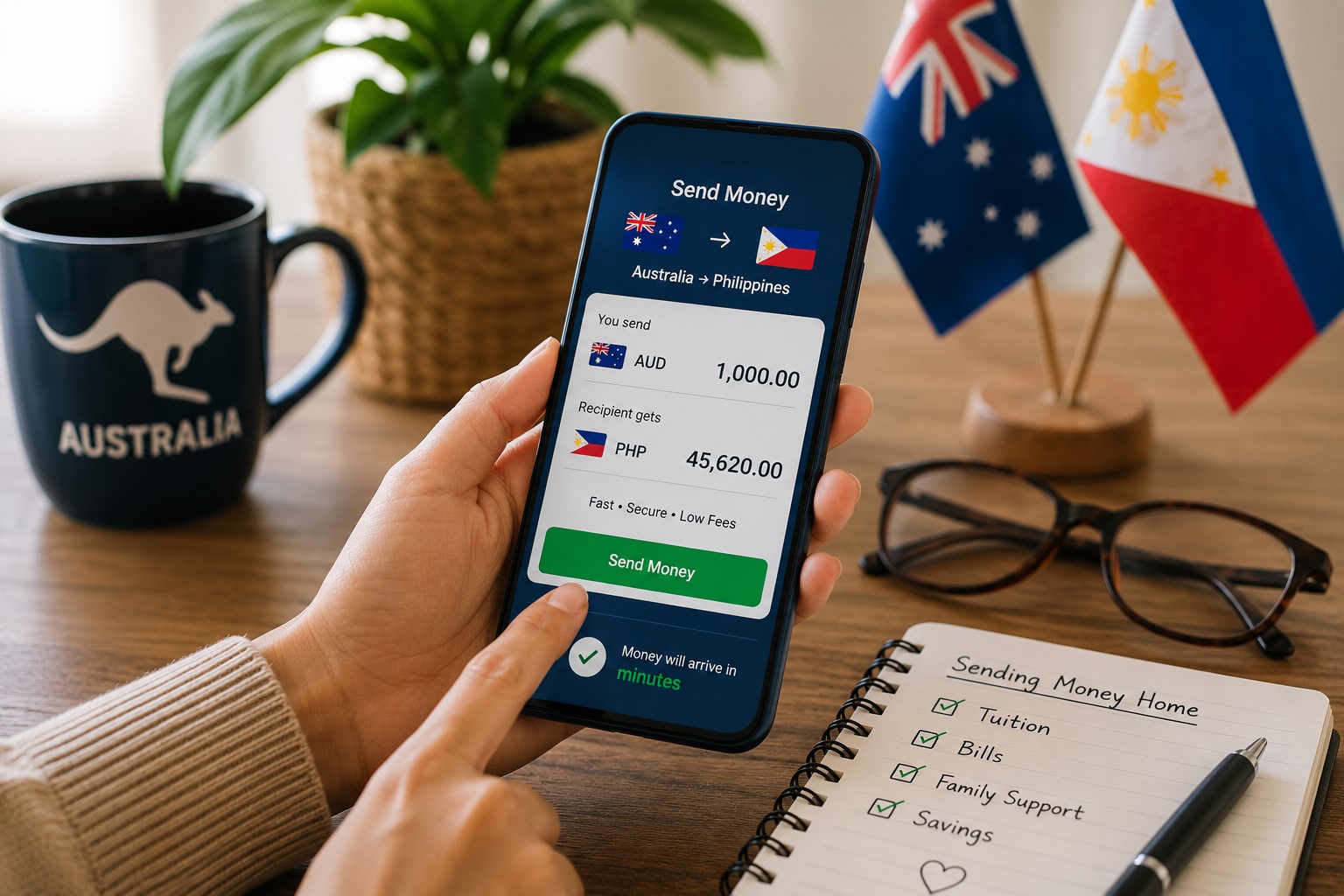
Final Thoughts: What’s the Best Way to Send Money From Australia to the Philippines?
Australians have more choices than ever when sending money to family and friends in the Philippines.
If I were sending directly to a Philippine bank account, I would start by comparing Wise and Revolut with the current offers from other remittance companies.
If I wanted to send directly to GCash, I’d compare Remitly, WorldRemit, Western Union and MoneyGram.
If my recipient needed physical cash, I’d look closely at Western Union, MoneyGram, Remitly and WorldRemit.
But I wouldn’t automatically use the same company every month.
Before you send, compare:
- Transfer fee
- AUD-to-PHP exchange rate
- Payment method
- Delivery time
- Recipient method
- Final amount of Philippine pesos received
That last number is the one that really matters.
Sending AUD 1,000 through a company advertising “$0 fees” doesn’t help much if another provider can put several hundred more pesos into your family’s hands.
Take an extra minute to compare the numbers.
When you’re sending money home regularly, those small savings can become a meaningful amount over the course of a year.


