If the sky in parts of the Visayas and Mindanao has looked unusually gray or hazy lately, it is not simply cloudy weather.
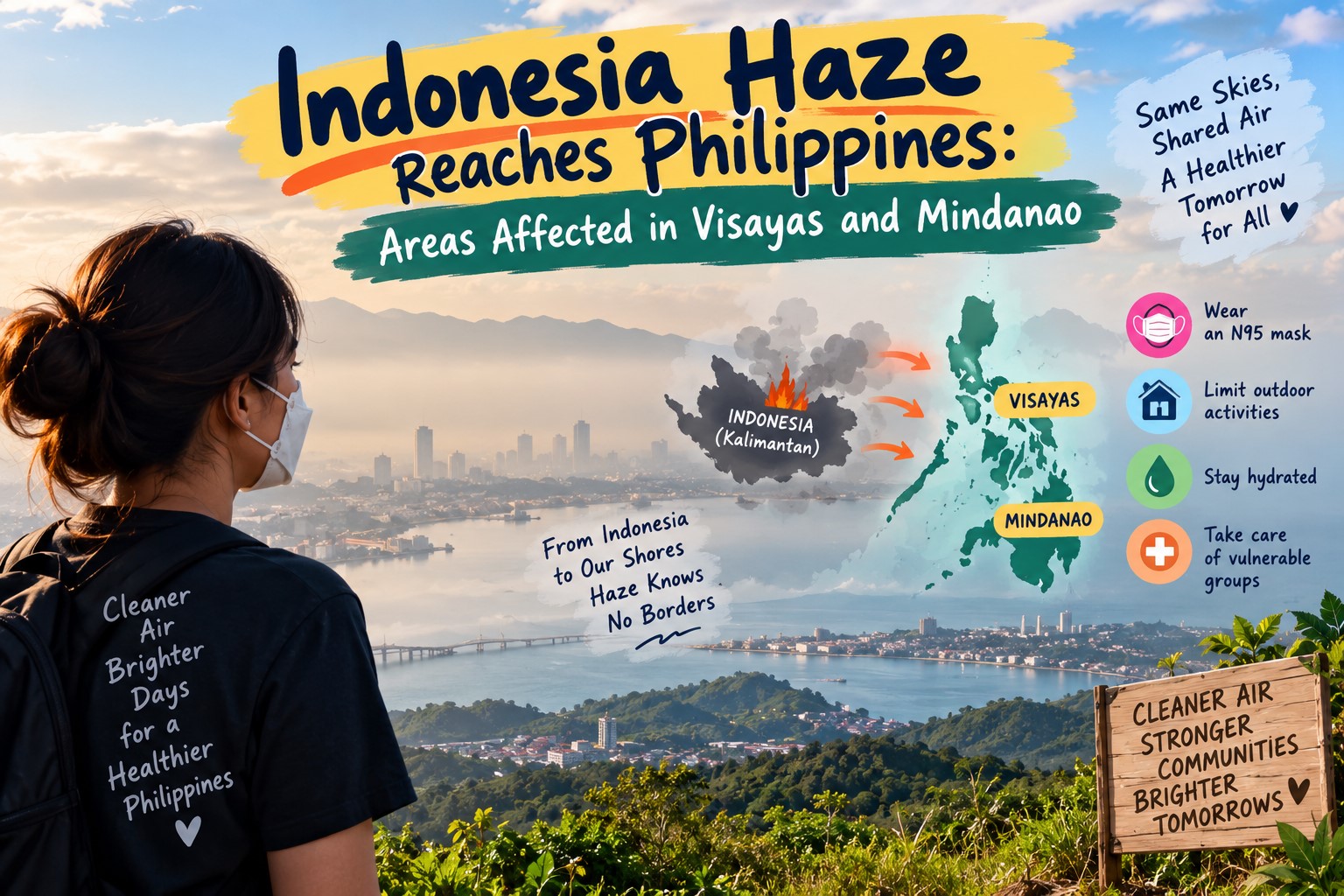
Haze linked to forest and land fires in Kalimantan, Indonesia has reached parts of the Philippines, affecting air quality across several areas in the Visayas and Mindanao.
As of September 20, 2026, the Department of Environment and Natural Resources (DENR) has reported unhealthy air-quality conditions in several monitoring stations, with some locations reaching “very unhealthy” or even “acutely unhealthy” levels.
The Department of Health (DOH), citing information from the Office of Civil Defense, said areas being closely monitored include Negros Occidental, Negros Oriental, Siquijor, Cebu, Bohol and all provinces in Mindanao.
So, where exactly is the haze coming from, which places are affected, and what should residents do?
Here’s what we know so far.
Content
Why Is There Haze in the Philippines?
The haze affecting parts of the country has been associated with smoke from ongoing forest and land fires in Kalimantan, Indonesia.
Smoke from a large fire does not necessarily stay close to where the fire is burning.
Very small particles can rise into the atmosphere and travel hundreds or even thousands of kilometers depending on wind direction and other weather conditions.
According to the DENR, prevailing winds have carried smoke and fine particulate matter from Indonesia toward the Philippines. The DOH has also said the observed haze is likely linked to transboundary smoke transported by the Southwest Monsoon or Habagat.
PAGASA’s outlook for September 17 to 23 also shows a weak Southwest Monsoon affecting the western sections of Southern Luzon, the Visayas and the Zamboanga Peninsula.
In other words, this is what is called transboundary haze — air pollution originating in one country that is transported by atmospheric conditions into another.
Which Areas in the Philippines Are Affected by the Haze?
The situation can change from hour to hour depending on wind, rainfall and local conditions, so being included in a haze advisory does not necessarily mean every town or city within that province has the same air quality.
As of September 19, the DOH said the areas under close air-quality monitoring include:
- Negros Occidental
- Negros Oriental
- Siquijor
- Cebu
- Bohol
- All provinces in Mindanao
The list was based on information from the Office of Civil Defense.
Separate DENR air-quality monitoring has also detected elevated pollution levels at individual stations in several parts of the Visayas and Mindanao.
Negros Island Region
Negros has been among the areas repeatedly affected by poor air quality during the haze episode.
According to DENR data reported on September 20, air quality as of noon on September 19 was classified as:
La Carlota City — Unhealthy for Sensitive Groups
Canlaon City — Unhealthy for Sensitive Groups
La Castellana — Very Unhealthy
Bacolod City — Acutely Unhealthy
The situation is important because air quality can change considerably throughout the day.
Earlier in September, for example, monitoring in Bacolod had improved temporarily after rainfall before deteriorating again later in the month.
That is why residents should rely on the latest DENR-EMB monitoring information rather than assuming conditions remain the same throughout the day.
Cebu
Cebu has also experienced significant deterioration in air quality.
On the morning of September 19, the Metro Cebu Ambient Air Quality Monitoring Station in Talisay City recorded a PM2.5 Air Quality Index of 209 at around 4 a.m.
By 7 a.m., the AQI had climbed to 238.
Both readings were classified as “Acutely Unhealthy.”
The DENR-Environmental Management Bureau in Central Visayas linked the deteriorating conditions to the continuing haze from Kalimantan and prevailing winds moving the pollution toward the Philippines.
Conditions were different in Toledo City, however. A monitoring station there recorded an AQI of 56 during one September 19 update, classified as “Fair.”
This difference shows why it is difficult to describe the air quality of an entire province using a single number.
One part of Cebu can experience severely polluted air while another area may have considerably better conditions at the same time.
Bohol and Siquijor
Bohol and Siquijor are among the areas specifically included in the latest close-monitoring advisory cited by the DOH.
Residents should continue checking air-quality and local government advisories because the intensity of haze may change depending on wind direction and weather conditions.
Leyte
Parts of Eastern Visayas have also reported degraded air quality.
According to the DENR’s September 19 monitoring summarized by The Philippine Star, Leyte registered air quality categorized as “Unhealthy for Sensitive Groups.”
That means people who are particularly vulnerable to air pollution should reduce prolonged outdoor exposure when these conditions are present.
What About Iloilo?
Western Visayas has also felt the effects of the transboundary haze earlier this month.
In Iloilo City, DENR-EMB monitoring at the Garden of Love station in La Paz recorded a rolling 24-hour PM2.5 Air Quality Index classified as “Unhealthy for Sensitive Groups” on September 4.
Other monitoring locations in Oton, Pavia and San Miguel in Iloilo Province recorded PM10 levels within the “Fair” category during the same period.
The DOH Western Visayas subsequently issued health precautions for residents.
Haze in Mindanao
The effects have been widespread across Mindanao.
The latest DOH advisory cited by GMA News placed all provinces in Mindanao under close air-quality monitoring.
However, this does not mean every part of Mindanao has exactly the same air quality.
DENR monitoring stations have shown considerable differences depending on location.
Some of the areas reporting elevated pollution include the Zamboanga Peninsula, Northern Mindanao, Davao Region and Soccsksargen.
Zamboanga Peninsula
The Zamboanga Peninsula was among the areas with the poorest air quality in the DENR’s September 19 assessment.
The region recorded air-quality conditions reaching the “Acutely Unhealthy” category.
Zamboanga City had also been among the locations reporting elevated PM2.5 levels earlier in the haze episode.
Northern Mindanao
Northern Mindanao has repeatedly recorded elevated particulate matter since the beginning of September.
DENR-EMB Region X previously reported varying conditions among monitoring stations.
Cagayan de Oro City recorded conditions ranging from “Fair” to “Unhealthy for Sensitive Groups,” while Tagoloan recorded “Unhealthy for Sensitive Groups.”
Iligan City recorded AQI values of 203 and 209 on August 31 and September 1, respectively — particularly concerning air-quality conditions during that monitoring period.
By September 19, the broader Northern Mindanao area was again reported at “Very Unhealthy” levels in the DENR’s national air-quality update.
Again, these categories can fluctuate depending on the monitoring station, time and weather conditions.
Davao Region
Davao Region has also been affected.
According to the September 19 DENR assessment, air quality across monitored locations in the region ranged from “Unhealthy for Sensitive Groups” to “Very Unhealthy.”
The DENR-Environmental Management Bureau in Davao has been monitoring the situation as haze from the Indonesian fires continues to affect southern portions of the Philippines.
Koronadal City and South Cotabato
Koronadal City has been another important monitoring point during the current haze episode.
DENR-EMB Region XII recorded a 24-hour average PM2.5 concentration of 48 micrograms per cubic meter on September 1 and 46 micrograms per cubic meter on September 2.
Both exceeded the maximum 24-hour value of 35 micrograms per cubic meter cited under DENR Administrative Order 2020-14 and were classified by the monitoring advisory as “Very Unhealthy.”
On September 3, readings continued to increase during the morning, reaching 60 micrograms per cubic meter by noon, corresponding to the “Acutely Unhealthy” category used in the advisory.
The DENR has emphasized an important limitation, however.
Koronadal is currently the only monitoring station in Region XII capable of analyzing PM2.5. Monitoring equipment in Tupi and General Santos City measures PM10 but not PM2.5, while other locations in the region do not have established stations providing equivalent measurements.
Because of this, Koronadal’s PM2.5 readings should not automatically be interpreted as representing the air quality of the entire Soccsksargen region.
What Is PM2.5?
You’ll probably see the term “PM2.5” mentioned frequently whenever authorities talk about the current haze.
PM2.5 refers to particulate matter measuring 2.5 micrometers or smaller.
These particles are extremely tiny.
Because of their size, they can remain suspended in the atmosphere for long periods and can be transported over considerable distances by wind — which is one reason smoke from Indonesia can affect areas far away from the original fires.
PM2.5 is also a health concern because these particles are small enough to travel deep into the lungs.
What Does “Unhealthy for Sensitive Groups” Mean?
You may also notice several terms being used in DENR advisories.
Air quality may be classified as:
Good
Fair
Unhealthy for Sensitive Groups
Very Unhealthy
Acutely Unhealthy
The worse the category becomes, the greater the concern about prolonged exposure to polluted outdoor air.
When an area reaches the “Unhealthy for Sensitive Groups” category, people who are more vulnerable to air pollution should already begin limiting prolonged outdoor exposure.
At “Very Unhealthy” and “Acutely Unhealthy” levels, precautions become even more important.
Who Is Most at Risk From the Haze?
Anyone can experience irritation when air pollution becomes severe, but certain groups require extra protection.
The DOH says particular attention should be given to:
- Children
- Older adults
- Pregnant women
- People with asthma
- People with other respiratory illnesses
- People with cardiovascular or heart conditions
- Outdoor workers who spend long periods exposed to polluted air
Haze exposure may cause irritation of the eyes, nose and throat and can worsen existing asthma and other respiratory or cardiovascular conditions.
People who spend much of their working day outside — including delivery riders, public utility drivers, street vendors and field workers — may also face longer periods of exposure.
What Should You Do When There Is Haze?
If your area is experiencing visible haze or poor air quality, reducing your exposure is one of the simplest things you can do.
The Department of Health recommends wearing an N95 mask when going outdoors.
The DOH has also advised commuters and outdoor workers to wash irritated eyes with clean water or saline solution, avoid rubbing their eyes, drink plenty of water and take breaks in enclosed areas away from smoke and road dust.
The DOH Western Visayas has also advised residents to avoid prolonged or strenuous outdoor activities and to keep doors and windows closed when haze levels are high.
People with existing respiratory conditions should also keep necessary medications readily available.
Should You Wear an N95 Mask?
Yes, particularly when air quality is poor and you need to go outside.
An N95 or equivalent respirator is recommended because it is designed to filter fine airborne particles when properly fitted.
The DOH specifically recommends N95 masks for people exposed to haze outdoors.
Simply seeing haze from your window does not tell you exactly how much PM2.5 is present, which is why official air-quality measurements remain important.
Motorists Should Also Be Careful
Haze is not only an air-quality issue.
Heavy haze can reduce visibility.
Drivers should slow down when visibility becomes poor, maintain a safe distance from other vehicles and use vehicle lights when necessary.
The DOH has specifically advised motorists to exercise additional caution when haze reduces visibility.
Can Rain Clear the Haze?
Rain can sometimes temporarily improve local air quality by removing some particles from the atmosphere.
We have already seen examples of air-quality readings improving after rainfall during the current haze episode.
However, rain does not necessarily solve the larger problem.
If fires continue producing smoke and winds continue transporting that smoke toward the Philippines, haze can return after conditions initially improve.
This helps explain why some cities have moved between “Fair,” “Unhealthy” and much worse classifications within a relatively short period.
How Long Will the Indonesia Haze Affect the Philippines?
There isn’t a fixed date when the haze will disappear completely.
Its movement depends on several factors, including:
- Activity of the fires in Indonesia
- Wind direction and speed
- Southwest Monsoon conditions
- Rainfall
- Atmospheric circulation
- Local sources of air pollution
This also means conditions may improve in one province while worsening somewhere else.
PAGASA’s September 17 to 23 outlook indicates that a weak Southwest Monsoon will continue affecting western parts of Southern Luzon, the Visayas and Zamboanga Peninsula, so changing atmospheric conditions remain an important factor in where smoke may travel.
Is the Entire Philippines Experiencing Dangerous Air Quality?
No.
This is an important point because the haze situation can sound more widespread than it actually is.
While smoke from the Indonesian fires has affected different parts of the country during September, air-quality conditions vary significantly between regions and individual monitoring stations.
According to the DENR assessment reported for September 19, much of the rest of the country was still registering “Good” to “Fair” air quality, although some individual monitoring locations outside the Visayas and Mindanao also recorded elevated levels.
Being somewhere under a broad haze advisory therefore does not automatically mean the air quality at your exact location is “Acutely Unhealthy.”
The best approach is to check the latest DENR-EMB monitoring information for your area whenever available.
Areas to Watch
Based on the latest government monitoring and advisories, residents should pay particular attention to developments in:
Negros Occidental, including Bacolod, La Carlota and La Castellana;
Negros Oriental and Siquijor;
Cebu, particularly Metro Cebu and Talisay;
Bohol;
Leyte;
Zamboanga Peninsula;
Northern Mindanao, including Cagayan de Oro, Iligan and parts of Misamis Oriental;
Davao Region;
Soccsksargen, including Koronadal City and South Cotabato; and
other areas throughout Mindanao covered by the government’s close-monitoring advisory.
The actual severity in each location can change throughout the day.
When Should You Seek Medical Help?
Mild irritation of the eyes or throat may occur during haze episodes, but people experiencing significant or worsening symptoms should take them seriously.
Seek medical assistance if you experience symptoms such as significant difficulty breathing, severe wheezing or other serious respiratory problems, particularly if you already have asthma, heart disease or another medical condition.
The DOH advises the public to contact the national emergency hotline 911 or appropriate local emergency services if urgent assistance is needed.
Final Reminder
The haze currently affecting parts of the Visayas and Mindanao is linked to smoke from forest and land fires in Kalimantan, Indonesia that has traveled toward the Philippines through prevailing winds.
As of September 19 and 20, 2026, some of the poorest air-quality readings have been recorded in parts of Negros, Cebu, the Zamboanga Peninsula, Northern Mindanao, Davao Region and Koronadal, while authorities are closely monitoring Negros Occidental, Negros Oriental, Siquijor, Cebu, Bohol and all provinces in Mindanao.
But the situation is constantly changing.
A city classified as “Acutely Unhealthy” in the morning could improve later after rain or changes in wind direction — and the opposite can happen as well.
For residents in affected areas, the practical advice remains simple: monitor official DENR, PAGASA, DOH, OCD and local government advisories, limit unnecessary outdoor exposure when air quality deteriorates, and wear a properly fitted N95 mask when going outside during significant haze.
This article will be updated as new air-quality readings and haze advisories become available.